
A Pennsylvania adult may spend weeks recognizing ADHD patterns, then face a second problem after finally seeking help. Finding an available clinician, completing an ADHD evaluation, receiving a prescription, and getting that prescription filled through Cigna are separate steps. A telehealth appointment can make the clinical visit easier to access, but it doesn't automatically remove referral requirements, prior authorization, step therapy, formulary restrictions, or pharmacy delays.
Cigna ADHD treatment works best as one connected care journey. The clinician must first determine whether ADHD is present, identify conditions that may look similar, and create an appropriate treatment plan. The insurance plan then determines which services and medications require approval, documentation, or previous medication trials. The following guide explains how Pennsylvania patients can prepare for each handoff.
Table of Contents
- Starting Cigna ADHD Treatment in Pennsylvania
- How an Online ADHD Evaluation Works
- Understanding Cigna ADHD Medication Coverage
- Comparing Stimulant and Non-Stimulant Pathways
- Verifying Insurance and Handling Referrals
- Building a Whole-Person ADHD Care Plan
- Key Questions and Practical Next Steps
Starting Cigna ADHD Treatment in Pennsylvania
A working parent in Harrisburg may recognize the pattern slowly. Missed deadlines, forgotten errands, unfinished household tasks, and emotional exhaustion can feel like personal failures until the same difficulties appear across work, driving, and relationships. A college student near Pittsburgh may reach a similar point after struggling to organize assignments despite understanding the material.
The first search often sounds simple: “Which Cigna psychiatrist treats ADHD?” The actual process has several checkpoints:
- Provider access: The clinician must serve Pennsylvania patients and participate with the patient's specific Cigna plan.
- Clinical evaluation: A qualified professional must assess ADHD symptoms, developmental history, functioning, and other possible explanations.
- Treatment planning: The clinician and patient decide whether medication, therapy, skills training, or a combination makes sense.
- Pharmacy access: The prescription must meet the patient's pharmacy benefit rules, including any authorization or formulary requirements.
A patient may pass one checkpoint and still encounter a problem at the next. An in-network evaluation doesn't guarantee that every follow-up service uses the same network arrangement. A diagnosis doesn't guarantee that a particular Cigna ADHD medication will be covered without additional documentation. A prescription doesn't guarantee an immediate pharmacy fill.
Practical rule: A patient should verify both the evaluation benefit and the pharmacy benefit before assuming the treatment pathway is complete.
Telehealth can help patients reach care when local appointment availability is limited. It can also reduce travel for people in Philadelphia, rural communities, or areas where in-person behavioral health access is difficult. However, the clinician still needs to confirm that the patient is located in Pennsylvania during the visit and that the practice can legally provide care in that setting.
Commercial Cigna plans, employer-sponsored benefits, ACA marketplace plans, and Medicaid-contracted coverage may apply different rules. Patients should also ask whether behavioral health services are managed through a separate administrator. The plan's member services team can clarify the correct network, referral process, and pharmacy contact.
For patients comparing options, online ADHD care in Pennsylvania can help explain how virtual evaluation and ongoing treatment may fit into a broader care plan. The key expectation is realistic: ADHD treatment is not one transaction. It is a sequence of clinical and administrative decisions that should remain coordinated.
How an Online ADHD Evaluation Works
An online ADHD evaluation begins with access questions, not medication selection. If the Cigna plan requires a referral, the patient may need to obtain one from a primary care clinician before scheduling psychiatric care. A PPO may allow more direct access, while an HMO may use a referral pathway, but the exact rule belongs to the individual plan.
Once the referral question is clear, the patient can look for a participating telehealth provider available to Pennsylvania residents. The appointment usually includes secure video, electronic intake forms, and a detailed psychiatric assessment. A useful overview of the clinical process is available in this guide on how to get an ADHD diagnosis.
What the clinician assesses
Rating scales can organize symptoms, but they don't establish a diagnosis by themselves. A clinician may use a tool such as the Adult ADHD Self-Report Scale, often called the ASRS, or a Conners measure as one part of the assessment. The structured interview explores childhood patterns, current functioning, school or work performance, relationships, sleep, mood, anxiety, substance use, and medical history.
ADHD symptoms must make sense across the patient's development and daily life. Concentration problems can also occur with depression, anxiety, trauma, sleep disorders, medication effects, substance use, or medical conditions. A careful evaluation reduces the risk of treating the wrong problem.
Prior records can strengthen diagnostic clarity. Helpful materials may include school reports, old evaluations, workplace accommodations, previous medication records, or observations from a family member who knows the patient's childhood history. Adults who don't have childhood paperwork can still receive a careful assessment, but the clinician may need to gather history from several sources.
Preparing for a virtual appointment
A patient can make the visit more productive by preparing:
- Choose a private space. The clinician needs to discuss sensitive symptoms without interruptions.
- Test the device. The camera, microphone, internet connection, and patient portal should work before the appointment.
- Create a medication list. Include prescriptions, over-the-counter products, supplements, caffeine use, and past ADHD medications.
- Write a symptom timeline. Note when attention, impulsivity, restlessness, forgetfulness, or emotional regulation problems became noticeable.
- Gather relevant records. School documents, previous evaluations, and primary care notes may answer important questions.
Diagnosis comes before prescribing. In many practices, the same clinician can continue into medication management, which helps connect the original assessment with later decisions about response, side effects, and functioning. Patients seeking an online ADHD evaluation should ask whether the service includes follow-up care, medication monitoring, and coordination with primary care.
A virtual visit can improve convenience, but it doesn't mean a same-day prescription is appropriate. The clinician may need more records, additional screening, or clarification of another condition before recommending medication.
The video can supplement preparation, but it can't replace an individualized psychiatric evaluation.
Understanding Cigna ADHD Medication Coverage
Cigna coverage is not a simple yes-or-no decision. The plan may list a medication as covered while still requiring prior authorization, step therapy, or quantity limits. The patient's formulary, benefit design, diagnosis, prescribed formulation, and previous treatment history can all affect access.
Cigna's stimulant policy states that prior authorization is required for benefit coverage of ADHD stimulant medications. The policy generally authorizes approved requests for up to one year and describes medical necessity pathways that include a documented ADHD diagnosis. Cigna's stimulant coverage policy also makes clear why the clinical record matters when a clinician submits an authorization.
The prescriber may document the diagnostic assessment, symptom history, functional impairment, relevant medical conditions, risk factors, and the reason for selecting a particular medication. Baseline symptom measures can help compare later progress. Follow-up notes may record benefits, side effects, adherence, dose changes, and whether the patient can perform daily tasks more effectively.
Coverage factors that affect the prescription
| Coverage Element | What It Means | Why It Matters for ADHD |
|---|---|---|
| Prior authorization | Cigna reviews whether the requested medication meets plan criteria before benefit coverage applies. | The pharmacy may not dispense the medication under the expected benefit until the review is complete. |
| Formulary position | The plan places medications in preferred or less preferred categories. | A covered medication may still involve different approval steps or patient cost-sharing. |
| Step therapy | The plan may require a trial of another medication before approving the requested option. | Previous medication names, doses, duration, response, and side effects may become important records. |
| Quantity limits | The plan may limit the amount or supply that can be dispensed. | The prescription may need to match the plan's dispensing rules. |
| Reauthorization | Continued coverage may require updated evidence that treatment remains beneficial. | Symptom tracking and follow-up documentation support continuity. |
The policy's one-year approval window doesn't mean every patient receives an automatic renewal. Cigna requires documentation of beneficial response for reauthorization, so a patient's longitudinal record has practical importance. Tracking attention, organization, sleep, appetite, mood, blood pressure when clinically indicated, and daily functioning gives the clinician useful information for both care and coverage.
Cigna's non-stimulant criteria also distinguish between agents and age groups. The policy identifies atomoxetine and viloxazine as indicated for adult ADHD and describes step-therapy controls with one-year approval windows for initial and reauthorization decisions. Cigna's non-stimulant medication criteria show why the requested medication and the patient's prior trials both matter.
A patient can learn more about individualized ADHD medication management before discussing a prescription. Clinical judgment should guide the medication choice, while benefit verification clarifies the administrative route.
Comparing Stimulant and Non-Stimulant Pathways
Three patients can face three different access conversations, even when all seek Cigna ADHD treatment.
A young adult with prominent focus problems and no known cardiac history may discuss a stimulant with the clinician. That conversation still requires a medical assessment, risk review, and coverage check. Cigna's policy includes an age-specific FDA-indication table. For example, Adderall XR is listed for children ages 6 to 12, adolescents ages 13 to 17, and adults in the policy's indication table. The Cigna stimulant criteria make age a coverage-relevant detail.
A parent concerned about appetite changes or sleep disruption may prefer to discuss non-stimulant options, but the clinician must weigh the full clinical picture. A patient with past stimulant misuse, significant anxiety, or another concern may also need an alternative pathway. Non-stimulants can involve their own authorization and step-therapy requirements, so choosing one doesn't bypass insurance review.
| Factor | Stimulant Pathway | Non-Stimulant Pathway |
|---|---|---|
| Clinical decision | Based on symptoms, medical history, risks, and patient preferences. | Based on the same individualized assessment, including comorbidities and tolerability concerns. |
| Cigna review | Prior authorization is required for benefit coverage under the stimulant policy. | Criteria vary by agent, age, plan, and prior treatment history. |
| Step therapy | The plan may require a preferred option or documentation explaining why another option is needed. | The plan may request failure or intolerance of preferred agents. |
| Monitoring record | Response, side effects, adherence, and functional change support ongoing management. | The same type of response documentation can support reauthorization. |
| Dispensing logistics | Controlled-substance rules and plan quantity limits may affect pharmacy timing. | Coverage can still involve authorization and quantity restrictions, even without stimulant controls. |
Cigna's criteria specifically cover Qelbree and Onyda XR for patients 6 years of age or older with a documented ADHD diagnosis. The policy allows initial approval for up to 12 months, with reauthorization also available for up to 12 months when beneficial response is documented. Cigna's non-stimulant policy provides the relevant framework for those agents.
Medication choice remains a clinician-patient decision. Insurance rules shape access logistics, but they shouldn't replace a thoughtful discussion about anxiety, sleep, appetite, substance-use history, work demands, pregnancy considerations, and other health factors. Patients can review a broader stimulant versus non-stimulant ADHD treatment comparison before the clinical discussion.
Verifying Insurance and Handling Referrals
Insurance verification works best before the first appointment and again before a new medication starts. A patient should use the member ID card, member portal, and plan documents to identify the behavioral health network and pharmacy benefit contact. Some plans manage behavioral health separately, so the name on the card may not identify the organization handling psychiatric claims.
Questions for Cigna member services
A prepared script prevents vague answers. The caller can ask:
- Network status: “Is this telehealth psychiatric practice in-network for both an ADHD evaluation and ongoing medication management?”
- Referral rules: “Does this plan require a primary care referral for outpatient psychiatric care?”
- Pharmacy review: “Does the prescribed ADHD medication require prior authorization, step therapy, or a quantity-limit exception?”
- Documentation: “Which clinical records must the prescriber submit for authorization?”
- Timing: “When did the authorization request enter review, and how can the member check its status?”
- Appeals: “What is the process for a denial, and where should an appeal be sent?”
An HMO may require a primary care referral, while a PPO may provide more direct specialist access. The actual plan document controls. If a referral is needed, the primary care office may need the receiving clinician's name, diagnosis information, appointment details, and reason for consultation.
A delayed prescription doesn't always mean the medication is excluded. The pharmacy may be waiting for an authorization, the prescriber may need to correct a quantity issue, or the plan may require documentation of a previous trial. The patient should ask the pharmacist for the exact rejection message and send that information to the prescribing office.
When a claim is denied: Ask whether the prescriber can request a peer-to-peer review, submit a formal appeal, or document why the preferred pathway isn't clinically suitable.
Records that may strengthen an appeal include the diagnostic evaluation, functional impairment, previous medication names and responses, side effects, relevant medical history, and the clinician's rationale. Patients should request written confirmation of the denial and appeal instructions rather than relying only on a telephone summary.
A practice may help coordinate records, referrals, and authorization submissions, but patients still benefit from keeping copies of their own documents. The insurance verification process can clarify what information to gather before scheduling and how benefit checks fit into the larger care plan.
Building a Whole-Person ADHD Care Plan
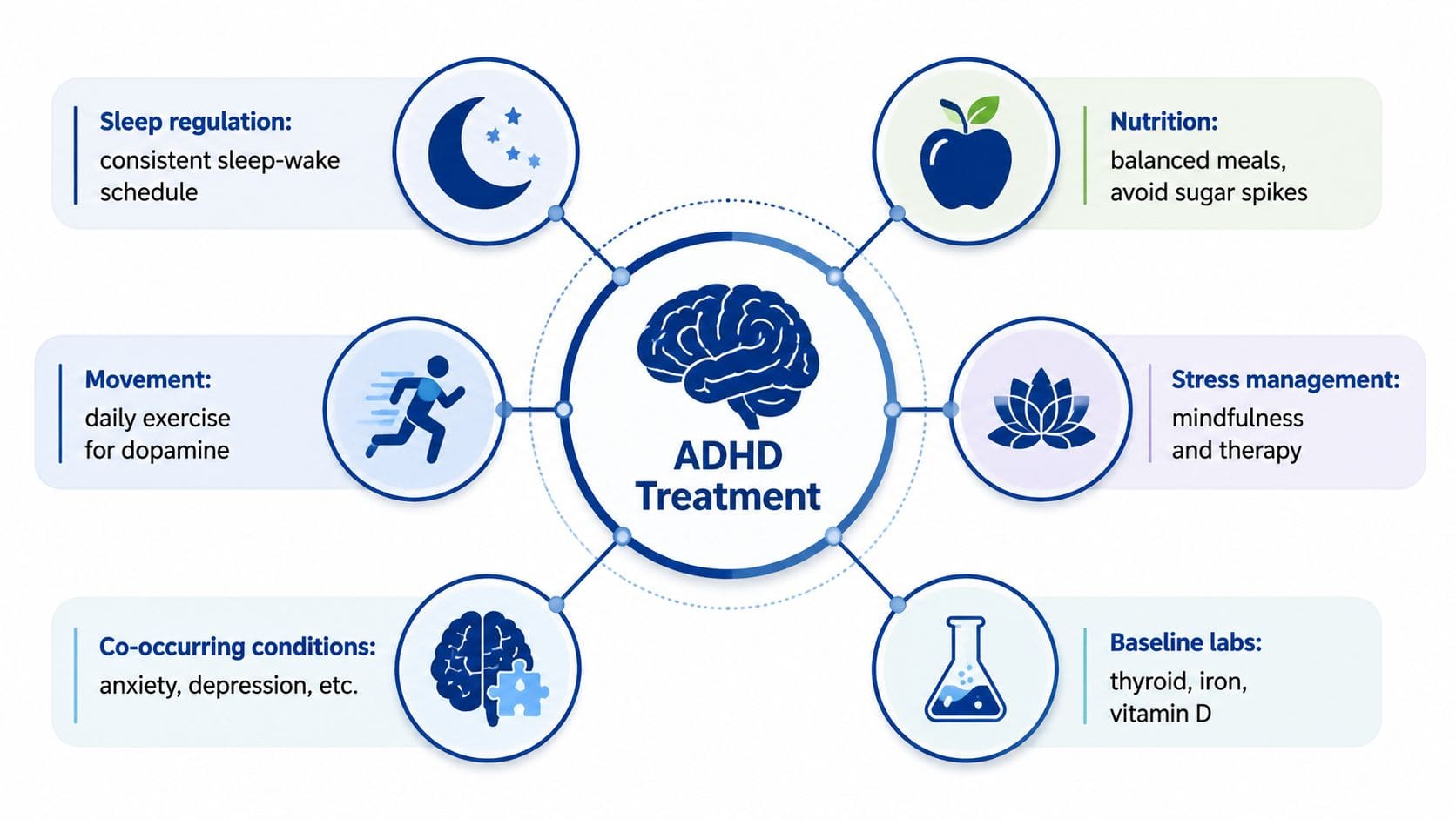
Medication addresses only one part of ADHD care. A useful plan also examines sleep timing, nutrition, movement, stress, mood, anxiety, trauma symptoms, substance use, and the patient's daily environment. These factors can worsen attention problems or resemble ADHD, and they can also affect how a patient experiences medication.
A clinician may review thyroid studies, metabolic testing, or other laboratory information when the history suggests it would help. The assessment may also consider cardiac risk factors before stimulant prescribing. Testing isn't identical for every patient, so the clinician should connect each test to the person's symptoms and medical history.
Six areas that support ongoing care
- Sleep regulation includes a consistent sleep-wake routine and evaluation of possible sleep disorders. Patients who want more background can read about ADHD and sleep.
- Nutrition focuses on regular, balanced meals, especially when appetite changes affect intake.
- Movement can support routine, energy regulation, and behavioral activation.
- Stress management may include therapy, mindfulness, planning systems, and realistic workload adjustments.
- Co-occurring conditions such as anxiety or depression may need their own treatment plan. Related care may include anxiety treatment or depression treatment.
- Laboratory and medical review helps the clinician identify health factors that could influence attention or medication decisions.
Telehealth follow-ups can track more than whether a patient “feels better.” The clinician can review missed deadlines, driving concerns, household organization, sleep, appetite, mood, side effects, and progress toward goals. That information supports safer adjustments and creates the response documentation that Cigna may require for continued authorization.
Integrative Psychiatry of America provides virtual psychiatric evaluations and medication management for patients across Pennsylvania, including ADHD care, through telehealth. Coordination with primary care, therapy, sleep specialists, or nutrition professionals may be appropriate when the patient's needs extend beyond medication.
Key Questions and Practical Next Steps
Telehealth evaluation doesn't equal a same-day prescription. The clinician may need to confirm the diagnosis, review records, screen for other conditions, or complete safety checks before recommending medication.
A medication listed as covered isn't automatically approved for every patient. Cigna may require prior authorization, step therapy, a specific formulation, or additional documentation. A pharmacy delay can also reflect an administrative problem rather than a clinical disagreement.
Patients can use this sequence:
- Verify benefits first. Confirm the behavioral health network, referral rules, pharmacy benefit, and authorization requirements.
- Schedule a secure evaluation. Choose a clinician who serves the patient's Pennsylvania location and can provide follow-up care.
- Gather records. Collect prior evaluations, medication history, school information, and relevant primary care notes.
- Discuss the formulary. Ask which options are preferred and whether step therapy applies.
- Prepare for authorization. Keep the diagnosis, functional goals, response notes, and side-effect history organized.
- Follow pharmacy updates. Ask for the exact reason for any rejected or delayed claim and send it to the prescribing office.
Patients should keep a personal record of diagnoses, medication responses, side effects, sleep changes, appetite changes, and functional goals. Integrative care continues alongside medication decisions. Sleep, nutrition, movement, stress management, and treatment of co-occurring anxiety or depression remain part of sustainable ADHD care.
Integrative Psychiatry of America offers virtual ADHD evaluations, medication management, and whole-person psychiatric care for adults throughout Pennsylvania. Patients can review Integrative Psychiatry of America, verify insurance, and request an appointment to discuss an organized path from ADHD assessment to ongoing treatment access.