
Yes, most insurance plans cover ADHD diagnostic testing, but whether it feels affordable depends entirely on your specific plan type, deductible status, prior authorization requirements, and whether the evaluation is coded as a basic clinical assessment or a more extensive neuropsychological battery. Diagnostic ADHD evaluations can cost $800 to $2,500, while insured patients often still pay $150 to $400 out of pocket, according to a consumer guide to ADHD testing costs.
A Pennsylvania adult may reach this question after years of missed deadlines, unfinished tasks, impulsive decisions, or work problems that never had a clear explanation. After months of searching for an ADHD evaluation, the insurance portal may offer no simple “ADHD testing” category. The evaluation may instead appear under outpatient mental health, psychological testing, or neuropsychological services.
That's why the useful question isn't only, “Is ADHD testing covered by insurance?” It's also, “Which parts of the evaluation are covered, under which codes, and what will the patient owe before benefits apply?”
Table of Contents
- Understanding Whether ADHD Testing Is Covered by Insurance
- How Mental Health Parity and the ACA Shape ADHD Coverage
- Comparing ADHD Testing Coverage Across Different Insurance Types
- Understanding Real Out-of-Pocket Costs for ADHD Evaluation
- Verifying Your Specific Coverage Before Scheduling
- Navigating Telehealth and Online ADHD Evaluation Coverage
- Taking the Next Step Toward an ADHD Evaluation
Understanding Whether ADHD Testing Is Covered by Insurance
Most major health plans cover ADHD diagnostic evaluations when the service is treated as a medically necessary outpatient mental health service. Coverage still varies by plan design, provider network, deductible, copay structure, referral rules, and prior authorization. Talkiatry's explanation of ADHD insurance billing describes why the same clinical work can receive different reimbursement depending on how the payer classifies each component.
A clinical ADHD evaluation usually involves more than one activity. The clinician may conduct a diagnostic interview, review developmental and medical history, use standardized rating scales, assess functional impairment, and consider other explanations such as anxiety, depression, sleep problems, or learning concerns. A neuropsychological evaluation adds broader cognitive testing and often faces stricter utilization review.

Why the simple answer can mislead
“Covered” doesn't mean “free.” A plan may cover the clinician's interview but apply the charge to an unmet deductible. It may reimburse rating-scale administration while limiting extended testing. An out-of-network provider may also create a separate reimbursement process, with a different patient responsibility.
Practical rule: Coverage should be verified by service component, not by diagnosis label alone.
Patients seeking a focused psychiatric evaluation can review the ADHD testing and treatment options available through virtual care. Before scheduling, the patient should ask the practice which services it bills and then confirm those services directly with the insurer.
The most reliable benefit check identifies the provider's network status, the relevant procedure codes, deductible balance, coinsurance, referral requirements, and prior authorization rules. That information gives a more accurate financial picture than a general statement that ADHD testing is included in mental health benefits.
How Mental Health Parity and the ACA Shape ADHD Coverage
The Affordable Care Act established mental health and substance use disorder services as essential health benefits for many Marketplace and employer-sponsored plans. As a result, many plans must include diagnostic evaluations within their mental health coverage rather than treating ADHD assessment as an entirely separate benefit. The CDC's 2024 data brief on ADHD provides important context for why this access matters.
In practice, ADHD testing is commonly billed as outpatient mental health care. The plan may process the diagnostic interview, rating scales, and neuropsychological testing under different benefit rules. Mental health parity supports access to covered mental health services, but it doesn't force every plan to pay every type of testing at the same level.
Diagnostic care is different from preventive screening
Patients sometimes assume ADHD testing should be free because health plans cover certain preventive services without cost sharing. That assumption usually doesn't apply. The HealthCare.gov preventive care guidance distinguishes qualifying preventive services from diagnostic care.
An ADHD evaluation is generally ordered because symptoms or functional difficulties require clarification. The purpose is to assess a possible condition and guide treatment, not to provide a routine preventive screening. The claim therefore usually enters the plan as diagnostic mental health care, with deductible or coinsurance rules that may apply.
| ACA Mental Health Coverage Requirements | How ADHD Testing Is Treated | What This Means for Patients |
|---|---|---|
| Many applicable plans include mental health and substance use disorder services as essential health benefits. | ADHD diagnostic workups are commonly handled within outpatient mental health benefits. | Coverage is often available, but the plan determines cost sharing and authorization. |
| Mental health benefits are subject to applicable parity requirements. | Different evaluation components may still use different billing codes and utilization rules. | A covered interview doesn't guarantee full payment for comprehensive testing. |
| Preventive services may qualify for no-cost coverage when plan rules apply. | ADHD diagnosis is usually diagnostic care rather than preventive screening. | Patients shouldn't assume a full ADHD workup will be free. |
The CDC reported ADHD prevalence among children ages 5 to 17 at 14.4% for public insurance, compared with 6.3% for uninsured children. Among children ages 12 to 17, prevalence was 17.6% with public insurance, 12.8% with private insurance, and 6.7% among uninsured children. These figures describe reported prevalence, not proof that insurance causes ADHD, but they show how insurance status is closely connected with diagnosis and follow-up access.
Comparing ADHD Testing Coverage Across Different Insurance Types
Insurance category gives a starting point, not a final answer. A private plan, Medicaid plan, or Medicare plan may cover ADHD-related diagnostic care, yet each can impose different rules for networks, medical necessity, authorization, and cost sharing.
| Insurance Type | ADHD Testing Coverage | Typical Out-of-Pocket Range | Key Limitations to Watch |
|---|---|---|---|
| Private insurance | Most major plans cover diagnostic evaluations under outpatient mental health benefits. | $150 to $400 with insurance, depending on plan factors, according to this ADHD testing cost guide. | Deductibles, network status, referrals, prior authorization, and limits on extended testing. |
| Medicaid | Public coverage can provide a pathway to evaluation, particularly for children, but administration and provider rules vary. | The amount varies by state plan and member benefits. | State-level rules, managed-care requirements, provider participation, and authorization. |
| Medicare | Part B covers outpatient mental health care used to diagnose or treat a condition. | After the Part B deductible, the beneficiary generally pays 20% of the Medicare-approved amount, according to Medicare's outpatient mental health coverage guidance. | The specific service must qualify, and broader testing may receive different review. |
Private insurance and employer plans
Commercial plans often cover a psychiatric diagnostic evaluation and basic behavioral rating scales when the clinician documents medical necessity. However, a neuropsychological battery may receive partial coverage, require prior authorization, or fall under a benefit with different cost sharing. In-network care generally offers more predictable negotiated rates than out-of-network care.
Patients with Aetna or another commercial payer can also review the practice's Aetna ADHD treatment information while confirming benefits with the insurer. The practice page can't replace the member's plan document or a direct benefit verification.
Medicaid and Medicare require closer plan-level review
Medicaid coverage varies by state and by managed-care arrangement. Publicly insured children showed higher reported ADHD prevalence than uninsured children in the CDC data cited earlier, which reinforces the importance of understanding the access pathway rather than assuming public coverage excludes evaluation.
Medicare Part B covers outpatient mental health services used to diagnose or treat a condition. Medicare also states that a yearly depression screening is free when the provider accepts assignment, but that preventive depression screening rule shouldn't be confused with full ADHD diagnostic testing.
For all three categories, the most important details are the actual member plan, the clinician's network status, the billed procedure, and whether authorization is required. The insurance label alone can't predict the final bill.
Understanding Real Out-of-Pocket Costs for ADHD Evaluation
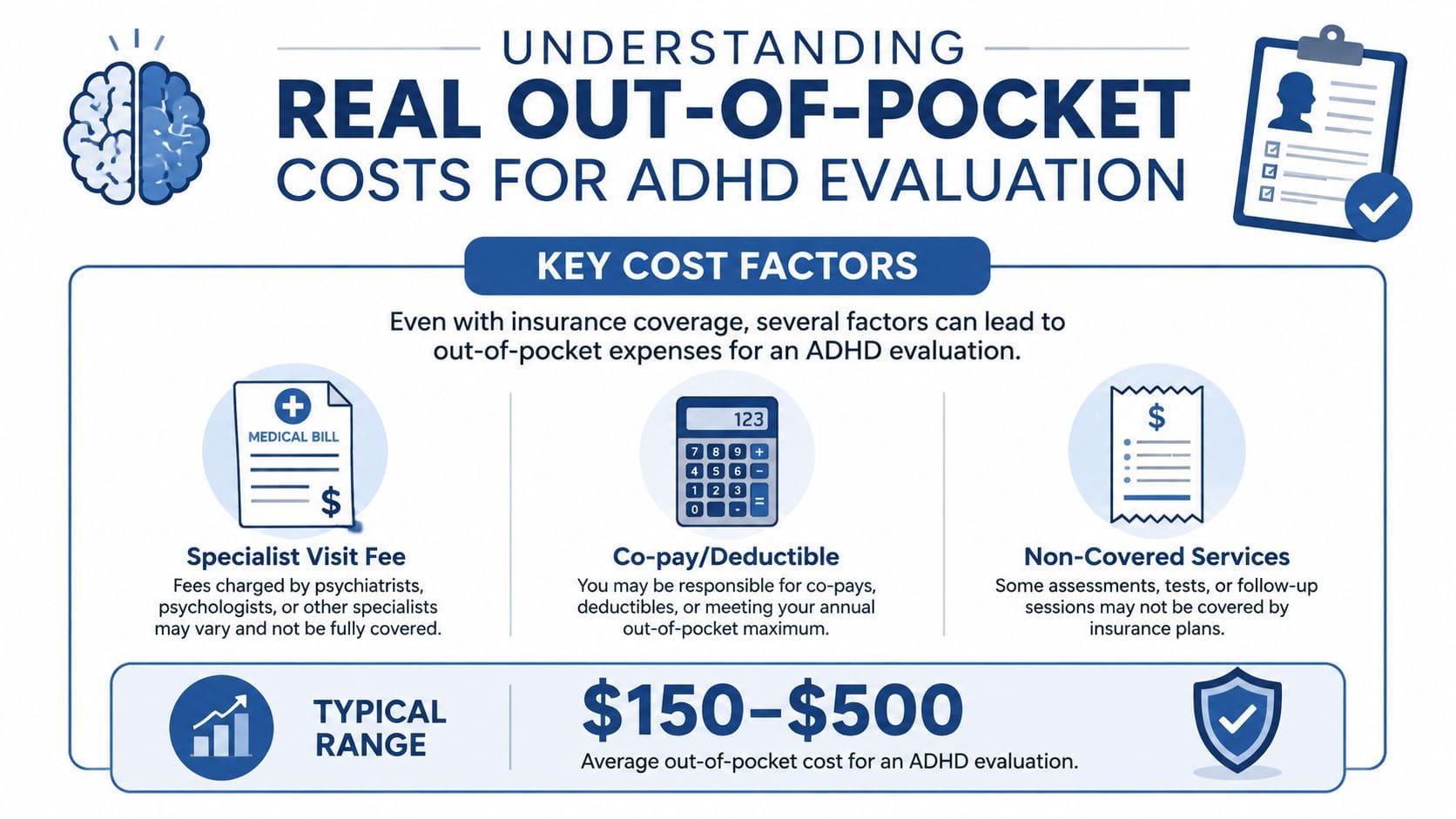
A plan can cover ADHD testing and still leave a patient with a substantial bill. The difference usually comes from what the clinician evaluates, which services the insurer recognizes, and whether the deductible has been met.
A 2025 consumer estimate placed diagnostic ADHD evaluations between $800 and $2,500, with insured out-of-pocket costs often between $150 and $400. A separate 2026 coverage guide reported that an initial evaluation can cost $200 to $400 before benefits begin when the deductible hasn't been met, while out-of-pocket testing may reach $1,000 to $2,500. These ranges come from the consumer ADHD testing cost guide and the 2026 ADHD coverage guide.
Why comprehensive testing costs more
A focused clinical assessment may involve an interview, symptom review, rating scales, and diagnostic formulation. Neuropsychological testing adds broader cognitive measures and interpretation. Insurers are often more willing to reimburse the interview and basic behavioral scales than a full cognitive battery unless the clinician documents a clear need, such as differential diagnosis, learning disorder concerns, or significant functional impairment. Josi Health's payer-focused discussion explains this distinction in billing practice.
The same clinical visit can therefore produce different financial outcomes depending on the component being billed. A patient might have a modest copay for a diagnostic interview but face deductible exposure for testing that the plan processes separately.
Coverage is a benefit category. Affordability is the result of the benefit category, deductible, network, and billed services working together.
CHADD survey data cited in the available coverage material indicated that 95% of respondents reported having health insurance. That finding suggests many people seeking ADHD care have some potential coverage, but it doesn't show how much their plans pay. Patients still need an individualized estimate.
The ADHD testing cost information can help patients understand why an adult psychiatric evaluation, neuropsychological testing, and documentation for accommodations may not be treated identically by a payer.
A written estimate is useful, but it isn't a guarantee of payment. The insurer's benefits representative can explain the member's deductible and coinsurance, while the clinician's office can explain the planned services and expected charges.
Verifying Your Specific Coverage Before Scheduling
The safest way to avoid an unexpected bill is to verify benefits before the appointment. Patients should call the behavioral health or mental health number on the insurance card and ask about the exact service, not “ADHD testing.”
Prior authorization deserves special attention. If a plan requires authorization and the provider doesn't obtain it before the service, the insurer may deny the claim even when the underlying evaluation is otherwise covered. Children's Psychological Services' insurance guidance describes prior authorization as a common requirement for ADHD-related services and medications.
Ask about each CPT-coded component
The following codes are commonly associated with different parts of an ADHD workup. The insurer should confirm whether each code is covered, whether the provider must be in network, and whether the deductible applies.
| CPT Code | Service Type | Typical Coverage Status | Questions to Ask Your Insurer |
|---|---|---|---|
| 90791 | Diagnostic evaluation, often used for an initial psychiatric or psychological interview. | Often handled under outpatient mental health benefits. | Is 90791 covered for ADHD evaluation? Does the deductible apply? Is prior authorization required? |
| 99213 to 99215 | Established-patient evaluation and management services, depending on the visit and documentation. | May be processed under mental health or medical benefits according to the payer and provider. | Which benefit applies? What are the copay and coinsurance? |
| 96127 | Standardized behavioral or emotional assessment administration. | May be covered separately, bundled, limited, or subject to plan rules. | Is 96127 covered per unit? Are there quantity limits or authorization requirements? |
| 96132 to 96139 | Neuropsychological testing services, including testing and professional interpretation components. | More likely to receive stricter utilization review or partial coverage. | Are these codes covered for ADHD? Must medical necessity be reviewed in advance? |
Use a short verification script
A patient or caregiver can ask:
- Does the plan cover outpatient diagnostic evaluation for suspected ADHD?
- Is the clinician in network for behavioral health benefits?
- Are CPT codes 90791, 99213 through 99215, 96127, and 96132 through 96139 covered separately?
- Has the deductible been met, and what coinsurance applies before and after that point?
- Does the plan require a referral or prior authorization?
- Will telehealth use the same benefit as an in-person mental health visit?
- Are there exclusions or limits for neuropsychological testing?
- Can the representative provide a reference number for the call?
The insurance verification process can help patients organize these questions. Benefit representatives can explain plan rules, but they usually can't promise the final claim outcome. The clinician's office should also confirm the planned evaluation components, because the insurer can't accurately discuss a code the patient hasn't identified.
Navigating Telehealth and Online ADHD Evaluation Coverage
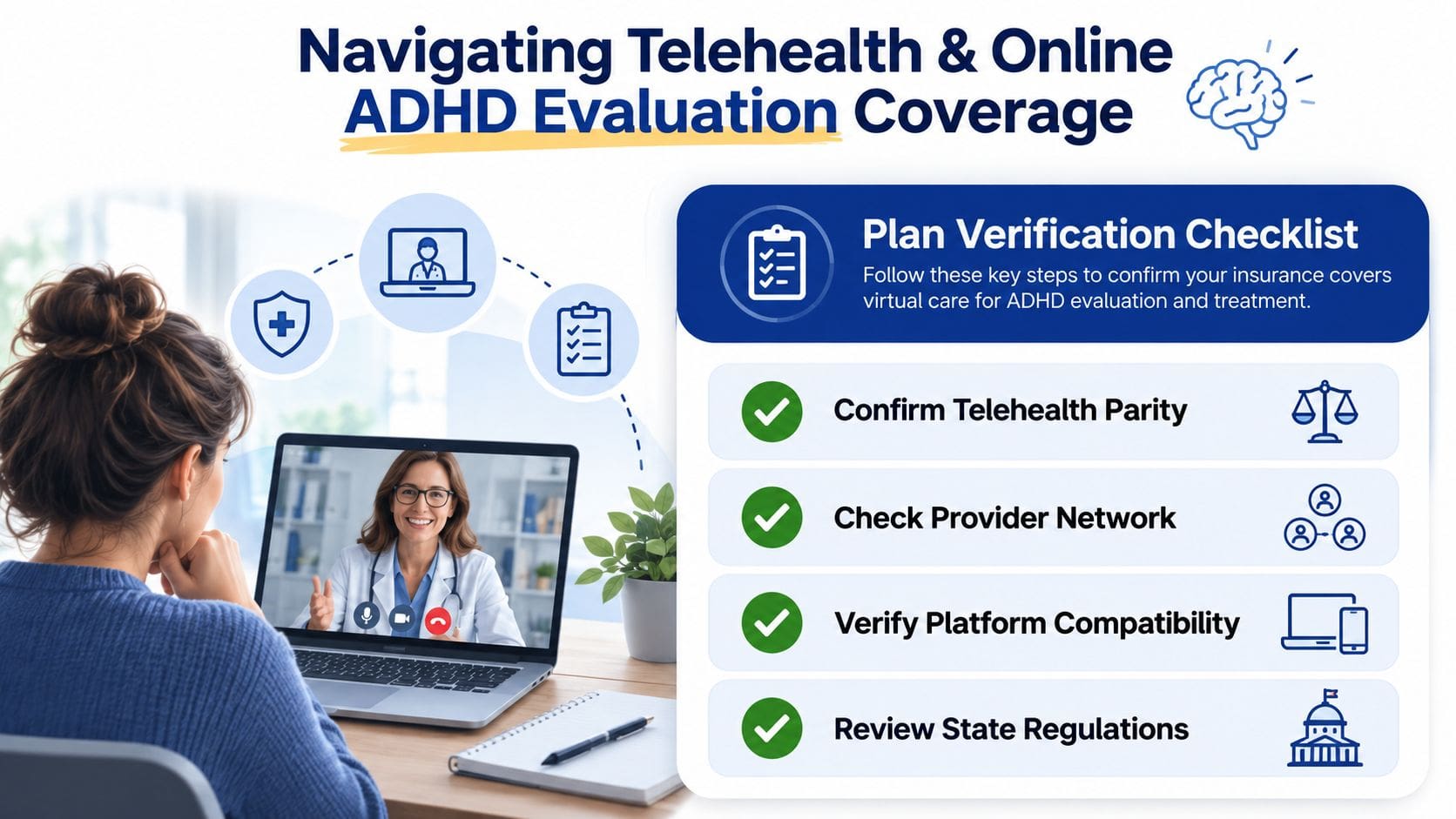
Telehealth can remove travel and scheduling barriers for Pennsylvania adults, including patients in Philadelphia and other communities who prefer a private appointment from home. Most commercial plans, Medicare, and Medicaid often cover mental health telehealth visits, including ADHD evaluations, but the exact benefit still depends on network status, state rules, plan language, and billing details.
Pennsylvania patients should separate three questions:
- Does the plan cover behavioral health telehealth?
- Is the specific clinician in network?
- Does the plan cover the particular ADHD service code delivered remotely?
Online diagnosis and follow-up care may differ
An insurer may cover an initial online diagnostic interview but handle follow-up medication management under a different benefit or require additional documentation. Some plans may also require in-person follow-up for particular prescribing situations. The practical answer depends on the payer, the medication plan, the patient's clinical needs, and applicable state and federal requirements.
Telehealth parity rules can influence whether a virtual behavioral health visit receives coverage comparable to an in-person visit. Parity doesn't mean every service is automatically reimbursed. A plan may still apply authorization rules, network restrictions, or code-specific limits.
Ask about the visit format and the billed code together. “Telehealth is covered” is too broad to predict payment.
Before scheduling, patients should verify the platform requirements, privacy expectations, provider location, and whether the appointment qualifies under the plan's telehealth benefit. A questionnaire completed online may not be treated as a stand-alone diagnostic service. It may function as one part of a clinician-led evaluation.
Pennsylvania residents can review telehealth ADHD evaluation services and then ask the insurer about the specific appointment type. Integrative Psychiatry of America provides virtual psychiatric evaluations and medication management through telehealth for patients throughout Pennsylvania. The coverage check remains essential, even when the clinical service is delivered remotely.
Taking the Next Step Toward an ADHD Evaluation
Insurance complexity shouldn't postpone a clinically appropriate evaluation. The process becomes more manageable when patients identify the planned service codes, confirm network status, check the deductible, and ask whether prior authorization is required.
A focused psychiatric evaluation may be appropriate when attention problems, impulsivity, disorganization, or executive-function difficulties interfere with work, relationships, education, or daily responsibilities. Diagnosis should come from a qualified clinician who considers the full history and possible co-occurring conditions, not from a questionnaire alone.
Pennsylvania adults can pursue virtual evaluation, medication management, and ongoing psychiatric treatment without traveling to an office. Patients should gather their insurance card, prepare specific questions, and request a written estimate before the appointment.
Integrative Psychiatry of America offers virtual psychiatric evaluations, ADHD evaluation and treatment, and medication management through secure telehealth for patients throughout Pennsylvania. Visit Integrative Psychiatry of America to review care options, verify insurance, and request an appointment.