
Azstarys has no available human pregnancy data to evaluate the risks of birth defects, miscarriage, or other adverse fetal outcomes. Broader methylphenidate evidence shows no major human teratogenic signal, but it suggests a small possible increase in cardiac malformations and a late-pregnancy preterm birth signal.
A positive pregnancy test can turn an ordinary medication routine into an urgent, frightening question: should the next Azstarys dose be taken, skipped, or stopped? Many adults with ADHD rely on treatment to work safely, manage appointments, complete tasks, and maintain daily stability. Pregnancy adds another layer because the available evidence is limited and sometimes points in different directions.
The safest response isn't an abrupt decision made from an internet search. A psychiatric prescriber and obstetric clinician should review the timing of exposure, ADHD severity, other health conditions, pregnancy history, and the practical consequences of untreated symptoms. The discussion below explains what is known about Azstarys and pregnancy, what remains uncertain, and how clinicians manage that uncertainty.
Table of Contents
- Discovering Pregnancy While Taking Azstarys
- What the FDA Label Actually Says About Azstarys
- Methylphenidate Class Evidence on Birth Defects
- Beyond Birth Defects, Preterm Birth and Neonatal Outcomes
- How Clinicians Approach the Risk-Benefit Decision
- Alternative ADHD Management Strategies During Pregnancy
- Getting Personalized Psychiatric Guidance in Pennsylvania
Discovering Pregnancy While Taking Azstarys
A patient may learn she is pregnant after taking Azstarys for days or weeks before conception was recognized. Fear of having already caused harm is understandable, but an exposure alone does not establish fetal injury. The next step is a prompt, structured medication review.
Azstarys has no available human pregnancy data sufficient to evaluate a drug-associated risk of major birth defects, miscarriage, or other adverse maternal or fetal outcomes. The FDA label also states that it is not known whether Azstarys can harm an unborn baby. The absence of product-specific evidence creates uncertainty. It does not prove that exposure is dangerous or that it is harmless. (FDA Azstarys prescribing information)
What the lack of data means
AZSTARYS was approved by the U.S. FDA in 2021. Its phase 3 studies reported no pregnancies, so those trials did not produce human pregnancy outcome data for this medication. Clinicians therefore review evidence from related methylphenidate medicines and weigh it against the patient's symptoms, health history, pregnancy timing, and daily functioning.
Accidental exposure is not proof of fetal injury. Stopping treatment without guidance can also create problems, particularly when untreated ADHD affects driving, work, appointments, organization, or safety. The appropriate conclusion is uncertainty, followed by individualized risk-benefit counseling. Broader methylphenidate findings may inform that discussion, but they cannot be treated as direct Azstarys evidence.
Practical rule: A positive pregnancy test calls for prompt medication counseling, not panic or self-directed discontinuation.
Patients can ask about the National Pregnancy Registry for Psychostimulants. The FDA label identifies a registry for ADHD medications, including Azstarys, and clinicians can register exposures through 1-866-961-2388. Enrollment may improve information for future patients, but it does not replace prenatal or psychiatric care.
A focused discussion of ADHD medication during pregnancy can help patients compare continuing Azstarys, adjusting treatment, or using nonmedication supports. Before the appointment, record the last dose, current dose, estimated pregnancy timing, other medications, and any symptoms affecting safety. A psychiatric prescriber and obstetric clinician can then make a plan suited to the pregnancy and the patient's actual level of impairment.
What the FDA Label Actually Says About Azstarys
A patient may discover she is pregnant while taking Azstarys and immediately ask whether the medication caused harm. The FDA label does not support that conclusion. It states that no available data in pregnant women can establish the risk of major birth defects, miscarriage, or other adverse maternal or fetal outcomes. It also warns that stimulant-related effects, including vasoconstriction and reduced placental perfusion, could create fetal risk. (FDA Azstarys prescribing information)
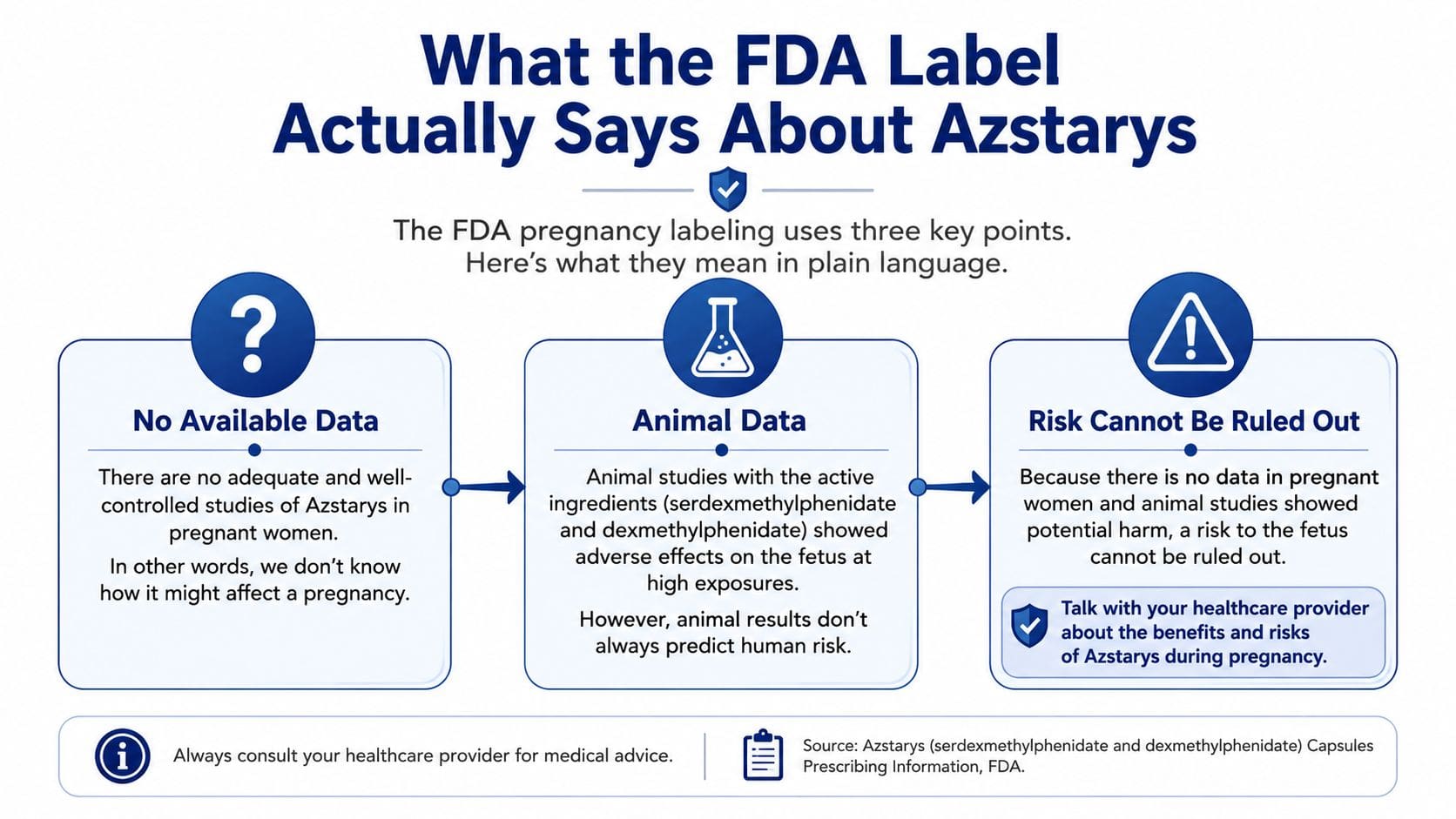
How to read the label
Azstarys contains dexmethylphenidate and serdexmethylphenidate. Serdexmethylphenidate is a prodrug, so the body converts it into dexmethylphenidate. The product's phase 3 studies reported no pregnancy outcomes, leaving clinicians without a direct Azstarys-specific estimate of fetal risk.
The FDA materials also discuss published studies of methylphenidate, the medication class that includes dexmethylphenidate. Those studies have not established a clear overall drug-associated risk, while the label still acknowledges a plausible biological concern. Stimulants can narrow blood vessels, potentially reducing placental blood flow. Because the placenta supplies oxygen and nutrients needed for fetal growth, that possibility affects monitoring and treatment planning.
No evidence of harm versus evidence of safety
These terms describe different levels of knowledge:
- No evidence of harm: Available data have not established that the medication causes a particular problem.
- Evidence of safety: Adequate, well-designed data support that the medication does not cause a particular problem.
Azstarys is closer to the first category. Current information does not prove that it causes birth defects or miscarriage, yet it cannot confirm safety across pregnancy outcomes either. The label therefore supports individualized counseling rather than a blanket yes-or-no answer.
In practice, a prescriber may recommend continuing, reducing, stopping, or changing treatment. That choice should weigh uncertain fetal effects against the patient's ADHD symptoms, pregnancy circumstances, and the consequences of untreated impairment. The FDA label frames the uncertainty. Clinical assessment determines how it applies to one patient.
Methylphenidate Class Evidence on Birth Defects
A patient may discover a pregnancy after taking Azstarys during the first trimester. Because direct pregnancy trials of Azstarys are unavailable, clinicians examine evidence from the broader methylphenidate class, which includes dexmethylphenidate. That evidence is limited, but it offers more guidance than treating the medication as entirely unstudied.
A 2021 review summarized more than 4,000 first-trimester methylphenidate exposures and concluded that methylphenidate is not a major human teratogen. In other words, the available pattern does not resemble a medication that commonly causes structural birth defects. (2021 review of methylphenidate pregnancy evidence)
A separate meta-analysis found a small but statistically significant increase in major malformations after early-pregnancy methylphenidate exposure, driven mainly by cardiac malformations. (Meta-analysis of methylphenidate and pregnancy outcomes) These results are not necessarily incompatible. The studies may have used different comparison groups, exposure definitions, and outcome measures.
Why the studies don't all agree
Most pregnancy medication research is observational. Researchers cannot randomly assign pregnant patients to take or avoid a stimulant, so they compare groups identified through prescriptions, medical records, and reported exposure.
Several factors can change the estimated association:
- Comparator selection: Results may differ when exposed patients are compared with the general population rather than with patients who have ADHD but are not taking medication.
- Confounding by indication: ADHD, related behaviors, coexisting conditions, and differences in healthcare access may influence pregnancy outcomes independently of medication exposure.
- Exposure timing: First-trimester exposure is most relevant to structural development. Later exposure may relate to different outcomes.
- Outcome definitions: One study may count all major malformations, while another analyzes cardiac findings separately.
NHS and Medicines in Pregnancy guidance remains cautious because methylphenidate safety information is limited. At the same time, it states that most exposed babies don't have birth defects. (Methylphenidate pregnancy review and independent guidance)
Methylphenidate pregnancy evidence summary
| Study or source | Key finding | Clinical implication |
|---|---|---|
| 2021 review | Methylphenidate is not a major human teratogen | The overall structural malformation signal is not large or definitive |
| 2020 meta-analysis | Small, statistically significant increase in major malformations, mostly cardiac | Early exposure may warrant discussion of fetal cardiac surveillance |
| NHS and Medicines in Pregnancy | Limited safety information, but most exposed babies do not have birth defects | Counseling should remain cautious without assuming inevitable harm |
The practical conclusion is measured: any absolute increase in risk, if real, appears small, yet uncertainty still matters. Patients can also review Ritalin and pregnancy guidance to see why methylphenidate-class evidence can inform counseling without serving as direct proof about Azstarys.
Beyond Birth Defects, Preterm Birth and Neonatal Outcomes
Structural birth defects are only one part of pregnancy safety. Medication exposure can also relate to blood pressure, placental function, fetal growth, delivery timing, and a newborn's early adjustment.
A 2026 PubMed-indexed cohort study found that ADHD medication use late in pregnancy was associated with a modestly higher risk of preterm birth, with a stronger association after longer cumulative exposure. Methylphenidate showed a late-pregnancy signal in that analysis. (Late-pregnancy ADHD medication cohort study)
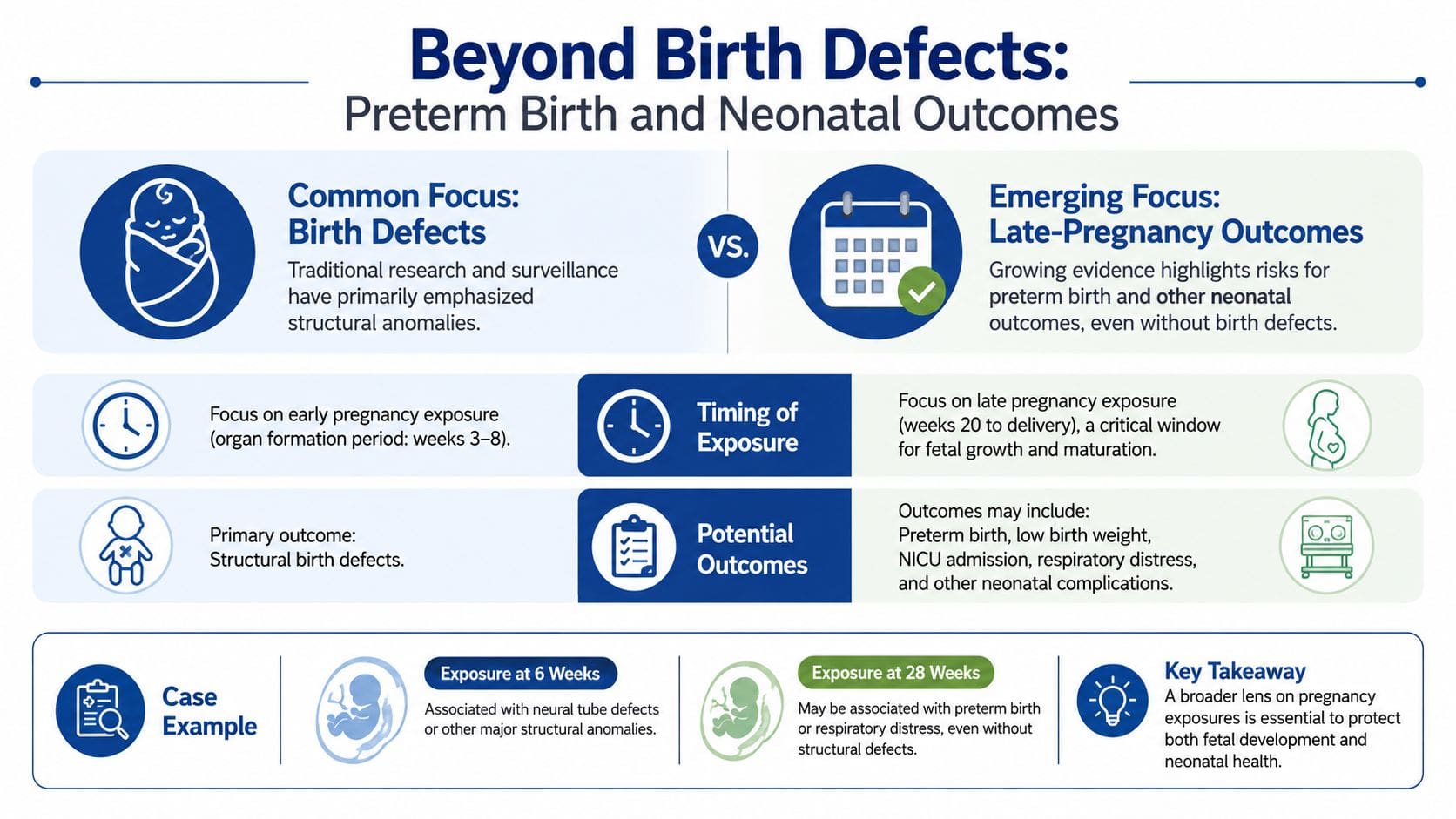
The broader outcome picture
The evidence is not uniformly concerning. A 2025 Australian study found no difference in maternal outcomes, including preeclampsia, cesarean delivery, or postpartum hemorrhage, among people dispensed methylphenidate or dexamphetamine during pregnancy. A 2025 Swedish cohort also found no increased risk of neurodevelopmental disorders in children exposed to methylphenidate in utero. These findings were reported in the same PubMed-indexed evidence base cited above.
Those results do not cancel the late-pregnancy preterm-birth association. They show why clinicians should separate outcomes rather than label the entire pregnancy risk as either safe or unsafe. Evidence about methylphenidate can inform counseling, but it does not establish that Azstarys itself causes any particular outcome.
MotherToBaby notes that limited research does not suggest increased preterm delivery or low birth weight when methylphenidate is taken as prescribed, while also emphasizing that the available conclusions remain limited and not definitive. (MotherToBaby methylphenidate pregnancy information)
The relevant question includes more than whether a baby develops normally. Exposure timing may also relate to pregnancy course, delivery, newborn adjustment, and later development.
Late-pregnancy discussions may include blood pressure, appetite, weight, fetal growth, and symptoms that could signal delivery complications. Treated and untreated patients may differ in ways that affect study results, so an observed association does not prove causation.
Patients seeking a broader review can read guidance on stimulants and pregnancy as context for an individualized discussion. Current evidence supports neither blanket reassurance nor automatic alarm.
How Clinicians Approach the Risk-Benefit Decision
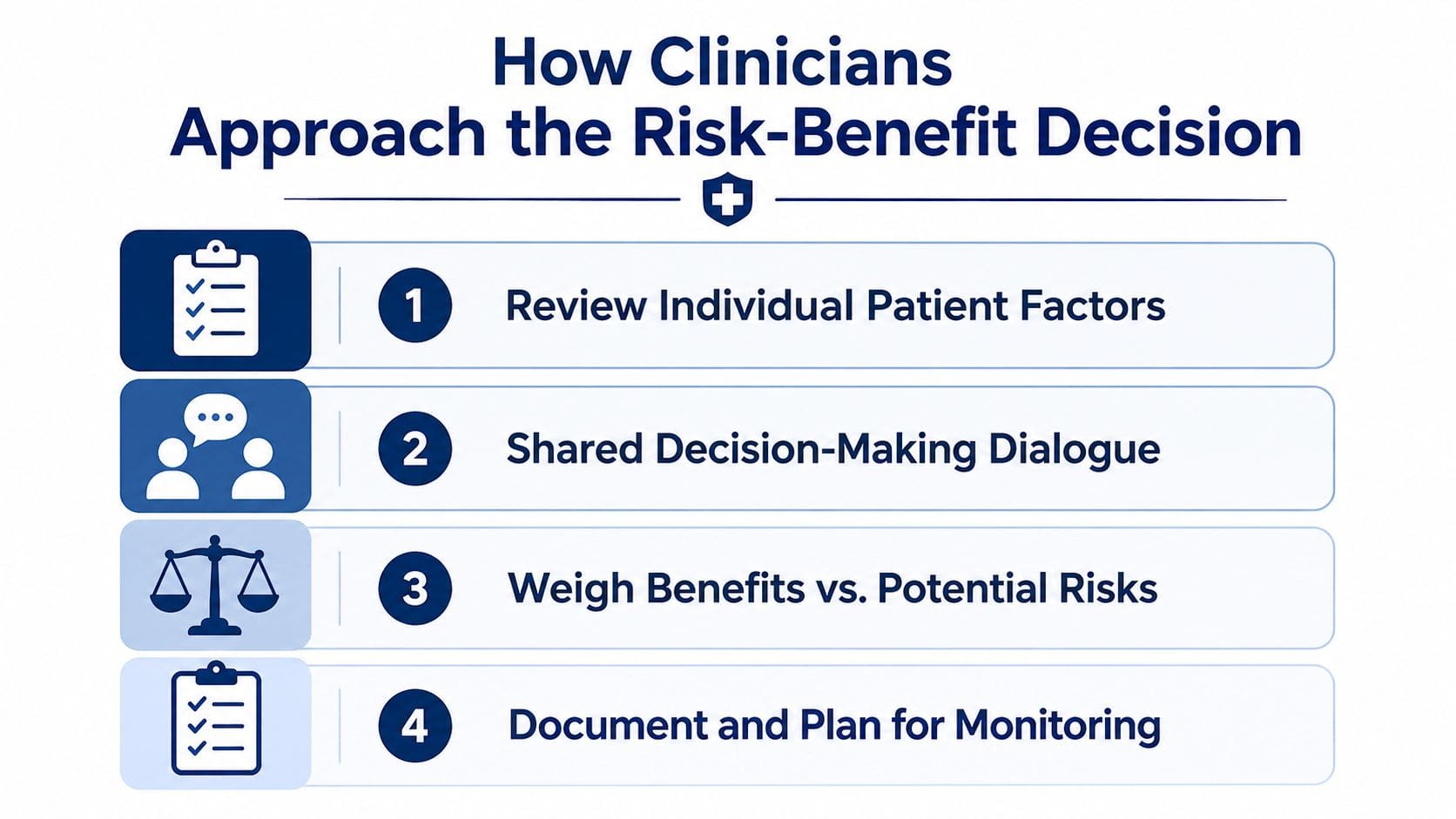
A medication decision begins with functioning, safety, and the realities of pregnancy. The clinician asks what untreated ADHD looks like in daily life. Missed prenatal appointments, disorganization around nutrition or supplements, unsafe driving, workplace errors, and severe impairment may change the balance between fetal uncertainty and treatment benefit.
Questions that shape the plan
The prescriber and patient review:
- Current symptom severity: Can the patient manage work, driving, home responsibilities, and prenatal care without medication?
- Exposure timing: Did exposure occur before pregnancy recognition, during the first trimester, or later?
- Medical factors: Are blood pressure, appetite, cardiovascular health, sleep, or fetal growth concerns present?
- Past treatment response: Have dose reductions, medication pauses, therapy, or other medications worked before?
- Patient values: How does the patient weigh uncertain fetal risk against disabling ADHD symptoms?
A plan may involve a planned pause, dose reduction, medication change, or continuation at the lowest effective dose. Abrupt discontinuation can cause a sharp return of symptoms and create driving, work, or caregiving risks. The prescriber should explain the change plan and coordinate it with the obstetric team.
Monitoring after exposure
After first-trimester exposure, the obstetric clinician may discuss fetal cardiac surveillance because methylphenidate studies have raised a possible cardiac-malformation signal. Patients can also ask about registry reporting through the National Pregnancy Registry for Psychostimulants, using 1-866-961-2388 as listed in the FDA materials. The FDA prescribing information describes these pregnancy considerations.
Late-pregnancy monitoring may include maternal blood pressure, appetite, weight, fetal growth, and signs that could raise concern about preterm delivery. The appropriate plan depends on obstetric history, overall health, exposure timing, and whether treatment continues.
The following video offers another visual explanation of shared clinical decision-making:
Alternative ADHD Management Strategies During Pregnancy
Azstarys continuation is only one possible plan. A patient and prescriber may consider a planned medication pause, dose reduction, medication switch, or continued treatment. The best option depends on how severely symptoms interfere with safety and daily functioning, along with previous responses to nonmedication strategies.
Medication alternatives
Some patients may discuss non-stimulant ADHD medications. These medications have different mechanisms and pregnancy evidence profiles, but “non-stimulant” doesn't automatically mean risk-free. A prescriber should review the specific medication, available pregnancy data, other diagnoses, blood pressure, sleep, and past treatment response. A resource on focus on ADHD treatment options can help patients understand the general distinction between stimulant and non-stimulant approaches.
A medication switch during pregnancy also carries practical downsides. The alternative may not control symptoms as well, may introduce new side effects, or may require a period of adjustment. Changing medication solely to avoid the word “stimulant” can produce a less effective plan.
Nonmedication supports
Behavioral treatment can reduce the number of executive-function demands placed on the patient. Useful tools include:
- External reminders: Calendar alerts, medication organizers, visual schedules, and written prenatal appointment plans.
- Task reduction: Breaking cooking, paperwork, and work assignments into short, visible steps.
- Environmental design: Keeping frequently used items in consistent locations and reducing distractions during safety-sensitive tasks.
- Cognitive strategies: Coaching or therapy focused on planning, time estimation, emotional regulation, and follow-through.
- Lifestyle foundations: Regular sleep, appropriate exercise, and consistent nutritional support can help preserve attention and energy.
These strategies often supplement rather than fully replace medication for patients with severe ADHD. A planned pause may fit someone with mild impairment and strong support, while continuation may be more clinically sound for someone whose untreated symptoms create substantial safety or prenatal-care concerns. Patients can learn more about non-stimulant ADHD treatment before discussing options with a prescribing clinician.
Getting Personalized Psychiatric Guidance in Pennsylvania
Azstarys and pregnancy decisions require more than a medication list. A careful evaluation considers ADHD severity, pregnancy timing, coexisting anxiety or depression, sleep, nutrition, cardiovascular factors, prior treatment attempts, and the patient's values. A one-size-fits-all instruction to stop or continue can miss the risks on either side.
Telepsychiatry makes medication management available without requiring travel to an office. Adults in Philadelphia, Pittsburgh, and smaller Pennsylvania communities can use secure virtual visits to discuss symptoms, pregnancy-related concerns, and coordination with obstetric care.
Integrative Psychiatry of America provides evidence-based psychiatric evaluations and medication management through secure telehealth throughout Pennsylvania. Its integrative approach considers lifestyle factors alongside pharmacologic treatment. Patients can review online ADHD medication management and discuss whether a consultation fits their needs.
Integrative Psychiatry of America offers virtual psychiatric evaluations and individualized ADHD medication management for adults throughout Pennsylvania. Patients planning pregnancy or already pregnant can schedule a consultation to review Azstarys exposure, treatment alternatives, and monitoring needs, then visit Integrative Psychiatry of America to schedule care or verify insurance.