
A positive pregnancy test can turn a routine ADHD refill into a hard question fast. For someone stable on Ritalin in Philadelphia, Pittsburgh, Harrisburg, or anywhere in Pennsylvania, the issue usually isn't panic, it's whether staying on methylphenidate still makes sense now that the pregnancy has changed the stakes.
The right answer depends on more than birth-defect fear. It depends on how far along the pregnancy is, what dose is being used, whether the ADHD is still well controlled, and what happens if treatment is stopped. Some readers mainly want reassurance, others need a risk calculation they can take into a telehealth visit, and others are trying to balance work safety, driving, sleep, prenatal appointments, and the risk of symptom rebound.
Ritalin and Pregnancy is best understood as a decision about two risks at once, medication exposure and untreated ADHD. The sections below break down the actual numbers, the cardiac signal that comes up most often, the questions about growth, miscarriage, and newborn adaptation, and the practical conversation to have with a prescriber before making a change.
Table of Contents
- The Core Question Behind Ritalin and Pregnancy
- How Methylphenidate Works and Why Pregnancy Changes the Calculation
- What the Birth Defect Evidence Shows
- Fetal Growth, Preterm Delivery, Miscarriage, and Newborn Adaptation
- The Other Side of the Equation, Untreated ADHD During Pregnancy
- Shared Decision Making with Your Prescriber
- Breastfeeding on Methylphenidate
- Putting It Together and Taking the Next Step
The Core Question Behind Ritalin and Pregnancy
A patient finds out she's pregnant on a Tuesday morning, and the bottle on the counter still says Ritalin. She's been functioning, working, driving, and keeping up with life because of that medication, and now every search result seems to swing between alarm and reassurance. That is the moment when the question changes from “Is this dangerous?” to “What is the actual trade-off for me?”
The evidence matters because people facing this decision do not need a slogan, they need a decision. A broad warning about birth defects misses the narrower concern in the published literature, while stopping treatment can affect daily functioning in ways that are very real, especially for adults with demanding jobs, multiple children, or significant ADHD symptoms.
Practical rule: the question is rarely “medication or no medication.” It is usually “what dose, what timing, what monitoring, and what level of ADHD impairment is acceptable during pregnancy?”
That framing is why this topic cannot be reduced to a yes-or-no answer. A first-trimester exposure needs a different discussion than a late-pregnancy refill. A person with mild symptoms may reasonably taper, while someone who drives for work or relies on stable attention for safety may need a different plan. For a similar clinical comparison in another stimulant category, see this discussion of Vyvanse and pregnancy safety.
The rest of the article follows the same logic patients use in clinic. It starts with how methylphenidate behaves in pregnancy, then moves through the malformation data, growth and miscarriage questions, the untreated-ADHD side of the ledger, and the postpartum and breastfeeding decisions that often come next.
How Methylphenidate Works and Why Pregnancy Changes the Calculation
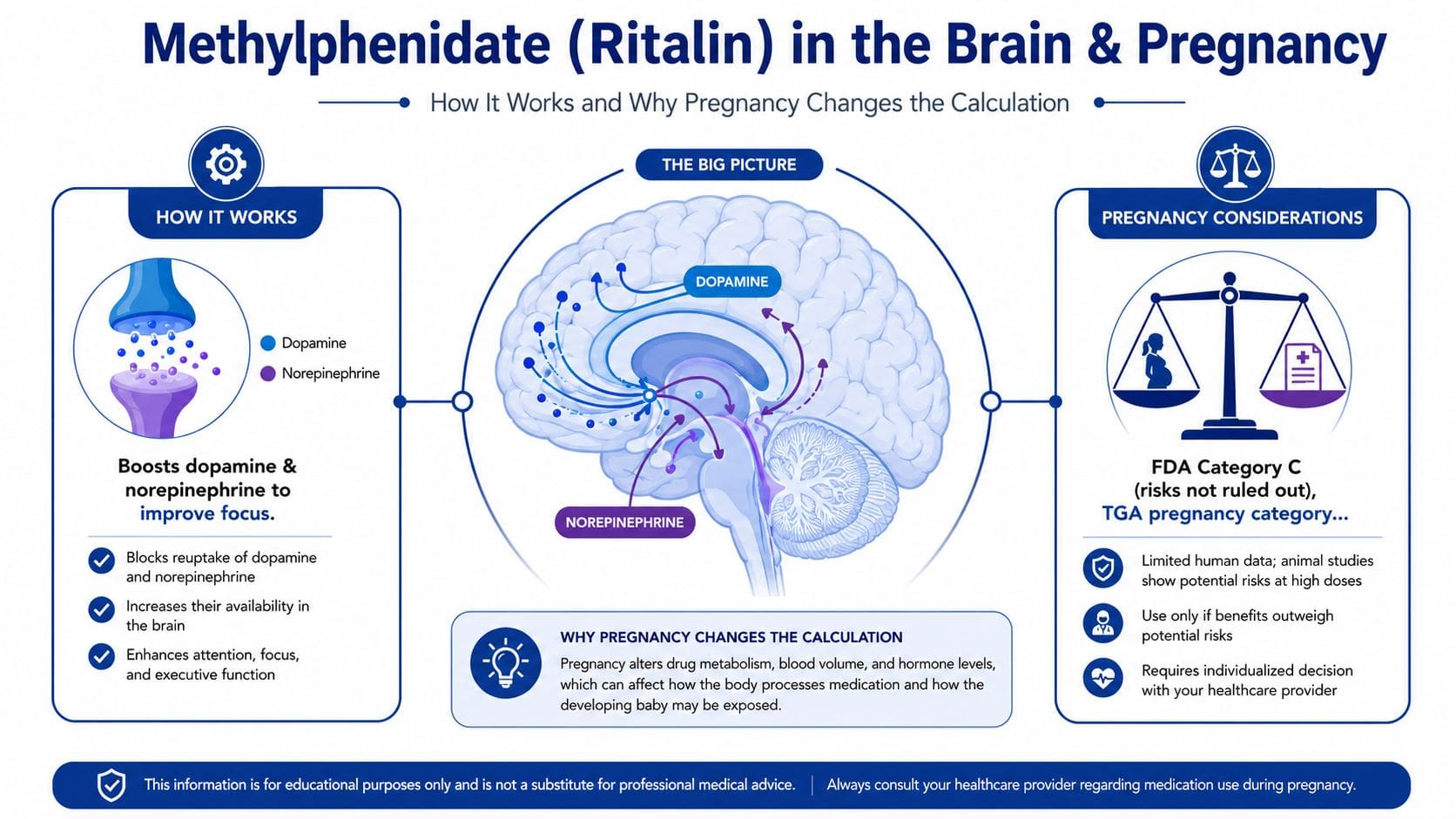
Methylphenidate is a stimulant that increases dopamine and norepinephrine signaling in the brain, which is why it can improve focus, impulse control, and task completion. That mechanism is familiar to prescribers, but pregnancy changes the context because the fetus is developing fast, especially during organ formation in the first trimester.
Why the first trimester matters most
The Australian TGA moved methylphenidate from pregnancy category B3 to D because large observational studies found a small increase in fetal cardiac malformations with first-trimester exposure, and the agency says it should not be prescribed to women of childbearing age unless the benefits outweigh possible risks TGA pregnancy safety update. That regulatory shift is not about a vague theoretical concern. It points directly at early gestation, when the heart is forming and when exposure is most relevant to structural outcomes.
A useful way to think about the placenta is as a filter that changes over time. It does not behave like a perfect wall, and it doesn't create the same exposure pattern at every stage of pregnancy. That's one reason dose, timing, and formulation matter. Immediate-release Ritalin and extended-release products such as Ritalin LA or Concerta can create different day-long exposure patterns, which is why formulation review matters during pregnancy, and why the separate Concerta article on the site is useful when the extended-release question comes up.
What changes in the body during pregnancy
Pregnancy can alter volume of distribution and renal clearance, so the same dose may feel different across trimesters. Some patients feel under-treated, others feel overstimulated, and many notice the effect changes as nausea, sleep, appetite, and body size shift. That's why a stable pre-pregnancy dose doesn't always stay stable once pregnancy is underway.
Before making any medication adjustment, many patients also look at the rest of their health picture. For some, practical supports like sleep routine, nutrition, and stress reduction matter more during the medication decision window than they would otherwise, and resources such as browse magnesium supplement forms for pregnancy can be part of that broader conversation when a clinician is helping a patient think through tolerability and pregnancy comfort.
What the Birth Defect Evidence Shows
The birth-defect literature has shifted from broad concern to a narrower question about the heart. A major 2017 observational analysis that included about 1.8 million publicly insured U.S. pregnancies and 2.5 million Nordic pregnancies found that first-trimester exposure to methylphenidate was associated with a 28% higher prevalence of cardiac malformations, which the authors translated into about 3 additional infants per 1,000 treated women, rising from roughly 10 per 1,000 births to 13 per 1,000 WBUR summary of the study. That absolute-risk framing matters more than the relative number by itself.
Relative risk and absolute risk are not the same thing
A 28% increase sounds alarming until it's translated into the rate in practice. The key clinical point is that the observed signal was small in absolute terms and was specific to cardiac malformations, not a broad wave of structural birth defects. Counseling should avoid treating one heart-defect signal as if it applies to every congenital anomaly.
The 2018 meta-analysis of nearly 3,000 methylphenidate-exposed pregnancies and almost 3 million controls found an odds ratio of 1.26 for major malformations and 1.59 for cardiac malformations PubMed abstract. That same evidence base concluded the small increase in major malformations was driven mostly by cardiac malformations, which fits the narrower heart-specific signal rather than a broad teratogenic pattern.
Why the 2024 synthesis changed the conversation
A 2024 systematic review and meta-analysis of 10 studies and 16.5 million pregnant women found no significant increase in congenital anomalies or miscarriages with methylphenidate compared with unexposed pregnancies, with pooled odds ratios of 1.14 for congenital anomalies and 1.15 for miscarriages JAMA Network Open article. That does not erase the older cardiac signal, but it does put it in context. The overall evidence no longer supports a broad “major malformations” warning, it supports a more focused discussion about possible cardiac risk during early pregnancy.
A large multinational cohort study also found that first-trimester methylphenidate exposure was not associated with increased overall congenital malformations, but did show a small increased risk of cardiac malformations with a pooled relative risk of 1.28 (95% CI, 1.00-1.64) PMC cohort study. That pattern is consistent across the most relevant datasets, and it is why many clinicians now separate overall birth-defect risk from heart-specific risk when counseling pregnant adults.
For readers who want a broader clinical discussion of stimulant exposure in pregnancy, this overview of stimulants and pregnancy is a useful companion to the birth-defect data.
Fetal Growth, Preterm Delivery, Miscarriage, and Newborn Adaptation
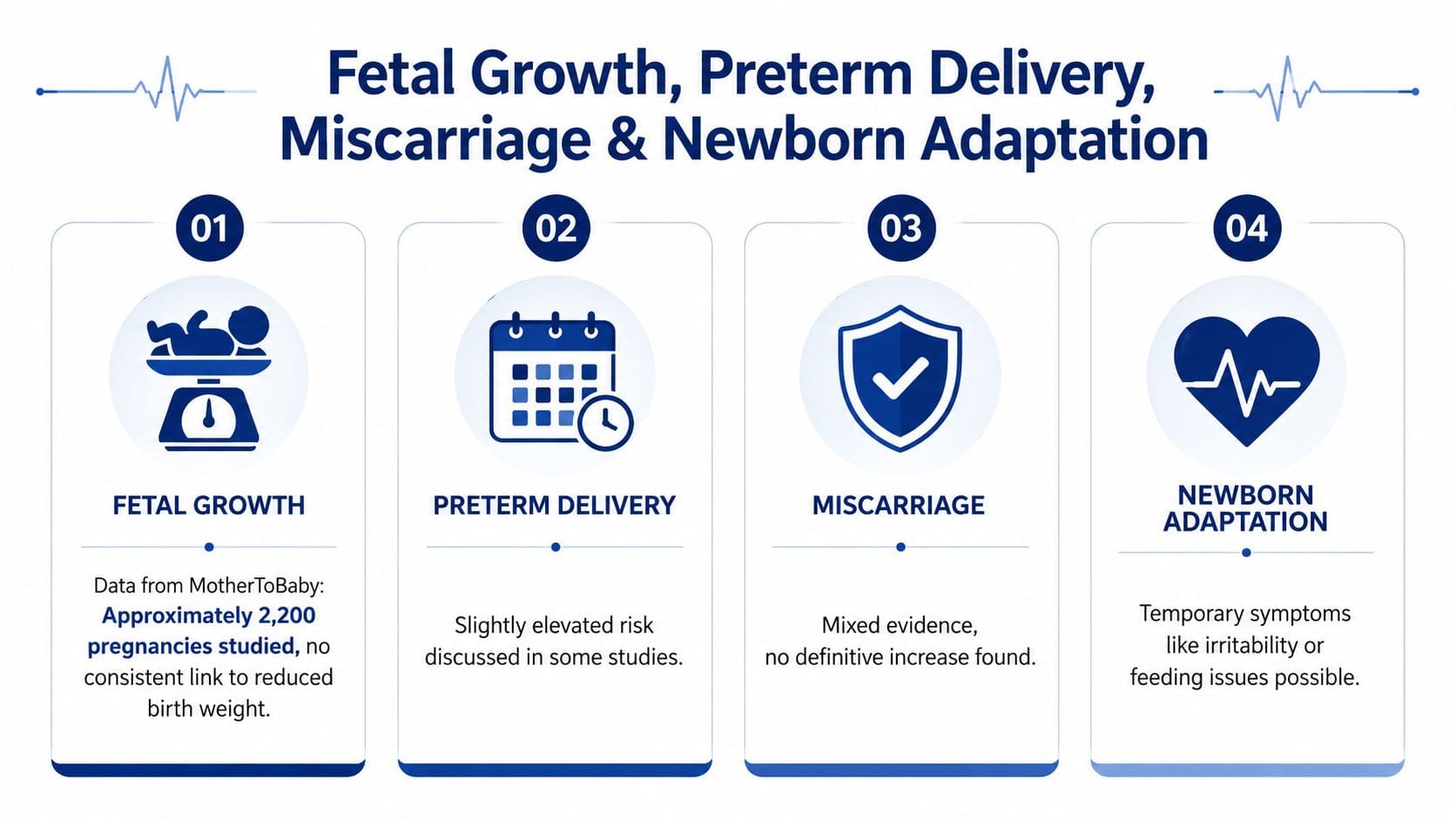
After the first wave of birth-defect anxiety settles, the questions usually get more practical. Pregnant patients ask whether Ritalin during pregnancy affects fetal growth, whether it changes the chance of early delivery, and what newborn care should look like if methylphenidate is continued late in pregnancy.
Growth and preterm delivery
MotherToBaby reviewed data from about 2,200 pregnancies and reported that methylphenidate is not expected to raise the overall risk of birth defects above background. Its summary also says the limited research does not point to higher rates of preterm delivery or low birth weight when the medication is taken as prescribed during pregnancy MotherToBaby methylphenidate fact sheet. That is useful counseling material because it addresses the outcomes patients worry about most once the anatomy-scan conversation is behind them.
The evidence base is still limited, so I would not describe growth risk as settled. I would describe it as not showing a clear signal so far.
Miscarriage and newborn adaptation
UKTIS is more cautious about miscarriage. Its monograph reports that early-pregnancy exposure has been associated with up to a two-fold increased risk of miscarriage, while also stating that therapeutic methylphenidate use does not suggest a significant increase in overall congenital malformations UKTIS methylphenidate monograph. That distinction matters in clinic, because a pregnancy can have a reassuring anatomy story and still leave an open question about early loss risk.
Newborn adaptation is the other issue that deserves a direct conversation. UKTIS notes that neonatal withdrawal symptoms may be expected after prenatal use UKTIS methylphenidate monograph. In practical terms, if exposure continues close to delivery, the newborn team may watch for irritability, feeding difficulty, sleep disruption, or jitteriness after birth.
For patients comparing stimulant choices during pregnancy, the same counseling logic applies to Vyvanse and pregnancy safety as well, because the decision usually comes down to symptom control, fetal uncertainty, and how close to delivery the medication is being used.
Most methylphenidate-exposed pregnancies still end in healthy term births, and the concerns raised in the literature are specific and small, not catastrophic and broad.
That framing helps patients read the evidence correctly. The goal is not to dismiss risk or to create alarm. It is to separate the more established concerns from the smaller, less certain ones, then decide with the prescriber whether the benefit of staying on treatment outweighs the remaining uncertainties.
The Other Side of the Equation, Untreated ADHD During Pregnancy
A pregnancy medication discussion that counts drug exposure but ignores untreated ADHD leaves out half the decision. Pregnant adults with uncontrolled ADHD can run into driving safety problems, work errors, missed appointments, sleep disruption, anxiety, depression, and self-medication patterns, and those effects matter for both parent and fetus. The central question is whether the loss of function is tolerable without treatment, not whether the symptoms are “serious enough” to count.

Why function belongs in the risk ledger
Pregnancy care should weigh the benefits of treating ADHD against the risks of leaving it untreated. The same medication question can look very different for a pregnant nurse, driver, accountant, teacher, or parent managing several children, because the cost of inattention shows up in different parts of daily life. In practice, I also ask about basic supports outside psychiatry, including sleep, meals, and a plan for nutrition support for pregnant women with ADHD, because those details can change how much medication a person needs.
Recent evidence also points away from a hidden long-term neurologic penalty for the child. A 2025 population-based cohort and meta-analysis found no increased risk of offspring neurodevelopmental disorders with in utero exposure to methylphenidate, amphetamines, or atomoxetine Nature article. That does not settle every question about dosing, lactation, or maternal functioning, but it does reduce the idea that pregnancy exposure automatically creates a lasting developmental problem.
What stopping can look like in real life
Stopping Ritalin while pregnant can be reasonable for some patients, especially when symptoms are mild or nonpharmacologic supports are enough. For others, abrupt discontinuation brings scattered attention, missed prenatal tasks, worsening anxiety, and a symptom rebound after delivery. That rebound risk is one reason current reviews still treat the decision as individualized rather than automatic.
There is no single correct answer here. Continuing, tapering, or pausing the medication can all be defensible choices, but only after both sides of the equation are visible. The goal is not to push medication, it is to keep a one-sided decision from overweighting fetal fear and underweighting maternal safety and daily function.
Shared Decision Making with Your Prescriber
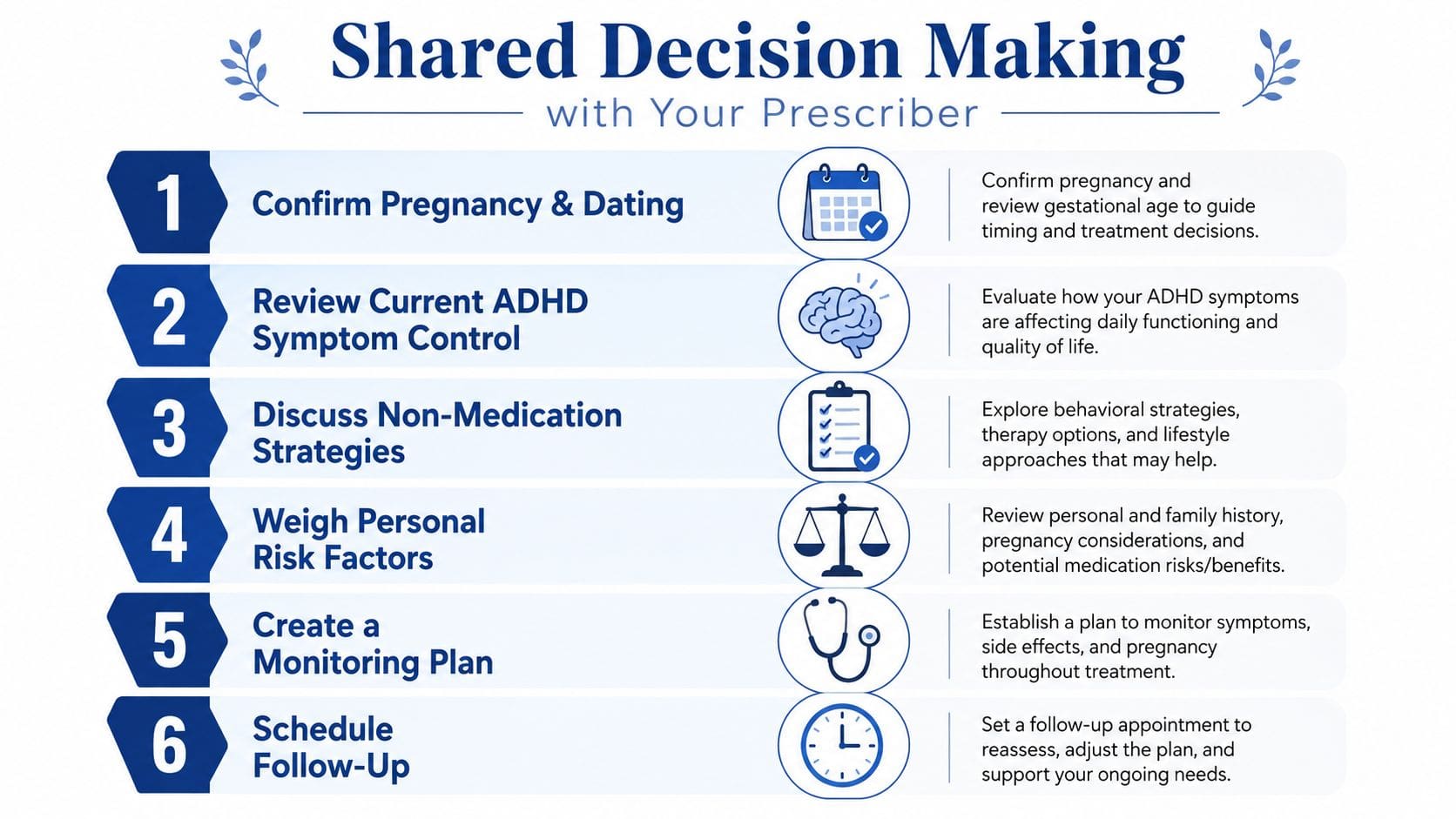
A useful pregnancy visit is concrete. It starts with the pregnancy date, the current formulation, and the symptom pattern that was present before conception, because those details shape the rest of the discussion more than the brand name alone. For patients who want a structured review, a service like Medication Management can help organize the decision, and an ADHD Evaluation can be useful if the diagnosis or current severity needs to be rechecked before changing anything.
Questions that make the visit more useful
A patient can ask, “What does my absolute cardiac risk look like with my timing and dose?” That is a better question than asking for a blanket yes or no, because the relevant data point is the small heart-defect signal seen with early exposure, not a generalized warning about every pregnancy outcome.
Other useful questions include, “Is this the lowest effective dose?” and “If I stop, what signs mean the ADHD is getting in the way of prenatal care, driving, or work?” If first-trimester exposure already happened, the next practical question is whether fetal cardiac evaluation should be part of the obstetric plan.
A simple decision framework
- Confirm dating and exposure window. Early pregnancy exposure carries a different meaning than exposure after organ formation.
- Review formulation and dose. Immediate-release and extended-release regimens don't always behave the same across the day.
- Check current function. Look at work safety, driving, sleep, and ability to keep appointments.
- Consider non-medication supports. Structure, reminders, sleep protection, and partner support may reduce the dose needed.
- Plan monitoring. Ask whether a fetal cardiac scan is appropriate after first-trimester exposure.
- Schedule follow-up. ADHD in pregnancy is rarely a one-visit decision.
For readers who prefer a telehealth walk-through, the site's education video can help frame the conversation, and the broader Medication Management online pathway is designed for people who want a medication review rather than a single brief opinion.
Breastfeeding on Methylphenidate
Breastfeeding creates a second decision point after delivery. The question changes from fetal exposure during pregnancy to milk transfer and infant monitoring after birth, and those are different clinical questions. That distinction matters because the lactation evidence has to stand on its own.
What is known about milk transfer
Available lactation guidance suggests that methylphenidate passes into breast milk in small amounts, and infant exposure is generally low when the medication is taken as prescribed. Reports of exposed infants have not shown clear side effects, which is reassuring for parents who want to protect feeding while also keeping their ADHD controlled.
If you want a concise overview that sits alongside this discussion, the Concerta and pregnancy page covers how methylphenidate is handled across pregnancy and postpartum planning.
The practical issue is observation. Pediatricians usually watch for changes in sleep, feeding, irritability, and overall settling, especially during the first days or weeks after birth. If a baby is unusually fussy, is not feeding well, or is sleeping too little or too much, that calls for a prompt pediatric check.
Why postpartum planning helps
The postpartum period often makes ADHD symptoms feel sharper, not softer. Sleep deprivation and routine changes can worsen attention and impulse control, so the breastfeeding plan should be coordinated with both obstetric and pediatric follow-up. That matters most for parents who were already running close to empty before delivery.
Breastfeeding and pregnancy are related decisions, but they are not the same decision. The safest plan fits the parent's symptoms, the baby's feeding pattern, and the pediatric follow-up plan.
The broader point is straightforward. The evidence on lactation is thinner than the evidence on first-trimester malformations, but what is available is reassuring enough that many patients can keep breastfeeding with individualized monitoring. That kind of postpartum review fits a structured Medication Management follow-up better than a rushed discharge conversation.
Putting It Together and Taking the Next Step
The current evidence points to a small, specific cardiac signal with first-trimester methylphenidate exposure, not a broad, statistically clear malformation problem. At the same time, the untreated-ADHD side of pregnancy is real, and it can affect work safety, driving, prenatal care, mood, and postpartum functioning. Those two facts belong in the same conversation.
For adults in Philadelphia, Pittsburgh, Harrisburg, Erie, Scranton, Allentown, Lancaster, Reading, and across Pennsylvania, virtual ADHD evaluation and medication review can be done through secure telehealth. Integrative Psychiatry of America offers that kind of statewide access, along with insurance verification and cash and membership options, so the decision doesn't have to wait for an in-person opening.
Practical supports can help while the medication question is being worked through. The Daily Agenda Planner and 5-4-3-2-1 Grounding Tool are useful when pregnancy, work, and ADHD are all pulling at attention at once. If the diagnosis, dose, or timing needs a structured review, that's a good time to book a visit and make the plan concrete.
If you're weighing Ritalin and Pregnancy and want a careful, evidence-based plan, Integrative Psychiatry of America can help you review ADHD symptoms, medication options, and postpartum follow-up through virtual care in Pennsylvania. You can also verify insurance and schedule an appointment to talk through what makes sense for your pregnancy, your functioning, and your next step.