
A positive pregnancy test can turn a steady ADHD routine into a very different conversation overnight. For someone taking Qelbree and finally feeling functional, the first question is rarely about pharmacology. It is usually more immediate. Should I stop today? How will I manage work or driving? Is the baby already at risk?
The hard part is that Qelbree and pregnancy sits in a gray zone. The FDA label gives a clear warning and a clear action step, but human data remain limited. This is not a simple "safe" or "unsafe" answer. It is a shared decision based on ADHD severity, prior medication response, pregnancy timing, and the real cost of untreated symptoms.
Some patients also start asking about the rest of the picture at the same time. They think about nutrition and supplements because they want to do everything right at once. If that is where the mind is going, a general pregnancy resource such as pregnancy Omega 3 supplement UK may be part of the broader planning conversation, but it does not replace a medication review.
For women balancing ADHD treatment and reproductive planning, ADHD in women and integrative treatment often offers a better frame than a one-size-fits-all warning.
Table of Contents
- The Moment Pregnancy Changes the ADHD Conversation
- What the FDA Label Actually Says About Qelbree in Pregnancy
- The Evidence So Far and What It Cannot Tell Us
- Why a Pregnancy Exposure Registry Exists and How to Join
- Breastfeeding While Taking Qelbree
- Shared Decision Making With Your Prescriber
- Key Takeaways and Next Steps
The Moment Pregnancy Changes the ADHD Conversation
A patient may feel fine on Qelbree, then open a pregnancy test and realize the medication question has changed completely. The old question was, "Does this help my ADHD?" The new one is, "Does staying on it still make sense now that pregnancy is part of the picture?"
That shift feels emotionally rough because online advice often splits into extremes. One source treats every psychiatric medication as dangerous. Another makes pregnancy sound like a reason to continue anything that helps. Neither approach helps much in clinic. Qelbree while pregnant needs a more careful lens because the FDA label does not give a blanket yes or no.
The practical issue is that ADHD does not disappear in pregnancy. People still need to manage appointments, work, relationships, driving, meals, and sleep. If Qelbree has made daily functioning possible, stopping it without a plan can create a different kind of risk, even if the pregnancy exposure concern is real.
Practical rule: when pregnancy is recognized, make the medication decision quickly, but not casually.
That is why this conversation belongs in a prescriber's office, not in a forum comment section. A clinician must weigh symptom severity, prior medication history, and whether non-drug supports can carry more of the load for now. Some patients do best with temporary discontinuation. For others, the balance may favor continued treatment after careful review.
The label-based warning matters because viloxazine is not one of the better-studied pregnancy medications. The reassuring part is that the uncertainty is stated openly. The frustrating part is that the evidence remains too thin for anyone to promise certainty.
What the FDA Label Actually Says About Qelbree in Pregnancy
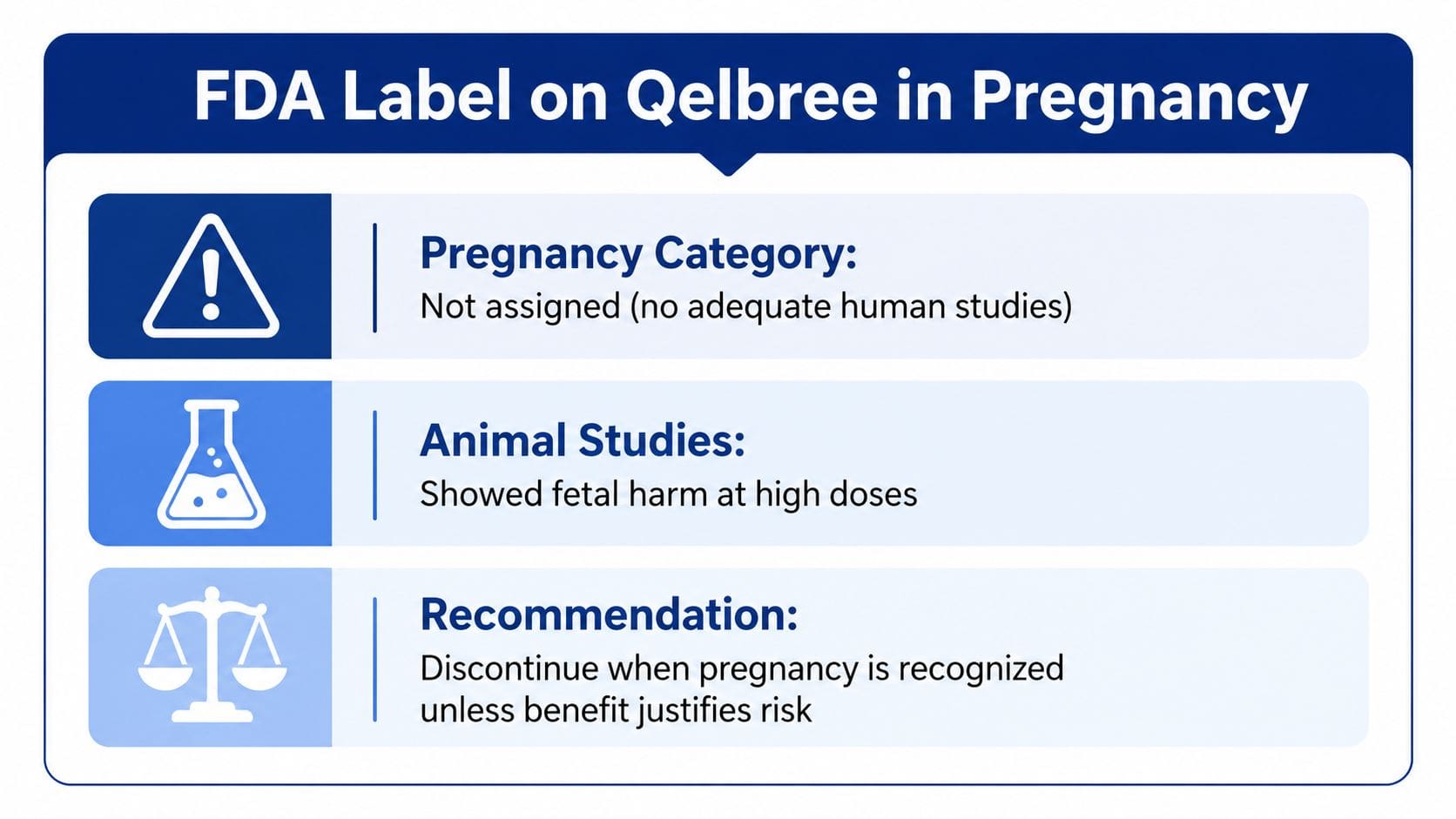
The FDA labeling for Qelbree (viloxazine) is more direct than many patients expect. It says the drug should be discontinued when pregnancy is recognized, unless the benefits of therapy outweigh the potential risk to the mother. It also says the available human data are insufficient to determine risk for major birth defects, miscarriage, or adverse maternal outcomes. The label does not pretend the evidence is stronger than it is.
How to read the label without overreading it
This wording is not a total ban. It is a decision rule. In plain terms, the label tells clinicians to reassess promptly. It also tells them to stop the medication unless they find a clear reason to continue.
That distinction matters because patients often hear "pregnancy warning" and assume the medication is automatically forbidden. The actual message is more nuanced. The FDA is saying the human pregnancy data are too limited to inspire confidence. Because of that, the default position is discontinuation once pregnancy is known, unless there is a strong reason not to.
The label also points to a pregnancy exposure registry, which strongly suggests that the evidence base is still being built. A registry exists because post-marketing human pregnancy data are still needed, not because the question has already been settled. That is why Qelbree pregnancy counseling should sound measured, not absolute.
If the issue comes up during an ADHD medication review, a focused visit like medication guidance for pregnant women can help organize the decision around symptoms, safety, and alternatives.
The clearest takeaway is simple. The FDA label does not say Qelbree is proven harmful in every pregnancy. It says the evidence is insufficient, animal data raise concern, and treatment should usually stop when pregnancy is recognized unless the clinical benefit is strong enough to justify continuing.
The Evidence So Far and What It Cannot Tell Us
The best human data available for viloxazine remain small, so every number needs careful handling. The FDA review cites a published report with 23 viloxazine-exposed pregnancies, including 10 normal infants, 4 elective abortions, and 2 spontaneous abortions, with no congenital malformations reported in that series. The same review also says the sample is too limited to establish causality or estimate risk. That is the key reason this does not become a reassuring green light. FDA NDA review on viloxazine pregnancy data
Why “no malformations reported” is not the same as “safe”
A tiny case series can help, but it cannot answer the big questions patients ask. It cannot quantify the risk of major congenital malformations. It cannot rule out miscarriage risk. It cannot prove the medication is safe across different trimesters or doses. It can only report what happened in that small group.
The animal data help explain why the warning remains in place. FDA-reviewed labeling notes maternal toxicity and deaths in pregnant rats and mice at exposures of about 2x and 1x the maximum recommended human dose (mg/m²). Offspring toxicities appeared only at those maternally toxic doses. That tells clinicians the concern is not theoretical, even though animal findings do not translate perfectly to humans. Drugs.com pregnancy summary for viloxazine
The most honest interpretation is that the human signal is reassuring but incomplete. No strong human evidence here demands panic. But there is also nowhere near enough evidence to call the drug established for pregnancy use. This kind of uncertainty supports shared decision making, not blanket reassurance.
For patients comparing viloxazine with other ADHD medications, pregnancy considerations for Strattera can help show how limited reproductive data shape similar discussions across non-stimulant options.
Why a Pregnancy Exposure Registry Exists and How to Join
A pregnancy exposure registry exists because the information gap is real. For psychiatric medications, especially newer ADHD agents, people often become pregnant before the evidence base is complete. The registry collects outcome data from those exposures so future patients and clinicians have something better than guesswork.
The official registry for psychiatric medications is the National Pregnancy Registry for Psychiatric Medications. The Qelbree label tells health care providers to advise pregnant patients about it. The manufacturer directs enrollment through 1-866-961-2388 or the registry website. National Pregnancy Registry for Psychiatric Medications
What registry participation actually means
Registry participation is not the same as joining a treatment trial. It offers a structured way to report exposure details and pregnancy outcomes so researchers can build a safer evidence base over time. That includes information about whether the medication continued, when exposure occurred, and what happened to the pregnancy and infant.
A registry does not decide the medication question for the patient. It helps answer the next patient's question more reliably.
That is why registration can be meaningful even when the clinical decision is still unsettled. It gives the patient something concrete to do while the prescriber weighs risks and benefits. It also reflects a bigger truth about viloxazine pregnancy data. Researchers are still assembling the evidence in real time.
If ADHD treatment questions are part of a broader medication discussion, the same kind of careful follow-up is often built into online stimulant and non-stimulant treatment planning. The point is not that every medication has the same risk profile. The point is that pregnancy decisions work best when a structured system tracks outcomes and revisits the plan.
Breastfeeding While Taking Qelbree
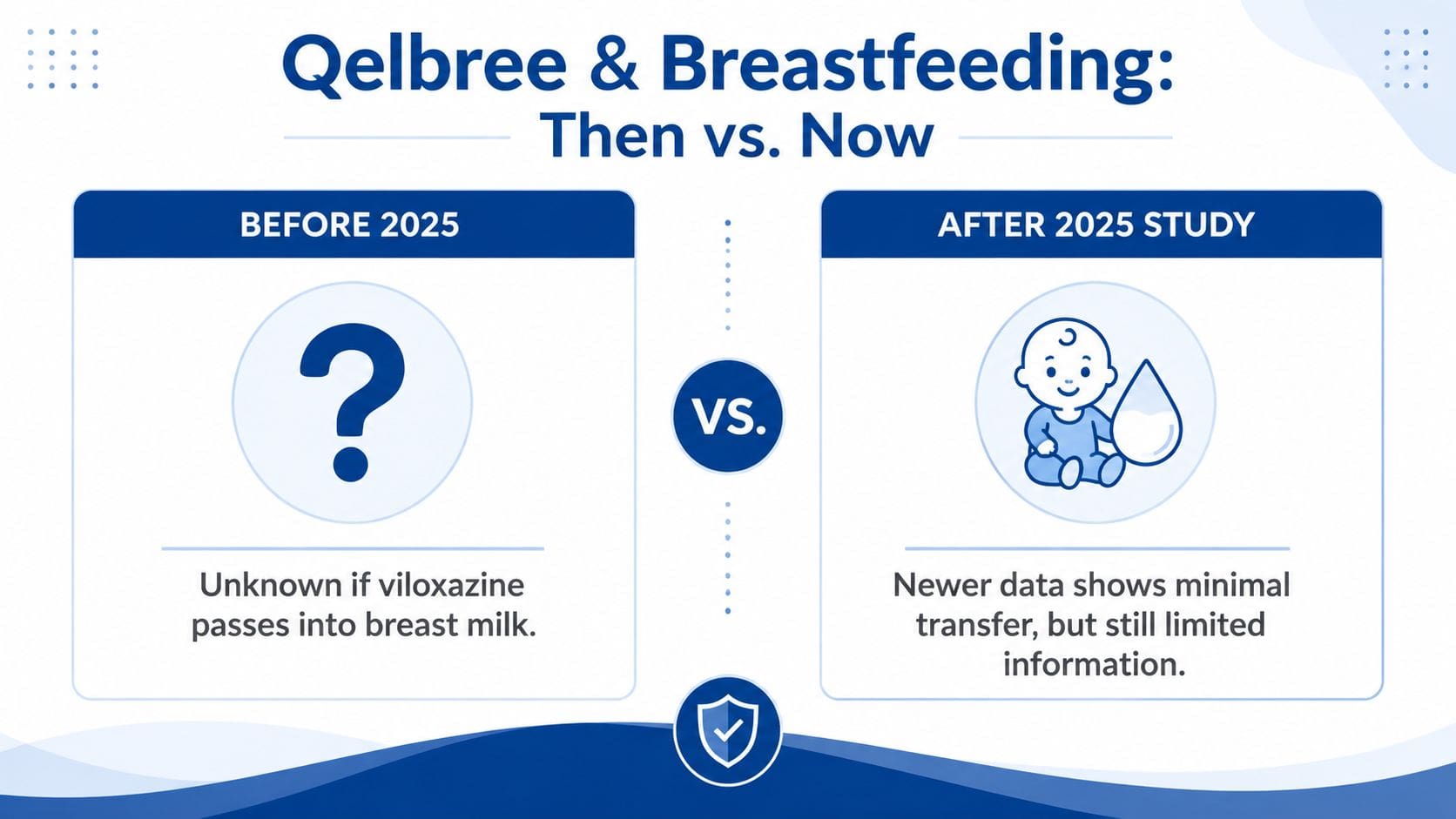
Breastfeeding has been one of the least developed parts of the Qelbree conversation in public-facing materials. Older consumer resources often stopped at "it's not known" or "talk to your clinician." That left nursing parents with very little practical guidance. The newer lactation data make that discussion more useful.
The most concrete addition is a 2025 lactation study of 15 healthy women showing low transfer of viloxazine into breast milk. That does not make the medication automatically ideal for breastfeeding, but it does move the conversation away from pure uncertainty. It suggests infant exposure may be lower than many patients feared, while still leaving enough unanswered questions to avoid overconfidence. Qelbree lactation FAQ
How to think about low transfer in real life
Low transfer into milk is encouraging because it answers the first question many nursing parents ask. Is the drug likely to show up in breast milk at all? The 2025 study offers a more reassuring answer than the older "unknown" framing. Even so, the study is small. It does not settle infant safety across all ages, feeding patterns, or maternal dosing situations.
That is why breastfeeding decisions should still include a practical monitoring plan. Prescribers usually want to know whether the infant is feeding normally, sleeping as expected, gaining well, and showing unusual irritability or sedation. These are the real-world signals that matter when the evidence base is still thin.
For some parents, breastfeeding goals and psychiatric stability are both high priorities. In that setting, a "stop the medication immediately" response may not fit the whole picture. That is where individualized review helps, especially when ADHD symptoms are severe enough to interfere with sleep, routines, or infant care. If supportive products are being considered alongside medication planning, a general resource such as evidence-based skincare for nursing can help with separate postpartum choices, but it does not replace medication counseling.
The best current interpretation is cautious optimism. Breastfeeding with Qelbree no longer sits in a complete data vacuum, but it still belongs in a prescriber-patient discussion rather than a generic yes-or-no rule.
Shared Decision Making With Your Prescriber
The right Qelbree decision during pregnancy usually comes down to four questions. None of them is abstract, and none should be answered in isolation.
The questions that actually change the plan
- How severe is the ADHD? If symptoms affect driving, work performance, prenatal appointments, or basic home functioning, untreated ADHD can carry real costs.
- What has already worked or failed? Prior stimulant response, non-stimulant tolerability, and past side effects all matter.
- Where in pregnancy did the question come up? A new pregnancy test, first-trimester exposure, and late-pregnancy continuation are not the same clinical scenarios.
- What support is available if the medication changes? Therapy, coaching, reminders, family support, and structured routines can all reduce the load.
Those questions help turn a frightening moment into a plan. They also keep the discussion grounded in function, not fear. A patient who can barely stay organized without medication may make a different decision from a patient with milder symptoms and strong non-drug supports.
The clinician involved is often a board-certified psychiatric nurse practitioner or another prescriber who manages ADHD medication over time. In Pennsylvania, many adults use telehealth for this kind of ongoing review, especially when specialty access is limited or travel becomes hard during pregnancy. If follow-up is already happening virtually, online medication management can make it easier to adjust the plan without delaying care.
Bring specifics to the appointment: dose, timing of exposure, symptom changes since stopping or continuing, and any prior medication history.
Some patients also find it helpful to talk through the anxiety that comes with uncertainty because pregnancy decisions often stir up more than one issue at once. A general resource like anxiety counselling Vernon BC may help readers looking for coping support, but the medication question still belongs with the prescribing clinician who knows the full psychiatric history.
The strongest decisions here do not come from rule-following alone. They come from balancing the label, the limited evidence, and the significant cost of untreated ADHD in the patient's daily life.
Key Takeaways and Next Steps
Qelbree and pregnancy is a shared decision, not a yes-or-no search result. The FDA label says to discontinue Qelbree when pregnancy is recognized unless the benefit outweighs the risk. It also says the available human pregnancy data are insufficient to determine the risk of birth defects, miscarriage, or maternal outcomes. That alone should tell patients this medication deserves prompt reassessment, not casual continuation.
The human evidence base is still small. The FDA review's 23-pregnancy report included 10 normal infants, 4 elective abortions, and 2 spontaneous abortions, with no congenital malformations reported. That information is useful, but not definitive. It is enough to avoid exaggeration, but not enough to remove uncertainty.
The registry exists because that uncertainty is still active. Pregnant patients exposed to viloxazine can contribute to better future guidance by enrolling through the National Pregnancy Registry for Psychiatric Medications at 1-866-961-2388. That step helps build the evidence current patients wish they already had.
Breastfeeding is a different conversation from pregnancy, and the new lactation data are more reassuring than older public-facing materials. Still, a small study with 15 healthy women does not eliminate the need for individualized planning, especially when infant feeding, sleep, and maternal symptom control are all in play.
For adults in Pennsylvania who need a careful review of Qelbree while pregnant, pregnancy planning, or another ADHD medication option, the right next move is a clinician visit that focuses on function, timing, and alternatives. A focused psychiatric evaluation can help decide whether to continue, taper, switch, or support the plan with non-medication strategies.
If you're weighing ADHD medication during pregnancy or planning ahead for a possible pregnancy, do not wait and guess your way through it. Integrative Psychiatry of America offers virtual psychiatric evaluations, medication management, and practical follow-up across Pennsylvania. Schedule a focused review to decide whether Qelbree still fits your situation, whether another option makes more sense, and what support can help you stay functional and safe during pregnancy.