
A work presentation is open on the laptop in Philadelphia. Notes are ready, slides are polished, and the opening line has been practiced several times. Then the body starts reacting as if something dangerous is about to happen. The heart races, hands shake, the mouth goes dry, and the mind starts throwing out thoughts like “What if this goes badly?” or “What if the mind goes blank?”
The same pattern shows up in Pittsburgh before an exam, in Lancaster before a recital, and in conference rooms, courtrooms, classrooms, audition spaces, and job interviews across Pennsylvania. Performance anxiety can affect capable, prepared people. It often shows up most intensely in people who are committed to doing well.
That's why seeking performance anxiety treatment isn't a sign that something is wrong with character or motivation. It's often a practical next step for someone who wants the body and mind to stop working against them in important moments. A private self-check can be a useful place to start. The Anxiety Symptom Checker can help readers think through whether symptoms are occasional nerves, a more disruptive anxiety pattern, or a reason to seek formal care.
Table of Contents
- The Search for Relief from Performance Anxiety
- Understanding Performance Anxiety Symptoms and Causes
- Evidence-Based Psychotherapy for Lasting Change
- Medication Management for Performance Anxiety
- An Integrative Approach to Building Resilience
- Practical Self-Help Strategies to Use Now
- Finding Care in Pennsylvania and FAQs
The Search for Relief from Performance Anxiety
A student in Pittsburgh can know the material and still freeze during an exam. A singer in Allentown can rehearse for weeks and still feel shaky right before stepping on stage. A professional in Philadelphia can be respected at work and still feel overwhelmed before presenting to colleagues.
That split between real ability and intense fear confuses many people. They assume that if they were more confident, more disciplined, or more prepared, the anxiety would go away. Often, that isn't how this works. Performance anxiety is not merely a lack of preparation. It's a stress response that can hijack attention, memory, breathing, and muscle control at the exact moment someone needs access to their skills.
When high achievers struggle in private
Many adults hide this well. They overprepare, avoid certain opportunities, or push through while feeling miserable. On the outside, they may look polished. Internally, they may be rehearsing escape plans, checking for signs of shaking, or worrying that one mistake will expose them.
Practical rule: If fear before a performance is changing career choices, school participation, auditions, interviews, or relationships, it's worth treating.
Helpful skill-building can begin outside formal treatment too. Performers who want practical rehearsal ideas may benefit from Encore Academy's strategies to build confidence, especially around preparation and mental readiness. Those strategies can support care, but they usually aren't enough when anxiety keeps returning despite strong practice habits.
Why treatment is a strategic move
Performance anxiety treatment can help a person stop organizing life around fear. Instead of declining presentations, avoiding classes, or dreading every high-stakes event, treatment focuses on reducing the physical surge, changing unhelpful thought patterns, and rebuilding confidence through repeatable tools.
For people across Pennsylvania, confidential telehealth can make that process easier to start. That matters for busy adults in Harrisburg, college students in Scranton, and working professionals in Erie who don't want another drive, waiting room, or scheduling barrier between them and care.
Understanding Performance Anxiety Symptoms and Causes
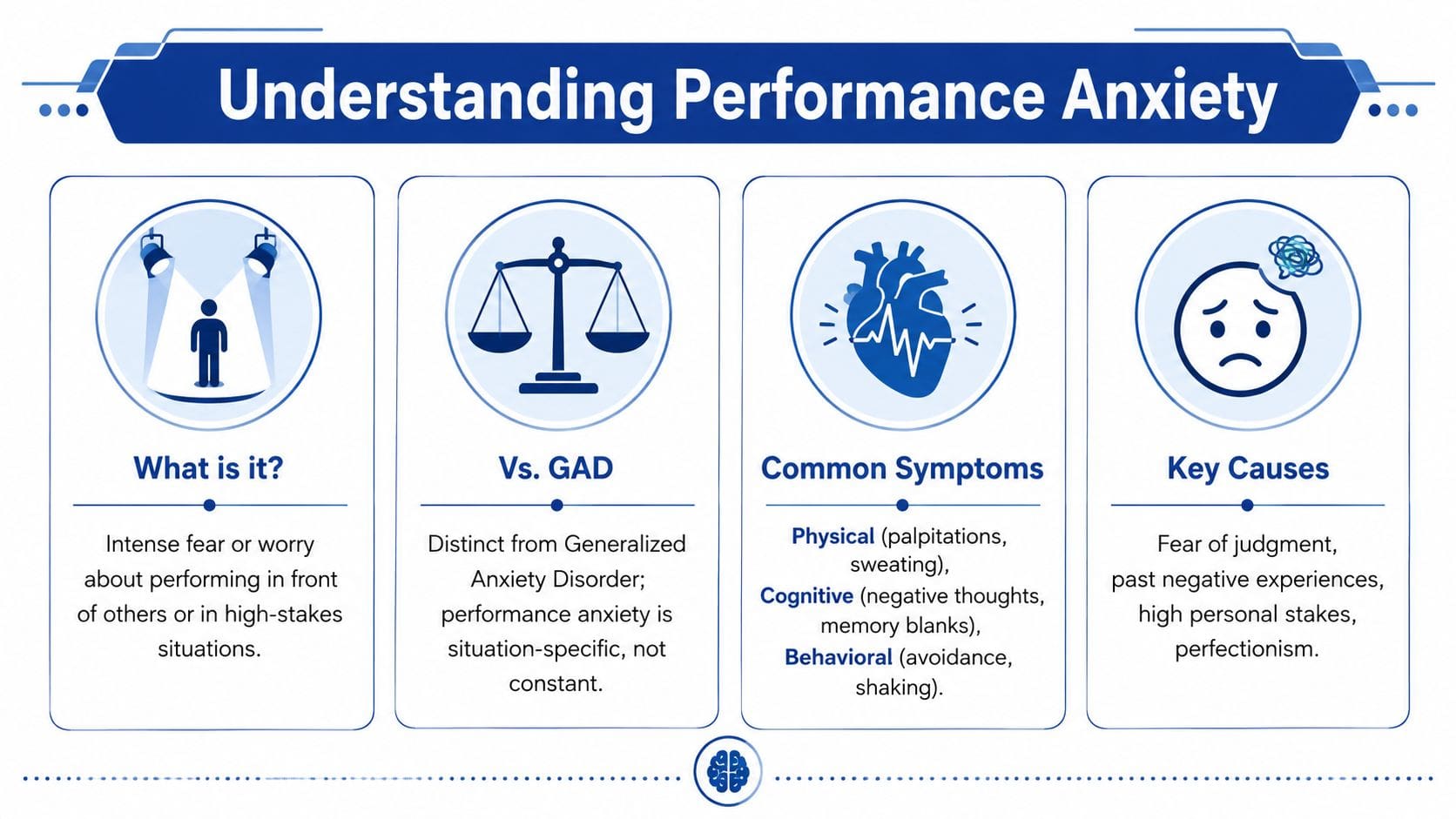
Performance anxiety usually means intense fear, worry, or body-based distress tied to a specific high-stakes situation. It often appears when someone expects to be watched, judged, evaluated, or compared. Public speaking is a common example, but it can also show up with tests, interviews, sports, meetings, musical performances, or sexual situations.
How performance anxiety differs from generalized anxiety
A key distinction is scope. Performance anxiety is usually tied to a trigger. Generalized anxiety tends to spread across many parts of life and may feel present even when nothing specific is happening.
That distinction matters because treatment planning changes depending on whether anxiety appears mainly before performance situations or whether it's part of a broader pattern. Readers trying to sort out emotional overlap may find key distinctions to know helpful, especially when stress, low mood, and anxiety symptoms start blending together.
Symptoms people often notice first
Some people notice body symptoms before they recognize the anxiety itself. Others notice the mental spiral first.
Physical symptoms
- Racing heart: The chest feels tight or fast, sometimes with a sense of pounding.
- Sweating and flushing: This can become its own focus, especially if the person fears others will notice.
- Trembling: Hands, voice, legs, or facial muscles may feel shaky.
- Dry mouth or throat tightness: Speaking or singing may suddenly feel harder.
- Nausea or dizziness: The body may react as if it needs to flee.
Cognitive symptoms
- Negative self-talk: Thoughts become harsh, perfectionistic, or catastrophic.
- Fear of failure: The mind treats a small mistake as if it would be a major humiliation.
- Memory blanks: Well-rehearsed material suddenly feels inaccessible.
- Hyperfocus on being judged: Attention shifts away from the task and toward imagined criticism.
Behavioral symptoms
- Avoidance: Turning down opportunities, dropping classes, or skipping events.
- Over-preparation: Rehearsing far beyond what's useful in an effort to feel safe.
- Using alcohol or other substances to cope: This can create short-term relief and long-term problems.
- Safety behaviors: Holding a script tightly, avoiding eye contact, speaking too quickly, or trying to leave immediately afterward.
A symptom tracker can help identify patterns. A Feeling Journal can make it easier to notice what happens before, during, and after feared situations.
Why it develops
Performance anxiety doesn't come from one single cause. Common contributors include past embarrassing experiences, critical environments, pressure to be perfect, family expectations, trauma, social anxiety traits, and careers or schools where mistakes feel highly visible.
Sometimes the problem isn't lack of confidence. It's a nervous system that has learned to treat evaluation like danger.
Evidence-Based Psychotherapy for Lasting Change
Psychotherapy works best when it targets the exact loop that keeps performance anxiety going. That loop usually includes a trigger, body activation, catastrophic thinking, avoidance, and temporary relief. Temporary relief teaches the brain to stay afraid next time.

How CBT changes the anxiety loop
Cognitive Behavioral Therapy, often called CBT, helps a person identify the thought patterns that intensify fear and then test whether those thoughts are accurate, useful, or distorted. A common example is: “If the voice shakes, everyone will think I'm incompetent.” Another is: “If there's one pause, the whole presentation is ruined.”
In treatment, a clinician helps the patient slow those thoughts down and replace them with something more realistic. Not fake positivity. Realistic thinking. That might sound like, “A shaky start is uncomfortable, but it doesn't mean failure,” or “Audiences tend to notice content more than tiny mistakes.”
Common CBT targets include:
- Catastrophizing: Treating an imperfect performance as a disaster.
- Mind reading: Assuming others are judging harshly without evidence.
- All-or-nothing thinking: Seeing the event as total success or total failure.
- Overidentifying with outcome: Believing one performance defines intelligence, talent, or worth.
For adults seeking structured support, anxiety treatment in Philadelphia can include CBT-informed care delivered through telehealth.
Why exposure work matters
Exposure therapy sounds intimidating, but good exposure work is gradual and collaborative. The point isn't to overwhelm someone. The point is to help the brain learn, through repetition, that anxiety can rise and fall without escape.
A clinician might help someone build a ladder of feared situations. That ladder could start with reading a paragraph aloud on video, then joining a mock interview, then practicing a work presentation live, then delivering the actual performance. Each step is intentional.
Clinical insight: Confidence usually follows practice under tolerable stress, not endless rehearsal in perfect safety.
This short video gives a useful overview of anxiety treatment principles many patients find grounding before starting care.
How telehealth fits real life in Pennsylvania
Telehealth works well for performance anxiety because treatment often involves conversation, cognitive work, skill practice, and planned exercises. A person in Harrisburg can practice presentation thoughts from home. A student in Scranton can meet between classes. A working adult in Reading can attend without adding travel stress to an already packed day.
Integrative Psychiatry of America provides virtual psychiatric evaluations, medication management, and evidence-informed treatment across Pennsylvania through secure telehealth. For many patients, that convenience removes one of the biggest barriers to starting care at all.
Medication Management for Performance Anxiety
Medication isn't the right fit for everyone with performance anxiety, but for some people it can be useful. The key question isn't “What's the strongest medication?” It's “What problem is the medication supposed to solve?”
Beta-blockers for physical symptoms
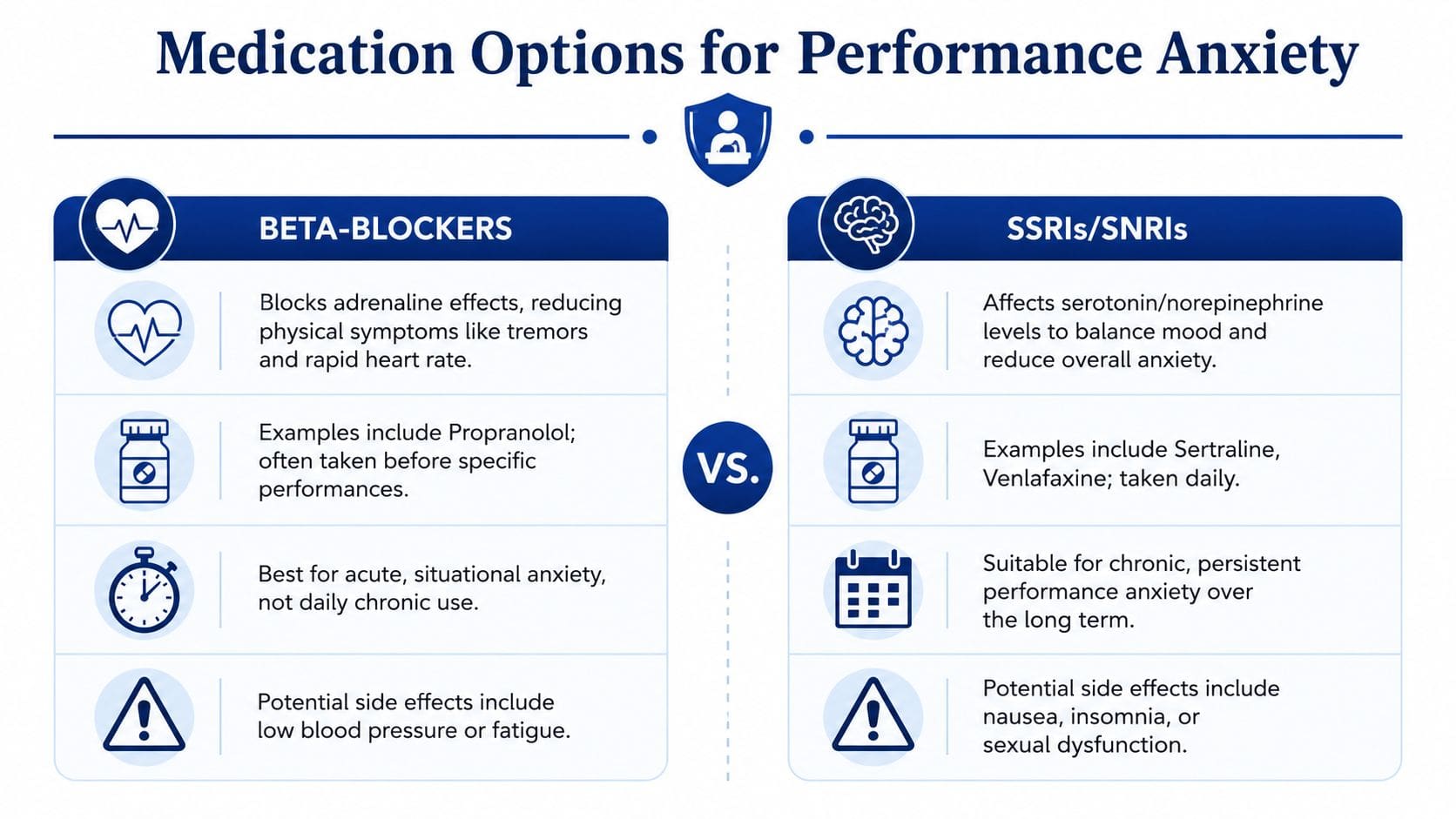
Beta-blockers are often considered when the main problem is the body's adrenaline response. A person may be mentally prepared but still struggle with a pounding heart, shaky hands, or a quivering voice right before speaking or performing.
These medications are commonly used on an as-needed basis for specific situations. They don't teach coping skills, and they don't address every cause of anxiety, but they can reduce the physical intensity that makes performance feel unmanageable.
This option may make sense when:
| Situation | Why it may fit |
|---|---|
| Public speaking | Physical symptoms are the main barrier |
| Auditions or recitals | Tremor or racing heart interferes with execution |
| Work presentations | Anxiety is brief and tied to specific events |
SSRIs and SNRIs for broader anxiety patterns
SSRIs and SNRIs are a different conversation. These medications are more often considered when performance anxiety is part of a larger anxiety picture. That may include ongoing worry, social anxiety, panic symptoms, or anxiety that affects many parts of life instead of isolated events.
They are usually taken daily rather than only before a performance. They also take time to evaluate. A clinician typically watches for benefits, side effects, and whether the medication matches the person's underlying diagnosis.
What safe medication management looks like
Medication decisions should follow a full psychiatric evaluation, not a rushed request for a single drug. A qualified prescriber looks at medical history, current symptoms, past medication experiences, other conditions, substance use, sleep, and the specific performance demands involved.
Questions often include:
- What symptoms show up first: Is the problem mainly tremor and rapid heart rate, or a deeper fear cycle?
- How often does this happen: Rarely, monthly, weekly, or almost daily?
- Is there another anxiety condition underneath it: Social anxiety and generalized anxiety can change the plan.
- Are there medical reasons to avoid certain options: Blood pressure, asthma, other medications, and side effects all matter.
Ongoing online medication management gives patients in Pennsylvania a way to review options, monitor response, and adjust treatment without repeated office travel.
An Integrative Approach to Building Resilience
A Pennsylvania patient may do everything possible to prepare for a presentation, audition, exam, or competition, then still feel their body surge into alarm. In practice, that usually means the treatment plan needs to address more than the event itself. Performance anxiety is shaped by the full load on the nervous system, including sleep, skipped meals, caffeine, work stress, physical tension, and how little recovery time a person has between demands.
Lifestyle factors that affect the nervous system
Exercise often helps because it lowers baseline tension and gives stress hormones a more useful outlet. The goal is not an intense routine that falls apart after a week. A repeatable plan works better, especially for patients balancing long commutes, shift work, caregiving, or school schedules in places like Pittsburgh, Harrisburg, or the Philadelphia suburbs.
Food and hydration matter more than many people expect. A person may assume the problem is purely psychological, but anxiety often becomes harder to control when the body is underfueled, dehydrated, or running on caffeine. I commonly ask patients what they ate before the performance, how much coffee or energy drink they had, and whether they had any real downtime that day. Those details change the picture.
Mindfulness can help, but it should be used realistically. It does not erase fear or make a high-stakes moment feel pleasant. It helps a person notice, name, and steady the reaction without getting pulled fully into it. Some people do better with brief grounding and sensory awareness than with long meditation exercises, which is one reason treatment should fit the person rather than follow a formula.
Why integrative care matters for performance
An integrative plan brings together the parts of care that affect day-to-day functioning. That may include psychotherapy, medication when indicated, sleep support, movement, nutrition review, and body-based regulation skills. Telehealth makes this easier for many Pennsylvania residents who want psychiatric care without adding more travel, missed work, or scheduling strain.
Movement-based practices also deserve a place in the conversation. Some patients regulate better through rhythm, posture, and physical expression than by sitting still and trying to relax on command. Readers interested in body-based approaches may appreciate how dance improves mental well-being, especially if standard relaxation methods have felt forced.
Building resilience also means practicing recovery between high-pressure moments, not only during them. Small skills used consistently often matter more than one perfect routine. Integrative Psychiatry of America offers self-soothing techniques for calming the nervous system that can support this kind of steady practice between appointments.
The goal is a steadier baseline, so presentations, performances, and evaluations feel challenging, not dangerous.
Practical Self-Help Strategies to Use Now
Self-help strategies aren't a substitute for treatment when anxiety is persistent or disabling, but they can reduce intensity and help a person function more effectively before an appointment.
Breathing that settles the body
Fast, shallow breathing tells the body to stay on alert. Diaphragmatic breathing does the opposite.
Try this:
- Place one hand on the chest and one on the abdomen. The lower hand should move more.
- Breathe in through the nose gently. Don't force a huge inhale.
- Exhale slowly and longer than the inhale. A longer exhale often helps the body de-escalate.
- Repeat for several rounds before the event. It works best when practiced before panic peaks.
Grounding when panic starts rising
Grounding is useful when the mind starts spiraling or the room feels unreal. The 5-4-3-2-1 method is simple and portable.
- Five things seen: Name visible objects slowly.
- Four things felt: Notice feet on the floor, clothing on skin, air on hands.
- Three things heard: Pick out nearby sounds without judging them.
- Two things smelled: If nothing is obvious, notice neutral air or a drink nearby.
- One thing tasted: Gum, water, coffee, or just the inside of the mouth.
A guided self-soothing resource can help patients practice this before they need it under pressure.
Mental rehearsal that helps instead of hurts
Visualization can calm or worsen anxiety depending on how it's used. Many anxious people think they're mentally rehearsing, but they are replaying failure scenes. Helpful visualization is specific, grounded, and realistic.
Use this framework:
- See the environment clearly: The room, podium, Zoom screen, stage, or classroom.
- Imagine one manageable stress moment: A pause, a difficult question, a shaky start.
- Picture recovery, not perfection: Taking a breath, checking notes, continuing with composure.
Rehearse coping, not just success. A person who knows how to recover from a wobble usually feels safer than a person trying to guarantee a flawless performance.
Finding Care in Pennsylvania and FAQs
Performance anxiety treatment is accessible across Pennsylvania without requiring in-person travel for every step. For adults in Philadelphia, Pittsburgh, Harrisburg, Erie, Scranton, Allentown, Lancaster, or Reading, telehealth can make evaluation, follow-up, and medication review far more practical.
Accessing support from anywhere in Pennsylvania
The next step is usually a virtual evaluation that looks at triggers, symptom pattern, medical history, other mental health concerns, and what has or hasn't worked already. From there, care may include therapy recommendations, medication management, lifestyle interventions, or a combination.
For many adults, the biggest relief comes from learning that this pattern is treatable and that care can be individualized. Someone with isolated presentation anxiety may need a very different plan than someone whose performance fear sits inside broader social anxiety, depression, ADHD, OCD, or trauma-related symptoms.
Frequently asked questions
Is performance anxiety a real medical diagnosis?
Performance anxiety is very real, but the term itself is often descriptive rather than a standalone diagnosis. In some people, it may reflect social anxiety or another anxiety condition. In others, it may be situational and still deserve treatment because of how much it interferes.
How long does treatment take?
That depends on what's driving the anxiety, how severe it is, and whether avoidance has become entrenched. Some people improve with targeted short-term work. Others need longer treatment if anxiety is part of a broader pattern.
Can someone get a beta-blocker at the first telehealth appointment?
Sometimes a prescriber can discuss that option early, but it depends on the evaluation. Medical history, current medications, health conditions, and symptom pattern all matter. Safe prescribing requires more than matching a symptom to a medication name.
When should someone seek professional help?
Professional care makes sense when anxiety leads to avoidance, repeated distress, lost opportunities, sleep disruption, panic-like episodes, or dependence on alcohol or other substances before performances.
Patients across Pennsylvania can learn more about virtual anxiety care, check insurance options, and request an appointment through Integrative Psychiatry of America. For adults looking for confidential telehealth support with performance anxiety, medication management, or broader anxiety symptoms, the next step can be simple and private.