
A Pennsylvania adult may want therapy for persistent worry, low mood, trauma symptoms, relationship strain, or substance-use concerns, but still need a careful answer about medication. Travel across the state, privacy at home, scheduling, and uncertainty about which type of provider to choose can make that decision harder.
Lori Simons, Ph.D., LPC, Psychologist/Therapist at Integrative Psychiatry of America, offers a psychology and psychotherapy resource within a statewide virtual psychiatric practice. Her role complements psychiatric evaluation and medication-management services without replacing them. That distinction matters for patients deciding whether therapy, psychiatric care, or coordinated treatment fits their needs.
The purpose of this profile is practical rather than promotional. It explains Lori Simons' documented professional role, what online therapy in Pennsylvania can involve, how psychology and psychiatric providers may collaborate, and what prospective patients should ask before scheduling. It doesn't add unverified years of experience, specific therapy techniques, patient outcomes, or personal stories.
Pennsylvania's own behavioral-health telehealth survey supports the continued role of virtual care. Ninety-two percent of respondents said they received services at the same frequency or more often than before COVID-19, and 96% received telehealth from home. The survey also found that 75% wanted to continue telehealth for at least some services, while respondents identified reduced travel-time, transportation, and scheduling barriers as important benefits. (Pennsylvania OMHSAS telehealth survey)
For a patient in Philadelphia, Bucks County, the Lehigh Valley, Pittsburgh, Harrisburg, or a rural Pennsylvania community, secure virtual therapy can provide a more accessible route to professional support. Patients interested in Lori Simons' psychology services can review Psychology Services and then choose an appropriate appointment pathway.
Table of Contents
- Introduction to Lori Simons and Online Therapy at IPA
- Who Is Lori Simons PhD LPC and What Her Role Means for Patients
- How Psychotherapy and Psychiatric Care Work Together
- Who Online Therapy in Pennsylvania May Help Most
- What to Expect From Secure Virtual Therapy Across Pennsylvania
- Collaborative Care Between Psychology and Psychiatry at IPA
- Choosing Online Therapy With Lori Simons and Your Next Step
Introduction to Lori Simons and Online Therapy at IPA
Lori Simons, Ph.D., LPC is identified by Integrative Psychiatry of America as a Psychologist/Therapist. That credential profile places psychotherapy and psychological expertise at the center of her role. Patients searching for Lori Simons PhD, an online psychologist in Pennsylvania, or a telehealth psychologist in Pennsylvania may be looking for more than a short biography. They often need to understand what care could look like and how therapy relates to medication management.
A prospective patient might begin with one concern, such as anxiety that interferes with sleep or work. During a clinical evaluation, other concerns may emerge, including depression, attention difficulties, trauma symptoms, relationship problems, or substance use. A psychologist or therapist can focus on emotional patterns, coping, behavior, functioning, and personal goals, while a psychiatric provider evaluates medical and medication-related questions.
The right pathway isn't determined by a search term or a symptom checklist alone. A screening tool can identify concerns, but it doesn't establish a diagnosis. A clinical evaluation considers symptoms, history, functioning, safety, previous treatment, current medications, and the patient's priorities.
A practical starting point: the question isn't whether therapy or medication is universally better. The useful question is which combination of services matches the patient's needs.
Online therapy can be appropriate when a patient has a private space, workable technology, and concerns that can be safely addressed through virtual sessions. It can also reduce travel demands for people living far from major treatment centers. Pennsylvania's telehealth guidance recognizes behavioral-health services delivered through real-time, two-way interactive audio-video technology, with consent required before care is provided through telehealth. (Pennsylvania behavioral-health telehealth guidance)
This article doesn't claim a specific outcome for Lori Simons' patients. Instead, it offers a clear way to understand her documented psychology role within a practice that also provides virtual psychiatric care. Patients can learn more through About Integrative Psychiatry of America and explore additional clinician-focused mental-health education through browse team blog posts.
Who Is Lori Simons PhD LPC and What Her Role Means for Patients
Lori Simons' listed credentials are Ph.D., LPC, Psychologist/Therapist. In plain language, those credentials indicate a provider whose work centers on psychology and therapy. They don't, by themselves, establish a particular treatment modality, testing battery, patient population, or outcome record. Those details should be confirmed directly with the practice during scheduling.

What a psychology provider contributes
A Ph.D.-level psychologist can bring psychological formulation to a patient's care. Formulation means organizing information about symptoms, emotions, behavior, development, relationships, stressors, and functioning so treatment can address the person rather than only one symptom.
A licensed professional counselor may provide psychotherapy and counseling support within the scope of the applicable license and practice setting. Patients should ask how Lori Simons' services are structured, which concerns she treats virtually, whether psychological assessment is appropriate, and how referrals are handled when a different level of care is needed.
Psychotherapy may help patients work toward individualized goals such as:
- Emotional awareness: Recognizing patterns in thoughts, feelings, and reactions.
- Coping and functioning: Building practical responses to stress and daily demands.
- Relationships: Examining communication, boundaries, conflict, and life transitions.
- Behavioral change: Supporting healthier routines and decisions.
- Co-occurring concerns: Addressing substance-use issues alongside anxiety, mood, trauma, or other mental-health symptoms when clinically appropriate.
Lori Simons' documented expertise includes substance-use and co-occurring disorders. That matters because substance use can affect mood, sleep, attention, safety, relationships, and medication decisions. It also means patients may need coordinated treatment rather than a narrow focus on one diagnosis.
How her role differs from psychiatric care
A board-certified psychiatric mental health nurse practitioner or another psychiatric provider focuses on psychiatric evaluation, diagnosis, and medication management within the provider's scope of practice. A psychologist or therapist focuses primarily on psychotherapy and psychological care. Neither role automatically replaces the other.
Lori Simons' psychology role can complement IPA's psychiatric services by adding access to therapy and psychological perspective within the same practice. Patients can read the provider information on About Integrative Psychiatry of America and review Psychology Services to determine which questions to bring to an appointment.
How Psychotherapy and Psychiatric Care Work Together
Psychotherapy addresses psychological, emotional, behavioral, and relationship concerns. Psychiatric care addresses clinical evaluation and medication-management needs. Combined care may be useful when symptoms involve both areas, but not every patient needs both services.
A patient with depression may want therapy to understand hopeless thoughts, withdrawal, or relationship changes. The same patient may also need a psychiatric evaluation to review symptom severity, medical factors, previous medications, side effects, or safety concerns. Another patient may reasonably begin with therapy alone, while someone with an established medication plan may need psychiatric follow-up without starting psychotherapy immediately.
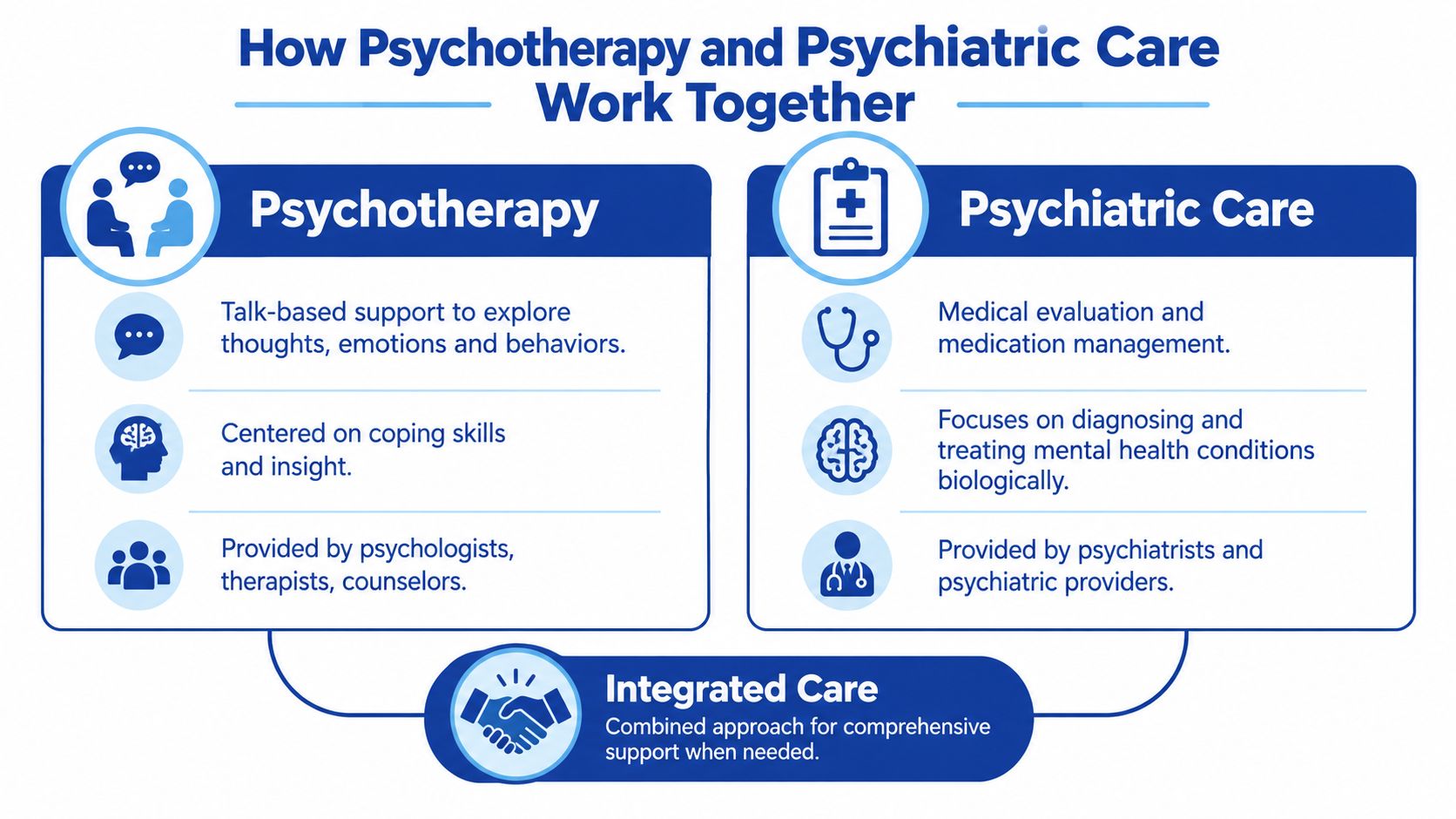
Psychotherapy vs psychiatric medication management at a glance
| Care Type | Primary Focus | When It Is Often Considered | How It Coordinates at IPA |
|---|---|---|---|
| Psychotherapy | Thoughts, emotions, behavior, coping, relationships, and functioning | A patient wants talk-based care, skills, insight, behavioral support, or help with life challenges | The psychology provider develops therapy goals and may coordinate care when psychiatric input is clinically relevant |
| Psychiatric medication management | Psychiatric evaluation, diagnosis, medication selection, monitoring, and follow-up | Symptoms may require medication review or a medical perspective on treatment | A psychiatric provider reviews response, tolerability, history, and ongoing medication needs |
| Integrated care | Psychological and psychiatric needs addressed together | Symptoms, functioning, substance use, or treatment history suggest that coordinated services may help | Providers can align treatment goals and communicate within appropriate privacy and consent requirements |
The distinction between screening and diagnosis prevents a common misunderstanding. An online questionnaire can help a patient describe concerns, but a clinician must evaluate the broader picture before diagnosing ADHD, depression, anxiety, PTSD, OCD, or another condition. The CDC's adult ADHD guidance notes that adult ADHD evaluation considers symptoms and functioning, including whether symptoms began before age 12, occur in more than one setting, and interfere with daily life.
Psychotherapy and psychiatric care can also sit alongside lifestyle supports. Patients exploring general wellness strategies may find a practical discussion of how running eases anxiety, but exercise information shouldn't substitute for a clinical evaluation or prescribed treatment.
The broader integrative psychiatry approach considers how psychological, medical, behavioral, and lifestyle factors may interact. The treatment plan still depends on the individual's assessment and preferences.
The comparative evidence for telepsychiatry is also relevant to patients who worry that virtual care is automatically less rigorous. A 2023 meta-analysis found no significant difference in symptom improvement for 8 of 10 psychiatric disorders studied, and across all diagnoses combined found no significant differences in 27 of 29 outcomes, including the primary outcome. For depressive disorders, telepsychiatry was statistically more effective than face-to-face treatment in that analysis, with a standardized mean difference of -0.325, a 95% confidence interval of -0.640 to -0.011, and P = 0.043. (2023 telepsychiatry meta-analysis)
Who Online Therapy in Pennsylvania May Help Most
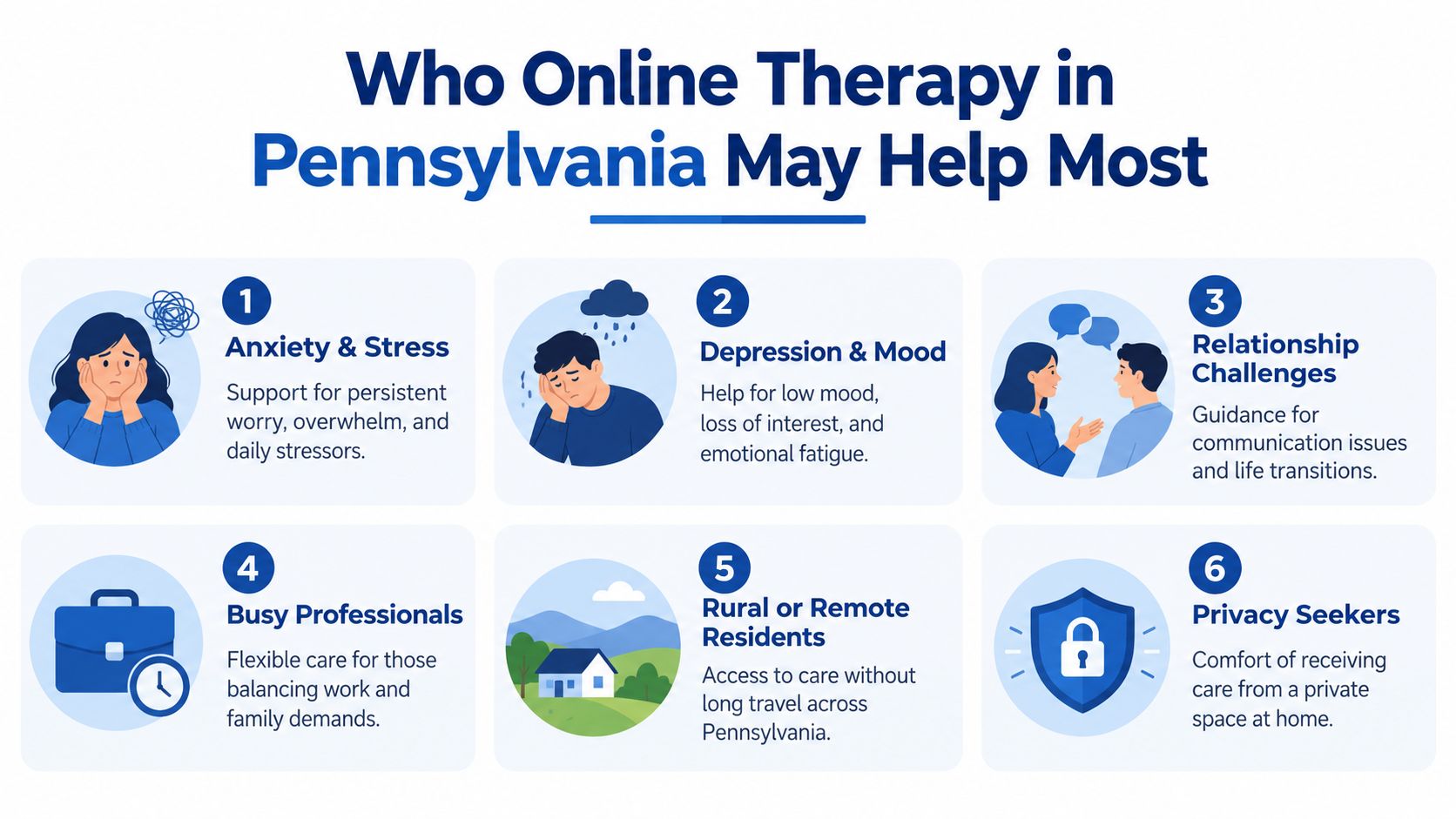
Online therapy may suit Pennsylvania adults who can participate safely and privately through telehealth and whose concerns can be addressed through virtual psychotherapy. Clinical evaluation determines whether virtual care is appropriate, whether psychiatric care should be included, and whether a higher level of treatment is needed.
Lori Simons' documented expertise in substance-use and co-occurring disorders is especially relevant for patients whose substance use overlaps with anxiety, depression, trauma symptoms, attention concerns, or relationship disruption. Co-occurring concerns can complicate treatment planning because one problem may affect the symptoms, risks, and treatment choices associated with another.
Common reasons patients explore virtual therapy
Online therapy may be considered by patients seeking support for:
- Anxiety and stress: Persistent worry, overwhelm, avoidance, or difficulty managing daily demands.
- Depression and mood changes: Low mood, reduced interest, isolation, emotional fatigue, or impaired functioning.
- Trauma-related concerns: Symptoms connected with distressing experiences, subject to clinical evaluation and safety planning.
- Relationship and life-transition difficulties: Communication problems, boundaries, grief, work changes, or family stress.
- Substance-use concerns: Therapy support when alcohol or drug use affects mood, behavior, health, or relationships.
- Attention and executive-function concerns: Adults seeking evaluation or treatment planning for possible ADHD, with diagnosis based on a careful clinical assessment rather than one questionnaire.
A patient living in Erie, Scranton, Lancaster, or the Lehigh Valley may value access without a long trip to an office. Someone in Philadelphia may prefer a private session at home because work and family responsibilities make office visits difficult. These are general telehealth advantages, not statements about what Lori Simons' patients report.
When online therapy may not be enough
Virtual therapy may not be the right setting for an immediate safety crisis, severe impairment, unstable medical needs, or a situation requiring intensive in-person supervision. A patient experiencing imminent danger should use emergency services or a local crisis resource rather than wait for a routine telehealth appointment.
Connectivity and privacy also affect suitability. Pennsylvania survey work identified lack of internet and device access as the most common remaining barriers to telehealth, so patients should discuss alternatives if video access is unreliable. (Pennsylvania telehealth survey)
Patients seeking broader community options can review this guide to finding mental health support. For IPA's explanation of virtual psychiatric care, the telepsychiatry resource provides additional context.
What to Expect From Secure Virtual Therapy Across Pennsylvania
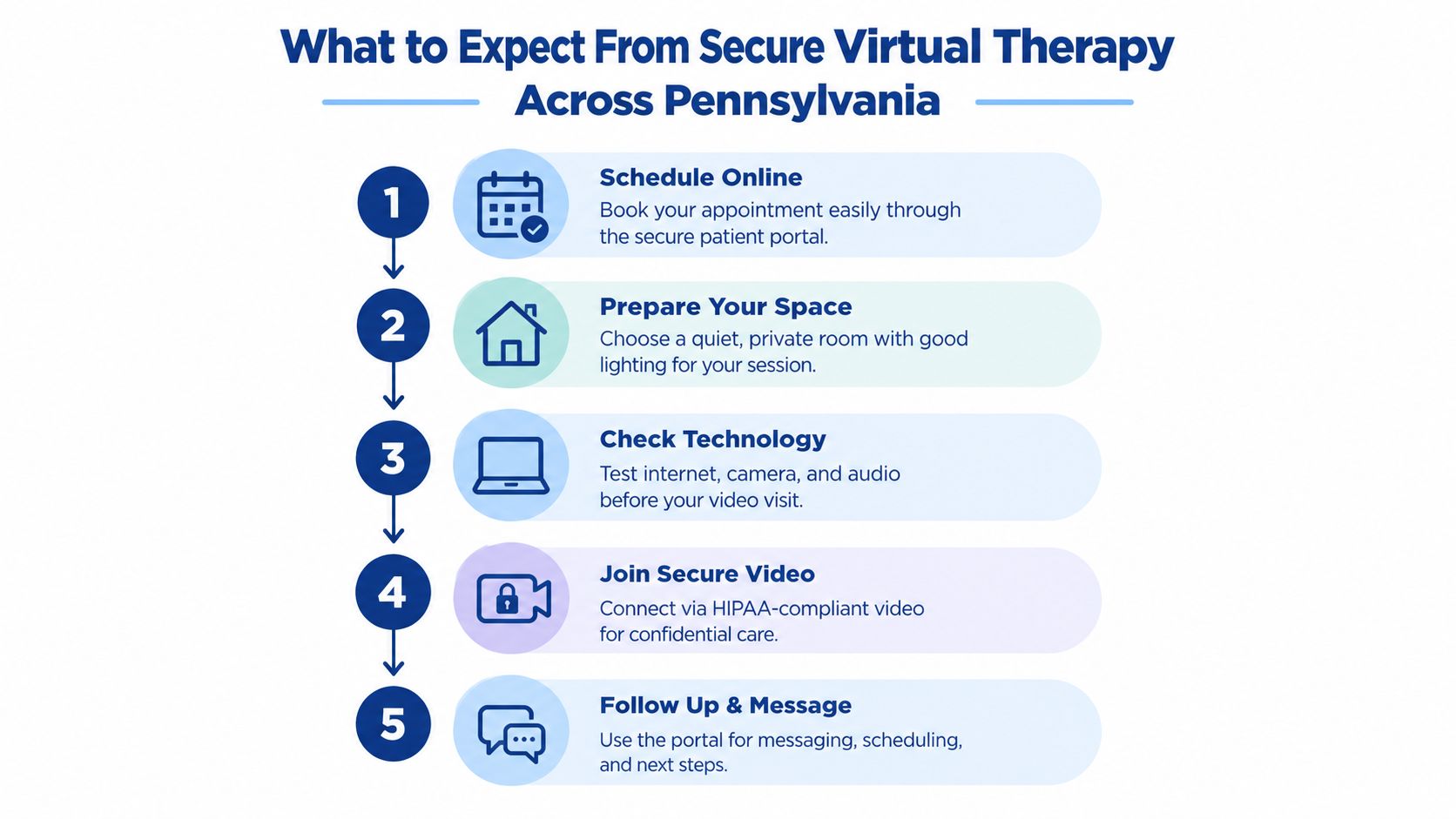
Secure virtual therapy generally involves consent, a private setting, reliable technology, real-time communication, and a plan for follow-up. Patients usually connect through a secure video process rather than ordinary text messaging or email.
Pennsylvania OMHSAS defines behavioral-health telehealth as a compensable service delivered at a distance through real-time, two-way interactive audio-video transmission. The state framework excludes text messaging, email, and fax as substitutes for that service. Pennsylvania guidance also allows telephone-only behavioral-health care in limited circumstances, such as when a person lacks video capability or faces an urgent medical situation. (Pennsylvania OMHSAS telehealth definition)
Practical preparation before a visit
A patient can make virtual therapy more useful by preparing the environment and the technology:
- Choose privacy: A room with a closed door can reduce interruptions. Headphones may help when other household members are nearby.
- Check the connection: Patients should test the camera, microphone, browser, and internet connection before the appointment.
- Plan for interruptions: A backup phone number or agreed communication plan can help if video fails.
- Consider safety: The provider should know the patient's current location during the session and understand how urgent concerns will be handled.
- Use the portal: Secure scheduling, messages, and follow-up instructions should remain within the practice's approved system.
A virtual setting can change how a therapist observes the session and how a patient participates. Patients may need to describe more of their surroundings, manage interruptions, or adjust where they sit. Those are ordinary teletherapy considerations, not evidence that a particular provider faced a specific launch challenge or uses a proprietary digital technique.
Consent is part of the process. Pennsylvania rules require consent before behavioral-health services are rendered through telehealth, and later state legislation preserved audio-only flexibility for behavioral-health treatment and supervision in appropriate circumstances. (Pennsylvania telehealth licensing guidance)
Patients should also separate clinical access from insurance assumptions. Benefits, deductibles, copays, network status, and authorization requirements vary by plan. Pennsylvania Medical Assistance policy states that behavioral-health telehealth services are paid at the same rate as in-person services in the fee-for-service system, with related guidance applying to enrolled providers across fee-for-service and managed-care arrangements. (Pennsylvania telemedicine FAQs) Private insurance plans can apply different rules.
For information about secure systems and privacy practices, patients can review HIPAA-compliant telehealth at IPA.
Collaborative Care Between Psychology and Psychiatry at IPA
Collaboration means that therapy and psychiatric care can address different parts of the same clinical picture while keeping the patient's goals connected. It doesn't mean every patient must see multiple providers, and it doesn't guarantee that a referral or combined plan will be clinically appropriate.
A patient may begin by requesting therapy for anxiety, depression, trauma symptoms, relationship strain, or substance-use concerns. During the initial clinical process, the psychology provider may identify questions that warrant psychiatric evaluation. Those questions could involve medication history, significant mood changes, attention symptoms, side effects, sleep disruption, medical factors, or safety.
The reverse pathway can also occur. A patient seeking psychiatric medication management may benefit from psychotherapy to address coping, behavior, relationships, substance use, or the patterns that medication alone may not target. A psychiatric provider can recommend therapy when that fits the patient's needs, while the psychology provider can communicate clinically relevant information through appropriate consent and practice procedures.
Where psychological assessment may fit
Psychological assessment can provide structured information about symptoms, functioning, personality, cognition, or other areas when clinically indicated. The specific purpose, tools, interpretation, and availability must be confirmed with the practice. This article doesn't claim that Lori Simons performs a particular named test.
That distinction protects patients from a common mistake. A test result can inform an evaluation, but it doesn't automatically establish a diagnosis or determine a medication plan. Providers interpret assessment information alongside history, current functioning, observations, and other clinical data.
A coordinated patient experience
Within a virtual practice, collaboration may include:
- Shared treatment questions: Providers clarify whether therapy, medication management, or both address the patient's main concerns.
- Referral when needed: A patient can be directed toward a different service or level of care when virtual outpatient treatment isn't sufficient.
- Continuity: Relevant updates can support consistent goals when the patient receives more than one type of care.
- Patient choice: Combined care remains an option, not an obligation.
IPA's Psychology Services and Psychiatric Care pages provide the clearest service-level context. Patients who want general education can also browse the Mental Health Blog.
Choosing Online Therapy With Lori Simons and Your Next Step
A patient deciding whether to contact Lori Simons can start with the care question rather than the diagnosis label.
- Therapy may be the starting point when the main need involves coping, emotions, behavior, relationships, life transitions, or substance-use support.
- Psychiatric evaluation may be the starting point when medication questions, significant symptom changes, prior treatment response, or diagnostic clarification are central.
- Coordinated care may be worth discussing when psychological concerns and medication needs overlap, or when substance use affects mood, attention, safety, or functioning.
- A different setting may be necessary when symptoms create an immediate safety concern or require intensive in-person support.
Lori Simons' role gives Pennsylvania patients access to a Ph.D.-level psychology and therapy resource within a practice that also provides virtual psychiatric care. That structure can make it easier to ask how psychotherapy, psychological assessment, and medication management might fit together, while still keeping the treatment plan individualized.
Patients seeking broader clinical evaluation can review the online mental health evaluation. Those interested specifically in therapy should begin with Psychology Services, then review About Integrative Psychiatry of America for provider information.
Insurance verification remains a separate step. Coverage, copays, deductibles, network status, and prior authorization requirements can vary, so patients should confirm benefits before assuming that a service is covered.
Integrative Psychiatry of America offers secure virtual psychology and psychiatric care for eligible Pennsylvania patients, including people exploring therapy, medication management, or coordinated support. Patients who want to learn whether Lori Simons' services fit their concerns can visit Integrative Psychiatry of America, review the available care options, and request the next appropriate appointment.