
A 34-year-old Personal Choice PPO member in Philadelphia may spend years compensating for missed deadlines, unfinished tasks, and inconsistent focus before searching for Independence Blue Cross ADHD care. The search quickly becomes practical: Which providers accept IBX? Does the plan require a referral? What will an evaluation cost before the deductible is met? Will the pharmacy fill a stimulant prescription, and what happens if the first medication needs adjustment?
Those questions matter because ADHD care doesn't end with diagnosis. The workflow runs from plan verification to a documented evaluation, prescription authorization, first fill, and regular medication management. Keystone HMO, Personal Choice, Medicare Advantage, telehealth access, referrals, and pharmacy rules can all change that path.
This guide focuses on the experience of Pennsylvania adults seeking an IBX psychiatrist, ADHD evaluation, or online psychiatry. It also explains where members commonly get stuck and how better preparation can reduce avoidable delays. For clinical background, readers can review this overview of ADHD prevalence and its growing role in mental health care.
Table of Contents
- Why IBX Members Search for ADHD Care
- How IBX Structures Behavioral Health Access
- Getting an ADHD Evaluation Under IBX
- ADHD Medications and IBX Coverage Rules
- Telehealth ADHD Treatment for IBX Members
- Where ADHD Treatment Gets Stuck Under IBX
- Practical Next Steps for IBX Members
Why IBX Members Search for ADHD Care
The search often begins with a problem that looks ordinary. A Philadelphia professional misses a work deadline, rereads the same email repeatedly, or avoids starting a task until the pressure becomes uncomfortable. Anxiety may have been blamed for years. A stimulant borrowed from a college friend may have seemed to help, but informal access doesn't provide diagnosis, monitoring, or a safe treatment plan.
The next step is usually a search for “ADHD treatment near me.” That search creates a second problem. The plan card becomes the first barrier, not the last. A member has to determine whether the clinician is in network, whether the visit falls under behavioral health, whether a referral applies, and whether prescription coverage is separate from the appointment benefit.
The questions members actually need answered
Insurance directories rarely answer the whole workflow. A member may still need to ask:
- Network status: Is the clinician contracted for this specific Keystone or Personal Choice plan?
- Referral rules: Does the plan require a primary care referral before behavioral health care?
- Visit cost: Will the evaluation apply to a copayment, coinsurance, or deductible?
- Medication access: Does the pharmacy benefit cover the prescribed stimulant or non-stimulant?
- Authorization: Will the prescriber submit required documentation and respond to a denial?
ADHD diagnosis itself follows DSM-5 criteria for children and adults, according to the clinical guidance published through IBX. That guidance estimates adult ADHD prevalence at about 4.4% in the United States and 3.4% internationally, while U.S. childhood and adolescent prevalence is around 9.4%. Independence Blue Cross clinical guidance places ADHD within mainstream behavioral health and neurodiversity support rather than treating it as an unusual specialty concern.
Why the plan name changes the experience
A Keystone HMO generally uses a managed network and may require referral coordination. A Personal Choice PPO may allow more self-directed specialist scheduling, but the member's cost share and out-of-network exposure can differ. Medicare Advantage products follow their own benefit structure.
The practical gap is significant. A provider can appear in an online directory yet have no current appointment availability, no open panel, or a different contract arrangement for the member's exact product. The plan portal may also separate behavioral health benefits from pharmacy rules, leaving members to solve the connection themselves.
Practical rule: Treat the insurance card as a starting point. Verify the behavioral health benefit, the clinician's exact network status, and the medication process before the first appointment.
How IBX Structures Behavioral Health Access
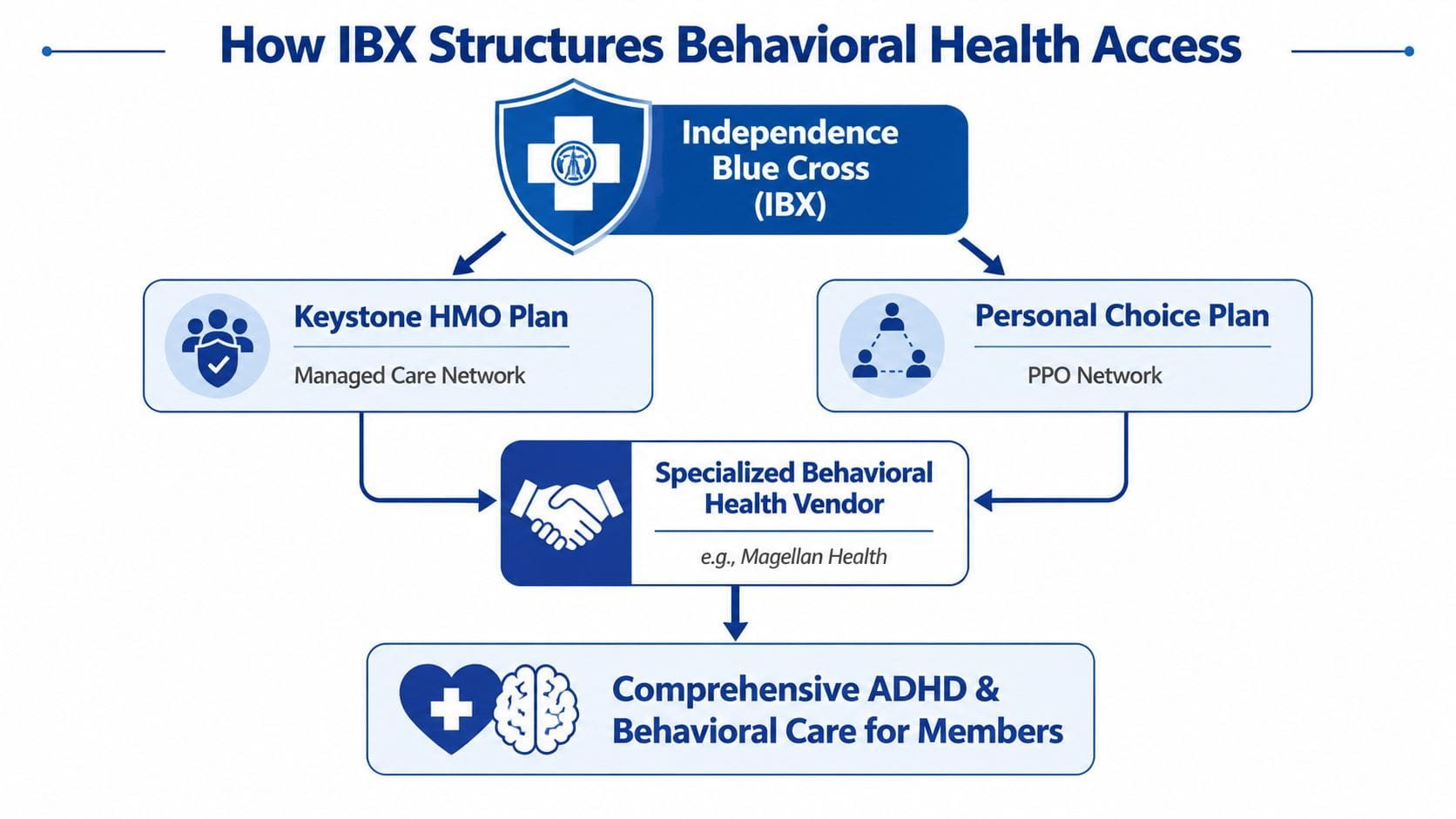
IBX uses a navigation model for behavioral health rather than leaving every member to search independently. Its behavioral health pages direct members to a Behavioral Health Care Navigation team that can help identify an in-network clinician and, in some situations, arrange an appointment in as quickly as 1 to 2 days. That access model is described on the IBX behavioral health access page.
Start with the product, not the logo
“Independence” on a card doesn't identify every access rule. Members should first identify the plan product and behavioral health rider.
- Keystone HMO: The member may need primary care coordination or a referral before seeing a behavioral health clinician. The referral requirement should be verified for both evaluation and follow-up care.
- Personal Choice PPO: The member may have more direct access to an in-network specialist. The visit can still carry a different cost share depending on deductible status and network tier.
- Medicare Advantage: Behavioral health access follows the Medicare Advantage product's own navigation and benefit rules. IBX publishes a behavioral health navigator line with access available around the clock for its Medicare behavioral health pathway.
IBX lists behavioral health navigation at 1-800-688-1911, Monday through Friday from 8 a.m. to 6 p.m., while its Medicare behavioral health line offers 24/7 navigator access. Those details appear in the IBX behavioral health member information.
Separate the visit from the prescription
The ADHD evaluation and medication-management visit generally run through the behavioral health benefit. The prescription is processed separately through the pharmacy benefit. A successful appointment claim doesn't guarantee that the pharmacy will approve the selected medication.
Members should also ask whether the clinician is in network for the exact plan. A therapist and an IBX psychiatrist may have different contracts, even when both appear under behavioral health. The same issue can arise between an IBX-contracted telehealth platform and an independent Pennsylvania-licensed practice.
The member portal can show a medication as covered while hiding practical limits such as prior authorization, preferred pharmacies, quantity controls, or step therapy. Calling the behavioral health team and the pharmacy benefit administrator can clarify those separate layers before treatment begins.
Getting an ADHD Evaluation Under IBX
A legitimate ADHD evaluation IBX pathway requires more than a brief refill conversation. The clinician needs to establish whether symptoms fit DSM-5 criteria, began during the required developmental period, cause meaningful impairment, and occur across relevant settings. The evaluation also considers conditions that can mimic or worsen attention problems.
The 2024 American Family Physician review of adult ADHD recommends a history, symptom and function assessment, collateral information, confirmation of symptoms before age 12, validated rating scales, and impairment in at least two settings.
What the clinician documents
For adults, the ASRS v1.1 can organize symptom screening. For adolescents, clinicians may use tools such as the Conners or Vanderbilt scales, alongside information from parents, teachers, and the patient. A rating scale supports clinical judgment. It doesn't diagnose ADHD by itself.
The clinician should also review sleep quality, substance use, mood symptoms, anxiety, medical history, and current medications. Possible contributors such as anemia, thyroid dysfunction, and sleep disorders may need medical assessment or coordination with primary care. School reports, workplace examples, old report cards, prior treatment notes, and pharmacy history can strengthen the developmental and functional picture.
A full evaluation often takes substantially longer than a refill visit. The clinician may use a longer initial appointment and a follow-up to clarify diagnosis, review records, and discuss treatment options. Exact scheduling depends on the practice and clinical complexity.
Documentation that supports a clean review
| Documentation element | Purpose | Authorization impact |
|---|---|---|
| DSM-5 symptom history | Establishes diagnostic fit and symptom duration | Helps distinguish evaluation from a medication-only encounter |
| Validated rating scale | Organizes symptom reporting | Adds structured clinical evidence |
| Functional impairment | Connects symptoms to work, school, or relationships | Shows medical necessity beyond subjective distress |
| Two-setting history | Confirms symptoms aren't limited to one environment | Supports adult diagnostic reasoning |
| Medical and substance-use review | Identifies competing risks or explanations | Guides safe medication selection |
| Prior records and pharmacy history | Shows previous evaluations or treatment | Can reduce repeated information gathering |
Members seeking a structured virtual assessment can review the online ADHD evaluation service and ask the practice how it handles IBX verification and authorization documentation.
ADHD Medications and IBX Coverage Rules
An adult member can leave an appropriate appointment with a prescription that still cannot be filled. IBX medication access depends on the plan, pharmacy benefit, formulary position, clinical documentation, and prescriber network status. Keystone HMO, Personal Choice PPO, and Medicare Advantage products may apply different rules to the same medication.
Clinical fit and coverage approval follow separate tracks. A clinician may choose a medication based on symptom pattern, duration of effect, side effects, schedule, or past response. The plan may require a generic trial, a particular formulation, prior authorization, quantity limits, or supporting records before the pharmacy can dispense it.
How the pharmacy workflow works
IBX uses prior authorization for medications that require approval and relies on completed request forms in its pharmacy process. Its utilization-management information also addresses approval for higher-acuity behavioral services, including inpatient, residential, partial hospitalization, intensive outpatient, ABA, and TMS care. The IBX utilization-management notice shows why organized records matter when a request goes to review.
Brand-name stimulants often create more coverage friction than commonly available generics. A Pennsylvania prescribing and coverage discussion notes that plans may request DSM-5 documentation, symptom scales, previous generic trials, and pharmacy-benefit paperwork for brand medications such as Vyvanse or Adderall XR. Use the Pennsylvania Vyvanse access guide as general context, then confirm the member's actual formulary.
| Medication | Class | Typical IBX coverage notes |
|---|---|---|
| Methylphenidate | Stimulant | Generic options may be preferred, while selected long-acting brands may require additional review |
| Amphetamine salts | Stimulant | Generic products may be used before a brand alternative under step therapy |
| Vyvanse | Stimulant | Brand coverage can require documentation or prior authorization |
| Concerta | Stimulant | Formulary position varies by product and plan |
| Azstarys | Stimulant | Prescribers may need to confirm formulary status and medical necessity |
| Strattera | Non-stimulant | Coverage depends on the pharmacy benefit and plan formulary |
| Intuniv or guanfacine | Non-stimulant or adjunct option | May be considered when clinically appropriate, with plan-specific rules |
| Qelbree | Non-stimulant | Coverage may involve formulary review or prior authorization |
| Clonidine | Adjunct option | Use and coverage depend on the clinical plan and prescription benefit |
Before the first fill, confirm the preferred pharmacy, authorization requirement, quantity limit, refill timing, and prescriber network status. The ADHD medication management service describes the monitoring and dose-adjustment work that follows the initial prescription. That ongoing process can require follow-up visits, response tracking, side-effect review, and communication with the pharmacy when coverage rules affect the chosen medication.
Telehealth ADHD Treatment for IBX Members
Telehealth can remove travel barriers for Pennsylvania adults who work irregular hours, care for family, or live far from a behavioral health office. It doesn't remove insurance verification. A virtual visit still depends on the member's state of residence, the clinician's Pennsylvania licensure, the plan's telehealth benefit, and network participation.
Keystone HMO, Personal Choice PPO, and many Medicare Advantage products may include virtual behavioral health access. The member should verify the exact product because a plan's telehealth benefit can differ by employer group, rider, or service category.
Choosing a virtual pathway
Members may encounter several routes:
- IBX-contracted platforms: Services such as MDLive or Doctor on Demand may provide virtual behavioral health appointments through the plan's contracted pathway.
- Independent practices: A Pennsylvania-licensed psychiatric practice may bill IBX directly if it participates in the member's network.
- Out-of-network care: A PPO may offer some out-of-network coverage, but the member should confirm reimbursement and authorization before booking.
The provider should verify benefits for both the initial evaluation and follow-up medication visits. The pharmacy benefit remains separate, so telehealth approval doesn't determine whether a specific stimulant is covered.
What happens during virtual medication management
A follow-up visit may review attention, task completion, sleep, appetite, mood, anxiety, blood pressure history, adverse effects, adherence, and the timing of benefit. The clinician then decides whether to continue, adjust, change, or pause medication. Controlled-substance prescribing requires careful identity, location, documentation, and monitoring procedures.
Federal telemedicine rules have changed over time, and the temporary or permanent status of controlled-substance prescribing requirements can affect how a practice onboards new patients. Members should ask whether the practice requires an in-person visit or a qualifying video evaluation before prescribing a Schedule II stimulant. Established patients may not need repeated in-person visits, but a new patient may still need hybrid onboarding.
Before the first appointment, the member should test camera and microphone access, upload the insurance card, confirm the pharmacy address, and keep prior records available. Pennsylvania telepsychiatry practices can serve patients across the state only when licensure and plan rules support the arrangement. The online ADHD treatment pathway provides another place to review how virtual care can be organized.
Where ADHD Treatment Gets Stuck Under IBX
The hardest part of IBX ADHD treatment is often continuity. A member may complete an evaluation and receive an appropriate prescription, yet encounter a denial, a pharmacy shortage, a network change, or a refill problem before the treatment plan has stabilized.
The first common failure occurs when the record doesn't clearly document DSM-5 symptoms, duration, functional impairment, or rating-scale results. The prescriber may understand the diagnosis, but the authorization reviewer sees an incomplete record. A brief note that says “attention problems” rarely carries the same weight as a detailed account of symptoms across work, home, and earlier life.
The recurring blockers
- Missing documentation: The workaround is a focused record review that includes developmental history, impairment, differential diagnosis, and validated scales.
- Step therapy: If the plan expects a generic methylphenidate or amphetamine-salt trial, the prescriber should document response, adverse effects, duration, and reason for any change.
- Midyear insurance changes: A new member card can alter network and pharmacy processing. The office should recheck benefits before the next prescription.
- Quantity controls: Travel or unusual scheduling can produce an early-refill request. The clinician may need to document the dates, medication supply, and medical necessity.
- Credentialing changes: If a clinician leaves the IBX network, the member should verify whether continuity-of-care protections or a new in-network clinician applies.
- Pharmacy shortages: An approved medication can remain unavailable at the selected pharmacy. The member and prescriber may need to coordinate an allowed alternative without sending duplicate prescriptions.
Escalation when ordinary calls fail
The prescriber's office should communicate with the IBX pharmacy team or behavioral health case manager when a request stalls. A peer-to-peer review may clarify why a medication or service was denied, especially when the initial submission omitted relevant records.
Members can request an internal appeal through the plan. Pennsylvania also provides an external review pathway through the state Insurance Department for eligible disputes. The Pennsylvania Insurance Department external review information should be consulted for current eligibility and filing requirements.
For patients: Keep the denial letter, claim explanation, pharmacy message, and prescriber's supporting note together. Appeals move faster when the record shows exactly what was requested and why.
Practical Next Steps for IBX Members
A useful plan begins before the evaluation. The member should identify the exact IBX product, then confirm how that product routes behavioral health care. Keystone HMO, Keystone PPO, Personal Choice PPO, and Medicare Advantage plans may handle referrals, network access, and pharmacy benefits differently.
A preparation sequence that reduces rework
- Verify the plan tier. Use the member portal or call the behavioral health number on the back of the card. Ask whether the evaluation and medication-management visits require a referral or prior authorization.
- Confirm the clinician's contract. Ask whether the provider is in network for the exact plan, not merely listed as accepting Independence Blue Cross. Verify both the diagnostic visit and follow-ups.
- Gather the clinical record. Collect prior evaluations, school documentation, workplace examples, medication history, pharmacy claims, and relevant primary-care information.
- Ask about office workflow. The member should learn whether the prescriber's office submits prior authorizations, tracks responses, and handles peer-to-peer reviews.
- Plan for refills. Controlled medications often require careful timing. Calendar reminders can help prevent a routine refill from becoming an urgent request.
- Identify a backup pharmacy. A second preferred-network pharmacy can help when a medication isn't available at the first location.
Daily structure can support clinical care, but it shouldn't replace evaluation or medication monitoring. A practical resource on ADHD attention management may help members organize tasks while insurance and treatment decisions are underway.
Members seeking an Independence Blue Cross psychiatrist or virtual clinician can also review ADHD doctor options near Pennsylvania patients. The key questions remain the same: Is the provider licensed for care in Pennsylvania, contracted with the exact IBX plan, and prepared to manage the documentation and follow-up required for ADHD treatment?
The most reliable workflow is simple in principle: verify first, prepare records, complete a real evaluation, confirm the pharmacy rules, and schedule follow-up before the first prescription runs out. That approach doesn't eliminate every plan restriction, but it gives the member and prescriber a clear record when coverage or continuity problems arise.
Integrative Psychiatry of America provides virtual psychiatric evaluations and ADHD medication management through telehealth for patients across Pennsylvania, with insurance verification available before care begins. Adults seeking confidential online psychiatry can visit Integrative Psychiatry of America to review ADHD services, confirm IBX participation, and request an appointment.