
Most people looking for how to get rid of anxiety depression have already tried the obvious things. They've downloaded a meditation app, cut back on coffee for a week, gone for a run, and felt briefly better. Then the 3 a.m. wake-ups return, and the flat, heavy feeling lands on top of them again.
Anxiety and depression usually arrive as a pair, and that pairing is why generic advice fails. A racing mind needs one set of tools. Hopelessness needs another. Neither responds well to a plan that skips the central question, which is whether this is a rough month or a treatable condition.
Nothing about that is rare. The World Health Organization estimates that about 5.2% of adults globally experience depression, and its 2019 estimate identified roughly 280 million people living with the condition (WHO depression fact sheet).
Table of Contents
- Start With Ten Minutes of Relief
- Follow the Escalation Ladder to the Right Level of Care
- Make a Safety Plan Before You Need One
- Build the Daily Habits That Carry the Rest
- Use CBT Techniques Between Sessions
- Know Where Medication and Integrative Care Fit
- Get Confidential Help in Pennsylvania
- When the Plan Is for You Versus a Family Member
Start With Ten Minutes of Relief
Get out of the spike first, then decide what to do about the pattern. None of the actions below treats a disorder. What they do is drop arousal far enough that you can think, eat, leave the house, or make a phone call.
| Tool | Time | What it helps | How to do it |
|---|---|---|---|
| Paced breathing | 3-5 min | Physical anxiety arousal | Inhale 4 seconds, exhale 6 seconds, repeat |
| 5-4-3-2-1 grounding | 2-3 min | Racing thoughts, dissociation | Name 5 things you see, 4 you feel, 3 you hear, 2 you smell, 1 you taste |
| Short outdoor walk | 10 min | Low mood, restlessness | Walk at an easy pace, no phone |
| Water and a protein snack | 5 min | Irritability, shaky energy | Pair protein with a slow carbohydrate |
| One five-minute task | 5 min | Hopelessness, avoidance | Pick the smallest undone task and finish it |
| One text to one person | 2 min | Isolation | Send a specific message, not a vague 'hey' |
The scene this usually plays out in looks like 7 a.m. after four hours of broken sleep, chest tight, every task on the day's list feeling equally pointless, and a workday that starts in an hour. That state is a bad time to make decisions. It's a fine time to breathe out longer than you breathe in, eat something with protein, and finish one small thing so the day has a data point that isn't failure.
The slow exhale matters more than the inhale. Extending the out-breath toward six seconds nudges the parasympathetic side of the nervous system, which is why paced breathing calms a pounding heart faster than a lecture about mindfulness. The 5-4-3-2-1 sequence works for the same practical reason: it gives a spinning mind a task with an end.
If naming sensory details feels harder than it should, a fuller walkthrough of grounding techniques for anxiety covers variations for panic, dissociation, and public settings.
The honest limit: these tools lower the volume on a spike. They don't treat an underlying disorder, and treating a spike as proof you're fine is how people lose years.
If the spike passes but the low mood, worry, or sleep disruption stays for two weeks or more, the next question isn't which coping skill to add. It's which level of care fits.
Follow the Escalation Ladder to the Right Level of Care
Care moves in tiers, and the tier is set by three things: how long symptoms have lasted, how much they interfere with work, sleep and relationships, and whether safety is at risk. Willpower doesn't set it. Neither does how badly someone wants to avoid treatment.
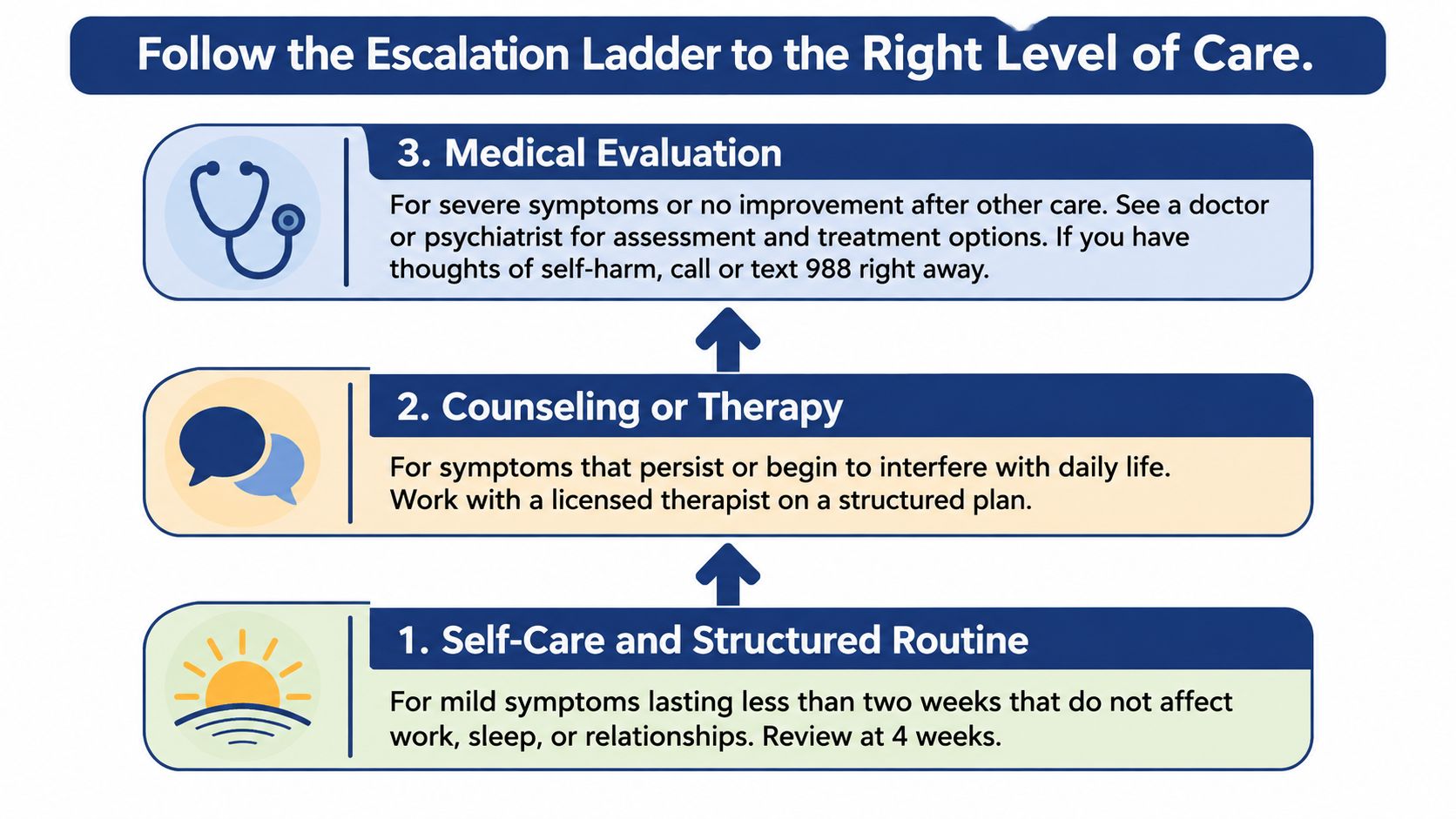
This is the model the WHO guidance on stepped, measurement-guided care describes. Assessment comes first and covers severity, suicide risk, bipolar-spectrum symptoms, substance use, medical contributors such as thyroid disease, sleep, and functional impairment. Treatment selection follows severity and preference, not habit.
| Level | Fits when | Timeline | Next step |
|---|---|---|---|
| Tier 1 self-care | Mild symptoms under two weeks that do not impair work, sleep or relationships | Review at 4 weeks | Structured routine and self-monitoring |
| Tier 2 psychotherapy | Persistent symptoms, functional impairment or a repeating history | Start within weeks, not months | Evidence-based therapy such as CBT |
| Tier 3 medication plus therapy | Moderate to severe symptoms, partial response to earlier care, or significant impairment | Reassess at 4-6 weeks on an adequate dose | Medication evaluation combined with psychotherapy |
| Urgent care | Suicidal thoughts, psychosis, mania, severe agitation or inability to care for yourself | Same day | Call or text 988, call 911, or go to the nearest emergency department |
The bottom row isn't a referral, it's a same-day action, and emergency mental health services covers where to go in Pennsylvania when a routine appointment is too slow.
Waiting is the most expensive option on that list. The reported median delay from symptom onset to treatment is 6 to 8 years for mood disorders and 9 to 23 years for anxiety disorders, and fewer than 1 in 10 people with major depressive disorder receive minimally adequate treatment (JMIR analysis of the treatment gap).
Combined treatment earns its place at Tier 3. The same WHO evidence shows psychotherapy plus pharmacotherapy outperforms medication alone for depressive-symptom reduction (standardized mean difference 0.33), treatment response (risk ratio 1.25) and remission (risk ratio 1.23), and a brief structured psychological-treatment model produced a 41% response rate at roughly two months against 17% under usual care.
Two pitfalls do real damage here. Treating presumed unipolar depression without screening for bipolar-spectrum symptoms can trigger mania. Judging a medication a failure before an adequate dose and duration have had a fair trial wastes months.
Recovery is not linear, and it's also not rare. In the 2024/25 treatment year, 50.5% of people in England who completed NHS Talking Therapies treatment for anxiety or depression moved to recovery (UK Parliament briefing on NHS Talking Therapies). A bad week at week three is not evidence the plan is failing.
Make a Safety Plan Before You Need One
Thoughts of self-harm, an inability to stay safe, psychosis, mania or severe agitation means emergency care today. Call or text 988 in the U.S., call 911, or go to the nearest emergency department. A routine appointment three weeks out is not the right container for that.
Everyone else with moderate symptoms should still write a plan, because judgment degrades exactly when the plan is needed. Clinicians build it in this order:
- Personal warning signs. The specific thoughts, sensations or behaviors that showed up in the days before the last bad stretch.
- Internal coping. Two or three things that have worked before, not things that sound soothing.
- People and places that distract. A coffee shop, a sibling's kitchen, a gym at 6 a.m.
- People to call for help. Names and numbers written out, because phones get locked and memories get foggy.
- Professionals and crisis lines. The prescriber's number, the therapist's number, 988.
- Making the environment safer. Firearms removed or locked, medications stored with someone else, alcohol out of the house.
A plan belongs in a phone note or on paper, reviewed with a clinician and updated when circumstances change. For family members, the useful move is to ask directly about suicide, stay calm when the answer is yes, and help the person connect to care rather than debating whether the feeling is justified.
Build the Daily Habits That Carry the Rest
Habits carry the load between appointments, and the three that matter most are sleep, movement and food. Each has a dose, and the dose is where most advice falls apart.
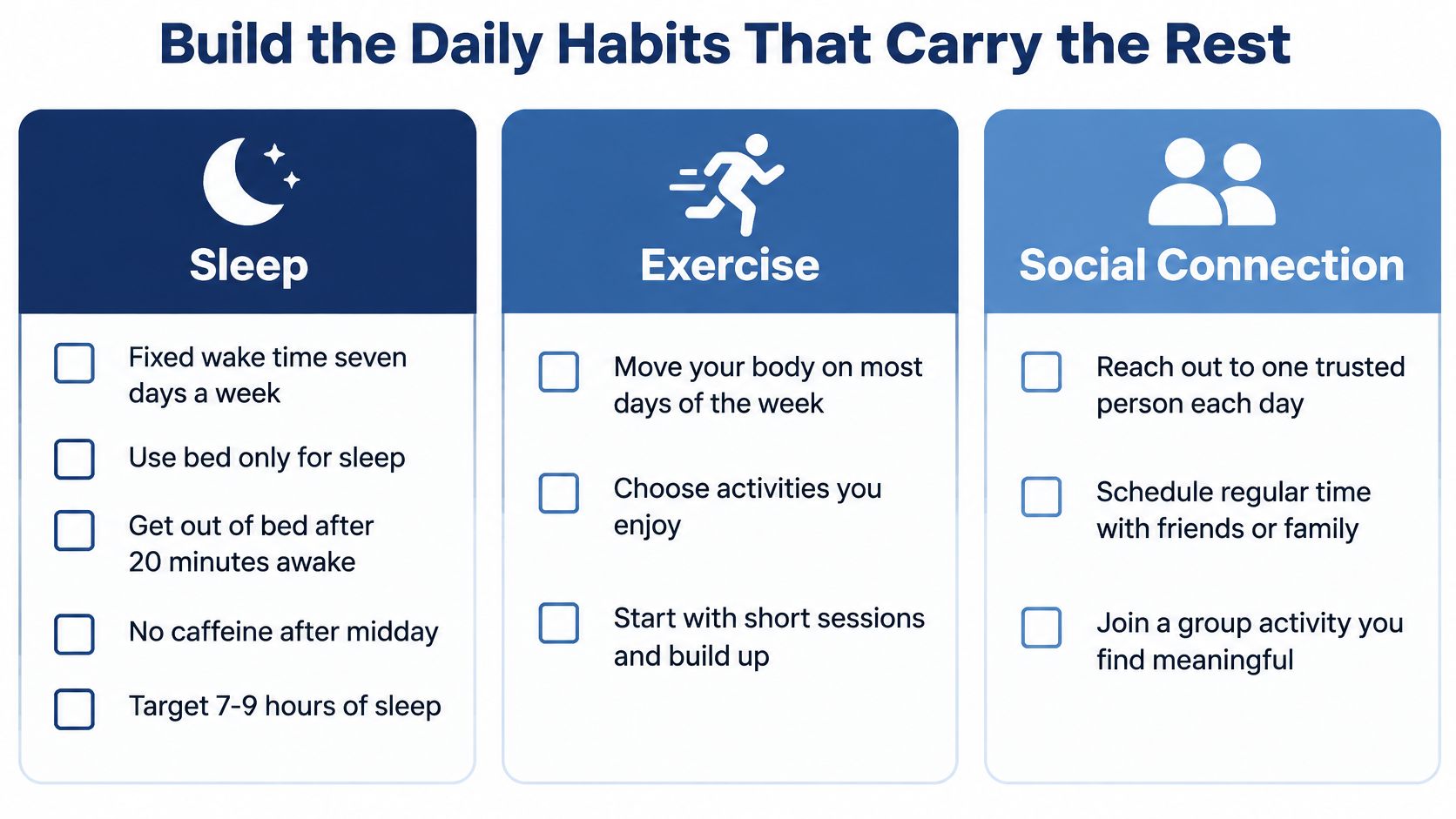
Sleep responds to a fixed wake time seven days a week more than to any bedtime ritual. Keep the bed for sleep, get up after 20 minutes awake, cut caffeine after midday, and aim for 7 to 9 hours. A consistent wake time does the heavy lifting because it anchors the circadian signal that everything else follows.
Exercise works as a structured adjunct, not a replacement for urgent or moderate-to-severe care. Pooled effects across physical-activity interventions were medium for depression (median effect size -0.43) and anxiety (median effect size -0.42) versus usual care, and a Cochrane review of 35 depression trials found a moderate reduction against no treatment or control (standardized mean difference -0.62, 95% confidence interval -0.81 to -0.42), with evidence quality and adherence varying (Cochrane evidence on exercise for depression).
The commonly cited protocol is supervised sessions three times weekly for 45 to 60 minutes over 10 to 14 weeks. A sedentary adult shouldn't start there. Ten-minute walks, adding duration first, then intensity, then resistance, is how the plan survives contact with a real week. Here's how movement fits into a broader plan:
Nutrition means regular meals with protein and fiber, alcohol kept low because it worsens both anxiety and sleep, and supplements treated as clinician-guided rather than self-prescribed. Record weekly minutes, sleep hours, perceived exertion and mood, then review at four to six weeks.
The recurring mistakes are predictable. Prescribing an intensity you won't repeat next month. Ignoring injury or cardiovascular risk. Interpreting a missed week as biological treatment failure. And dropping effective clinical treatment because exercise produced an early lift that won't hold on its own.
Use CBT Techniques Between Sessions
Psychotherapy helps people identify and change troubling emotions, thoughts and behaviors, and it works either instead of medication or alongside it. For anxiety, exposure therapy uses brief, supportive contact with feared situations so the body learns to tolerate distress (NIMH on psychotherapies). The skills are learnable, and practicing them between sessions is what makes a 12-week course outperform a 12-week conversation.
Three Techniques You Can Start This Week
Behavioral activation. Schedule one small activity graded by difficulty, not by motivation, and log mood before and after. The script is: "Tuesday, 10 a.m., 15-minute walk, mood 3/10 before, 5/10 after." Motivation follows action, not the reverse.
A thought record. Catch the automatic thought ("I will fail this review"), name the distortion, write the evidence for and against it, then write a balanced alternative. One page, five minutes, no editing for elegance.
An exposure ladder. List feared situations from mild to hard, start on a rung that produces discomfort rather than panic, stay until distress drops by roughly half, and repeat until that rung loses its grip. Leaving early teaches the brain the opposite lesson.
Interpersonal therapy and problem-solving therapy carry the cases where the problem is external: a dying parent, a layoff, a marriage in trouble. No amount of cognitive restructuring fixes a situation that needs a decision.
A normal course runs weekly for about 12 to 16 sessions. Between them, mood tracking for weekly journalers gives a therapist something better than recollection to work with.
Mindfulness-based approaches add a different lever, training attention on the present instead of on rehearsal of the future, and mindfulness-based cognitive therapy is the structured version most often used for recurrent low mood. Self-help alone becomes a weak plan the moment functioning or safety starts to deteriorate.
Know Where Medication and Integrative Care Fit
Depression may be treated with medicine, counseling, or both, and the FDA is explicit that antidepressants can cause side effects, which makes clinician-guided selection and follow-up the point rather than the paperwork (FDA on depression medicines).

Benefits usually build over four to six weeks at an adequate dose. The early weeks can bring activation, nausea or a shift in sleep, and stopping abruptly is the most common avoidable mistake in the whole process.
What to Ask Before the First Prescription
- Expected benefit and timeline. What change should show up by week four, and what counts as a response.
- Sexual and weight effects. Ask directly, because patients may not volunteer it.
- Interactions. Including alcohol, sleep aids, supplements and anything bought over the counter.
- Duration. How long to continue after feeling better, and how to taper.
- The next step if this one fails. A plan B named in advance prevents a silent stall.
This path is common, not a last resort. In 2024, 19.3% of U.S. adults took prescription medication for mental health and 14.0% received counseling or therapy from a mental health professional (CDC data brief on mental health treatment).
Integrative psychiatry treats the medication decision as one component among several. Nutritional counseling, exercise education, mindfulness, supplements and advanced genetic and blood testing sit alongside psychotherapy and medication management rather than replacing them. Lab work such as thyroid testing can uncover a medical contributor to low mood or anxiety. Genetic testing to pick an antidepressant has limited and mixed evidence, so it belongs as an optional add-on for a specific question, not a standard step. Nutritional psychiatry is a supportive area of research, not a cure.
For anyone weighing options remotely, depression medication online explains how evaluation, prescribing and follow-up work through video visits.
Get Confidential Help in Pennsylvania
Pennsylvania adults can be evaluated and treated for anxiety and depression through confidential video visits with a psychiatric provider. No waiting room, no commute, and no need to explain yourself twice to a front desk.
The insurance footing is concrete. Pennsylvania expanded telemedicine coverage through Senate Bill 739, signed into law on July 3, 2024, and the governor's office states the law requires health insurance and managed-care plans to pay for covered health-care services delivered through telemedicine (Pennsylvania Governor's Office announcement on Senate Bill 739). Coverage still depends on the specific service, plan rules, network status and eligibility, so a benefits check is worth ten minutes before the first visit.
Integrative Psychiatry of America provides virtual psychiatric care to adults across Pennsylvania, from Philadelphia and Pittsburgh to the Lehigh Valley, Harrisburg, Lancaster, Reading, Scranton and Erie. Care comes from board-certified psychiatric mental health nurse practitioners and other psychiatric providers, not physicians, and telepsychiatry is as effective as in-person psychiatric care for the conditions the practice treats, including anxiety, depression, ADHD and PTSD.
The first appointment is a full history: symptom onset and severity, bipolar-spectrum screening, substance use, medical contributors, sleep, and a written plan with a follow-up date attached. Free self-assessment tools, including an Anxiety Symptom Checker and a 5-4-3-2-1 grounding tool, organize symptoms beforehand. They don't diagnose anything.
Before the visit: bring a medication list and a short note on your three biggest symptoms, with how many days in the past two weeks each one showed up.
One next step is enough. Verify insurance or request an appointment through depression treatment at Integrative Psychiatry of America and let the assessment answer the question that a search engine can't.
When the Plan Is for You Versus a Family Member
The same ladder looks different depending on whose symptoms are being tracked. Someone seeking care for themselves can report the inside view: the 4 a.m. waking, the dread before a meeting, the thought that shows up in the shower. A spouse or adult child has the outside view, and it's often more accurate on function, because the person living it has adapted to a shrinking life without noticing.
- When it's for you. Report the worst week, not the average week. Track sleep hours, appetite, and how many days you left the house. Bring that note to the first visit instead of reconstructing it in the room.
- When it's for a family member. Describe what you observe, in dates and specifics, and say plainly that you're worried. You can send information to a clinician; you can't receive it back without the patient's written permission.
- When the person declines care. Ask what would make the decision easier, offer to book the appointment and sit in the waiting room, and drop the topic between attempts. Pressure hardens resistance.
Consent comes first: an adult relative's diagnosis and medication plan stay private unless that person signs a release, and a clinician who confirms details without one has broken a rule, not helped.
For a minor child, the rules flip. A parent or guardian consents to evaluation and treatment and stays inside the plan. For an adult who is struggling but still safe, the role is support, logistics and persistence, not control. The person who needs the treatment is the one who has to show up for it, and a plan built with them holds better than a plan built for them.
Integrative Psychiatry of America offers confidential video psychiatric care to adults across Pennsylvania, including medication management, psychotherapy, and integrative support such as nutrition, exercise and mindfulness guidance. Its board-certified psychiatric mental health nurse practitioners build a written plan with a follow-up date, so anxiety and depression get tracked rather than endured. Visit Integrative Psychiatry of America to verify insurance, try a free symptom checker, or request an appointment.