
A single brain zap usually lasts a second or two; the overall symptom window can last days to weeks, and sometimes longer. These are two different timelines: the sensation itself is brief, while episodes may recur during adjustment after an antidepressant dose change.
How Long Do Brain Zaps Last: Timelines by Scenario
| Scenario | Typical timeline for one episode | Overall window |
|---|---|---|
| Missed or late dose | Seconds | Days to a couple of weeks, as described in consumer health guidance (WebMD) |
| Abrupt stop | Seconds | Days to weeks; discontinuation symptoms may persist longer (Medical News Today) |
| Gradual taper | Seconds | Days to weeks; tapering may reduce symptoms (Psychiatrist.com) |
| Prolonged or intermittent symptoms | Seconds | Weeks to months, with uncommon longer reports (PMC clinical overview) |
A questionnaire-based study of 2,267 people who reported brain zaps after antidepressant use found that the most common duration for an individual episode was about 1 second. Half a second, 2 seconds, and 3 seconds were also frequently reported; episodes lasting longer than several seconds were uncommon, though a few respondents described events up to 30 seconds (questionnaire findings). Individual zaps are therefore usually brief, even when they recur over time.
The overall window varies. Antidepressant discontinuation symptoms may resolve within days to weeks, and clinical descriptions also include symptoms lasting months or, rarely, longer (clinical overview). The cited clinical overview describes a broad range rather than a guaranteed timeline. The RACGP prescribing guide discusses antidepressant discontinuation; it does not establish a precise brain-zap duration estimate (RACGP prescribing guide).
Symptoms can follow a missed dose, stopping, or reducing medication, but onset varies by person and medication. If symptoms continue beyond the expected adjustment period, worsen, or come with unusual features, contact a clinician rather than assuming they are withdrawal.
A Sudden Shock That No One Warned You About
Brain zaps usually last only a moment per episode, but they can recur for days or weeks during antidepressant adjustment. So, how long does it take for brain zaps to go away? There is no single timeline: the overall window depends in part on the medication change and the individual.
The jolt can feel startling—a flash or brief electrical sensation—especially when it happens repeatedly. Keeping track of when it occurs and whether a dose was late or changed can help make the pattern easier to discuss. People who also have trouble keeping medication timing consistent may find practical advice for ADHD refills useful.
A brief episode and a longer recovery period are not the same thing. If symptoms are persistent or accompanied by concerning changes, seek medical advice rather than relying on duration alone.
How We Reviewed Brain Zap Duration and Guidance
This explainer draws on clinician-oriented references, including questionnaire findings, prescribing guidance, and clinical descriptions. Consumer health sites were also consulted for plain-language descriptions of when symptoms may follow missed doses, stopping, or tapering; their broad timing estimates are presented as guidance, not precise predictions. We distinguish the duration of an individual episode from the overall symptom window, since these are different measures. Reports of unusual or prolonged symptoms should be considered separately from the typical brief sensation.
What Brain Zaps Actually Feel Like
Brain zaps usually feel like a brief electrical jolt, a tiny flash behind the eyes, or a sudden burst of static in the head. Some people describe them as a camera flash or a skipped beat in the brain; the language varies because the sensation is hard to pin down.
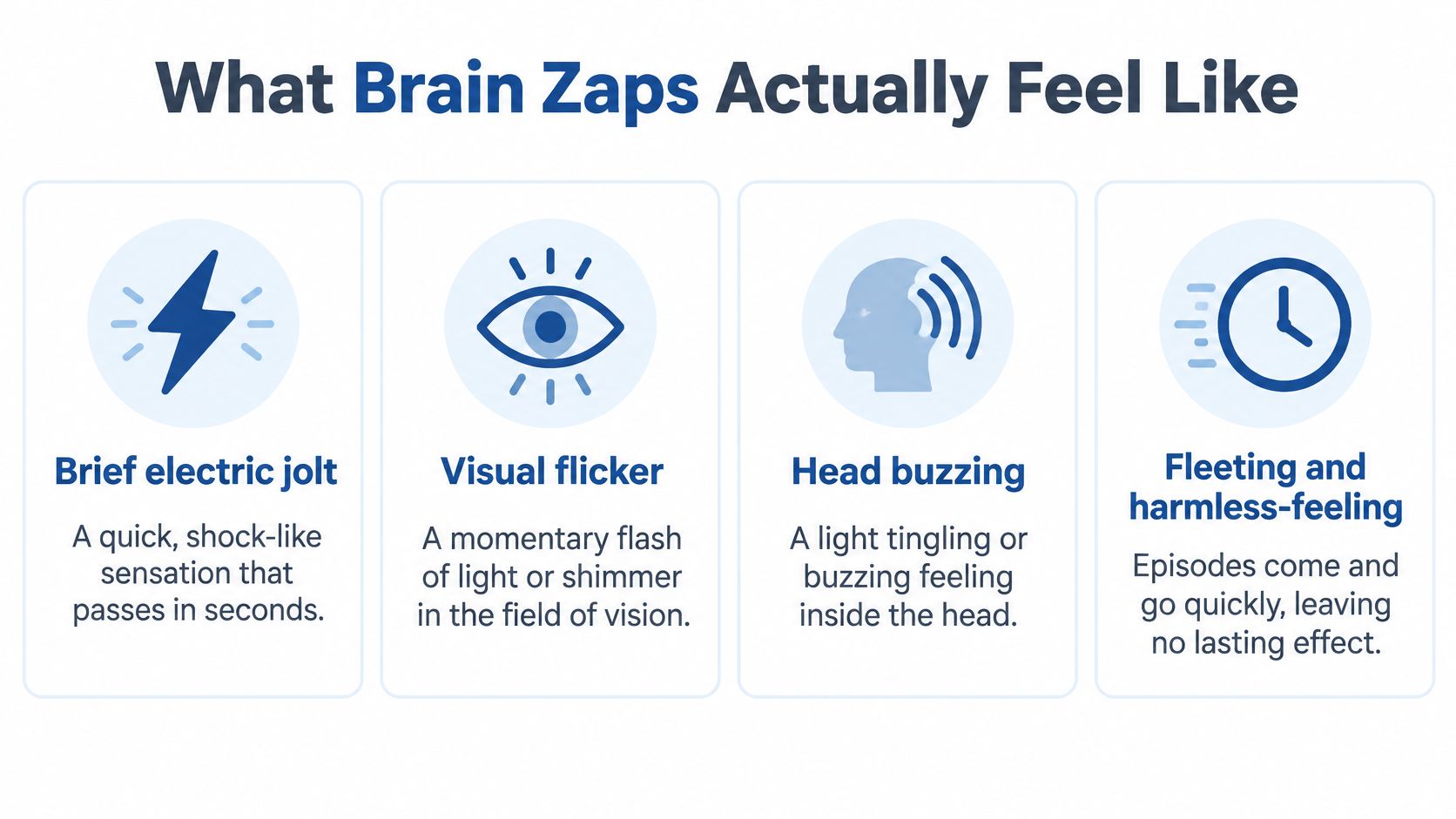
The sensation is brief, but the pattern can repeat
The electrical metaphor does not mean the brain is getting shocked. It describes a sudden sensory interruption that may make someone stop mid-sentence or blink hard. WebMD notes that some people notice brain zaps after taking a dose late or missing one, and Medical News Today says they often occur after stopping or reducing antidepressants. A zap is an event, while withdrawal is a pattern: several zaps may happen in a day, though each passes quickly.
Common triggers that make them seem random
Head turning, eye movement, fatigue, and feeling run down can make the sensation more noticeable. People may report it while looking to the side, standing up quickly, or trying to fall asleep.
The pattern can feel random, but medication changes may be relevant. For a plain-language explanation of serotonin, see what is 5-HT.
A simple way to describe it to a clinician
A helpful description is short and specific: “a one-second jolt behind the eyes when turning my head after missing doses.” That gives a prescriber details to consider, including timing, triggers, and whether the symptom fits the expected pattern.
The Most Common Causes of Brain Zaps
Brain zaps are often associated with changes in serotonergic antidepressants, especially SSRIs and SNRIs. Medical News Today describes them in connection with stopping or reducing antidepressants, while WebMD discusses them as a possible discontinuation symptom. For related information about brain fog, see Sunridge Medical.
How medication changes shape the timeline
SSRIs and SNRIs affect serotonin signaling. When a medication is reduced or stopped, the body adjusts to the change; that adjustment may produce the brief sensation people call a zap. WebMD and Psychiatrist.com discuss symptoms following abrupt stopping or a late dose, and Psychiatrist.com notes that shorter half-life medications can be more prone to withdrawal symptoms (Psychiatrist.com questionnaire findings).
Half-life, dose, taper speed, and missed-dose patterns can all matter. Medications with shorter half-lives leave the body more quickly than those with longer half-lives, which can make changes in dose more noticeable. The FDA prescribing information for sertraline describes its elimination half-life as roughly a day; specialist guidance also discusses how medication half-life relates to discontinuation symptoms (Royal College of Psychiatrists guidance).
Brain Zaps After Stopping Zoloft or Sertraline
Sertraline (Zoloft) has an elimination half-life of roughly a day, according to its prescribing information. Abrupt stopping or inconsistent dosing can still lead to discontinuation symptoms. The timing and intensity vary, and gradual tapering may make symptoms easier to manage. Shorter half-life antidepressants, including paroxetine and venlafaxine, can be associated with earlier or sharper discontinuation symptoms, as specialist antidepressant-stopping guidance explains.
For readers starting treatment rather than ending it, how long before Zoloft starts working covers the beginning of treatment and its different timing questions.
Medications and situations that can set them off
- Missed doses: A late dose may be enough for some people to notice symptoms.
- Abrupt discontinuation: Sudden stopping is a recognized trigger for antidepressant discontinuation symptoms.
- Switching medicines too quickly: A rapid switch can leave the body adjusting to a new pattern before the old one has settled.
- Other brain-active medications: WebMD and Psychiatrist.com note that discontinuation symptoms are not unique to antidepressants.
A medication change is useful context when discussing symptoms with a prescriber.
Who Is Most Likely to Experience Them
People with recent dose changes, missed doses, or longer antidepressant use may be more likely to notice brain zaps. WebMD discusses symptoms after suddenly stopping, while Psychiatrist.com notes associations with longer use and medications that leave the body faster.
Personal factors that shape the timeline
Dose, duration, and how quickly a medication leaves the body may affect the experience. Anxiety and sleep problems can also make symptoms harder to tolerate, without necessarily causing the zaps themselves.
For example, someone taking sertraline for an extended period who misses doses during a hectic week may notice symptoms after the medication schedule changes. The concern is often the sudden change, not that the brief sensation itself proves a dangerous problem.
Longer use, a faster taper, and missed doses can contribute to symptoms. A careful plan can help reduce the chance of a difficult adjustment.
Why some people feel a longer window
Several medications being adjusted close together can make the timeline harder to interpret. Previous withdrawal symptoms may also be relevant. For a plain overview of medication side effects and reactions, see understand prescription drug reactions. The overview at how does Wellbutrin work may help readers comparing antidepressants.
Practical Strategies to Reduce Frequency and Intensity
The most useful step is not to stop suddenly. Medical News Today and Psychiatrist.com discuss gradual tapering, and Psychiatrist.com notes that switching from a shorter half-life medication to fluoxetine may reduce severity in some cases.
A prioritized plan for managing symptoms
If zaps start after a missed dose, contact the prescriber rather than guessing at a fix. During a taper, share a symptom log and ask whether the step size or interval should change. Steady sleep, regular meals, hydration, and less caffeine may make symptoms less noticeable, but do not replace a medication plan. Do not restart, stop, or change a dose on your own, or add supplements as a substitute for clinical advice.
To address brain zaps, start with a prescriber-guided review of dose timing and the taper plan. Discuss:
- A clinician-guided taper: Smaller dose steps may give the body more time to adjust.
- Whether a longer half-life option is appropriate: A prescriber can consider whether a different medication strategy fits.
- Consistent timing: Review whether late or missed doses could be contributing.
- What not to do: Do not abruptly stop, double a dose, restart, or change medication without instructions from your prescriber.
Tracking as a practical tool
Note the day, dose, time of the zap, and what was happening beforehand. A simple log gives the prescriber concrete details to consider, though it cannot by itself determine the cause. The article SSRI supplements and diet for depression may help readers who want to discuss nutrition alongside medication planning.
A slow, thoughtful taper cannot guarantee zero symptoms, but it can help reduce how often they occur and how intense they feel.
The same principle appears in the YouTube discussion below, which may suit people who learn best by hearing taper concepts explained aloud.
When Duration Becomes a Warning Sign
A longer zap is not automatically a more serious withdrawal event. A typical brain zap is brief; a sensation lasting longer than a few seconds may need a different explanation. DetoxPlus UK notes that a prolonged sensation could point to a seizure rather than a typical zap, while Medical News Today and WebMD describe the usual sensation as short-lived.
When another diagnosis needs to be considered
If a sensation lasts well beyond a second or two, a clinician may consider possibilities beyond antidepressant withdrawal. Migraine aura, panic symptoms, sleep disruption, medication effects, and seizure activity can create confusing head sensations. Duration alone cannot distinguish them.
Seek prompt medical evaluation for:
- Loss of awareness: Blackout, confusion, or time loss changes the picture.
- New neurological symptoms: Weakness, trouble speaking, or abnormal movements need attention.
- Persistent dizziness or fainting: These symptoms do not fit a simple, brief zap pattern.
- Symptoms that continue well beyond the expected adjustment period: Ongoing recurrence deserves a medication-plan review.
WebMD says brain zaps themselves are not medically dangerous, while advising people to contact a physician for extreme or persistent symptoms. If a sensation is prolonged, paired with confusion, or accompanied by other neurological symptoms, seek evaluation.
Why clinicians look at the whole picture
The useful question is not only “How long did it last?” but also “What else was happening?” A medication review can help assess taper speed, other medicines, and whether another condition needs consideration. Persistent symptoms deserve a proper evaluation rather than an assumption.
How Integrative Medication Management and Telehealth Can Help
A medication review can help make the timeline easier to understand. Integrative medication management considers the prescription, dose timing, sleep, stress, nutrition, and other factors that may affect the experience.
Why telehealth fits this problem well
Brain zaps can be time-sensitive and easy to misunderstand, making virtual follow-up practical for some people. A secure telehealth visit through medication management online can help a patient review symptoms and discuss a taper plan.
For people across Philadelphia, Pittsburgh, Harrisburg, Erie, Scranton, Allentown, Lancaster, and Reading, statewide virtual psychiatric care can make it easier to talk through a plan. Tracking tools like the Feeling Journal and Daily Agenda Planner can help note whether zaps cluster around missed doses, poor sleep, or stressful days.
A good next step for Pennsylvania patients
A clinician can review whether symptoms fit antidepressant discontinuation, whether the taper needs to slow down, or whether another issue should be considered. A few days of symptom notes may help make that conversation more specific.
For anyone in Pennsylvania considering virtual psychiatric evaluation or medication management, a useful next step is to schedule a visit, verify insurance, or use a tracking tool before the next dose change.
Frequently Asked Questions About Brain Zaps
When will brain zaps stop? Many settle within days to weeks of a dose change, though intermittent symptoms can last longer. A prescriber can help assess symptoms that persist or worsen.
Do brain zaps go away? In the typical pattern, they resolve as the body adjusts or the medication plan is managed. Persistent or unusual symptoms still deserve evaluation.
How do I tell if I have brain zaps? They are usually described as a very brief shock, flash, or static-like jolt in the head, sometimes associated with eye movement or head turning and a medication change.
Should you go to the ER for brain zaps? A typical brief zap tied to a dose change does not by itself mean an emergency. Seek emergency care for loss of awareness, weakness, trouble speaking, severe confusion, prolonged episodes, or other urgent neurological symptoms.
Can brain zaps come back after they stop? They may return after another missed dose or a change made too quickly. Discuss recurring symptoms with the prescriber.
How long should a safe taper take? There is no universal schedule. The taper should be matched to the medication, dose, and individual response with a prescriber’s guidance.
Do brain zaps damage the brain? Typical brain zaps are described as distressing but usually harmless. Persistent or unusual symptoms should still be evaluated.
How long do brain zaps last after stopping antidepressants? The overall window varies; symptoms may last days to weeks and can sometimes continue longer. The duration of each individual zap is usually much shorter.
How long do brain zaps last after stopping Zoloft or sertraline? There is no single timeline. Symptoms depend on the dose change and individual response, so discuss persistent or severe symptoms with the prescriber.
A next step with Integrative Psychiatry of America may be to schedule a virtual psychiatric visit, verify insurance, or use a tracking tool if brain zaps are lingering, returning, or making a taper difficult. A careful medication plan can make the next few days easier to understand.