
A Philadelphia paramedic finishes the shift, gives a clear handoff, and drives home. Then sleep won't come. A routine question from a partner feels irritating, and thoughts about the next tour arrive before there's been any real rest.
First responder mental health support belongs in that gap between doing the job and feeling well. For Pennsylvania responders, getting help also means sorting out practical questions about privacy, rotating schedules, insurance records, and whether treatment connects to the department.
Table of Contents
- When Shift Stress Stops Feeling Normal
- What First Responder Mental Health Support Addresses
- Evidence-Based Care for Trauma Sleep and Mood
- How Peer Support Holds After the First 48 Hours
- Who Can See Your Mental Health Records
- Choosing Virtual Psychiatric Care in Pennsylvania
- What to Do Next in Pennsylvania
When Shift Stress Stops Feeling Normal
Completing a shift doesn't prove that a responder is recovering between shifts. Someone can keep making calls while sleep, patience, and relationships deteriorate.
Consider a hypothetical paramedic who still arrives on time and completes documentation. At home, the responder avoids conversation, checks the schedule repeatedly, and starts relying on alcohol to come down. No single call seems important enough to explain it.
That uncertainty can delay the decision to seek care. The responder may think treatment belongs to someone who witnessed something worse, missed work, or couldn't finish a call.
Practical rule: A person doesn't need to stop functioning at work before asking for an evaluation.
Recognition without self-diagnosis
A useful starting point is noticing changes rather than choosing a diagnosis. The question isn't whether a responder has earned the word trauma. It's whether the current pattern deserves attention.
Examples worth bringing to a clinical conversation include:
- Recovery that never feels complete: Time away from work no longer restores energy or interest.
- Changes at home: A partner notices withdrawal, irritability, or less patience.
- Coping that feels harder to control: Alcohol or other substances become part of winding down.
- Dread before duty: Anticipating the next shift takes over time that previously felt separate from work.
These examples aren't a diagnosis. They give a psychiatric provider something concrete to evaluate.
Why starting care can feel risky
A review of first-responder mental-health research reported that 60% of respondents in a large representative sample identified a need for care, yet fewer than half of that group sought treatment. Concerns included appearing weak, receiving different treatment from colleagues, and career repercussions.
That makes hesitation understandable, but it doesn't make worsening symptoms something to ignore. A guide to when a psychiatric evaluation may be appropriate can help distinguish ordinary uncertainty from reasons to arrange care.
The next conversation doesn't require a detailed account of every difficult call. It can begin with sleep, mood, coping, and the practical conditions that would make treatment possible.
What First Responder Mental Health Support Addresses
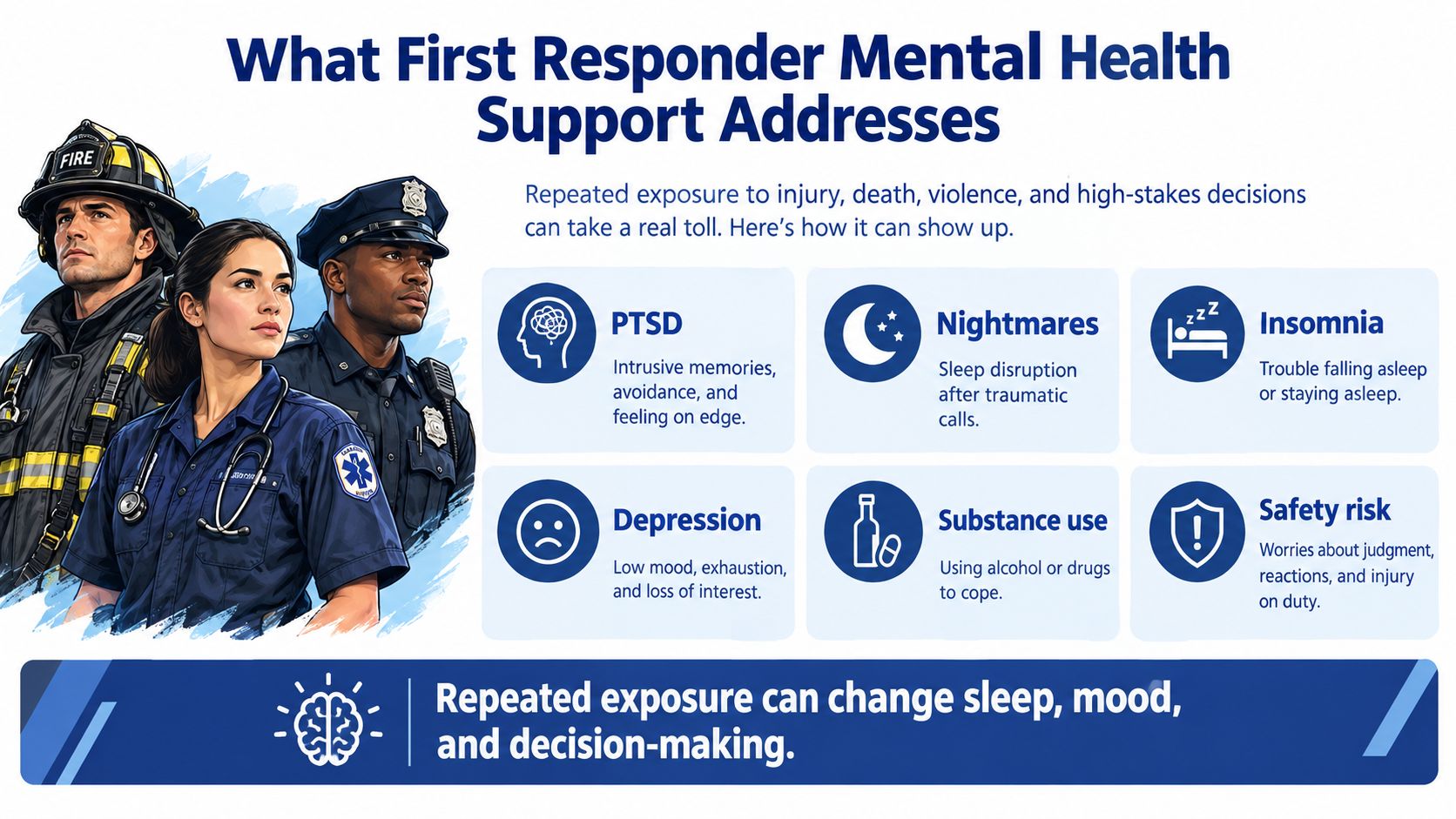
Support should address trauma, mood, anxiety, sleep, coping, and safety together. Waiting for one unmistakable critical incident can miss the effects of repeated exposure.
Emergency work can involve injury, death, violence, and decisions with serious consequences. A responder's difficulties may not fit neatly into one category. Someone seeking help for nightmares may also describe low mood, drinking, or persistent tension.
The graphic outlines concerns that deserve attention during an assessment.
What the research numbers mean
A systematic review and meta-analysis of ambulance personnel estimated that 11% met PTSD criteria or screening thresholds, 15% experienced depression, 15% experienced anxiety, and 27% experienced general psychological distress.
Those categories shouldn't be added together. They describe different outcomes, and a responder can experience more than one problem. General psychological distress is broader than a single diagnosis.
A SAMHSA bulletin on first-responder behavioral health summarized estimates of approximately 30% among first responders versus 20% in the general population, while sampled police officers after Hurricane Katrina showed PTSD estimates ranging from 7% to 19%.
These findings establish substantial concern, not a universal rate for every Pennsylvania department. Roles, exposure, measurement, and timing differ.
Screening isn't a diagnosis
A screening tool flags symptoms that deserve closer attention. A clinical evaluation examines their context, duration, impact, and possible explanations before a qualified provider determines a diagnosis.
That distinction matters when concentration or exhaustion becomes the main complaint. A provider shouldn't assume every difficulty comes from PTSD, nor treat a questionnaire result as the whole answer.
Trauma-informed mental-health care offers a useful framework for discussing these concerns without making a detailed trauma retelling the starting requirement.
For readers who prefer a video format, the following video provides another resource alongside the written discussion.
Evidence-Based Care for Trauma Sleep and Mood
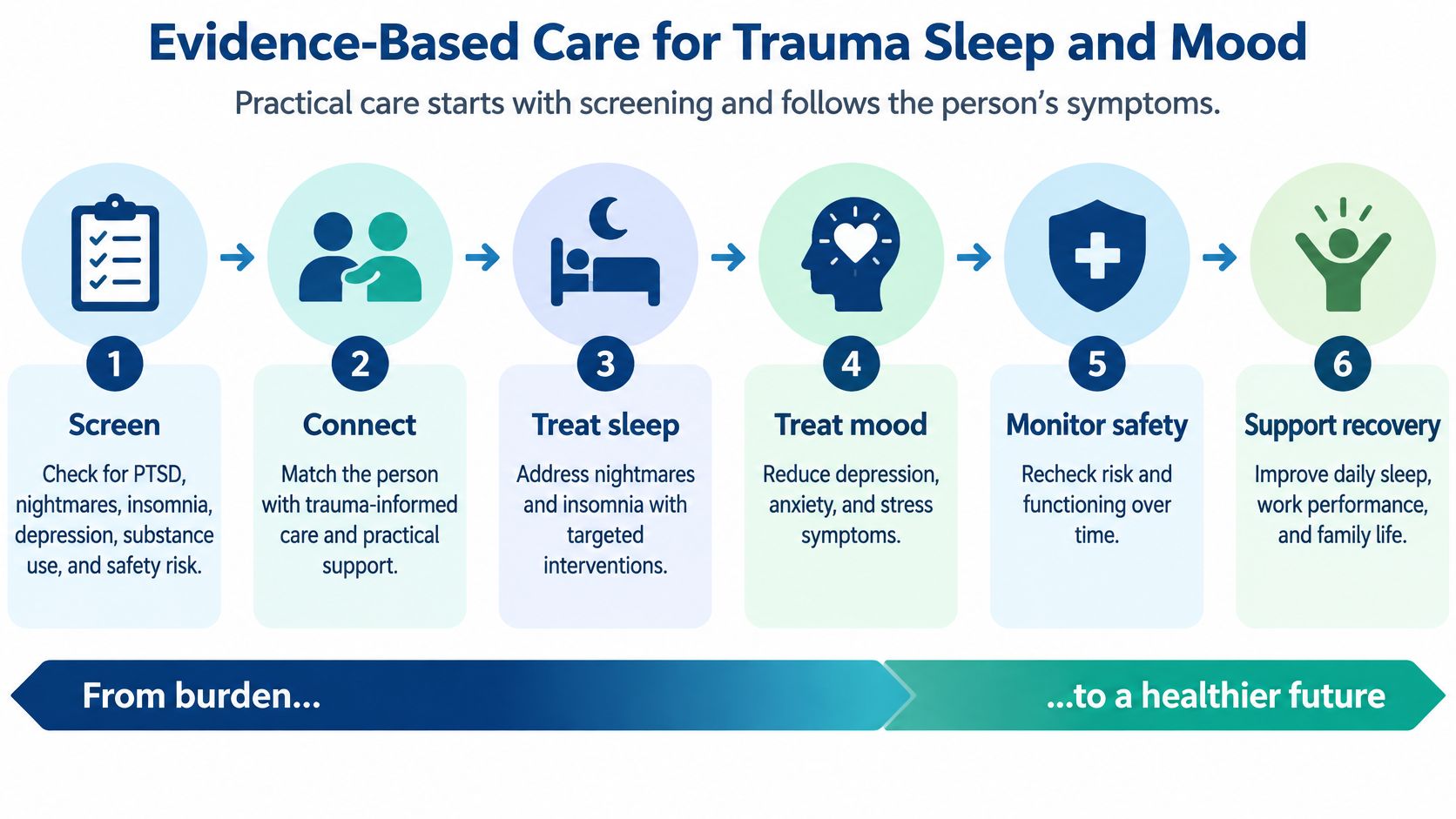
Treatment should follow the responder's symptom pattern, not focus on trauma while leaving sleep and mood unattended. The starting assessment should include PTSD symptoms, nightmares, insomnia, depression, substance use, and safety concerns.
A useful care plan also identifies practical goals. For a shift worker, those might include getting restorative sleep between tours, reducing distressing memories, or participating in family life without feeling constantly on edge.
The care pathway below shows how assessment connects to treatment and follow-up.
Treating trauma and sleep together
A randomized pilot trial involving 49 firefighters tested a culturally adapted four-day group combining written exposure therapy with cognitive behavioral therapy for insomnia and nightmares, plus an individual session before and after; compared with delayed treatment, effects were large for PTSD (Hedges' g = 1.70) and insomnia (g = 1.47) and medium for nightmares (g = 0.72), with improvements, including depressive symptoms, maintained at three months.
Those effect sizes describe differences between study groups. They aren't percentages, and they don't predict a particular patient's result.
The practical lesson is narrower and useful: trauma treatment and targeted sleep treatment can belong in the same plan. The relationship between PTSD and sleep problems deserves explicit attention rather than an assumption that sleep will automatically improve.
What belongs alongside clinical treatment
A randomized trial of SOLAR-m in 163 distressed firefighters found greater improvement in depression, anxiety, and PTSD symptoms than an active mood-monitoring control at eight weeks. That supports a role for accessible digital skills, not replacing assessment when suicidality, severe symptoms, substance use, or impaired functioning is present.
A Pennsylvania telehealth plan may combine:
- Medication management when indicated: Discussion of treatment targets, risks, side effects, and work-related concerns.
- Psychotherapy and sleep care: Matching the intervention to the assessed problems.
- Daily recovery practices: Exercise, nutrition, and mindfulness adapted to actual shift demands.
For optional reading about bedtime routines, Optimal Native's post-shift reset for better sleep may provide discussion points. It isn't a substitute for insomnia treatment.
Follow-up should compare current symptoms and functioning with the starting picture. The pilot's follow-up timing offers a useful reassessment point, not a promise that recovery follows a fixed calendar.
How Peer Support Holds After the First 48 Hours
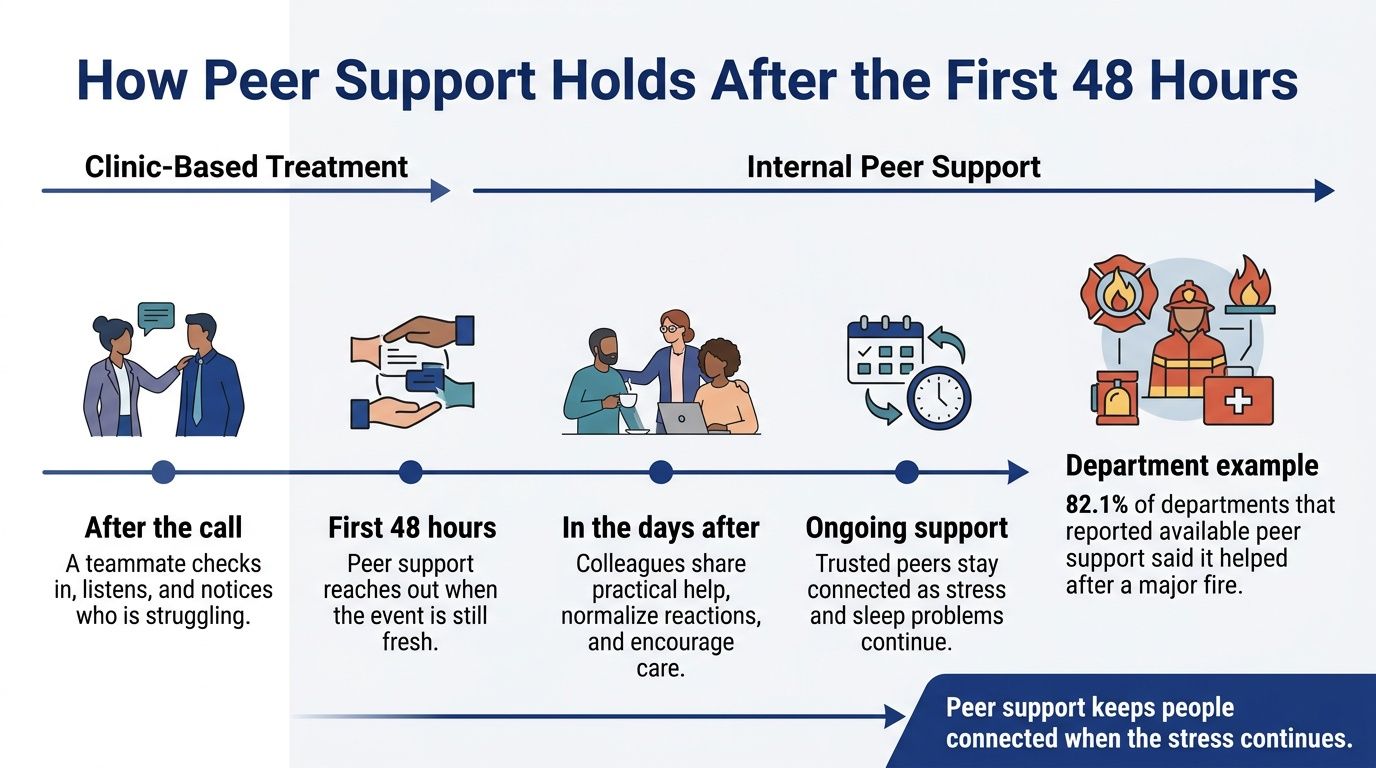
Peer support matters after the initial outreach ends. A trusted colleague can help someone stay connected, notice changes, and take the next step toward care.
Consider a hypothetical crew after a major fire. During the immediate aftermath, teammates check in and offer practical help. Later, the department returns to its normal pace, but one firefighter still avoids sleep because of nightmares.
The timeline illustrates how contact can continue beyond the immediate response.
The quieter period still needs attention
In a study summary involving 745 firefighters, 82.1% of departments reporting available support provided it during the first 48 hours, compared with 51.7% in the following months; support periods coincided with lower anxiety, depression, and PTSD symptoms, and post-fire peer support was associated with lower mental-health-disorder risk.
The larger percentage describes availability during the immediate period, not a treatment success rate. The distinction matters when departments assess whether support actually continues.
A study examining firefighters after a colleague's death found higher mean PTSD symptom scores among those exposed to that loss, 8.34 versus 4.27, and reported that stronger peer support buffered relationships involving emotional damage, alcohol-related problems, PTSD symptoms, and suicide risk.
These findings support continued connection. They don't establish that peer support alone treats PTSD.
Where peer help reaches its limit
A helpful peer conversation can stay concrete: whether sleep has changed, whether drinking has increased, and whether arranging outside care feels possible. It needn't become an investigation or require a detailed retelling.
A review discussing proactive first-responder support describes Resilience First Aid as a strength-based approach involving resilience skills, peer support, and recognition of suicide risk. Resilience shouldn't mean tolerating unsafe workloads or hiding distress.
A colleague can help someone reach care without becoming that person's clinician.
Worsening sleep, intrusive memories, escalating substance use, or thoughts of suicide call for clinical assessment, with urgent help when safety is uncertain. A spouse or household member may participate in supportive conversations when appropriate, but shouldn't carry responsibility for monitoring suicide risk.
Who Can See Your Mental Health Records
Privacy depends partly on how care begins, how it is paid for, and what information the service agrees or must disclose. Self-referred treatment, employer-funded counseling, and a fitness-for-duty review aren't interchangeable.
A systematic review of first-responder treatment barriers found that 33.1% endorsed mental-health-care stigma, with confidentiality concerns and perceived career consequences among common barriers. Scheduling and uncertainty about where to obtain help also mattered.
A useful response is a privacy map, not a promise of absolute secrecy. Before disclosing trauma details, a responder can ask the provider to explain the particular pathway.
A Pennsylvania privacy map
| Pathway or record | What needs clarification |
|---|---|
| Private self-referral | Who maintains the treatment record, who can access it, and what permissions govern sharing? |
| Employer-sponsored care | Does the program require a referral, confirm attendance, or provide information to the employer? |
| Insurance billing | What appears on claims or an explanation of benefits, and who can view those records? |
| Mandated reporting or safety disclosure | Which legal or imminent-risk circumstances may require disclosure? |
| Fitness-for-duty evaluation | Who requested the evaluation, what question it answers, and who receives the findings? |
Employer-funded services may involve referral or payment records. That doesn't make them inappropriate, but it makes clear explanations essential.
Private payment also shouldn't be treated as a guarantee that no record exists. The provider should explain documentation and disclosure policies regardless of the payment method.
Questions before the appointment
A short checklist can make the conversation easier:
- Documentation: What information enters the clinical record?
- Access: Who may receive records, attendance information, or a summary?
- Billing: How does the service appear on statements and insurance documents?
- Exceptions: What circumstances could require disclosure without ordinary permission?
- Workplace separation: Is this treatment, an employer-directed evaluation, or both?
Rules and obligations may differ across police, fire, EMS, volunteer departments, and military-adjacent roles. Individual circumstances deserve a specific answer rather than assumptions based on a colleague's experience.
A guide to HIPAA compliance in telehealth can support that discussion. A secure video platform addresses part of privacy, but billing records, releases, and evaluation purpose still need separate clarification.
Choosing Virtual Psychiatric Care in Pennsylvania
The appropriate route depends on urgency, treatment needs, privacy preferences, and appointment feasibility. An employee-assistance program, outside telehealth practice, and emergency service serve different purposes.
Virtual access alone doesn't ensure that someone starts treatment. In a stepped telehealth study of first responders, 99 participants screened positive for a mental-health risk, but only 56, or 56.6%, completed the offered appointment; shift work, mandatory staffing, limited appointment time, stigma, and professional concerns complicated access.
Three Ways Pennsylvania First Responders Can Get Care
| Care route | Who starts it | Schedule fit | What others may see | Best used when |
|---|---|---|---|---|
| Department or employee-assistance program | The responder or an employer referral | Depends on program access | Referral, attendance, or payment information may exist; policies need review | The program offers a suitable level of support with understood privacy terms |
| Private telehealth outside the chain of command | The responder contacts a practice | Appointment availability must match duty and rest periods | Clinical and billing records remain subject to applicable policies and disclosure rules | Non-emergency evaluation and ongoing treatment are needed |
| Emergency or crisis care | The responder, another person, or emergency personnel | Urgency takes priority over routine scheduling | Safety-related information may need sharing | Immediate danger or inability to remain safe requires urgent assessment |
For someone considering telepsychiatry in Pennsylvania, practical questions include rescheduling after mandatory overtime, finding a private location, and arranging follow-up. No practice should be assumed to offer appointments outside its stated availability.
What IPA offers
IPA is one Pennsylvania option for statewide virtual psychiatric care, including specialized support for first responders. Christopher Clark, MSN, PMHNP-BC, leads the practice as a board-certified psychiatric mental health nurse practitioner with emergency trauma and hospice experience.
Visits use secure, HIPAA-compliant telehealth. A patient portal supports messages, appointment requests, and refill requests; it shouldn't be treated as an emergency response service.
Care can include evaluation and treatment for PTSD, anxiety, depression, ADHD, OCD, and substance-use concerns. When appropriate, opioid-dependence care can include Suboxone with counseling, while whole-person planning can incorporate exercise, nutrition, and mindfulness.
Before booking, prospective patients can request provider information and insurance verification through the practice. Benefits, copays, deductibles, network status, and authorization requirements vary by plan and aren't guaranteed.
Anxiety or PTSD symptom checkers can provide optional preparation. Their role is organizing concerns, not establishing eligibility, diagnosis, or a medication plan.
What to Do Next in Pennsylvania
The next action should match safety first, then the level of support needed. A routine appointment isn't the appropriate starting point when someone cannot remain safe.
For immediate danger, 911 is the emergency route. For thoughts of suicide or a mental-health crisis, the 988 Suicide and Crisis Lifeline provides a crisis-support pathway; someone unable to stay safe needs urgent help rather than waiting for routine scheduling.
A manageable preparation sequence
For non-emergency care, preparation can fit into a day off without requiring a complete personal history.
- Write down the changes. A short note about sleep, mood, alcohol or drug use, and relationships gives the provider a starting picture. Describing what has changed is more useful than trying to select the correct diagnosis.
- Gather treatment information. A medication list, prior treatment experience, and relevant medical concerns can support the evaluation. Supplements and substances belong in that discussion too.
- Identify schedule limits. Rotating shifts, mandatory overtime, and realistic rest periods should shape appointment planning.
- Bring the privacy checklist. Written questions make it easier to get clear answers before discussing sensitive details.
The next conversation may involve a trusted peer, a family member, or an outside clinician. That choice should reflect the concern rather than pressure to use a particular department pathway.
Turn preparation into contact
An anxiety or PTSD symptom checker, grounding exercise, or mood tracker may help organize the appointment agenda. These optional tools don't replace assessment and shouldn't delay urgent care.
A treatment evaluation isn't the same as a fitness-for-duty review. Prospective patients should confirm the service's purpose, any employer involvement, and the intended recipients of information before proceeding.
For Pennsylvania non-emergency care, the practical administrative step is insurance verification or a question about cash and membership options. An inquiry can also clarify provider credentials, scheduling, and whether the practice can address the concerns described.
A realistic starting goal: Arrange an appropriate assessment, not a guaranteed diagnosis, prescription, or recovery deadline.
One task completed today is enough to begin. A brief appointment inquiry containing schedule constraints and privacy questions can turn an unclear intention into a concrete next step.
Integrative Psychiatry of America offers statewide Pennsylvania telehealth evaluations and ongoing psychiatric care, including support for first responders facing trauma-related symptoms, sleep difficulties, and mood concerns. Prospective patients can visit Integrative Psychiatry of America to verify insurance or ask about payment options, clarify privacy questions, and request a non-emergency appointment.