
A person can feel exhausted, unmotivated, and mentally foggy, yet still lie awake because the mind won't settle. A missed deadline then looks like laziness, a forgotten conversation looks like carelessness, and difficulty starting a routine task gets labeled “depression” or “ADHD” before anyone asks when the pattern began.
Depression and poor concentration often overlap, but the overlap doesn't create an either-or diagnosis. The attention problem may come from depression, reflect a longstanding developmental pattern of ADHD, or result from both conditions operating together. A careful evaluation follows the timeline, the settings affected, the relationship to mood and sleep, and the cost to daily functioning.
Table of Contents
- When Focus Slips and Mood Drops Together
- Why Depression Itself Disrupts Concentration
- How ADHD and Depression Patterns Actually Differ
- Why ADHD and Depression Frequently Coexist
- What a Real Psychiatric Evaluation Actually Looks At
- Sleep Stress and the Functional Cost Behind the Symptoms
- A Hypothetical Case When the Real Story Emerges
- How Pennsylvania Telehealth Can Clarify the Overlap
When Focus Slips and Mood Drops Together
Sarah, a hypothetical 34-year-old project manager, sought help after several months of low mood. She couldn't finish reports, missed meetings, and lost the thread of conversations. An antidepressant improved her tearfulness and energy, but she still opened the same document repeatedly without completing it.
Her clinician initially described the remaining difficulty as residual depression. A fuller history revealed something more complicated. Sarah had misplaced school materials as a child, delayed tedious assignments for years, and relied on frantic deadline pressure long before her first depressive episode. The mood problem was new. The disorganization wasn't.
Three possible explanations
Poor concentration can fit several clinical pictures:
- Depression alone: Attention worsens during a depressive episode, alongside low mood, loss of interest, fatigue, sleep changes, guilt, slowed thinking, or indecision.
- Longstanding ADHD uncovered by depression: Chronic problems with organization, time management, forgetfulness, and follow-through become harder to compensate for when mood and energy decline.
- Both conditions: A persistent ADHD pattern forms the baseline, while depression adds fatigue, hopelessness, loss of pleasure, and an extra layer of cognitive slowing.
Timeline rule: The most useful first question often isn't “Which symptom is present?” It's “When did this symptom become part of the person's life?”
A single label can fail in either direction. Calling every attention problem depression may leave ADHD-related executive dysfunction untreated. Calling every low-motivation problem ADHD may miss a mood disorder that needs prompt attention, especially when hopelessness or thoughts of death appear.
The answer usually emerges from the sequence. Did concentration deteriorate when mood fell, or did it create problems across childhood, school, work, home, and relationships before depression appeared? That distinction won't establish a diagnosis by itself, but it gives the evaluation a more reliable starting point.
Why Depression Itself Disrupts Concentration
Depression can directly impair thinking and concentration. The DSM-5 symptom criteria for major depressive disorder explicitly include a “diminished ability to think or concentrate.” Diagnosis requires five of nine symptoms, so concentration problems can be part of the central depressive picture rather than a minor side effect.
A depressive episode can make ordinary mental tasks feel physically heavy. A person may reread a paragraph without retaining it, lose a sentence halfway through speaking, or sit with an email because every decision feels unusually difficult. Clinical reviews describe cognitive effects across executive function, learning, memory, processing speed, attention, and concentration (review of cognitive dysfunction in depression).
Brain fog versus measurable slowing
“Brain fog” describes a person's experience, not a separate diagnosis. Some people notice distractibility, while others mainly notice slower recall, indecision, or difficulty shifting between tasks. Testing may identify slower responses or weaker performance on attention and interference tasks, even when the person doesn't describe feeling sad first.
Neurobiology helps explain the experience without solving the diagnostic question. Depressive states can disrupt brain systems involved in attention, motivation, working memory, and reward, which makes sustained effort harder. The practical clue is the relationship to the mood episode. If concentration worsens with anhedonia, fatigue, sleep disruption, psychomotor change, guilt, or hopelessness, depression becomes more plausible.
Mood tracking can make that relationship easier to see. A person may use a simple daily record to log mood changes for insight, noting sleep quality, energy, focus, motivation, and major stressors without treating the record as a diagnostic test.
The pattern also has limits. Cognitive symptoms may not disappear immediately when mood improves, so persistent inattention deserves reassessment rather than an automatic conclusion that the original diagnosis was wrong. Clinicians compare the timing of symptoms, broader depressive signs, childhood history, and functioning across settings.
How ADHD and Depression Patterns Actually Differ
Depression-related inattention usually develops or worsens with mood symptoms. ADHD generally reflects a longstanding developmental pattern that affects more than one setting. Both conditions can cause procrastination, forgetfulness, low motivation, trouble completing tasks, and poor concentration, so symptom timing carries more weight than any single complaint.
The adult ADHD symptoms overview can help a reader organize concerns before an appointment, but a symptom list can't establish the diagnosis. The comparison below shows the clinical pattern clinicians try to clarify.
| Feature | Depression Pattern | ADHD Pattern | Combined Pattern |
|---|---|---|---|
| Onset | Attention problems appear during or around a depressive episode | Attention and organization problems trace back to childhood or adolescence | Lifelong attention problems become worse during depressive episodes |
| Persistence | Symptoms may fluctuate with mood and energy | Difficulties persist across work, home, school history, and relationships | A chronic baseline remains, with mood-related deterioration |
| Mood relationship | Focus worsens with sadness, anhedonia, fatigue, guilt, or hopelessness | Distractibility often increases with boredom, low stimulation, or competing rewards, even when mood is neutral | ADHD-related frustration and depressive symptoms reinforce each other |
| Typical experience | Slowed thinking, indecision, mental fog, reduced interest | Time blindness, disorganization, task switching, losing items, inconsistent attention | Chronic executive dysfunction plus depressive slowing and loss of pleasure |
| Improvement clue | Concentration may improve as the depressive episode lifts | Attention problems remain after mood improves | Mood improvement reveals residual ADHD symptoms |
What “across settings” means
A clinician may ask whether a person struggled with instructions at school, household routines at home, and deadlines at work. ADHD becomes more likely when the pattern is persistent and cross-situational, accompanied by disorganization, forgetfulness, impulsivity, or restlessness.
A person with depression may have previously managed these responsibilities adequately, then lose capacity during an episode. Stress, poor sleep, anxiety, medication effects, and medical conditions can complicate either picture.
Practical focus strategies can offer short-term support while assessment continues. For example, Pretty Progress focus advice may help organize tasks, but coping tools don't determine whether the underlying problem is ADHD, depression, both, or another condition.
Why ADHD and Depression Frequently Coexist
ADHD and depression often occur together, which makes dual assessment clinically important. In the National Comorbidity Survey Replication, major depression affected 18.6% of adults with ADHD versus 7.8% of adults without ADHD, with an odds ratio of 2.7 (adult ADHD and comorbidity findings). Reviews report depression in people with ADHD across a broad range of 18.6% to 53.3%, while ADHD among people with depression has been reported around 9% to 16%, reflecting variation across samples and settings.
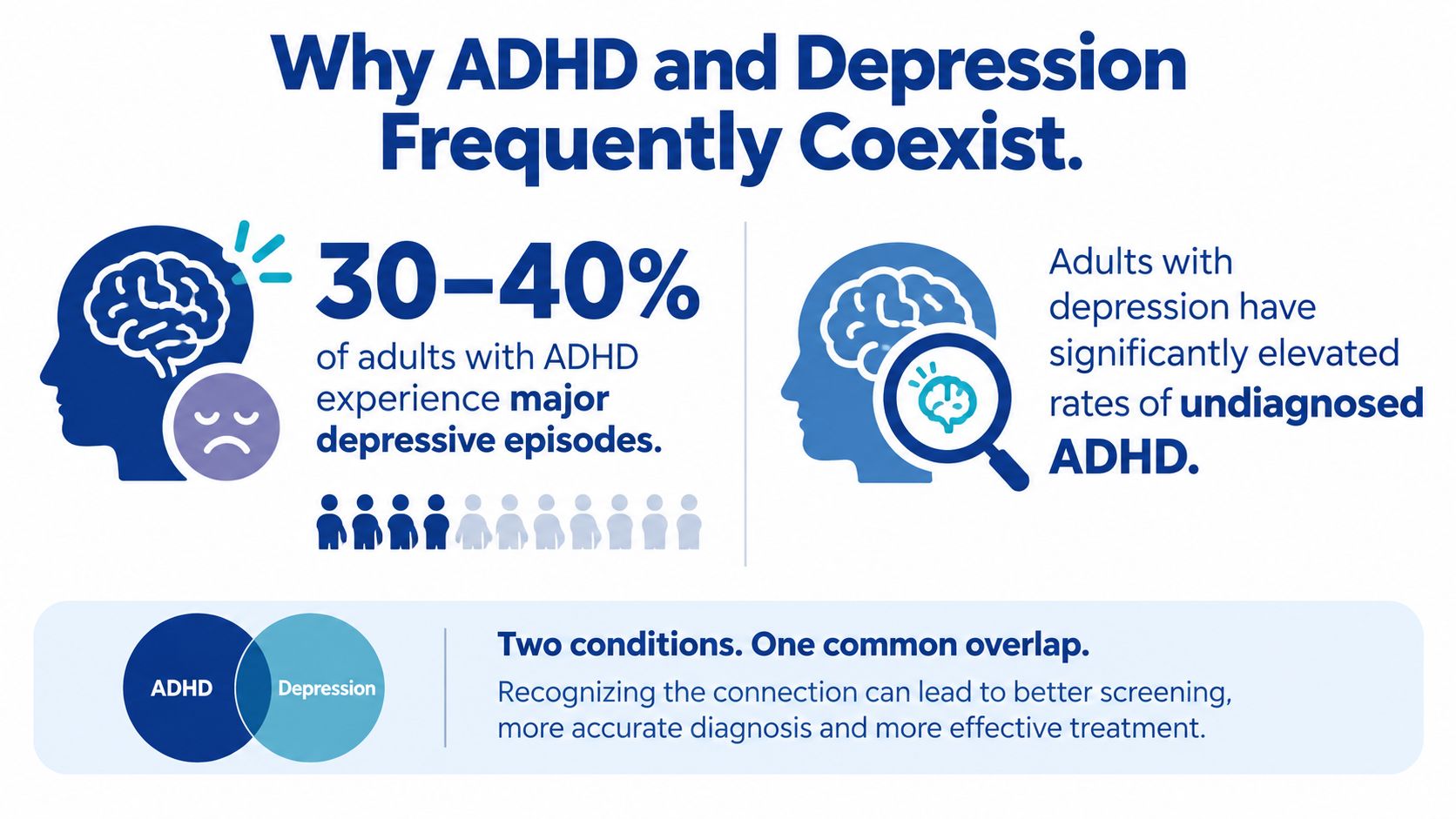
Those figures don't tell a person which diagnosis applies. They show why clinicians shouldn't assume that one condition excludes the other. A person may have chronic ADHD-related difficulty with starting, planning, and finishing tasks, then develop depression after repeated failures, conflict, exhaustion, or loss of confidence.
What coexistence can look like
A typical week may include missed deadlines caused by longstanding time-management problems. The consequences then trigger shame, hopelessness, withdrawal, and reduced pleasure. Restless or non-restorative sleep can intensify fatigue and make both the attention problem and mood symptoms feel worse.
Research on combined ADHD and depressive symptoms describes greater burden across areas such as processing speed, delayed verbal recall, and set-shifting than in ADHD alone (neurocognitive findings in ADHD and depression). In plain language, the person may not only lose focus. Switching tasks, remembering spoken information, and recovering from a setback may also become harder.
The practical implication is sequencing, not oversimplification. If depression is severe or unstable, clinicians may prioritize mood and safety before interpreting residual attention symptoms. If chronic inattention remains after mood improves, ADHD may deserve a closer evaluation. A treatment plan can address both, but the order and pace depend on severity, risks, sleep, medical factors, and patient preference.
Readers seeking Pennsylvania care for overlapping symptoms can review co-occurring ADHD, anxiety, and depression services in Philadelphia.
What a Real Psychiatric Evaluation Actually Looks At
A screening questionnaire is a starting point, not a diagnosis. ADHD criteria require symptoms for at least six months, impairment, and at least five symptoms in one or both symptom domains for adults, according to the Merck Manual ADHD criteria. Concentration alone doesn't meet that standard.
The questions behind the score
A careful evaluation commonly examines:
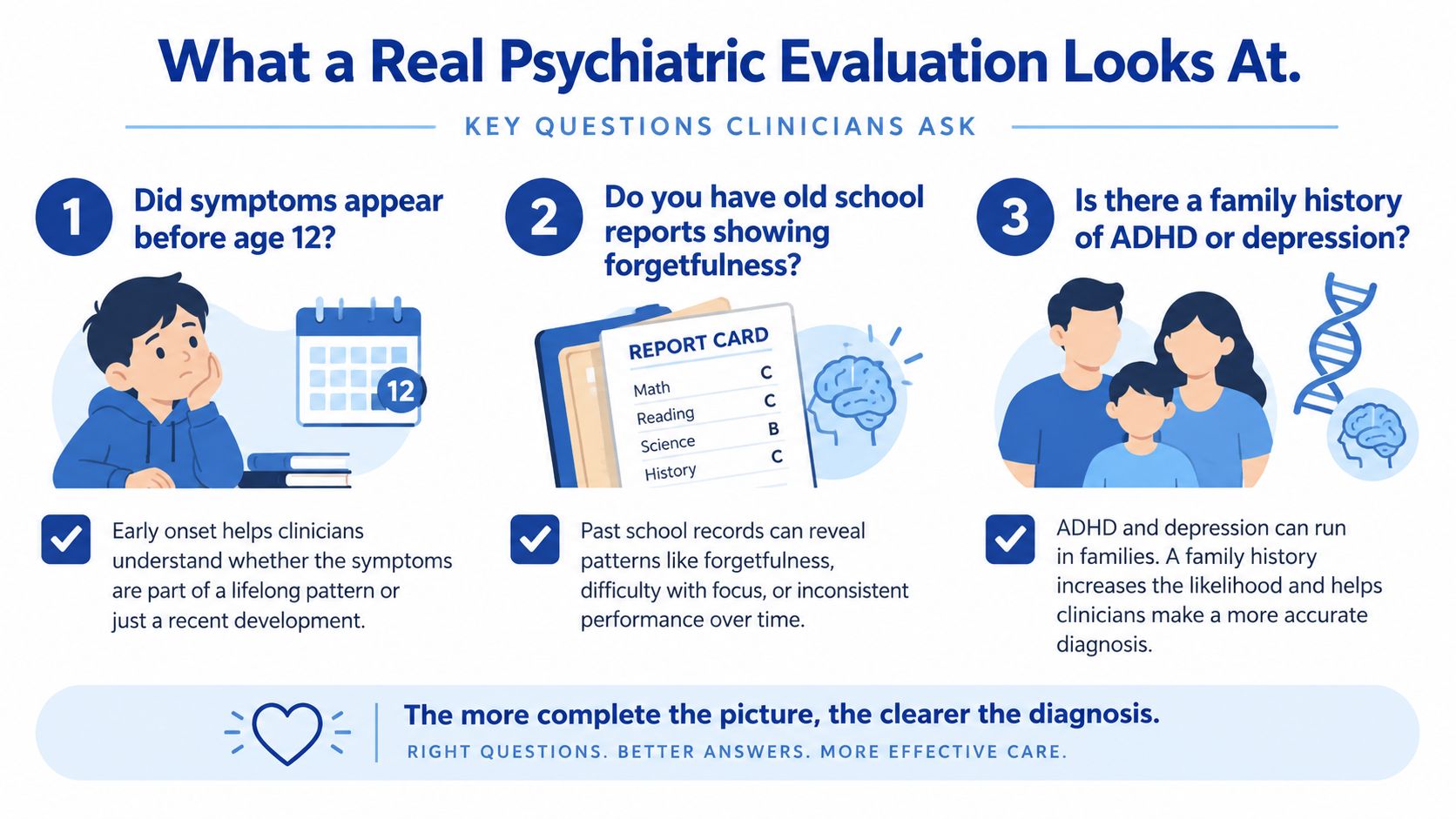
- Developmental history: Did forgetfulness, distractibility, disorganization, or impulsivity appear in childhood? Old report cards, school comments, and family recollections can provide useful context.
- Cross-situational impairment: Does the pattern affect work, home responsibilities, relationships, school history, or driving? A difficulty limited to one stressful environment may need a different interpretation.
- Symptom timing: Did concentration change during a depressive episode, or has it been present for as long as the person can remember?
- Mood and safety: Are there loss of pleasure, hopelessness, guilt, sleep or appetite changes, psychomotor changes, or suicidal thoughts?
- Other contributors: Clinicians review sleep, anxiety, trauma, substance use, medications, and medical conditions.
Tools such as the Adult ADHD Self-Report Scale and PHQ-9 can organize symptoms. Neither questionnaire can separate ADHD from depression on its own, and neither replaces an interview.
A clinician may request collateral information from a partner, parent, or another person who has observed functioning over time. The trade-off is time. A longer assessment can feel demanding, but it offers more opportunity to distinguish a developmental pattern from a mood-linked change.
A medical workup may be considered when fatigue or cognitive difficulty suggests another contributor. Thyroid studies, a complete blood count, metabolic testing, or vitamin testing may be appropriate based on history and symptoms. These tests can identify or rule out some contributors, but they don't diagnose ADHD or depression, and no routine genetic test reliably makes that distinction.
The adult ADHD testing and evaluation pathway can help readers understand why history matters more than a single score.
Sleep Stress and the Functional Cost Behind the Symptoms
Sleep and stress can mimic, amplify, or conceal both depression and ADHD. A person who sleeps poorly may think more slowly, forget instructions, lose emotional control, or struggle to begin tasks. Those effects can resemble depressive fatigue or ADHD-related inattention, so sleep assessment belongs near the center of the evaluation.
Chronic stress adds another layer. Ongoing work pressure, caregiving, financial strain, relationship conflict, or untreated anxiety can consume working memory and reduce task persistence. A person may appear inattentive because the mind is occupied by threat, rumination, or exhaustion rather than because one specific diagnosis explains every symptom.
Functional impairment is clinical evidence
Clinicians look beyond symptom labels and ask what the problem costs:
- Work: missed deadlines, incomplete reports, performance concerns, or repeated errors.
- Home: unpaid bills, forgotten appointments, unfinished chores, or disrupted routines.
- Relationships: missed conversations, withdrawal, irritability, or conflict over follow-through.
- Health: inconsistent sleep, skipped meals, missed medication, or difficulty attending care.
These consequences help determine severity and guide treatment priorities. A staged plan may first address acute depression, immediate safety concerns, severe sleep disruption, or destabilizing substance use. Once those factors improve, residual attention symptoms become easier to interpret.
Sleep-disordered breathing can also contribute to daytime fatigue and concentration problems, especially when there is snoring, witnessed breathing pauses, morning headache, or non-restorative sleep. Information about non-invasive sleep apnea treatment options may help a patient prepare questions for a medical evaluation.
Treatment sequencing involves trade-offs. An ADHD medication may not be the first step during severe mood instability or untreated insomnia, while delaying attention-focused care can prolong functional harm. The plan should specify what will be monitored, such as sleep continuity, task completion, mood, appetite, anxiety, and safety.
Readers can also review why depression can cause insomnia when sleep and mood symptoms appear to move together.
A Hypothetical Case When the Real Story Emerges
Hypothetical example, not an IPA patient case: Maya is a 38-year-old project manager who seeks care after a second episode of low mood. During both episodes, she feels slowed down, cries more easily, loses interest in social plans, and struggles to concentrate. Depression is a reasonable initial concern because the attention problem worsens alongside clear mood symptoms.
The history fills in missing years
Maya's early school reports describe forgetfulness and incomplete work despite adequate understanding. Her family remembers a child who lost belongings, needed repeated instructions, and postponed boring assignments until the last possible moment. In adulthood, she has changed jobs successfully, but every role has required elaborate reminders, last-minute effort, and constant rescue from deadline chaos.
Those difficulties didn't begin with depression. They appeared across school, home, and work, and they remained present during periods when Maya felt hopeful and enjoyed life. The developmental pattern supports a closer ADHD evaluation, while the episodic loss of pleasure, tearfulness, fatigue, and hopelessness supports depression as a separate concern.
An antidepressant trial improves Maya's energy and tearfulness. Her disorganization, restless task switching, and difficulty estimating time remain largely unchanged. That response doesn't prove ADHD, and it doesn't invalidate the depression diagnosis. It signals that the clinical picture may contain more than one process.
What the case teaches
Treating the most obvious or urgent condition first can be reasonable. Stopping there can miss the longstanding pattern that shaped a person's education, career, relationships, and self-image.
A thorough review would examine current impairment, childhood evidence, family history, sleep, anxiety, substance use, medication effects, and medical contributors. If both conditions are confirmed, an individualized plan might combine medication when clinically appropriate, psychotherapy, executive-function strategies, steadier sleep and meal routines, gradual physical activity, or brief mindfulness practices. Not every patient needs every intervention, and treatment response varies.
The useful outcome measure is functional rather than numerical. Can Maya follow through more consistently, manage routines with less crisis-driven effort, concentrate more reliably, and experience fewer depressive symptoms? Those changes guide reassessment better than a single score or a promise of a particular result.
How Pennsylvania Telehealth Can Clarify the Overlap
A Pennsylvania telehealth evaluation can distinguish depression, ADHD, both conditions, or another contributor by reconstructing the person's history and current impairment. Telehealth doesn't turn a questionnaire into a diagnosis. It provides a setting for a structured clinical interview, record review, validated tools when appropriate, and follow-up observation over time.
The first visit may be more detailed than a routine medication check. A clinician can ask about developmental milestones, school report patterns, childhood behavior, job changes, relationship effects, sleep, stress, substance use, medical history, and previous treatment responses. The central question remains whether attention problems existed before mood episodes and whether they occur across settings.
What the process can include
A clinician may:
- Clarify the differential: The working possibilities can include ADHD, depression, both, anxiety, sleep-related impairment, medication effects, substance-related symptoms, or a medical cause.
- Review supporting information: Records, school documents, family or partner observations, and symptom questionnaires can add context. They support clinical reasoning but don't replace it.
- Assess treatment response: Improvement in tearfulness with persistent disorganization may prompt reassessment, while improved focus with ongoing hopelessness may indicate untreated mood symptoms.
- Build a staged plan: Options can include psychotherapy, medication when indicated, sleep support, routines, executive-function strategies, and scheduled markers for review.
The practice's telepsychiatry overview explains how virtual psychiatric care can support assessment and follow-up. Pennsylvania adults can also compare psychiatric care services, psychology care, integrative care for ADHD, anxiety, and depression, and online ADHD treatment with insurance. Insurance benefits, deductibles, copays, network status, and authorization requirements vary by plan, so benefit verification should happen before treatment begins.
The next step is to collect old school records if available, note when concentration changed, list sleep and mood patterns, and document concrete functional costs. A Pennsylvania telehealth evaluation through Integrative Psychiatry of America can help adults turn that history into a clearer diagnostic and treatment discussion.
Integrative Psychiatry of America provides secure virtual psychiatric care across Pennsylvania, including evaluation and treatment planning for overlapping ADHD and depression symptoms. Adults seeking clarification can visit Integrative Psychiatry of America to review care options, verify insurance, and request an appointment.