
A Pennsylvania patient with a Blue Cross Blue Shield card may expect ADHD care to follow the same path as a routine primary-care visit. The first call can quickly prove otherwise. A Philadelphia-area member may learn that an evaluation is subject to one set of behavioral-health rules, while a prescribed stimulant uses a separate pharmacy benefit with its own formulary tier, quantity limit, or prior-authorization process.
That experience doesn't mean ADHD treatment isn't covered. It means “covered” doesn't always mean immediately accessible. Blue Cross Blue Shield includes multiple independent plans, and the patient's licensee, employer group, product type, network, and pharmacy benefit can shape the result.
For Pennsylvania members, a practical starting point is a complete ADHD evaluation in Pennsylvania, followed by plan verification and a treatment discussion that accounts for clinical needs and insurance requirements. The following roadmap explains what usually happens after a BCBS member hands over an insurance card, without promising a coverage outcome that only the specific plan can determine.
Table of Contents
- A Pennsylvania Patient's First Call About Blue Cross Blue Shield ADHD Treatment
- Why Blue Cross Blue Shield Is Not One Single Plan
- What BCBS Plans Typically Require for ADHD Evaluation
- Medication Coverage and Prior Authorization Across BCBS
- How to Verify Your BCBS Benefits for ADHD Care
- Understanding Copays Deductibles and Real Out-of-Pocket Costs
- Medication Management Follow-Up and Refills Under BCBS
- Your Next Steps Toward BCBS-Covered ADHD Care in Pennsylvania
A Pennsylvania Patient's First Call About Blue Cross Blue Shield ADHD Treatment
A newly referred patient from the Philadelphia suburbs calls for an ADHD evaluation expecting a simple answer: the insurance card says Blue Cross Blue Shield, so the visit and medication should be covered. During the benefits conversation, the patient discovers that the plan may treat the evaluation as behavioral health, route prescriptions through a separate pharmacy benefit, and require authorization before a stimulant can be dispensed.
The patient's primary-care visits had been predictable, so the difference feels surprising. ADHD care can involve several distinct services: diagnostic evaluation, psychological testing when clinically indicated, medication management, follow-up visits, and prescription processing. Each service may have its own network rules, deductible treatment, referral requirements, or utilization review.
Practical rule: A BCBS member should verify the exact plan before assuming that a covered clinician, a covered evaluation, and a covered medication all follow the same rules.
The card alone may not identify every relevant detail. A Pennsylvania patient could have Independence Blue Cross, Highmark, an employer-sponsored plan administered elsewhere, an out-of-state Blue plan, or another BCBS product. Even within the same licensee, PPO and HMO designs can differ, as can employer formularies and marketplace plans.
The safest process separates clinical eligibility from insurance payment. A psychiatric provider can determine whether an ADHD evaluation or treatment plan is clinically appropriate and can provide documentation when requested. The insurer still makes the final decision about eligibility, authorization, reimbursement, and member responsibility.
Why Blue Cross Blue Shield Is Not One Single Plan
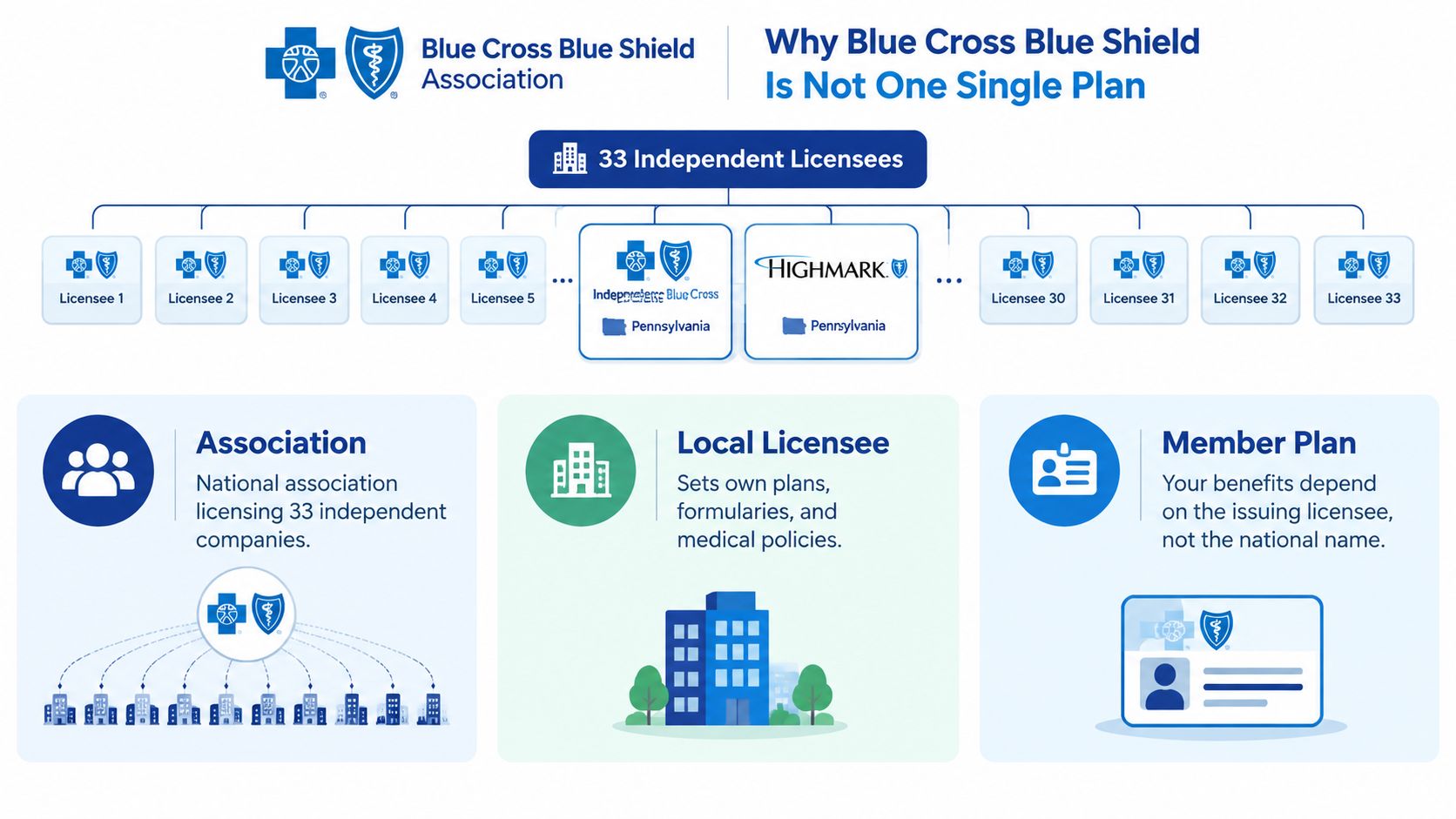
Blue Cross Blue Shield is a federation of independent local licensees, not one national ADHD benefit design. The Blue Cross Blue Shield Association describes a system in which 33 independent licensees operate their own plans and policies, as shown in the required licensee comparison infographic.
Pennsylvania patients most often need to identify whether their coverage comes through Independence Blue Cross or Highmark, while recognizing that other arrangements exist. Independence Blue Cross is associated with southeastern Pennsylvania, including Philadelphia and surrounding communities. Highmark serves central, western, and northern parts of the state through Highmark Blue Shield and Highmark Blue Cross Blue Shield products.
The plan name changes the questions
A member shouldn't stop at “Does BCBS cover ADHD?” The useful questions are more specific:
- Issuing licensee: Is the plan from Independence Blue Cross, Highmark, or another BCBS entity?
- Product design: Is it a PPO, HMO, employer-customized plan, marketplace plan, or another product?
- Behavioral-health benefit: Does the policy cover the proposed evaluation and medication-management visits?
- Pharmacy benefit: Which company manages prescriptions, and which ADHD medications appear on the formulary?
- Network status: Is the psychiatric provider, psychologist, testing service, and pharmacy in network?
An employer group can select a custom formulary, and the same medication may be handled differently across products. A plan may also use separate vendors for behavioral health, pharmacy claims, and telehealth administration. That's why the member's portal and member-services number matter more than the national BCBS name printed on the card.
Patients seeking Independence Blue Cross-specific guidance can review the practice's Independence Blue Cross ADHD resource while still confirming benefits for the exact member plan.
What BCBS Plans Typically Require for ADHD Evaluation
A BCBS-covered ADHD evaluation generally needs more than a symptom checklist. The diagnosing clinician must assess whether symptoms fit established diagnostic criteria, cause meaningful impairment, and aren't better explained by another medical or psychiatric condition.
For adults, an evaluation commonly examines current functioning at work, home, and in relationships, along with evidence that relevant symptoms were present earlier in life. Childhood report cards, family observations, school accommodations, and prior evaluations can help establish the developmental history. A screening tool such as the Adult ADHD Self-Report Scale, Conners forms, or Vanderbilt questionnaires can organize information, but a rating scale alone doesn't establish a diagnosis.
What a thorough evaluation usually covers
A psychiatric provider may assess:
- Attention and executive function: Organization, working memory, task completion, distractibility, and time management.
- Multiple settings: Whether symptoms appear across more than one environment rather than only during one stressful circumstance.
- Functional impairment: Effects on employment, education, household responsibilities, finances, driving, or relationships.
- Coexisting conditions: Anxiety, depression, sleep disorders, substance use, trauma symptoms, and possible bipolar symptoms.
- Medical safety: Relevant cardiac history, current medications, substance exposure, and other factors that could affect treatment.
A brief screen may be reasonable when the presentation is straightforward and the clinical history is clear. A more thorough assessment becomes more important when previous medication trials failed, learning disabilities are suspected, symptoms began recently, or red flags suggest another medical explanation. Depending on the history, the clinician may recommend coordination with primary care or additional medical workup, such as thyroid testing or a cardiovascular review.
Documentation supports medical necessity
Insurance reviewers may look for the confirmed diagnosis, impairment, assessment findings, treatment rationale, and follow-up plan. Pennsylvania plans can also require the diagnosing professional to hold the appropriate license or credentials for the service. Telehealth may be acceptable when the provider is in network and uses a compliant platform, but the plan's rules control reimbursement.
A careful initial evaluation helps later requests because the record can explain why a particular treatment is appropriate. It also protects the patient from being placed on medication when concentration problems stem from untreated sleep disruption, mood symptoms, substance use, or another condition.
Medication Coverage and Prior Authorization Across BCBS
BCBS medication coverage is a plan-specific pharmacy decision. Independence Blue Cross and Highmark products may separate generic, preferred-brand, and nonpreferred medications, while stimulant restrictions can depend on the medication class, dose, age, quantity, and days' supply.
Historical BCBS reporting found that ADHD diagnoses among commercial BCBS members increased by more than 30% over the study period (BCBS analysis summary). Another BCBS report found that in 2017, 6.4 children per 100 BCBS members were diagnosed with ADHD nationwide, compared with 8.1 per 100 members in Massachusetts. The same report stated that about 27% received both medication and therapy, 49% received medication only, and 12% received therapy only (Blue Cross Blue Shield Health of America reporting). Those figures describe historical BCBS populations, not the benefits of a current Pennsylvania member.
Common authorization differences
Adults and children may face different documentation expectations. One Blue Shield commercial stimulant policy uses prior authorization for adults older than 18 and requires adult ADHD confirmation by a mental-health specialist or continuation of treatment that began in childhood. It also addresses FDA-labeled maximum doses and consolidation to the fewest higher-strength dosage forms (commercial stimulant policy).
Blue Cross Blue Shield of Michigan guidance illustrates another approach. It requires members to be at least 6 years old and may require failure or intolerance of two generic or preferred products before a higher-tier medication is approved (BCBS Michigan pharmacy guidelines). These policies shouldn't be treated as Pennsylvania plan rules, but they show why a national yes-or-no answer can mislead.
| Coverage factor | What to confirm | Common supporting documentation |
|---|---|---|
| Formulary tier | Generic, preferred-brand, or nonpreferred status | Medication name, dose, and clinical rationale |
| Prior authorization | Whether approval is required before dispensing | Diagnosis, evaluation, prescriber details, and medical necessity |
| Step therapy | Whether a preferred product must be tried first | Previous medication history, inadequate response, or intolerance |
| Quantity limits | Allowed quantity, strength, and days' supply | Prescription instructions and treatment rationale |
| Denial review | Reason for denial and appeal deadline | Corrected request, records, and supporting clinical notes |
Patients can use online ADHD medication management information to understand the clinical side, but the pharmacy benefit determines the final coverage decision. Independence Blue Cross explains that prior-authorization requests can be submitted electronically through CoverMyMeds or SureScripts, or by fax with supporting information, as described in its pharmacy prior-authorization process.
How to Verify Your BCBS Benefits for ADHD Care
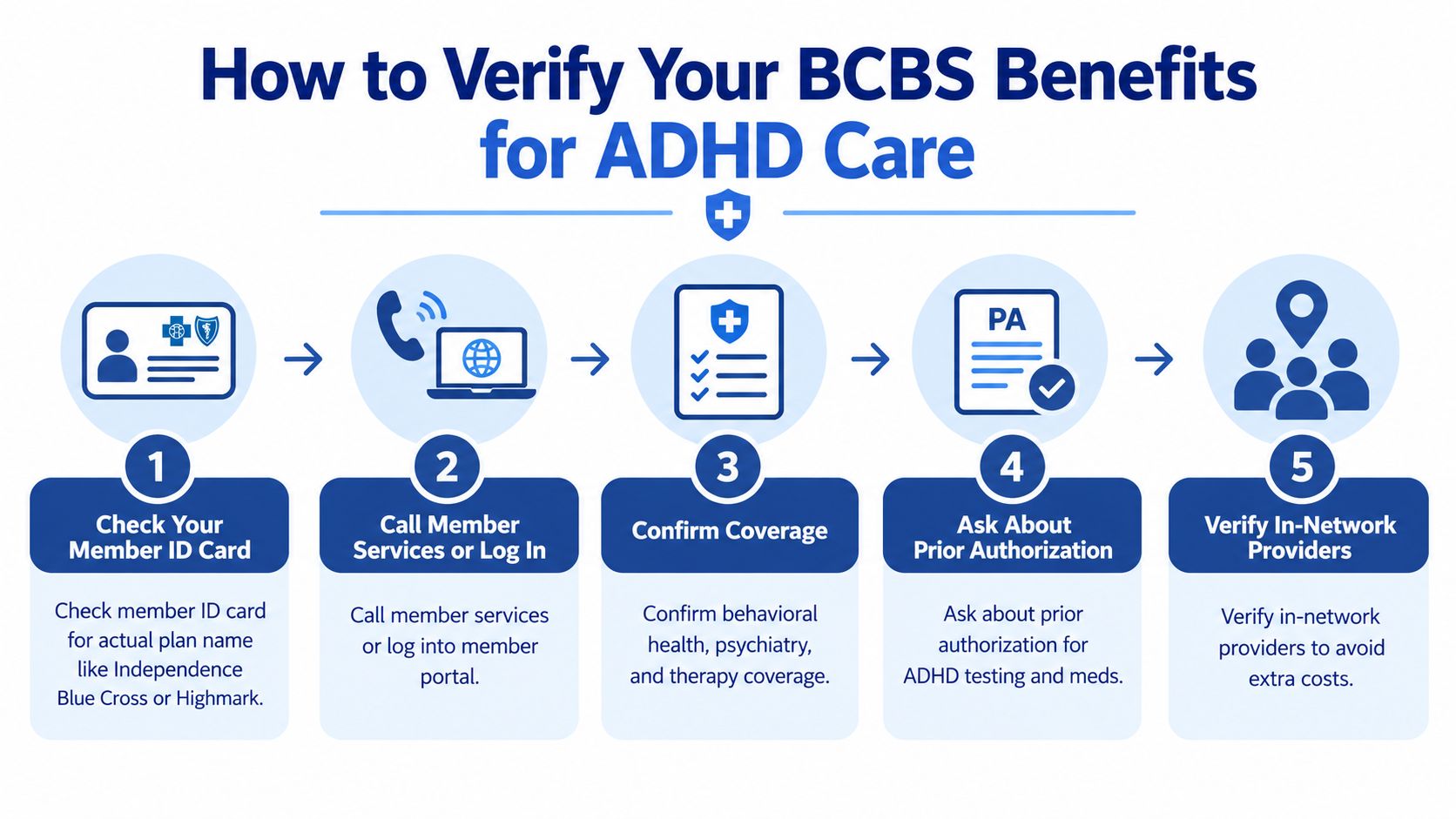
A patient can reduce avoidable delays by verifying the exact benefit before scheduling. The process starts with the member ID card and ends with written or documented confirmation of the questions that matter.
A practical verification sequence
Identify the issuing plan. Record the plan name, member ID, group number, customer-service number, and effective date. “Blue Cross Blue Shield” by itself isn't enough.
Check the portal and call member services. Review the summary of benefits, formulary, deductible, out-of-pocket maximum, specialist benefit, exclusions, and behavioral-health information. The representative can clarify whether a referral or authorization is required.
Ask about each service separately. Confirm coverage for ADHD evaluation, medication management, psychological testing when clinically indicated, and telepsychiatry. Ask whether the specific clinician and practice are in network.
Clarify pharmacy rules. Determine which pharmacy benefit manager handles prescriptions, whether stimulants require prior authorization, whether step therapy applies, and whether quantity limits affect the proposed prescription.
Record the call. Keep the representative's name or identification, call reference number, effective dates, authorization number, approved services, quantity limits, and expiration date. Benefit verification is useful, but it isn't a guarantee of payment.
IPA's general insurance verification process follows the same practical sequence. The patient provides insurance and demographic information, the practice checks eligibility and applicable benefits when possible, and the patient receives available coverage and cost information before completing intake. The patient then supplies ADHD assessment information, attends a telehealth evaluation, and discusses an individualized plan when clinically appropriate. IPA's CADE, or Comprehensive ADHD Diagnostic Evaluation, approach can include access to a PhD psychologist for additional psychological assessment or testing when clinically indicated.
Patients who work in healthcare marketing or administration may also find this health-insurance lead-generation guide from Growform useful for understanding how benefit inquiries are organized before a patient reaches a practice.
Telehealth adds a second layer. Controlled-substance prescribing rules, state requirements, in-person evaluation expectations, and the plan's own pharmacy policy can all affect whether a telehealth-started prescription is reimbursed. A federal BCBS pharmacy policy published for 2026 describes a recurring pattern in which adults 22 and older may face prior authorization review for stimulant ADHD medications, while younger patients may face fewer restrictions unless the dose exceeds FDA limits (2026 methylphenidate policy). That policy isn't a universal rule for every Pennsylvania member.
Understanding Copays Deductibles and Real Out-of-Pocket Costs
The final cost of BCBS ADHD care depends on the contract, employer design, network status, service coding, and benefit year. A patient should estimate costs in layers rather than rely on a general statement that ADHD treatment is covered.
A deductible is the amount a member may need to pay for eligible services before the plan begins sharing costs. Some plans apply a deductible to behavioral-health visits, medication management, laboratory work, or telehealth, while others handle those services differently. A member may owe the allowed amount for an evaluation until the applicable deductible is satisfied.
A copay is usually a fixed amount for a covered in-network visit. Coinsurance is generally a percentage of the plan's allowed amount after the relevant deductible has been met. Out-of-network care can produce a larger member responsibility, and some services may not be covered without required authorization.
Prescription costs follow a separate path
Medication expenses can depend on generic or brand status, formulary tier, quantity limits, pharmacy network, deductible, and pharmacy-benefit design. A preferred generic may have a different member cost from a nonpreferred brand, even when both treat the same condition. Prior authorization can delay dispensing, but authorization alone doesn't establish the patient's final cost.
Members should ask whether the plan has an embedded individual deductible, a shared family deductible, or another structure. They should also ask how the annual out-of-pocket maximum applies to behavioral-health services and prescriptions.
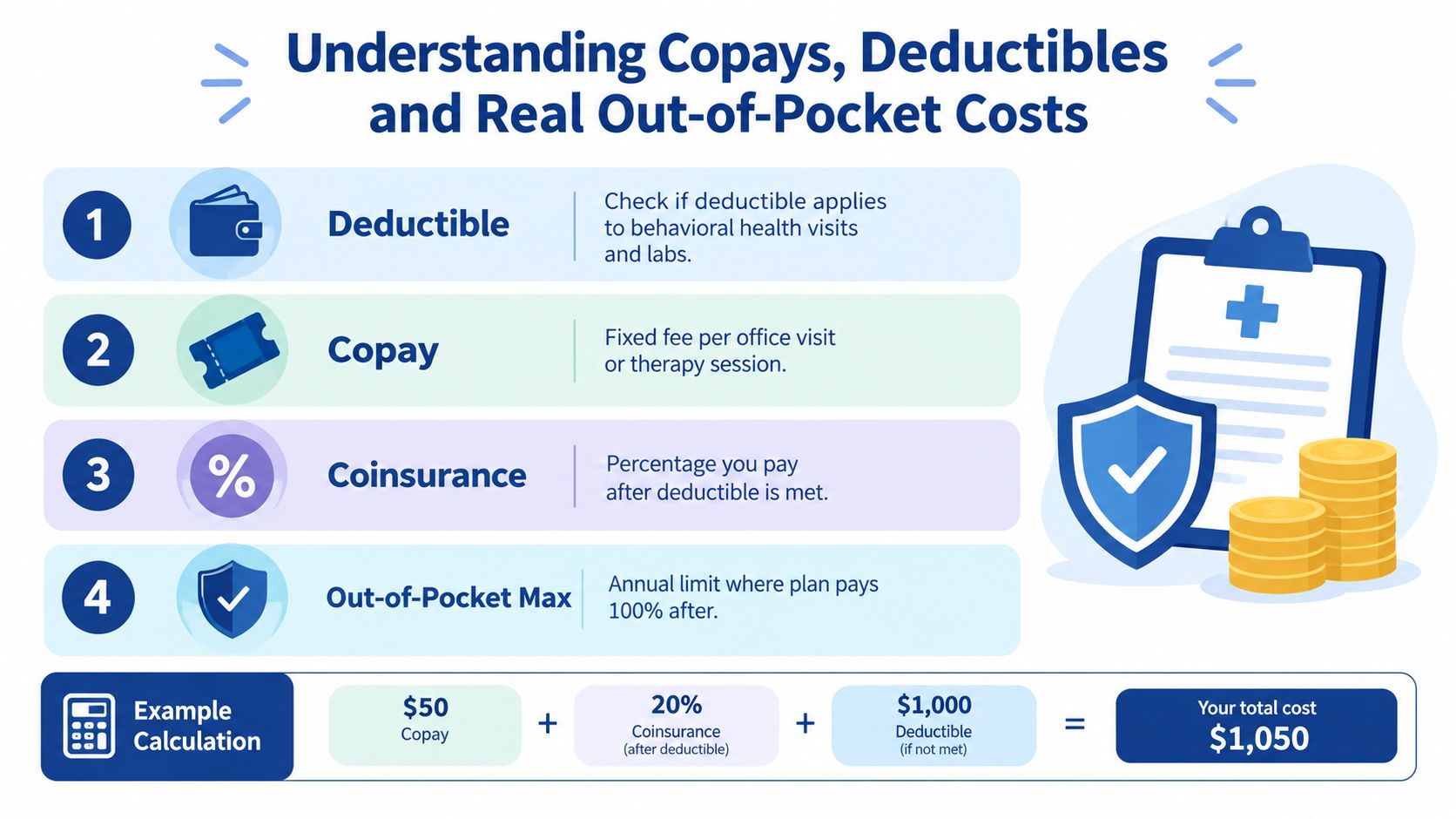
Before an appointment, the patient can request the expected allowed amount, specialist copay, coinsurance, evaluation cost, and medication copay. Explanations of benefits and pharmacy receipts should be saved because the actual bill can change with claim coding, site of care, authorization status, and the timing of the benefit year. IPA can help verify applicable benefits when possible, but the insurer determines the final adjudication.
Medication Management Follow-Up and Refills Under BCBS
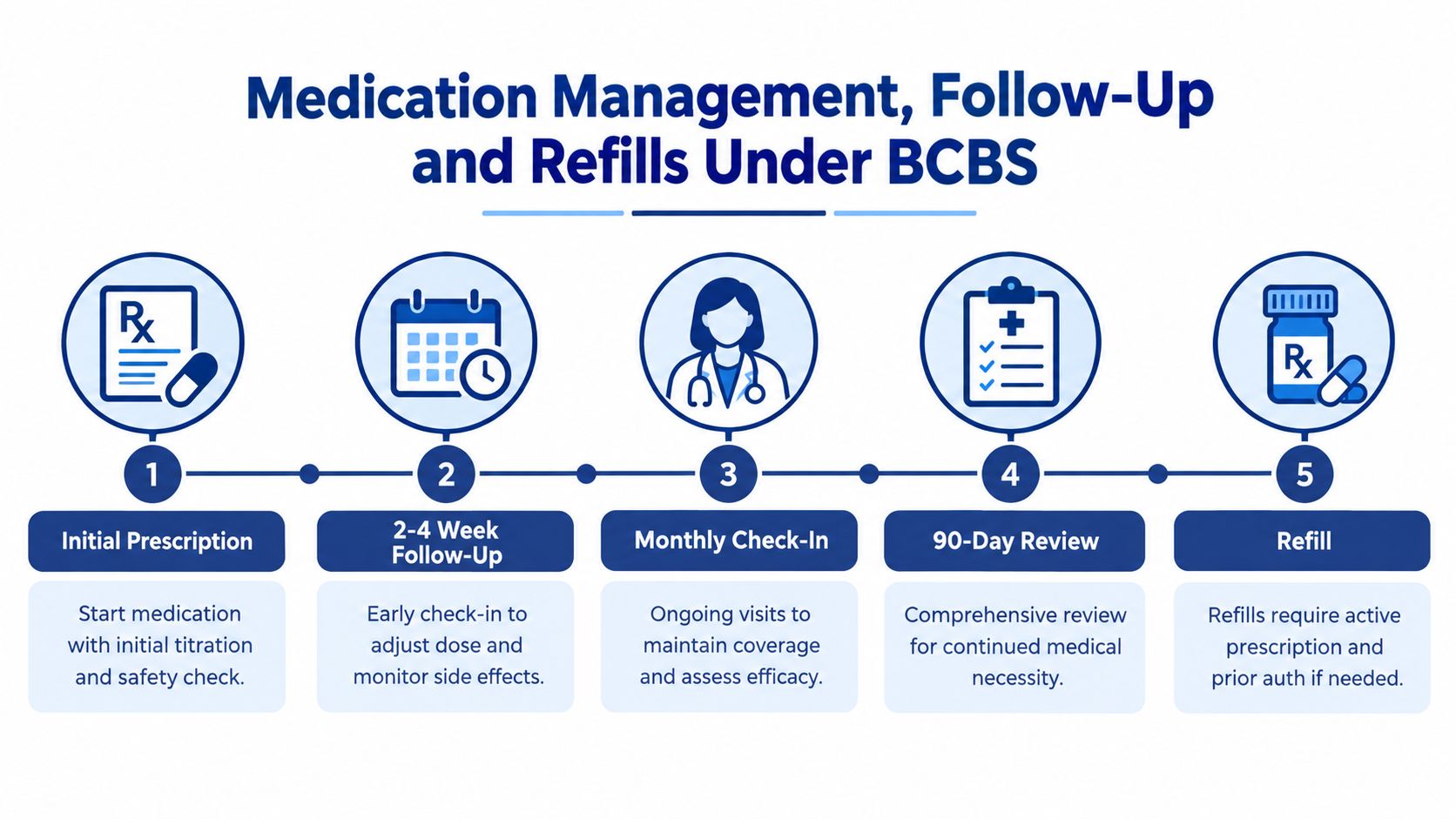
ADHD medication management combines clinical monitoring with administrative timing. After a medication starts, the prescriber needs enough follow-up to assess benefit, side effects, safety, adherence, sleep, appetite, blood pressure, weight, and functioning. The insurer may also need records that support continued medical necessity.
An early follow-up often occurs within 2 to 4 weeks, with later visits occurring every 1 to 3 months once treatment is stable, depending on clinical judgment, medication, patient age, and applicable rules. Those intervals are practical care patterns, not a promise made by every BCBS plan.
What patients should organize
- Before the first prescription: Confirm the medication's formulary status, prior-authorization requirement, quantity limit, and pharmacy routing.
- At early follow-up: Report symptom changes, side effects, sleep, appetite, mood, blood pressure information when available, and problems obtaining the medication.
- Before a refill: Ask when the next visit must occur and whether the prescription requires a current authorization.
- After a prescriber change: Gather prior evaluations, medication history, recent follow-up notes, and prior authorization records so the new provider can assess continuity.
A dose change usually requires a new prescription, but some plans can re-review maintenance stimulant therapy, particularly when the requested dose, concurrent controlled-substance prescriptions, or documentation raises utilization-review questions. Audio-only care may not satisfy every plan or prescribing requirement, even when video telehealth is accepted.
Continuity depends on both sides. The prescriber must document current clinical need, and the member must know when the plan's authorization or prescription window ends.
A plan switch can create friction even when the medication itself hasn't changed. The new plan may require a fresh authorization, a preferred product, or records from the prior clinician. Patients can review the practice's online ADHD medication-management service and ask directly how follow-up, refills, records, and authorization requests are handled.
Your Next Steps Toward BCBS-Covered ADHD Care in Pennsylvania
The most efficient path begins before the first clinical appointment. A Pennsylvania patient should locate the BCBS member card and identify the issuing licensee, whether that's Independence Blue Cross, Highmark Blue Shield, or another plan serving the state.
Next, confirm outpatient mental-health and prescription-drug coverage for the specific policy. The patient should verify that the chosen psychiatric provider or telepsychiatry practice is in network and ask whether the evaluation, medication-management visits, psychological testing, and telehealth services require referrals or prior authorization.
A useful preparation folder
Gather the information that can answer both clinical and insurance questions:
- Insurance identifiers: Member ID, group number, plan name, and effective date.
- Clinical history: Childhood evaluations, school accommodations, previous diagnoses, and prior medication trials.
- Symptom information: Current work, school, home, and relationship impairment, plus relevant rating scales such as ASRS or Vanderbilt.
- Safety details: Current medications, allergies, sleep pattern, substance-use history, mood symptoms, and relevant medical history.
- Administrative records: Explanations of benefits, authorization letters, denial notices, pharmacy messages, and call reference numbers.
The patient should request specific information about the stimulant formulary tier, deductible status, expected copay or coinsurance, quantity limits, and authorization requirements. A verification response can guide scheduling, but it doesn't replace the plan's final claim decision.
Once coverage is reasonably understood, the patient can complete intake and the CADE evaluation process when appropriate. If medication begins, the patient should plan for an early follow-up within 2 to 4 weeks and keep one organized folder for prescriptions, records, and insurance communications. That preparation can make a corrected request or appeal easier if the first authorization is denied.
Integrative Psychiatry of America provides virtual ADHD evaluation, treatment, medication management, and follow-up for eligible Pennsylvania patients, with insurance verification available for applicable BCBS-related plans. Patients can visit Integrative Psychiatry of America to review the appointment pathway, submit insurance information, and request care without assuming coverage before the plan verifies it.