
If an attention test gives a clear score, why can't that score settle whether someone has ADHD? The gap lies between performance during a task and a persistent pattern of symptoms that affects daily life. Attention deficit tests can help describe difficulties, but clinicians must determine what those difficulties mean.
For Pennsylvania adults and families considering an evaluation, understanding that distinction can prevent confusion and unnecessary testing. A useful assessment doesn't produce only a positive or negative result. It connects symptoms, developmental history, observations, and everyday impairment to a clinically reasoned diagnosis.
Table of Contents
- Attention Deficit Tests at a Glance
- DSM-5 Criteria Clinicians Check by Age
- How a Full ADHD Evaluation Unfolds
- Computer Tasks and Their Real Accuracy
- Why Test Results and Symptoms Conflict
- Are Digital and Biological Tests Ready Yet
- Who Performs ADHD Evaluations
- Prepare for Your Pennsylvania ADHD Evaluation
Attention Deficit Tests at a Glance
No attention deficit test confirms ADHD by itself. Each tool contributes evidence, and a licensed clinician makes the diagnosis through a broader assessment.
Attention deficit tools and what each can establish
| Tool | What it measures | Can it establish ADHD alone? | Main limitation |
|---|---|---|---|
| Clinical interview | Symptom history, onset, and impairment across home, school, work, and social settings | No, but it is the core of a diagnostic evaluation | Accuracy rests on a thorough interview, available records, and collateral input |
| Parent, guardian, or teacher rating scale | Frequency, duration, and functional impact of symptoms | No, it is evidence within a full evaluation | A single informant may miss patterns seen elsewhere |
| Self-report symptom questionnaire | The person's own view of attention and impulsivity | No, it is a screening step | It can identify concerns but cannot rule ADHD in or out |
| Continuous performance test, such as Conners CPT | Sustained attention and response inhibition | No | Limited accuracy in adults; a normal result doesn't reliably rule ADHD out |
| Computerized objective test, such as QbTest | Attention and activity measures during a computer task | No | Meaningful false-positive and false-negative rates |
Screening, Evaluation, and Diagnosis Aren't Interchangeable
Screening asks whether attention concerns warrant a closer look. A self-report questionnaire can help someone recognize patterns and organize concerns for an appointment. A high score signals a reason to investigate, not a confirmed disorder.
Evaluation gathers the information needed to understand those concerns. It includes the clinical interview, developmental history, rating scales, relevant records, and observations from people who know the patient. Computer tasks may contribute when they answer a specific clinical question.
Diagnosis is the clinician's judgment that the person meets diagnostic criteria and that other explanations have received appropriate consideration. It isn't the label attached to a questionnaire's score range.
Practical rule: A useful test result should help answer a clinical question, not substitute for asking one.
The adult ADHD symptom questionnaire can serve as an initial information-gathering step. Results become more useful when accompanied by examples, such as unfinished assignments, missed appointments, or repeated problems organizing household responsibilities.
The self-report row represents screening. Interviews, informant scales, and optional performance tasks belong within evaluation. None removes the need to examine diagnostic criteria, test accuracy, and the patient's circumstances.
DSM-5 Criteria Clinicians Check by Age
Clinicians apply age-specific symptom thresholds, then examine onset, duration, settings, and impairment. The checklist concerns a pattern of behavior, not a computer-generated diagnostic score.
DSM-5 symptom thresholds by age group
| Age group | Symptoms required | Onset rule | Settings and duration |
|---|---|---|---|
| Children up to age 16 | At least 6 symptoms of inattention, at least 6 of hyperactivity-impulsivity, or both | Several symptoms present before age 12 | Two or more settings; symptoms lasting at least six months |
| Adolescents age 17 and older, and adults | At least 5 symptoms in the relevant symptom cluster | Several symptoms present before age 12 | Two or more settings; symptoms lasting at least six months |
The CDC's clinical guidance specifies at least six symptoms through age 16, compared with at least five for people age 17 and older, in the relevant symptom cluster. Symptoms must also be inconsistent with developmental level and interfere with social, academic, or occupational functioning.
The American Psychiatric Association's ADHD overview describes the shared requirements of at least six months, difficulties in two or more settings, and symptoms present before age 12. These requirements prevent clinicians from treating a recent, isolated difficulty as sufficient evidence of ADHD.
How the Criteria Work in Practice
Consider a hypothetical adult who reports five qualifying inattentive symptoms affecting both household responsibilities and work. That person may meet the adult symptom-count threshold, but the clinician still needs evidence supporting the remaining criteria. A child reporting the same count wouldn't meet the childhood threshold.
Context matters as much as counting. A newly demanding job may expose longstanding organizational difficulties, or it may create temporary overload without a childhood pattern. Those possibilities require different reasoning.
The American Psychiatric Association's DSM-5 summary explains that DSM-5 moved the onset requirement from before age 7 to before age 12. Earlier report cards, family observations, and behavior notes can help establish that developmental history, even when the patient seeks a diagnosis in adulthood.
Missing childhood paperwork doesn't make current concerns unimportant. It means the clinician must carefully assess what other reliable historical information is available.
How a Full ADHD Evaluation Unfolds
A full evaluation connects the patient's account with developmental history, outside observations, and alternative explanations. The clinician's task is to explain the pattern, not merely collect enough high scores.
The American Academy of Pediatrics guideline recommends gathering information from parents or guardians, teachers, school personnel, and relevant mental-health clinicians. It treats rating scales as evidence-gathering tools rather than independent diagnostic instruments.
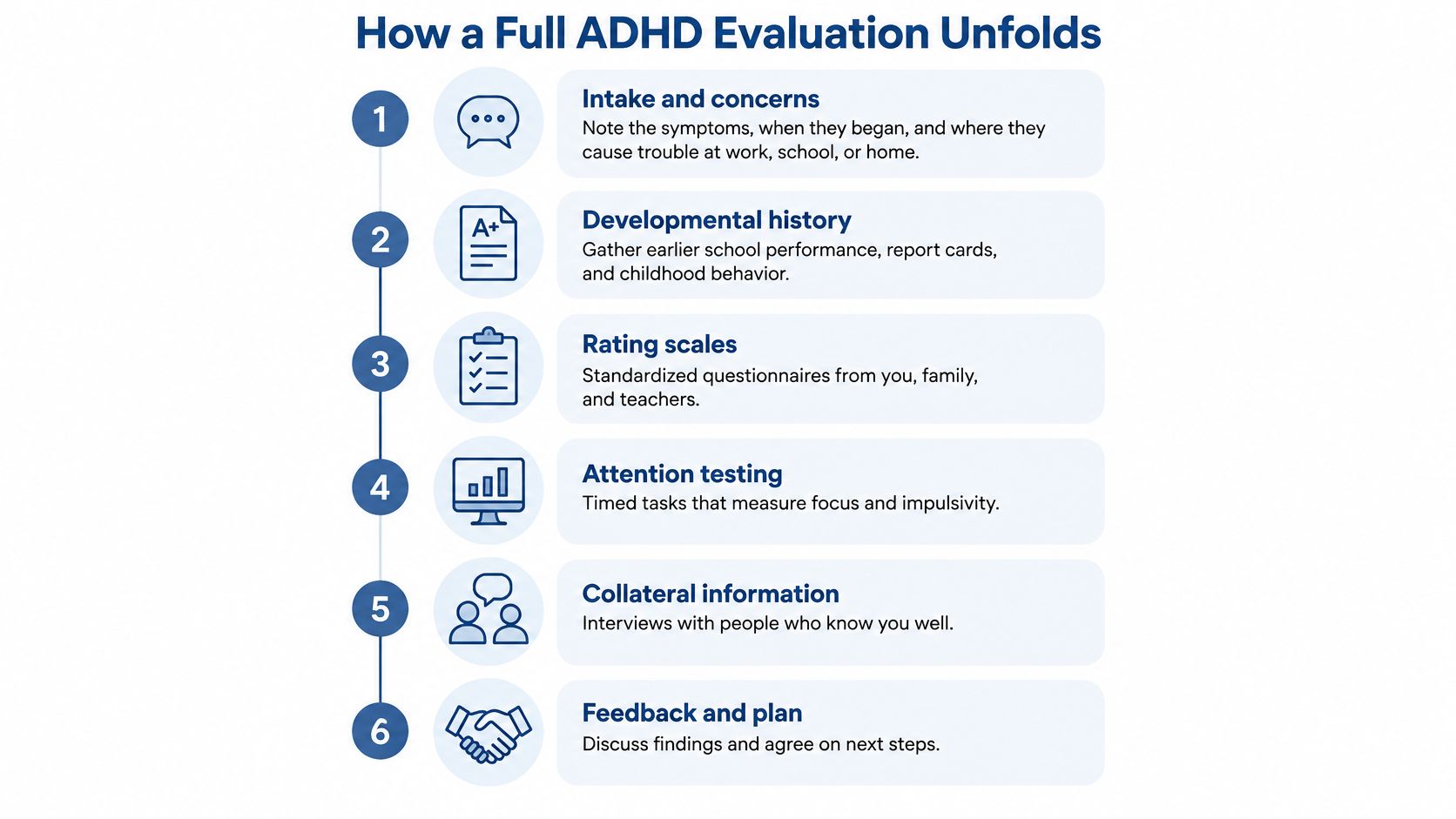
The process includes several connected activities, illustrated below.
From Initial Concerns to a Clinical Explanation
Intake and concerns. The patient describes the difficulties prompting the appointment and where they cause trouble. Specific consequences help: repeatedly missing work deadlines provides more information than describing poor focus alone.
Developmental history. The clinician explores earlier school performance, behavior, organization, and family observations. Report cards may contain useful comments about incomplete work, distractibility, or excessive talking. Historical evidence helps distinguish a longstanding pattern from a recent change.
Clinical interview. The discussion covers current symptoms alongside sleep, mood, substance use, medical history, medications, and supplements. The clinician also asks how the patient manages responsibilities and what supports make functioning easier. A highly organized partner or extensive reminder system may affect how difficulties appear.
Collateral reports. Parents and teachers can describe a child's behavior under different demands. An adult may provide observations from a partner or family member, when appropriate and available. Disagreement isn't automatically a problem, since observers may see different activities and levels of structure.
Rating scales and optional objective tests. Standardized questionnaires organize symptom reports. A computer task may answer a narrower question about attention control, but it doesn't replace the interview. The clinician should explain why any additional test would change the assessment or plan.
Differential screening. The clinician considers sleep, anxiety, depression, learning difficulties, medical conditions, and substance-related explanations that could mimic or accompany ADHD.
Diagnosis and plan. The clinician explains which findings support the conclusion, which remain uncertain, and what happens next. A treatment discussion may include medication, behavioral strategies, or assessment of another condition. When the evidence remains incomplete, collecting more information may be more appropriate than assigning a premature label.
Timing and Telehealth
A thorough assessment may finish during an extended visit or require another appointment for records and collateral ratings. Patients should receive a clear explanation of which components their case requires, rather than a promise that every evaluation follows an identical timetable.
Telehealth can support the interview and review of questionnaires and records. Some psychological or equipment-based testing may require a separate arrangement. The appointment format should follow the clinical question, not determine the diagnosis.
Computer Tasks and Their Real Accuracy
Computerized attention tests measure task performance, but their accuracy isn't sufficient for independent ADHD diagnosis.
Sensitivity and specificity of the QbTest
| Measure | Sensitivity | Specificity | What it means for a reader |
|---|---|---|---|
| QbTest total score | 0.78 (95% CI 0.69-0.85) | 0.70 (95% CI 0.57-0.81) | About 22% of affected people could be missed; about 30% of non-ADHD clinical cases could test positive |
| QbTest subscales | 0.48-0.65 | 0.65-0.83 | Lower sensitivity, so more affected people can be missed |
These pooled estimates come from a QbTest systematic review and meta-analysis involving 15 studies and 2,058 participants, 48.6% of whom had ADHD. The total score's sensitivity and specificity correspond to approximately 22% missed affected participants and 30% positive results among non-ADHD clinical cases.
What Those Numbers Actually Mean
Sensitivity describes how often a test identifies affected people. Specificity describes how often it correctly identifies people without the condition. Neither tells an individual patient the probability of ADHD from a score alone.
That probability also changes with how common ADHD is in the group undergoing testing. A high result in a carefully assessed referral population doesn't carry the same meaning as a high result in an unselected screening population.
The confidence intervals, abbreviated CI, show uncertainty around the pooled estimates. They're another reason not to interpret the decimal values as exact promises about an individual patient.
What Conners CPT Measures
Continuous performance tests such as Conners CPT examine sustained attention and response inhibition. Omission errors occur when the person misses a target. Commission errors occur when the person responds when no response was required.
Other measurements include reaction-time variability, meaning inconsistency in response speed, and sometimes detectability, meaning the ability to distinguish targets from non-targets.
A 2024 systematic review of adult continuous performance tests found substantial study heterogeneity, high risk of bias, and limited classification accuracy. Adult performance profiles were inconsistent, with overlap involving anxiety, depression, sleep deprivation, substance use, and other psychiatric conditions.
An abnormal result can support further investigation but cannot establish ADHD. A normal result also cannot reliably exclude it.
A precise measurement of performance isn't necessarily a precise explanation for that performance.
Before testing, patients can ask which medications, caffeine intake, sleep conditions, and environmental factors the clinician will document. Another useful question concerns purpose: will testing inform the initial assessment, identify a specific weakness, or help track change? A score shouldn't independently justify medication or dismiss alternative explanations.
Why Test Results and Symptoms Conflict
The expectation that a single test should settle the question overlooks a basic distinction: daily functioning and performance during a controlled task aren't identical. The CDC's diagnostic guidance explains that no single test diagnoses ADHD and that several other conditions can produce similar symptoms.
A focused work session illustrates why appearance alone doesn't describe someone's broader functioning.

Consider someone who performs well on a clearly structured computer task but repeatedly misses deadlines, forgets household responsibilities, and struggles to organize projects. The task samples performance under particular conditions. It doesn't reproduce the competing priorities and self-directed planning required throughout an ordinary day.
The opposite conflict also deserves attention. Poor task performance after disrupted sleep doesn't establish a longstanding neurodevelopmental condition.
What Else the Clinician Considers
- Sleep disorders or insufficient sleep. Fatigue can impair concentration and task performance.
- Anxiety and depression. Worry, low mood, and related symptoms can interfere with attention. The comparison of ADHD and anxiety symptoms helps explain why the underlying pattern matters.
- Learning disabilities. Trouble concentrating during reading or written assignments may reflect a specific learning difficulty.
- Sensory problems. Hearing or vision difficulties can make instructions and classroom activities harder to follow.
- Substances and medications. The assessment should include medication effects, substance use, and caffeine.
- Medical conditions. Changes in energy, alertness, or general health may require medical evaluation.
These possibilities aren't necessarily mutually exclusive. Someone can have ADHD alongside another condition, so identifying anxiety or poor sleep doesn't automatically end the assessment.
The accompanying video offers another educational format for considering attention concerns.
Reconciling the Evidence
Clinicians compare the timing of symptoms, real-world consequences, outside observations, and testing conditions. They ask whether the difficulties existed before a recent stressor and whether similar problems occur during different activities.
A partner's description of forgotten commitments or a teacher's record of incomplete assignments may clarify what a task score misses. Conversely, a recent change in sleep or medication may explain an unexpected decline.
Conflicting findings call for interpretation, not a choice between believing the patient and believing the test. Unresolved questions may justify additional records, targeted testing, or reassessment after addressing another contributor.
Are Digital and Biological Tests Ready Yet
A new test can look precise and still answer the wrong question. A thermometer gives an exact number, but that number alone cannot tell you why someone has a fever. Digital and biological attention measures work the same way: they produce objective-looking data, yet technological objectivity does not automatically establish diagnostic accuracy. Each tool needs validation for its intended population and purpose before it earns a place in an evaluation.
Different Levels of Evidence
- Research-stage biomarkers include candidate patterns in smartphone behavior, eye tracking, and retinal images. Investigators are still determining whether these patterns generalize beyond the original study groups.
- Clinically validated tests have evidence supporting a defined use in a defined population. Validation for screening does not establish suitability for independent diagnosis.
- Routine clinical tools fit an established assessment process, with clear interpretation and follow-up responsibilities.
An eye examination and a validated ADHD assessment answer different clinical questions.

The 2025 smartphone pilot in JMIR Formative Research examined 10 smartphone-derived signals in 40 participants, identifying candidate markers involving restlessness, inconsistent attention, and task completion that require replication. Retinal imaging research sits at a similar stage. Studies in this area have drawn on data from a small number of hospital sites in a single country, so the findings may not transfer to other populations or clinical settings.
Reviews of the broader assessment literature reach a consistent conclusion: no single tool is adequate for definitive diagnosis on its own. Computerized continuous performance tasks illustrate why. In at least one pediatric study, a large share of children without ADHD scored in the abnormal range on such a task, meaning many of them would have been flagged incorrectly if the score had been treated as a diagnosis. That result reflects one study and one administration, not every population or use of the test, but it captures the core limitation. A score generated in minutes cannot weigh developmental history, settings, or overlapping conditions.
Questions That Matter More Than Novelty
A complex interface can obscure basic uncertainties. Device differences, population bias, privacy protections, and independent replication all matter when a tool collects sensitive behavioral or biological information. The flashier the output, the more important it becomes to ask what evidence sits underneath it.
The discussion of genetic testing for mental health provides related context for separating a biological measurement from the clinical conclusion drawn from it.
Before relying on a new testing claim, patients and families can consider:
- Validation. Has independent evaluation supported the intended use?
- Population fit. Did testing include people with similar ages and clinical concerns?
- Interpretation. Which qualified clinician explains the result?
- Follow-up. What assessment follows a positive result, and how are unexpected findings handled?
Digital measures may complement a context-rich evaluation. They should not displace one just because they appear more objective than an interview.
Who Performs ADHD Evaluations
Several licensed professionals contribute to ADHD assessment, but their roles and testing services differ. The appropriate professional depends on whether the main question involves diagnosis, treatment, learning, or school support.
- Licensed psychologists may administer cognitive and achievement testing when a learning disability or another psychological question requires investigation. Their reports can distinguish those findings from ADHD assessment.
- Physician psychiatrists and board-certified psychiatric mental health nurse practitioners conduct clinical interviews, review collateral information, apply diagnostic criteria, and consider treatment.
- Primary care pediatricians commonly begin childhood evaluations and coordinate information from families and schools.
- School teams document classroom functioning and evaluate eligibility for educational services. A school assessment isn't itself a medical diagnosis.
The guide to professionals who diagnose ADHD provides additional context for choosing an evaluation pathway.
Questions Before Booking
Patients can clarify the following responsibilities before an appointment:
- Interview responsibility. Who conducts the clinical assessment?
- Test interpretation. Who scores and explains questionnaires or computer tasks?
- Referral needs. Could a separate psychologist's assessment be necessary?
- Written findings. How will conclusions and recommendations be documented?
Additional psychological testing can add appointment time and cost. A recommended battery should have a clear purpose, with fees explained before testing begins.
At Integrative Psychiatry of America, board-certified psychiatric mental health nurse practitioners complete evaluations through secure telehealth for adults and children ages 6 and older throughout Pennsylvania. The clinical process includes interview findings, collateral review, and application of diagnostic criteria.
Prepare for Your Pennsylvania ADHD Evaluation
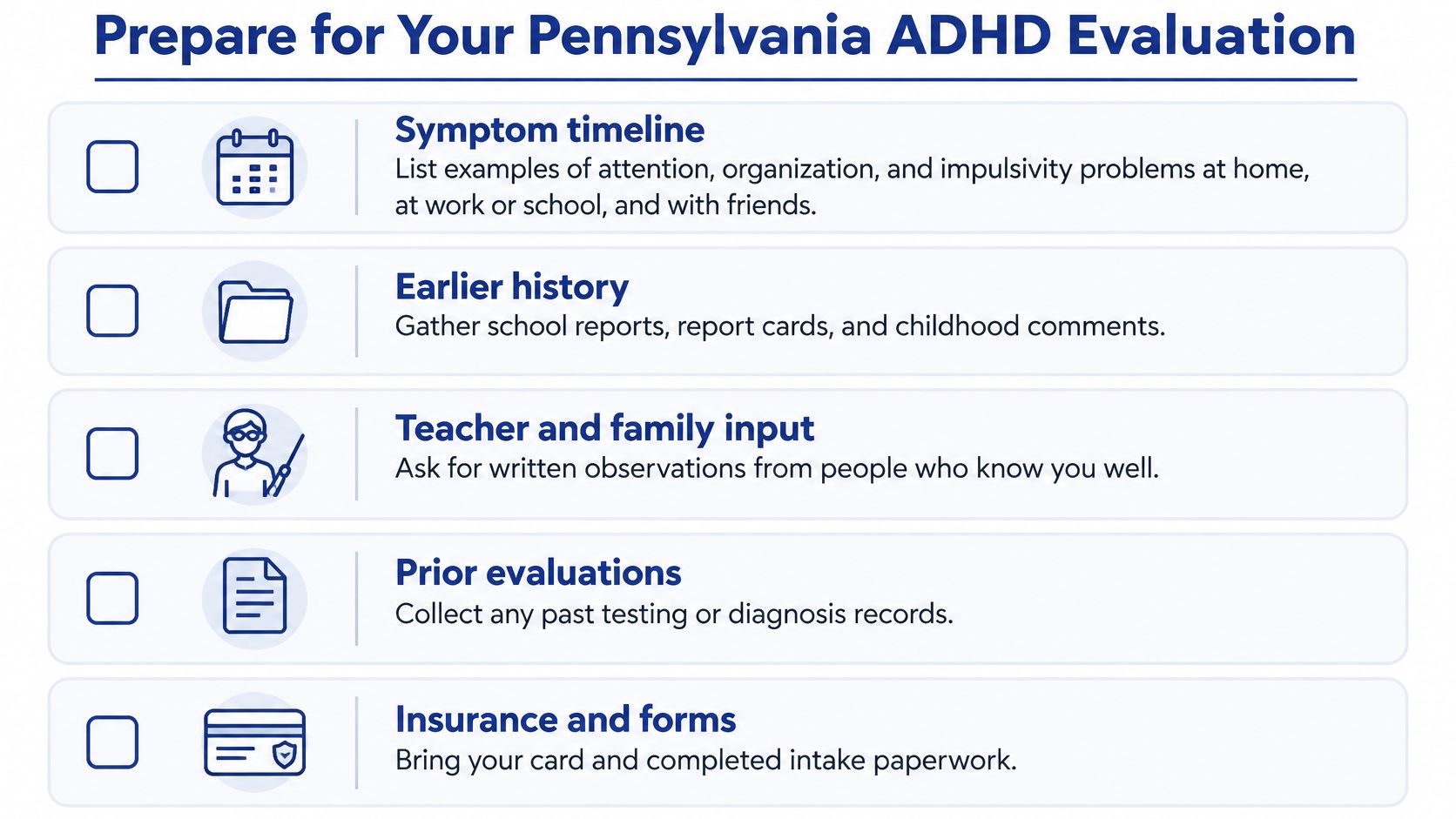
Preparation helps the clinician understand concrete difficulties rather than relying on general impressions. Useful materials include:
- Symptom timeline. Examples of attention, organization, and impulsivity problems at home, work, school, and during social activities.
- Earlier history. School reports, report cards, childhood behavior notes, or family observations that describe earlier patterns.
- Current health picture. Medication and supplement lists, caffeine intake, substance use, and sleep patterns.
- Other records. Previous evaluations, learning assessments, medical history, and available recent laboratory results. New laboratory testing isn't something to obtain independently solely for this appointment.
- Collateral contacts. A parent, teacher, partner, or another person who can describe relevant functioning.
The checklist below can help organize records and appointment paperwork.
Coverage and the Next Step
Insurance benefits, copays, deductibles, network status, and authorization requirements vary by plan. Patients should verify coverage for the evaluation and any separately recommended psychological testing before booking.
Integrative Psychiatry of America offers diagnostic evaluations and ongoing medication management for children ages 6 and older, adolescents, college students, and adults across Pennsylvania. Board-certified psychiatric mental health nurse practitioners provide care through secure telepsychiatry.
The practice's free Adult ADHD Screener offers an information-gathering starting point, not a diagnosis. Adults and families seeking clinical clarification can review the Pennsylvania ADHD evaluation pathway and request an appointment for a full assessment.
Integrative Psychiatry of America provides virtual ADHD evaluation and, when clinically appropriate, ongoing medication management throughout Pennsylvania. Adults and families seeking help interpreting attention concerns can visit Integrative Psychiatry of America to request an appointment and verify insurance before beginning care.