
A Pennsylvania adult may spend months wondering whether unfinished projects, missed appointments, restless thoughts, or chronic disorganization point to ADHD, anxiety, poor sleep, or something else. A parent may see school and home problems but receive only a recommendation to “watch and wait.” A quick online quiz can feel validating, yet it can't determine the cause or establish a diagnosis.
The more useful question isn't which doctors diagnose ADHD. It's which licensed clinician performs a structured, age-appropriate evaluation, considers other explanations, and can provide an appropriate treatment plan. That distinction matters whether someone is seeking adult ADHD treatment in Philadelphia, a child evaluation near Pittsburgh, or confidential ADHD telehealth anywhere in Pennsylvania.
Table of Contents
- Why Finding the Right ADHD Diagnosing Clinician Feels Harder Than It Should
- Which Licensed Clinicians Can Diagnose ADHD
- What a Credible ADHD Evaluation Actually Includes
- Why Clinician Process Matters More Than the Title on the Door
- How ADHD Evaluation Differs for Children, Teens, and Adults
- Telehealth ADHD Evaluations in Pennsylvania
- Why Many Adults Get Diagnosed Late and What to Do About It
- Preparing for Your First Appointment and Next Steps in Pennsylvania
Why Finding the Right ADHD Diagnosing Clinician Feels Harder Than It Should
A working parent in Harrisburg might finally schedule an appointment after years of compensating with calendars, urgency, and late nights. A college student near Pittsburgh might recognize the pattern only after losing the structure that once kept school manageable. Both may search for doctors who diagnose ADHD and find lists of psychiatrists, psychologists, physicians, and nurse practitioners.
The list is accurate, but incomplete. Some clinicians diagnose ADHD, some provide medication management after an outside diagnosis, and some don't offer adult ADHD evaluations at all. A provider may also recognize attention symptoms without having the training or time to separate ADHD from anxiety, depression, trauma, sleep problems, substance use, or learning difficulties.
Practical rule: Ask what the evaluation includes before asking only which credential appears after the clinician's name.
A credible process gathers developmental history, current symptoms, functional examples, and information from more than one setting. It also checks whether symptoms began during childhood, persisted over time, and cause meaningful impairment. The assessment should fit the patient's age, responsibilities, communication needs, and clinical complexity.
Adults may need help reconstructing childhood symptoms and describing impairment at work, home, and in relationships. Parents should expect questions about school performance, behavior in different settings, teacher observations, and other developmental or medical concerns. Patients with significant mood symptoms, trauma histories, substance-related problems, or possible autism may need coordinated specialty care.
This guide explains who can evaluate ADHD, what a sound assessment contains, how children's and adults' evaluations differ, and what Pennsylvania patients should expect from telehealth. It also addresses late diagnosis, insurance questions, and the practical steps to take before booking an appointment.
Which Licensed Clinicians Can Diagnose ADHD
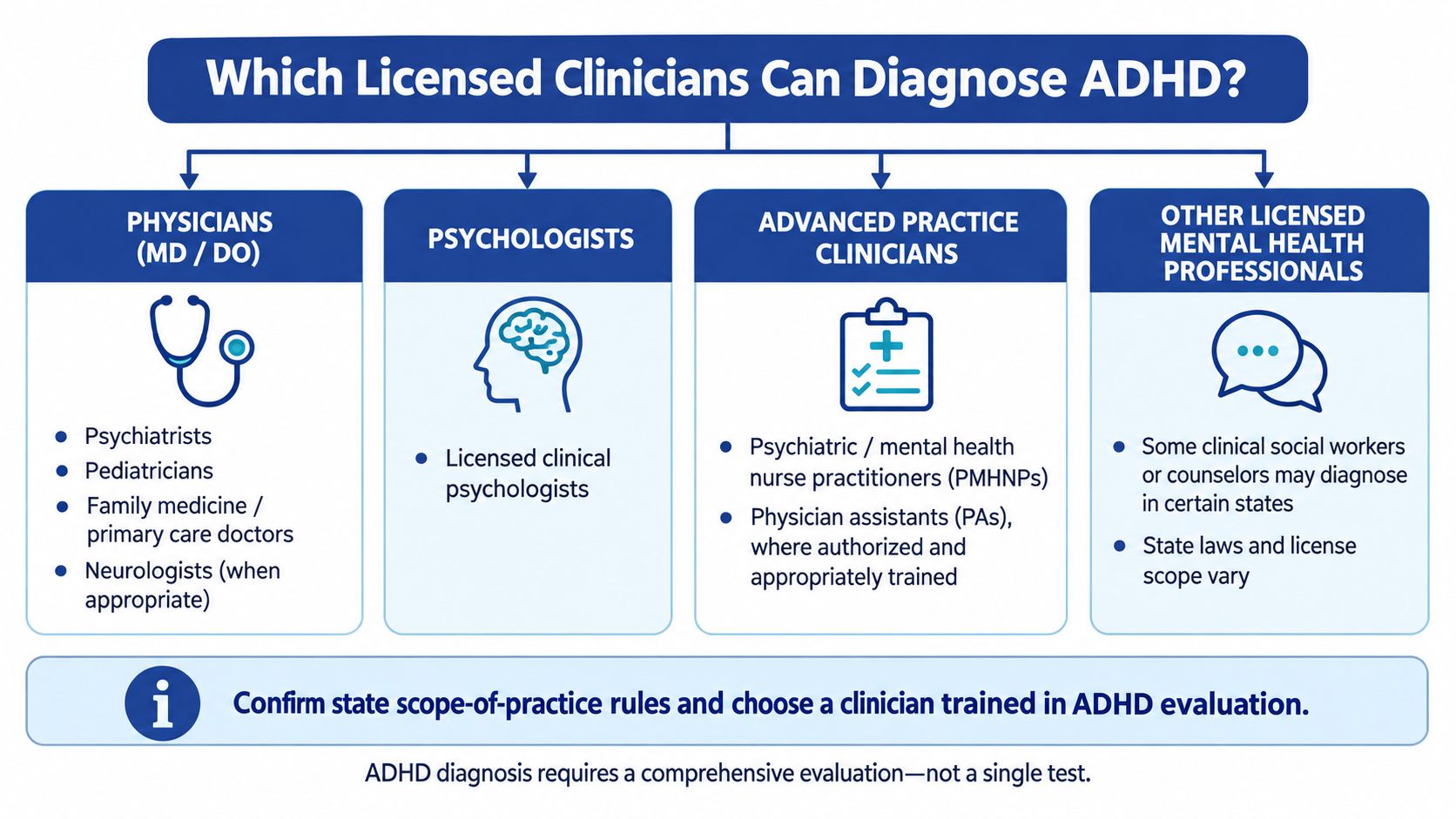
Qualified mental-health professionals and primary-care clinicians can diagnose ADHD when they have the appropriate training, scope of practice, and evaluation process. U.S. public-health guidance identifies psychologists and primary-care providers, including family-medicine physicians and nurse practitioners, among clinicians who may diagnose ADHD. For children and adolescents, primary-care clinicians are directed to evaluate patients ages 4 through 18 who show academic or behavioral problems alongside inattention, hyperactivity, or impulsivity. CDC clinical guidance
Psychiatric clinicians
Psychiatrists are physicians who evaluate mental-health conditions and can prescribe medication. A board-certified psychiatric mental health nurse practitioner can also assess ADHD and, within Pennsylvania practice requirements, provide psychiatric treatment and medication management.
The practical difference isn't that one title automatically produces a better diagnosis. The relevant questions are whether the clinician evaluates ADHD directly, understands adult and child presentations, reviews competing explanations, and offers follow-up after the assessment. Patients comparing a psychiatrist with a psychiatric NP can review the distinctions in psychiatrist versus psychiatric NP care.
Primary-care clinicians
Family physicians, pediatricians, and other primary-care clinicians are often the first access point, particularly for children and adolescents. They may diagnose and manage straightforward presentations or refer when symptoms overlap with complex psychiatric, developmental, neurological, or medical conditions.
A primary-care visit can also identify sleep concerns, medication effects, thyroid concerns, or other health issues that affect concentration. Referral becomes sensible when the presentation falls outside the clinician's experience or when co-occurring conditions require specialty coordination.
Psychologists
Psychologists can conduct detailed clinical evaluations and psychological testing. Prescribing authority varies by jurisdiction and professional role, so a psychologist may diagnose ADHD while coordinating medication care with a physician or psychiatric nurse practitioner.
Testing can help clarify learning, cognitive, or developmental questions, but testing alone doesn't establish ADHD. Patients exploring the broader relationship between nutrition, gut health, and attention can also review resources about probiotic strains for ADHD, while keeping such information separate from formal diagnosis and treatment decisions.
What a Credible ADHD Evaluation Actually Includes
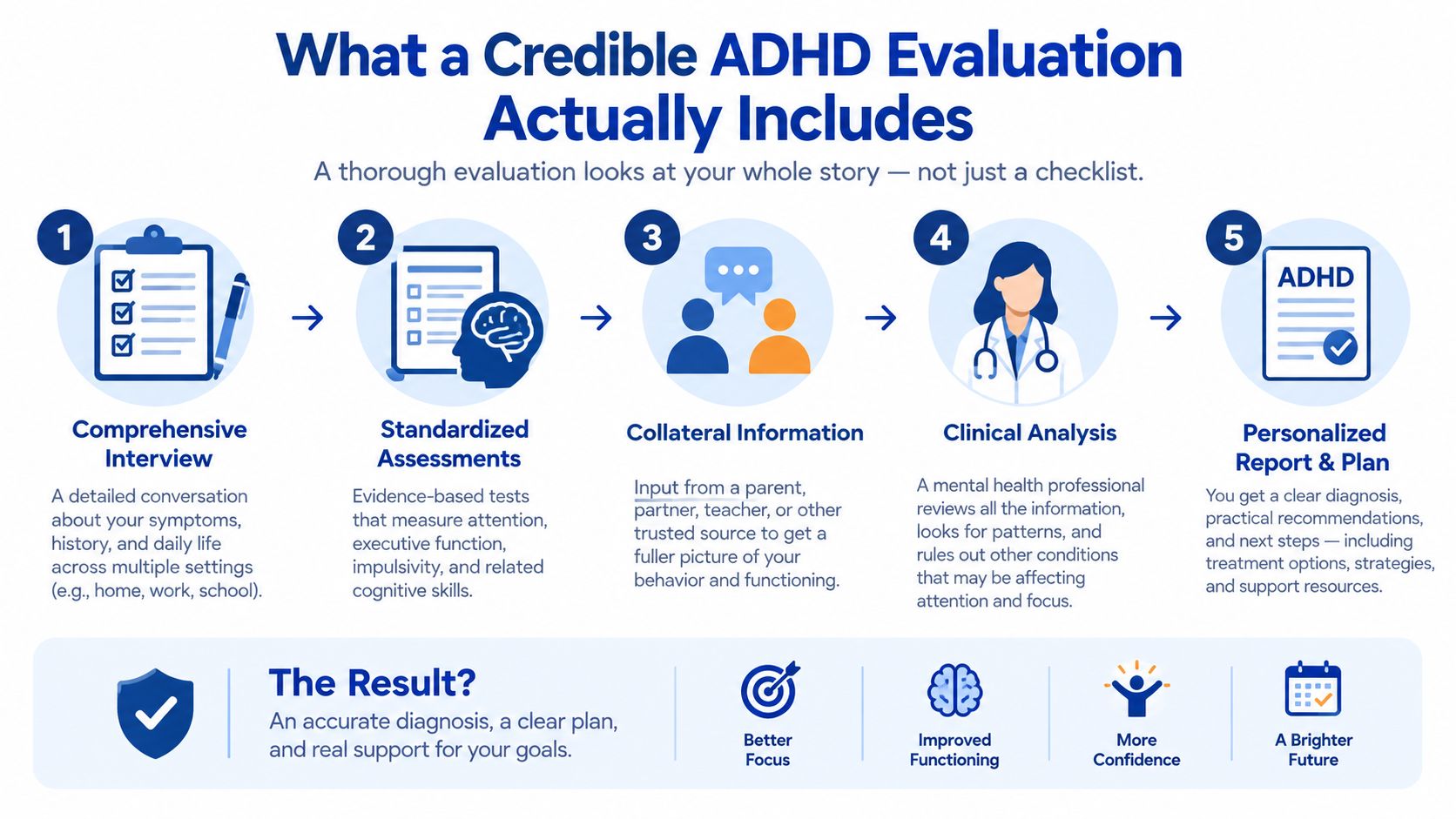
A credible ADHD evaluation combines a clinical interview, developmental history, symptom measures, functional examples, collateral information when available, and assessment of alternative explanations. No blood test, brain scan, or standalone computerized test can diagnose ADHD. The CDC explains that clinicians must evaluate symptoms and consider conditions that can look similar.
The core clinical steps
The clinician should first understand why the patient is seeking help now. Current symptoms matter, but so do their frequency, duration, severity, and effects on work, education, relationships, household responsibilities, and safety.
A structured evaluation commonly includes:
- Current symptom interview: The clinician asks for real examples rather than relying on yes-or-no answers.
- Developmental history: The assessment looks for evidence that several symptoms existed before age 12, even if nobody recognized them as ADHD at the time.
- Cross-setting impairment: Symptoms should appear in at least two settings, such as home and work or school, and negatively affect functioning.
- Validated rating scales: Tools such as the Adult ADHD Self-Report Scale, Diagnostic Interview for ADHD in Adults, or Conners Adult ADHD Rating Scales can organize information. They support clinical judgment but don't replace it.
- Collateral information: A partner, parent, sibling, teacher, school record, or former clinician may provide useful evidence when the patient agrees and the source is available.
The AAFP overview of adult ADHD assessment describes the evaluation as clinical and multi-source rather than dependent on one result. A positive screening score should prompt a fuller assessment, not produce an automatic diagnosis.
The differential diagnosis
Attention problems overlap with anxiety, depression, trauma-related symptoms, substance use, sleep disorders, learning disorders, thyroid disease, seizure disorders, and effects of head injury. A clinician should review psychiatric, medical, developmental, family, medication, and substance-use histories, along with sleep and functional impairment.
Laboratory testing doesn't confirm ADHD. A clinician may order thyroid studies or other tests when the history or physical findings suggest a medical explanation. Neuropsychological testing isn't routinely required, but it may help when childhood records or observer reports aren't available, malingering is suspected, or substantial comorbidity makes interpretation difficult. AAFP guidance on adult ADHD diagnosis and differential assessment
Red flags include a diagnosis based only on an online quiz, no questions about childhood, no discussion of impairment in multiple settings, or no review of sleep, mood, substances, trauma, and medications.
Patients who need a more extensive cognitive or learning assessment can review psychological testing for ADHD and ask whether testing would change diagnosis, treatment, accommodations, or referrals.
Why Clinician Process Matters More Than the Title on the Door
The credential answers whether a clinician may provide care. It doesn't answer whether that clinician routinely performs adult ADHD evaluations or knows how to interpret overlapping symptoms.
A 2025 clinician survey found that fewer than half of adult clinicians offered ADHD diagnostic services. Only 27.3% reported adequate ADHD training in formal education, while 53.6% wanted additional training. Survey findings published in PubMed help explain why a patient may contact a licensed provider and still be told that the practice doesn't conduct diagnostic evaluations.
What patients should ask
A Pennsylvania adult doesn't need to interrogate a clinician, but a few direct questions can reveal whether the service fits:
- Evaluation scope: Does the appointment include developmental history and current functional impairment?
- Diagnostic method: Which structured interview or rating scales does the clinician use?
- Collateral evidence: Can the patient provide school records, a partner's observations, or a parent's history?
- Differential diagnosis: How does the clinician distinguish ADHD from anxiety, depression, trauma, sleep disorders, substance use, or bipolar-spectrum symptoms?
- Treatment pathway: If ADHD is diagnosed, does the practice offer medication management, therapy referrals, behavioral strategies, or coordination with other clinicians?
Differential diagnosis is where much of the clinical reasoning occurs. Restlessness may reflect ADHD, anxiety, trauma, medication effects, sleep deprivation, or a combination. A person can have ADHD and depression, ADHD and anxiety, or ADHD alongside a learning disorder. A careful clinician doesn't force every symptom into one label.

The central question is not “Can this clinician prescribe?” It is “Can this clinician correctly evaluate this patient's presentation and create a safe next step?”
How ADHD Evaluation Differs for Children, Teens, and Adults
The diagnostic framework changes with age because the available evidence changes. Children usually depend more heavily on parent, teacher, and school information. Adults often need a detailed reconstruction of childhood symptoms and a close look at current impairment across work, home, and relationships.
Under DSM-5 criteria, people younger than 17 generally need at least six symptoms in an inattentive or hyperactive-impulsive domain. People aged 17 and older generally need at least five symptoms. Symptoms must persist for at least six months, appear in at least two settings, and negatively affect functioning. SAMHSA's DSM-5 reference
Comparison by age
| Element | Children (4–12) | Teens (13–17) | Adults (18+) |
|---|---|---|---|
| Main information sources | Parents, teachers, school records, pediatric notes | Teen, parents, teachers, school records, prior clinicians | Adult patient, partner or family when available, school or work records |
| Functional settings | Home, classroom, activities, peer relationships | Home, school, activities, peer relationships | Work, home, education, relationships, finances, daily responsibilities |
| Clinical emphasis | Development, classroom behavior, learning, behavior across settings | Increasing independence, academic demands, emotional and behavioral changes | Developmental history, current impairment, masking, comorbid conditions |
| Rating scales | Parent and teacher forms | Parent, teacher, and adolescent forms | Adult self-report with collateral information when available |
| Possible added testing | Learning, language, developmental, or cognitive questions | Learning, executive-function, or complex developmental questions | Neuropsychological testing when records are unavailable or comorbidity complicates interpretation |
A parent can gather report cards, teacher comments, individualized education program records, prior evaluations, medication lists, and examples from home. A teenager should be included in the conversation rather than treated as a passive subject.
Adults shouldn't abandon an evaluation because childhood records are missing. A parent, sibling, partner, or former teacher may provide useful collateral information, and the clinician can examine consistent developmental patterns through detailed examples. A parent seeking broader developmental guidance can also consult the Guiding Growth parent resource.
For Pennsylvania families seeking ongoing care, ADHD treatment for children should follow the diagnostic assessment and the child's developmental, medical, school, and family context.
Telehealth ADHD Evaluations in Pennsylvania
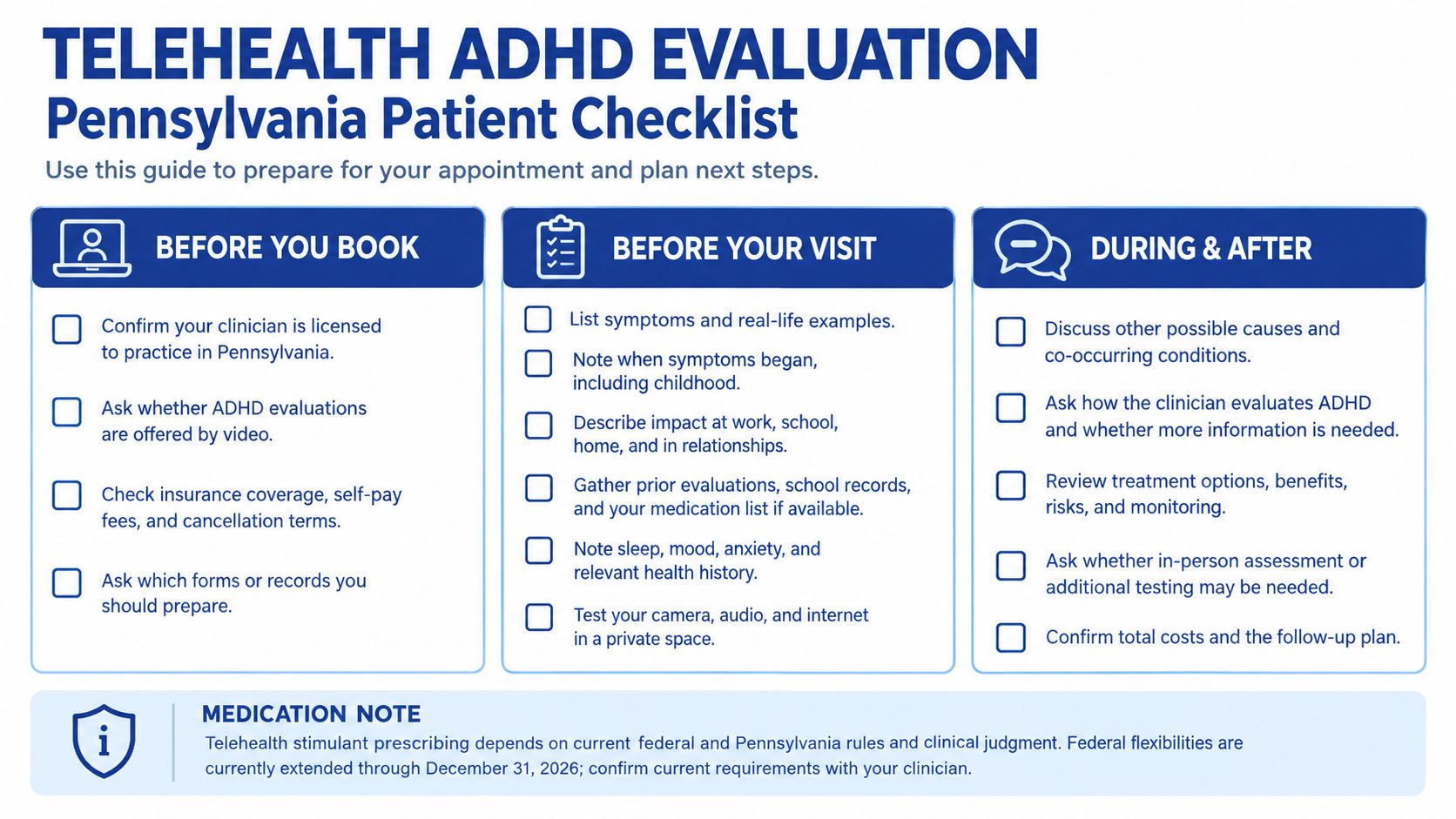
A legitimate telehealth ADHD evaluation uses secure video care without lowering the clinical standard. The clinician still needs a structured interview, developmental and medical history, symptom measures, functional examples, differential diagnosis, and a follow-up plan.
What happens remotely
Before or during a virtual visit, the patient may complete electronic rating scales and provide medication information, prior records, school documents, or collateral contacts. The clinician can observe communication, thought process, mood, attention, and engagement through video while asking for concrete examples from daily life.
A secure telehealth evaluation commonly includes:
- Identity and location confirmation: The clinician verifies where the patient is receiving care and whether the practice serves that Pennsylvania location.
- Clinical interview: The discussion covers current symptoms, childhood history, impairment, medical conditions, sleep, mood, trauma, substances, and medications.
- Rating information: Validated tools organize symptoms but don't decide the diagnosis.
- Medical safety review: The provider determines whether an in-person examination, vital signs, laboratory work, or another clinician's input is needed.
- Follow-up planning: The patient receives a clear explanation of findings, treatment options, referrals, and monitoring.
A virtual appointment can replace travel. It can't replace clinical reasoning, appropriate medical assessment, or referral when the case requires in-person care.
Pennsylvania rules add safeguards when controlled substances are prescribed. Before prescribing, an initial medical history and physical examination generally must be completed unless an emergency exception applies. The rules also require reevaluation of the patient's condition and medication effectiveness, along with counseling about the diagnosis and controlled substance. Pennsylvania controlled-substance prescribing rules
Some patients may need an in-person physical examination, laboratory testing, cardiac assessment, neurological evaluation, or specialty referral. Telehealth works best when the clinician documents symptom frequency, onset, cross-setting impairment, collateral sources, competing diagnoses, and the plan for monitoring. Patients considering a remote assessment can review telehealth ADHD evaluation in Pennsylvania.
Why Many Adults Get Diagnosed Late and What to Do About It
Late diagnosis doesn't necessarily mean late onset. A person may have compensated successfully until college, parenthood, a promotion, sleep disruption, or increased administrative demands exposed difficulties that were previously hidden.
CDC data estimated that 15.5 million U.S. adults had an ADHD diagnosis in 2023, and 55.9% received that diagnosis at age 18 or later, representing approximately 8.7 million adults diagnosed during adulthood. CDC adult ADHD data Diagnostic criteria still require evidence that several symptoms began before age 12.
Women and other underrecognized patients may show disorganization, executive-function difficulty, internal restlessness, emotional dysregulation, or extensive masking rather than obvious childhood hyperactivity. Some people appear successful because they use exhausting compensatory systems, work excessive hours, or rely on crisis-driven productivity.
Access can remain difficult even after recognition. NHS England's 2025 taskforce reported adult ADHD waiting times of up to eight years, regional treatment rates varying as much as twelve-fold, and only 15% of adults with ADHD receiving pharmacological treatment in the cited prescribing data. These figures are UK-specific, but they illustrate how awareness doesn't guarantee access to a trained evaluator. NHS England taskforce discussion
Adults can prepare by bringing school records if available, asking relatives for childhood examples, and describing specific effects on work, relationships, household tasks, driving, finances, or education. Missing records shouldn't end the conversation. It should prompt a more careful history and, when appropriate, collateral evidence from another trusted person.
Preparing for Your First Appointment and Next Steps in Pennsylvania
Before booking, gather childhood records, school or work examples, prior evaluations, medical history, current medications, sleep information, and names of clinicians who may provide collateral information. Write down what happens in more than one setting and how symptoms affect daily functioning.
Ask the prospective clinician whether the practice provides diagnosis or only medication management, which rating scales or interviews it uses, how it evaluates co-occurring conditions, and whether follow-up care is available. Patients should also verify network status, copays, deductibles, authorization requirements, and telehealth benefits because coverage varies by plan.
Choose the next step that matches the current need:
- Request Appointment: Use this path when the patient is ready to discuss evaluation or treatment.
- Verify Insurance: Confirm benefits before scheduling.
- ADHD Evaluation: Choose this when diagnosis remains uncertain.
- ADHD Treatment or Medication Management: Use this when ADHD has already been diagnosed and ongoing care is needed.
Pennsylvania adults and families can review ADHD evaluation in Pennsylvania before contacting a provider. The right clinician should explain the process clearly, avoid diagnosing from a questionnaire alone, and identify when another professional or in-person assessment is needed.
Integrative Psychiatry of America provides secure virtual psychiatric care across Pennsylvania, including structured ADHD evaluations and follow-up medication management for appropriate children, teens, and adults. Patients seeking confidential guidance can visit Integrative Psychiatry of America to review the evaluation pathway, verify insurance, or request an appointment.