
Viibryd (vilazodone) has no FDA approval for obsessive-compulsive disorder, and there are zero randomized, double-blind, placebo-controlled trials of it in OCD. Any use for OCD is off-label, an individualized clinical judgment rather than a labeled OCD treatment.
A Pennsylvania adult starts vilazodone for depression in the spring. Mood lifts by week six, sleep settles, and then a familiar pattern returns. The stove gets checked four times before leaving the house, and an email gets rewritten until the words blur. So the question arrives: if this medicine helped the depression, can it handle the intrusive thoughts too? The answer splits cleanly. On approval and trial evidence, the record is empty. On clinical judgment, a licensed prescriber can still weigh a trial, with named risks and a named monitoring plan. The verdict comes first here, then the decision that remains.
Table of Contents
- Is Viibryd Approved for OCD
- How Viibryd Compares With Proven OCD Care
- Why Serotonin Activity Does Not Prove It Treats OCD
- Labeled Doses and the Missing OCD Trial Data
- Serotonin Syndrome and Everyday Medication Mixes
- What a Clinician Reviews Before Off-Label Use
- Plan an OCD Evaluation in Pennsylvania
Is Viibryd Approved for OCD
No. The FDA approved vilazodone for major depressive disorder in adults, and the Viibryd approval history on Drugs.com shows no OCD indication. That means vilazodone is not an approved OCD treatment. An FDA approval works like a label on a bottle: it tells clinicians which condition, dose, and treatment course were reviewed for that medicine. For OCD, that label is absent.
Prescribing vilazodone for OCD is off-label. The medicine is being used outside its approved condition, without an approved OCD dose and without a labeled OCD treatment duration. That does not make the decision improper, but it does change the standard of care around it. The prescriber has to explain why the trial is reasonable, what outcomes will be tracked, and when the medication should be stopped if intrusive thoughts and rituals do not improve.

The depression evidence supports vilazodone for depression, not for OCD. Depression trials enroll people who meet depression criteria and measure depression outcomes. They answer a narrow question: does the medicine improve depressive symptoms compared with placebo in the studied population? They do not hand back an OCD response rate, an OCD remission threshold, or an OCD-specific dose and duration. A drug can help one condition and remain untested for the rituals and intrusive thoughts that bring someone to an OCD appointment.
Confusion often starts here. Serotonin-related medicines can affect more than one condition, but the diagnosis being treated matters. Depression, anxiety, and OCD may overlap, and a Pennsylvania adult can have more than one at the same time. Still, improvement in mood does not prove that obsessions or compulsions will improve. Those are different targets, and they need separate measurement.
The distinction that matters: off-label doesn't mean illegal or careless. It means the prescriber is working without an approved condition, an approved OCD dose, or a labeled OCD duration, and is accountable for that reasoning in the chart.
A separate OCD assessment gives the decision its proper frame. Intrusive thoughts, repeated checking, washing, rewriting, reassurance seeking, and hours lost to rituals all need to be mapped before medication is adjusted. An OCD treatment evaluation for adults can clarify symptom pattern, impairment, co-occurring depression or anxiety, prior medication response, and side-effect history. Those details shape the plan. They do not create an FDA protocol that does not exist.
How Viibryd Compares With Proven OCD Care
Set the options side by side and the bottom row stops looking like a peer.
| Treatment | Role in OCD | Evidence status | Usual place in care |
|---|---|---|---|
| Fluoxetine, sertraline, fluvoxamine, or paroxetine | FDA-approved SSRI options for OCD | Controlled trials and guideline support | First-line medication choices |
| Clomipramine | FDA-approved tricyclic for OCD | Established efficacy with more side-effect burden | Often after SSRI trials |
| Exposure and response prevention | First-line psychotherapy | Strong evidence, alone or with medication | Core behavioral treatment |
| Vilazodone (Viibryd) | No FDA indication for OCD | No randomized placebo-controlled OCD trials | Off-label only, not a substitute |
Reading the bottom row correctly
Vilazodone has a plausible mechanism for OCD. It blocks the serotonin transporter and partially activates the 5-HT1A receptor, a combination that sounds tailor-made for an illness treated with serotonergic drugs. A systematic review table on OCD pharmacotherapy makes the limit plain: reviewers found no randomized, double-blind, placebo-controlled trials of vilazodone in OCD, and treatment-resistant OCD reviews report that its effects in OCD had not been documented.
Plausible is not the same as proven. That single sentence separates vilazodone from every other row in the table, and it's why no clinician should present the drug as an evidence-based substitute for an SSRI, for clomipramine, or for exposure and response prevention.
Exposure and response prevention carries the strongest behavioral evidence in OCD, used alone or paired with medication. The structure matters, and a clear walkthrough of what ERP therapy involves explains why the response half of the name does more work than the exposure half.
If a first trial of ERP or medication isn't enough, the escalation path still runs through proven options. An exposure and response prevention therapy program is the behavioral anchor most treatment plans get built around, and it doesn't require an off-label medication decision to start.
If vilazodone is already in the regimen
Plenty of readers aren't choosing a new drug. They're already taking vilazodone for depression and wondering what to do about the checking, the counting, or the mental review that never quite stops.
That situation calls for a separate assessment of obsessive-compulsive symptoms rather than an assumption. Persistent OCD generally points toward guideline-supported serotonin reuptake inhibitor care combined with ERP. Expecting a dose increase of a depression medicine to produce an OCD-specific response is a hope, not a plan.
Why Serotonin Activity Does Not Prove It Treats OCD
Serotonin is why people ask about Viibryd for OCD in the first place, and it's also where the reasoning slips.
OCD treatment with SSRIs is often explained as raising serotonin signaling enough, for long enough, to loosen the grip of obsessions and the urge to perform compulsions. The logic has real support behind it, since the SSRIs that treat OCD all act on serotonin reuptake. The biology underneath the word is unpacked in this plain-language guide to what 5-HT is.
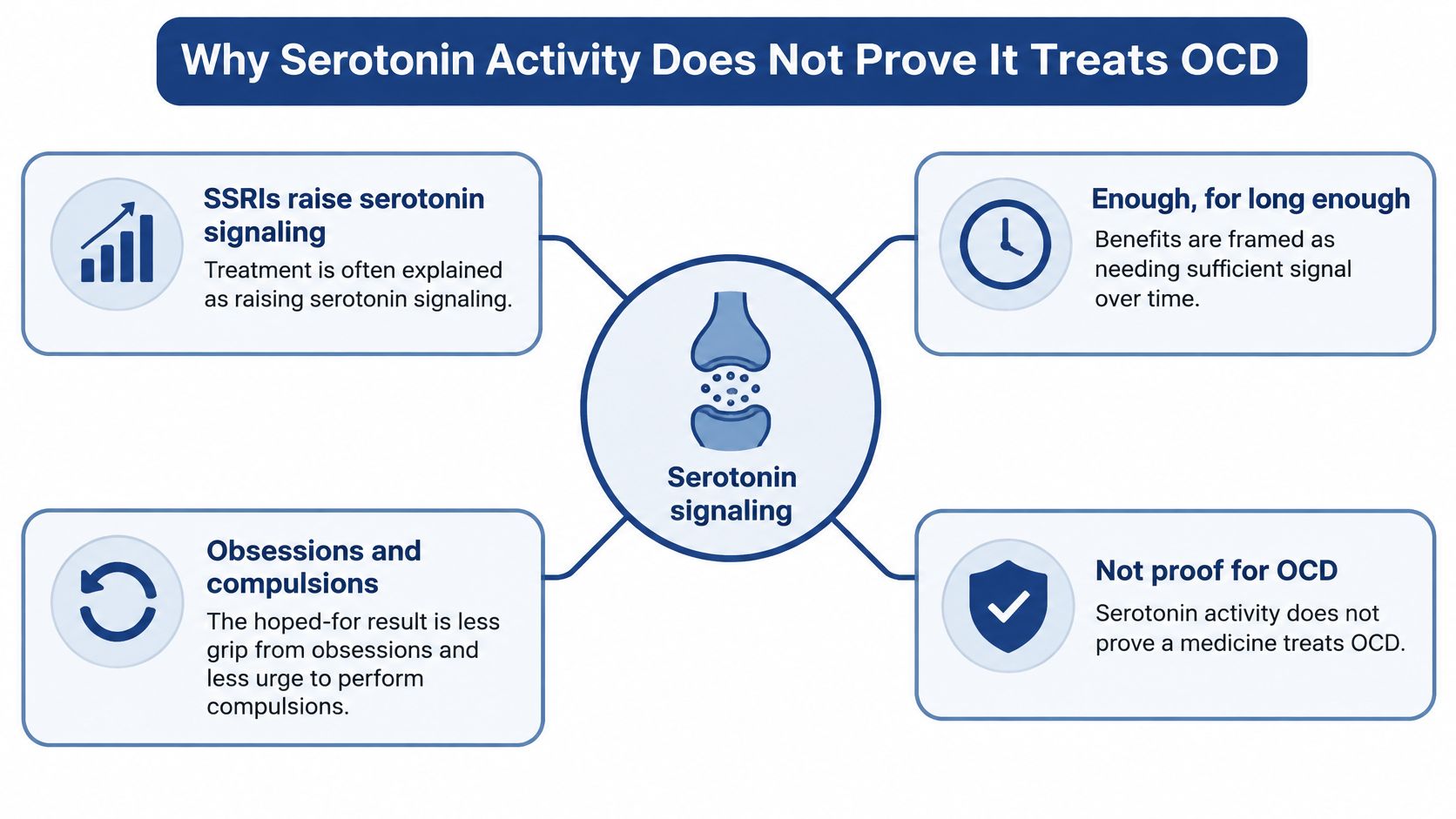
Vilazodone shares part of that story. The FDA prescribing information for vilazodone describes it as a serotonin reuptake inhibitor and a partial agonist at serotonin 5-HT1A receptors. Picture a partial agonist as a dimmer switch rather than an on switch. It pushes the receptor partway and, in doing so, can limit how much fuller stimulation happens.
The label's own limit
Here is the part that rarely makes it into internet summaries. The label states that the precise antidepressant mechanism isn't fully understood, and that the net effect of the 5-HT1A activity, including its role in the medication's clinical effects, remains unknown.
That unknown matters for an OCD decision. A shared serotonin pathway justifies a careful clinical conversation. It cannot show anti-obsessional benefit, a response rate, or a remission threshold. Two keys can fit the same lock style and still open different doors.
A short video overview of how vilazodone is discussed in clinical practice puts the pharmacology in context.
The pooled safety analyses people misread
Older FDA safety material mentions OCD, and that mention gets quoted as if it were efficacy data. It isn't.
The 2011 vilazodone labeling places OCD references inside pooled analyses of pediatric and adolescent antidepressant trials. Those analyses combined 24 short-term studies of nine antidepressants and more than 4,400 participants with major depressive disorder, OCD, or other psychiatric disorders. The purpose was spotting safety signals across a drug class, not measuring whether any single drug reduces compulsions.
Nothing in that pool supplies an OCD response rate, a remission threshold, or a recommended treatment duration for vilazodone. A plausible mechanism earns a conversation with a prescriber. It doesn't earn a treatment claim.
Labeled Doses and the Missing OCD Trial Data
The dosing schedule for vilazodone is specific. It was built for depression, then written into the label. That gives a prescriber a clear map for major depressive disorder. It does not give the same map for OCD. The distinction matters because a labeled dose answers one question: how this medicine was studied and dosed for an approved condition. It leaves a different question open: whether that dose helps obsessions and compulsions.
| Step | Dose and instruction | What it was established for | OCD status |
|---|---|---|---|
| Days 1 to 7 | 10 mg once daily with food | Major depressive disorder | Not an OCD starting dose |
| After 7 days | 20 mg once daily with food | Major depressive disorder | No OCD duration data |
| After at least 7 more days | Up to 40 mg once daily | Labeled adult maximum for depression | Not shown to treat OCD |
| Above 40 mg | Not in the product label | Speculative dosing idea, not a trial result | Exceeds standard dosing and lacks trials |
| Taken without food | Lower drug exposure | Food effect on the depression dose | Do not self-adjust timing or dose |
The titration sequence, the food instruction, and the 40 mg ceiling come from the vilazodone pharmacology and dosing review, which describes labeled adult use for depression.
Think of the label as a train timetable for one route. It tells a clinician when the medicine is usually started, when it is usually increased, and where labeled dosing stops. It does not mean the same train runs on every track. Depression dosing can guide safe prescribing habits. It cannot supply an OCD success rate or tell a clinician how long to wait before judging compulsion change.
Why food belongs in the instructions
The label opens at 10 mg once daily with food for 7 days, moves to 20 mg daily, and allows 40 mg daily only after at least another 7 days. Food is part of the dosing instruction because taking vilazodone without food can reduce exposure. A skipped breakfast or a tablet taken before a commute can change how much medicine the body sees. That is a practical issue, not a small detail. A patient who has been taking it on an empty stomach should raise that at the next visit instead of changing timing alone.
The slow titration also deserves attention. Starting low and increasing gradually is used to improve tolerability during labeled depression treatment. For OCD, the unanswered piece is different. The label may tell a prescriber how to reach 40 mg. It does not tell the prescriber what OCD outcome to expect at 10 mg, 20 mg, or 40 mg.
Where the data stop
OCD trials with established SSRIs commonly require higher dosing and a longer therapeutic assessment window than depression trials do. That pattern has led to speculation that doses above the labeled maximum might be considered in OCD, but speculation is not the same as a trial result. Doses above 40 mg have not been tested for OCD in the way an approved OCD treatment would need to be.
This is the gap that keeps the decision modest. A clinician can use the label to understand exposure, titration, and safety boundaries. The clinician cannot point to vilazodone OCD dose-response data, a response curve, or a treatment-duration schedule. There is no equivalent OCD map to consult.
What a chart entry has to say: the reason this drug was chosen, the symptom change that would count as success, the review date, and the rule for stopping.
Any off-label discussion also has to document monitoring for gastrointestinal effects, activation, insomnia, sexual adverse effects, serotonin toxicity, and suicidality. Activation deserves plain language, because patients describe it before they name it. Restlessness, trouble falling asleep, or feeling keyed up in the first couple of weeks is what it usually looks like, and it belongs in a message to the prescriber rather than in a decision to quit abruptly.
Medication alone still isn't the plan. ERP belongs alongside it for the obsessive-compulsive symptoms, whether or not vilazodone stays on board for depression.
Serotonin Syndrome and Everyday Medication Mixes
Safety checks start before the OCD question is finished. A person can have a plausible reason to try vilazodone off label and still have a medication list that makes the risk hard to justify.
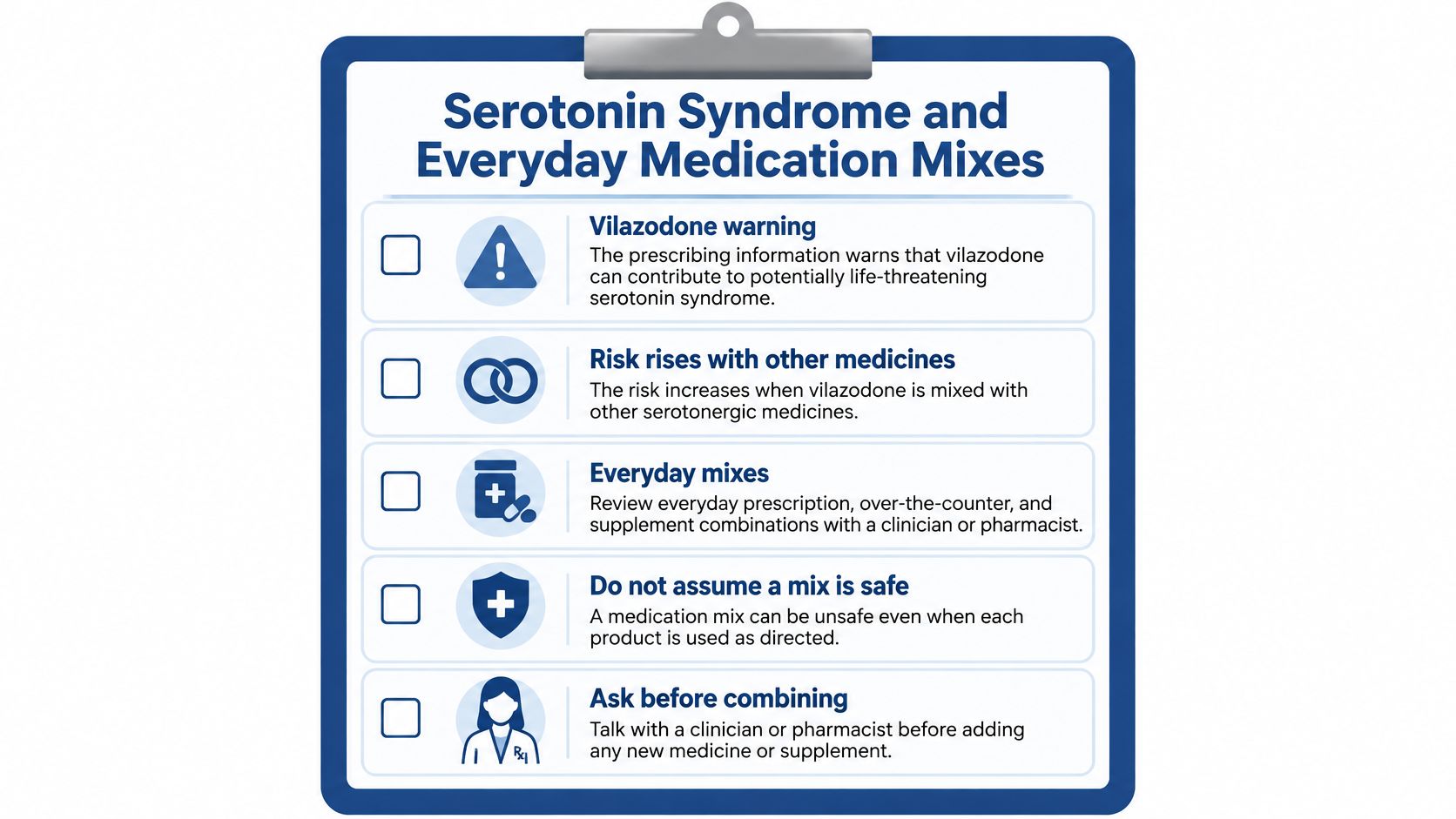
The vilazodone prescribing information on DailyMed warns that vilazodone can contribute to potentially life-threatening serotonin syndrome. The warning becomes more important when it is combined with tramadol, fentanyl, lithium, buspirone, amphetamines, triptans, or St. John's wort. In premarketing major depressive disorder trials, serotonin syndrome symptoms were reported in 0.1% of vilazodone-treated patients.
That figure is useful as a label fact and weak as a personal forecast. It does not establish risk for someone with OCD, for someone taking several interacting medicines, or for a higher-dose off-label plan. A low percentage in one studied group works like a weather average: helpful for context, unhelpful for deciding what one household should do on a specific day.
The combinations that show up in real visits
- ADHD stimulants: amphetamine-class medicines sit on the interaction list. A stimulant plus vilazodone needs a supervised plan, not a casual add-on.
- Migraine triptans: sumatriptan and its relatives belong on the medication list before any dose change, even when they are used only a few times a month.
- Lithium and buspirone: both appear in the warning, and both are easy to forget because another clinician may prescribe them.
- St. John's wort: the herbal product counts. Patients often leave supplements out of the history because they do not consider them medicines.
- Opioid pain treatment: tramadol and fentanyl are named specifically. That makes this a defined interaction, not a broad caution about every pain medicine.
Medication lists get tangled fastest when several prescribers are involved or when family members manage medicines for one another. A caregiver guide to autism medications may help some households organize those records before an appointment. For this decision, the vital list is the one that includes vilazodone, every serotonergic medicine, supplements, and as-needed drugs.
Startup effects versus an emergency
Early nausea, loose stools, or mild activation are common and usually settle. Emergency signs look different: agitation, confusion, sweating, fever, diarrhea, tremor, muscle rigidity, and a rapid heart rate.
The practical distinction is timing and intensity. A little stomach upset in the first days can be expected, while a fast change in mental status or body temperature calls for urgent help.
Serotonin syndrome is uncommon and still urgent. A combination is not proven safe because one drug was tolerated alone. Switching from another antidepressant needs clinician-set timing so two serotonergic drugs do not overlap unsafely. Bring every prescription, supplement, and as-needed medicine to the visit, in a bag or on a phone photo of the labels.
What a Clinician Reviews Before Off-Label Use
Walk into the visit with symptoms and a timeline, not a brand name.
First, is it OCD
The pattern has to fit. Obsessive-compulsive disorder means intrusive, unwanted thoughts plus repetitive behaviors or mental acts aimed at reducing the distress they cause, with enough time loss or impairment to matter.
Screening answers are not a diagnosis. Neither is a quiz score from a website. A clinician separates OCD from generalized anxiety, from depressive rumination, from PTSD reminders, and from ADHD-related restlessness, because those look alike in a waiting room and lead to different medicines.
Then, what has already been tried
Treatment history decides more than any brand preference. Which serotonin reuptake inhibitor was used, at what dose, for how many weeks, and was ERP delivered by someone trained in it?
A four-week course at a low dose isn't a failed trial. Neither is three months of a drug that never reached a therapeutic dose. Meanwhile, comorbid depression may explain why vilazodone is already on the list, though depression benefit says nothing about OCD benefit. Adverse effects the person won't tolerate, pregnancy or breastfeeding plans, suicide risk, and every interacting medicine from the previous section all belong in the same review.
A useful question to bring: if this medicine helps, what will we measure, and when will we decide it didn't work?
If off-label use stays on the table after that review, the risk-benefit conversation gets documented: the reason, the success criteria, the monitoring plan, and when to stop.
Patients are typically better served by an evidence-supported SSRI or clomipramine plan combined with ERP than by stretching a depression medicine into a job it was never studied for. Integrative Psychiatry of America approaches OCD with medication and behavioral techniques together, through a psychiatric evaluation and a personalized plan rather than a single-pill promise. No outcome can be guaranteed, and a prescriber may conclude that vilazodone isn't the right option. The reasoning behind online psychiatry and medication management explains how follow-up visits track response and side effects over time.
Plan an OCD Evaluation in Pennsylvania
If obsessions or compulsions are disrupting work, school, or home, the next step is a thorough psychiatric evaluation, not a self-directed switch to or away from Viibryd.
Integrative Psychiatry of America provides outpatient psychiatric care by telehealth for adults across Pennsylvania, including Philadelphia and the surrounding counties. Care includes thorough psychiatric evaluations, personalized treatment plans, medication optimization, and collaborative care coordination, all through secure virtual visits. Appointments for a thorough psychiatric evaluation can be scheduled on the practice website, and every visit happens through secure telehealth. Clinicians are board-certified psychiatric mental health nurse practitioners, not physician psychiatrists.
What the appointment can cover matters for anyone whose symptoms travel together. OCD alongside anxiety, depression, ADHD, or PTSD gets assessed as a whole picture, current medicines get reviewed one by one, and the plan may pair medication management with behavioral treatment. Readers who want the fuller picture of how treatment is structured can review online OCD treatment in Pennsylvania before booking. The free Anxiety Symptom Checker is a reasonable way to organize symptoms beforehand, with the caveat that it doesn't diagnose OCD or rule it out.
Insurance deserves one accurate paragraph. Coverage, copays, deductibles, network status, and prior authorization requirements vary by plan, so benefit verification comes before any assumption about cost. Nothing about coverage is guaranteed until the plan answers.
Two soft next steps fit readers who want care in Pennsylvania: request an appointment for an evaluation, or verify insurance first if cost is the deciding factor. Anyone outside Pennsylvania, anyone in crisis, and anyone with possible serotonin syndrome symptoms needs local urgent or emergency care instead of a scheduling request. Crisis support is available by call or text to the 988 Suicide and Crisis Lifeline.
Integrative Psychiatry of America offers virtual psychiatric evaluations and ongoing medication management to adults across Pennsylvania, including second opinions when someone is weighing an off-label decision like Viibryd for OCD. The practice pairs medication decisions with behavioral treatment and reviews the full medication list before anything changes. Visit Integrative Psychiatry of America to request an appointment or verify insurance before the first visit.