
Many adults take melatonin with Zoloft without a known major drug interaction, but the combination isn't automatically safe. A clinician should check the dose, timing, other sedatives, and reason for poor sleep before a patient adds it.
Table of Contents
- A Sleepless Night on Zoloft
- Can Melatonin Be Taken With Zoloft
- How Zoloft and Melatonin Act in the Body
- Side Effects and When to Call
- Real Timing Situations Patients Bring to Visits
- Ask for a Medication and Sleep Review
A Sleepless Night on Zoloft
After starting sertraline, sold as Zoloft, a Pennsylvania adult lies awake replaying conversations and checking the clock. A bottle of melatonin is within reach. The question feels simple: can it help with sleep while they take an antidepressant?
The combination may be compatible for some people, but that does not make it automatically appropriate. A supplement can still cause problems even when no major interaction is known.
It is understandable to want restful sleep without disrupting depression or anxiety treatment. Still, the reason sleep is poor matters. A bedtime supplement may not address the cause, and its effects can vary from person to person.

The sleep complaint matters
Zoloft can affect sleep in different ways. Some people feel more alert, while others become sleepy. Trouble falling asleep, waking repeatedly, and feeling exhausted during the day are distinct complaints, and they may call for different responses.
Depression can also disrupt sleep, so insomnia that begins during treatment does not automatically point to a medication effect. This overview of why depression causes insomnia explains how mood symptoms and sleep problems can overlap. Keeping track of when sleep changes and how it feels can help a prescriber assess the pattern.
Bedroom conditions can affect rest, too. Advice on sleep troubleshooting for Rogue Valley homes addresses the home environment, a separate consideration from medication safety.
Supplement bottles don't undergo the same premarket checks for dosing, safety, and effectiveness as prescription sertraline. A familiar brand or a natural label alone cannot show whether a product suits a particular person.
Separating the sleep complaint from the medication question makes the next step clearer. A prescriber can review symptoms, other medicines, and the supplement before advising on personal use. The checkpoint table can help organize that conversation.
Can Melatonin Be Taken With Zoloft
Melatonin with Zoloft safety checkpoints
| Checkpoint | What it means | Usual takeaway |
|---|---|---|
| Known drug interaction | No well-established major interaction between melatonin and sertraline; melatonin mainly uses CYP1A2, while sertraline's stronger inhibitory effect involves CYP2D6 | Often compatible on a stable dose, still not a blanket yes |
| Why sleep is poor | Zoloft may cause insomnia or sleepiness | Melatonin may fit trouble falling asleep, not every sleep complaint |
| Daytime sedation | Both can cause drowsiness or fog | Driving should wait until the personal response is known |
| Other sedatives | Alcohol, benzodiazepines, opioids, sedating antihistamines, and other sleep aids can add sedation | The combination may be inappropriate |
| Dose on the bottle | Products often range from under 1 mg to 10 mg, and labels can be inaccurate | A clinician chooses the dose; higher isn't better |
| Clock time | Melatonin signals the intended sleep period rather than a fixed evening hour | Same-night use may be reasonable with clinical approval; Zoloft stays at its prescribed time |
| Special situations | Pregnancy, breastfeeding, seizures, autoimmune or liver disease, children and teens | Individual medical advice is needed before starting |
Different liver pathways help explain why clinicians don't usually treat this pair as a classic prohibited combination. That reasoning isn't proof that every product, dose, or patient has been thoroughly studied. A stable sertraline regimen makes the decision easier to assess than a regimen that just changed.
The next question is whether melatonin matches the complaint. Someone whose sleep schedule runs late may need a different approach from someone who wakes repeatedly with panic or pain. Melatonin won't reliably address every reason for insomnia.
Drowsiness changes the practical verdict
A patient may fall asleep more easily and still function worse the next morning. Slowed thinking, unsteadiness, and delayed reactions matter even when the person doesn't describe feeling heavily sedated.
Other bedtime substances can make that trade-off unacceptable. Diphenhydramine, doxylamine, prescribed benzodiazepines, opioids, and alcohol all deserve explicit discussion. Separating doses by a few hours doesn't guarantee that overlapping effects disappear.
The bottle strength also needs review. More melatonin doesn't necessarily produce better sleep, and a larger amount can leave more unwanted effects. IPA's discussion of SSRIs, supplements, and diet for depression provides context for treating supplements as part of the medication list.
Timing should reflect the intended sleep period and treatment goal. A clinician may recommend a different schedule for shifting a delayed body clock than for occasional difficulty falling asleep. Pregnancy, breastfeeding, seizure disorders, autoimmune disease, liver disease, and younger age require individualized judgment.
The same-night rule
A patient shouldn't add, stop, or move either product tonight based only on this article.
- Sertraline stays consistent. The patient keeps the prescribed clock time unless the prescriber changes it.
- Previously approved melatonin follows the plan. If a clinician has accepted a low dose for bedtime use, the patient takes it shortly before the intended sleep period.
- Alcohol and extra sleep aids stay out. Another sedating product shouldn't become part of that night's experiment.
- An unsuccessful night doesn't justify escalation. The patient shouldn't raise the bottle dose because the first nights fail.
How Zoloft and Melatonin Act in the Body
Zoloft changes serotonin signaling, while melatonin acts more like dimming the house lights. Their different jobs explain why adding melatonin isn't the same as adding another depression treatment.
The comparison below separates those roles.
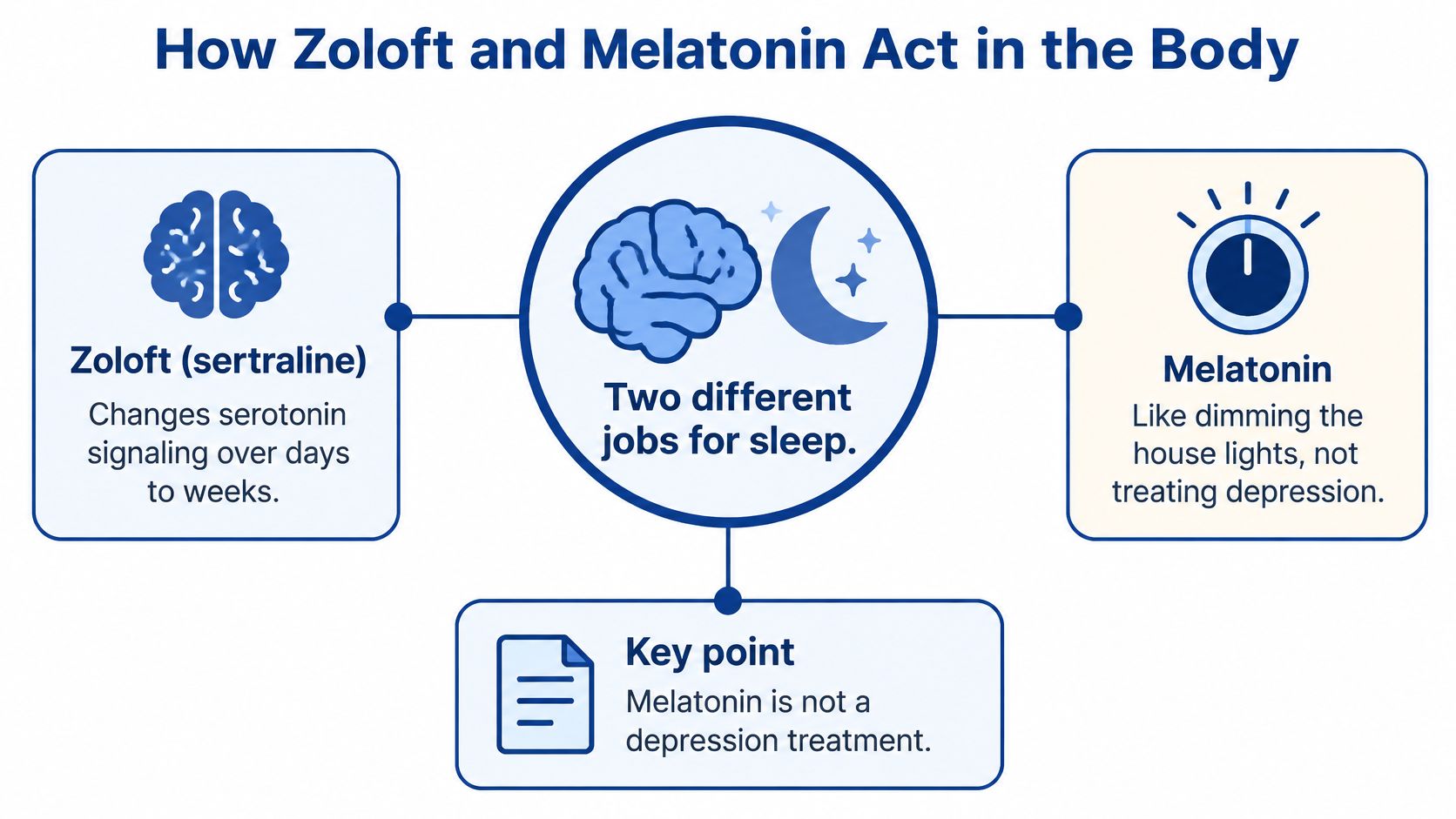
Serotonin signaling and the body clock
Sertraline is a selective serotonin reuptake inhibitor, or SSRI. Prescribers use it for depression, anxiety disorders, OCD, PTSD, and other appropriate indications. It reduces serotonin reuptake between nerve cells, while meaningful symptom improvement develops over days to weeks rather than immediately.
Say an adult starts treatment because persistent worry and low mood have disrupted daily life. Early sleep changes don't necessarily reveal whether the medication will ultimately help. The prescriber needs to consider the timing, severity, and accompanying symptoms.
The pineal gland releases the body's melatonin in darkness. Supplemental melatonin can influence sleep timing, but it doesn't treat the underlying mood disorder. A person can become sleepier while depression, anxiety, or nighttime rumination still needs treatment.
Liver enzymes help clear both substances. Melatonin mainly follows a pathway called CYP1A2; sertraline's more notable enzyme inhibition involves CYP2D6. These names describe processing pathways, not a safety certificate for the combination.
Serotonin syndrome is a separate concern
Serotonin syndrome isn't an expected routine effect of ordinary melatonin combined with an SSRI. It is a potentially life-threatening reaction to excessive serotonin activity, often involving interacting serotonergic medicines.
MAOIs and certain other antidepressants raise a different level of concern when combined with sertraline. Some pain medicines, cough products, and mood supplements can also change the assessment. A medication review must include those products rather than focusing only on melatonin.
A frightening interaction name shouldn't distract from the more likely problem: a person who feels too foggy or unsteady to function safely.
A related video is available below.
Anxiety, pain, caffeine, evening screens, and sleep apnea can all contribute to insomnia during antidepressant treatment. The prescribed time of day may matter as well. A supplement can't determine which explanation fits, so the history remains more useful than guessing from the symptom alone.
Side Effects and When to Call
The safest monitoring approach follows the person's alertness, mood, and functioning, not just an interaction checker's result. A reassuring database entry doesn't cancel a new symptom.
Common unwanted effects can include next-morning grogginess, vivid dreams, headache, dizziness, and nausea. A high or late dose may leave a hungover feeling. Because sertraline can already cause insomnia or somnolence, meaning sleepiness, the change deserves careful interpretation.
A brief check after clinical approval
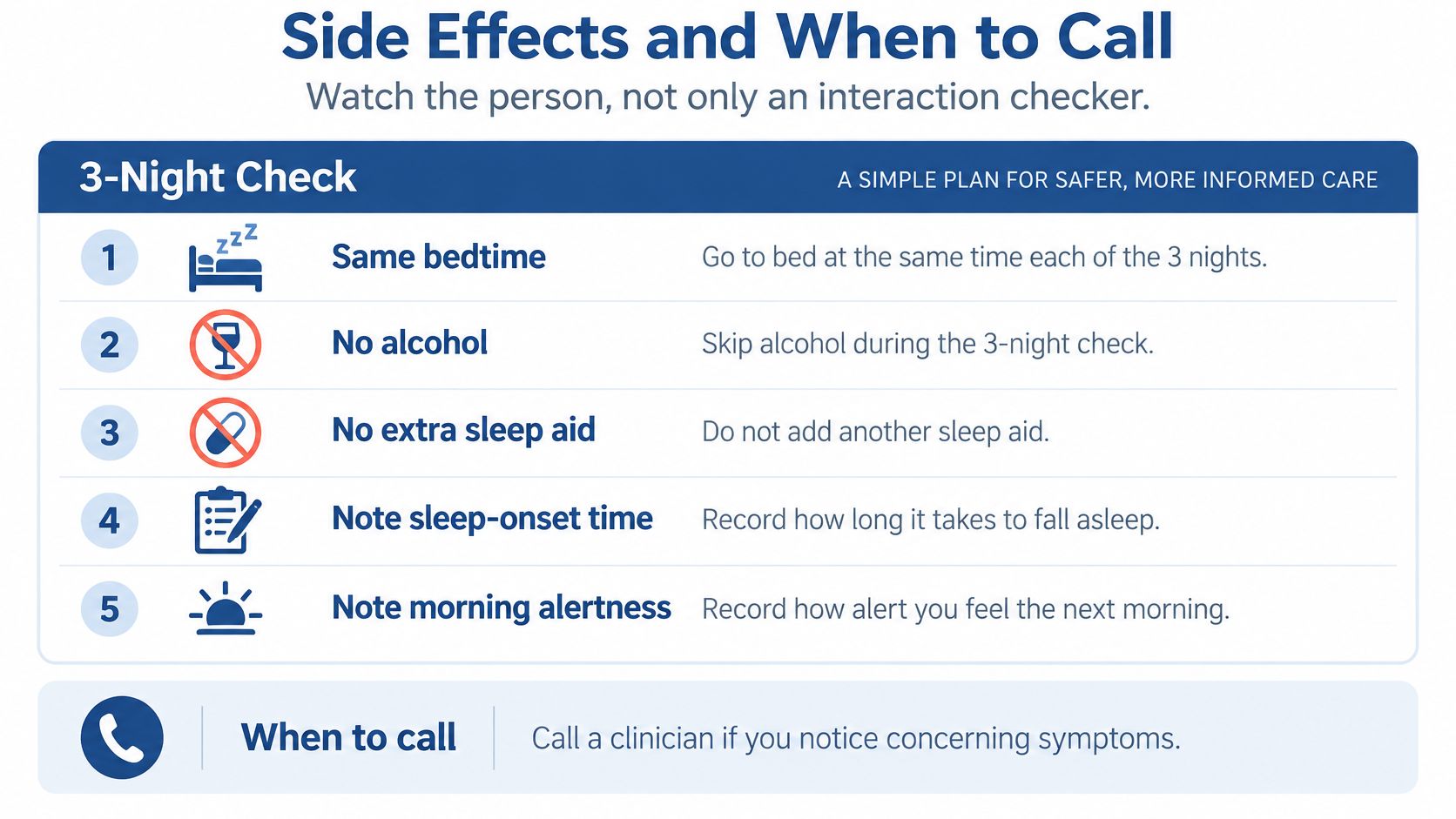
A 3-night check can organize observations after a clinician approves the combination. It isn't a requirement to continue through side effects or a substitute for follow-up.
- Consistent bedtime: The patient keeps the intended sleep period steady.
- No alcohol: Alcohol would complicate both sleep quality and the safety assessment.
- No extra sleep aid: Another new product makes it harder to identify the cause of symptoms.
- Sleep-onset notes: A paper diary records approximately when sleep begins and whether awakenings occur.
- Morning alertness: Notes capture dizziness, slowed thinking, and difficulty getting out of bed.
The checklist below keeps those observations together.
Driving, night-shift work, operating machinery, and caring for children require reliable alertness. A patient who feels impaired shouldn't drive, even after apparently adequate sleep.
What to notice after adding melatonin
| What you notice | Likely meaning | Next step |
|---|---|---|
| Sleep comes faster and mornings feel normal | Dose and timing may be tolerable | The prescriber should still hear about use at the next visit |
| Heavy sleep but groggy morning | Dose may be high or taken too late | Further increases should stop, with advice sought before the next dose |
| No change after several nights | The problem may not be melatonin-responsive | A review should address caffeine, schedule, apnea, and Zoloft timing |
| New dizziness, headache, or nausea | Either product or the combination may contribute | The patient should contact the prescriber rather than stack another aid |
| Confusion, fainting, severe agitation, or worsening mood | Urgent clinical assessment may be needed | Severe or sudden symptoms require urgent care |
Changes that need prompt contact
A patient whose sertraline was just started or increased shouldn't independently add melatonin. That makes an already changing clinical picture harder to interpret. IPA's explanation of how long Zoloft takes to start working helps frame a discussion about early treatment changes.
Pregnancy, planned surgery, or a newly prescribed anticoagulant should trigger a prompt medication review. A switch into unusually high energy, impulsive behavior, racing thoughts, and little need for sleep also needs prompt assessment. That pattern is different from feeling exhausted but unable to sleep.
Stopping Zoloft abruptly can cause discontinuation symptoms and a return of the treated condition. A concerning night calls for advice, not an unsupervised stop.
Symptoms that shouldn't wait
Chest pain, trouble breathing, fainting, seizures, severe confusion, or uncontrollable agitation require emergency assessment. New or worsening suicidal thoughts require immediate help; intent, a plan, or inability to remain safe makes the situation an emergency.
Heavy sweating, tremor, fever, and muscle rigidity after another serotonergic drug was added can suggest serotonin syndrome. Those signs aren't typical of melatonin alone, but the suspected cause shouldn't delay emergency care.
For nonemergency follow-up, the patient should bring a complete medication and supplement list. The note should explain why sleep changed, the sertraline clock time, and whether snoring, gasping, or another sleep disorder warrants testing.
A single-ingredient product makes review easier than a mixed sleep formula. Some tested melatonin products have contained amounts that differ from their labels, and some have contained serotonin. Independent quality testing can reduce uncertainty without proving personal safety. Gummies also resemble candy, so secure storage away from children matters.
Real Timing Situations Patients Bring to Visits
Timing decisions become clearer when the patient's actual workday, responsibilities, and symptoms enter the conversation. The following hypothetical situations lead to different clinical decisions.
A Harrisburg professional with a late sleep onset
A Harrisburg professional takes Zoloft in the morning but stays awake past midnight. Coffee continues through the afternoon, and work messages arrive in bed.
A clinician may discuss low-dose nighttime melatonin after assessing caffeine, screen habits, and possible antidepressant activation. The decision isn't whether the products can share a day. It is whether a supplement addresses the problem better than changing an evening routine or reviewing treatment.
A Pittsburgh worker finishing a night shift
A Pittsburgh shift worker asks about taking melatonin at 8 a.m. before daytime sleep. The intended sleep period matters more than whether the clock says morning.
The immediate decision concerns the commute: a sedating product shouldn't precede driving home. Blackout curtains, household noise, and rotating shifts also affect the plan. Persistent schedule-related problems may warrant assessment for a circadian rhythm disorder rather than an improvised bedtime routine.
A college student combining bedtime products
Say a college student takes sertraline, adds a 10 mg melatonin gummy, and also uses an antihistamine sleep aid. The student then struggles to wake for class and feels dizzy on the stairs.
The central concern is stacked sedating effects, not a mysterious interaction unique to Zoloft. The next decision is a medication review, not trying a stronger gummy or adding another product.
A parent considering the same gummies for a teen
A parent notices that a teen taking sertraline also has trouble sleeping. Sharing the adult's product may seem convenient, but an adult article can't establish pediatric dosing or appropriate mood monitoring.
The prescribing clinician should assess the teen's sleep pattern, symptoms, and medication response. The decision changes from an adult supplement question to an individualized child or adolescent treatment question.
A useful visit note contains the product name, milligram label, clock time, other sedatives, and number of nights tried.
Across these scenarios, moving Zoloft between morning and evening remains a prescriber decision. The same medicine can feel activating to one patient and sedating to another.
Sleep apnea, restless legs, and bipolar-spectrum illness can resemble a straightforward bedtime problem. Loud snoring with gasping, an uncomfortable urge to move the legs, or markedly reduced need for sleep each changes the evaluation. Sleep optimization addresses sleep disorders that affect mood, focus, and overall well-being, rather than merely making a person drowsier.
Ask for a Medication and Sleep Review
If insomnia continues, daytime functioning declines, or mood changes accompany poor sleep, a medication-and-sleep review may be more useful than searching for another supplement. Bring the exact melatonin bottle or product label to the discussion. The type and amount matter, and a stable Zoloft routine does not make every supplement automatically suitable.
The review can help distinguish difficulty falling asleep from a possible sleep disorder, medication side effects, or a treatment response that needs reassessment. Symptoms that led to sertraline, such as anxiety, depression, or attention problems, also belong in the conversation.
Preparing for a useful appointment
A short record can help make the visit more specific. Include:
- Reason for treatment: Symptoms that led to sertraline and which have improved.
- Sleep pattern: Bedtime, awakenings, naps, work shifts, and how you feel in the morning.
- Complete product list: Prescription medicines, antihistamines, caffeine products, cannabis, alcohol, and supplements.
- Treatment priorities: Safe driving, reliable work performance, caregiving, and relief from nighttime distress.
A mood tracker or sleep diary can organize what you notice over time. These tools cannot establish a diagnosis or determine whether melatonin is safe for you.
Pennsylvania care options
Integrative Psychiatry of America provides virtual psychiatric care in Pennsylvania. Board-certified psychiatric nurse practitioners can prescribe medication when clinically appropriate, with medication decisions made collaboratively with patients and families.
Care may combine medication management with psychotherapy, nutritional psychiatry, and lifestyle optimization. The practice's online medication management service can support a discussion of prescribed treatment alongside sleep and lifestyle concerns.
You can raise depression or mood symptoms, anxiety, and attention problems during an appointment. Poor sleep can complicate attention, so an ADHD evaluation should consider sleep rather than assume it is unrelated. Insurance coverage and plan requirements vary; the practice's Insurance and Fees pathway can help patients check benefits before requesting an appointment.
This page cannot confirm whether melatonin and Zoloft are appropriate together for you. An individualized review can weigh the sleep concern, other products, and possible daytime drowsiness rather than offer a blanket yes.
Clinical reviewer: Christopher Clark, MSN, PMHNP-BC.
Updated 2026.
Integrative Psychiatry of America offers Pennsylvania adults virtual psychiatric evaluation and medication management for concerns involving sleep, mood, anxiety, and attention. A medication-and-sleep review can clarify whether melatonin fits your treatment plan or whether another issue needs attention. Pennsylvania residents can visit Integrative Psychiatry of America to explore care options, check insurance benefits, and request an appointment.