
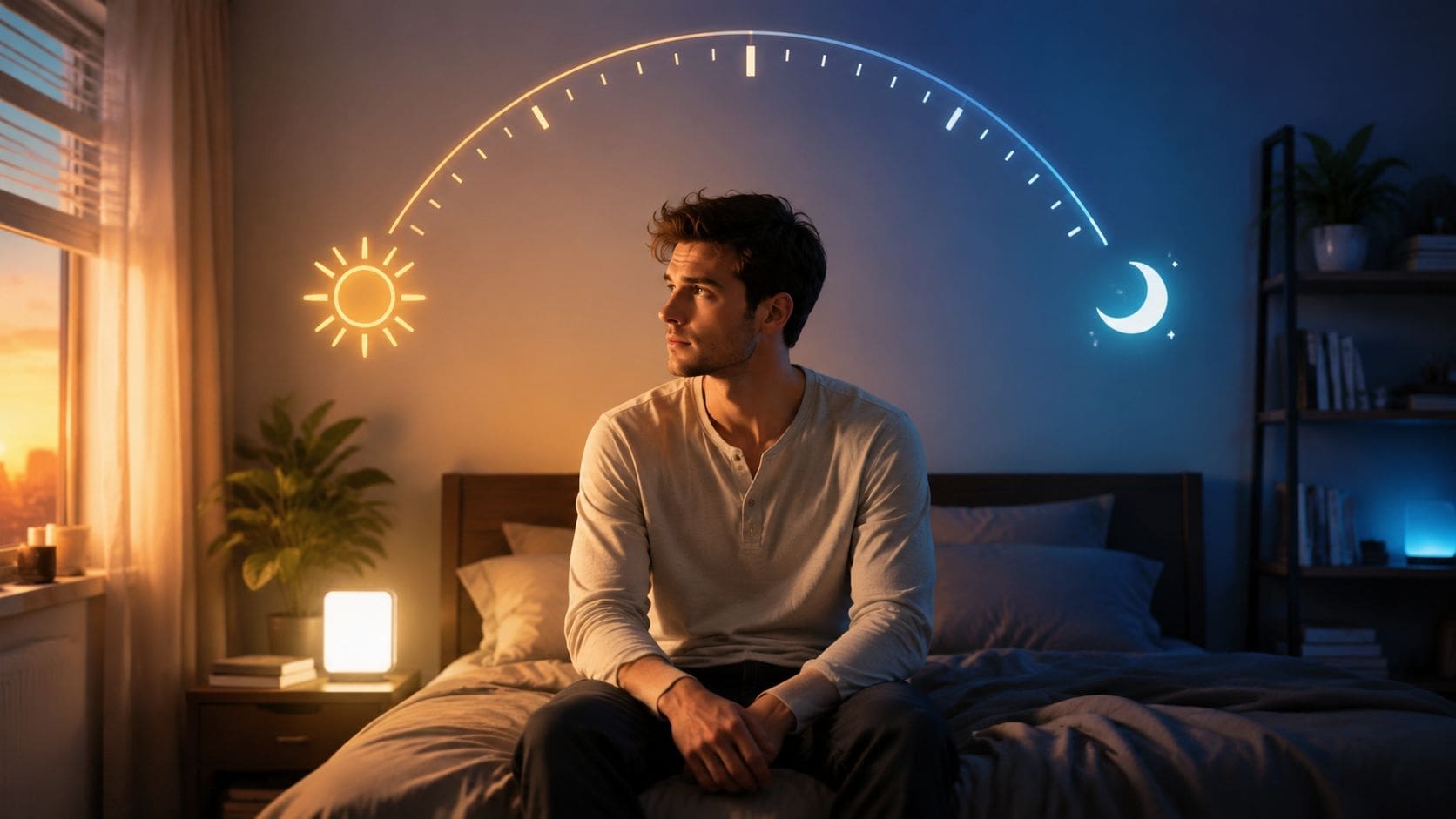
A common pattern goes like this. Someone lies awake until 2 a.m., finally falls asleep, then drags through an 8 a.m. meeting feeling foggy, irritable, and a little ashamed that “simple sleep” seems so hard. On weekends, that same person sleeps later and suddenly feels more normal, which makes the whole situation even more confusing.
That pattern can affect work performance, mood, concentration, family routines, and even confidence. It can also overlap with depression, anxiety, ADHD, and stress-related burnout. In some people, the problem isn't a lack of discipline. It's a body clock that's running out of sync with the schedule life demands.
Poor sleep can also blur the line between emotional symptoms and a true sleep-wake timing problem. For readers trying to sort out that difference, this explanation of why depression can cause insomnia and how mood and sleep interact gives useful context.
Table of Contents
- Introduction to Circadian Rhythm Disorder
- Understanding Circadian Rhythm Disorders
- Types and Symptoms of Circadian Rhythm Disorders
- Biology and Causes of Circadian Rhythm Disorders
- How Circadian Rhythm Disorders Are Diagnosed
- Treatment Options for Circadian Rhythm Disorders
- Telehealth Care in Pennsylvania and Self Management Tips
Introduction to Circadian Rhythm Disorder
A circadian rhythm disorder isn't just “bad sleep.” It's a timing problem. The body may want sleep at hours that clash with school, work, parenting, or social routines.
That's why some people can sleep a full night if left alone, yet still struggle badly in daily life. A college student may feel fully awake near midnight and miss early classes. A hospital worker may switch shifts and spend days feeling mentally off-balance. An older adult may get sleepy very early in the evening and wake long before sunrise.
The impact reaches beyond tiredness. People often notice lower frustration tolerance, more anxiety around bedtime, worsening focus, and a sense that the day never starts or ends at the right time.
Practical rule: When sleep feels normal on a preferred schedule but falls apart on a required schedule, timing deserves a closer look.
Circadian rhythm problems can be identified, evaluated, and treated. The details matter, because different types call for different strategies. A person who naturally drifts later each day needs a different plan than a person whose sleep is disrupted by overnight shifts.
Understanding Circadian Rhythm Disorders
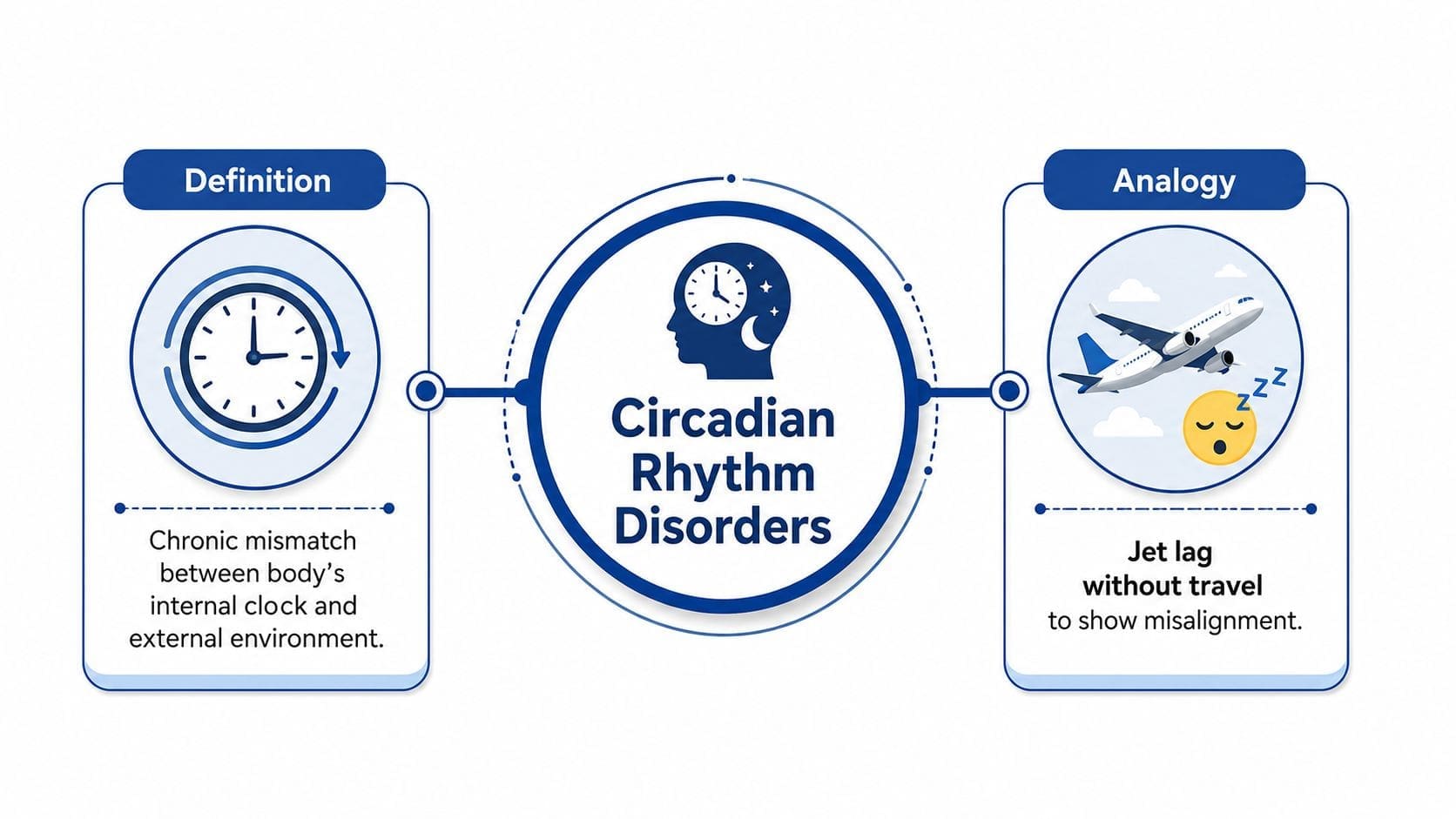
At the simplest level, circadian rhythm disorders are chronic mismatches between the body's internal clock and the outside world. A helpful analogy is jet lag without travel. The person hasn't boarded a plane, but the brain and body still act as if they're living in a different time zone.
Why this matters in daily life
These disorders affect much more than bedtime. When the internal clock and the demanded schedule don't line up, the person may have trouble with alertness, memory, work consistency, emotional regulation, and motivation. Many patients describe feeling as if their body resists the very hours when they most need to function.
This isn't rare. Circadian rhythm sleep-wake disorders affect approximately 3% of the global adult population, with rates rising to 7–16% in adolescents and young adults, according to Cleveland Clinic's overview of circadian rhythm sleep-wake disorders.
That younger age pattern matters because many patients first notice the problem during school, college, or early working years. Those are also life stages when ADHD symptoms, anxiety, and depression often become more visible.
Why readers often get confused
Many people assume insomnia always means an inability to sleep. In circadian problems, the issue is often when the body can sleep, not whether it can sleep at all. A person may do poorly with a conventional schedule and then sleep more normally once allowed to follow the body's preferred timing.
A few clues often point toward a timing disorder rather than simple poor sleep habits:
- Sleep starts too late or too early: The person can't reliably match standard sleep hours.
- Weekends look different: Sleep improves when alarms and obligations are removed.
- Mood changes follow schedule changes: Emotional symptoms worsen when the routine shifts.
- Effort doesn't fix it: Strict “go to bed earlier” advice often fails.
Circadian problems often hide in plain sight because people blame themselves before they consider a body-clock disorder.
For patients already managing attention issues or mood symptoms, early recognition can be especially important. Sleep timing can intensify emotional distress, while emotional distress can make the sleep problem feel even harder to untangle.
Types and Symptoms of Circadian Rhythm Disorders
Some readers use the phrase “circadian rhythm disorder” as if it describes one condition. It doesn't. It's a category that includes several patterns with different timing problems and different treatment priorities.
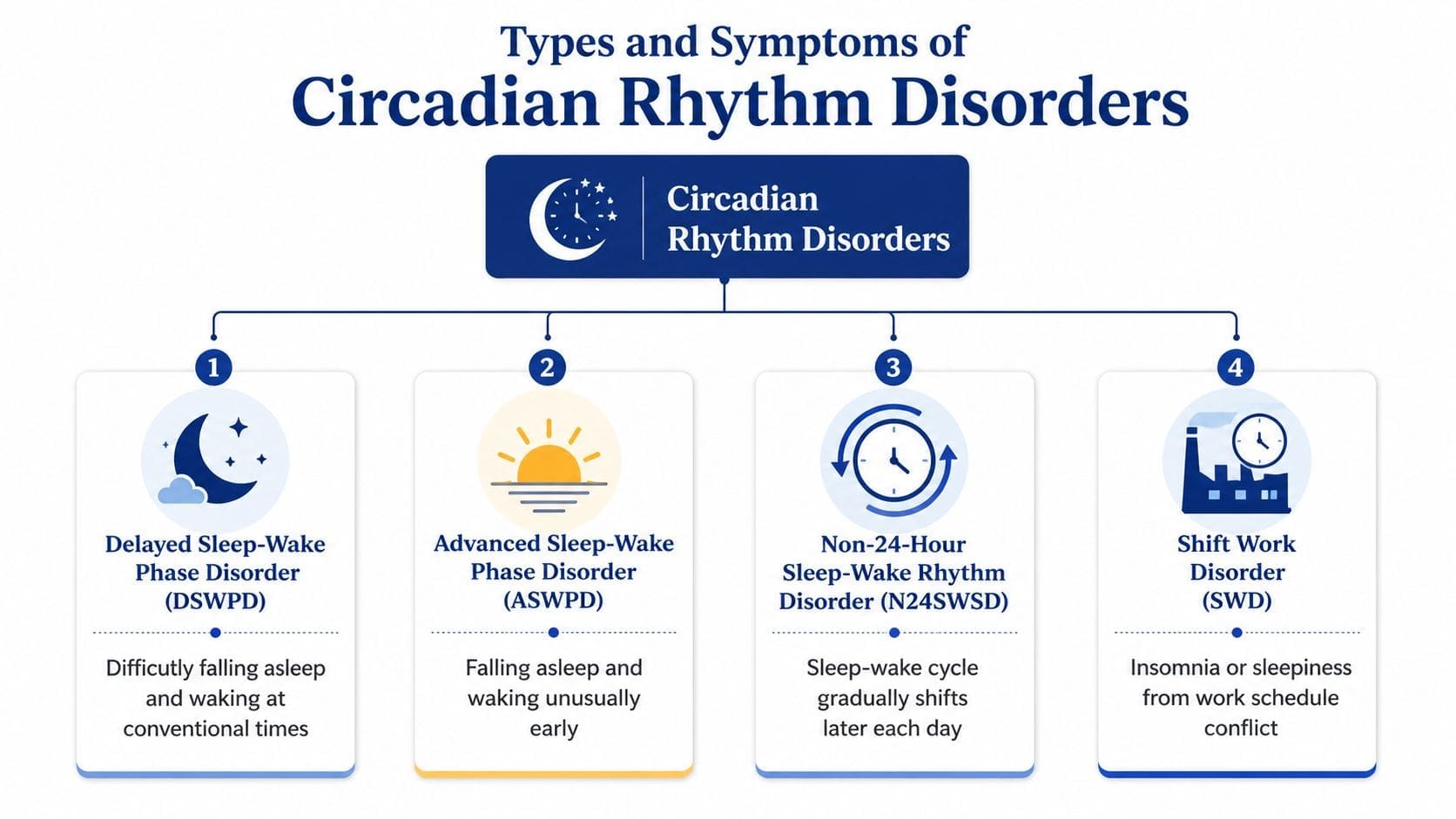
Circadian rhythm sleep disorders are defined by persistent sleep-wake disturbances lasting at least one month, caused by misalignment between the body clock and external cues, as described in this clinical review on circadian rhythm sleep disorders.
Four common patterns
Delayed sleep-wake phase disorder
This is the classic “can't fall asleep until very late” pattern. The person may not get sleepy until the early morning hours, then struggles to wake for work or school. A teenager missing first period or an adult repeatedly late for morning calls fits this pattern.
Advanced sleep-wake phase disorder
This pattern runs in the opposite direction. Sleepiness starts unusually early in the evening, and waking happens very early in the morning. People sometimes misread this as “good discipline,” but it can interfere with dinner plans, evening family time, and social life.
Non-24-hour sleep-wake rhythm disorder
The sleep schedule gradually shifts later over time instead of staying anchored to a 24-hour day. Patients may describe periods of several better days followed by several rough days as sleep timing keeps drifting.
Shift work disorder
This happens when a job schedule conflicts with the body's normal clock. Nurses, emergency workers, manufacturing staff, and overnight support teams often describe insomnia when trying to sleep after work and excessive sleepiness while on duty.
A short overview can help some readers visualize these patterns before a formal evaluation.
Symptoms that often bring people in for help
The symptoms usually aren't limited to “not sleeping right.” Patients may report:
- Morning impairment: Trouble waking, repeated snoozing, mental fog, or missing obligations
- Daytime consequences: Irritability, low frustration tolerance, slower thinking, or reduced work output
- Mood strain: More sadness, anxiety, or emotional reactivity when sleep timing is off
- Schedule dependence: Feeling better on vacations, weekends, or flexible schedules
Older adults and caregivers sometimes worry about safety effects of poor sleep, not just fatigue. For that concern, this resource for senior fall safety offers practical context on how disrupted sleep may affect balance and mobility.
Sleep timing can also shift with seasonal light changes in vulnerable individuals. Readers who notice darker months make sleep and mood worse may find this discussion of seasonal affective disorder treatment in Pennsylvania useful.
Biology and Causes of Circadian Rhythm Disorders
The brain keeps time with a built-in control center called the suprachiasmatic nucleus, or SCN. It sits in the hypothalamus and acts as the master clock, coordinating sleep-wake timing and other daily rhythms. Light is its strongest signal, but melatonin, activity, and social routines also influence timing, as outlined in this review of circadian rhythm sleep disorders and circadian phase assessment.
The body clock in plain language
A useful analogy is a home orchestra. The SCN acts like the conductor. Light tells the conductor when the day starts, while darkness helps signal that the body should prepare for sleep. Meals, exercise, routines, and social contact help the rest of the system stay in step.
When that timing system gets mixed signals, sleep can shift. Late-night screen exposure, overnight work, travel across time zones, and inconsistent daily routines can all push the clock away from the schedule a person wants.
Why some people are more vulnerable
Not everyone reacts the same way to schedule changes. Some people adapt faster. Others seem wired toward late nights or early rising. Genetic differences in clock mechanisms can play a role, and neurodevelopmental conditions such as ADHD or autism can overlap with circadian disruption.
Mood also matters. A meta-analysis found that night shift workers are 40% more likely to develop depression compared to daytime workers, based on research on circadian disruption and mental health. That doesn't mean every shift worker will become depressed. It does show that timing disruption isn't a minor inconvenience. It can affect emotional health in a meaningful way.
A misaligned body clock can look psychiatric, feel psychiatric, or worsen an existing psychiatric condition. Sometimes it does all three.
Readers interested in a broader whole-body view may also appreciate this overview of the inflammation and gut-brain axis, since sleep, stress regulation, and mental health often interact rather than operating as separate systems.
How Circadian Rhythm Disorders Are Diagnosed
A common Pennsylvania telepsychiatry visit starts like this: someone says, “I'm exhausted, but I still can't fall asleep when I need to.” The next step is not to judge one rough night. It is to map the body's timing pattern over days and weeks, the same way you would look for a repeating pattern on a calendar rather than one missed appointment.

What clinicians look for first
Diagnosis usually begins with a careful history. Clinicians ask when sleep starts, how long it takes to fall asleep, when waking happens, whether naps are common, and how work shifts, school schedules, light exposure, caffeine, and screen use affect the pattern.
The goal is to separate three problems that can feel similar. One person has insomnia and cannot sleep even with a good schedule. Another has a body clock that is shifted later or earlier than desired. A third is trying to sleep at a biologically difficult time because of rotating shifts or social demands.
That distinction matters because treatment changes depending on the pattern.
A weekday versus weekend comparison often gives away the diagnosis. If sleep comes more easily and feels more refreshing on free days, the problem may be timing rather than an inability to sleep.
Tools that make the pattern visible
Sleep logs are often the starting point because they turn a frustrating story into a visible pattern. A simple daily record of bedtime, wake time, naps, alertness, and sleep quality can show whether sleep timing is stable, delayed, advanced, or drifting.
Actigraphy adds an objective layer. It uses a wrist-worn device to track movement and rest across multiple days in the home setting. The American Academy of Sleep Medicine describes actigraphy as useful in the assessment of circadian rhythm sleep-wake disorders, especially when paired with sleep diaries and clinical history, in its practice parameters for actigraphy in sleep and circadian rhythm evaluation.
Some cases also call for dim-light melatonin onset testing. That test looks at when the body starts producing melatonin under controlled low-light conditions, which can help confirm where the internal clock is set.
What testing may include
Depending on the situation, an evaluation may include:
- Sleep logs: Daily tracking of sleep timing, variability, and naps
- Actigraphy: Home-based measurement of rest and activity patterns over time
- Dim-light melatonin onset testing: Measurement of melatonin timing when the diagnosis remains unclear
- Clinical questionnaires: Structured screening to separate circadian misalignment from insomnia, depression, anxiety, or sleep apnea
The process works a lot like checking whether a watch is broken or set to the wrong time. A person may be sleeping enough hours, but if those hours happen at the wrong biological time, work, school, mood, and concentration can still suffer.
This is one reason virtual care can be so helpful. In telepsychiatry, patients across Pennsylvania can review sleep logs, daily routines, medication timing, and mental health symptoms from home with a clinician who looks at the whole picture. At Integrative Psychiatry of America, that may include discussion of light exposure, supplements, and medication effects, especially when depression treatment and sleep timing interact. Patients who want to learn more can review this guide to light, medication, and supplements for depression treatment in Pennsylvania.
The clearest diagnostic clue is often a repeated mismatch between the body's sleep timing and the person's actual life demands.
Specialized sleep testing is sometimes needed, but many circadian rhythm disorders become much clearer once the pattern is tracked carefully and interpreted in context.
Treatment Options for Circadian Rhythm Disorders
Treatment works best when it matches the specific pattern. A person with delayed sleep timing needs a different approach than a person working rotating nights, and both need a different plan than someone with non-24-hour drift.
Light, melatonin, and schedule shifts
Light is one of the strongest tools available. Therapeutic bright light therapy requires 10,000 lux exposure for 30–60 minutes to effectively reset the circadian clock and improve sleep timing, based on Cleveland Clinic's circadian rhythm disorder fact sheet.
The timing of light matters as much as the light itself. Morning bright light may help someone whose schedule has drifted too late. Evening light exposure may be used differently for someone whose clock runs too early. Reducing evening light, especially from bright screens and overhead lighting, can also support people whose body clocks are already delayed.
Melatonin can help, but it isn't just a “sleep gummy” situation. In circadian care, timing matters more than taking a random bedtime dose. Used thoughtfully, melatonin can act as a clock signal rather than merely a sedative.
Behavioral and integrative approaches
Medication or supplements alone rarely solve the whole problem. Daily routines either reinforce the new clock timing or pull it back off course. That's why treatment often combines biological tools with behavior change.
Helpful strategies may include:
- Consistent wake time: Waking at the same time helps anchor the body clock better than choosing an earlier bedtime.
- Evening wind-down cues: Lower lighting, fewer stimulating tasks, and a predictable pre-sleep routine tell the brain that night is approaching.
- Exercise timing: Physical activity can support circadian stability when done on a regular schedule.
- Mindfulness and arousal reduction: Racing thoughts and bedtime dread can keep a timing disorder from improving, even when the schedule plan is correct.
- Cognitive behavioral work for insomnia: This can help when the person has developed anxiety about sleep on top of a circadian issue.
Some patients also want a broader plan that connects light exposure, supplements, and psychiatric symptom care. This overview of light, medication, and supplements for depression treatment in Pennsylvania may help frame those conversations.
Special considerations for non-24-hour patterns
One of the most misunderstood situations involves non-24-hour sleep-wake rhythm disorder, especially in people without light perception. Standard light therapy may not work well there because light input to the master clock is impaired. In those cases, non-photic methods such as carefully timed melatonin can be central, and consistency becomes a major part of treatment success.
That's where many patients get discouraged. They expect a one-time reset. Circadian treatment usually behaves more like training a clock than flipping a switch.
Comparison of Treatment Modalities
| Treatment | Benefits | Considerations |
|---|---|---|
| Bright light therapy | Helps shift sleep timing when used at the right time of day | Needs correct timing and enough intensity |
| Timed melatonin | Can support phase shifting and circadian anchoring | Timing matters more than convenience |
| Sleep schedule stabilization | Builds long-term rhythm consistency | Progress can be slow if weekends differ sharply |
| CBT-I strategies | Reduces conditioned insomnia and bedtime anxiety | Works best when paired with circadian-specific timing plans |
| Exercise and lifestyle rhythm support | Reinforces daily structure and body-clock cues | Requires routine, not occasional effort |
| Shift-specific planning | Addresses work-related timing conflict | May need repeated adjustment as schedules change |
Treatment usually fails when the plan is reasonable but inconsistent. Body clocks respond to repetition.
A practical plan often starts small. One wake time. One light routine. One evening adjustment. Then the response is tracked and refined.
Telehealth Care in Pennsylvania and Self Management Tips
A common Pennsylvania scenario looks like this. You know your sleep timing is off, but your work shift changes, the kids need to get to school, or the nearest specialist is a long drive away. Circadian care often works better when support can come to you, not only when you can get to an office.
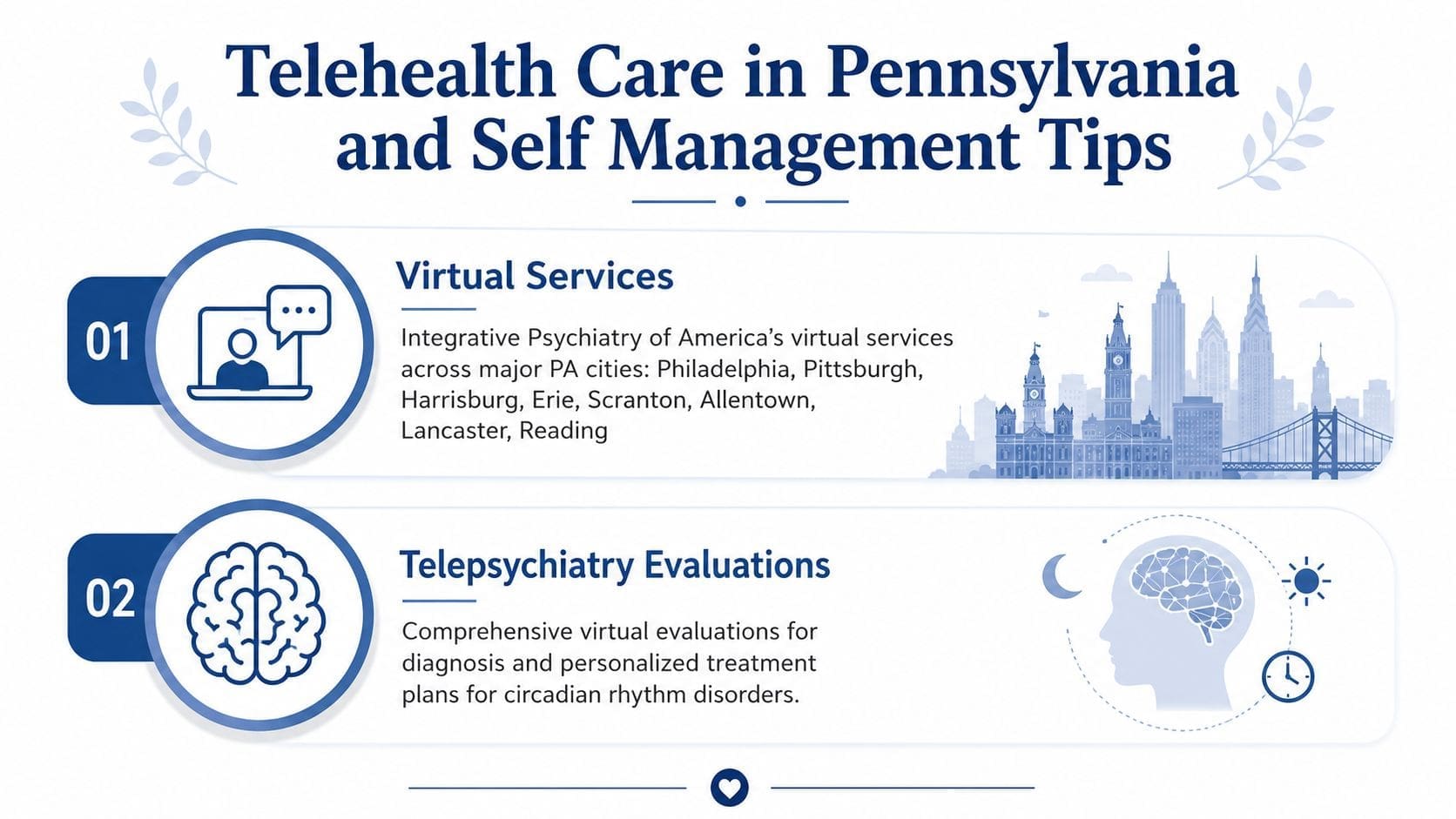
Virtual care helps with access, but the stronger model is virtual care plus a clear treatment plan. In an integrative telepsychiatry practice such as Integrative Psychiatry of America, care is not limited to a quick sleep discussion. A clinician can evaluate the full picture, including mood symptoms, anxiety, ADHD, medication effects, work schedule demands, and daily habits that may be pulling your body clock later or earlier than you want. That matters because circadian problems rarely live in isolation. They often overlap with depression, irritability, poor focus, or stress-related insomnia.
What self-management can look like at home
Home care works best when it acts like setting the same clock every day. The body clock learns from repeated cues, not occasional effort. A simple plan is usually easier to follow than an ambitious one that changes every few days.
Useful habits include:
- Pick one wake time: A steady morning wake-up gives your brain a reliable anchor, even if sleep was imperfect the night before.
- Reduce bright evening light: Lower screen brightness, dim the room, and cut back on activating tasks late at night if your schedule tends to drift later.
- Create a short bedtime ritual: Repeating the same few steps helps your brain link those actions with slowing down.
- Track mood and sleep together: A journal can show patterns, such as anxiety rising after several late nights or low mood showing up when your rhythm shifts.
- Use tools that support routine: Planners, symptom checkers, grounding exercises, and structured reminders can make follow-through more realistic.
For readers exploring digital support options, this helpful guide for patients on RPM gives a useful overview of remote patient monitoring concepts that may complement broader home-based care.
The telehealth piece matters because self-management is only one part of treatment. Some adults need medication review, help sorting out whether the problem is delayed sleep phase versus insomnia, or treatment for anxiety, depression, PTSD, OCD, or ADHD that is disrupting sleep timing. Integrative Psychiatry of America provides virtual psychiatric evaluations, medication management, and evidence-informed mental health treatment across Pennsylvania, including Philadelphia, Pittsburgh, Harrisburg, Erie, Scranton, Allentown, Lancaster, and Reading. If you want a clearer picture of how online visits work, review what telepsychiatry is and how online psychiatric care works.
Many patients do better when they stop chasing a perfect night of sleep and start building a repeatable rhythm. Tools such as the Adult ADHD Assessment, Anxiety Symptom Checker, Daily Agenda Planner, Feeling Journal, Exercise Routine Generator, and 5-4-3-2-1 Grounding Tool can support that process between visits.
A circadian rhythm disorder is a medical and behavioral problem, not a character flaw. With steady coaching, practical home strategies, and virtual psychiatric care that addresses the whole person, many adults in Pennsylvania can build a schedule that supports both sleep and mental health.
Integrative Psychiatry of America provides virtual psychiatric evaluations, medication management, and evidence-informed mental health treatment throughout Pennsylvania. Adults dealing with disrupted sleep timing, depression, anxiety, ADHD, OCD, PTSD, or related concerns can learn more about options through Integrative Psychiatry of America, verify insurance coverage, explore free mental health tools, or schedule a secure telehealth appointment from anywhere in the state.