
The browser has twelve tabs open, three clinic websites promise answers within days, and the actual problem, a missed deadline, a forgotten bill, a conversation lost midway, still isn't solved. That's the point where most adults start searching for an Adult ADHD clinic, not from curiosity, but from exhaustion. Adults in Pennsylvania don't need the fastest promise. They need a clinic that diagnoses carefully, monitors medication safely, and stays useful after the first prescription.
Table of Contents
- Why Picking the Right Adult ADHD Clinic Matters
- What a Defensible Adult ADHD Evaluation Actually Looks Like
- Telehealth vs In-Person ADHD Care and When Each Makes Sense
- Insurance, Prior Authorization, and the Cost Conversation
- Integrative Treatment Options Beyond Medication
- Safety Monitoring and Prescription Logistics
- Questions Worth Asking Before You Book
Why Picking the Right Adult ADHD Clinic Matters
A rushed choice can cost more time than waiting for a careful one. An evaluation that skips childhood history, misses anxiety or sleep problems, or treats a questionnaire as a diagnosis can send treatment in the wrong direction for years. Patients then cycle through medications that don't fit, while the underlying problem stays unnamed.
Demand for adult care isn't marginal. CDC data from October to November 2023 estimated 15.5 million U.S. adults, 6.0% of the adult population, had a current ADHD diagnosis, and 55.9% received that diagnosis at age 18 or older, according to CDC estimates on adult ADHD diagnosis and treatment in 2023. The same data found 36.5% were receiving no treatment. Adult clinics therefore handle two groups at once, adults continuing care from childhood and adults recognized only after work, relationships, finances, or daily organization began to break down.
Start With the Actual Need
Patients should name the need before comparing clinics. Some need a first evaluation. Others already have a diagnosis and need medication management, therapy, skills support, or a second opinion after a poor response. A clinic built only for quick prescribing fits none of those needs well.
The intake process gives an early quality signal. Strong clinics ask about functional impairment, developmental history, co-occurring conditions, substance use, sleep, and cardiovascular history before discussing medication. Weak clinics move straight to scheduling and payment. Convenience still matters, especially for freelancers and remote workers juggling irregular hours, and practical tools such as the top ADHD app for freelancers can support daily structure. Apps don't replace diagnosis, though. The central question stays simple: does the clinic's process earn trust before it asks for commitment?
What a Defensible Adult ADHD Evaluation Actually Looks Like
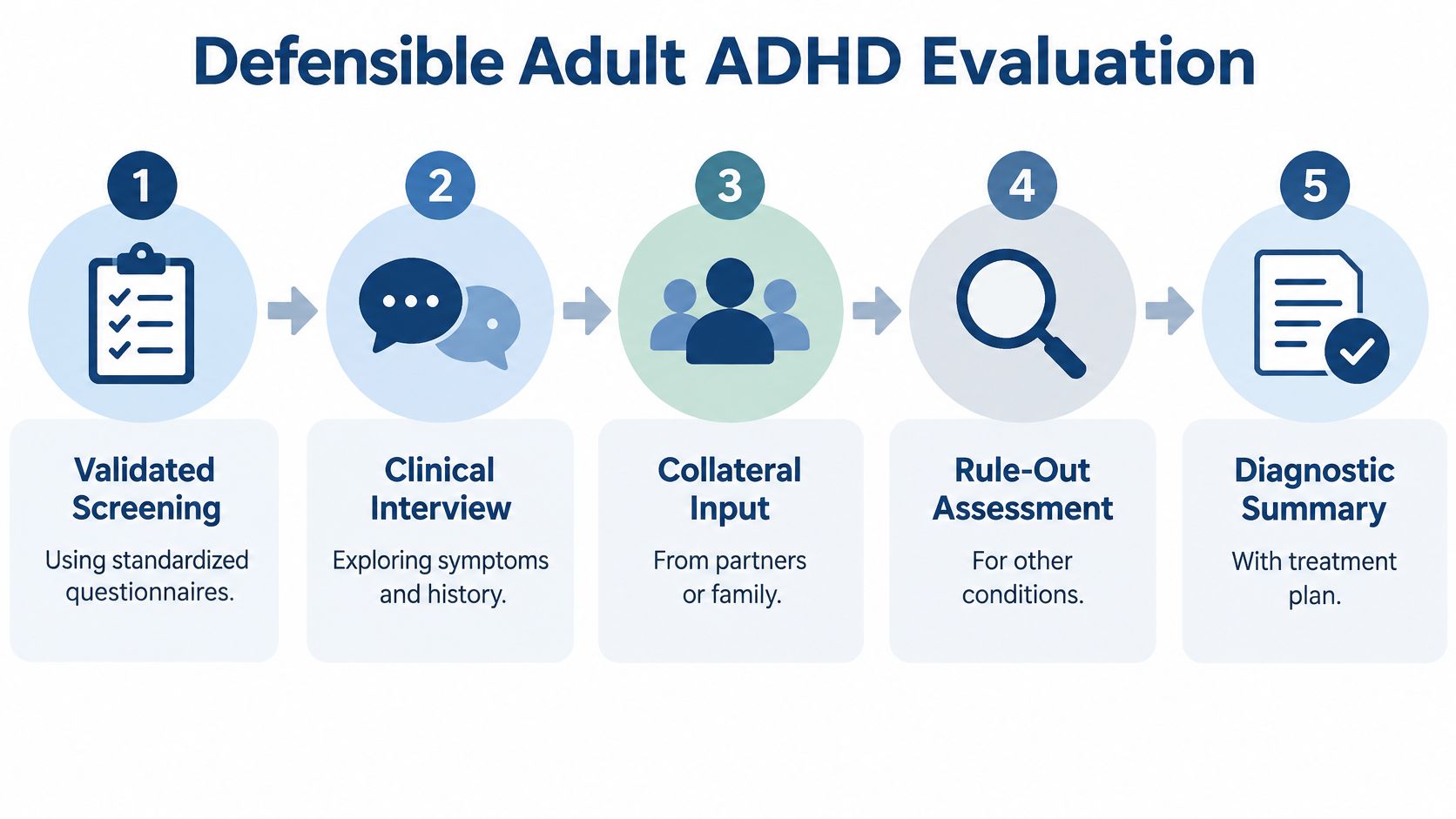
A defensible evaluation follows stages. A positive screening score is a triage signal, not a diagnosis, and credible clinics treat it that way. NHS England specifies that a positive Adult ADHD Self-Report Scale screen, defined there as a score of at least four, indicates a need for thorough assessment rather than confirming ADHD, as explained in NHS England guidance on adult ADHD screening and assessment.
The flowchart below maps the sequence patients should expect before a clinician reaches a conclusion.
The Five Stages That Should Not Be Skipped
- Validated screening: Clinicians use an instrument such as the Adult ADHD Self-Report Scale (ASRS) to decide whether full assessment is warranted.
- Structured clinical interview: The interview covers all 18 DSM-5 symptoms, duration, impairment, developmental history, and childhood onset.
- Onset and setting check: Clinicians verify that clinically significant symptoms began before age 12 and appear across at least two settings, such as work and home.
- Collateral evidence: A partner, parent, school record, or other informant helps confirm history when available.
- Differential diagnosis: Anxiety, depression, bipolar-spectrum illness, trauma, sleep disorders, substance use, personality pathology, and medical causes all require active consideration.
Good documentation names concrete examples. Missed deadlines, unsafe driving, impulsive spending, unfinished paperwork, and repeated conflict at home carry more diagnostic weight than the label "distractible." Pennsylvania adults comparing services can review what a thorough process involves through adult ADHD testing and evaluation services in Pennsylvania and compare that structure against any clinic under consideration.
Neuropsychological testing has a narrower role than marketing suggests. It helps most when childhood records are unavailable, malingering is suspected, or co-occurring conditions create real diagnostic ambiguity. It supplements clinical history. It doesn't replace it, and patients shouldn't pay for it automatically.
A clinic that cannot explain what it rules out has not explained how it diagnoses.
Telehealth vs In-Person ADHD Care and When Each Makes Sense
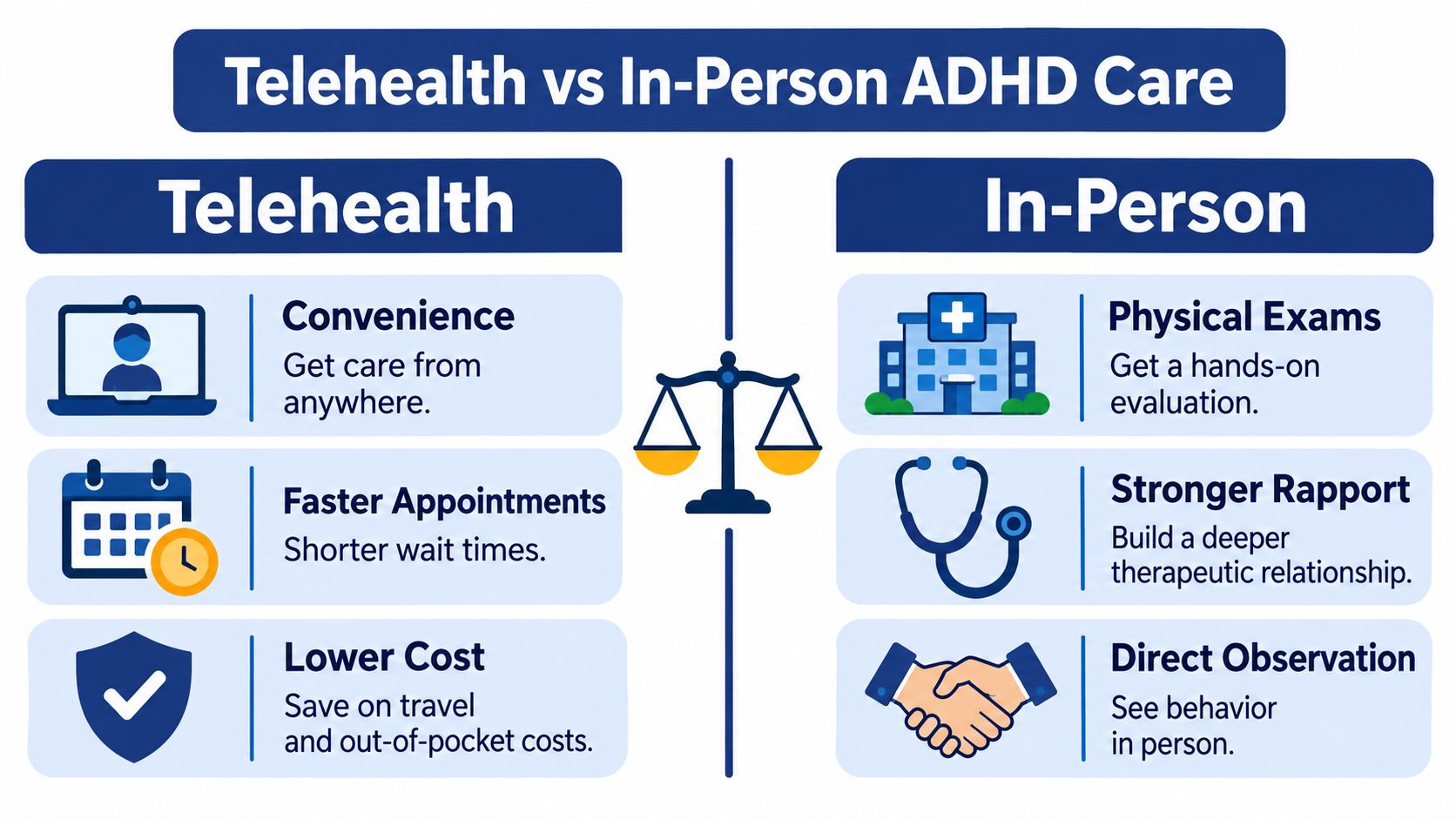
Telehealth and in-person care aren't rivals. They're tools, and each fails when a clinic uses it for every case without thought. For many Pennsylvania adults, virtual visits handle initial evaluations, medication titration, and most therapy sessions well. Travel time disappears, scheduling gets easier, and follow-up becomes more consistent.
The comparison below shows where each format carries a practical advantage.
Where Virtual Care Holds Up
Rapport can develop well on video when visits run long enough and clinicians ask direct questions. Collateral input can also work remotely, since partners or parents can join a call or submit forms. Patients exploring online ADHD treatment options for Pennsylvania adults should still expect the same staged evaluation described earlier, not a shortened version.
Safety monitoring needs structure, not a waiting room. Blood pressure, pulse, weight, and sleep can be tracked at home or through a local pharmacy or primary care visit, then reviewed at follow-up. The format doesn't excuse skipping those checks.
A short clinical overview can help patients picture how virtual assessment and follow-up fit together.
Where In-Person Care Adds Value
Complex cases may warrant in-person assessment. Suspected malingering, active substance use, unclear childhood history, or significant cardiovascular concerns can require direct observation, physical examination, or local coordination. Patients with unreliable internet, limited privacy at home, or difficulty engaging on video may also do better in person.
Clear distinction: convenient virtual care is not low-touch care. Strong telehealth clinics build in monitoring, collateral review, and regular follow-up rather than relying on occasional refill visits.
Insurance, Prior Authorization, and the Cost Conversation
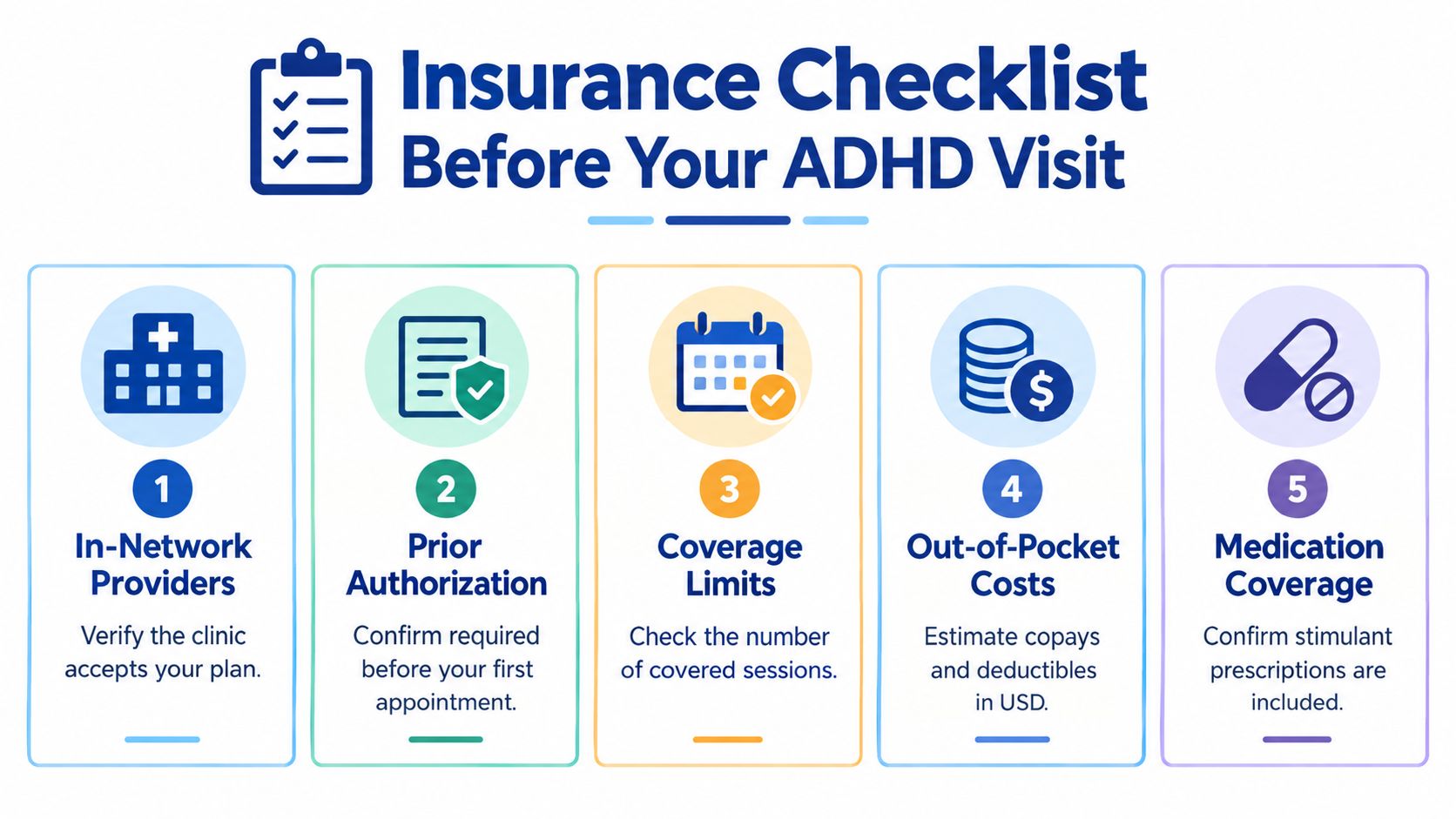
Coverage determines which Adult ADHD clinic most patients can use, yet many clinic websites dodge the topic. Verification should happen before the first visit, not after a diagnosis creates urgency around medication. Benefits, copays, deductibles, network status, and authorization requirements vary by plan, so no clinic can guarantee coverage in advance.
The checklist below outlines the items worth confirming before booking.
What to Verify Before the First Appointment
- Network status: Patients should confirm that both the clinic and the prescribing clinician participate in the plan, since those answers can differ.
- Telehealth coverage: Plans don't always cover virtual psychiatric visits on the same terms as in-person visits, so parity needs direct confirmation.
- Cost sharing: Copay, coinsurance, and deductible amounts shape the final cost of evaluation and repeated follow-up.
- Medication coverage: Formularies can favor specific stimulant or nonstimulant products, and pharmacies apply their own stock limits.
Prior authorization deserves separate attention. Insurers may ask for documentation of impairment, symptom duration, and prior medication trials before approving certain controlled stimulants. That review can take time, and incomplete records slow it further. A concise personal history, covering symptom onset, settings affected, prior treatment, and current medications, helps clinicians build a cleaner submission.
Pennsylvania patients comparing coverage pathways can review online ADHD treatment with insurance in Pennsylvania for guidance on benefit verification before scheduling. When insurance isn't available or network options are thin, patients should ask directly about cash-pay or membership fees, what those fees include, and whether follow-up visits cost extra. Written cost estimates beat verbal reassurance every time. Surprise bills erode trust faster than a longer wait for an appointment.
Integrative Treatment Options Beyond Medication
Medication often starts the conversation, but it rarely finishes it. CDC data from 2023 found 35.2% of adults with current ADHD were receiving both medication and counseling or behavioral treatment, while 33.4% reported taking a stimulant and 5.9% reported using a nonstimulant medication, according to the CDC report on adult ADHD treatment patterns. Combined care isn't an upsell. It reflects how treatment works in practice.

How the Components Reinforce Each Other
Stimulant and nonstimulant medications address attention regulation. They don't teach planning, time estimation, or emotional control. Cognitive behavioral therapy for ADHD and behavioral coaching fill that gap, building systems for task initiation, organization, and follow-through that keep working between doses.
Sleep sits underneath both. Poor sleep worsens attention, irritability, and medication tolerance, so sleep optimization isn't a wellness extra. Exercise counseling, nutritional support, and mindfulness practices play a similar supporting role, steadying energy and mood so medication and therapy gains hold. Environmental design, such as simplified workspaces, visible reminders, and structured routines, reduces the daily friction that medication alone can't touch.
The target is functional change. Fewer missed deadlines, finished tasks, safer driving, and calmer relationships matter more than a lower symptom score on paper. A common pitfall is calling treatment successful when symptoms ease but daily functioning doesn't move.
Strong integrative clinics coordinate across modalities rather than selling isolated services. Follow-up visits should track how medication, sleep, mood, and substance use interact over time, since a change in one area alters the others. Pennsylvania patients interested in that model can read about integrative psychiatry for ADHD, anxiety, and depression to see how combined care gets organized.
Medication can open the door. Skills, sleep, and structure decide whether patients walk through it consistently.
Safety Monitoring and Prescription Logistics
Responsible stimulant care starts before the first prescription. Clinicians should record baseline blood pressure, pulse, weight, sleep, substance-use risk, and cardiovascular history, alongside symptom severity. Shared decision-making then guides medication selection and titration toward the lowest dose that produces meaningful functional benefit with tolerable side effects.
FDA safety guidance recommends that clinicians assess a patient's risk of misuse, abuse, and addiction before prescribing stimulants, counsel patients not to share medication, and continue monitoring for nonmedical use and diversion, including unusually frequent renewal requests, throughout treatment, as stated in FDA guidance on safe use of prescription stimulants. Secure storage and proper disposal belong in that first conversation, not in fine print.
What Follow-Up Should Actually Cover
Each visit should reassess target symptoms, functioning, adherence, and adverse effects. Sleep, mood activation, misuse or diversion risk, and interactions with alcohol or other substances need direct questions. Persistent impairment shouldn't trigger automatic dose escalation, since untreated anxiety, depression, sleep deprivation, or substance use often explains the plateau better.
Logistics deserve equal planning. CDC data reported that 71.5% of adults taking stimulant medication had difficulty getting prescriptions filled because of limited availability, according to CDC data on ADHD in adults and medication access. Patients need a shortage contingency plan, clear refill policies, and honest guidance on pharmacy transfers, travel, and job changes. Clinical guidance summarized by NICE also supports documenting effectiveness and adverse effects, with at least an annual specialist medication review.
Adults comparing prescribers can review online ADHD medication management in Pennsylvania and check whether monitoring practices match that standard. Clinics that treat refills as automatic are signaling a problem. Clinics that build routine monitoring into every visit are signaling the opposite.
Questions Worth Asking Before You Book
The quality of an intake call predicts the quality of care. Clinics that welcome specific questions tend to run specific processes. Clinics that deflect, rush, or demand payment before answering basics have already given useful information, just not the kind their marketing intends.
| Question Category | What to Ask | What a Strong Answer Sounds Like |
|---|---|---|
| Credentials | Who conducts the evaluation, and what license supports prescribing? | A named clinician with clear credentials, such as a board-certified psychiatric mental health nurse practitioner |
| Evaluation structure | Does the process cover childhood onset, two settings, and collateral input? | A staged process with screening, structured interview, and differential diagnosis |
| Appointment length | How long does the first evaluation run? | Enough time for history, impairment examples, and medical review, not a brief symptom check |
| Follow-up cadence | How often does titration get reviewed? | Scheduled follow-up tied to response, side effects, sleep, and blood pressure |
| Pharmacy problems | What happens when a pharmacy cannot fill a prescription? | A stated transfer process, shortage plan, and nonstimulant alternatives when appropriate |
| Coordination | How do therapy, coaching, and integrative services connect? | Shared goals and documented functional targets, not disconnected services |
Vague language deserves skepticism. "Individualized care" means nothing without an explanation of what gets individualized, how often progress gets measured, and what changes when treatment stalls. Refusal to discuss credentials, pressure to book before questions get answered, or promises that medication will definitely be prescribed are all reasons to keep looking.
Preparing for the First Visit
Preparation shortens the path to a confident diagnosis. Patients should gather prior records, school transcripts or report cards if available, and a list of current medications and supplements. A one-page personal history helps more than patients expect: when symptoms first appeared, which settings they affect, what has been tried, and what daily life looks like now. Concrete examples beat general descriptions, since clinicians document impairment from specifics.
Missing childhood records shouldn't stop anyone from seeking evaluation. A 2025 U.S. Department of Health and Human Services review identified persistent underdiagnosis plus sex, racial, and ethnic disparities in adult ADHD diagnosis and treatment, as documented in the HHS review of barriers to adult ADHD diagnosis. Historical estimates also show recorded prevalence varied across groups, including 2.1% among Hispanic adults, 5.4% among non-Hispanic White adults, and 1.9% among non-Hispanic Black adults in the 2001 to 2003 National Comorbidity Survey Replication, according to NIMH statistics on adult ADHD prevalence. Those gaps reflect recognition and access differences, not only symptom differences. Partner or family reports, old work reviews, and consistent lifelong patterns can support history when formal records don't exist.
The First 30 Days After Evaluation
A realistic first month includes a diagnostic summary, clear functional targets, and a titration schedule with defined check-in points. Therapy or coaching referrals should connect to those same targets. Patients should leave the first visit knowing what happens if medication isn't appropriate, what happens if the diagnosis stays uncertain, and when the next review occurs. Uncertainty handled openly is a sign of rigor, not weakness.
Pennsylvania adults, from Philadelphia and Pittsburgh to Harrisburg, Lancaster, and Erie, have more virtual options than ever, which makes selection criteria more important, not less. The right Adult ADHD clinic will answer hard questions directly, explain its diagnostic stages without hedging, and treat follow-up as the core of care rather than an afterthought. Patients who cannot get those answers should keep searching. Settling for a fast diagnosis is easy. Living with a wrong one isn't.
Pennsylvania adults ready to move from research to a careful, staged evaluation can explore virtual ADHD assessment, medication management, and integrative psychiatric care through Integrative Psychiatry of America, where prospective patients can verify insurance and request an appointment online. Care there is built around documented functional goals, structured follow-up, and honest discussion of diagnosis, medication risks, and nonmedication supports.