
You've spent years compensating. In Philadelphia, Harrisburg, or another Pennsylvania community, that may look like working late to meet ordinary deadlines, relying on elaborate reminder systems, losing essentials, or feeling mentally overloaded by routine decisions. An online questionnaire finally seems to explain the pattern, but it can't answer the question that matters most: what kind of ADHD diagnosis doctor evaluates adults carefully and provides a defensible clinical answer?
A thorough evaluation is more than a checklist and less than a single laboratory test. It connects current symptoms with childhood history, impairment across settings, medical and psychiatric context, and possible alternatives such as anxiety, depression, trauma, sleep disorders, or substance use. The right Pennsylvania telehealth clinician should help determine not only whether ADHD fits, but also what care would be safe and useful afterward.
Table of Contents
- What an ADHD Diagnosis Doctor Actually Does for Adults
- Clinician Qualifications and the Role of Telehealth
- What the Evaluation Actually Includes Step by Step
- Insurance, Self-Pay, and Membership Pathways
- How to Prepare Before Your Virtual Appointment
- What Happens After the Diagnosis and Building a Whole-Person Plan
- Practical Questions Adults Ask After Their Evaluation
What an ADHD Diagnosis Doctor Actually Does for Adults
A Harrisburg professional may have reached retirement before anyone noticed the pattern. A Philadelphia parent may have managed school, work, and family responsibilities through constant overpreparation. Both may recognize themselves in ADHD descriptions only after years of being called distracted, inconsistent, anxious, or disorganized.
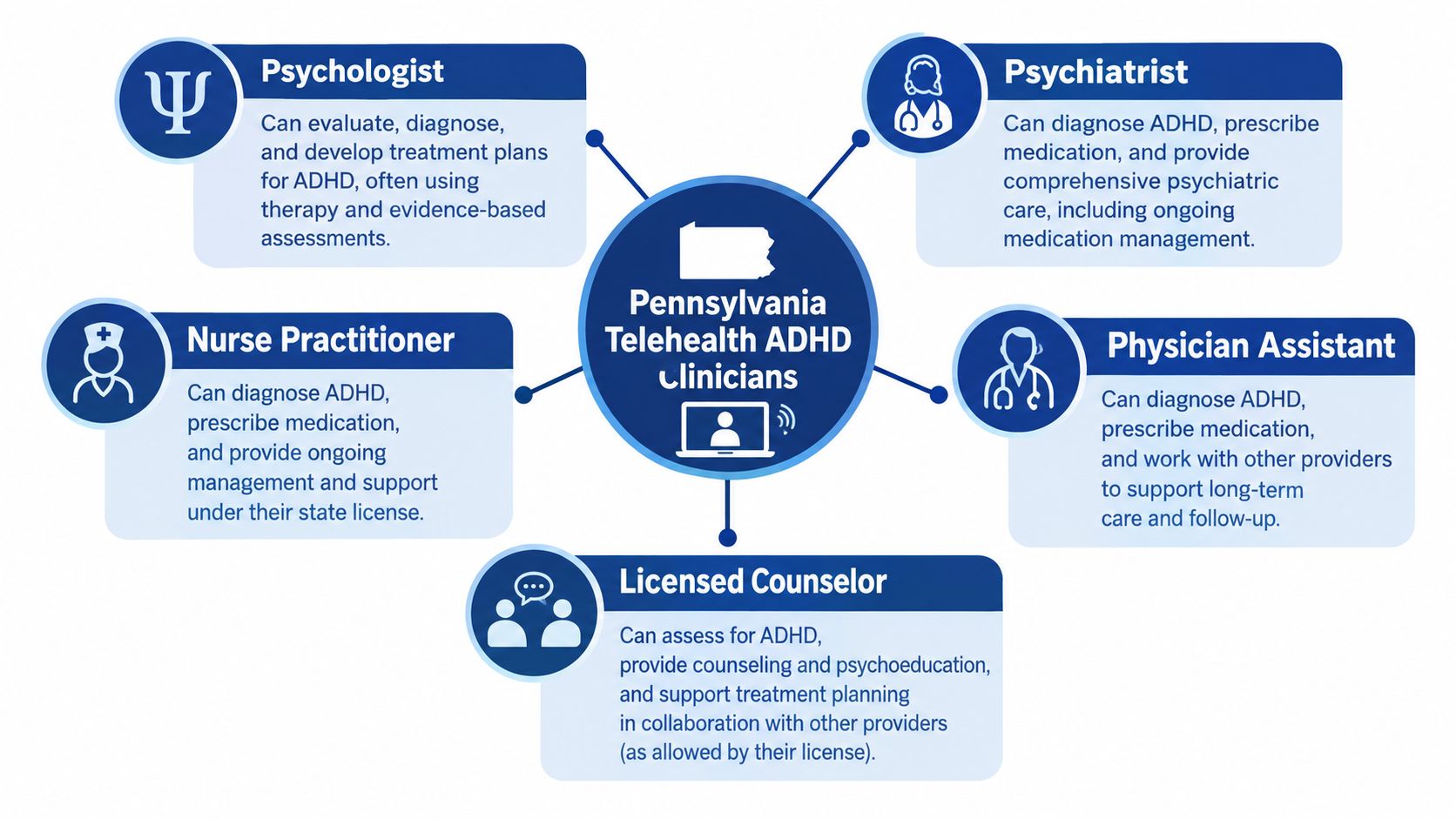
The phrase ADHD diagnosis doctor can be misleading because several licensed professionals may participate in assessment. Psychiatrists and psychiatric mental health nurse practitioners can evaluate psychiatric symptoms and, within their scope of practice, prescribe and manage medication. Psychologists may conduct detailed psychological or neuropsychological testing. Neurologists can assess neurological conditions and may evaluate attention concerns, although adult ADHD care often requires psychiatric expertise.
A therapist or counselor can contribute valuable observations, symptom history, and treatment support. That role may not include prescribing or a formal medical diagnosis, depending on credentials and Pennsylvania scope-of-practice rules. The first inquiry should establish who will conduct the evaluation, what credentials that clinician holds, and whether medication management is available if treatment becomes appropriate.
Why the first appointment needs context
Adult ADHD symptoms overlap with many other concerns. Poor concentration may accompany depression, anxiety, trauma, inadequate sleep, medication effects, substance use, learning differences, or mood disorders. ADHD may also coexist with these conditions, so finding one explanation doesn't automatically eliminate the others.
The American Psychiatric Association's ADHD overview explains that assessment commonly combines symptom descriptions, psychiatric and medical history, family history, and standardized questionnaires. It also confirms that no blood test or routine brain scan independently confirms ADHD.
Practical rule: A quick questionnaire can identify a reason to seek care. It can't establish the diagnosis by itself.
A careful provider will ask what happens at home, work, school, and in relationships. The clinician will also ask how long the pattern has existed, what it costs the patient in functioning, and whether childhood evidence supports a developmental condition. That level of review protects the patient from both premature labeling and continued uncertainty.
Clinician Qualifications and the Role of Telehealth
Pennsylvania adults should start with a clinician qualified to evaluate psychiatric symptoms and manage the possible treatment pathway. A board-certified psychiatric mental health nurse practitioner can be an appropriate first stop for an adult seeking ADHD assessment, medication management, or care for coexisting anxiety or depression. A psychiatrist, who is a medical doctor, can perform the same type of psychiatric diagnostic work and prescribe medication.
Psychologists bring expertise in psychological assessment and cognitive testing. Their reports can clarify attention, memory, learning, and executive-function concerns, but psychologists generally don't prescribe medication. A licensed counselor or therapist may gather important history and provide therapy, while the scope of formal diagnosis and prescribing depends on the professional's license and role.
What telehealth changes, and what it doesn't
Secure virtual care can connect patients in Philadelphia, Bucks County, Pittsburgh, Allentown, Harrisburg, Lancaster, Reading, Scranton, Wilkes-Barre, and Erie with Pennsylvania-licensed providers without requiring a drive to an office. Convenience matters for adults managing work, caregiving, transportation barriers, or privacy concerns.
Telehealth doesn't remove the need for clinical rigor. A legitimate remote evaluation still requires a private setting, identity and location verification, careful documentation, review of records when available, and screening for coexisting or alternative conditions. Patients should ask whether the platform is HIPAA compliant, whether the clinician is licensed in Pennsylvania, and who will make the final diagnostic decision.
The distinction between a psychiatric nurse practitioner and a psychiatrist matters less than whether the specific clinician has the training, authority, and process needed for the patient's situation. Patients can review the difference between an online psychiatrist and a psychiatric nurse practitioner before choosing whom to contact.
A marketing questionnaire often asks whether the patient loses things, procrastinates, or struggles to focus. A clinical evaluation asks when those problems began, where they occur, how severe the impairment is, and what else might explain them. That difference is the most useful quality check.
What the Evaluation Actually Includes Step by Step
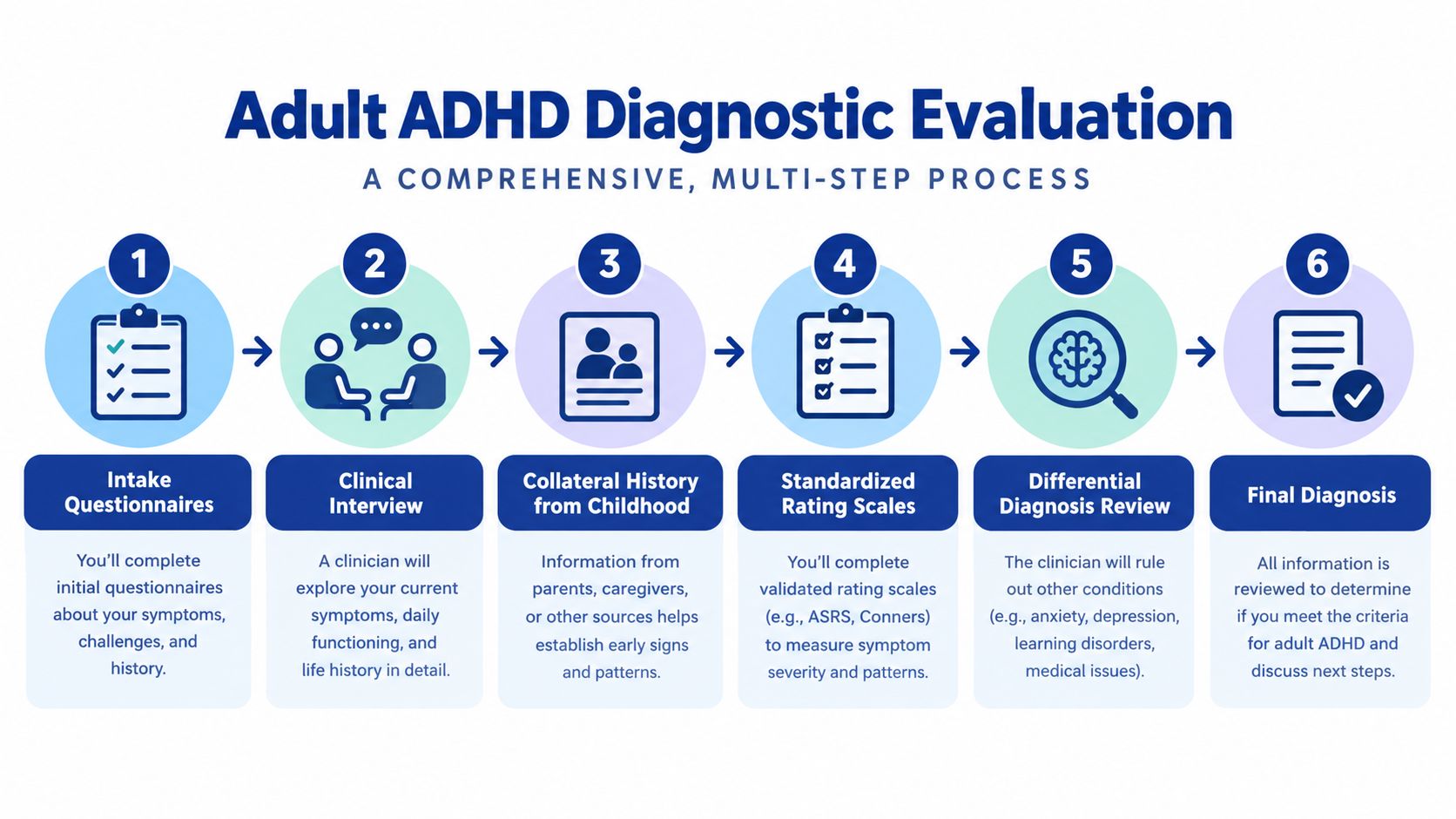
A defensible adult ADHD evaluation follows a staged process. The clinician gathers current symptoms, developmental history, functional impairment, collateral information when feasible, and evidence for or against competing explanations before making a diagnosis.
Step one starts before the video visit
The first intake usually covers current inattention and hyperactivity-impulsivity, medical and psychiatric history, family history, medications, substance use, sleep, and functional risk. Patients can prepare by writing down specific examples rather than broad descriptions. “I miss deadlines” becomes more useful when paired with what was missed, how often the pattern affects work, and what compensatory effort was required.
The interview then maps symptoms to DSM-5 or ICD-11 criteria. Adolescents and adults generally need at least five symptoms in one or both symptom domains. Symptoms must persist for at least six months, cause meaningful impairment, and appear in at least two settings. Several symptoms must have been present before age 12, which is why an adult assessment cannot focus only on present-day concentration.
Step two tests the explanation
Rating scales such as the Adult ADHD Self-Report Scale and Conners Adult ADHD Rating Scales help quantify symptoms and monitor change. They support the interview, but they don't replace clinical judgment. A high score signals that further evaluation may be appropriate, not that the patient has received a diagnosis.
Collateral information can come from a parent, partner, sibling, close friend, school record, or older report card. It isn't always available, especially for adults whose caregivers are unavailable or whose childhood records were lost. Neuropsychological testing may help when childhood history is unclear, collateral reports cannot be obtained, malingering is suspected, or comorbidities make the findings difficult to interpret. It remains an adjunct rather than a routine requirement.
The adult ADHD testing and evaluation service should explain what information the clinician needs and what happens if ADHD doesn't fully account for the symptoms. A diagnosis should emerge from the whole pattern, not from the most familiar answer on a form.
A short educational video can also help patients understand why ADHD assessment requires more than a questionnaire.
Insurance, Self-Pay, and Membership Pathways
The financial pathway can shape access, but no clinician or practice can guarantee an insurance outcome. Benefits, copays, deductibles, network status, and authorization requirements vary by plan, including plans issued by Cigna, Aetna, UnitedHealthcare, and BCBS or IBX.
Insurance may cover a telehealth evaluation or follow-up medication management, but the relevant benefit could fall under medical or behavioral health coverage. A patient should contact member services or request practice-based benefit verification and ask:
- Network status: Is the evaluating provider in network for this exact plan?
- Benefit category: Does adult ADHD evaluation use behavioral health, medical, or another benefit?
- Patient responsibility: What copay, deductible, or coinsurance applies?
- Authorization: Does the plan require prior authorization or a referral?
- Telehealth rules: Does coverage apply to virtual evaluation and follow-up visits?
The guide to whether ADHD testing is covered by insurance can help patients prepare those questions before booking.
Comparing the main routes
| Pathway | Potential advantage | Important limitation |
|---|---|---|
| In-network insurance | May reduce direct costs when the service and clinician qualify | Coverage and authorization still depend on the individual plan |
| Out-of-network reimbursement | May offer access to a preferred provider | The patient may pay first and seek reimbursement, with no guarantee of repayment |
| Self-pay care | Can provide clearer pricing and fewer insurance restrictions | The full amount may remain the patient's responsibility |
| Membership care | May bundle ongoing access or follow-up support | Membership terms, included services, and insurance coordination vary |
A same-day questionnaire or rapid appointment may sound efficient, but speed doesn't prove completeness. Adults with unclear childhood history, trauma, sleep problems, substance use, or mood symptoms may need a more careful process. The safest choice balances access, transparency, clinician qualifications, and the depth of evaluation.
How to Prepare Before Your Virtual Appointment
Good preparation doesn't mean trying to prove ADHD. It means bringing enough detail for the clinician to test the diagnosis fairly.
Start with childhood evidence. Report cards, teacher comments, individualized education records, old evaluations, and parent recollections can show whether attention, organization, impulsivity, or behavior patterns existed before age 12. Adults who can't find records can write down memories from school, friendships, sports, chores, and family life.
A practical preparation list
- Create a symptom timeline: Note when problems appeared, how they changed, and where they cause impairment now.
- Collect functional examples: Record missed deadlines, lost items, unfinished tasks, impulsive decisions, forgotten appointments, or relationship conflicts.
- List every substance and medication: Include prescriptions, over-the-counter products, supplements, caffeine, alcohol, cannabis, and other substances.
- Review sleep: Note irregular schedules, insomnia, snoring, daytime fatigue, and other sleep concerns that could affect attention.
- Request prior records: Primary care, therapy, school, and previous psychiatric records may clarify earlier symptoms or alternative explanations.
- Complete rating scales accurately: Don't select answers based on what seems most likely to secure a diagnosis. Accurate answers help the clinician interpret the entire pattern.
A partner, parent, sibling, or close friend may provide useful collateral information, with the patient's permission. Their role isn't to argue for or against ADHD. It is to describe observable patterns and changes over time.

Before the appointment, test the camera, microphone, internet connection, and patient portal login. Choose a private room and keep records nearby. Pennsylvania adults can review the ADHD evaluation pathway in Pennsylvania when organizing questions about scheduling, credentials, and next steps.
What Happens After the Diagnosis and Building a Whole-Person Plan
The evaluation should end with an explanation, not merely a label. The clinician should tell the patient which findings support ADHD, which findings remain uncertain, whether another condition may be contributing, and what treatment options fit the person's medical and psychiatric context.
Medication decisions require individualized judgment. Stimulant and non-stimulant medications differ in mechanism, monitoring needs, risks, and suitability. A careful provider reviews health history, current medications, sleep, substance use, mood symptoms, and functional goals before recommending treatment. Follow-up allows the clinician to assess benefit, adverse effects, blood pressure or other relevant concerns, and whether the plan needs adjustment.
Treatment works best as a coordinated plan
Medication may address core symptoms, but it doesn't automatically build routines, repair sleep, resolve relationship strain, or remove years of shame. Depending on the patient, a plan may include psychotherapy, ADHD-focused skills coaching, workplace or academic accommodations, exercise counseling, nutrition education, mindfulness, structured calendars, and environmental changes.
Patients looking for practical daily strategies can also review ADHD symptom management tips as a supplement to, not a substitute for, professional care. Helpful tools might include time-blocking, visual reminders, task breakdowns, and a consistent medication routine.
Integrative Psychiatry of America provides virtual psychiatric care across Pennsylvania through board-certified psychiatric mental health nurse practitioners, including ADHD evaluation and medication management when clinically appropriate. Patients can compare that type of care with other local, in-person, or specialty assessment options through the adult ADHD treatment information.
A diagnosis doesn't define intelligence, character, or identity. It gives the patient and clinician a framework for choosing support, measuring progress, and revising the plan when the first approach doesn't fit.
Practical Questions Adults Ask After Their Evaluation
How long does the process take?
There isn't one appropriate duration for every adult. A straightforward history with available records may require less clarification than an evaluation complicated by trauma, sleep problems, mood symptoms, substance use, or uncertain childhood evidence. A provider should explain what the assessment includes rather than promising an instant answer.
A rushed appointment may feel convenient, but it can leave important questions unanswered. A longer process isn't automatically better either. The useful standard is whether the clinician gathered enough information to support or challenge the diagnosis.
When should someone seek a second opinion?
A second opinion can make sense when the conclusion conflicts with the documented history, the clinician didn't ask about childhood, impairment was never explored across settings, alternative explanations were ignored, or the patient felt pressured toward medication. It may also help when a provider dismisses symptoms solely because the patient performed well academically or maintained a demanding career.
Patients should bring the original report, rating scales, medication list, and relevant records. The next clinician can then evaluate the evidence rather than start from a vague summary.
Can ADHD care coexist with therapy or primary care?
Yes. A psychiatric provider can coordinate with a therapist and primary care clinician when the patient authorizes information sharing. Therapy may address anxiety, depression, trauma, emotional regulation, relationship conflict, or practical skills. Primary care can evaluate medical contributors, sleep concerns, medication interactions, and other health needs.
The team should clarify who manages medication, who monitors specific risks, and how urgent concerns will be handled. Clear roles reduce duplicated prescriptions and prevent important information from remaining in separate offices.
What if symptoms don't improve?
Persistent symptoms don't automatically disprove ADHD. The clinician may need to review adherence, dose, medication timing, sleep, substance use, anxiety, depression, trauma, learning difficulties, or workplace demands. The original diagnosis may remain appropriate, but the treatment plan may need adjustment.
Ongoing attention problems can also point to another condition. Sleep apnea, anxiety, and mood disorders may produce concentration difficulties or coexist with ADHD. A responsible provider revisits the differential diagnosis instead of repeatedly increasing medication without examining the broader picture.
How can adults document the diagnosis for work or school?
Patients should ask the treating clinician what documentation can be provided and what information the employer, school, licensing body, or disability office requires. A request generally should focus on functional limitations and reasonable accommodations rather than disclose every private clinical detail.
Possible supports depend on the setting and the individual's needs. Examples may include written instructions, distraction-reduced workspace, structured deadlines, assistive technology, or flexibility around task organization. The patient should review the relevant institution's process before requesting a letter.
The most useful next step is practical: verify benefits, gather childhood and medical records, choose a qualified Pennsylvania provider, and prepare honest examples of current impairment. A careful evaluation is not a promise of a particular diagnosis or prescription. It is the beginning of a clearer plan that can include treatment, therapy, accommodations, or a different medical explanation when ADHD isn't the best fit.
Integrative Psychiatry of America offers secure virtual psychiatric care across Pennsylvania, including adult ADHD evaluation and medication management through board-certified psychiatric mental health nurse practitioners. Visit Integrative Psychiatry of America to review the evaluation pathway, verify insurance, and request an appointment.