
Yes, Concerta, extended-release methylphenidate, can cause or worsen anxiety, including in people without prior anxiety. In adult clinical trials, anxiety occurred in 8.2% of people taking Concerta compared with 2.4% taking placebo, a difference of 5.8 percentage points.
A patient may notice the change shortly after starting treatment or following a dose adjustment. The medication may improve focus while bringing a racing heart, chest tightness, restless thoughts, or a low-level sense of panic. The difficult clinical question isn't just whether Concerta can cause anxiety. It's whether the anxiety comes from the medication, the dose, the late-day wearing-off period, poor sleep, untreated ADHD, or a separate anxiety disorder.
Table of Contents
- A Common Concern on Stimulant Therapy
- How Concerta Affects the Brain and Mood
- What the Research Shows About Anxiety Rates
- Symptoms Worth Tracking and Reporting
- Is It the Medication, the Dose, or Something Else
- Practical Ways to Manage Anxiety While on Concerta
- Talking to a Provider Through Telehealth in Pennsylvania
A Common Concern on Stimulant Therapy
A hypothetical patient in suburban Philadelphia starts extended-release methylphenidate for adult ADHD. Work becomes easier. Email gets answered, meetings feel more manageable, and unfinished tasks no longer pile up as quickly. Within days, however, the patient notices a racing heart before client calls, tightness across the chest, and a persistent feeling of being overactivated.
That pattern deserves attention. Improved concentration doesn't automatically mean the dose is well tolerated. A stimulant can help executive function while producing physical activation that feels like anxiety. The symptoms may also expose an existing problem that was previously hidden beneath disorganization, missed deadlines, sleep loss, or chronic stress.
The direct answer
Yes, Concerta can cause or worsen anxiety. The FDA prescribing information for Concerta lists anxiety among common adult adverse reactions. The same labeling identifies insomnia, irritability, dizziness, increased sweating, and appetite or weight loss as frequent reactions. Several of those effects can intensify the physical sensation of nervousness.
The FDA labeling also states that Concerta is contraindicated in patients with marked anxiety, tension, or agitation because methylphenidate may aggravate those symptoms. That warning doesn't mean every person with mild anxiety must avoid stimulant treatment. It does mean baseline severity matters before starting or increasing the medication.
Why the distinction matters
Medication-induced anxiety often follows a recognizable dose pattern. Anxiety may rise after the morning dose, become more noticeable during the medication's strongest effect, or appear as the medication wears off. By contrast, anxiety caused primarily by generalized anxiety disorder, social anxiety, trauma, or ongoing life stress may remain present even when Concerta isn't active.
Untreated ADHD can also generate genuine anxiety. Repeated missed obligations, difficulty organizing work, impulsive decisions, and emotional overload can leave a patient braced for the next problem. In that situation, effective ADHD treatment may eventually reduce anxiety, even though the first medication or dose creates too much activation.
The practical task is to identify the pattern before changing the regimen. A short symptom log usually provides more useful information than a general statement that Concerta “feels wrong.”
How Concerta Affects the Brain and Mood
Concerta contains extended-release methylphenidate. Methylphenidate increases the activity of dopamine and norepinephrine, chemical messengers involved in attention, motivation, alertness, and cognitive control. Those same alerting systems also influence the body's response to perceived stress.
A useful analogy is an alertness dial on a stereo. Turning the dial up can make an important conversation easier to follow. If the dial goes too high, the brain may struggle to separate “pay attention to this email” from “stay alert for danger.” Ordinary concerns can then feel urgent, while physical sensations such as muscle tension, trembling, rapid breathing, or a pounding heartbeat can reinforce the impression that something is wrong.
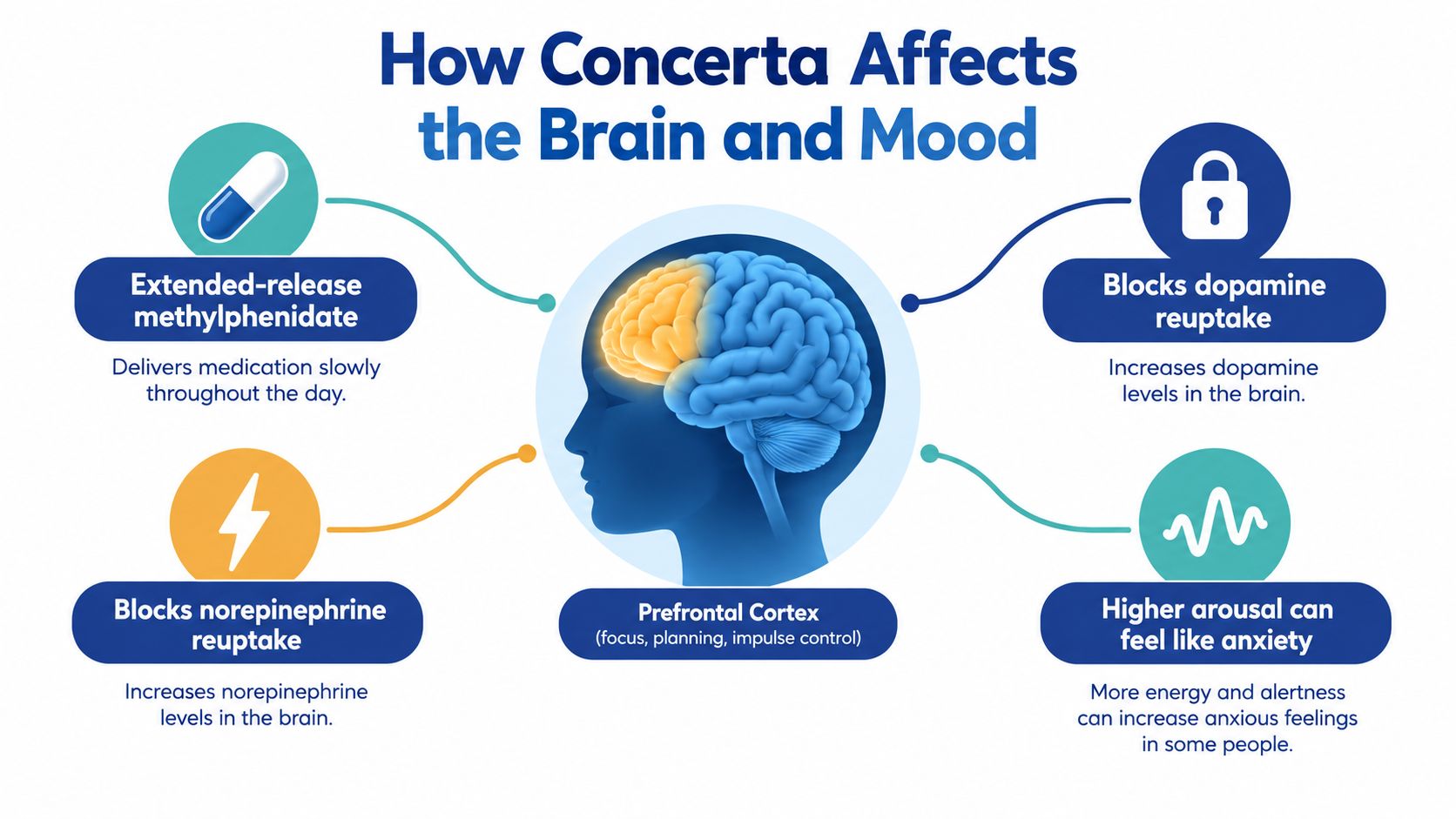
Activation isn't always an anxiety disorder
Stimulant activation and anxiety can overlap, but they aren't identical. A patient may feel alert, productive, and physically energized without distress. Another patient may experience the same alerting effect as jitteriness, irritability, racing thoughts, or panic-like discomfort.
The difference often depends on the relationship between benefit and activation. Calm focus usually allows flexible attention and normal emotional control. Excessive stimulation can produce rigid concentration, restlessness, repetitive worry, and difficulty disengaging from a threatening thought.
Concerta's extended-release delivery is intended to provide prolonged coverage rather than the abrupt changes associated with some short-acting schedules. Even so, patients can experience mood changes during the medication's rising effect or as its benefit fades. The timing of symptoms matters more than the label “extended-release.”
What clinicians assess
A medication review considers the dose, the time of administration, food and caffeine intake, sleep quality, other medications, cardiovascular symptoms, and the patient's psychiatric history. The ADHD medication management information explains why stimulant tolerability must be assessed alongside attention benefits.
The central question is whether the medication is helping within a tolerable range. A patient shouldn't have to choose between concentration and a sustained state of fear, agitation, or physical distress.
What the Research Shows About Anxiety Rates
A patient who develops fear or physical tension after starting Concerta may reasonably suspect the medication, but research rates cannot identify the cause in an individual case. In FDA-reviewed adult trials, anxiety occurred in 8.2% of adults receiving Concerta and 2.4% receiving placebo, according to the FDA Concerta label. This controlled result supports an association, while leaving room for ADHD-related stress, baseline anxiety, poor sleep, or other factors.
A broader review included 13 trials, 14 comparisons, and 3,829 adults. Its adverse-event analysis found a risk ratio of 2.23, with a 95% confidence interval of 1.40 to 3.57, for anxiety with extended-release methylphenidate compared with placebo. The review reported anxiety in approximately 28% of the methylphenidate arm within that adverse-event analysis (Cochrane review in PMC). That figure is much higher than the FDA's 8.2% rate because the review pooled studies using different symptom definitions and methods for identifying adverse events. It should not be treated as a personal prediction for someone taking Concerta.
Anxiety and nervousness rates in methylphenidate clinical trials
| Population | Methylphenidate rate | Placebo rate | Notes |
|---|---|---|---|
| Adults in Concerta double-blind trials | 8.2% | 2.4% | FDA-reported anxiety rate, a difference of 5.8 percentage points. FDA label |
| Adults in an extended-release methylphenidate review | Approximately 28% in the review's adverse-event analysis | Not presented as one comparable rate | Risk ratio 2.23, with a 95% confidence interval of 1.40 to 3.57. Cochrane review cited above |
| Children and adolescents in cited observational evidence | 18.4% | No placebo comparison provided | The figure may include ADHD symptoms or pre-existing emotional difficulties, so it is not a precise Concerta probability. Cochrane review cited above |
These results measure different populations and outcomes. A controlled adult trial, spontaneous adverse-event reporting, and pediatric observational evidence cannot be compared as equivalent rates. Age, dose, formulation, comorbidity, and study design all influence the findings.
For a practical interpretation, record whether anxiety begins during the medication's rising effect, persists through the day, appears as coverage fades, or follows poor sleep and untreated ADHD symptoms. The ADHD and anxiety in adults resource provides relevant clinical context. The figures show that anxiety is plausible during stimulant treatment, not that Concerta caused every episode or that treatment must fail.
Symptoms Worth Tracking and Reporting
Anxiety related to Concerta can appear as a thought problem, a body problem, a mood change, or a combination of all three. A clinician needs more detail than “the medication causes anxiety.” The useful information is when the symptom starts, how long it lasts, and whether it repeats after each dose.
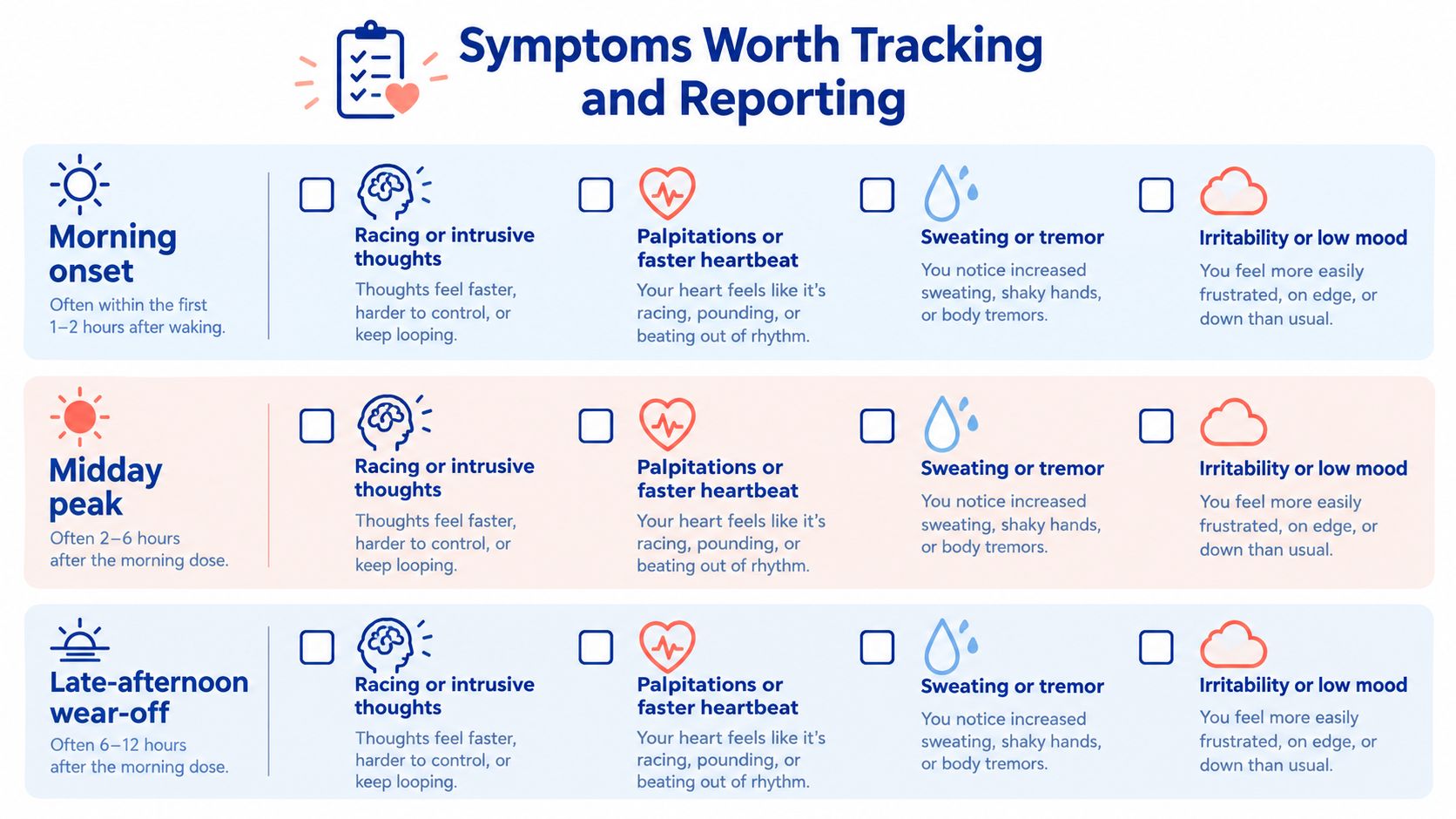
What to record
A simple log can cover several days and include the following:
- Dose timing: Record when Concerta was taken and whether the schedule changed.
- Symptom onset: Note the time racing thoughts, chest tightness, palpitations, tremor, sweating, nausea, or shortness of breath began.
- Mental symptoms: Describe catastrophic thinking, intrusive worry, panic-like fear, or difficulty disengaging from a thought.
- Mood changes: Record irritability, tearfulness, agitation, unusual emotional intensity, or a sense of being unable to settle.
- Possible amplifiers: Include caffeine, nicotine, decongestants, alcohol, missed meals, stressful events, and poor sleep.
- Duration and severity: Note how long symptoms lasted and whether they interfered with work, driving, relationships, or sleep.
The pattern can be more informative than the intensity on any single day. Symptoms that repeatedly follow administration suggest a different problem from anxiety that begins only during a stressful meeting or persists from waking until bedtime.
When waiting isn't appropriate
New or persistent anxiety should be reported promptly to the prescribing clinician, particularly when it comes with insomnia, agitation, palpitations, or functional impairment. The FDA labeling identifies anxiety, irritability, insomnia, and increased blood pressure among reactions associated with discontinuation in clinical trials.
Chest pain, fainting, severe palpitations, new suicidal thoughts, hallucinations, severe panic, or rapidly worsening agitation require urgent evaluation rather than routine symptom tracking. A patient should also seek immediate medical assessment for symptoms that could reflect a serious cardiac or psychiatric condition.
The anxiety symptom checker may help organize concerns, but a screening tool doesn't diagnose medication-induced anxiety or determine whether Concerta should be changed.
Is It the Medication, the Dose, or Something Else
A new symptom during Concerta treatment doesn't identify its own cause. Clinical reasoning starts with timing, then considers dose, sleep, substances, stress, and co-occurring conditions.
A symptom beginning soon after the morning dose may indicate direct stimulant activation or a dose that exceeds the patient's tolerable range. Anxiety appearing late in the afternoon or evening may reflect the medication wearing off, accumulated fatigue, or sleep interference. Anxiety that exists at the same intensity throughout the day points more strongly toward an independent anxiety condition or another medical or substance-related factor.
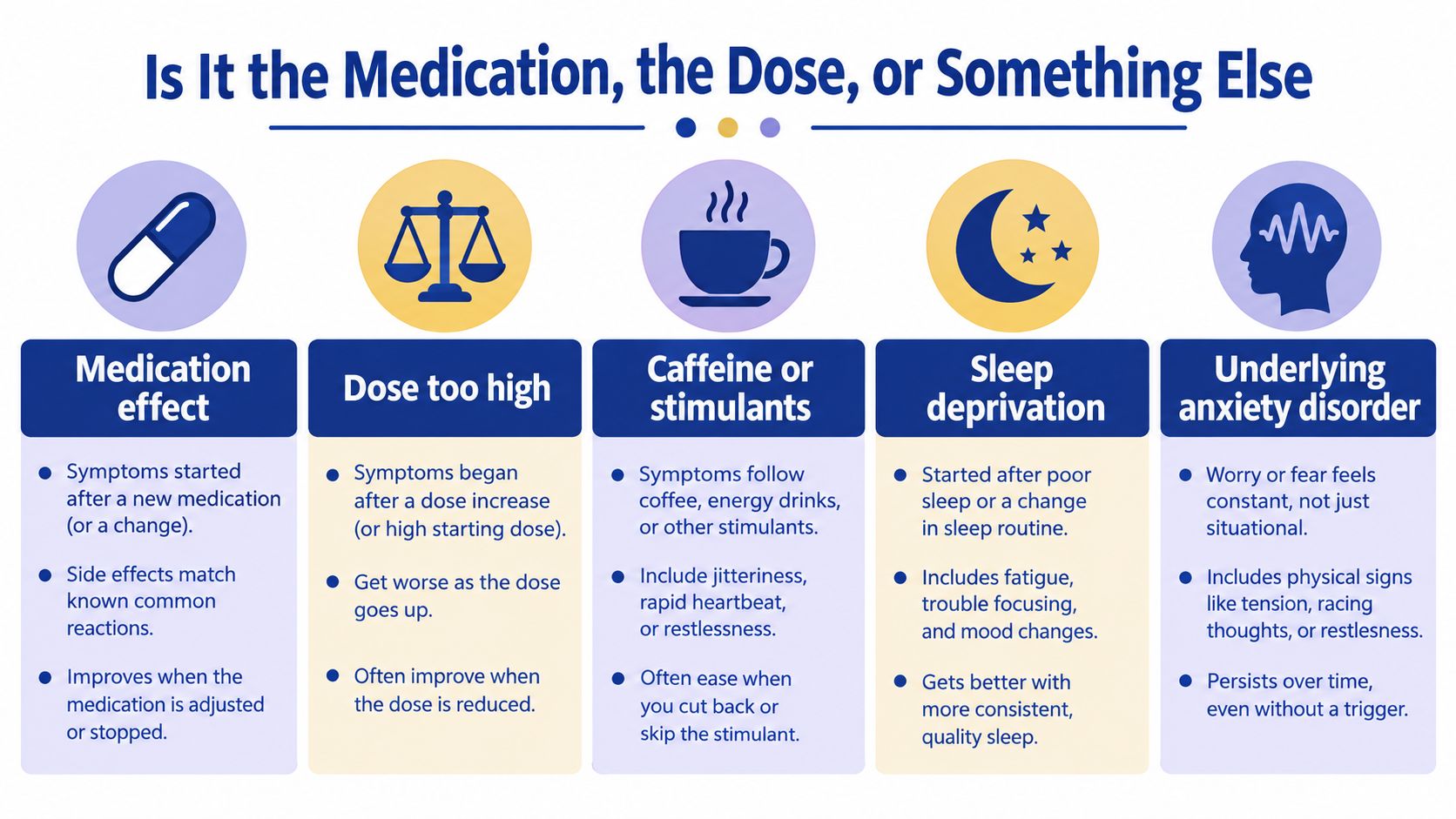
Five explanations worth separating
Medication effect. Methylphenidate can increase alertness and autonomic activation. A patient may feel physically anxious even when the surrounding situation is safe and the mind isn't focused on a specific worry.
Dose intolerance. A dose can improve attention but still be too activating. More focus isn't always better treatment if the patient becomes tense, restless, irritable, or unable to sleep.
Rebound or late-day change. Anxiety that arrives as the medication fades may represent a wearing-off effect rather than excessive medication at the morning peak. The treatment plan may need a different release pattern or a reconsideration of coverage.
Sleep loss. Insomnia can raise baseline nervousness and make ordinary stimulant effects feel much stronger. The medication may then appear to be the sole cause when sleep disruption is maintaining the cycle.
Caffeine and situational stress. Coffee, energy drinks, nicotine, decongestants, deadlines, conflict, and major life changes can amplify physical activation. A stable Concerta dose may feel different during a week of poor sleep and unusually high stress.
Anxiety can also come from untreated ADHD
ADHD can create persistent worry through unfinished tasks, missed commitments, disorganization, and repeated negative feedback. A patient may have both ADHD and generalized anxiety disorder, social anxiety, panic disorder, or trauma-related symptoms. Treating attention may reduce anxiety for some people, while stimulant activation worsens it for others.
The comparison of stimulant and non-stimulant ADHD treatment can help explain why clinicians don't apply one rule to every patient. The right decision depends on the symptom timeline, the treatment response, the level of impairment, and the risks associated with continuing the current regimen.
Practical Ways to Manage Anxiety While on Concerta
Management usually begins with the factors that can be changed safely and observed clearly. Patients shouldn't alter the dose, add medication, or stop Concerta independently, but they can gather information that makes the clinical decision more precise.
Reduce avoidable activation
Caffeine deserves particular attention. Coffee, tea, pre-workout products, energy drinks, nicotine, and some cold medicines can add to jitteriness or palpitations. A practical approach is to record caffeine intake for two weeks while keeping the prescribed Concerta schedule unchanged, unless the prescriber gives different instructions.
Sleep protection matters just as much. A consistent wake time, reduced evening stimulation, and review of late-day dosing can show whether insomnia is driving the anxiety. Alcohol may disrupt sleep and worsen next-day nervousness, so reducing alcohol can clarify the medication pattern.
Use skills during the peak
Behavioral tools won't correct an excessive dose, but they can reduce the escalation that follows physical activation.
- Paced breathing: Practice slow breathing during the expected symptom window, such as approximately 90 minutes after the morning dose, if that timing matches the patient's pattern.
- Structured movement: A morning walk or other appropriate aerobic activity can discharge tension and support a predictable routine.
- Scheduled worry time: Containing repetitive worry to a defined period can prevent it from occupying the entire workday.
- Grounding: Name sensory details, identify the immediate task, and separate a body sensation from the conclusion that danger is present.
The grounding techniques for anxiety resource can support this kind of symptom management. These techniques are supportive measures, not substitutes for evaluating chest pain, severe panic, suicidal thinking, or a medication reaction.
Medication options require individualized review
A prescriber may first confirm adherence, review the lowest effective dose, assess timing, and consider whether the formulation fits the patient's day. Depending on the pattern, the clinician may reduce the dose, adjust the schedule, change formulation, or reconsider the stimulant class.
Some patients may need a non-stimulant option such as atomoxetine or viloxazine. Others may need treatment for an independent anxiety disorder, which could involve psychotherapy or a separate medication strategy. Alpha-2 agonists, beta-blockers for selected physical symptoms, or an SSRI may be considered in appropriate cases, but each has its own risks, contraindications, and monitoring needs.
A medication change should follow the symptom record, not a single difficult afternoon.
Talking to a Provider Through Telehealth in Pennsylvania
A virtual medication review works best when the patient arrives with usable information rather than a general report of feeling anxious. A one-week log can include the Concerta dose, administration time, meals, caffeine, sleep, anxiety peaks, pulse, blood pressure, and every other medication or supplement.
The clinician may review the original ADHD evaluation, confirm current symptoms, assess anxiety and mood, and screen for factors that change stimulant safety. The review can include cardiovascular symptoms, bipolar-spectrum symptoms, substance use, suicidal thinking, and the possibility that anxiety existed before Concerta.
What a focused review can decide
A clinician may recommend one carefully defined change, such as a dose reduction, a timing adjustment, a different formulation, or a switch to a non-stimulant. Making one change at a time helps show what improved or worsened the symptoms.
Home pulse and blood pressure readings can add useful context, but they don't replace a physical examination when symptoms suggest a medical emergency. Patients can also bring prior records, pharmacy information, and a list of previous ADHD or anxiety treatments.
Clear documentation supports improve patient provider communication, especially when symptoms vary across the day. A precise description such as “palpitations began after the morning dose and lasted until lunch” gives the clinician more to work with than “Concerta caused panic.”
When telehealth isn't enough
Telehealth may be appropriate for stable patients without red flags. Chest pain, fainting, severe palpitations, new suicidal thoughts, hallucinations, severe agitation, or panic that doesn't settle require urgent or in-person assessment. Emergency services should be used when immediate safety is in question.
Pennsylvania patients seeking virtual ADHD evaluation or medication management can review the available care model, insurance process, and appointment pathway before scheduling. Integrative Psychiatry of America provides secure telehealth across Pennsylvania, including medication management for ADHD and anxiety, with care led by board-certified psychiatric mental health nurse practitioner Christopher Clark, MSN, PMHNP-BC.
Pennsylvania patients who develop anxiety after starting or increasing Concerta can request a focused virtual medication review rather than trying to interpret the timing alone. Visit Integrative Psychiatry of America to review ADHD and anxiety services, verify insurance, and request an appointment.