
Anxiety can look like ADHD because both can cause concentration problems and restlessness. Clinicians distinguish them by examining onset, setting consistency, and whether symptoms persist when anxiety is lower, while remembering that 47.1% of adults with ADHD had an anxiety disorder in the National Comorbidity Survey Replication, compared with 19.5% of adults without ADHD (CHADD).
An adult in Pennsylvania may sit at a desk unable to begin a routine task, reread the same email, lose track of a conversation, and feel physically unable to settle. A parent may watch a child avoid homework, forget instructions, and appear constantly in motion. ADHD may come to mind immediately, but anxiety can create a remarkably similar picture.
The important question isn't whether one symptom resembles ADHD. A careful clinician asks when the pattern began, what triggers it, where it appears, how much it disrupts functioning, and whether it remains when worry decreases. Those details often reveal whether anxiety is driving the difficulty, ADHD is contributing, or both conditions are present.
Table of Contents
- Understanding Overlapping Symptoms in Adults
- The Clinical Pattern Behind Inattention and Restlessness
- How Clinicians Distinguish ADHD from Anxiety
- What to Expect During a Comprehensive Evaluation
- Treatment Approaches for Overlapping Conditions
- Taking the Next Step for Care in Pennsylvania
Understanding Overlapping Symptoms in Adults
Consider this clearly labeled hypothetical example. An adult seeks an ADHD evaluation after months of poor concentration, procrastination, restlessness, and feeling overwhelmed. During a detailed history, the person describes spending much of the day anticipating criticism, replaying conversations, and worrying about making mistakes. Focus deteriorates most sharply before meetings, deadlines, and difficult messages, while calmer periods bring noticeable improvement.
That pattern doesn't prove anxiety is the only issue. It does provide a clinically meaningful clue. Attention problems closely tied to worry, rumination, physical tension, or specific stressful situations may reflect anxiety more than a longstanding attention-regulation difficulty. Clinicians also ask whether similar problems existed earlier in life and whether they occurred across home, school, work, and social settings.
Can anxiety look like ADHD? Yes. Both conditions can produce distractibility, restlessness, procrastination, sleep disruption, and trouble organizing thoughts. Anxiety often pulls attention toward perceived danger or possible failure. ADHD more commonly reflects persistent difficulty regulating attention and executive functions, even when the person feels calm.

The pattern matters more than the label
How do clinicians tell ADHD and anxiety apart? They compare the timeline and internal experience rather than relying on one symptom or questionnaire. A person with anxiety may say, “I can't focus because I keep thinking something will go wrong.” A person with ADHD may describe attention drifting during calm activities, losing track of steps, or forgetting information without a specific fear occupying the mind.
Can someone have ADHD and anxiety at the same time? Yes, and the combination is common. A clinical review reports anxiety disorders in roughly 25% to 50% of people with ADHD, while an epidemiological study found anxiety in about 47% of adults with ADHD (peer-reviewed review). Anxiety may develop after repeated missed deadlines and disorganization, or it may exist independently and intensify ADHD symptoms.
People who recognize themselves in adult ADHD symptoms shouldn't treat that resemblance as a diagnosis. The same outward behavior can arise from different mechanisms, and treatment can change substantially depending on which mechanism is primary.
Clinical rule: A positive symptom checklist identifies topics for evaluation. It doesn't establish ADHD, anxiety, or the relationship between them.
The Clinical Pattern Behind Inattention and Restlessness
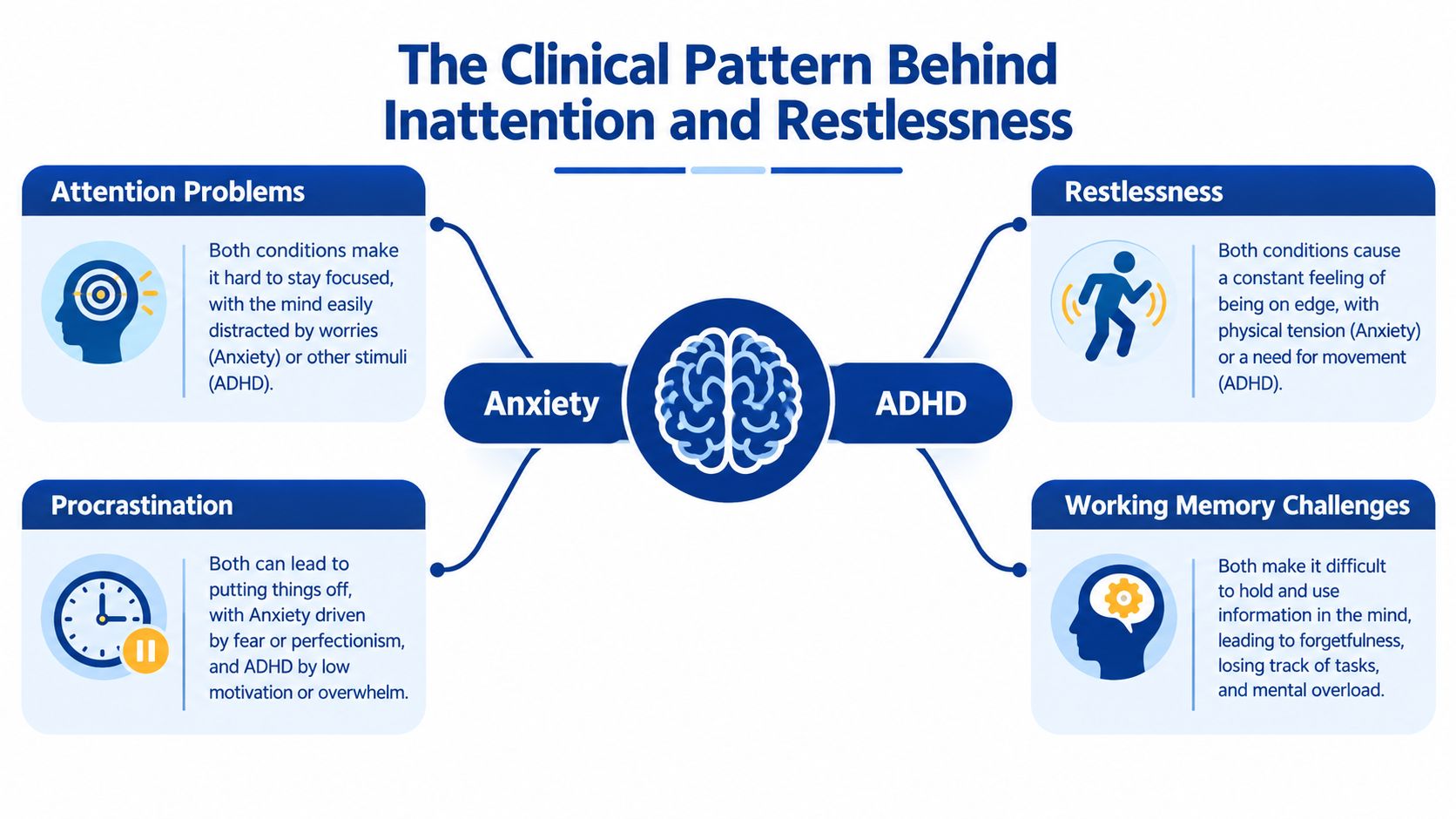
The central distinction is often state-dependent impairment. Anxiety-related inattention tends to worsen when worry, threat appraisal, or panic is active. ADHD-related inattention tends to be more persistent, including during periods when the person feels relatively calm (ADDitude?).
Attention can fail in both conditions, but the experience differs. Anxiety may narrow concentration around a feared outcome, such as an unanswered message or an upcoming presentation. ADHD may scatter attention across unrelated stimuli, interrupt task sequencing, or make routine work difficult to sustain without urgency, novelty, or external structure.
One behavior can have several causes
Restlessness may feel like a need for movement or stimulation in ADHD. Anxiety-related restlessness more often feels like being on edge, unable to relax, or physically braced for a problem. Both can interfere with sleep, patience, and sustained work.
Procrastination also requires interpretation. Someone with ADHD may delay a boring or poorly structured task because starting and sequencing it are difficult. Someone with anxiety may avoid the task because of fear of failure, judgment, uncertainty, or an anticipated physical surge of distress. Both patterns can produce the same missed deadline.
Working memory and organization reveal another layer. ADHD may involve losing instructions, misplacing items, forgetting intentions, and struggling to hold several steps in mind. Anxiety can consume working-memory capacity with rumination, leaving fewer mental resources for planning and recall.
A mediation analysis found a significant indirect pathway from ADHD symptoms to anxiety through executive dysfunction and functional impairment, with a coefficient of 0.362 and a confidence interval of 0.087 to 0.665 (the peer-reviewed analysis). This supports a practical observation: repeated problems with planning, task initiation, and follow-through can create secondary anxiety, while anxiety can then further disrupt the same executive functions.
For readers exploring general concentration strategies, sustaining attention for brain health may offer useful background. General focus advice, however, won't determine whether the underlying problem is ADHD, anxiety, sleep disruption, medication effects, or another medical concern.
How Clinicians Distinguish ADHD from Anxiety
A symptom comparison can organize the conversation, but a table cannot diagnose ADHD or anxiety. It shows common clinical patterns, not rules that apply identically to every person.
| Symptom | ADHD pattern | Anxiety pattern | Can occur in both? |
|---|---|---|---|
| Attention problems | Attention regulation remains difficult across calm and stressful situations, often with distractibility or incomplete tasks | Worry, threat appraisal, or rumination captures attention, especially during stress | Yes |
| Restlessness | Movement may provide stimulation or help maintain engagement | The body feels tense, keyed up, or unable to relax | Yes |
| Procrastination and avoidance | Tasks may be delayed because they feel boring, confusing, or difficult to start | Tasks may be avoided because of fear, uncertainty, judgment, or anticipated failure | Yes |
| Working memory and organization | Instructions, deadlines, belongings, and task sequences may be forgotten | Worry occupies mental space and disrupts planning or recall | Yes |
| Racing thoughts | Ideas shift rapidly between topics or stimuli | Thoughts loop around threats, consequences, or “what if” scenarios | Yes |
| Physical symptoms | Restlessness can occur, but physical anxiety symptoms aren't defining features | Muscle tension, stomach discomfort, trembling, sweating, or rapid heartbeat may accompany worry | Sometimes |
| Functional impairment | Difficulties often appear across work, home, school, or social settings | Impairment may intensify around specific triggers or stressful periods | Yes |
Developmental history changes the interpretation
Adult ADHD is a neurodevelopmental condition, so clinicians look for evidence that symptoms began earlier in life rather than appearing only during a recent stressful period. The history may include chronic disorganization, forgetfulness, impulsive behavior, difficulty completing schoolwork, or longstanding problems managing time.
Setting consistency matters too. ADHD symptoms generally affect more than one environment, although structure, interest, and external support can make them less visible in one setting. Anxiety may be more situation-linked, such as worsening around social evaluation, health concerns, conflict, deadlines, or uncertainty.
DSM-5-based adult ADHD diagnosis requires at least five symptoms of inattention and/or hyperactivity-impulsivity lasting at least six months, occurring in at least two settings, and causing measurable functional impairment (American Academy of Family Physicians). The symptoms also must not be better explained by another mental disorder, including anxiety.
Comorbidity makes the distinction less tidy. Historical adult ADHD research found multiple anxiety disorders in 50% of referred adults with ADHD, 42% of nonreferred adults with ADHD, and 14% of controls (landmark adult ADHD study). A clinician may find a lifelong ADHD pattern that anxiety now magnifies, an anxiety disorder that resembles ADHD, or two conditions that require separate attention.
A positive online screener during a high-anxiety period deserves context, not dismissal and not automatic confirmation. Research in clinically anxious adults found that self-reported anxiety, rather than objective cognitive testing, significantly predicted self-reported ADHD symptoms, underscoring the limits of self-report during acute distress (screening and factor-analysis research). Readers can learn why evaluation differs from testing through IPA's explanation of ADHD evaluation versus ADHD testing.
What to Expect During a Comprehensive Evaluation
There isn't one screening question, lab test, or genetic result that can reliably separate anxiety from ADHD. A sound evaluation combines a clinical interview, developmental history, current functioning, medical review, and validated questionnaires used as supporting information rather than as the diagnosis itself.
The clinician builds a timeline
The assessment usually examines:
- Childhood history: School reports, family observations, early forgetfulness, impulsivity, incomplete work, or difficulty following routines can clarify whether symptoms predated adult stress.
- Current settings: Work, home, relationships, education, and daily responsibilities show whether impairment is broad or linked to particular situations.
- Symptom timing: The clinician asks whether concentration worsened after anxiety, sleep disruption, trauma, medication changes, illness, or another major stressor.
- Internal experience: Worry, rumination, panic sensations, avoidance, physical tension, distractibility, impulsivity, and task initiation are examined separately.
- Functional impact: Diagnosis requires more than inconvenience. The evaluation considers missed responsibilities, relationship strain, academic or occupational problems, and difficulty managing daily life.
Sleep disorders, thyroid abnormalities, anemia, medication effects, substance use, and other medical issues can contribute to fatigue, restlessness, cognitive difficulty, or anxiety-like symptoms. Laboratory testing is individualized when the history suggests a possible medical contributor. Genetic testing shouldn't be presented as a diagnostic method for deciding whether symptoms come from ADHD or anxiety.
Screening supports judgment
Validated ADHD and anxiety tools can identify symptom domains and help track change over time. They can't establish causation, confirm childhood onset, or determine whether one condition better explains the other.
Patients often improve the assessment by bringing concrete examples rather than general impressions. A short record of calm-day focus, stress-triggered deterioration, sleep quality, physical anxiety symptoms, missed steps, and patterns across settings can give the clinician more useful information than a single score.
Psychological testing for ADHD may be relevant in selected situations, but testing isn't a substitute for psychiatric history and clinical judgment. The most useful evaluation leaves room for uncertainty, competing explanations, and the possibility of comorbidity.
Treatment Approaches for Overlapping Conditions
Treatment follows the clinical pattern, not the most visible symptom. If anxiety primarily drives concentration problems, care may focus on worry cycles, avoidance, physical arousal, sleep, and stress response. If ADHD is primary, treatment may target attention regulation, task initiation, organization, impulsivity, and medication management when clinically appropriate.

Treatment changes when both conditions are present
When ADHD and anxiety coexist, treatment may need to address both while monitoring which symptoms improve, persist, or worsen. Psychotherapy can help with worry, avoidance, emotional regulation, and coping. Psychiatric medication may be appropriate for anxiety, ADHD, or both, but the choice depends on medical history, symptom severity, side effects, sleep, substance-use risk, and patient preferences.
Lifestyle support can reinforce care without replacing it. Regular physical activity, consistent sleep routines, mindfulness practices, nutritional education, and practical planning systems may help reduce strain on attention and emotion regulation. No single combination produces the fastest relief for everyone, and stimulant or nonstimulant ADHD medication may affect anxiety differently from one person to another.
A resource such as CBD oil for ADHD, a detailed overview can help readers understand why supplements require caution. CBD shouldn't be treated as a proven diagnostic or universal treatment, and patients should discuss possible interactions and risks with a qualified clinician.
A personalized approach may include medication management, counseling, behavioral strategies, and medical evaluation when indicated. Integrative psychiatry for ADHD, anxiety, and depression describes one care model that considers overlapping symptoms rather than forcing an immediate either-or conclusion.
A treatment plan should also define what will be monitored. Useful markers include the ability to begin tasks, sustain attention on calm days, sleep more consistently, tolerate uncertainty, reduce avoidance, and manage responsibilities across settings. The plan can then be adjusted when the initial formulation changes.
A short educational video may help patients understand how anxiety and attention symptoms can interact:
Taking the Next Step for Care in Pennsylvania
Uncertainty often delays care. Adults may worry about finding the right provider, understanding insurance benefits, or being judged for not knowing whether the problem is ADHD, anxiety, or both.
Virtual psychiatric care can make evaluation more practical for Pennsylvania residents, including people in Philadelphia, Bucks County, Pittsburgh, the Lehigh Valley, Harrisburg, Lancaster, Reading, Scranton-Wilkes-Barre, or Erie. Benefits, copays, deductibles, network status, and authorization requirements vary by plan, so insurance verification should happen before assuming coverage.
A confidential appointment gives the clinician space to review developmental history, current symptoms, medical contributors, and treatment preferences. Adults can begin with online adult ADHD diagnosis while also discussing anxiety, sleep, mood, trauma, or other concerns that may affect concentration.
Integrative Psychiatry of America provides secure virtual psychiatric evaluations and ongoing care across Pennsylvania for adults seeking clarity about ADHD, anxiety, or both. Patients can review Integrative Psychiatry of America, verify benefits, and request an appointment for evaluation, treatment planning, or medication management.