
A missed deadline turns into an unopened bill. A forgotten task becomes an argument with a partner. By evening, an adult may feel overwhelmed, irritable, and unsure whether the underlying problem is ADHD, anxiety, burnout, poor sleep, or something else. Medication may help attention, but many people still need practical support for starting tasks, organizing responsibilities, regulating emotions, and repairing strained relationships.
Table of Contents
- What a Psychologist Can Do for Adult ADHD
- ADHD Evaluation Versus ADHD Therapy
- Executive Functioning Skills Therapy Targets
- Emotional Regulation and Relationship Patterns
- Psychotherapy Approaches Used for Adult ADHD
- How Therapy and Medication Management Work Together
- Telehealth Psychology in Pennsylvania
- Common Questions About Psychology and Adult ADHD
What a Psychologist Can Do for Adult ADHD
A psychologist can help an adult with ADHD turn broad difficulties into workable targets. Instead of promising to remove the condition, treatment focuses on how symptoms affect organization, follow-through, emotional regulation, work, relationships, anxiety, depression, and daily routines.
A licensed psychologist typically holds a doctoral degree, such as a PhD or PsyD, and trains in thinking patterns, behavior, emotional responses, and psychological assessment. Some also develop expertise in adult ADHD, cognitive behavioral therapy, or neuropsychology.
A psychologist may offer an evaluation, ADHD-focused therapy, emotional support, and coordination with a psychiatric provider. Therapy might address procrastination by breaking an avoided task into a first action, or improve follow-through by building one reliable system for reminders and deadlines. The clinician adapts these tools to the person's actual schedule rather than prescribing a universal routine.
Practical rule: Psychological care should connect ADHD knowledge to a specific change in daily life, such as one task system, a plan for starting difficult work, or a method for pausing before an impulsive response.
Psychology has clear limits. Therapy does not directly alter the core neurobiology associated with attention, impulse control, or working memory. Structured cognitive behavioral therapy can improve symptoms and functioning, and reviews report moderate benefits compared with waiting-list controls, including better organization, daily functioning, and wellbeing in adult ADHD research. These gains concern practical functioning, not a cure.
Psychologists do not prescribe medication in Pennsylvania. They can provide therapy and coordinate care with a psychiatrist, psychiatric nurse practitioner, or primary care provider when medication evaluation is appropriate. Supportive routines, including natural calming techniques for ADHD, may complement clinical treatment but should not replace it.
Adults can review Dr. Lori Simons' online psychology care in Pennsylvania when considering a clinician's background and format. The best fit depends on treatment goals, training, diagnosis, and coordination needs.
ADHD Evaluation Versus ADHD Therapy
An ADHD evaluation answers whether the diagnostic criteria fit. ADHD therapy addresses what happens after, or alongside, that clarification.
| ADHD evaluation | ADHD therapy |
|---|---|
| Examines childhood and adult symptom history | Builds skills for current daily challenges |
| Reviews impairment across settings | Practices organization, planning, and follow-through |
| May include collateral information and rating scales | Tracks progress and adjusts strategies |
| May include cognitive or attention testing | Addresses emotions, relationships, and co-occurring concerns |
| Produces diagnostic feedback and recommendations | Provides ongoing support and behavioral change |
Adult diagnosis requires more than a symptom checklist. An adult must have at least five symptoms of inattention and/or hyperactivity-impulsivity for at least six months, symptoms must occur in at least two settings, and they must cause measurable impairment in daily life, according to adult ADHD diagnostic guidance from the American Academy of Family Physicians.
A psychologist may ask about school history, family observations, work performance, relationships, sleep, mood, substance use, and medical conditions. A partner, parent, old report card, or workplace record may add useful context when available. Testing can contribute information, but not every psychologist performs formal ADHD testing, and no single screening tool establishes a diagnosis.
Therapy often starts with a clinical assessment phase, even when formal testing isn't needed. Someone may pursue therapy without seeking a diagnosis if the main goal involves organization, emotional regulation, or anxiety. Adults seeking formal testing can review psychological testing for ADHD and ask what the service includes before scheduling.
Executive Functioning Skills Therapy Targets
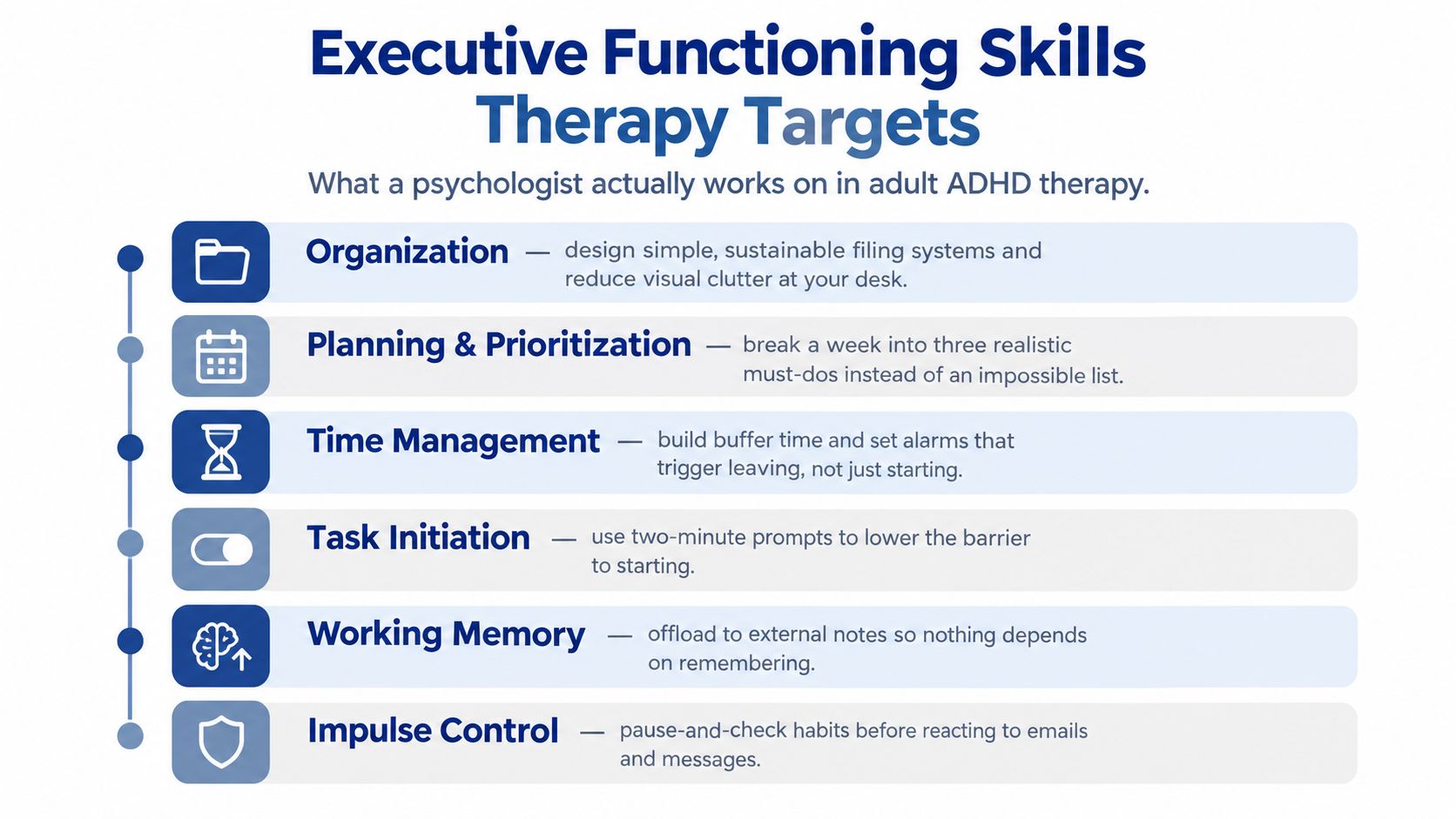
Executive-function therapy helps externalize tasks that ADHD makes difficult to manage internally. The focus isn't on generic productivity tricks. A psychologist studies where a person's system breaks down, then builds supports that fit work demands, energy patterns, home responsibilities, and available technology.
A typical plan may include:
- Organization: One task manager, one calendar, and clearly labeled places for important items can replace scattered notes and memory-based reminders.
- Planning and prioritization: Large projects become defined next actions. A vague goal such as “finish taxes” might become “open the tax folder and list missing documents.”
- Time management: The person practices estimating task duration, adding transition time, and setting alarms that signal leaving or switching activities, not only starting.
- Task initiation: A psychologist may use short starting prompts, body-doubling, accountability, or environmental changes to reduce the gap between intention and action.
- Working memory: Written instructions, meeting notes, visible reminders, and follow-up messages reduce the need to hold every detail mentally.
- Impulse control: Pause-and-check routines can create space before sending an angry email, interrupting a conversation, or making an unplanned purchase.
Procrastination often has a trigger. A task may feel boring, ambiguous, emotionally risky, or too large to begin. Therapy identifies that trigger and tests a smaller response, such as opening the document, setting a brief timer, or completing one clearly defined step.
A consistent external system can reduce cognitive load. An adult might use one digital calendar for appointments, a short daily list for tasks, and a brief planning routine to choose realistic priorities. The Focus Block Planner can support that type of time-blocking approach.
These strategies require practice and revision. A plan that works during a quiet week may fail during travel, illness, parenting stress, or a major work deadline. Medication may make attention and impulse control more accessible, while therapy helps convert that improved access into repeatable routines.
Emotional Regulation and Relationship Patterns
Adult ADHD can affect emotions and relationships as directly as calendars and deadlines. Repeated forgetfulness may lead to criticism, embarrassment, or self-doubt. A person may then avoid difficult conversations, react defensively, or interpret ordinary feedback as proof of personal failure.
Psychological work helps separate ADHD-related patterns from character judgments. The goal isn't to excuse missed commitments. It's to identify the sequence, such as distraction, delay, panic, avoidance, conflict, and shame, then practice a different response.
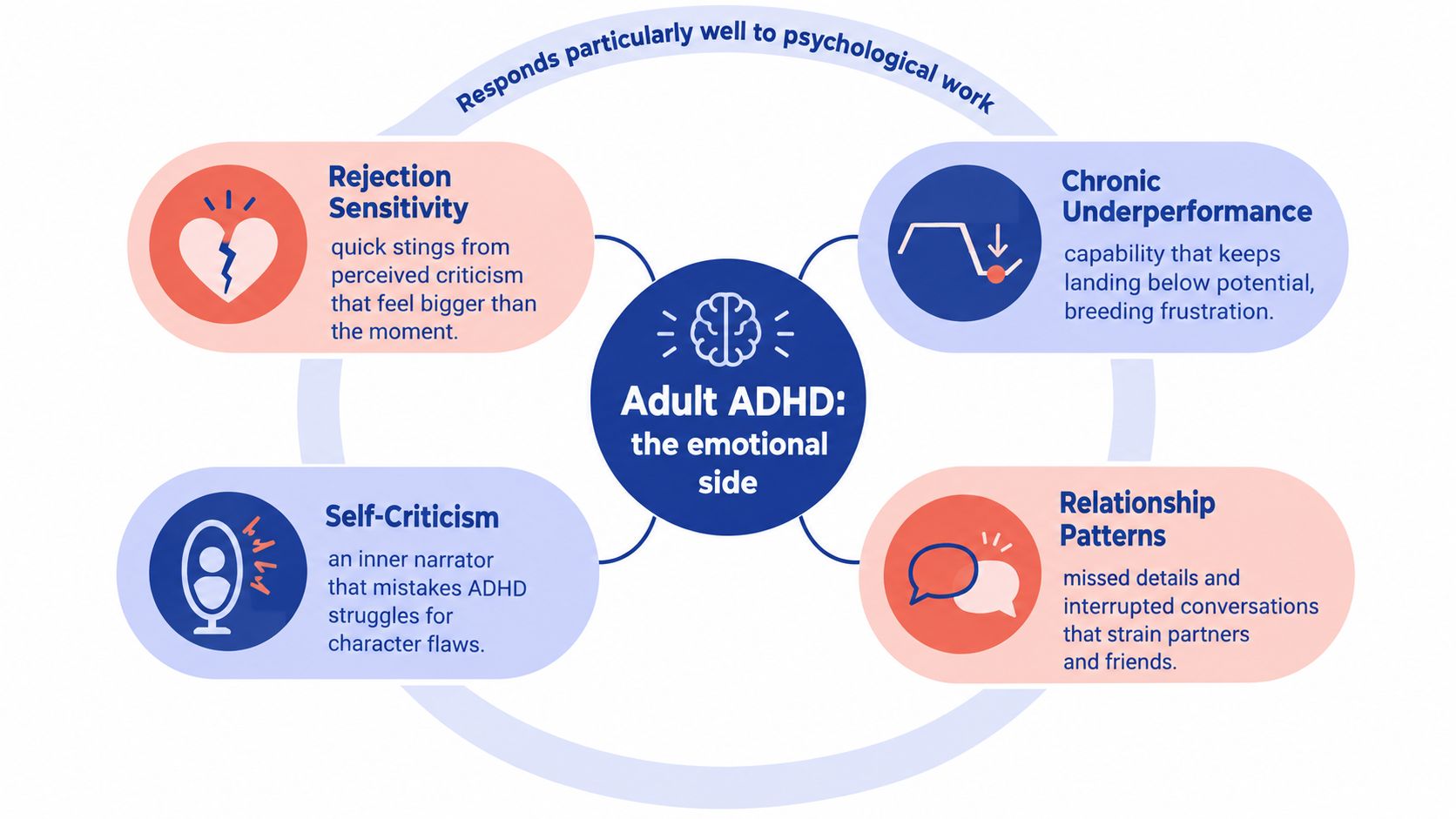
Common therapy targets include:
- noticing emotional escalation before it becomes an impulsive response;
- challenging all-or-nothing beliefs about competence;
- tolerating discomfort during avoided tasks;
- repairing conversations after interruption or missed follow-through;
- creating shared household systems that don't depend on one partner's memory.
Anxiety and depression may overlap with ADHD, but they aren't automatically caused by it. Chronic underperformance can contribute to low mood and worry, while independent anxiety, depression, trauma, or sleep problems can also produce inattention. A careful assessment considers whether symptoms began in childhood, occur across settings, and remain present outside periods of mood or sleep disturbance.
Therapy can address emotional regulation and relationship strain while a psychiatric provider evaluates medication when appropriate. If depression or anxiety meets criteria for separate treatment, ADHD-focused skills alone may not be enough. Psychological care provides the layer that addresses identity, meaning, self-criticism, communication, and relational repair.
Psychotherapy Approaches Used for Adult ADHD
Cognitive behavioral therapy for ADHD, often called CBT-AD, has the clearest practical role for many adults. It uses structured sessions, behavioral experiments, skills practice, and accountability to address planning, task initiation, distractibility, and time management. Evidence reviews describe CBT as useful for organization, daily functioning, and residual symptoms, while clinical guidance supports structured psychological intervention with CBT elements when indicated. CBT can improve how a person manages ADHD-related difficulties, but it does not remove the underlying neurobiological symptoms on its own.
Other approaches may suit particular goals:
- Acceptance and Commitment Therapy: Supports values-based action while making room for frustration, anxiety, perfectionism, or boredom.
- Mindfulness-based interventions: Practice noticing distraction, urges, and emotional escalation before responding automatically.
- Supportive psychotherapy: Offers education, validation, problem-solving, and space to process years of misunderstood difficulties.
- Behavioral skills coaching: Builds routines, scheduling, accountability, and environmental supports. Coaching and licensed psychotherapy have different scopes. Coaching may not address diagnoses, trauma, depression, or complex emotional patterns.
- Relationship or family work: Examines communication habits, shared expectations, conflict cycles, and repair.
| Approach | Primary focus | Best fit for |
|---|---|---|
| CBT-AD | Planning, task initiation, reframing, and accountability | Structured skills practice |
| Acceptance and Commitment Therapy | Values-based action despite discomfort | Avoidance, perfectionism, and anxiety |
| Mindfulness-based work | Awareness of distraction and reactivity | Emotional regulation and attentional control |
| Supportive therapy | Education, validation, and problem-solving | Adjustment, shame, and life stress |
| Skills coaching | External systems and follow-through | Routine building and practical accountability |
The right approach depends on symptom presentation, co-occurring conditions, work or family demands, and treatment preferences. Open-ended conversation can offer support, yet many adults need therapy that produces a concrete between-session experiment. A clinician might test a planning system, observe where follow-through breaks down, and revise the system rather than treating motivation as a character flaw.
How Therapy and Medication Management Work Together
Therapy and medication address different parts of adult ADHD care. A psychologist or therapist evaluates psychological patterns and teaches skills. A psychiatric prescriber evaluates medical factors, prescribes medication, adjusts doses, and monitors response and side effects. In Pennsylvania, psychologists don't prescribe medication.
Evidence-based medication management commonly begins with stimulant treatment as first-line therapy. Non-stimulants such as atomoxetine may be used when stimulants are contraindicated, not tolerated, or declined, as described in adult ADHD pharmacological guidance.
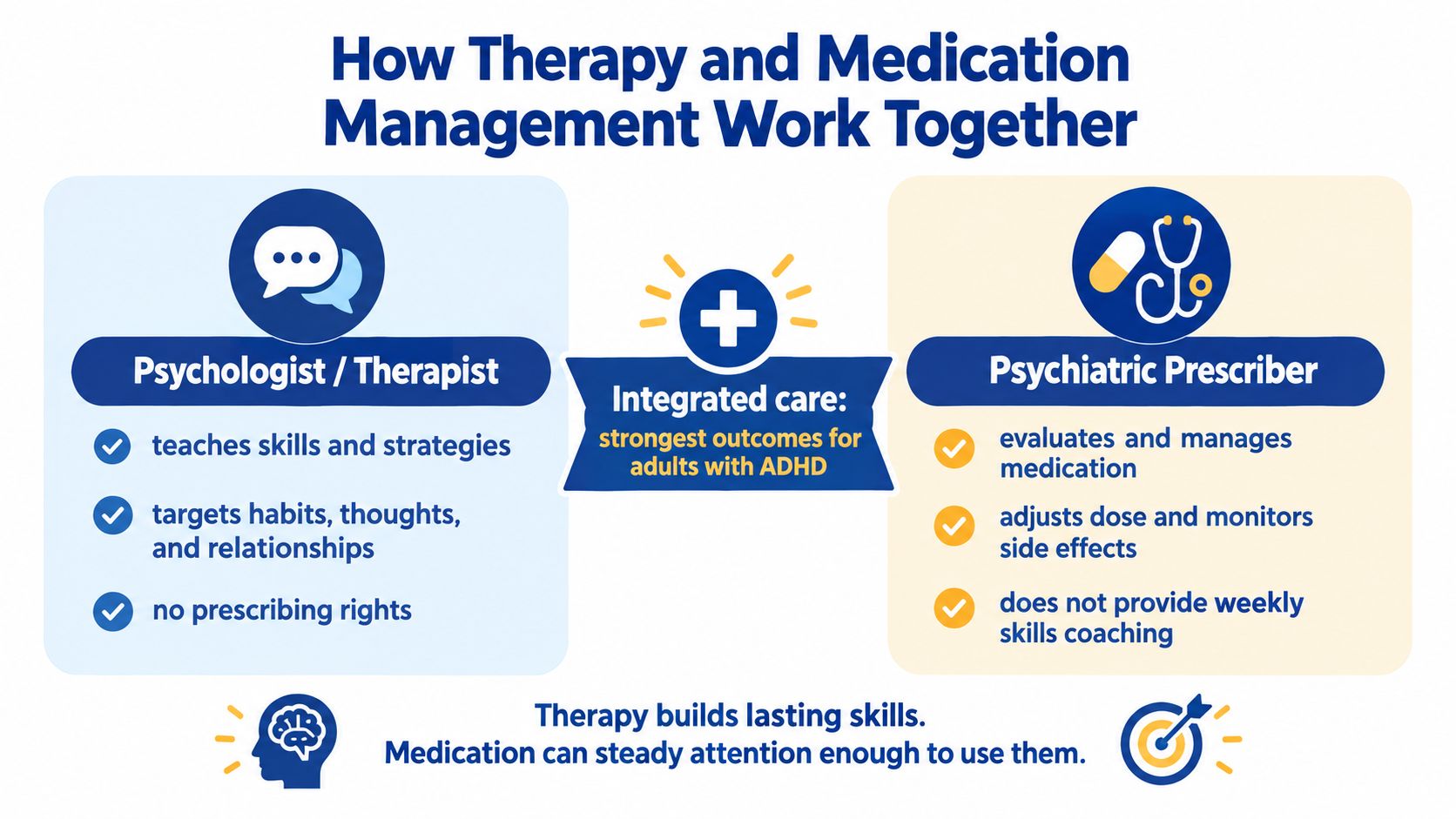
Medication may reduce barriers involving sustained attention, impulsivity, or working memory. Therapy then helps the person use that increased capacity to build routines, handle emotional triggers, communicate clearly, and complete real-world tasks. Therapy can still help someone who takes medication, especially when residual impairment remains.
Combined care may be useful when:
- medication helps somewhat but work or home functioning remains impaired;
- anxiety or depression complicates treatment;
- motivation changes sharply from day to day;
- a new job, parenting role, move, or relationship transition demands new systems;
- medication is not desired, tolerated, or clinically appropriate.
Controlled studies and long-term follow-up data indicate that psychosocial treatment, especially individual CBT, can sustain gains for up to 12 months after treatment, and reviews describe combined medication and psychosocial care as especially beneficial for many adults with ADHD in this clinical review.
A collaborative plan can include consent-based communication, shared goals, and clear responsibility for medication and therapy decisions. Adults seeking virtual prescribing can review telepsychiatry medication management as one possible part of a broader care plan.
Telehealth Psychology in Pennsylvania
Telehealth psychology can connect Pennsylvania adults with licensed psychological care without requiring travel to an office. The patient must be physically located in Pennsylvania during the session, and the psychologist must hold the appropriate Pennsylvania license. Secure video visits can support evaluation, therapy, skills practice, and follow-up for adults across the state, including Philadelphia, the Lehigh Valley, Pittsburgh, Harrisburg, Lancaster, and other communities when provider availability fits.
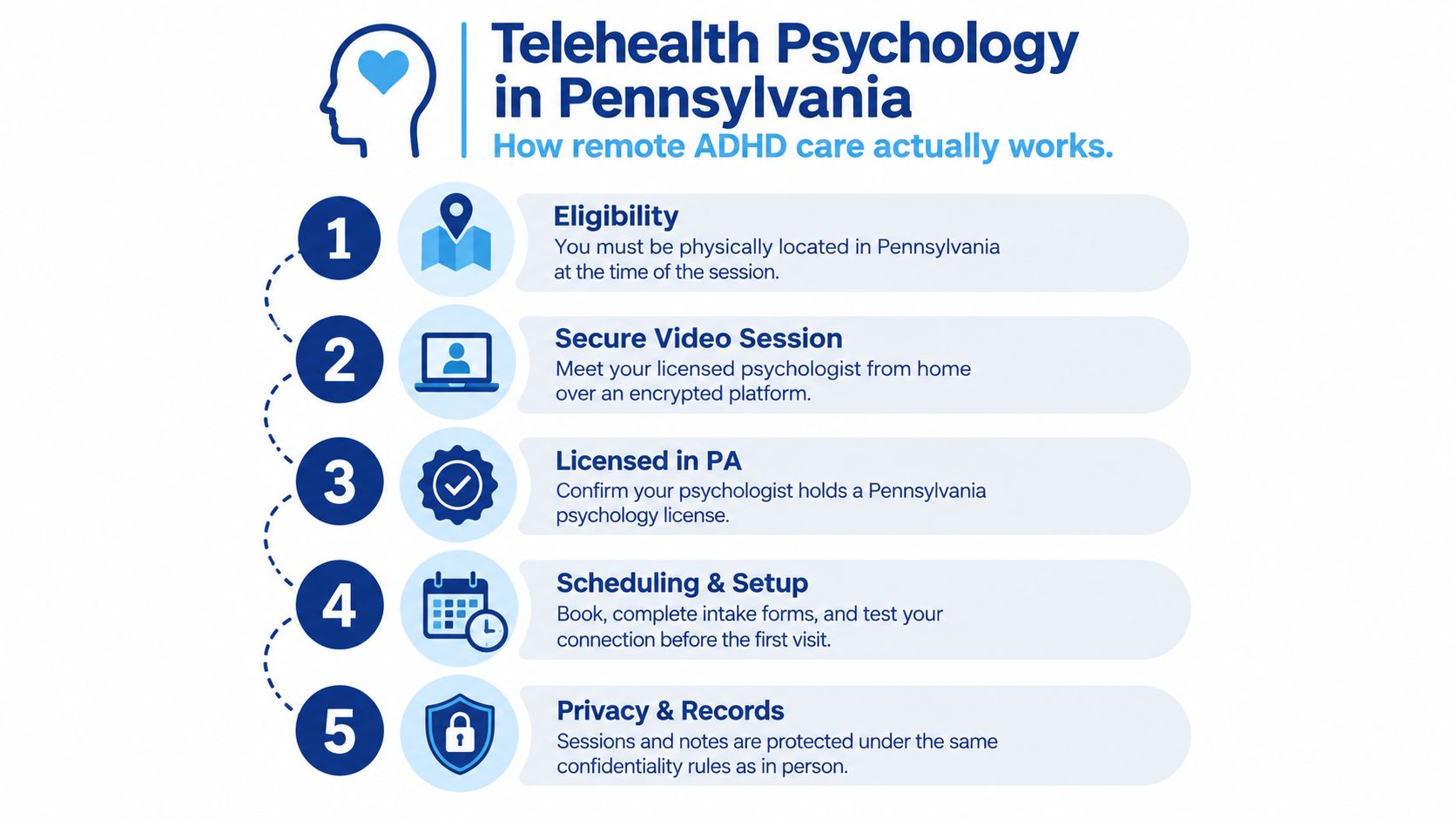
A typical sequence is individualized rather than fixed. The first visit may cover ADHD history, current impairment, work or school demands, relationships, sleep, stress, anxiety, depression, and treatment goals. Follow-ups may focus on one or two targets, such as externalizing tasks, reducing distractions, breaking down projects, or pausing before emotional reactions.
The provider may review what worked, identify barriers, and modify the plan. Homework between sessions is common, but it should be concrete and manageable. A calendar experiment, brief planning routine, written task system, or communication exercise can provide useful information without turning treatment into another overwhelming project.
Telehealth has limits. Formal cognitive batteries may require in-person arrangements when a psychologist determines that remote testing cannot answer the clinical question. Medication decisions remain with a psychiatric prescriber, and controlled-substance prescribing involves its own telepsychiatry relationship and clinical requirements.
Before the first appointment, an adult can prepare:
- A symptom timeline: Note childhood patterns, adult difficulties, and settings where impairment occurs.
- A functional snapshot: List problems with bills, work completion, sleep, relationships, driving, or household responsibilities.
- Current information: Gather medications, supplements, relevant medical history, and prior mental health treatment.
- A private setting: Use headphones, reliable internet, and a space where confidential conversation is possible.
- Specific goals: Identify the one problem that would make daily life easier if it improved.
Adults can also review what to expect from online therapy in Pennsylvania before deciding whether remote care fits their needs.
Common Questions About Psychology and Adult ADHD
Can a psychologist treat adult ADHD?
Yes. A psychologist can evaluate adult ADHD when qualified to provide that service, deliver ADHD-focused psychotherapy, teach executive-function skills, address emotional and relationship patterns, and coordinate with a psychiatric provider. Treatment may improve task initiation, organization, follow-through, emotional reactivity, and functioning even when attention symptoms remain.
Can therapy help ADHD even if someone takes medication?
Yes. Therapy can help adults who take medication but still struggle with planning, procrastination, routines, self-criticism, communication, or anxiety. Medication and therapy aren't interchangeable. Medication may help core symptoms more directly, while psychotherapy helps the person build and maintain behavioral systems around those symptoms.
What's the difference between an ADHD therapist and a psychiatric provider?
An ADHD therapist, such as a psychologist or other appropriately licensed clinician, focuses on assessment within scope, psychotherapy, coping skills, emotional patterns, and functional behavior. A psychiatric provider, such as a psychiatrist or board-certified psychiatric mental health nurse practitioner, can evaluate medical factors and manage medication. Some adults need one service, while others benefit from coordinated care.
Adult ADHD assessment must also distinguish ADHD from stress, depression, anxiety, trauma, poor sleep, substance effects, and medical conditions. The CDC's report on adult ADHD estimated that 15.5 million U.S. adults, or 6.0% of adults, had a current ADHD diagnosis in 2023, and about one-half received that diagnosis at age 18 or older. The same report highlights why adult evaluation needs developmental history and current impairment, not symptom reporting alone.
A psychologist may also recommend medical coordination when fatigue, sleep problems, thyroid abnormalities, anemia, or another health issue could affect concentration or mood. Genetic or laboratory testing doesn't determine an ADHD psychotherapy plan or establish the diagnosis. Clinical history, functional impairment, co-occurring symptoms, behavioral patterns, and personal goals remain central.
Pennsylvania adults can begin by identifying whether the priority is diagnostic clarity, skills-based therapy, medication evaluation, or coordinated care. Insurance benefits, deductibles, copays, network status, and authorization rules vary, so Insurance & Fees information and direct benefit verification can prevent surprises.
Integrative Psychiatry of America provides secure virtual psychiatric care across Pennsylvania, including ADHD evaluation, treatment planning, and medication management, with psychotherapy and whole-person support considered when clinically appropriate. Adults who want to discuss ADHD-related functioning, medication options, or coordinated care can visit Integrative Psychiatry of America and request an appointment.