
A patient may be sitting at the kitchen table, portal open, wondering whether a missed ADHD dose, a refill question, or a return of anxiety symptoms belongs in a message or a phone call. That moment is where confusion usually starts. Patient portal secure messaging feels simple on the surface, but it works best when patients treat it as a clinical care channel, not a casual text thread.
For telepsychiatry, that difference matters. A well-timed message can help with refill planning, brief symptom updates, and appointment logistics. The wrong message, sent through the wrong channel, can delay urgent care. That is especially important in mental health, where convenience and privacy matter, but so do safety, triage, and clear response expectations.
Table of Contents
- What Patient Portal Secure Messaging Actually Is
- How Secure Messaging Protects Your Privacy
- What You Can Safely Handle Through Secure Messaging
- Best Practices for Writing an Effective Portal Message
- Inside the Integrative Psychiatry of America Patient Portal
- When to Message and When to Call Instead
- Troubleshooting Common Portal Messaging Problems
- Key Takeaways and Next Steps for Pennsylvania Patients
What Patient Portal Secure Messaging Actually Is
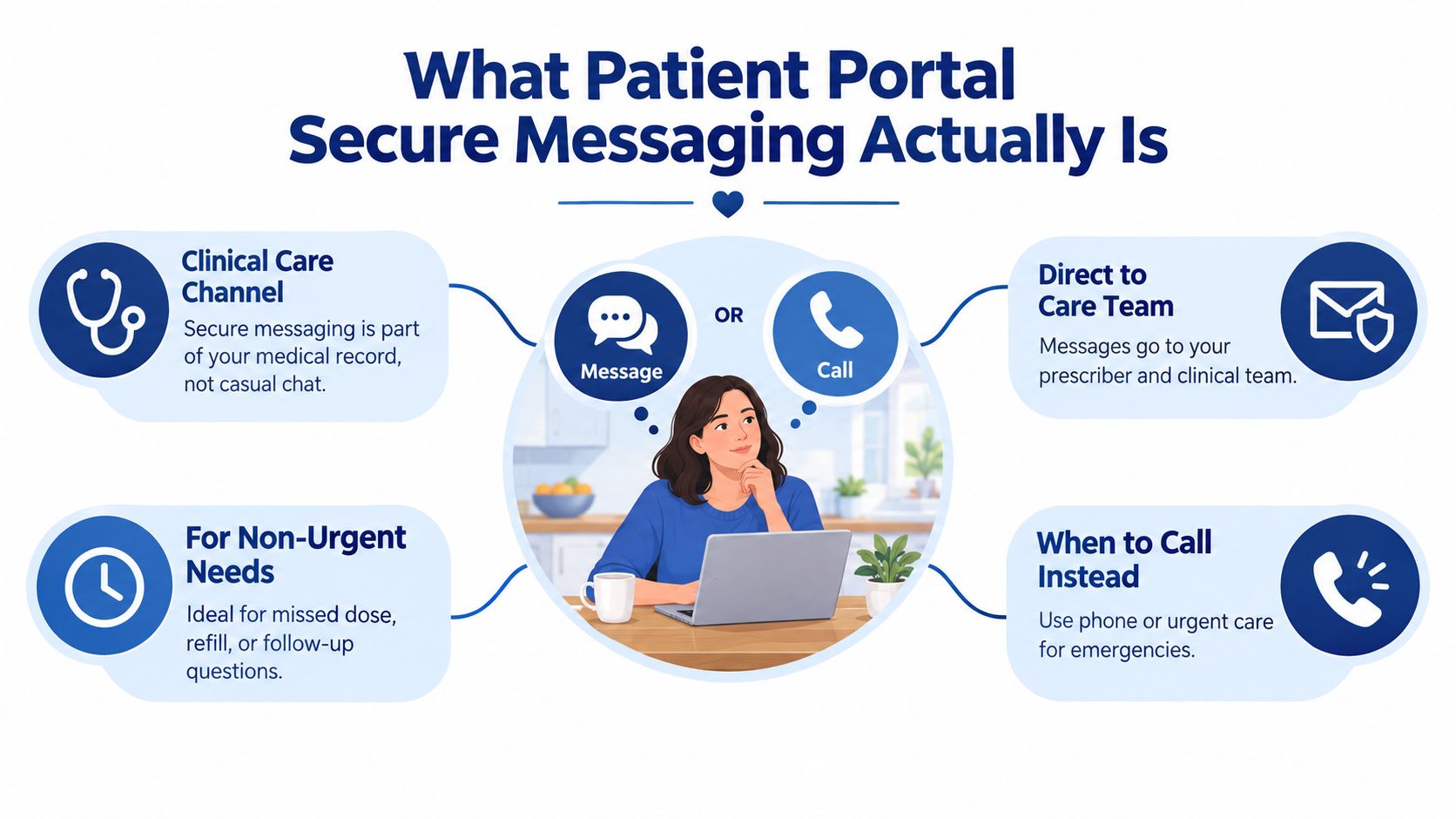
A patient opens the portal on a Tuesday night, notices only a few pills left, and sends a note asking about a refill before next week. That message enters a clinical work queue, much like a lab result or callback request. It may feel casual on the screen, but inside the practice it is handled as part of patient care.
Patient portal secure messaging is a protected message thread inside a healthcare portal. The message is tied to the patient's identity, connected to the medical record, and meant for non-urgent clinical communication. In mental health care, that often includes refill planning, brief symptom updates, follow-up questions after a visit, and appointment requests.
How it differs from texting and email
A portal message works more like a front desk note that is attached to the chart than a text sent to one person's phone. The care team can review it, route it to the right staff member, document the reply, and decide whether the issue belongs in messaging, a phone call, or a visit. That structure is why secure messaging is often discussed alongside broader healthcare secure messaging standards.
For telepsychiatry, that distinction matters. A short update such as “my sleep improved after the dose change” can often be reviewed in the portal. A refill request for a medication that will run out next week may also fit. New symptoms that raise safety concerns may need a call or urgent evaluation instead. Patients who are still learning how online care works can compare portal communication with video visits by reading what telepsychiatry is.
Practical rule: Write a portal message the way you would leave a clear, dated note for a care team during business hours.
Why practices rely on it
Practices use secure messaging because it supports triage, documentation, and follow-through in one place. A refill question can be reviewed by staff, checked against the chart, and sent to the prescribing clinician if needed. An appointment request can be redirected to scheduling. A symptom update can be saved in the record so the next clinician who opens the chart sees the same information.
That workflow also has limits. Portal messages are not watched like a crisis line, and they do not promise an immediate back-and-forth exchange. In telepsychiatry, that trade-off is part of using the tool responsibly. Messaging gives patients a private, organized way to communicate about non-urgent needs, but the care team still has to sort the message, judge urgency, and answer within the practice's response window.
Secure messaging is also widely used at scale. In a large Mayo Clinic portal study covering 2010 through 2017, patients sent 1,569,172 of 3,702,748 secure messages, and 203,166 patients used the channel compared with 5,690 clinicians, which shows how common this form of communication became in routine care (study details).
That popularity does not make portal messaging equal for everyone. It works best for patients who have internet access, know how to log in, can write out their concern clearly, and feel comfortable waiting for a reply. For psychiatric care in particular, those barriers matter. A tool built for convenience can still leave some patients behind if they need language support, faster help, or another way to communicate.
How Secure Messaging Protects Your Privacy
Most patients care less about technical jargon than about one basic question. Who can read the message, and how is it protected?
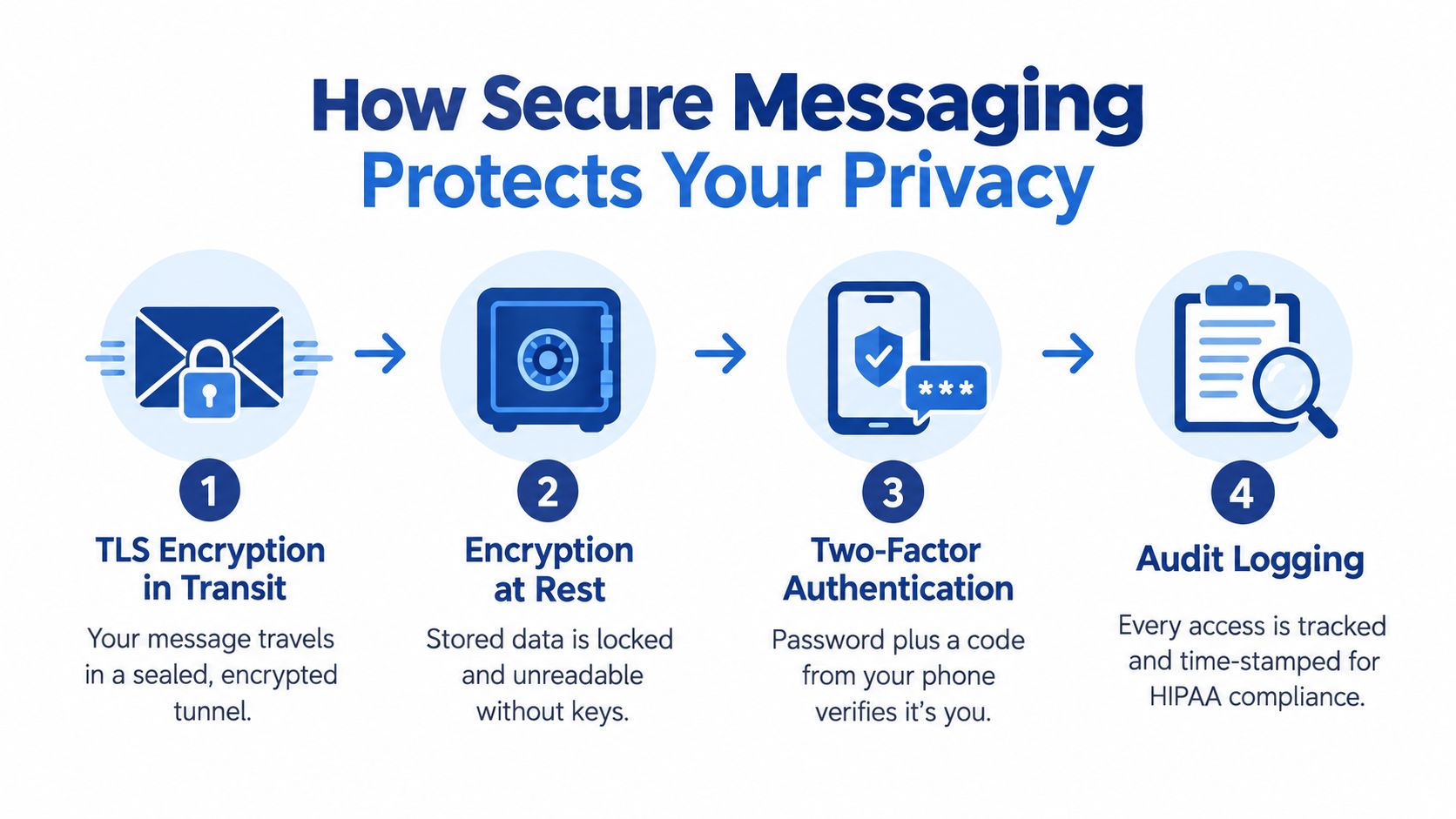
A secure portal uses layered safeguards to answer that question. The safest way to understand them is through plain visual comparisons.
What the protections mean in real life
Encryption in transit works like a sealed courier envelope. As the message travels between device and portal, it's protected rather than exposed in plain text. HHS advises patients to use encryption on their devices and apps used to communicate with healthcare providers or health plans when possible, which supports keeping sensitive communication inside a secure, encrypted clinical channel instead of ordinary consumer messaging apps (HHS guidance).
Encryption at rest is closer to a locked file cabinet. A 2026 HIPAA-compliance guide for patient portals states that secure messaging must include encryption in transit and at rest, access limited to authorized users, audit logging, and a signed Business Associate Agreement with the vendor (HIPAA portal guide).
Authentication is the digital version of showing ID at the door. Another 2026 portal-security guide specifies unique user authentication, role-based access control, and automatic session timeouts, with example timeout targets of 15 minutes for staff interfaces and 30 to 60 minutes for patient-facing sessions (portal security guide).
A helpful way to picture controlled document access is to compare it with access-controlled file sharing, where only approved people can open specific content rather than anyone with a forwarded email.
What role-based access changes
Role-based access means not every staff member sees everything. Scheduling staff may only need access to appointment questions. Clinical staff may need access to medication messages. That separation matters in psychiatry, where records can be especially sensitive.
Patients who want more detail about how virtual care platforms handle privacy can review HIPAA compliance in telehealth.
A short explainer can make these protections easier to visualize.
Even a secure system can't remove every human risk. Patients still need to log out on shared devices, protect their passwords, and avoid placing sensitive details in message subject lines.
What You Can Safely Handle Through Secure Messaging
The simplest decision rule is this. If the issue can safely wait one to two business days, a portal message may fit. If waiting could put the patient at risk, a call or emergency care fits better.
That rule matters because patients and clinicians often still don't get clear guidance on what secure messaging is for, what counts as non-urgent, and how to avoid burdening the care team. Reviews of the literature describe ongoing confusion about appropriate message content, expected response times, urgent escalation, and triage in mental health settings (review summary).
Common psychiatric tasks that fit
In telepsychiatry, portal messaging often works well for stable, bounded issues:
- Refill planning: “Adderall XR 20 mg will run out next Tuesday. The dose is unchanged. Could the refill be reviewed?”
- Brief symptom updates: “Sleep has improved since the dose change, but afternoon focus is still poor.”
- Scheduling and paperwork: appointment changes, form requests, pharmacy updates.
- Mild side-effect check-ins: dry mouth, mild nausea, or drowsiness that isn't worsening quickly.
Tasks that need faster contact
Some issues don't belong in an asynchronous message queue at all:
- Safety emergencies: suicidal thoughts with intent or plan, overdose concerns, or psychosis with immediate risk.
- Severe reactions: intense agitation, severe withdrawal symptoms, chest pain, fainting, or a medication problem that feels dangerous now.
- Rapid change: symptoms that have sharply worsened over hours and can't wait.
| Task | Use Secure Messaging | Use Phone or Emergency Care |
|---|---|---|
| Routine refill at a stable dose | Yes | No |
| Brief update between visits | Yes | No |
| Appointment rescheduling | Yes | No |
| Mild stable side effect | Yes | Sometimes call if worsening |
| New severe medication reaction | No | Yes |
| Suicidal thoughts or immediate safety concern | No | Emergency care |
Patients seeking help with stimulant or non-stimulant refill workflows can also review how ADD medications are managed online, but any refill request still has to follow the clinic's safety and prescribing process.
Best Practices for Writing an Effective Portal Message
A good portal message helps the care team answer the right question quickly. A vague or overly long message often slows things down because staff have to clarify basics before a clinician can act.
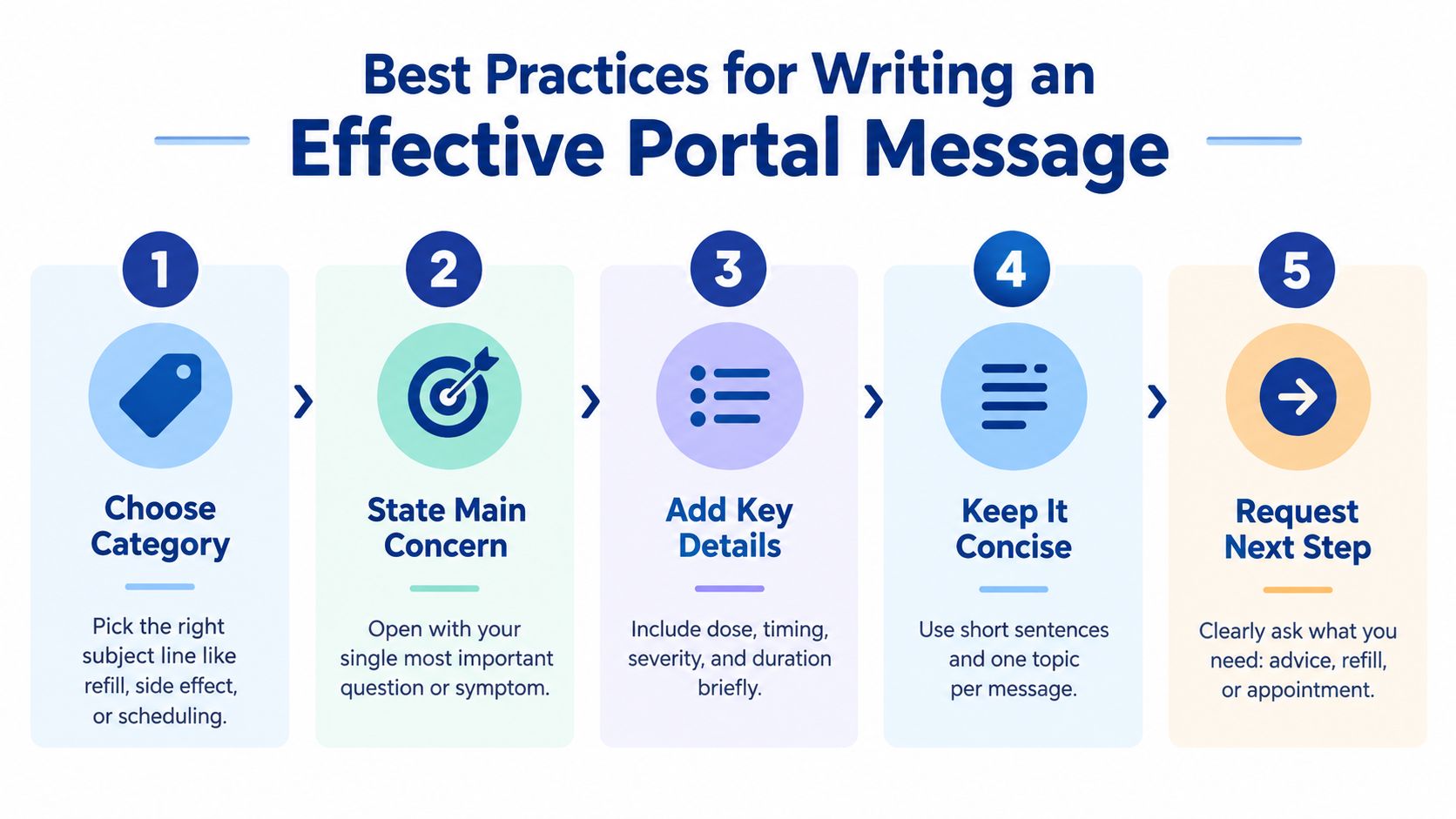
A simple message structure that works
- Choose the right category. Refill, side effect, scheduling, form request, or symptom update.
- Open with the main issue. Put the key medication or symptom in the first sentence.
- Add timing. State when the problem started or when the refill is needed.
- Include only useful context. Dose, recent changes, pharmacy name, and related symptoms.
- Ask one clear question. Refill, advice, or appointment.
- Stop there. One message should usually cover one issue.
Example of a useful message
A helpful message might read like this:
“Vyvanse 30 mg will run out in five days. The dose hasn't changed. The pharmacy is the same as last month. Could the refill be reviewed, or should a follow-up visit be scheduled first?”
That gives the team a medication, timeline, and request in a few lines.
What to leave out
Patients should avoid sending Social Security numbers, long life histories, or multiple unrelated concerns in one thread. Urgent red-flag symptoms should not be packaged into a routine portal note.
Clinicians usually triage these messages by topic and urgency. Refill requests may go through a prescription workflow. Administrative issues may go to front-desk staff. Anything that sounds psychiatrically acute may trigger a faster callback or redirection to emergency services. Patients who want a broader view of this care process can review how online psychiatric medication management works.
Inside the Integrative Psychiatry of America Patient Portal
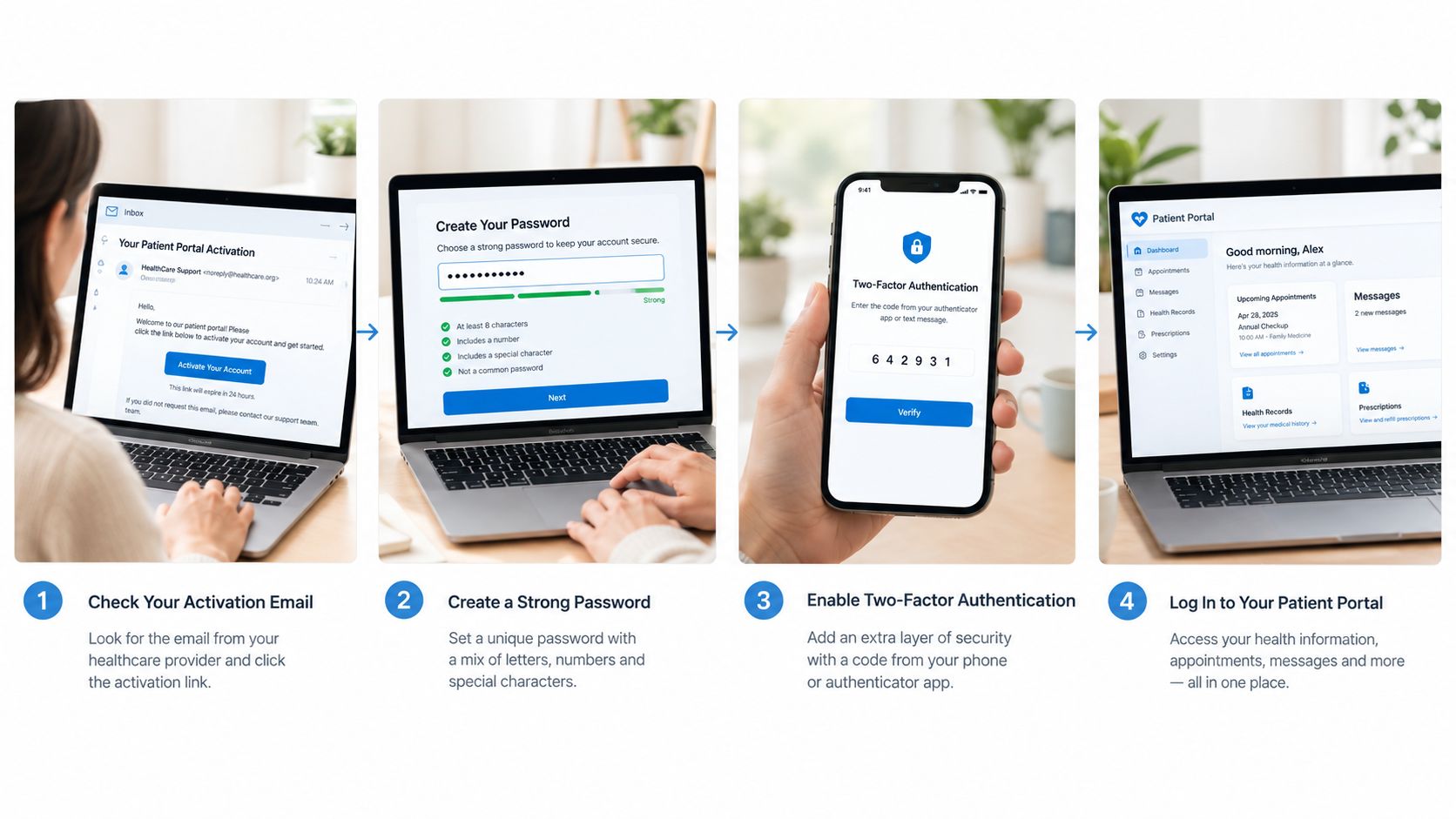
A patient's first portal experience usually starts after the first visit, when an activation email arrives. The next steps are straightforward. Create a password, confirm identity, and enable the login security step if prompted. After that, the portal becomes the main place to check messages, appointments, prescriptions, and uploaded documents.
What patients usually see after login
Most portals group tasks into a few core tabs:
- Inbox: message threads with the care team
- Appointments: upcoming visits and scheduling details
- Prescriptions: refill requests and medication status
- Documents: forms, instructions, and shared files
At Integrative Psychiatry of America, the portal supports secure messages, appointment requests, and refill communication as part of virtual psychiatric care. Patients comparing ongoing care options for mood symptoms can also see how virtual follow-up fits into online psychiatry for depression in Philadelphia.
How a refill request moves through the system
The refill workflow is often where the portal feels most useful. A patient selects the medication, confirms the pharmacy, and submits the request. After that, the status may change from “received” to “in review” to “sent to pharmacy,” depending on the platform.
That doesn't mean every refill is automatic. Some requests can be processed quickly if the dose is stable and follow-up requirements are up to date. Others may need chart review, pharmacy confirmation, or a scheduled visit before any prescribing decision is made.
A portal can move information efficiently, but it doesn't replace clinical judgment. Medication changes, diagnostic questions, and many symptom decisions still require a visit.
When to Message and When to Call Instead
It is 9:30 p.m. You notice your anxiety is worse than usual, you have two doses of medication left, and you are not sure whether to send a portal message, call the office, or get help right away. That decision matters because secure messaging is a care channel with its own pace. It is useful, but it is not built for urgent back-and-forth.
A simple rule helps. If the issue can safely wait for a business-hours review, send a message. If you need same-day guidance or live clarification, call. If there is a safety risk now, use emergency care.
Three channels, three jobs
Portal messaging works best for non-urgent care coordination. Phone calls fit problems that may need questions and answers in real time. Emergency services are for situations where waiting could lead to harm.
That division is not just about convenience. It protects patients from using a slow channel for a fast-moving problem.
One primary care study found that secure messaging did not meaningfully increase in-person visit use before and after patients started messaging, which suggests messaging can substitute for some office contact when clinics set clear workflow rules (primary-care study).
In psychiatry, those workflow rules matter even more. A refill request, a symptom update, and a possible medication reaction do not belong in the same queue just because they are all typed into the portal.
Quick comparison for common scenarios
| Scenario | Best Channel | Why |
|---|---|---|
| Refill needed next week, dose unchanged | Secure message | Staff can review the chart, pharmacy, and follow-up timing during business hours |
| Mild dry mouth after starting a medication, otherwise stable | Secure message | A clinician can assess the side effect without urgent back-and-forth |
| Need to request or change a follow-up visit | Secure message | This is usually an administrative task |
| Anxiety, insomnia, or agitation worsened sharply today | Phone call | The team may need to ask follow-up questions the same day |
| Medication feels acutely wrong, such as severe restlessness, heavy sedation, or a concerning new reaction | Phone call | Live triage is safer than waiting in an inbox |
| Suicidal thoughts with a plan, overdose concern, severe confusion, or psychosis with immediate safety risk | Emergency care | Immediate evaluation is needed |
Why response windows matter
A portal inbox is not the same as a text thread. Messages are reviewed according to clinic workflow, staffing, and urgency category. That is why patients should never assume an instant reply.
In a large secure messaging dataset, clinicians replied to 72.2% of patient messages within 1 day, 90.6% within 3 days, and 96.0% within 5 days, with a median response delay of 0.6 days. The same study also found that highly responsive clinicians received far more new patient messages, which shows how strongly response reliability shapes portal use (JMIR study).
Clear expectations help. A survey of hospital portal instructions found that many hospitals gave patients a stated turnaround time, and nearly all of those hospitals promised a reply within 3 business days (hospital instruction survey).
For telepsychiatry patients, this means a Friday afternoon refill message may not function like a same-day rescue request. If the medication is time-sensitive, calling is usually safer than hoping the message reaches the right reviewer before the next missed dose.
A practical way to choose
Use the portal for planned care. Examples include refill requests sent before you run out, brief updates on stable side effects, non-urgent questions after a visit, and appointment requests.
Call for problems that are changing today. That includes new symptoms that feel hard to judge, medication problems that may need same-day advice, or any situation where a few follow-up questions could change what you should do next.
Some patients also face access barriers that make portal messaging harder to use well. Limited internet access, shared devices, low digital comfort, language barriers, and disability-related access needs can all slow communication. In those cases, calling the office may be the safer and more realistic option, even for issues that are not medically urgent.
Troubleshooting Common Portal Messaging Problems
Portal problems usually fall into a few predictable categories. Most have simple fixes.
Login or account access problems
If the account is locked, the first step is usually the password reset link on the sign-in page. If the reset email doesn't appear, checking spam or junk folders often solves it. Shared-device users should also make sure the browser isn't autofilling an old password.
If the portal still won't open, calling the office during business hours is often faster than repeated failed login attempts.
Message won't send or seems to disappear
Start with the basics:
- Check the recipient: The wrong inbox or category can block routing.
- Update the browser: Older browsers sometimes fail on portal forms.
- Disable blockers briefly: Pop-up or privacy extensions may interfere with attachments or send buttons.
If the message appears in “drafts” rather than “sent,” it likely never left the account.
Refill seems delayed
Review the pharmacy listed in the request. An old pharmacy is a common cause of confusion. Then check the message thread or refill status for signs that the request is still pending review.
If the usual response window has passed, a short follow-up note is reasonable. Keep it brief and include the medication name and refill date needed.
Notifications aren't arriving
Patients should verify email address, mobile number, and notification preferences inside the portal profile. Spam filtering can also catch portal alerts. If alerts are turned on but nothing arrives, office staff can usually confirm whether the portal has the correct contact information.
Key Takeaways and Next Steps for Pennsylvania Patients
Patient portal secure messaging works best when patients treat it like a documented clinical interaction. It's not casual texting. It's a structured way to handle non-urgent refill planning, symptom updates, and appointment questions without waiting on hold.
For psychiatric care, the safest rule stays simple. If the concern can wait, message. If the patient needs same-day guidance, call. If there's a risk of harm, use emergency care.
A short checklist before sending the first message
- Log in securely: Use the portal account, not ordinary email.
- Confirm contact settings: Make sure notifications go to the right phone or email.
- Keep the message focused: one topic, one request, clear timeline.
- Use the right channel: urgent mental health or medication safety issues need faster contact.
Why this matters in telepsychiatry
Secure messaging is often described as a convenience feature, but the bigger issue is how it affects workflow, equity, and care quality. A 2025 scoping review notes ongoing challenges that include privacy concerns, limited access, provider workload, and equitable implementation, while newer studies also describe empathic communication gaps and rising message volumes (2025 scoping review).
That's why the portal should be used thoughtfully. It can improve access for many patients, including those managing ADHD, anxiety, depression, OCD, or PTSD from home in Pennsylvania. But it still depends on clear triage rules, realistic response windows, and a shared understanding of what belongs in a message.
For patients preparing to reach out for the first time, the most useful next step is simple. Log in, review contact preferences, and write the shortest clear message that gives the care team what it needs to respond safely.
Integrative Psychiatry of America provides virtual psychiatric care across Pennsylvania, including secure portal communication for non-urgent questions, refill requests, and appointment coordination as part of ongoing telepsychiatry treatment. Patients who want help with ADHD care, medication management, anxiety, depression, OCD, or PTSD can learn more or request care through Integrative Psychiatry of America.