
A lot of people looking for online therapy in Pennsylvania are sitting with the same mix of urgency and skepticism. They want help, they want privacy, and they don't want to waste time on a platform that turns out to be out of network, out of state, or wrong for what they need.
That caution is smart.
Online mental health care in Pennsylvania is real, mainstream, and often practical. It's also not one thing. A therapy visit, an ADHD evaluation, and medication management follow different rules, bill differently, and feel different in the room. For Online Therapy in Pennsylvania: What to Expect, it's important to know the mechanics before booking. That avoids bad fit, surprise costs, and delays in care.
Table of Contents
- What Online Therapy in Pennsylvania Actually Looks Like
- How a Virtual Appointment Works From Start to Finish
- What Insurance Typically Covers for Online Therapy
- Prior Authorization Referrals and Appeals Explained
- Checking Benefits and Controlling Out-of-Pocket Costs
- Real-World Scenarios Pennsylvania Readers Often Face
- Your Practical Next Steps
What Online Therapy in Pennsylvania Actually Looks Like
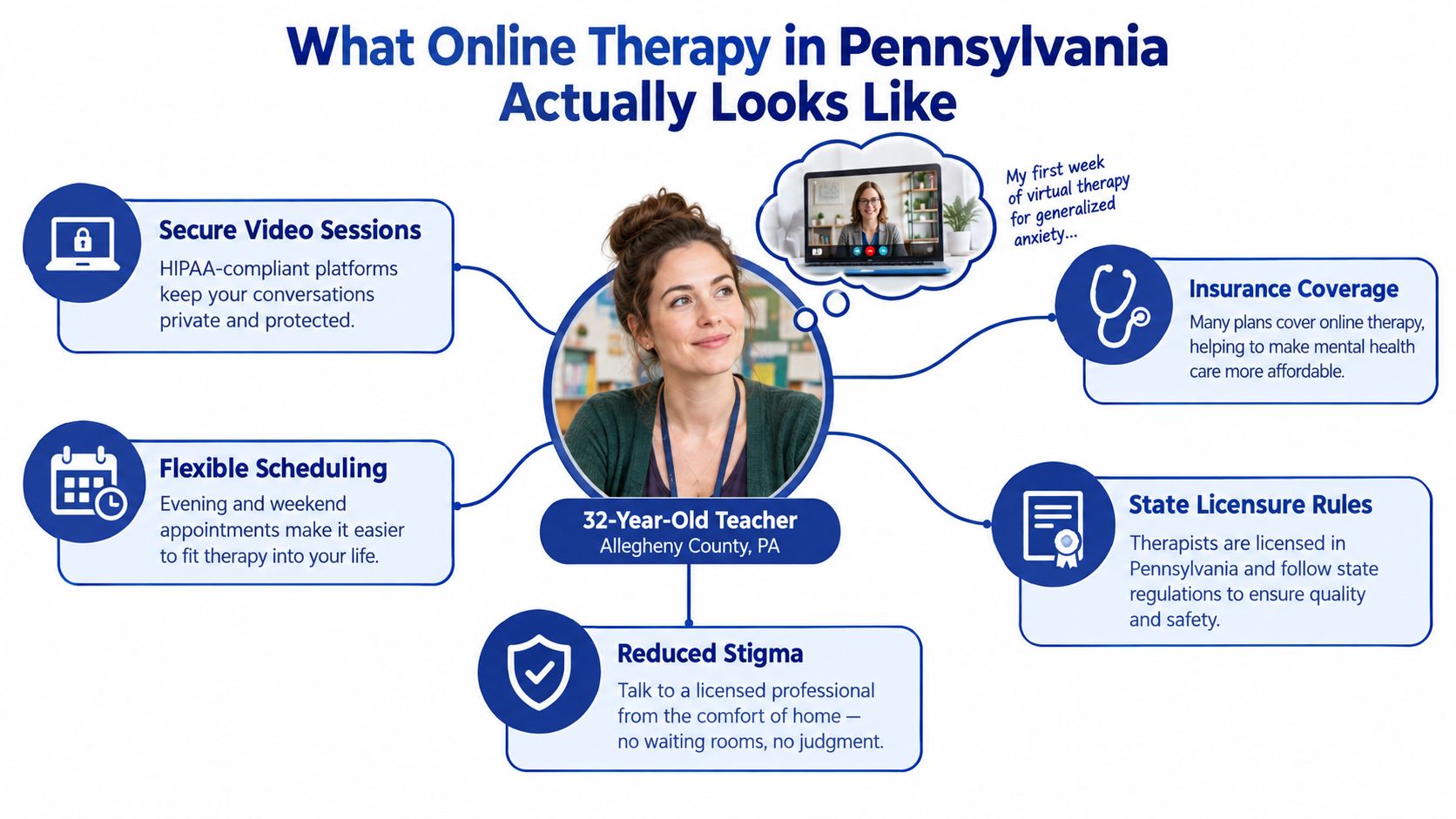
It often starts the same way. A parent in Scranton closes the bedroom door after the kids are down, opens a laptop, and tries to decide whether to book a therapist, a psychiatric prescriber, or one of the large apps that bundle everything together. In Pennsylvania, that choice matters because these are different services with different rules, billing patterns, and expectations.
A normal first week of online care is pretty plain. You fill out intake forms, upload an insurance card, sign consent paperwork, and join a scheduled visit from home, work, or another private spot in Pennsylvania. If the fit is right, you leave with a treatment plan, follow-up schedule, and a clear sense of whether you need weekly therapy, medication management, or both.
The three formats patients actually see
Live video therapy is the standard form of online counseling. That usually means scheduled sessions with a Licensed Professional Counselor, Licensed Clinical Social Worker, psychologist, or another licensed therapist using a secure telehealth platform.
Telepsychiatry or virtual medication management covers diagnostic assessment, medication decisions, and follow-up visits with a psychiatric physician or psychiatric mental health nurse practitioner. It is more medical, more structured, and usually shorter on follow-ups than therapy.
Asynchronous messaging shows up on many platforms, but patients should treat it as support, not the visit itself. Pennsylvania OMHSAS behavioral health telehealth guidance centers covered telehealth on real-time, two-way interactive audio-video transmission and excludes text messaging, email, fax, and general instant messaging as the service itself in its behavioral health telehealth guidance.
That distinction matters. If a company mainly sells chat access, you are not getting the same thing as a standard therapy session or psychiatric appointment under Pennsylvania telehealth rules.
State experience also helps explain why virtual care stuck. Pennsylvania's behavioral health telehealth survey found that many respondents were receiving care at home and wanted telehealth to remain part of treatment after the pandemic, which tracks with what clinicians still see across the state. Patients use it because it cuts drive time, childcare strain, missed work, and no-show risk.
What changes the experience before you ever click "book"
Start by matching the service to the problem. If you want regular support for anxiety, grief, trauma, or relationship stress, book therapy. If you need diagnostic clarification, medication review, or a prescriber to manage bipolar disorder, ADHD, major depression, or panic symptoms, book psychiatric care. If you need both, do not assume one clinician is doing both jobs.
Pennsylvania telehealth rules also shape what the visit feels like. Video is still the default for behavioral health care. Audio-only may be allowed in some situations, but it is a fallback, not the standard people should plan around.
For a plain-language psychiatric overview, IPA's page on what telepsychiatry is is a useful starting point. To understand why scheduling, intake reminders, and follow-up messages now feel more automated, it also helps to see how healthcare virtual assistants work, because many Pennsylvania practices now use them for administrative steps before and after the clinical visit.
How a Virtual Appointment Works From Start to Finish
A good virtual appointment feels structured, not chaotic. The patient clicks a link, lands in a waiting room, confirms where they are physically located, and starts talking with a clinician who can see and hear them clearly. That's what compliant, routine tele-mental health looks like.
Before the visit starts
Most Pennsylvania practices use a HIPAA-compliant video platform such as doxy.me, Zoom for Healthcare, or a built-in EHR portal. Patients should use a private space, a working camera, and a microphone that doesn't cut in and out. A parked car can work in a pinch, but it's rarely ideal for a first psychiatric assessment.
Identity and location matter. In Pennsylvania telehealth, the clinician must know who the patient is and where the patient is physically located at the time of the session. Licensure is tied to the patient's location, not just the provider's office address.
For people who need interpreter support, telehealth gets better when language access is handled deliberately rather than improvised. Practices and patients can review options that improve telehealth language access before the appointment instead of trying to solve it after check-in.
What happens in the first session
A first evaluation is usually the longest visit. It often runs 45 to 60 minutes. That time goes fast when the clinician is doing the job correctly.
The visit usually includes:
- Identity and location check: The clinician confirms the patient's name, date of birth, and current physical location in Pennsylvania.
- Reason for treatment: Anxiety, depression, ADHD concerns, OCD symptoms, trauma history, insomnia, mood changes, or substance use concerns.
- Full history: Medical history, mental health history, prior therapy, past medications, side effects, and family history.
- Safety review: Suicidal thinking, self-harm risk, violence risk, and urgent instability.
- Substance use screening: Alcohol, cannabis, stimulants, opioids, and anything else that could affect diagnosis or prescribing.
- Treatment planning: Therapy referral, medication options, labs if clinically appropriate, follow-up timing, and next steps.
Patients looking for the psychiatric intake pathway can review IPA's online mental health evaluation process.
A solid intake doesn't rush toward a prescription. It sorts out what problem is actually being treated.
What follow-up visits feel like
Follow-up therapy sessions are often 45 to 53 minutes. Medication follow-ups are usually shorter, often 15 to 30 minutes, because the focus is narrower. The clinician may review symptom response, side effects, sleep, appetite, attention, work function, and adherence.
On the patient's screen, this usually feels simple. There's a waiting room, then the clinician's face, then conversation. Some providers screen-share worksheets, rating tools, or lab results. Others keep it conversational.
Pennsylvania's telehealth rules are not loose on modality. State guidance defines telehealth behavioral health care around real-time, two-way audio-video, and it does not treat a telephone conversation, email, or fax as the service itself, as summarized in this Pennsylvania telehealth policy reference. Patients who need controlled-substance treatment planning should assume video will be required unless a specific legal exception applies.
What Insurance Typically Covers for Online Therapy
Most patients ask the wrong first question. They ask, “Do you take my insurance?” The better question is, “What does my specific plan cover for tele-mental health with an in-network Pennsylvania provider?”
That's the difference between a smooth visit and a billing fight.
The broad rule in Pennsylvania
Pennsylvania telemedicine coverage rules for commercial insurance say that a policy offered, issued, or renewed in the commonwealth must cover medically necessary services delivered through telemedicine when provided by a participating network provider, and the insurer may not exclude a service solely because it was delivered through telemedicine, according to the state summary at CCHP Pennsylvania coverage rules.
That matters because it blocks the old excuse that a visit isn't covered just because it happened online.
State policy also helped normalize use. A Pennsylvania tele-behavioral health report noted that 80% of behavioral-health visits were virtual during the pandemic. The same report cited a Pennsylvania clinician survey showing telehealth use among clinicians rose from 45% before the pandemic to 93% once COVID-19 took hold, while service-recipient use rose from 10% before the pandemic to 88% during the pandemic, based on the Pennsylvania tele-behavioral health report.
Coverage by plan type
Different plan categories still create different headaches.
| Plan Type | Therapy Coverage | Psychiatry & Med Management | Key Pennsylvania Note |
|---|---|---|---|
| Commercial in-network plans | Usually covered when medically necessary | Usually covered when medically necessary | Telemedicine can't be excluded solely because it's delivered remotely when plan conditions are met |
| Employer plans | Often similar to commercial rules, but employer plan design still matters | Often covered, subject to network and plan rules | Self-funded employer plans can follow a different administrative structure |
| Individual plans | Usually include tele-mental health when medically necessary | Usually include psychiatric follow-up when in network | Pennsylvania notes some individual policies are affected by January 2026 changes |
| Medicaid and CHIP managed care | Covered when statutory conditions are met | Covered when medically necessary and within program rules | Beginning January 1, 2026, Medicaid and CHIP managed care plans must pay for medically necessary telemedicine services when conditions are met, per the Pennsylvania Department of State telemedicine FAQs |
| Medicare | Mental health telehealth is broadly used, but patients still need to confirm provider participation and service type | Medication management may be covered if all billing and clinical requirements are met | Patients should verify current rules with the treating practice and Medicare-related plan details |
What this means in practice
Patients should expect therapy and medication management to be treated as separate benefit questions. Group therapy, psychiatric follow-ups, and higher-acuity programs may be covered, but they don't always use the same authorization or network pathway.
Benefits also vary by copay, deductible, coinsurance, network status, and prior authorization rules. That's why a generic “yes, we take insurance” answer isn't enough. Anyone comparing options can start with IPA's breakdown of whether insurance covers online psychiatry.
Pennsylvania also removed a major reimbursement barrier on the provider side. The state's Medicaid fee-for-service system pays behavioral health telehealth at the same rate as in-person care, and the same guidance notes that telehealth-delivered psychological interventions for depression show outcomes similar to face-to-face care for depressive symptom severity, quality of life, therapeutic alliance, and treatment satisfaction in the OMHSAS telehealth bulletin. For patients, that means the main decision usually isn't “Does online care work at all?” It's whether the provider, modality, and insurance fit the case.
Prior Authorization Referrals and Appeals Explained
Most routine online therapy visits don't get blocked by prior authorization. The administrative trouble usually shows up around certain medications, high-frequency treatment, or higher levels of care.
What prior authorization actually means
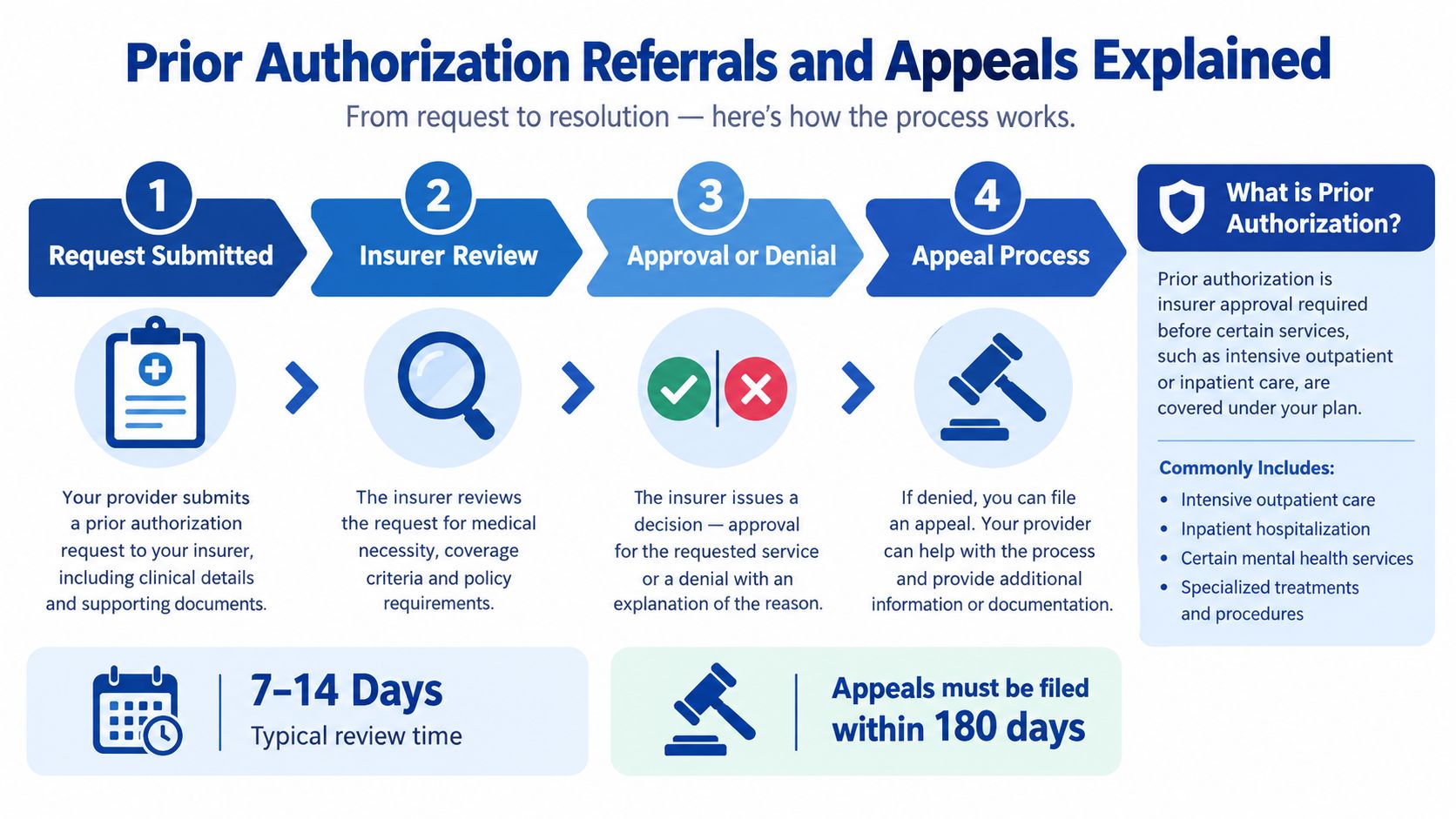
Prior authorization is insurer approval required before some services or prescriptions will be paid under plan rules. In mental health, that may affect intensive outpatient programs, unusually frequent visits, or medications that sit behind formulary restrictions.
Step therapy is a related problem. The plan may want a patient to try one treatment before covering another. That's common in pharmacy benefits and especially relevant when medication management is part of care.
What to gather before calling the insurer
The fastest way to lose time is to call member services without documents in hand.
Patients should have:
- The denial letter: It states the reason the claim or medication was rejected.
- Clinical notes if available: Especially if the treating clinician documented medical necessity.
- Treatment history: Past medications, side effects, and prior therapy attempts.
- Plan documents: Summary of Benefits, formulary details, and any utilization-management language.
- Referral information if relevant: Some plans still use referral structures in narrow circumstances.
Keep a call log. Date, time, representative name, and reference number can matter later if the insurer changes its story.
How appeals usually move
The first stop is the insurer's internal review. If that fails, Pennsylvania patients may have access to external review pathways through the state insurance system, depending on the plan and denial type.
Parity still matters here. Mental health claims shouldn't be held to tougher medical-necessity logic just because the condition is psychiatric. Patients who want a cleaner intake before scheduling can also review IPA's insurance verification process, which is the kind of step that catches problems before the first bill lands.
Checking Benefits and Controlling Out-of-Pocket Costs
The cheapest online therapy visit is often the one that gets verified correctly before it happens. The most expensive mistake is assuming a polished website means in-network coverage.
What to ask on the insurance call
Patients should pull the Summary of Benefits first, then call the number on the insurance card. The point isn't to ask one broad question. The point is to pin down the actual cost path for virtual behavioral health.
| Question to Ask | Why It Matters |
|---|---|
| Is tele-mental health covered under this plan when delivered by an in-network provider? | Confirms that the service category is active under the patient's plan |
| Does the patient owe a copay or coinsurance for online therapy visits? | Distinguishes flat visit cost from percentage-based cost |
| Has the deductible been met? | High-deductible plans can make “covered” care still expensive upfront |
| Is there a different cost for out-of-network virtual behavioral health? | Out-of-network pricing can change the total dramatically |
| Are medication management visits billed differently from therapy visits? | Psychiatric follow-ups often process under different billing structures |
| Are prior authorization or referral requirements triggered for any mental health services? | Identifies barriers before the appointment is booked |
| Are there session limits or utilization review rules? | Prevents surprise denials later in treatment |
| Can written confirmation of benefits be sent through the member portal or email? | Creates a paper trail if the claim is later processed incorrectly |
The cost-control moves that actually help
Written confirmation matters. So does checking licensure. A clinician may be excellent and still be a bad financial fit if the plan treats that provider as out of network.
Patients can also reduce cost by using:
- HSA or FSA funds when eligible under their plan and account rules
- Sliding-scale practices if insurance doesn't work out
- Community mental health centers for lower-cost care pathways
- Pennsylvania's COMPASS portal when Medicaid eligibility may be an option
For people seeking psychiatric evaluation or medication management online, one option among others is Integrative Psychiatry of America, a Pennsylvania virtual practice offering psychiatric evaluations and medication management through secure telehealth. That kind of model can be useful for adults who need statewide access, but the same verification rules still apply. Network status, deductible exposure, and medication benefit rules need to be confirmed before assuming affordability.
One mistake that keeps costing patients money
Patients often compare only the session price and ignore the deductible math. That's shortsighted.
If a plan has a high deductible, the negotiated in-network rate may still be worth using because those payments count toward the deductible threshold. In other cases, a transparent cash-pay rate may be easier to manage. The right choice depends on the patient's plan design and expected use of medical care across the year.
Real-World Scenarios Pennsylvania Readers Often Face
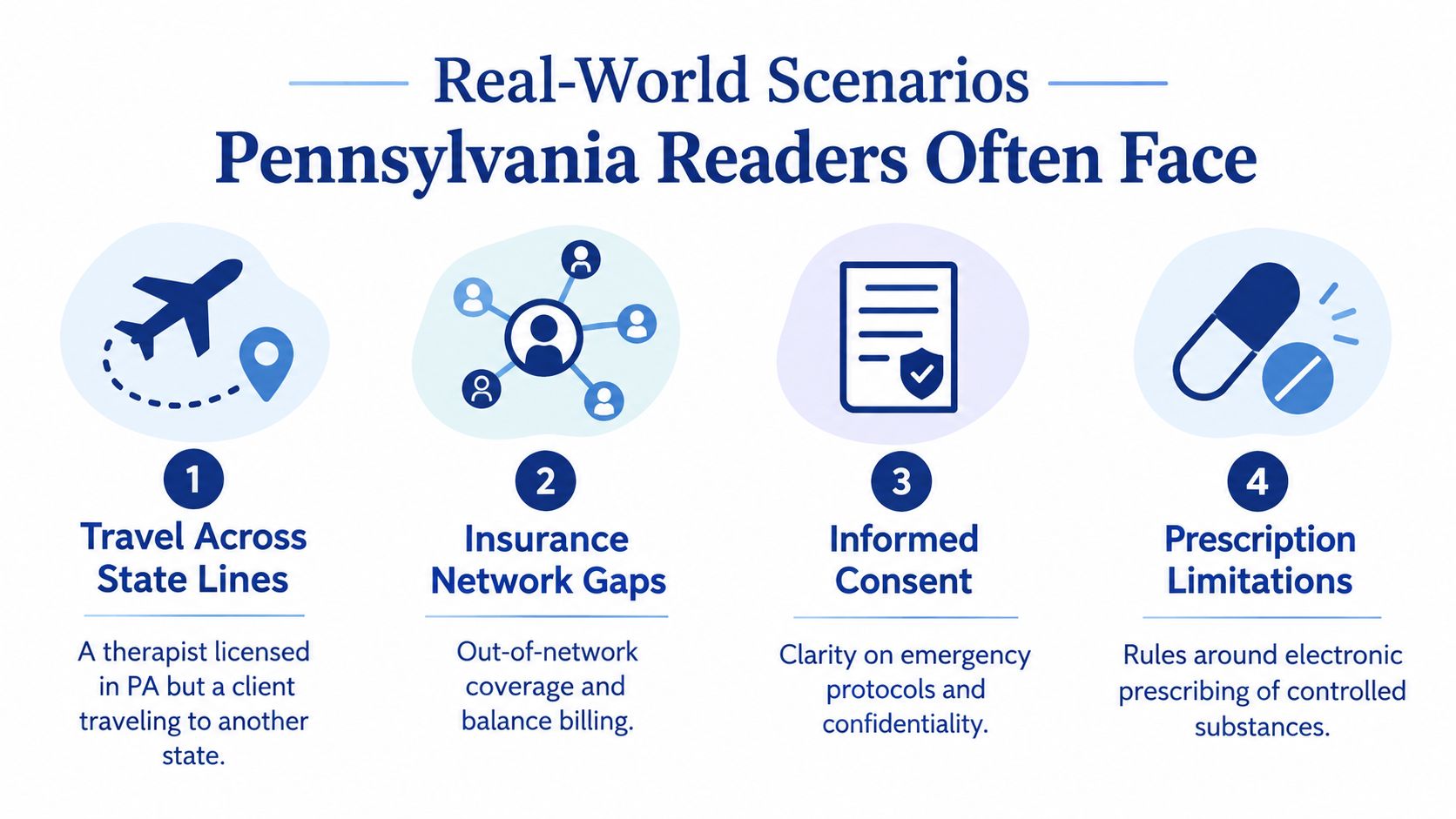
You book a Thursday video visit from your hotel in Ohio, assume it will count like any other session, and then learn five minutes before start time that your Pennsylvania clinician cannot legally proceed. That kind of problem is common. Online therapy works well in Pennsylvania, but only when the legal and insurance details match the reality of where you are, how the visit happens, and what kind of care you need.
Traveling outside Pennsylvania
For telehealth, your physical location at the time of the appointment matters. A lot.
If you are sitting in another state, your Pennsylvania therapist or psychiatric prescriber usually cannot just see you because you live in Pennsylvania. The clinician typically needs authority to practice where you are physically located that day. Patients get tripped up by weekend trips, college visits, work travel, and snowbird situations all the time.
Pennsylvania residents should treat this as a scheduling rule, not a technicality. Ask the office before you travel. If you expect frequent out-of-state visits, ask whether the clinician has any lawful cross-state pathway available. Pennsylvania is expected to broaden some cross-state counseling options as compact participation develops, but patients should not assume that change fixes every profession or every appointment type. The practical place to check the broader rule set is the cross-state licensing overview.
Audio-only and denied claims
A phone call is not automatically the same thing as a covered telehealth visit.
Pennsylvania allows audio-only use in some behavioral health settings, and that matters for patients with weak internet, no private video setup, or unreliable devices. Commercial insurers still often pay more predictably for live video. Medicaid and managed care rules may be more flexible in some cases, but patients should verify that before the appointment starts.
The takeaway is simple. If you think you may need to switch from video to phone, tell the practice ahead of time and ask how they bill it. Earlier Pennsylvania telehealth reporting found that virtual care helped many patients avoid travel, transportation problems, work disruption, and caregiving conflicts. It also showed that internet and device limits remained a barrier for some households. Those two facts can both be true.
If a claim is denied for a visit that should have been covered, do not stop at the first denial notice. Ask for the denial reason in writing, appeal it, and file a complaint with the Pennsylvania Insurance Department if the explanation does not match your plan documents.
Prescription continuity and network changes
Medication visits carry more operational risk than therapy-only care. Refills have deadlines. Pharmacies reject claims in real time. Controlled-substance prescribing adds another layer of scrutiny.
Do not wait until you have two pills left to find out your prescriber left the network, changed credentialing status, or cannot send a refill because you are out of state. Ask early how refill timing works, what follow-up interval is expected, and what happens if your regular clinician is unavailable. This matters even more for stimulant treatment, benzodiazepines, and other medications that tend to trigger tighter refill rules.
Network changes cause a different kind of mess. A clinician can remain clinically appropriate for you and still become financially unrealistic overnight. If that happens, ask three direct questions right away: Can you continue for a short transition period, is any single-case agreement available, and what records transfer will be needed if you switch? Patients who ask those questions early usually avoid the worst surprise, which is getting a large out-of-network bill after assuming nothing had changed.
Your Practical Next Steps
Patients who want care this week don't need more theory. They need a short sequence that avoids avoidable mistakes.
The fastest clean start
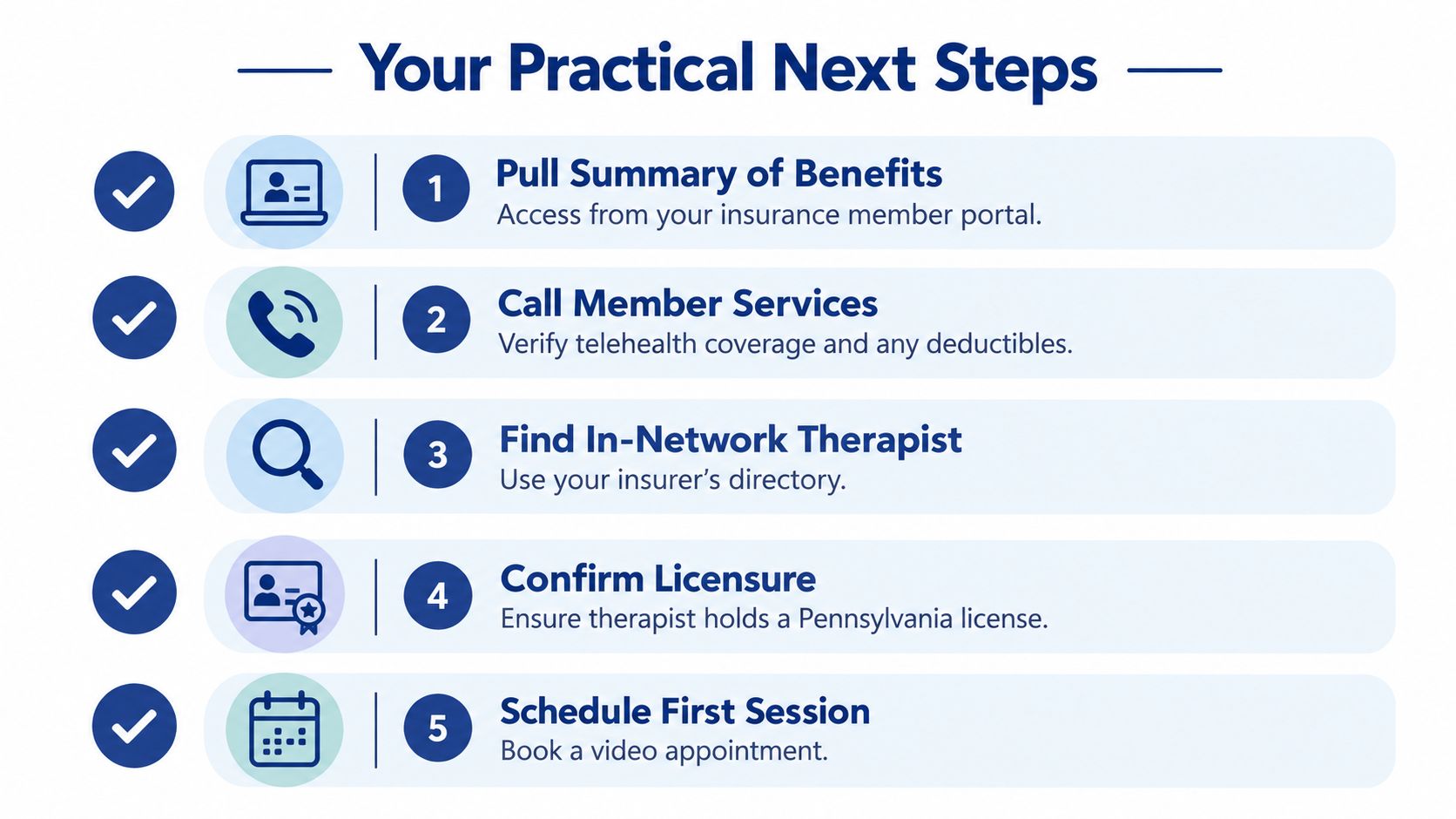
Start with the insurance portal. Pull the Summary of Benefits and save it.
Then call member services and confirm:
- Plan type and network rules
- Expected copay versus coinsurance
- Current deductible status
- Whether tele-mental health is covered with an in-network Pennsylvania provider
- Whether medication management is billed or reviewed differently from therapy
What to confirm before scheduling
Patients should confirm that the clinician holds an active Pennsylvania license and that the plan credentials that provider as in network if insurance use matters. This is especially important for adults seeking ADHD evaluation or medication management, because prescriber visits often trigger separate questions about pharmacy coverage, prior review, or refill logistics.
Book an initial evaluation first. Don't jump straight into assuming weekly sessions or ongoing medication follow-ups until the diagnostic picture is clear.
A first psychiatric assessment typically lasts 45 to 60 minutes, and patients should have medication lists, insurance details, ID, and a private setting ready. If the platform or clinical fit feels off, switching is allowed. It's better to change early than to force a poor setup for months.
For scheduling questions or next-step logistics, patients can use IPA's contact page.
Good records save time later. Patients should keep notes from every insurance call, every portal message, and every denial notice.
Integrative Psychiatry of America provides virtual psychiatric evaluations and medication management for adults across Pennsylvania, including care for ADHD, anxiety, depression, OCD, PTSD, and related concerns through secure telehealth. For readers who want a Pennsylvania-based option after working through the insurance and telehealth steps above, Integrative Psychiatry of America offers an appointment pathway built around online care rather than treating telehealth like an afterthought.