
An online ADHD quiz can be a useful starting point, but it isn't adult ADHD testing. A high score may explain why someone is struggling with focus, organization, or follow-through. It can't establish childhood onset, impairment across settings, or whether anxiety, depression, trauma, poor sleep, substance use, medication effects, or a medical condition better explains the symptoms.
A credible evaluation is a structured clinical process. In Pennsylvania, adults seeking a virtual assessment should expect a review of developmental history, current functioning, psychiatric and medical factors, validated assessment tools, and diagnostic feedback. Integrative Psychiatry of America uses a ADHD Diagnostic Evaluation, or CADE, approach when clinically appropriate, with access to a PhD psychologist when additional psychological testing is indicated.
Table of Contents
- Why a Positive Quiz Is Not the Same as Adult ADHD Testing
- What a Credible Adult ADHD Evaluation Actually Covers
- Screening Tools and Structured Interviews Compared
- Inside the CADE Evaluation Workflow
- Differential Diagnosis and the Role of the PhD Psychologist
- Preparing for a Telehealth ADHD Evaluation in Pennsylvania
- From Results to Next Steps and Treatment Planning
Why a Positive Quiz Is Not the Same as Adult ADHD Testing
A positive online quiz is a reason to ask better clinical questions, not a diagnosis. Treating the score as conclusive confuses screening with diagnosis and can attach an ADHD label to symptoms caused by something else.
Brief self-report tools ask about forgetfulness, distractibility, restlessness, and difficulty finishing tasks. Those experiences matter, but they also occur with anxiety, depression, trauma, inadequate sleep, substance use, medication effects, and medical conditions. A quiz rarely establishes when the pattern began, whether it was present in childhood, or whether it causes meaningful impairment in more than one setting.
The false-positive problem is substantial. In independent population samples, one brief adult ADHD screener indicated probable ADHD in 26.0% of a United Kingdom sample and 17.3% of a United States sample, compared with an expected prevalence of 2.5% in the study context, as reported in this adult ADHD screening study. The ASRS-v1.1 showed 60% sensitivity, 68.6% specificity, a 21.4% positive predictive value, and a 92.3% negative predictive value for full-syndrome DSM-IV adult ADHD. Those results support using the tool to help rule out the condition, rather than treating a positive result as confirmation.
Practical rule: A positive screener should open a diagnostic conversation, not close one.
What a responsible evaluation adds
A clinician examines the pattern behind the score. That means asking about symptom frequency and duration, developmental history, work or school functioning, relationships, household responsibilities, and psychiatric or medical conditions that could affect attention. The goal is a structured clinical evaluation, such as a ADHD Diagnostic Evaluation, or CADE, rather than a single questionnaire.
The Centers for Disease Control and Prevention reported that in 2023, an estimated 15.5 million U.S. adults, or 6.0% of the adult population, reported a current ADHD diagnosis, and roughly half reported receiving their first diagnosis at age 18 or older. The CDC adult ADHD report places adult assessment within routine clinical care, while also underscoring why a careful diagnostic process matters.
A rapid telehealth visit based only on a questionnaire may be convenient, but it leaves less room to test competing explanations and clarify impairment. A responsible assessment asks whether ADHD is present, whether another condition better accounts for the attention problem, or whether both require treatment. Patients can review ADHD testing versus evaluation to understand that distinction before scheduling care.
What a Credible Adult ADHD Evaluation Actually Covers
A credible adult ADHD evaluation is a structured clinical evaluation, not a questionnaire with a diagnostic label attached. It examines symptoms, developmental history, functional impairment, and competing explanations. For adults age 17 or older, DSM-5 criteria require at least five symptoms of inattention and/or hyperactivity-impulsivity, present for at least six months, with impairment in multiple settings and evidence that several symptoms were present before age 12, as outlined in this VA adult ADHD diagnostic guide.
The threshold matters because adults may recognize difficulties only after work, parenting, college, or relationship demands exceed their coping strategies. Current disorganization can be described accurately while the clinician still needs to determine whether it reflects a neurodevelopmental condition with earlier onset.
The clinical interview
The provider typically explores:
- Current symptoms: Attention, impulsivity, restlessness, task completion, time management, forgetfulness, and emotional or behavioral patterns affecting daily life.
- Childhood history: Report cards, school comments, family observations, academic struggles, behavioral concerns, and longstanding organizational difficulties.
- Functional impairment: Work performance, relationships, finances, driving, household tasks, medication adherence, and other responsibilities.
- Medical and medication history: Conditions, medications, substances, sleep concerns, and physical symptoms that may affect attention or energy.
- Psychiatric history: Anxiety, depression, trauma-related symptoms, mood episodes, substance use, prior treatment, and family psychiatric history.
- Mental-status examination: Mood, thought process, behavior, speech, cognition, insight, judgment, and safety concerns during the visit.
A symptom checklist supplies organized information, but it does not establish the diagnosis by itself. In routine adult practice, family physicians are advised that assessment commonly requires at least two visits to evaluate persistence, childhood onset, and alternative explanations.
The same principle applies to cognitive assessment: a single score should not represent a person's entire ability or functioning. It also informs efforts to reduce hiring bias with cognitive assessments.
What a thorough evaluation should mean
The term should describe the work performed, not just the service title. A thorough evaluation connects symptoms to real-life impairment, checks whether the pattern appears across settings, and considers collateral information when available.
Some adults have school records or a parent who can describe childhood behavior. Others were high-achieving, heavily supported, or skilled at masking difficulties. Missing records do not automatically rule out ADHD, but the clinician must weigh the available evidence and explain its limits. Adults can learn more about specialized assessment through Integrative Psychiatry of America's page on psychological testing for ADHD.
Screening Tools and Structured Interviews Compared
Brief screeners and structured interviews serve different purposes. A screener helps identify adults who may need a full assessment. A structured interview requires the clinician to examine each diagnostic criterion, ask for examples, establish developmental timing, and test competing explanations.
Validated tools may include the ASRS-v1.1, Adult ADHD Self-Report Scale, and Conners Adult ADHD Rating Scales. Structured interviews may include DIVA-5, ACE+, and MINI, depending on the clinician's training and the clinical question. The tool matters, but interpretation matters more.
The evidence supports a combined approach. One adult validation study found that the DIVA interview alone showed 90.0% sensitivity and 72.9% specificity. When continuous performance test variables were added, specificity increased to 83.3% while sensitivity remained 90.0%, as reported in this validation study of adult ADHD assessment methods. A 2021 review found that clinical interviews and behavior rating scales generally had adequate sensitivity but poor specificity, while cognitive test batteries alone had inadequate sensitivity and specificity.
Screening tool versus structured diagnostic interview
| Attribute | Brief Screener, such as ASRS-v1.1 | Structured Interview, such as DIVA-5 or ACE+ |
|---|---|---|
| Primary purpose | Triage and initial symptom identification | Diagnostic assessment |
| Main strength | Quick, accessible, and standardized | Probes criteria, history, context, and impairment |
| Main limitation | Can overestimate ADHD when used alone | Requires more clinician time and preparation |
| Childhood evidence | Usually limited or indirect | Explored directly through developmental questions |
| Alternative explanations | May not examine them adequately | Evaluated as part of the clinical formulation |
| Diagnostic role | One input among several | A central part of diagnostic reasoning |
The Adult ADHD Symptom Checker can help an adult organize concerns before an appointment. It shouldn't be used as proof that ADHD is present or absent.
CADE serves as the integration point. Validated questionnaires, interview findings, collateral information, impairment evidence, and clinical judgment come together in one formulation. That approach is more defensible than assigning a diagnosis from a cutoff score.
Inside the CADE Evaluation Workflow
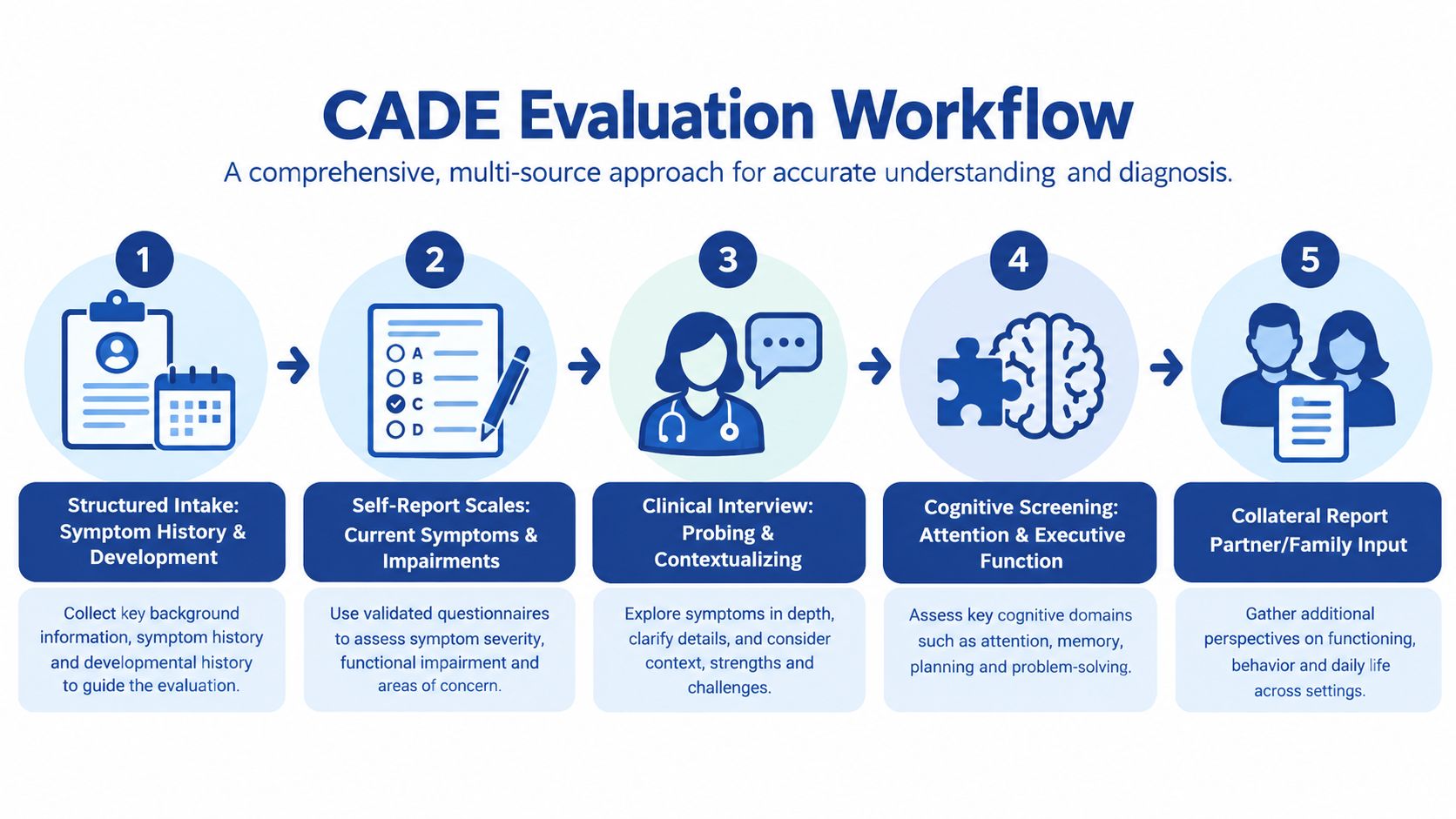
CADE, or ADHD Diagnostic Evaluation, is best understood as a connected clinical journey. The process begins with online intake and collection of medical, psychiatric, developmental, and symptom history. Early details help the provider understand what the adult is experiencing now and what the pattern may have looked like during childhood.
The clinical team then maps impairment across work, relationships, household responsibilities, and other settings. A family member, partner, or another person who knows the adult well may provide collateral information when clinically appropriate and available. Collateral history doesn't replace the patient's account. It can confirm patterns the patient has normalized, forgotten, or learned to compensate for.
How the information is connected
Validated rating scales provide structured information about current symptoms and impairment. The provider interprets those results alongside a semi-structured interview that probes DSM-based criteria in adult-specific terms. Adult ADHD may appear as missed deadlines, inconsistent performance, chronic task avoidance, internal restlessness, time blindness, impulsive decisions, or exhaustion from compensatory strategies. Childhood examples still matter, but the interview shouldn't rely on childhood behavior descriptions alone.
Cognitive screening or targeted testing may be considered when the clinical question calls for it. Such testing can offer additional information about attention and executive functioning, but it doesn't independently establish ADHD. Research on adult assessment supports a stepwise model, beginning with a DSM-based interview and developmental history, then adding collateral data, impairment review, and targeted validity testing when needed.
CADE integrates:
- Self-report: The adult's description of symptoms, history, coping strategies, and current difficulties.
- Observer report: Information from a partner, family member, or another appropriate collateral source.
- Clinician judgment: Interpretation of the entire pattern, including duration, impairment, context, comorbidities, and alternative explanations.
- Feedback: A transparent discussion of what the evidence supports, what remains uncertain, and what treatment options may fit.
The final step is diagnostic feedback. The provider reviews the findings, explains why ADHD is supported or not supported, discusses coexisting conditions, and identifies reasonable next steps. A result that doesn't confirm ADHD can still clarify why attention or executive-function problems are occurring.
Differential Diagnosis and the Role of the PhD Psychologist
Differential diagnosis is often the hardest part of adult ADHD testing. Attention problems are common across anxiety, depression, trauma-related conditions, sleep disorders, substance use, medication effects, medical conditions, and mood disorders. A screener can identify overlapping symptoms without distinguishing their cause.
The provider looks at pattern, chronicity, context, and impairment. Anxiety may produce distractibility through worry and mental preoccupation. Depression may reduce concentration, motivation, processing speed, and task initiation. Sleep disruption can affect attention and energy. Trauma can produce hypervigilance, avoidance, and memory difficulties. Bipolar-spectrum illness can involve episodic changes in energy, activity, impulsivity, and concentration, rather than a stable lifelong pattern.
Conditions that can resemble ADHD
| Condition | Overlap with ADHD | Key distinguishing features |
|---|---|---|
| Anxiety | Distractibility, restlessness, poor concentration | Worry, fear, physical tension, or attention disruption linked to anxious thoughts |
| Depression | Low motivation, forgetfulness, slowed task completion | Persistent low mood, loss of interest, hopelessness, or a change from prior functioning |
| Sleep disorder | Fatigue, forgetfulness, reduced attention | Symptoms tied to poor sleep, disrupted breathing, unusual sleepiness, or an unstable sleep schedule |
| Trauma-related condition | Hypervigilance, avoidance, concentration problems | Symptoms connected to traumatic experiences, triggers, threat perception, or re-experiencing |
| Substance use | Impulsivity, inconsistent functioning, attention changes | Timing related to substance use, withdrawal, intoxication, or recovery |
| Bipolar-spectrum illness | Impulsivity, restlessness, distractibility | Distinct episodes involving mood, energy, sleep need, activity, or judgment changes |
A PhD psychologist can add distinct expertise when the presentation is complicated, records are limited, learning concerns are present, or targeted cognitive or neuropsychological testing may answer a specific question. Testing can help clarify an executive-function profile or identify a cognitive strength that has masked underachievement. It can also consume time and resources without changing the clinical conclusion.
A 2026 Frontiers article on adult ADHD assessment notes that current frameworks may under-capture experiences such as mind-wandering, internal restlessness, time blindness, sensory over-responsivity, masking, compensatory strategies, effort, and mental fatigue. The article also discusses the lack of widely adopted U.S. adult ADHD diagnostic guidelines and reports that experts may view neuropsychological testing as unnecessary or a barrier in many cases.
IPA provides access to a PhD psychologist when additional psychological testing is clinically appropriate. Readers can review the practice's welcome for psychologist Lori Simons to understand that this role complements psychiatric evaluation rather than replacing it.
Preparing for a Telehealth ADHD Evaluation in Pennsylvania
A telehealth-first ADHD evaluation works best when the adult arrives with useful records and realistic expectations. Virtual care can make access easier across Pennsylvania, including Philadelphia, Bucks County, the Lehigh Valley, Harrisburg, Lancaster, Pittsburgh, and other communities, but the clinical work still depends on privacy, preparation, and honest discussion.
Information to gather before the visit
- School information: Report cards, teacher comments, individualized education records, or other childhood documentation, if obtainable.
- Collateral contact: A parent, partner, sibling, or another person who can describe longstanding patterns, if the provider requests it.
- Medication list: Current prescriptions, over-the-counter products, supplements, caffeine use, and prior psychiatric medications.
- Treatment history: Previous diagnoses, therapy, hospitalizations, substance-use treatment, and responses or side effects.
- Functional examples: Missed deadlines, unfinished projects, relationship conflicts, financial disorganization, driving concerns, or household tasks that show how symptoms affect daily life.
- Telehealth setting: A quiet, private space, a charged device, and stable internet for the video visit.
Pennsylvania patients should also understand that telehealth prescribing depends on clinical judgment, licensure requirements, medication rules, and federal regulations. Controlled-substance prescribing through telehealth isn't automatically available in every circumstance, and the applicable DEA rules can change. A provider must decide whether a medication is clinically appropriate and legally permissible for the individual situation.
Insurance verification requires specificity. The member services number on the insurance card can clarify whether the plan covers an outpatient psychiatric diagnostic evaluation, telehealth services, follow-up care, and any authorization requirements. Benefits, copays, deductibles, network status, and authorization rules vary by plan, including plans associated with Cigna, Aetna, UnitedHealthcare, and BCBS or IBX.
The telehealth ADHD evaluation page can help prospective patients understand the virtual pathway. Intake paperwork may be requested before the first appointment, and feedback may occur after the provider has reviewed the complete clinical picture.
From Results to Next Steps and Treatment Planning
An ADHD evaluation should end with a connected plan, not a label alone. During the feedback visit, the provider reviews the evidence, explains whether diagnostic criteria are met, identifies coexisting conditions, and discusses why particular recommendations fit the adult's needs.
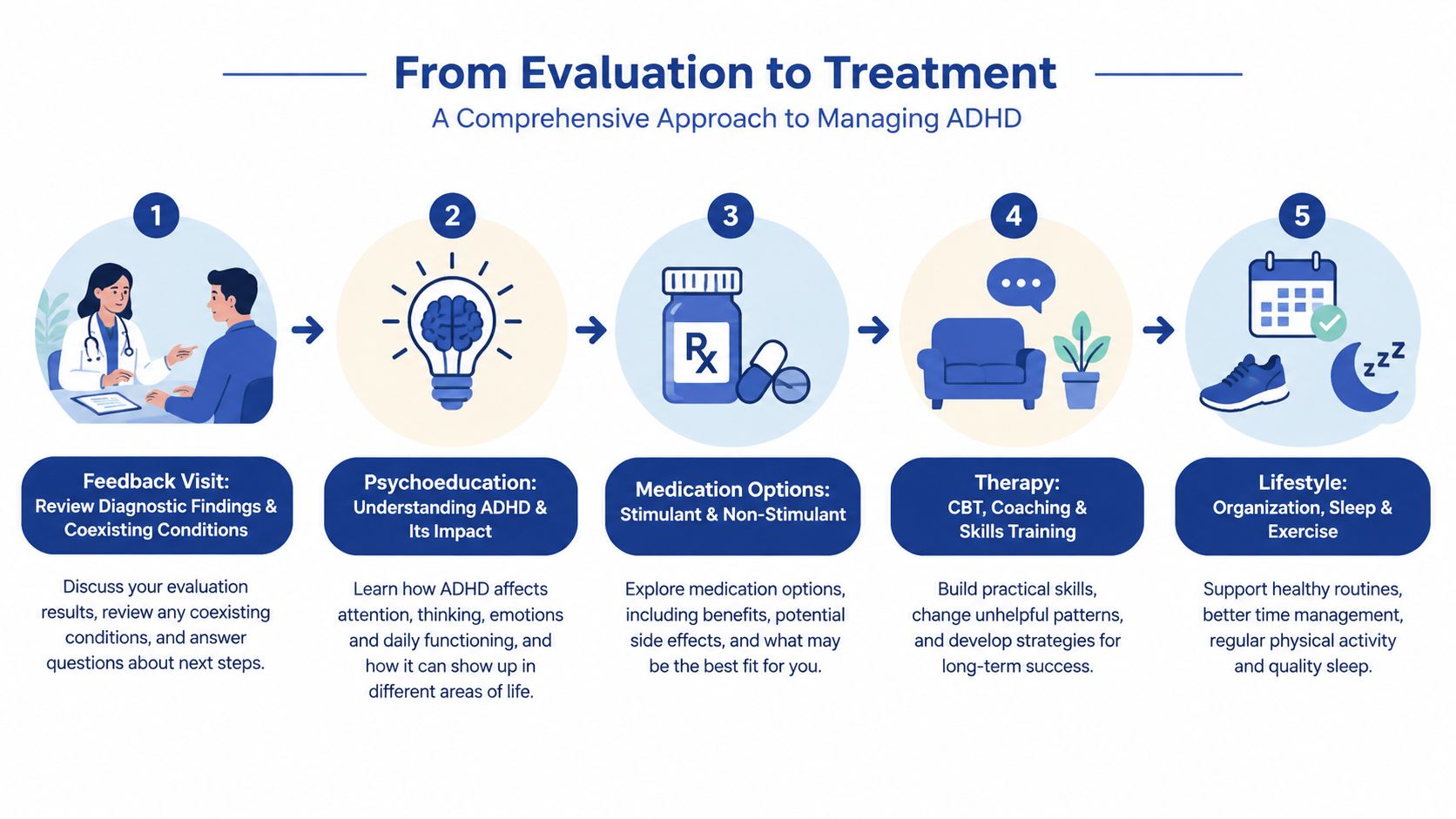
Treatment may include medication, psychotherapy, ADHD-focused coaching, skills training, workplace or academic accommodations, sleep intervention, or care for anxiety and depression. Medication isn't mandatory, and an evaluation doesn't guarantee eligibility for accommodations. The plan should focus first on the problems causing the greatest daily impairment.
What follow-up should address
Follow-up care may review symptom response, side effects, sleep, appetite, mood, blood pressure or other clinically relevant factors, and the person's ability to function. Guidance for adult ADHD medication management recommends starting stimulants conservatively, monitoring early response, and adjusting according to effectiveness and tolerability. One clinical source recommends follow-up within about one week after starting stimulants, while non-stimulants may take up to four weeks to show a response, as described by CAMH pharmacotherapy guidance. A separate review notes that each dosing change often requires a four- to six-week trial, so medication decisions should be monitored rather than rushed.
A practical next step is to schedule treatment follow-up, gather school or work records, and request a written summary if it would help with ongoing care. Integrative Psychiatry of America provides virtual psychiatric evaluations across Pennsylvania, including CADE-based adult ADHD assessment, validated tools, psychiatric treatment planning, and access to a PhD psychologist when additional testing is appropriate. Adults seeking a careful evaluation can visit Integrative Psychiatry of America to review the appointment pathway, request an evaluation, or begin insurance verification.