
A Pennsylvania adult may spend months compensating for missed deadlines, unfinished tasks, forgetfulness, or mental exhaustion before considering ADHD care. A parent may recognize similar patterns in a child and then hesitate, expecting insurance questions, referral requirements, and online appointments to create another administrative burden. Those concerns are understandable, but online ADHD treatment with insurance can follow a clear, manageable process.
Telehealth has become a familiar route to ADHD care. A 2024 peer-reviewed study found that 46.0% of adults with ADHD reported ever receiving telehealth services for the condition, as summarized in this review of insurance coverage for ADHD telehealth. Virtual care can be especially practical for follow-up medication management and behavioral support, when a patient needs continuity rather than another long trip across Pennsylvania.
The process usually begins with benefit verification, continues through intake and a thorough evaluation, and then moves into individualized treatment and follow-up. Pennsylvania residents can review the ADHD evaluation process while deciding whether virtual care fits their needs.
Table of Contents
- Starting Your Journey to ADHD Treatment in Pennsylvania
- How Insurance Covers Telehealth for ADHD in Pennsylvania
- Your Step-by-Step Guide to Getting Started
- What an Integrative ADHD Treatment Plan Involves
- Navigating Common Insurance Hurdles Together
- Take the Next Step Toward ADHD Care in Pennsylvania
Starting Your Journey to ADHD Treatment in Pennsylvania
A prospective patient often reaches out after a familiar sequence. Work tasks take longer than expected, household organization feels unmanageable, or a child's school concerns persist despite effort and support. The person may want an ADHD evaluation but worry that an insurance card won't answer the questions: Is telehealth covered? Is the provider in-network? Will medication be included?
Those questions deserve specific answers. Insurance coverage depends on the plan, the provider's network status, the type of service, and the pharmacy benefit. Virtual treatment can reduce travel and scheduling barriers, but it doesn't remove the need to confirm those details before care begins.
Practical rule: Coverage for the appointment and coverage for medication are separate questions.
Telehealth is no longer an unusual access channel for ADHD care. The 2024 study cited above found that 46.0% of adults with ADHD had ever used telehealth for their condition by the post-pandemic period, which supports the role of virtual visits in routine outpatient care. The finding doesn't guarantee that any particular Pennsylvania plan will cover a specific appointment, but it does show why patients increasingly encounter virtual behavioral-health claims in ordinary insurance systems.
A qualified Pennsylvania psychiatric provider should also look beyond attention problems alone. Anxiety, depression, sleep difficulties, trauma symptoms, substance use, learning differences, and medical conditions can overlap with or resemble ADHD. A responsible evaluation distinguishes screening from diagnosis and uses clinical history, functional impairment, interviews, and validated tools rather than relying on a questionnaire alone.
For adults and parents ready to move forward, the most useful first step is simple: gather the insurance card, confirm the patient's Pennsylvania residence, and ask how the practice handles eligibility, evaluation, treatment, and follow-up. The administrative path becomes less intimidating when each decision is handled separately.
How Insurance Covers Telehealth for ADHD in Pennsylvania
Yes, Pennsylvania insurance may cover online ADHD evaluation and treatment, but coverage isn't automatic. The plan must be reviewed for eligibility, benefits, network participation, medical necessity, and any authorization requirements.
Pennsylvania's Act 42 requires certain commercial health insurance policies to cover medically necessary services delivered through telemedicine when the provider is in-network, the service meets the insurer's medical policies and standard of care, and the technology is HIPAA compliant, according to the Pennsylvania telemedicine frequently asked questions. The law applies to certain group plans issued or renewed on or after March 31, 2025, with broader application beginning in January 2026 for other group plans and individual policies.
That framework supports access, but it doesn't turn every telehealth claim into an approved claim. A plan can still limit benefits by network, deductible, coinsurance, referral rules, authorization requirements, or billing category. An in-network provider generally offers a clearer coverage path than an out-of-network provider, but the patient's specific policy remains the controlling document.

What Pennsylvania parity rules mean
The Pennsylvania Insurance Department explains that mental health and substance use disorder coverage must comply with parity rules, meaning insurers must provide the same level of coverage for mental health and substance-use treatment as for medical and surgical services, as described in its mental health parity guidance. Parity supports fair treatment of behavioral-health benefits, but it doesn't eliminate network restrictions or prior authorization.
Medicare also provides an important federal pathway. Medicare states that it covers telehealth services from anywhere in the United States, including the patient's home, through December 31, 2027, according to this ADHD telehealth insurance policy overview. Commercial plans still vary, and Medicare eligibility rules apply, but the policy confirms that home-based virtual behavioral-health care has an established reimbursement route.
Patients should ask the insurer whether the plan covers a telehealth psychiatric evaluation, medication-management visits, and behavioral-health services. The insurer can also clarify whether a referral, deductible, copay, coinsurance, or prior authorization applies.
Your Step-by-Step Guide to Getting Started
A new Pennsylvania patient generally moves through four practical stages. Each stage answers a different question, so completing them in order helps prevent avoidable billing surprises.
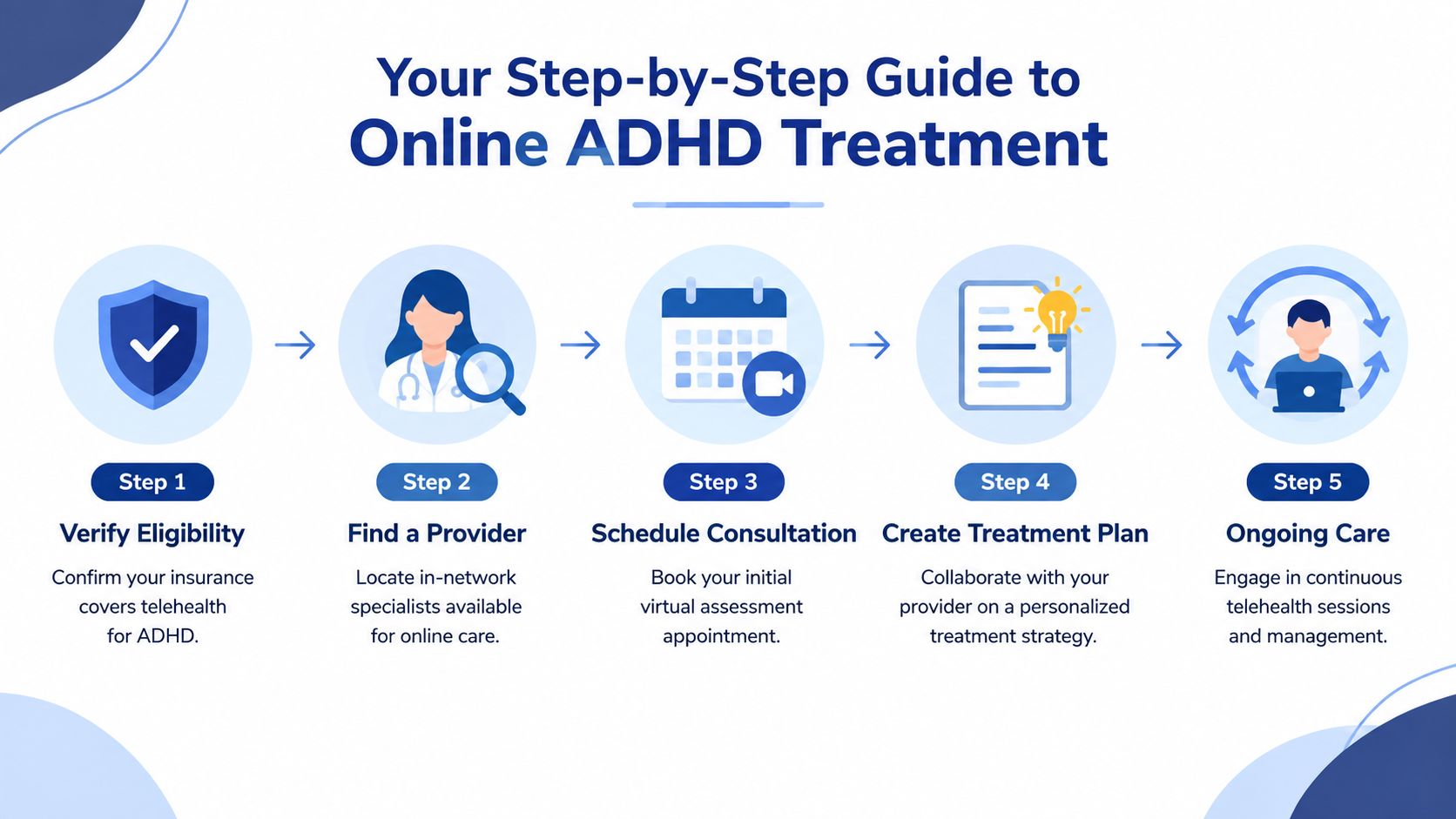
First, request an appointment and provide insurance information
The patient requests or schedules an appointment and provides demographic and insurance details. The practice needs accurate information from the insurance card, including the member name, identification number, group information when applicable, and the patient's Pennsylvania location.
The patient should also identify the main reason for seeking care. An adult may request an ADHD evaluation, while a parent may ask about child or adolescent ADHD treatment. Existing diagnoses, current medications, previous evaluations, and urgent safety concerns should be disclosed during intake.
Next, separate eligibility from benefits
IPA verifies eligibility and benefits when applicable and determines whether the provider participates with the plan. Patients should still confirm details with the insurer because eligibility information can change, and the insurer makes the final coverage determination.
Useful questions include:
- Telehealth coverage: Does the plan cover an online psychiatric evaluation for ADHD?
- Network status: Is the specific provider participating with the patient's exact plan?
- Patient responsibility: Will the visit apply to a deductible, copay, or coinsurance?
- Authorization: Does the evaluation, medication-management service, or prescribed medication require prior authorization?
- Pharmacy benefits: Which stimulants and nonstimulants are on the plan's formulary?
The practice's insurance verification process can help patients understand what information is needed before the appointment.
Then, complete the intake paperwork
The intake usually asks about attention symptoms, organization, impulsivity, emotional regulation, sleep, medical history, psychiatric history, medications, substance use, family history, and day-to-day functioning. Parents may need to provide developmental, school, and behavioral information for a child or adolescent.
Completing forms carefully gives the provider a more useful starting point. A screening form can identify symptoms that warrant further assessment, but it doesn't establish an ADHD diagnosis by itself.
Finally, attend the comprehensive evaluation
The psychiatric provider reviews the patient's history, symptoms, impairment, risks, and possible alternative explanations. When appropriate, IPA's CADE approach can incorporate structured ADHD assessment, clinical history, functional impairment, differential diagnosis, and validated tools.
The evaluation may support an ADHD diagnosis, suggest another explanation, identify co-occurring conditions, or show that additional psychological assessment would be useful. Patients can learn more about the virtual process through telehealth ADHD evaluation.
The following video offers general context about online ADHD care. It doesn't replace an individualized evaluation.
What an Integrative ADHD Treatment Plan Involves
A treatment plan after evaluation depends on the diagnosis, symptoms, medical history, risks, preferences, and functional goals. Insurance status shouldn't determine the clinical recommendation. It may affect which services, medications, or authorization pathways are financially available.
Medication management requires two insurance checks
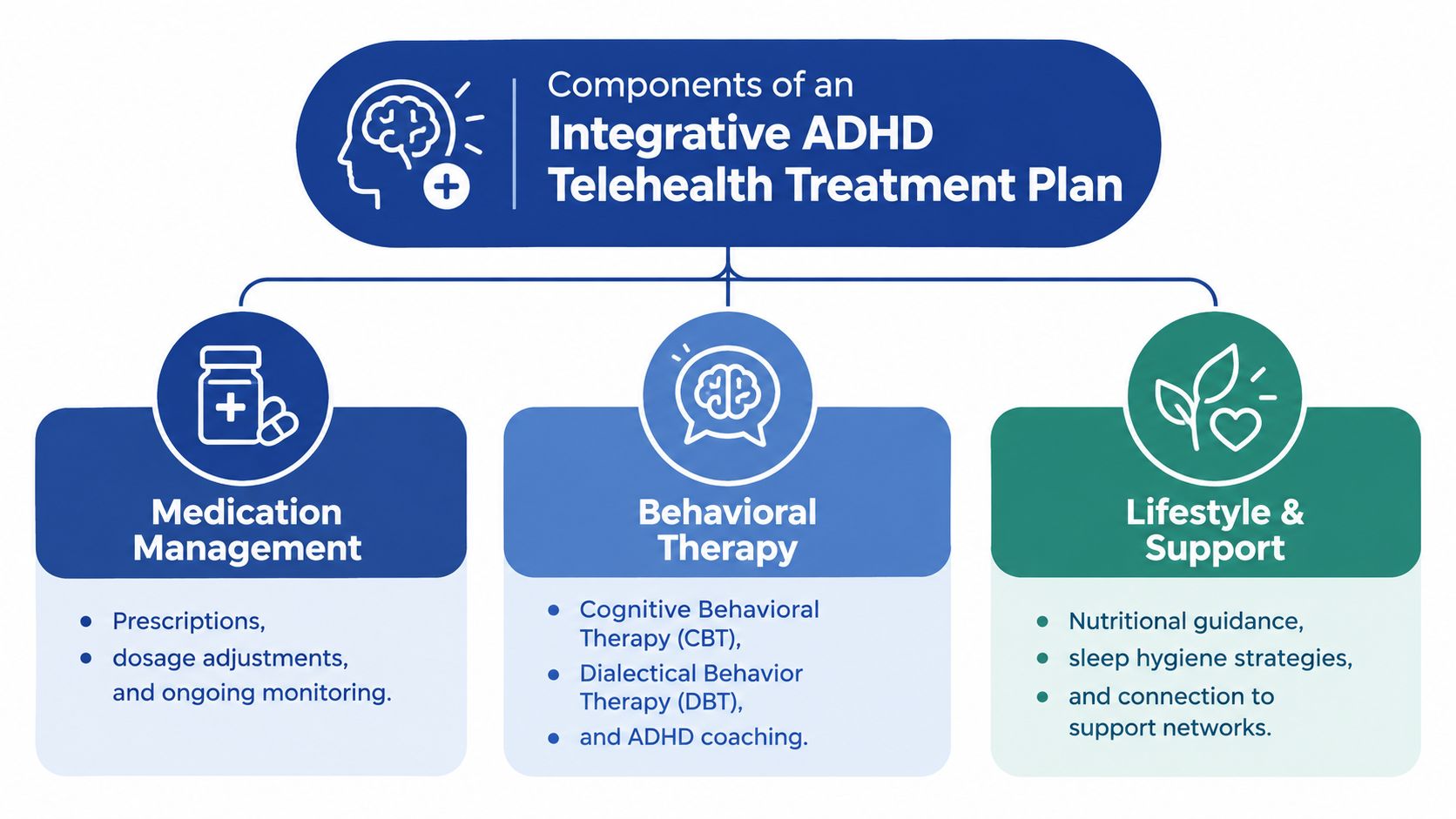
Medication management can include a stimulant, a nonstimulant, dose adjustments, monitoring, and discussion of side effects or treatment response. The appointment falls under the health plan's behavioral-health or medical benefit, while the prescription generally falls under the pharmacy benefit.
That distinction matters. A plan may cover the psychiatric visit but require prior authorization for a particular stimulant or nonstimulant. The formulary may also favor one medication over another, or apply a different deductible and coinsurance structure. The provider can submit clinically required documentation and discuss appropriate alternatives, but the insurer determines whether it approves the request.
Federal flexibility for controlled-medication prescribing, including ADHD stimulants, has been extended through December 31, 2026, under temporary rules. Those rules allow appropriately licensed and DEA-registered clinicians to prescribe medications such as Adderall and Vyvanse through audio-video telehealth without a prior in-person evaluation, as explained in this 2026 guide to ADHD medications and telehealth. Prescribing remains subject to clinical judgment, federal requirements, Pennsylvania law, and the provider's policies.
Behavioral strategies support daily functioning
Medication isn't the only treatment option. Behavioral strategies can target planning, task initiation, time awareness, emotional regulation, sleep routines, and environmental supports. Psychotherapy, ADHD coaching, skills training, or additional psychological assessment may be appropriate depending on the patient's needs and available providers.
A patient considering nonprescription approaches should discuss them with a clinician, especially when supplements could interact with medication or affect sleep, blood pressure, anxiety, or other health conditions. For general educational background, Maximum Health Products' guide to nootropics for ADHD can be read as a supplement-focused resource, not as a substitute for diagnosis or treatment planning.
Lifestyle care fills in the practical details
An integrative plan may include nutritional education, exercise counseling, sleep-hygiene strategies, mindfulness, meditation, lab screening when clinically indicated, and connections to psychotherapy or support networks. These elements don't “cure” ADHD, but they can address factors that influence concentration, energy, mood, and treatment tolerability.
Patients seeking whole-person care can review integrative psychiatry services to understand how medication management and lifestyle-focused support may fit together.
Navigating Common Insurance Hurdles Together
Insurance problems usually come from mismatched details rather than from telehealth alone. Eligibility may be active while a specific provider is out-of-network. A behavioral-health benefit may cover the visit while the pharmacy benefit requires authorization for the medication. A deductible may also apply before the plan begins sharing costs.
Benefits verification should separate three layers, as described in federal telehealth billing guidance:
- Visit coverage, whether the plan covers the online evaluation or follow-up.
- Clinician network participation, whether the specific provider is in-network for that plan.
- Pharmacy coverage, whether the prescribed stimulant or nonstimulant is covered and whether authorization applies.

Common terms in plain language
A deductible is the amount a patient may need to pay under the plan before the insurer begins sharing certain costs. A copay is a set charge for a covered service, while coinsurance is a percentage of the allowed amount. Out-of-network care may involve higher responsibility or limited reimbursement.
Prior authorization means the insurer wants clinical information before approving a medication or service. The provider may submit records, diagnostic findings, treatment history, and the rationale for the requested option. Approval isn't guaranteed, and the insurer controls the decision.
A plan can also contain pharmacy rules that patients won't see when booking a visit. The pharmacy may reject a prescription until the prescriber completes a required form, documents a previous medication trial, or uses a preferred alternative.
A hypothetical authorization example
Consider a patient whose plan covers psychiatric telehealth visits but requests prior authorization for a specific medication. The provider can continue appropriate clinical care while the authorization request is reviewed. If clinically suitable, the discussion may include a formulary alternative, a nonmedication strategy, or another treatment option.
This example is hypothetical, not a report about a particular patient. IPA can help verify benefits when appropriate, provide required clinical documentation, and address authorization requests, but it can't guarantee approval or control the insurer's timeline.
Pennsylvania patients with Cigna can review Cigna ADHD treatment information and should still confirm the exact terms of their own plan. The same principle applies to Aetna, UnitedHealthcare, BCBS, IBX, Medicare, and other insurers. The company name alone doesn't determine the patient's benefits.
Take the Next Step Toward ADHD Care in Pennsylvania
Online ADHD treatment can make evaluation and follow-up more accessible for Pennsylvania adults, parents, and families. The strongest process combines a licensed Pennsylvania provider, a thorough assessment, transparent benefit verification, and a treatment plan that addresses symptoms and functioning rather than focusing on medication alone.
Patients should look for a provider who can evaluate ADHD alongside anxiety, depression, sleep problems, trauma, substance use, and other conditions. They should also confirm whether the provider serves their location, participates with their plan, offers secure telehealth, and provides ongoing medication management when clinically appropriate.
The financial questions deserve equal attention. Ask whether the evaluation and follow-up visits are covered, whether the provider is in-network, how deductibles and coinsurance apply, and whether medications require separate pharmacy authorization. A benefits check can reduce uncertainty, but only the insurer can make the final coverage determination.
The care pathway remains straightforward:
- Verify benefits: Confirm telehealth, network status, and patient responsibility.
- Complete intake: Provide accurate clinical and insurance information.
- Attend evaluation: Participate in a thorough ADHD assessment.
- Review treatment: Discuss medication, behavioral strategies, therapy, lifestyle support, and any further assessment.
- Maintain follow-up: Continue virtual care and address authorization or formulary issues as they arise.
Adults and families in Philadelphia, Bucks County, Pittsburgh, the Lehigh Valley, Harrisburg, Lancaster, Reading, Scranton, Wilkes-Barre, Erie, and other Pennsylvania communities can begin by requesting an appointment or checking coverage before scheduling.
Integrative Psychiatry of America provides secure virtual ADHD evaluation, treatment planning, medication management, and follow-up for eligible Pennsylvania patients, with insurance verification available when appropriate. Visit Integrative Psychiatry of America to review care options, verify insurance, or request an appointment.