
A positive ADHD quiz feels like an answer because it produces a score. It isn't one. ADHD testing and an ADHD evaluation are different clinical activities, and confusing them can lead someone to claim a diagnosis that hasn't been established, or to dismiss genuine impairment because a brief tool didn't capture the full picture.
The American Academy of Pediatrics describes ADHD assessment as an evaluation process that considers symptoms, functioning, development, and co-occurring conditions, rather than a standalone test. Its guidance applies to children and adolescents from age 4 through 18, while adult guidance similarly emphasizes interview, developmental history, impairment, corroborating information, and alternative explanations. (AAP guideline review)
For adults in Pennsylvania who are considering online ADHD treatment, the practical question isn't just, “Did the test say positive?” It's, “What does the result mean in this person's life, history, health, and current mental health?” The distinction becomes especially important when symptoms overlap with anxiety, depression, trauma, sleep disorders, learning difficulties, or medical problems.
Table of Contents
- Why ADHD Testing and Evaluation Feel the Same But Aren't
- What ADHD Testing and Screening Actually Measure
- What a Full ADHD Evaluation Includes
- Testing vs Evaluation Side by Side
- Why a High Screening Score Can Still Miss the Real Problem
- How IPA's CADE Evaluation Process Works
- Getting a Real Evaluation Through Telehealth in Pennsylvania
- Choosing the Right Next Step for Your Situation
Why ADHD Testing and Evaluation Feel the Same But Aren't
Many adults begin with a viral quiz, a friend's comment, a social media post, or a symptom checklist from a therapist. A checklist may describe the person accurately, which can feel validating. A qualified clinician, however, must answer a harder question: Do the symptoms represent ADHD, another condition, several conditions together, or a temporary response to stress or illness?
That's the central difference in ADHD Testing vs. Evaluation. Both can involve rating scales and structured questions, but they don't produce the same kind of conclusion. Testing usually estimates whether a symptom pattern deserves follow-up. Evaluation integrates that information with clinical evidence before reaching a diagnostic conclusion.
The distinction matters because attention problems have many possible causes. Someone with anxiety may reread emails, lose track of conversations, or avoid complex tasks because worry consumes mental bandwidth. Someone with depression may experience slowed thinking and poor motivation. Sleep disruption can impair concentration and memory without indicating ADHD. Readers comparing ADHD and anxiety need a clinical process that examines the overlap instead of treating a symptom checklist as proof.
A score is a signal, not a verdict
A screening result can be useful. It may help a person describe concerns more clearly, prompt a primary care conversation, or help a clinician decide whether a more detailed assessment makes sense. It can also identify symptoms that deserve attention even when the final diagnosis isn't ADHD.
It can't establish that ADHD began in childhood, demonstrate impairment across settings, or rule out another explanation. Adult diagnosis also has a historical challenge because retrospective memories of childhood symptoms can be incomplete or inaccurate, which makes checklists alone insufficient. (Review of adult ADHD diagnostic challenges)
Practical rule: A screening score answers, “Should someone look more closely?” A full evaluation answers, “How does the evidence fit together?”
The difference protects both sides of diagnosis. It reduces overdiagnosis when distress is coming from another source, while also reducing under-recognition when a person has learned to mask symptoms or compensate successfully at a high personal cost.
What ADHD Testing and Screening Actually Measure
ADHD screening is a structured estimate of symptom likelihood. It commonly uses self-report or observer questionnaires that ask about behaviors such as distractibility, forgetfulness, impulsivity, restlessness, task completion, and organization. The tool assigns responses to symptom thresholds or standardized score ranges.
Common instruments include the ASRS v1.1, Conners Adult ADHD Rating Scales, Brown ADD Scales, and Vanderbilt forms. The ASRS and other adult measures generally rely on the person's report, while Vanderbilt forms are often used with children and may include parent or teacher observations. Each tool captures a particular perspective. None can independently establish the diagnosis.
What a screener can do
A screening tool can:
- Flag a pattern: Repeated endorsements may suggest that ADHD symptoms deserve professional attention.
- Start a conversation: Results give a patient and clinician specific examples to discuss.
- Organize concerns: A checklist can help identify whether problems involve attention, activity, impulsivity, or executive functioning.
- Support follow-up: A clinician may use the results to decide which parts of the history need deeper exploration.
Patients looking for a practical overview of what to expect in ADHD testing may find it helpful to see how questionnaires and assessment instruments fit into a broader process. The useful question remains what happens after the score is generated.
What a screener cannot do
A high score doesn't prove that ADHD causes the symptoms. A low score doesn't necessarily explain away substantial impairment, especially when a person masks symptoms, underestimates difficulties, or interprets questions differently from the clinician.
A screener also doesn't establish developmental onset, impairment in more than one setting, or the presence of co-occurring conditions. It won't determine whether sleep apnea, anxiety, depression, trauma, substance use, medication effects, or a learning disorder better explains the current complaint.
That's why an ADHD testing service should be understood as one part of clinical care, not a substitute for diagnostic reasoning. Testing provides information. Evaluation determines how that information fits into the complete clinical picture.
What a Full ADHD Evaluation Includes
A full ADHD evaluation brings several kinds of evidence together. Diagnosis depends on the pattern and duration of symptoms, their effect on daily life, when they began, and the surrounding clinical context. The clinician is not merely confirming a questionnaire result. The goal is to determine whether ADHD best explains the difficulties and to examine other possible causes.
Developmental history
Because ADHD is a neurodevelopmental condition, the clinician reviews childhood behavior, school performance, organization, forgetfulness, activity level, social functioning, and family observations. Adult memories matter, but they can be incomplete. School reports, earlier evaluations, parent input, and other records may help confirm the developmental pattern when available.
The clinician also compares current symptoms with diagnostic criteria. For adults, symptoms must persist for at least 6 months, and the assessment considers at least 5 of 18 symptoms, as summarized in the VA adult ADHD diagnostic guide. Reaching that symptom threshold does not establish ADHD without meaningful impairment and suitable clinical context.
Functional impairment
Symptoms become clinically significant when they disrupt important parts of life. The evaluation examines work or school performance, relationships, household responsibilities, driving, finances, time management, emotional regulation, and daily routines.
Two people can report similar symptoms while experiencing very different consequences. One may use effective supports that reduce disruption. Another may lose jobs, miss deadlines, avoid bills, or face repeated relationship conflict. Functional evidence shows how the symptoms operate beyond the questionnaire.
Structured interviews and collateral information
A clinician may use a structured or semi-structured interview, such as the DIVA or ACE+, to review symptoms across developmental periods and settings. A partner, parent, teacher, therapist, or outside record may provide collateral information when clinically appropriate.
Collateral information adds another perspective. It does not invalidate the patient's account, and it is especially useful when childhood history is unclear or current difficulties are hard to observe from one setting.
For adults seeking an ADHD evaluation in Pennsylvania, asking how the clinician gathers history, assesses impairment, and considers alternative explanations can clarify what the appointment includes.
Differential diagnosis and testing
The clinician reviews psychiatric and medical history for conditions that can resemble or coexist with ADHD. These may include anxiety, depression, trauma-related symptoms, sleep disorders such as sleep apnea, substance use, learning disorders, autism spectrum conditions, medication effects, and relevant medical problems.
Cognitive or neuropsychological testing can describe attention, working memory, processing speed, executive functioning, or learning in greater detail. Performance tests still cannot diagnose ADHD on their own. A critical review reported objective test sensitivity around 64% to 75% and specificity around 66% to 81%. Another adult study found that continuous performance measures added only about 10% specificity when combined with the DIVA interview. (Review of neuropsychological testing)
Routine brain scans, EEGs, and blood tests are not required solely for ADHD diagnosis unless another clinical indication exists, according to a guideline review of ADHD diagnosis.
The outcome is a reasoned clinical conclusion, not a questionnaire score restated in formal language.
Testing vs Evaluation Side by Side
Testing or screening is usually a focused measurement. A clinical evaluation is a clinical decision-making process that integrates measurements with history, impairment, collateral evidence, and differential diagnosis.
The following comparison shows why the two paths shouldn't be treated as interchangeable:
ADHD Testing vs. Evaluation Compared
| Dimension | Testing / Screening | Comprehensive Evaluation |
|---|---|---|
| Primary purpose | Estimates whether ADHD symptoms may be present | Determines how symptoms fit the complete clinical picture |
| Typical tools | Self-report or observer questionnaires, such as ASRS v1.1 or Vanderbilt forms | Clinical interview, structured interview, rating scales, developmental history, records, and collateral information when appropriate |
| Who may administer it | A patient, therapist, medical professional, or behavioral health clinician, depending on the tool and setting | A qualified licensed clinician with responsibility for diagnostic assessment |
| History reviewed | Often limited or not included | Developmental, psychiatric, medical, academic, and treatment history |
| Impairment assessed | May ask whether symptoms cause difficulty | Examines impact across work, school, relationships, and daily tasks |
| Other explanations | Usually not ruled out by the score | Anxiety, depression, trauma, sleep problems, substance use, learning disorders, and medical factors are considered |
| Output | A score or risk indication | A diagnostic formulation, recommendations, and possible treatment plan |
| Next step | Discuss whether a full evaluation is appropriate | Review conclusions and decide on treatment, referrals, supports, or further testing |
Psychological assessment can be more extensive when a person has complicated learning, developmental, or cognitive questions. Details about psychological testing for ADHD can help patients distinguish a targeted symptom screen from a broader assessment.
A screening result may be enough to justify a conversation. It isn't enough to justify assuming that medication, accommodations, or an ADHD label will address the actual problem.
Why a High Screening Score Can Still Miss the Real Problem
A fictional example makes the distinction clearer. Marcus, an adult with years of missed deadlines and difficulty sustaining attention, completes an ADHD screener and receives a positive result. The score accurately reflects his distress, but it doesn't identify the cause.

During a full evaluation, Marcus reports constant worry, poor sleep, a prior head injury, and cognitive fatigue that became more noticeable after the injury. Further clinical review raises concern about generalized anxiety, untreated obstructive sleep apnea, and lingering post-concussion symptoms. Those conditions can impair concentration, working memory, processing speed, and task initiation.
The evaluation changes the clinical question from “Which stimulant should Marcus try?” to “Which conditions are active, and what needs attention first?” That might lead to sleep evaluation, anxiety treatment, medical follow-up, rehabilitation recommendations, or carefully sequenced psychiatric care. ADHD could remain part of the differential diagnosis, but the positive screener alone can't decide that.
Why symptom overlap matters
Anxiety can pull attention toward threat and rumination. Sleep disruption can make ordinary planning and memory tasks feel unusually difficult. Trauma can produce hypervigilance, avoidance, emotional reactivity, and concentration problems. Medication effects, substance use, depression, and medical illness can also change cognitive performance.
This isn't an argument against ADHD screening. It's an argument for interpreting scores responsibly. A high result identifies symptoms that deserve explanation, while the evaluation determines whether ADHD is present, whether another condition accounts for the impairment, or whether several conditions need coordinated treatment.
A positive screener can be clinically useful without being diagnostically complete.
That distinction also reduces unnecessary exposure to treatments that may not address the primary problem. Medication decisions should follow a documented clinical rationale, assessment of risks, and consideration of alternatives.
How IPA's CADE Evaluation Process Works
Integrative Psychiatry of America's ADHD Diagnostic Evaluation, or CADE, is a structured approach designed to move beyond a brief symptom questionnaire. The process is administered by a licensed psychologist and combines assessment results with clinical history and diagnostic reasoning.

The main components
CADE may incorporate:
- Structured intake: Current concerns, goals, symptoms, psychiatric history, medical history, and prior treatment are reviewed.
- Validated rating scales: Standardized tools help quantify symptoms and organize areas for discussion.
- Developmental history: Childhood behavior, school functioning, family observations, and lifelong patterns are examined.
- Functional assessment: The clinician evaluates impairment in work, relationships, education, home responsibilities, and daily organization.
- Record and collateral review: Prior evaluations, school or work records, and input from family or other informants may be considered when clinically appropriate.
- Differential diagnosis: The clinician considers anxiety, depression, trauma, sleep problems, learning disorders, autism, substance use, medical issues, and medication effects.
- Feedback and recommendations: The patient receives a clinical conclusion and practical recommendations rather than only a numerical score.
A PhD psychologist can add psychological assessment or neuropsychological testing expertise when the cognitive profile is complex or when autism, learning disorders, or another condition requires closer examination. Those tests can describe strengths and weaknesses, but the final diagnosis still depends on the complete evaluation.
A structured process also helps address common pitfalls. Clinicians should not treat a positive screener as a diagnosis, ignore developmental history, assume every attention complaint represents ADHD, or overlook impairment and co-occurring conditions.
The following video offers another way to understand the difference between symptom measurement and broader clinical assessment.
CADE is relevant to adults seeking an ADHD evaluation in Philadelphia and throughout Pennsylvania because the virtual format can support structured assessment without reducing the process to a five-minute quiz.
Getting a Real Evaluation Through Telehealth in Pennsylvania
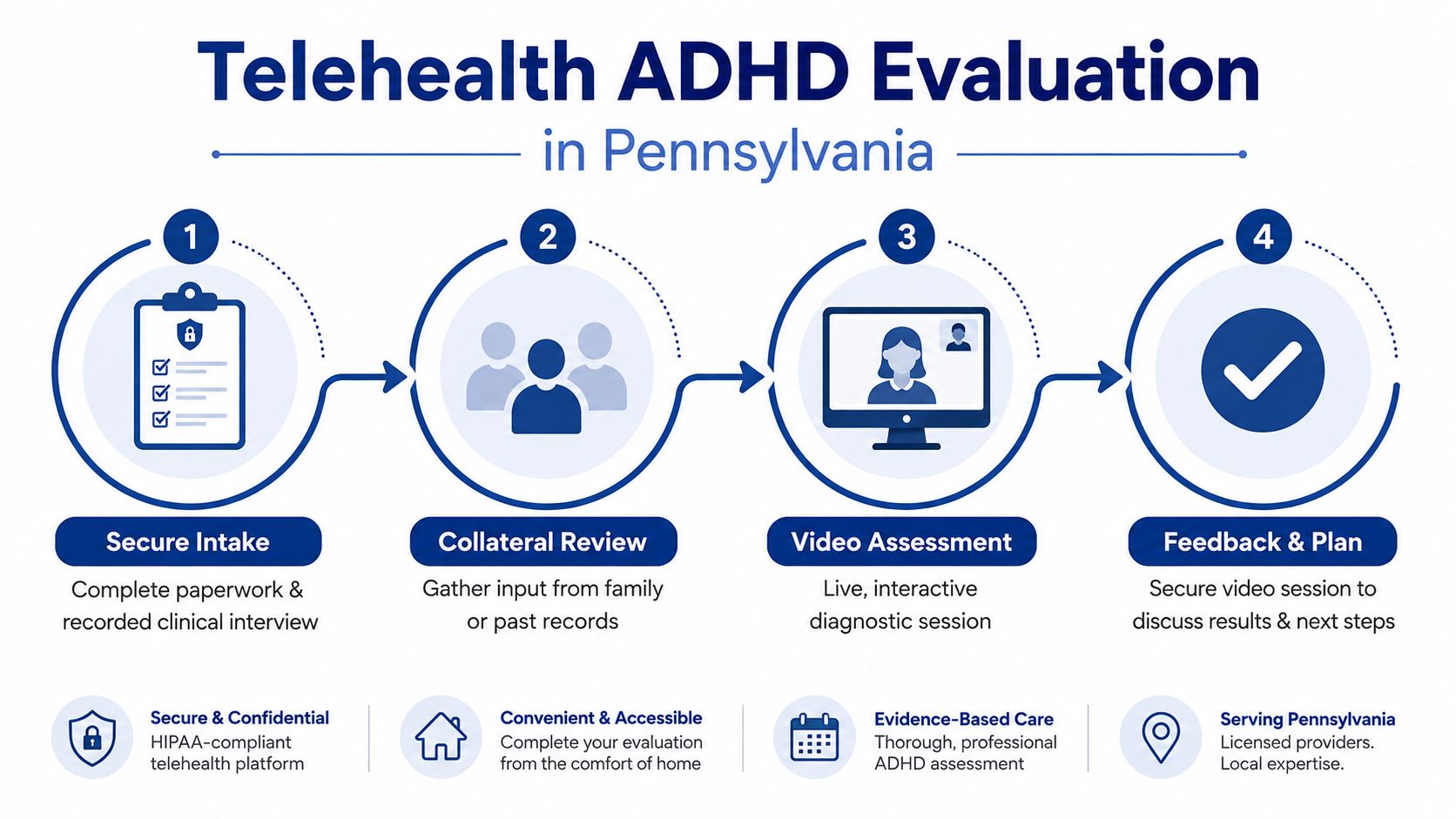
A telehealth evaluation can follow the same clinical logic as an in-person assessment. Patients generally complete intake paperwork, participate in a recorded clinical interview when used by the practice, attend secure video sessions, provide records or collateral information when appropriate, and review results in a feedback appointment.
Telehealth doesn't remove prescribing responsibilities. Pennsylvania licensing guidance states that stimulant prescribing is permitted through telehealth while requiring written consent before the first telehealth prescribing encounter. Controlled-substance prescribing also remains subject to applicable federal and state requirements, so patients should ask the practice how current rules affect their care. (Pennsylvania telehealth licensing summary)
Insurance and coordination
Coverage varies by plan. Commercial insurance may involve network rules, benefit verification, deductibles, copays, and prior authorization. Medicaid managed care plans can require specific documentation or authorization steps. Self-pay patients may have cash options, but the practice should explain fees before scheduling rather than implying that any insurer will cover an evaluation.
A thorough evaluation can support medication management because it documents impairment, diagnostic reasoning, and alternative explanations. That documentation may also help clinicians coordinate with primary care, schools, therapists, or other professionals. Records should be exchanged through appropriate authorization and secure procedures.
Patients can prepare by gathering school reports, previous assessments, work performance records, medication trial information, and relevant medical records. Testing the device, camera, microphone, internet connection, and private space before the first appointment can prevent avoidable disruptions.
Pennsylvania residents considering a remote assessment can review telehealth ADHD evaluation options and ask whether the service includes diagnostic feedback, treatment recommendations, and coordination when indicated.
Choosing the Right Next Step for Your Situation
A quick online quiz can be a reasonable starting point for curiosity, but it shouldn't be treated as a diagnosis or as a shortcut to medication. The right next step depends on the question the patient needs answered.
Three common starting points
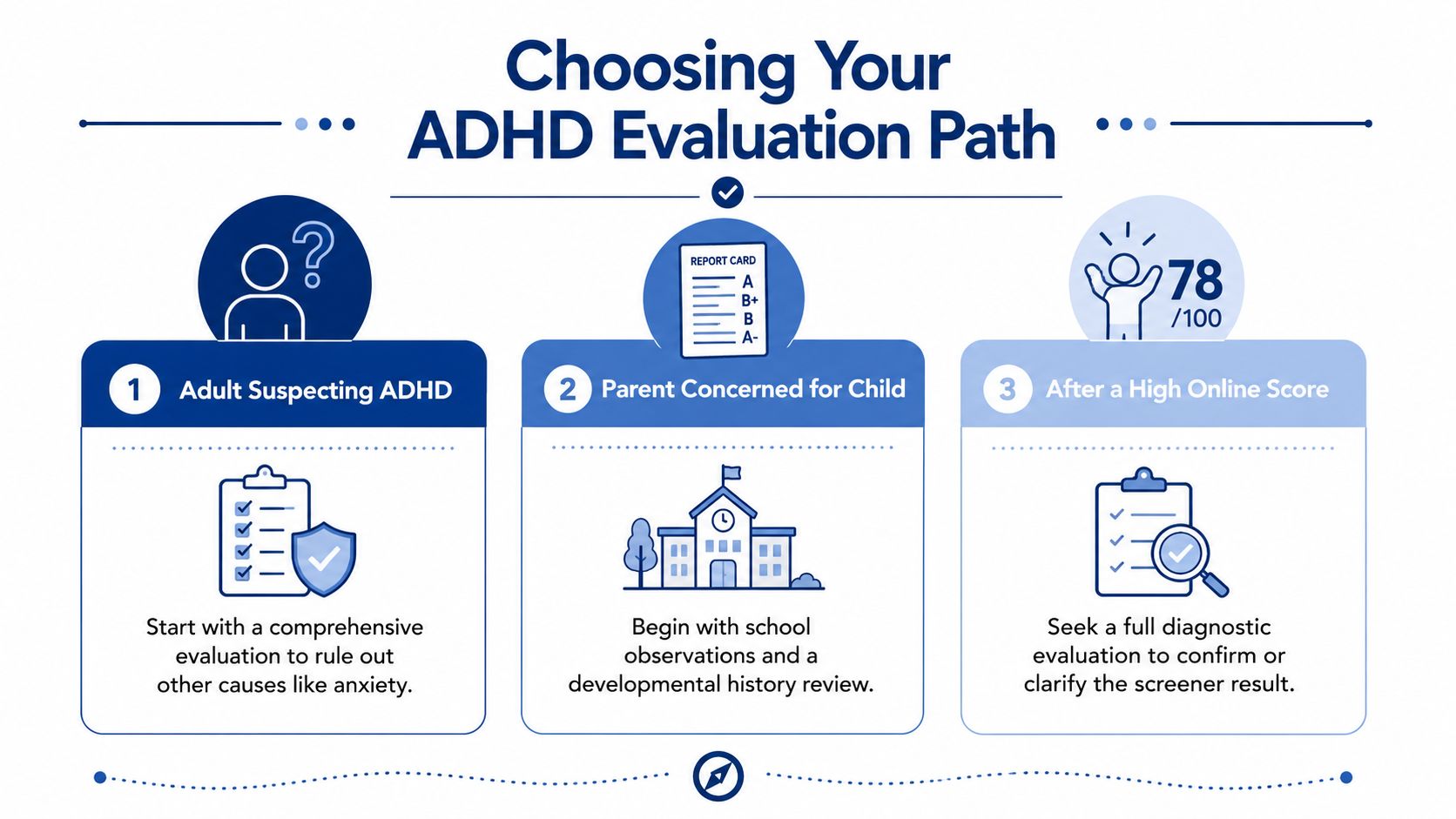
An adult who's mainly curious may complete a screener, write down concrete examples, and discuss the result with a licensed clinician. The screener is useful when the person isn't yet sure whether a formal assessment is warranted.
An adult who strongly suspects ADHD and wants treatment usually needs a thorough evaluation, particularly if medication is being considered. The clinician needs enough information to assess impairment, developmental history, risks, co-occurring conditions, and alternative explanations.
An adult already treated elsewhere who wants clarity may benefit from a specialist second opinion. Prior records, medication history, earlier diagnoses, and the reason for ongoing uncertainty can make the review more efficient and clinically meaningful.
Sudden attention changes after a head injury, active substance use, untreated sleep apnea, or recent trauma should prompt broader clinical attention rather than an assumption of ADHD. A child's assessment also requires developmental and school information, not an adult checklist applied without context.
Cost, wait time, and follow-up schedules vary across Pennsylvania practices and insurance plans. Patients should request a written fee estimate, ask whether the clinician is licensed in Pennsylvania, verify credentials, confirm network status, and clarify whether treatment or medication management requires a separate appointment. General educational resources, including what is Quantum LEEP Academy, can be explored separately, but coaching or education doesn't replace a licensed diagnostic evaluation.
A practical checklist:
- Name the question: Is the concern curiosity, diagnostic clarity, treatment planning, or a second opinion?
- Choose the depth: Use a screener for initial orientation, or request a full evaluation when diagnosis or medication is under consideration.
- Verify credentials: Confirm Pennsylvania licensure and the clinician's role in diagnosis and treatment.
- Prepare records: Collect prior evaluations, school or work information, medication history, and relevant medical details.
- Book the appropriate appointment: Ask what the evaluation includes, how feedback is delivered, and what happens afterward.
Integrative Psychiatry of America offers virtual psychiatric care across Pennsylvania, including structured ADHD assessment, treatment planning, and medication management when clinically appropriate. Patients seeking to understand whether attention problems reflect ADHD or another condition can visit Integrative Psychiatry of America to review care options, verify insurance, or request an appointment.