
A Pennsylvania professional can spend years building elaborate systems to compensate for missed deadlines, forgotten keys, unfinished paperwork, and an overfull mind. When those strategies stop working, the question often becomes direct: could adult ADHD explain the pattern, and what would an evaluation involve?
Adult ADHD testing isn't a single quiz, blood test, or brain scan. It's a structured clinical evaluation that examines current symptoms, childhood development, impairment across settings, medical and psychiatric history, and other conditions that may affect attention. For insured adults seeking virtual care in Pennsylvania, understanding that process makes it easier to choose an appropriate provider and prepare for an appointment.
Table of Contents
- Why Adult ADHD Testing Is a Clinical Process, Not a Single Test
- What Adult ADHD Actually Looks Like and the DSM-5 Criteria That Guide Testing
- Screeners, Structured Interviews, and Collateral History Compared
- How the CADE Evaluation Works From Intake to Diagnosis
- Where Labs and Genetic Testing Fit, and Where They Do Not
- Insurance, Telehealth Logistics, and Verifying Your Benefits
- After the Diagnosis, Treatment Options and Next Steps
Why Adult ADHD Testing Is a Clinical Process, Not a Single Test
A 34-year-old project manager in Pittsburgh may look organized at work while privately missing deadlines, losing car keys, forgetting routine tasks, and depending on exhausting last-minute effort. Years of compensation can conceal symptoms when intelligence, supportive systems, or job demands temporarily offset them.
That pattern calls for a clinical evaluation rather than an online label. The CDC's adult ADHD diagnostic overview describes adult diagnosis as including a symptom rating checklist and a detailed review of behavior and experiences across the person's history. The report estimates that 15.5 million U.S. adults, or 6.0% of adults, had a current ADHD diagnosis in 2023, with about half receiving that diagnosis at age 18 or older. Those figures reflect the number of adults entering care, not a reason to diagnose from a questionnaire alone.
What clinicians assess
The CADE framework used by Integrative Psychiatry of America provides a practical way to organize the evaluation. It connects the patient's current concerns with developmental history, functional impact, and alternative explanations. The clinician typically reviews:
- Current symptoms: Attention, organization, forgetfulness, impulsivity, restlessness, and follow-through.
- Developmental history: Whether relevant symptoms appeared in childhood, even if no one identified them as ADHD.
- Functional impairment: Effects on work, home responsibilities, relationships, education, finances, or daily safety.
- Collateral information: Reports from a parent, sibling, partner, or another well-informed person, when appropriate.
- Differential diagnosis: Anxiety, depression, PTSD, sleep disorders, thyroid disease, substance use, and other possible causes.
The guide to the difference between ADHD evaluation and testing explains why a screener cannot confirm ADHD. A diagnosis depends on clinical judgment, symptom chronology, impairment, and whether another condition better accounts for the difficulties. ADHD is a clinical diagnosis, not a laboratory result.
Why more than one visit may be appropriate
Some adults can describe clear childhood examples and consistent impairment across settings during an initial appointment. Others need time to obtain records, speak with a family member, clarify sleep or mood symptoms, or assess a co-occurring condition.
Consensus guidance recommends a semi-structured interview, collateral history, review of childhood and current symptoms, and assessment of impairment across at least two life domains. An adequate assessment and immediate discussion may take two hours or more (clinical consensus guidance). That time allows the clinician to test the working diagnosis against the full history instead of treating a score as the answer.
Telehealth can support this process for patients located in Pennsylvania who have a private setting, reliable technology, and appropriate follow-up access.
What Adult ADHD Actually Looks Like and the DSM-5 Criteria That Guide Testing
Adults must have a persistent pattern of symptoms, childhood onset, impairment, and symptoms in at least two settings to meet DSM-5 ADHD criteria. A clinician applies those requirements during a diagnostic interview rather than relying on a score from a questionnaire.
The DSM-5 uses two symptom groups. Inattention can involve difficulty sustaining focus, organizing tasks, following through, managing time, listening, or keeping track of possessions. Hyperactivity-impulsivity can appear as internal restlessness, excessive talking, interrupting, difficulty waiting, or acting before considering consequences. Adult hyperactivity doesn't always look like visible running or climbing. It may feel like an internal motor or an inability to settle.
The adult symptom threshold
For adolescents aged 17 and older and adults, DSM-5 requires at least five symptoms of inattention and/or hyperactivity-impulsivity. Children require six symptoms. Symptoms must persist for at least six months, create clinically significant impairment, and occur across settings such as home and work. The DSM-5 criteria table from the National Center for Biotechnology Information provides the formal symptom framework.
The three presentations are:
- Predominantly inattentive presentation: Inattention symptoms meet the threshold, while hyperactive-impulsive symptoms do not.
- Predominantly hyperactive-impulsive presentation: Hyperactive-impulsive symptoms meet the threshold, while inattention symptoms do not.
- Combined presentation: Both symptom groups meet their respective thresholds.
These labels describe the current presentation. They don't define a person's intelligence, motivation, character, or potential.
Why childhood history matters
The DSM-5 requires evidence that some symptoms were present before age 12, even when diagnosis happens much later (adult ADHD DSM-5 criteria). Adults without school records aren't automatically excluded. A clinician may consider detailed retrospective history, conversations with parents or older siblings, old report cards, standardized test records, or longstanding examples from family life.
Childhood evidence doesn't mean a patient needed a childhood diagnosis. Many adults developed coping strategies, received praise for being bright but inconsistent, or showed primarily inattentive symptoms that drew less attention. The central question is whether the developmental pattern supports ADHD and whether the symptoms now impair important areas of life. Readers can review common patterns in the adult ADHD symptoms resource, but a symptom list can't replace an evaluation.
Screeners, Structured Interviews, and Collateral History Compared
Self-report screeners, clinician interviews, and collateral history answer different questions. A good adult ADHD workup uses them as complementary sources rather than treating any one source as definitive.
Brief screeners are efficient. Structured interviews create diagnostic consistency. Collateral history helps establish developmental continuity and gives the clinician another perspective on real-world functioning.
Comparing the three pillars of an adult ADHD evaluation
| Tool | What It Measures | Strengths | Weaknesses | Role in Diagnosis |
|---|---|---|---|---|
| Self-report screener, such as ASRS-v1.1 or Conners Adult ADHD Rating Scales | Current symptoms and perceived frequency | Fast, organized, and useful for triage | Can miss cases or generate false positives; affected by insight and current stress | Supports further assessment, never confirms ADHD alone |
| Semi-structured diagnostic interview, such as a DIVA-based or ACE-based format | DSM-5 symptoms, onset, persistence, impairment, and alternative explanations | Allows consistent probing and real-life examples | Requires time, training, and clinical judgment | Core diagnostic method |
| Collateral history from family, partner, records, or workplace information | Childhood behavior and functioning across settings | Adds developmental context and outside observations | May be unavailable, incomplete, or influenced by memory | Helps corroborate the clinical history |
The limitations of screeners are measurable. In one adult study, ASRS-v1.1 showed 60% sensitivity, 68.6% specificity, 21.4% positive predictive value, 92.3% negative predictive value, and 67.5% overall classification accuracy (adult ADHD screening study). Those figures show why a positive result can be misleading and why a negative result doesn't always end the inquiry. Another Kessler screener showed 68.7% sensitivity and 99.5% specificity, which still means about one in three true adult cases could be missed when screening is used alone, according to the same research source.
What clinical interviews add
A trained clinician asks for examples, not just endorsements. “Often distracted” becomes more useful when connected to unfinished work, missed instructions, forgotten bills, interrupted conversations, or repeated problems across home and employment.
The interview also examines anxiety, depression, bipolar disorder, trauma, sleep, substance use, and medical factors. Patients can review the difference between ADHD evaluation and ADHD testing before booking, but the final impression must integrate all relevant evidence.
Practical rule: A questionnaire can open the door to assessment. It can't walk through the door and make the diagnosis.
How the CADE Evaluation Works From Intake to Diagnosis
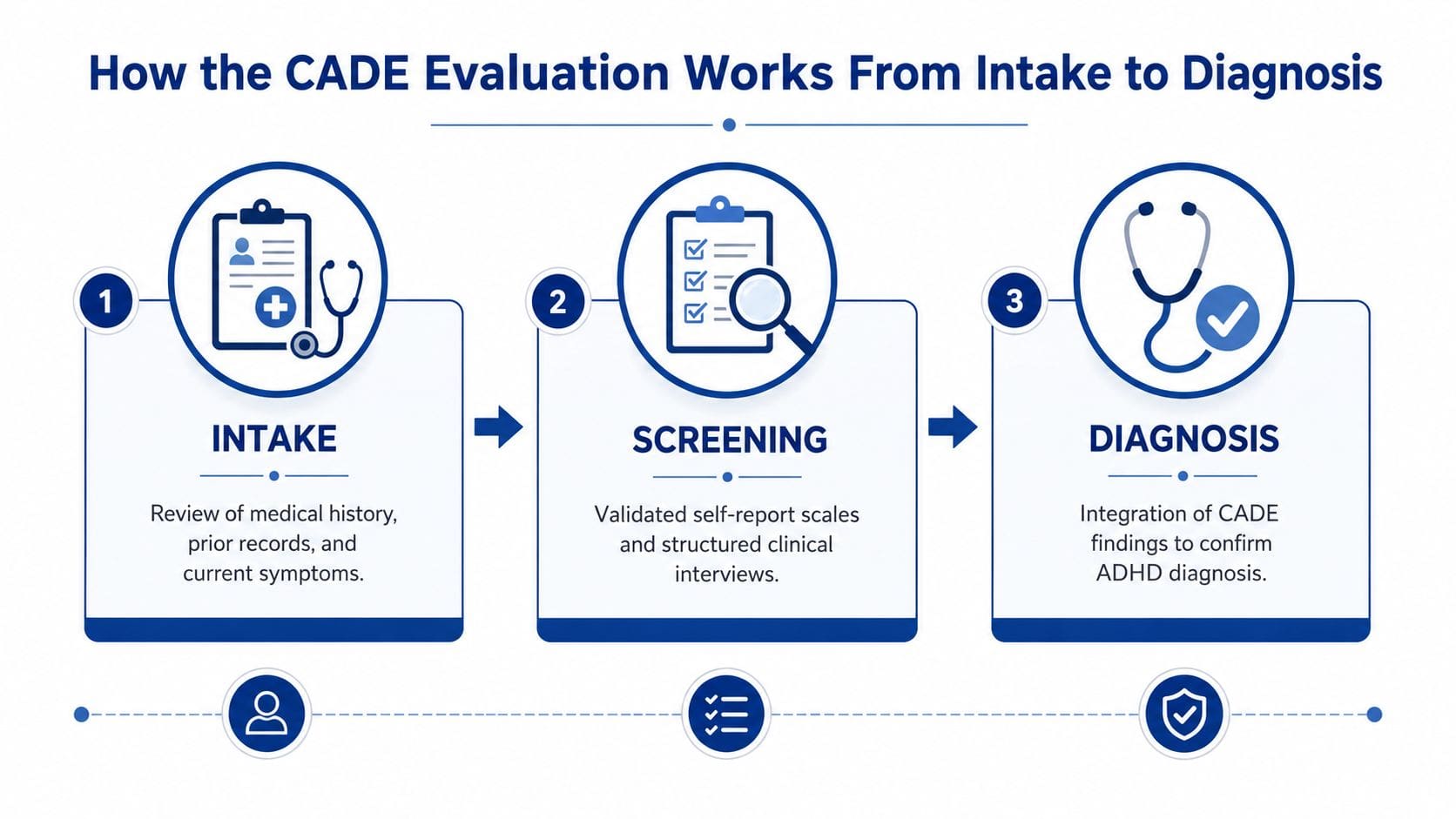
IPA's CADE, or ADHD Diagnostic Evaluation, gives clinicians a practical framework for moving from an adult's initial concerns to a reasoned diagnostic impression. It keeps the evaluation focused on symptoms, developmental history, impairment, and competing explanations. Adult ADHD remains a clinical diagnosis, not a laboratory result, and no screener can confirm it by itself.
Intake and clinical history
The evaluation starts with a psychiatric interview. The clinician reviews current concerns, medical history, previous psychiatric care, medications, sleep, substance use, developmental history, and the effect of symptoms on work, relationships, home responsibilities, and daily routines.
Bring prior records when available. Missing school reports do not automatically stop an evaluation. The clinician can ask detailed questions about childhood behavior and, when appropriate, gather collateral information from someone who knows the patient well.
Screening and structured assessment
Validated tools such as the ASRS organize current symptom reporting. They can identify areas requiring closer examination, including unfinished tasks, poor time management, distractibility, internal restlessness, and impulsive behavior.
A structured interview then tests whether the reported symptoms fit the broader clinical picture. A DIVA-based or ACE-based format can examine childhood onset, current symptoms, impairment, and examples across settings. Good assessment practice favors open questions and follow-up prompts for specific real-life examples rather than accepting vague endorsements (quality assessment guidance).
Differential diagnosis and diagnostic review
Anxiety, depression, PTSD, sleep disorders, thyroid disease, substance use, medication effects, and other medical or psychiatric conditions can affect attention. ADHD may coexist with another condition, or another condition may better explain the symptoms. The clinician keeps both possibilities under review.
The final assessment integrates interview findings, rating scales, collateral information, and DSM-5 criteria. The outcome may be an ADHD diagnosis, a different diagnosis, a co-occurring diagnosis, or a recommendation for additional assessment before reaching a responsible conclusion.
During the diagnostic review, the clinician explains the reasoning in plain language. Documentation and treatment recommendations depend on the findings, the patient's needs, and the next appropriate clinical step.
Where Labs and Genetic Testing Fit, and Where They Do Not
No laboratory panel or genetic test confirms adult ADHD. ADHD is diagnosed clinically through symptoms, developmental history, impairment, and differential diagnosis. Testing can investigate medical contributors, but it doesn't create a positive ADHD result.
A clinician may recommend laboratory work when symptoms suggest a medical explanation or when testing supports safe treatment planning. Possible questions can include thyroid dysfunction, anemia, glucose dysregulation, pregnancy, medication effects, or another health issue that may contribute to fatigue, concentration problems, or mood changes.
The appropriate role of medical testing
| Tool | What It Can Do | What It Cannot Do |
|---|---|---|
| Laboratory testing | Investigate selected medical contributors to cognitive or attention symptoms | Confirm or rule out ADHD by itself |
| Genetic testing | Provide limited information when clinically indicated for a separate treatment or medication question | Establish an ADHD diagnosis |
| Psychiatric evaluation | Assess symptoms, onset, impairment, comorbidities, and alternative explanations | Guarantee a particular diagnosis or treatment response |
Genetic tests marketed for mental health may appear precise, but they shouldn't be presented as proof that a patient has or doesn't have ADHD. The genetic testing and mental health overview can help patients understand where such tools may fit, but clinical judgment remains central.
Medical testing protects the evaluation from missed contributors. It doesn't replace the evaluation.
Ordering labs isn't a sign that the clinician doubts the patient's experience. It reflects a safety-focused approach. A careful provider investigates whether another condition contributes to attention symptoms while still assessing ADHD on its own diagnostic criteria.
Insurance, Telehealth Logistics, and Verifying Your Benefits
Pennsylvania adults should verify benefits before scheduling an online ADHD evaluation. Coverage depends on the specific plan, network status, deductible, copay, coinsurance, and authorization requirements. No insurer should be assumed to cover every service under every plan.
Cigna, Aetna, UnitedHealthcare, and BCBS or IBX plans may include telehealth psychiatric evaluation benefits, but the member's policy controls the outcome. Benefit verification helps identify questions before the appointment and reduces avoidable billing surprises.
A practical verification sequence
- Confirm network status: Ask whether the clinician or practice is in-network for the exact plan, not merely the insurance brand.
- Call member services: Use the number on the insurance card and ask about outpatient psychiatric evaluation through telehealth.
- Ask about cost sharing: Confirm the copay, deductible status, coinsurance, and whether mental health benefits differ from other specialist services.
- Check authorization rules: Ask whether an evaluation, follow-up visit, psychological testing, or medication management requires prior authorization.
- Document the call: Record the representative's name, the date, and any reference number provided.
The insurance verification process can help patients organize these questions. Verification is useful, but it isn't a guarantee of payment. The plan may process claims according to eligibility on the date of service and its own medical-necessity rules.
What a virtual visit typically requires
The patient generally needs a private location in Pennsylvania, a device with a camera and microphone, a stable internet connection, and identification for registration. The visit uses a secure telehealth platform, and the clinician confirms the patient's location and emergency contact information as part of routine safety procedures.
Medication discussions happen only after appropriate clinical assessment. If treatment includes a controlled medication, prescribing and follow-up must follow applicable federal and Pennsylvania requirements. Patients should ask how prescriptions, pharmacy coordination, refills, and follow-up visits are handled before treatment begins.
After the Diagnosis, Treatment Options and Next Steps
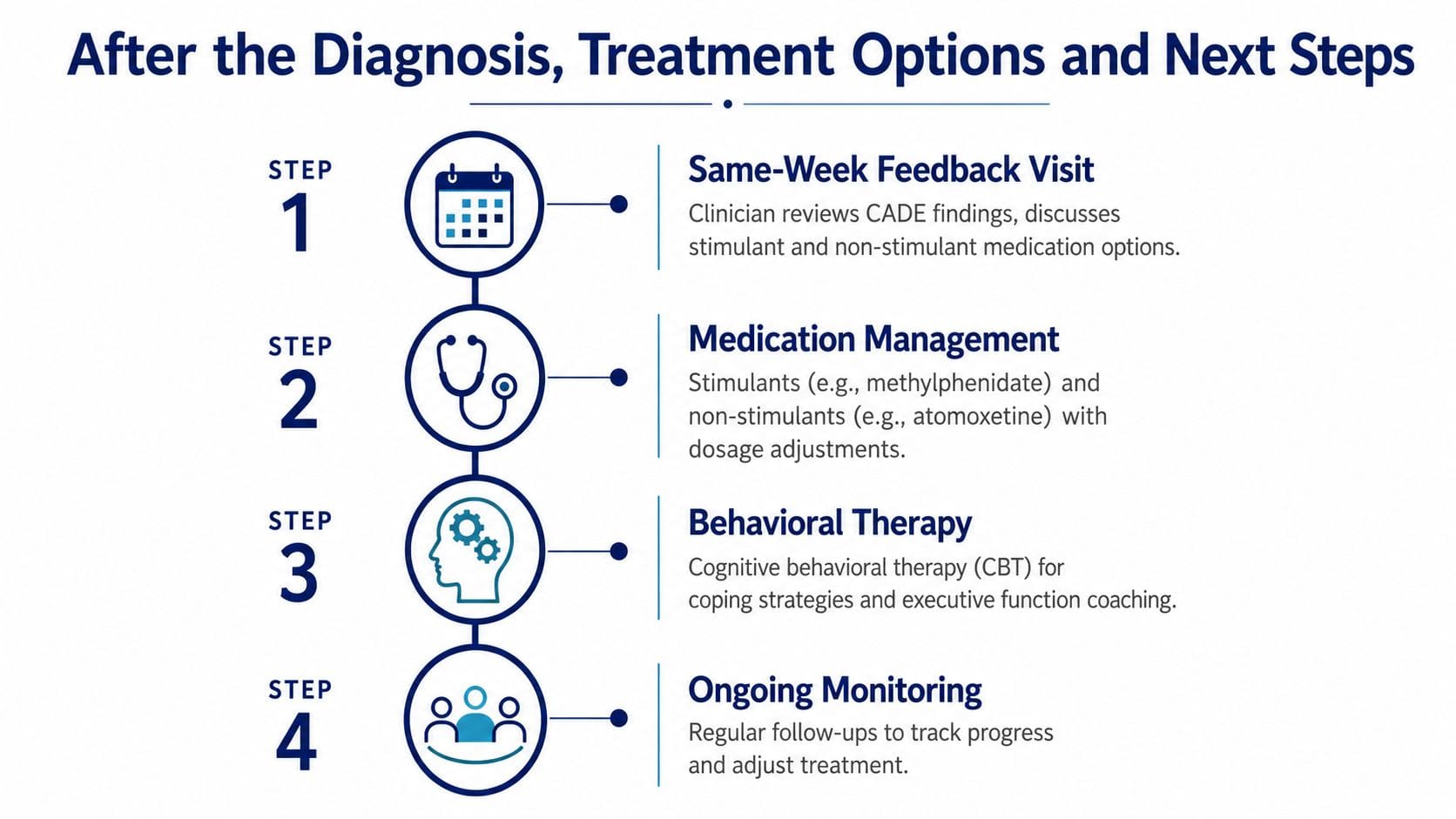
A diagnosis is the beginning of treatment planning, not the end of the evaluation. A feedback visit reviews the CADE findings, explains the diagnostic impression, and connects the findings to practical goals such as completing work, managing household responsibilities, improving sleep routines, or reducing impulsive decisions.
Medication and behavioral care
A psychiatric provider may discuss stimulant and non-stimulant medication options, depending on the patient's medical history, psychiatric history, preferences, risks, and treatment goals. IPA coordinates stimulant prescribing through compliant clinical workflows, with monitoring and follow-up rather than automatic refills.
Medication isn't the only option. Cognitive behavioral therapy, executive-function coaching, workplace accommodations, structured routines, sleep care, and practical planning tools may complement medication or support patients who don't use it.
An initial medication adjustment period often involves follow-up in two to four weeks, followed by visits every four to eight weeks once treatment is stable. Those intervals are clinical planning ranges, not a promise or requirement for every patient. The appropriate schedule depends on response, side effects, comorbidities, medication type, and safety considerations.
Questions patients commonly bring
Patients often want to know whether medication can be started, adjusted, paused, or changed. The answer depends on the evaluation, the medication involved, physical health, symptom response, and the clinician's monitoring plan. A patient shouldn't stop or change prescribed medication without discussing it with the prescribing provider.
A Pennsylvania adult ready to move forward can review the ADHD medication treatment options available online, complete intake forms, verify insurance, and request a CADE appointment through the patient portal. Integrative Psychiatry of America provides virtual psychiatric care statewide, including evaluation and medication management for appropriate patients.
Adults across Pennsylvania can request a virtual CADE evaluation through Integrative Psychiatry of America, where the process considers symptoms, developmental history, impairment, comorbidities, and treatment goals rather than relying on a screener alone. Patients with Cigna, Aetna, UnitedHealthcare, or BCBS/IBX can begin by verifying benefits, completing intake materials, and requesting an appointment for evaluation or ongoing ADHD medication management.