
You've tried the medication switch routine. One prescription helped a little but brought side effects. Another did almost nothing. A third felt promising for a week, then seemed to fade. For many people living with depression, anxiety, ADHD, OCD, or PTSD, that cycle starts to feel less like treatment and more like educated guessing. Genetic testing for medications can add one more piece of information, but it doesn't replace a full psychiatric evaluation or thoughtful follow-up care.
Table of Contents
- When Medications Stop Working and You Need Answers
- How Your Genes Influence Medication Response
- Which Psychiatric Medications Benefit Most from Testing
- What Getting Tested Involves
- Limitations and Equity Concerns You Should Know
- Understanding Costs Insurance Coverage and Privacy
- Integrating Genetic Results into Psychiatric Care
When Medications Stop Working and You Need Answers
A patient often reaches this point after several careful tries. The dose changed, the timing changed, and the prescriber listened closely, yet the results still didn't match the effort. That's when pharmacogenetic testing starts to make sense as a conversation, not because it promises the perfect medication, but because it may explain why one drug seems to miss while another causes trouble quickly.
That matters in real life. More than 98% of people may carry at least one genomic variant that can affect response to commonly prescribed medications, and the NIH notes that in 2022, 14% of FDA-approved medications carried a pharmacogenomic testing recommendation, affecting 6.7 billion outpatient prescriptions in the United States. Independent industry research also estimated that 13.6% of the top 300 most prescribed medications can be informed by pharmacogenetic testing (NIH genomics fact sheet).
Practical rule: When medication history is messy, genetics can help narrow the next step, but it cannot replace a careful look at diagnosis, side effects, sleep, substances, adherence, and drug interactions.
That's the balance patients need. Genetic testing can reduce uncertainty when a pattern keeps repeating, especially with antidepressants, ADHD treatment, or other psychiatric medications that depend on metabolic pathways. It does not tell a clinician whether grief, trauma, panic, attention problems, or depression is the main driver. It only helps answer how the body may process a medication once that medication is chosen.
For patients already exploring ADHD evaluation, depression treatment, or anxiety treatment through telehealth, this tool can sit inside a broader plan rather than acting as a shortcut. Used well, it can support more precise prescribing. Used poorly, it becomes just another expensive test without a follow-through plan.
How Your Genes Influence Medication Response
The liver enzyme part matters most
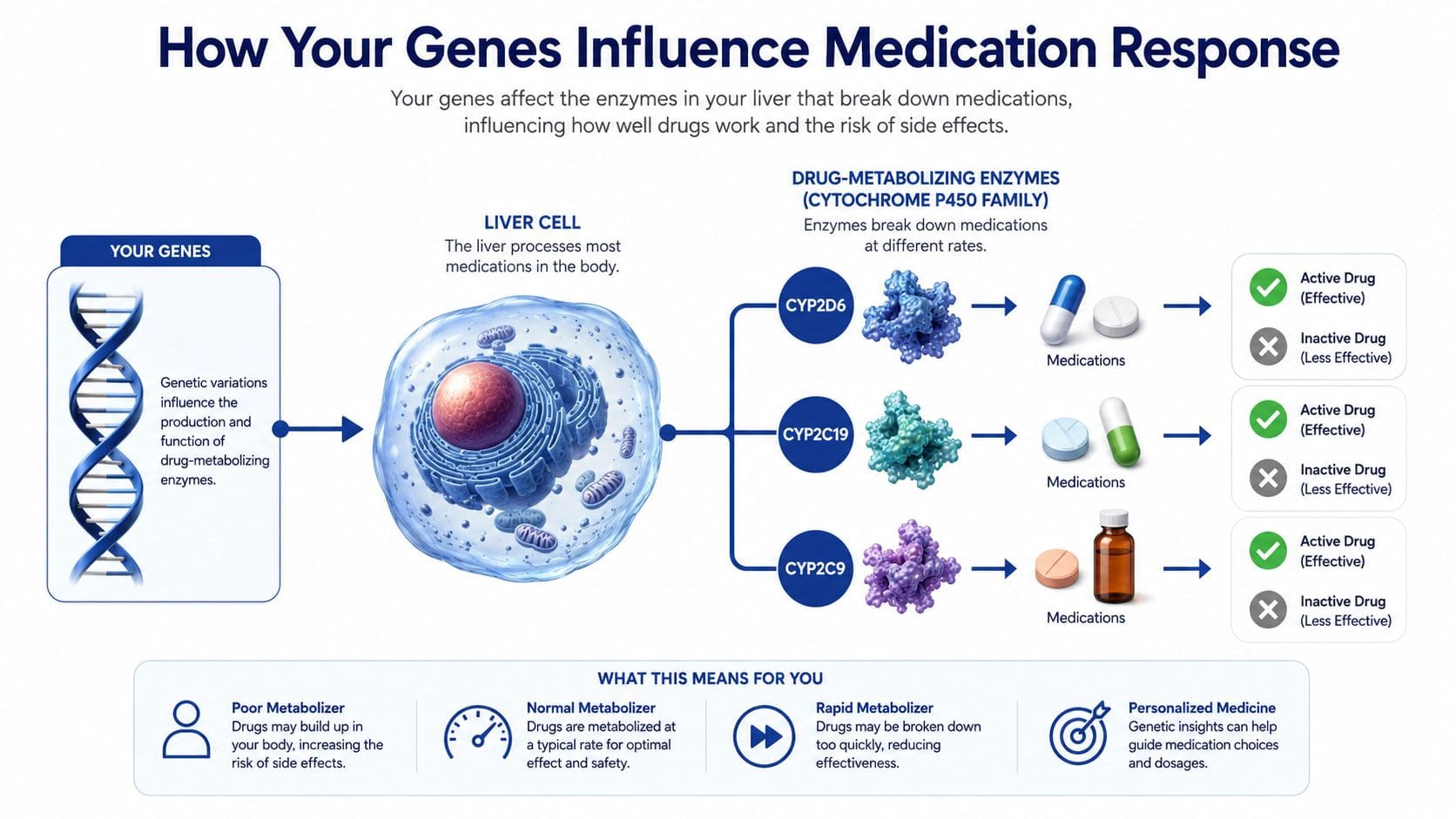
A patient starts an antidepressant, feels jittery and nauseated, then stops it because the side effects never settle. Another patient tries a similar medication and feels nothing after several weeks, even with a reasonable dose. In both cases, liver enzymes are often part of the explanation.
Most psychiatric medications pass through the CYP450 family of enzymes. Those enzymes act like a processing line. If a genetic variant slows that line, the drug can stay in the body longer and increase side effects. If the line runs too fast, the medication may clear before it has enough time to help.
That is why pharmacogenetic testing focuses on well-characterized gene-drug pairs. The ACMG technical standard describes clinical pharmacogenomic testing as evaluating germline variants involved in drug-response variability and using that information to infer a response phenotype for medication management (ACMG and FDA guidance overview05468-X/pdf)). FDA pharmacogenetic guidance discusses how genotype knowledge can help inform a therapeutic strategy, a dose choice, or the likelihood of benefit or toxicity, but only for selected medications, not every prescription (FDA pharmacogenetic associations).
A useful way to keep the result straight is this. Genotype is the DNA result itself. Phenotype is the practical reading of that result, such as poor metabolizer or ultrarapid metabolizer. For clinicians working with structured records, a resource on phenotype vs genotype in EHR data shows why the laboratory report and the patient's actual medication response are not the same thing.
Why this is about processing, not diagnosis
A test can show how the body may handle a drug, but it cannot prove whether that drug will fit a specific diagnosis. It does not measure adherence, and it cannot tell whether symptoms are being shaped by alcohol, cannabis, sleep loss, stress, or another prescription.
For that reason, genetic testing for medications works best as a decision-support layer. It can help a prescriber choose between drugs, adjust a dose, or avoid a medication that is likely to be processed poorly. It still leaves room for the clinical work of matching symptoms, side effects, history, and function to a treatment plan.
The same caution applies when people ask about folate-related strategies in psychiatric care. Some clinicians also review methylation pathway questions alongside medication metabolism, and a practical overview of methylfolate and MTHFR can be useful when that conversation comes up in a visit.
Which Psychiatric Medications Benefit Most from Testing
A patient who has already tried two antidepressants, felt shaky and wired on one, then had almost no benefit on another, is the kind of case where pharmacogenetic testing can add real value. The test does not pick a medication by itself. It can, however, explain why certain drugs may be harder to tolerate or less likely to work well, which helps narrow the next step.
The clearest use cases are medications with known gene-drug relationships, especially those influenced by CYP2D6 or CYP2C19 metabolism. In those situations, testing is most useful after repeated medication changes, side effects that seem out of proportion to the dose, or a pattern of poor response despite reasonable prescribing. As noted earlier, the FDA maintains a table of pharmacogenetic associations for selected drugs, which is a reminder that the evidence is medication-specific rather than universal.
Where the evidence is strongest
Antidepressants are often the first place clinicians look because several SSRIs and tricyclics have established metabolic guidance. Certain antipsychotics and some ADHD medications also fall into the group where genotype can influence dose selection or drug choice. Medication-specific guidance is more likely to exist for selected drugs than for every prescription in psychiatry.
Medications with narrow therapeutic windows or a strong dependence on one metabolic pathway are usually the most actionable. In practice, that can mean a test helps a clinician avoid a drug that may accumulate too much or clear too quickly. It can also support a lower starting dose or a slower titration when the patient's history suggests sensitivity.
For readers comparing options, this table keeps the evidence in perspective:
| Medication Class | Key Genes | Evidence Strength |
|---|---|---|
| SSRIs and some other antidepressants | CYP2D6, CYP2C19 | Strongest for selected drugs |
| Tricyclic antidepressants | CYP2D6, CYP2C19 | Strong for selected drugs |
| Some antipsychotics | CYP2D6, CYP2C19 | Moderate to strong for selected drugs |
| Some ADHD medications | CYP2D6 | Variable, depends on the drug |
| Many mood stabilizers and newer agents | Often limited or drug-specific | Limited for routine use |
Where testing is less likely to change care
Some medications still have too little actionable evidence for the test to drive a clear choice. In those cases, the report may be useful background, but prescribing still depends on symptoms, prior response, comorbidities, and side effect risk.
That is why a test should not be treated like a list of “safe” or “unsafe” drugs. Even a strong gene result does not make a medicine right for someone whose main problems are insomnia, substance use, uncontrolled anxiety, or diagnostic uncertainty. The test helps most when the rest of the clinical picture is already clear.
A clinician reviewing a depression genetic test may use it to fine-tune antidepressant selection, but the final decision still rests on symptom pattern and treatment history. For a practical example of how that fits into care, see depression genetic test.
What Getting Tested Involves
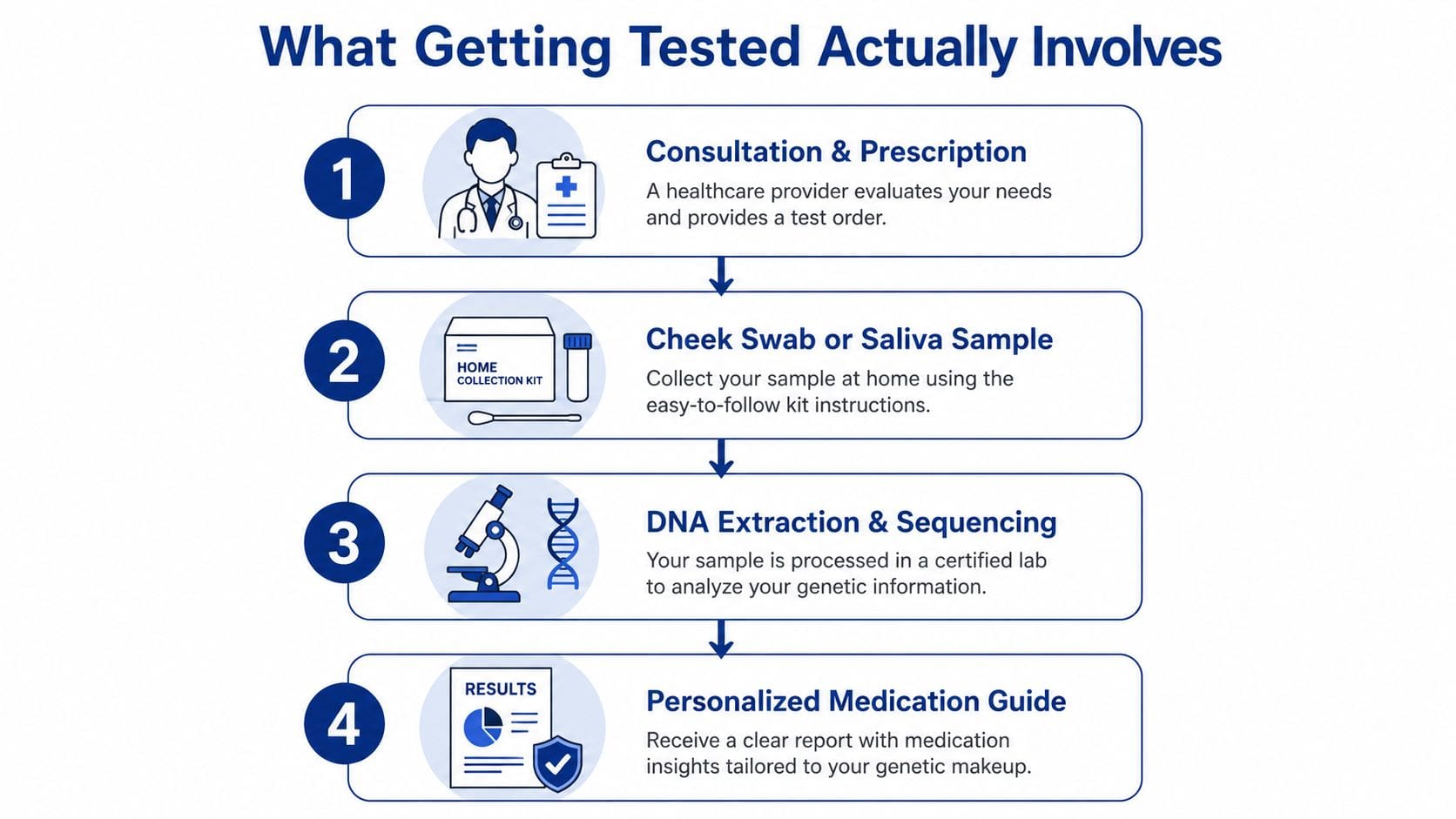
The process is usually straightforward for the patient. Most pharmacogenomic panels use a cheek swab, saliva sample, or occasionally blood. The laboratory then runs targeted sequencing or a gene panel focused on variants already known to affect medication metabolism and response.
What the report usually gives back
The result goes beyond a simple yes-or-no answer and lists metabolic phenotypes for enzymes such as CYP2D6 or CYP2C19, then pairs those findings with medication guidance. The report is written for clinicians, not for self-selection at home.
That detail is where many people get tripped up. A lab report may show that someone is likely a poor metabolizer, but it does not choose the medication for tonight or replace clinical judgment. It gives the prescriber a clearer way to interpret certain medications and side effects.
Why follow-up matters more than the sample itself
A good psychiatric clinician reviews the test next to the full history. That includes prior medication trials, response timing, anxiety or depression severity, sleep, substance use, other medical conditions, and the treatment goal. Without that review, the genetics can be technically correct and clinically unhelpful.
Continuity matters here. A psychiatric practice can order testing, interpret it in context, and adjust treatment without sending the patient between separate offices. Some patients prefer that kind of follow-up when they already feel worn down by medication changes and symptom burden. For anyone looking for a structured path through the process, genetic testing for psychiatric medications near me is the kind of search that often leads to a clinician who can both order the test and act on the result.
A practical lab-side point also helps. People often assume a genetic test works like a broad screening panel, but it is closer to a focused workflow with predefined targets. That is one reason patient-facing material on hazardous materials handling tips can be a useful comparison point for understanding how laboratories manage specialized specimens and procedures with care.
Limitations and Equity Concerns You Should Know
The biggest limitation is also the one most consumer pages skip. Pharmacogenetic testing may work best when results are paired with strong follow-up care, but follow-up is exactly what many medically underserved patients struggle to access. Recent reviews and implementation studies suggest PGx may be especially useful in underserved populations because of high medication burden and fewer clinical encounters, yet poor access to interpretation and medication management could leave the benefit unrealized or even deepen disparities (underserved implementation review).
Ancestry and diversity still matter
Many PGx studies have lacked genetic diversity. That means some gene-based dosing algorithms may be less certain for Black, Hispanic, Indigenous, rural, or tribal patients. The issue is not that testing is useless across ancestries. The issue is that the evidence base is uneven, and that nuance gets lost when the test is marketed as universal.
That gap matters in psychiatry because patients often want a simple answer, especially after several failed medication trials. A cautious clinician should explain that a report built on limited diversity may still be informative, but the level of certainty can vary by variant and population. That is especially important when treating patients whose care has already been complicated by access barriers.
Genetics does not explain every medication failure
Pharmacogenetic testing does not account for diagnosis mismatch, adherence, sleep disruption, substance use, drug-drug interactions, or environmental stress. It also cannot tell whether a medication failed because the dose was too low, the timing was off, or the diagnosis itself needs to be revisited. For that reason, PGx should never be treated as the whole answer.
A practical way to think about it is this. If a patient improves briefly and then relapses, genetics may be part of the story, but it is rarely the only story. The medication plan still needs observation, adjustment, and real-world follow-up.
For patients dealing with access or coverage questions, a resource on 2026 compliance requirements can help frame why mental health benefits, authorization rules, and plan details often shape whether testing and care are reachable. In Pennsylvania, those access issues can be especially relevant for people trying to find consistent care, which is why mental health provider shortage in Pennsylvania is part of the broader conversation.
Bottom line: PGx can reduce guesswork, but it can also expose how unequal access to follow-up care shapes who benefits from precision medicine.
Understanding Costs Insurance Coverage and Privacy
The financial side often decides whether testing happens. Coverage is inconsistent, and many plans only pay when a patient has a clear history of medication failures or a specific clinical reason. Other plans still treat testing as experimental or investigational, which leaves patients paying out of pocket.
What patients usually have to sort out
Prior authorization may be required. Medicare and Medicaid coverage can vary by plan and region, so there is no single universal answer. The safest approach is to verify benefits before the sample is collected, not after the bill arrives.
Privacy is a separate concern, and it matters. Genetic results become part of the medical record, which means HIPAA protections apply in the usual healthcare setting. GINA, the Genetic Information Nondiscrimination Act, also offers important protections, although patients should still ask how their data is stored, shared, and used.
A quick comparison for decision-making
- Insurance-covered testing: Usually easier when there is documented medication failure or a clear clinical indication.
- Self-pay testing: Often faster to arrange, but the patient carries the full cost burden.
- Unknown coverage: Risky without a benefits check, because the patient may face an unexpected balance bill.
Why the billing question belongs in the clinical conversation
The right test is not just about genes. It is also about whether the result will change treatment in a meaningful way. If a clinician cannot explain how the report will influence medication management, the test may not be worth the spend yet.
Patients in Pennsylvania who are comparing access, online care, and billing details can use Insurance and Fees to understand how coverage is usually handled in a telehealth practice setting. That conversation is especially important when the test is part of a broader medication management plan rather than a one-time purchase.
Integrating Genetic Results into Psychiatric Care
The most useful pharmacogenetic testing sits inside a broader treatment plan. Genetics can inform medication choice, but it does not replace psychotherapy-informed care, sleep work, movement, nutrition, stress reduction, or ongoing reassessment. In practice, the test adds another layer of evidence. It does not become the whole picture.
For a virtual psychiatric practice like Integrative Psychiatry of America, that means results are interpreted alongside the full clinical picture, including symptoms, prior medication experience, sleep, routine, and other health factors. The same approach applies whether the concern is ADHD medication management, anxiety treatment, or depression treatment. A genotype may point toward a better starting option, but the plan still has to fit the person's life, follow-up needs, and tolerance for change.
A thoughtful medication plan usually includes:
- A clear psychiatric assessment that checks diagnosis, severity, and comorbidities.
- Medication management follow-up so dose changes are tracked instead of guessed.
- Lifestyle supports such as sleep, nutrition, and activity changes that influence symptoms.
- A review of prior trials so the same mistakes are not repeated.
- Interpretation of genetic results in the context of the patient's goals and history.
That approach matters because genetic testing is most useful when it changes the next prescribing decision. A report that sits in the chart without action does little for the patient sitting in front of you. It also matters for equity. Genetic panels do not perform equally well across all ancestry groups, and follow-up care has to account for that limitation instead of treating the result as final. The plan should leave room for clinical judgment, especially when ancestry, family history, and medication response do not line up neatly with the report.
Clinical reality: The test helps most when it informs the next medication choice, the next dose adjustment, or the decision to monitor more closely.
For adults in Pennsylvania who want a careful telehealth conversation about whether pharmacogenetic testing belongs in their treatment plan, a thorough psychiatric evaluation is the right place to start. Integrative Psychiatry of America offers virtual psychiatric evaluations, medication management, and integrative care across Pennsylvania, including for patients who have already tried several medications and want a more systematic path forward.
A first telehealth visit can cover what medications and supplements you have already tried, what side effects got in the way, how your symptoms affect daily function, and whether genetic testing would change the next step. Bring a current medication list, any prior test results, and the questions that matter most to you. That kind of visit gives you a practical plan, not just a lab result.