
The refill should have been routine. Instead, the pharmacy says the stimulant is not there. The next pharmacy says the same thing. The calendar keeps moving while work, school, parenting, and basic concentration start to wobble. For adults in Pennsylvania, that moment has become familiar. An ADHD Medication Shortage guide should answer the practical question fast, not just explain the news.
The safest response is usually not panic. It is also not waiting passively. It is a short workflow: count what is left, message the prescriber, check nearby pharmacies, and decide whether a same-class switch or a short bridge makes sense. That kind of continuity matters. Disruption in care is exactly what patients feel when a refill turns into a scavenger hunt. That point also appears in the broader conversation about the benefits of seamless patient journeys.
For adults who use telehealth, the shortage is easier to manage when the plan is organized before the medication runs out. A clear portal message, a realistic pharmacy rotation, and a prescriber who understands dose-equivalence limits can cut a lot of avoidable chaos. If the current routine has already broken down, the next step is a structured response, not guessing.
Table of Contents
- When the Pharmacy Says They Are Out
- Why the Shortage Is Still Going in 2026
- The First 72 Hours When You Cannot Fill a Prescription
- Switching Within the Same Stimulant Class Safely
- When the Entire Stimulant Class Is Tight
- Running Refill Coordination Through a Telehealth Portal
- After a Forced Switch and When Supply Returns
When the Pharmacy Says They Are Out
The first “no” is usually the hardest. One call turns into three. The adult patient is left trying to decide whether to stretch doses, skip a weekend, or ask for something completely different. In Pennsylvania, that can mean the difference between a same-day fix in Philadelphia and a week of dead ends in a smaller county.
The shortage is not a one-off inconvenience. The U.S. had 323 active medication shortages in the first quarter of 2024. That was the highest level recorded by ASHP and Utah Drug Information Service. ADHD stimulants were part of that broader picture. Mixed amphetamine salts, lisdexamfetamine, and methylphenidate were all affected at different points (ABC News). The FDA said the issue had shifted from an initial manufacturing delay to a demand-driven shortage. That helps explain why the problem keeps resurfacing instead of disappearing after one supplier catches up (ABC News).
What that means in real life
An adult who has taken the same medication for years may suddenly need a backup plan. That does not mean the medication stopped working. It means supply became uneven across pharmacies and wholesalers. The most useful mindset is to treat the refill like a care coordination problem.
Practical rule: the goal is not to find any pill that sounds similar. It is to find a safe, documented substitute that matches the patient's actual dose, timing, and daily routine.
For patients who want a useful primer on how ADHD meds are classified and why that matters during a shortage, the internal guide on understanding ADHD medication fits well here. It helps make sense of why one pharmacy may have a product while another does not, even when both look similar on paper.
The main takeaway is simple. The shortage is real. It has lasted long enough to disrupt routine care. It needs a plan that starts the same day the pharmacy says no.
Why the Shortage Is Still Going in 2026
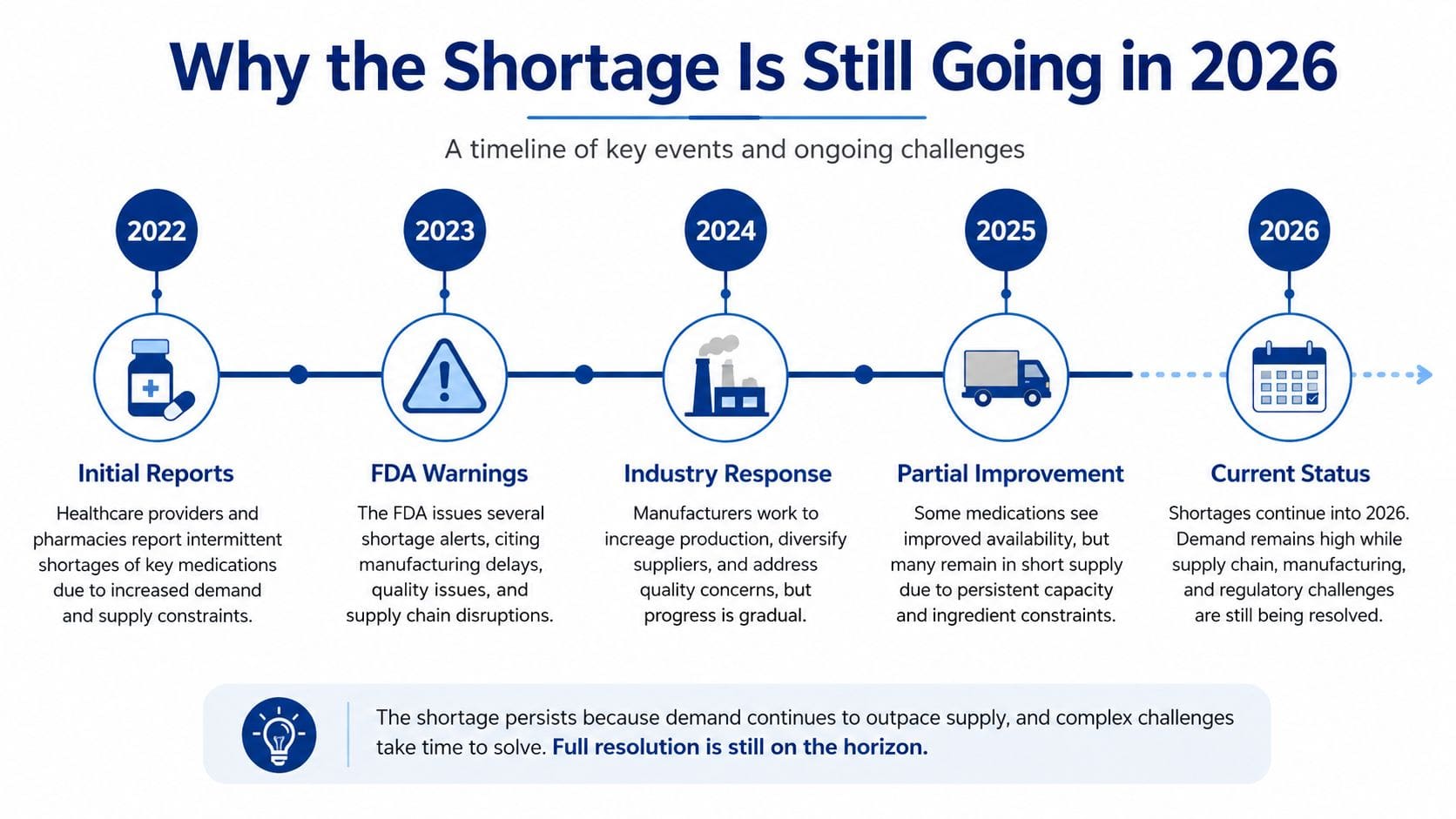
The shortage did not begin as a single national event. It did not end that way either. Mixed amphetamine salts entered shortage in October 2022. Lisdexamfetamine followed in July 2023. Methylphenidate also followed in July 2023. That is why adults now run into gaps across more than one stimulant family (ABC News). By early 2024, the FDA described the problem as demand-driven rather than a simple manufacturing delay. That means the pressure has remained system-wide rather than isolated to one maker (ABC News).
The pattern is uneven, not random
In 2026, the most persistent pain point has been generic immediate-release mixed amphetamine salts, the generic form of Adderall. Availability varies by pharmacy, dose strength, and manufacturer (Tiltaken). A 1 August 2023 FDA and DEA joint letter reported shortages across the three major stimulant categories named above. It cited a shortage of about 1 billion dosages alongside manufacturer production limits (PMC).
By April 2026, tracking summaries described nearly every major ADHD stimulant as being in critically low supply, including Vyvanse, Adderall, and Concerta, with some periods where only chewable and liquid forms were intermittently available (DrGuide). That does not mean every pharmacy is empty. It means the same prescription may be fillable in one ZIP code and unavailable in another.
European regulators have also said ADHD medicine shortages in the EEA were driven by unexpectedly high demand that exceeded manufacturing capacity, along with other production problems. They also said the shortages were not related to a safety issue. The EMA said the shortage could continue until the end of 2025 depending on the medicine and country (EMA). That international picture matters because it reinforces the same conclusion. This is a sustained access problem, not a brief blip.
The practical lesson is clear. Adults should plan for patchy supply. They should not assume next month will look better by default.
The First 72 Hours When You Cannot Fill a Prescription
The clock matters most in the first three days. The first task is to count the tablets left, estimate the exact days of supply, and send a message through the patient portal the same day the pharmacy says the medication is unavailable. Waiting for the next scheduled visit usually wastes time.
A concise portal note works better than a long story. It should include the current dose, how many tablets remain, which pharmacies have already been checked, and whether the shortage is causing worse focus, sleep, appetite, or irritability. If a faxed prescription handoff is part of the workflow, a service such as online fax for prescriptions can fit into that coordination process when the practice uses it.
What to ask in each pharmacy call
- Current stock: Ask whether the exact dose and formulation are on hand today.
- Manufacturer or strength: Ask whether a different strength or manufacturer is available.
- Transfer rules: Ask whether the pharmacy can receive the prescription electronically or needs a new order.
- Restock timing: Ask when the next shipment is expected, if they can share that information.
A short weekend or non-working-day break can sometimes stretch supply when the prescriber says it is clinically appropriate. NHS BNSSG guidance says breaks of 1 to 2 days do not require dose re-titration when restarting stimulant medicine. It also advises trying different pharmacy chains and independents because they do not all use the same suppliers (NHS BNSSG). That same guidance says prescribers should not issue more than 30 days at a time. This partly preserves fairness and partly avoids adding pressure to supply (NHS BNSSG).
If the patient is down to a few tablets, the best move is usually not to ration blindly. It is to document the supply, message the prescriber, and keep the refill request moving.
Adults in Pennsylvania who use online care can handle that through ADHD medication management online, which matters when the nearest stocked pharmacy is not around the corner. The point is to reduce dead time, not to improvise from memory while the medicine runs out.
Switching Within the Same Stimulant Class Safely
When the exact product cannot be filled, the next step is often a same-class substitution. That means moving from one amphetamine product to another amphetamine product, or from one methylphenidate product to another methylphenidate product. It does not mean mixing the two classes casually. The dose-equivalence table is a tool for that narrow purpose only.
Why same-class switching needs a prescriber
The Australian TGA guidance is explicit that dose-equivalence tables should be used only for within-class switching. That helps prevent underdosing or overdosing when moving between methylphenidate-based and amphetamine-based products (TGA guidance PDF). Before any re-titration, NHS guidance recommends checking height, weight, blood pressure, and pulse. The new formulation can behave differently in the body (TGA guidance PDF).
Same-Class Substitution at a Glance
| Step | What Happens | Why It Matters |
|---|---|---|
| Identify the class | Amphetamine stays with amphetamine, methylphenidate stays with methylphenidate | Cross-class conversions can mislead dosing |
| Use a validated equivalence table | The prescriber matches the substitute using a trusted conversion reference | Reduces dose errors |
| Check vitals first | Height, weight, blood pressure, and pulse are reviewed before re-titration | Gives a baseline before the change |
| Reassess after the switch | Symptoms are reviewed after the new dose has had time to settle | Shows whether the replacement is actually working |
The operational mistake many adults make is assuming every extended-release product is interchangeable. That is not true. Duration, timing, and rebound symptoms differ. A capsule that lasts all day for one patient may wear off early for another.
For patients who want a clearer overview of formulation differences, the internal page on ADHD medication management is a useful companion. It helps explain why one substitute might preserve focus but change sleep or appetite.
A forced switch is not a failure if the substitute is documented, monitored, and revisited. It becomes a problem when no one checks how the patient feels after the first week or two.
When the Entire Stimulant Class Is Tight
Sometimes same-class switching is not available. If multiple stimulant categories are constrained at once, the conversation needs to shift from “which stimulant is in stock?” to “what keeps function stable while supply is unpredictable?” That is where bridge strategies become useful.
Options to discuss with a prescriber
- Non-stimulants: Atomoxetine, guanfacine, and viloxazine can be considered when stimulant supply is unreliable or the patient cannot switch cleanly within class.
- Split dosing: Shorter-acting products may be combined to approximate a once-daily pattern when a longer product is not available.
- Temporary combination regimens: A prescriber may use a short-term plan that covers work hours, parenting demands, or school obligations until supply improves.
NHS BNSSG guidance says stimulant breaks on weekends or other non-working days can be considered when clinically appropriate. CHADD notes that clinicians may need to combine shorter-acting products to approximate a once-daily regimen if a 12-hour product cannot be obtained (NHS BNSSG). That kind of workaround can help, but it requires careful timing and monitoring for rebound symptoms and adherence problems.
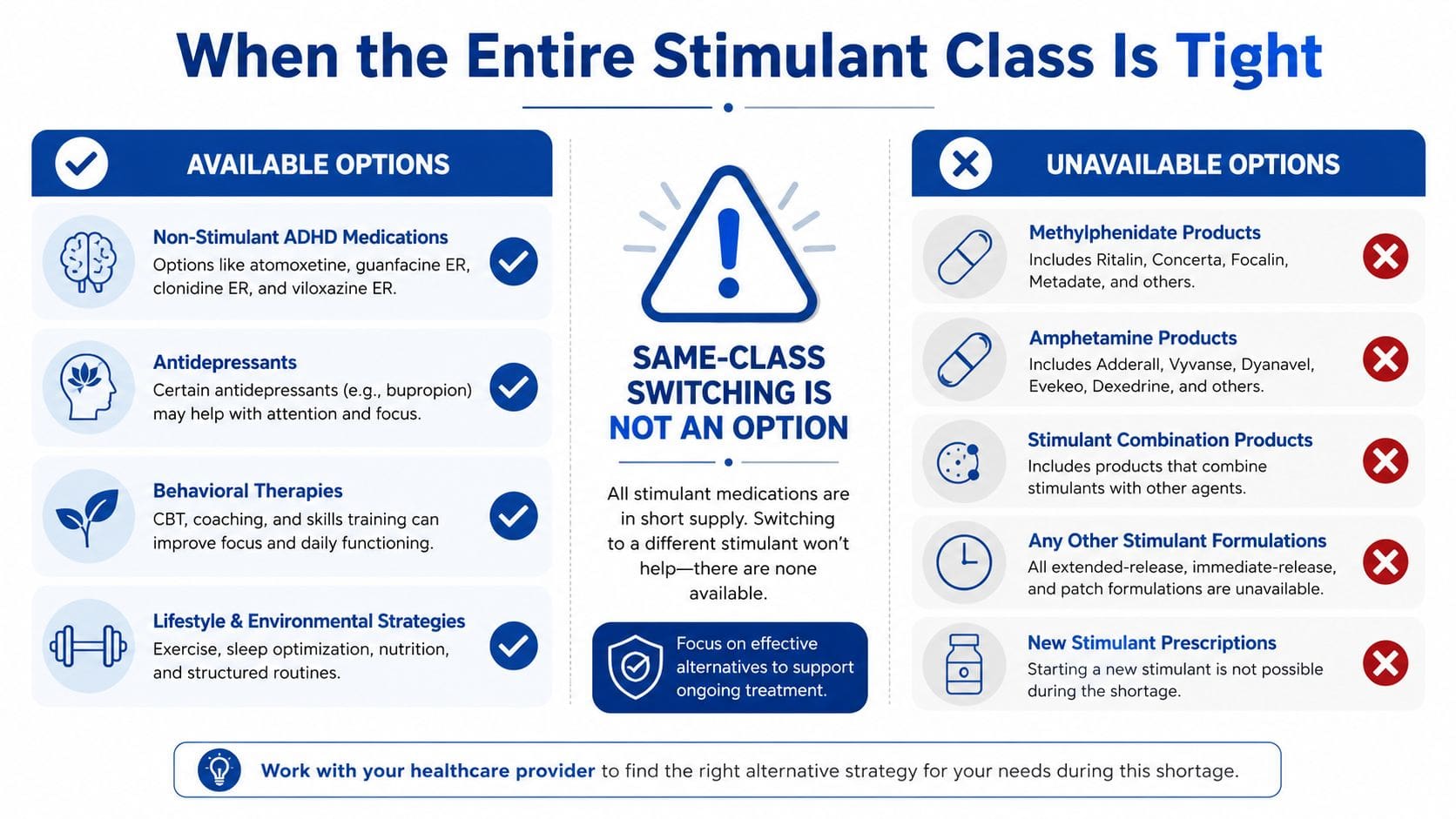
The main trade-off is straightforward. Short-acting coverage can preserve function. It can also create more ups and downs during the day. Non-stimulants can be steadier, but they usually are not instant fixes. For adults juggling work or school, that timing matters as much as the label on the bottle.
People looking for practical focus support during unstable supply periods may also find ADHD focus strategies for students helpful as a temporary non-medication layer. It will not replace medication management, but it can reduce the pressure on the medication plan while the prescriber works on a bridge.
For patients who need a cleaner overview of non-stimulant options, the internal guide on non-stimulant ADHD treatment is the right next stop. The key point is that bridge strategies should come from a clinician, not from a guess made at the pharmacy counter.
Running Refill Coordination Through a Telehealth Portal
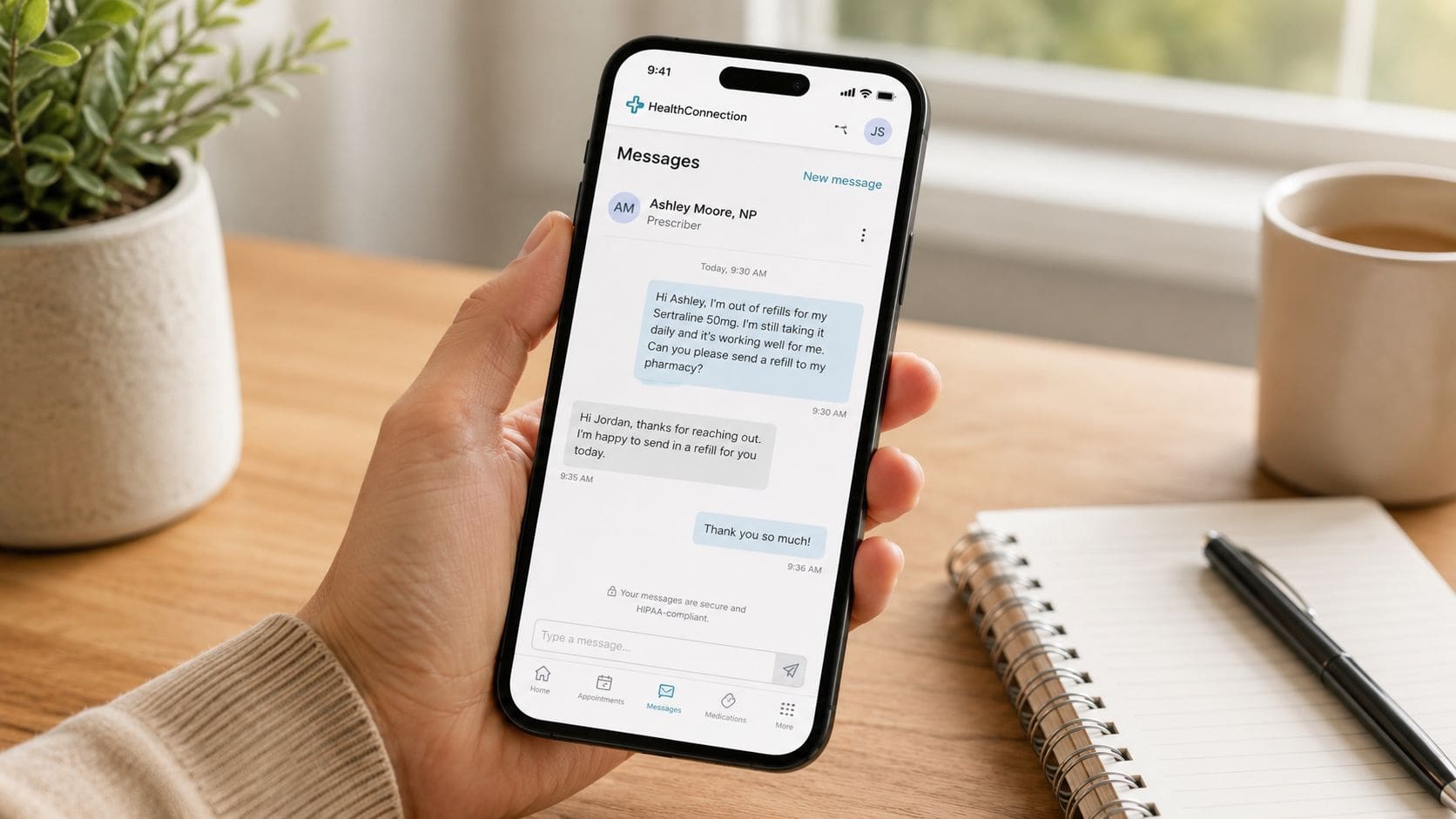
The fastest refill coordination usually happens through the patient portal, not over a back-and-forth phone tag loop. A clear message lets the prescriber see the current dose, how much medication is left, which pharmacies have already been tried, and whether symptoms are slipping. That is especially useful when the patient is in Philadelphia but the only stock is across town. It also helps when someone in a rural county has already called every nearby chain.
A good telehealth workflow is simple. The patient messages the portal with the facts. The prescriber reviews whether a same-class substitute makes sense. The follow-up visit is booked only if the dose needs to change or the substitute feels off. Good communication can make a real difference during unstable supply. That is why concise portal messages often work better than waiting to explain everything at the next appointment.
What a strong portal note includes
- Current medication and dose: The exact product matters, not just the class.
- Tablets remaining: This helps the prescriber decide whether a bridge is needed.
- Pharmacies contacted: It saves everyone from repeating calls already made.
- Symptom changes: Focus, sleep, appetite, and irritability should be named plainly.
An integrative psychiatric visit can also look at sleep, nutrition, exercise, and stress load. Those factors change how a substitute feels once the patient starts it. In practical terms, telepsychiatry is not only about replacing one bottle. It is also about checking whether the whole routine still supports attention and daily function. In Pennsylvania, that is useful for adults in Philadelphia, Pittsburgh, Harrisburg, Lancaster, and smaller communities that do not have easy specialist access.
The shortest downtime usually comes from one thing, fast, factual portal communication.
For adults already in care, the internal page on ADHD medication management online fits this workflow well. It matches the way shortage-era refill coordination happens, through secure messaging, follow-up, and timely dose decisions.
After a Forced Switch and When Supply Returns
Once a substitute is in place, the work begins. The first two to four weeks matter most. That is when focus, sleep, appetite, mood, and rebound symptoms tell the prescriber whether the replacement is holding up. A new stimulant plan can feel workable on day one. It can still prove too short, too strong, or too jittery by the end of the second week.
What to watch daily
- Focus and follow-through: Is the patient finishing tasks, or just starting them?
- Sleep and appetite: New insomnia or appetite loss can mean the substitute is too activating.
- Mood and irritability: A sharper edge can signal rebound or poor coverage.
- Wear-off pattern: Early afternoon crashes often matter more than the capsule name.
Those changes should be written down, not guessed from memory. A daily note, even a brief one in the patient portal or a phone reminder, gives the prescriber a cleaner picture than a vague report weeks later. If the medication is helping some parts of the day but not others, that is useful data, not a failure.
When the original medication returns, the switch back should still be deliberate. The fact that the preferred product is back in stock does not mean the substitute should be abandoned without review. The prescriber may decide to step back into the original regimen carefully so the patient does not lose the stability gained during the shortage.
Some reactions need faster contact. Chest pain, severe blood-pressure changes, new suicidal thoughts, or a sudden loss of effectiveness with new symptoms should be reported urgently rather than waiting for the next portal exchange. Those are not refill problems. They are clinical problems.
For adults who want a practical way to track how treatment is going after any switch, the Feeling Journal tools and the portal itself can be useful, especially when the medication pattern changes from week to week. The goal is to make the data easy to review so the next decision is not based on guesswork.
The shortage is still manageable when the steps are steady: count the remaining supply, message the prescriber, rotate through pharmacies, switch within class only when appropriate, and follow up after any change. Adults in Pennsylvania who need structured ADHD care during unstable supply periods can verify insurance or schedule a virtual evaluation with Integrative Psychiatry of America. The practice provides telehealth psychiatric care and medication management across Pennsylvania, including Philadelphia, with portal-based refill coordination that fits this exact workflow.