
Late on a weekday night, a Pennsylvania adult is usually not searching for “ADHD testing” because it sounds interesting. The search usually starts after missed deadlines, half-finished tasks, lost keys, another tense conversation at home, or the sense that focus has been harder to trust for years. At that point, the central question is not whether attention feels off. It's whether the next step should be an ADHD evaluation, formal ADHD testing, or both.
That difference matters because ADHD diagnosis is not built on a single test. Authoritative clinical guidance says there is no single test that can diagnose ADHD, and a proper assessment has to rule out conditions that can look similar, including sleep disorders, anxiety, depression, and learning disabilities (CDC guidance on ADHD diagnosis). For many adults, especially in telehealth, the most useful path is a structured clinical evaluation first, then testing only if the case is complex enough to justify it. For a broader look at why ADHD is so often missed or delayed, the prevalence of ADHD across age groups gives useful context.
Table of Contents
- Why the Difference Between Evaluation and Testing Matters
- Understanding Clinical Evaluation Versus Neuropsychological Testing
- What Happens During a Comprehensive ADHD Evaluation
- When ADHD Testing Adds Value and When It Does Not
- Insurance Coverage and Out-of-Pocket Costs for Evaluation and Testing
- How to Prepare for Your ADHD Evaluation in Pennsylvania
- Next Steps After Your Evaluation and Starting Treatment
Why the Difference Between Evaluation and Testing Matters
A lot of people reach the same crossroads. They know something is wrong, they've read a few screening lists, and they assume a big test battery will finally give them a yes-or-no answer. In real practice, that assumption can waste time and money, because the most useful first step is often a clinical ADHD evaluation, not a giant testing package.
The late-night search that leads to the wrong purchase
A patient in Pittsburgh, Philadelphia, or Erie might find a page for “ADHD testing” and think that's the only legitimate route. But testing and evaluation do different jobs. A screening tool or computerized attention task can measure certain functions, while a diagnostic evaluation pulls together history, impairment, and competing explanations before anyone labels the problem ADHD.
Practical rule: if the question is “What is going on, and what else could it be?”, the evaluation comes first.
That order matters because ADHD symptoms overlap with many other problems. Sleep loss can look like inattention. Anxiety can look like distractibility. Depression can look like slow processing and poor follow-through. A good clinician has to sort through those possibilities before calling it ADHD.
Why cost and accuracy are tied together
The most expensive option is not always the most accurate one. Research cited by the CDC shows that objective measures alone predicted ADHD diagnosis with 79% accuracy in adults and 78% in children, but adding subjective clinical information raised accuracy to 89.5% in adults and 86.7% in children (CDC diagnosis guidance). That is the practical reason many adults do better with a broader ADHD evaluation instead of testing alone.
For people in Pennsylvania, that difference also affects access. A telehealth evaluation can often be the fastest path to a real answer, while a full testing battery can add scheduling delays, extra visits, and higher out-of-pocket risk. The smartest next step is usually not “more testing.” It's the right kind of assessment for the level of complexity.
Understanding Clinical Evaluation Versus Neuropsychological Testing
A psychiatric clinician and a testing psychologist are not doing the same job. A clinical psychiatric evaluation asks whether the symptom pattern, onset, impairment, and differential diagnosis fit ADHD. Neuropsychological testing measures specific abilities, such as attention, working memory, and processing speed, and can be useful when the picture is more complicated.
Side by side comparison
| Feature | ADHD Evaluation | ADHD Testing |
|---|---|---|
| Main purpose | Builds a diagnosis and rules out look-alike conditions | Measures attention, memory, impulse control, or executive function |
| Who leads it | A qualified clinician, such as a psychiatric nurse practitioner | A psychologist or other testing professional |
| Core inputs | Interview, history, rating scales, impairment, collateral reports | Computerized tasks, rating scales, and sometimes a broader test battery |
| Can it diagnose ADHD alone? | Yes, when done thoroughly | No, not by itself |
| Best use case | Most adults seeking a clear clinical answer | Complex cases, learning concerns, accommodations, or differential diagnosis |
| Common risk | Under-collection of collateral history | False reassurance or false positives if used alone |
A full ADHD evaluation online should still look like a real evaluation. It should include symptom history, functional impairment, onset over time, and a differential diagnosis review. In telehealth practice, that work can be done well when the clinician knows what to ask and knows when a brief screener is not enough.
For a closer look at the testing side, the psychological testing for ADHD page explains how testing fits into a broader diagnostic picture. That distinction matters because patients sometimes ask for “testing” when what they really need is a competent clinical assessment that can make a decision.
Where each approach fits in real life
A patient with a straightforward history of long-standing distractibility, disorganization, and school struggles may not need an elaborate battery. A patient with uneven academic skills, suspected learning disability, or a confusing pattern that could be anxiety, depression, or ADHD may benefit from more testing.
A brief screener can start the conversation. It cannot finish it.
That is especially true for adults. Adult ADHD often gets missed until work, parenting, or relationship demands expose the pattern. In that setting, the quality of the interview matters more than the number of subtests. The practical trade-off is simple, clinical evaluation is usually faster and less expensive, while testing can add cost, time, and, in some cases, clearer documentation for learning questions or accommodations.
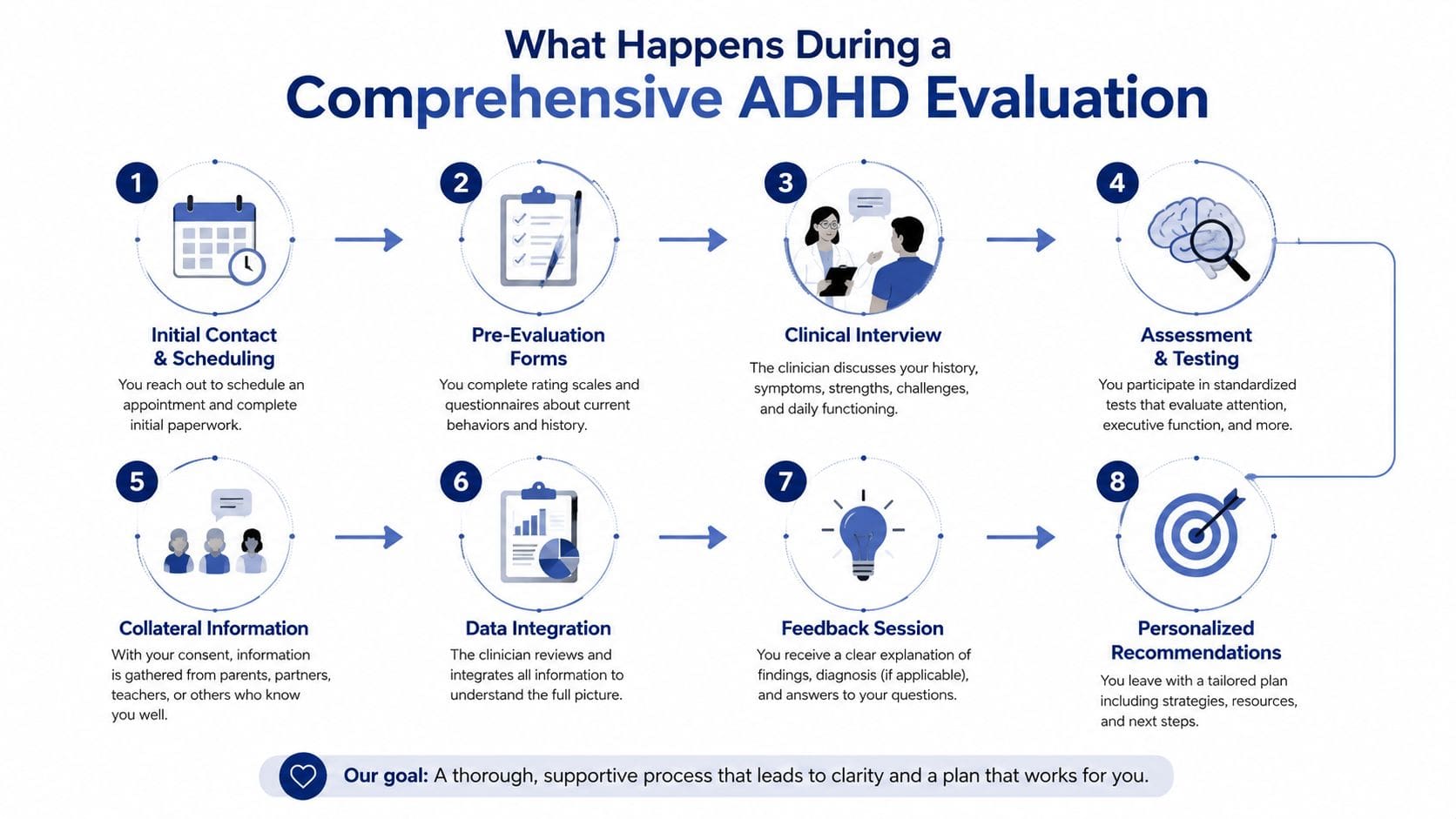
What Happens During a Comprehensive ADHD Evaluation
A good ADHD evaluation is staged, not rushed. The clinician starts by confirming that symptoms are present and are causing impairment, then checks whether the pattern has another explanation. That process is what keeps a diagnosis from becoming a guess.
The core clinical workflow
A high-quality ADHD assessment usually includes these steps:
- Symptom review. The clinician checks inattention, hyperactivity, impulsivity, and emotional regulation symptoms.
- Functional impairment review. The focus stays on work, home, school, finances, relationships, and day-to-day follow-through.
- Developmental and academic history. Childhood patterns matter because ADHD is a developmental condition.
- Collateral information. Input from a partner, parent, teacher, or family member can help cross-check the story.
- Rating scales. Structured questionnaires add consistency, especially when multiple informants are used.
- Differential diagnosis. The clinician rules out sleep problems, depression, anxiety, substance use, and other causes.
- Comorbidity review. ADHD can coexist with learning disability, mood disorder, or anxiety.
- Treatment planning. The clinician discusses next steps, which may include medication, skills work, or additional testing.
The key point is that the process is designed to answer more than one question. It asks whether ADHD is present, whether something else is driving the symptoms, and whether any coexisting problem needs its own treatment. That's why a board-certified psychiatric nurse practitioner can often do a lot in one thorough telehealth evaluation.
What to bring to the appointment
A patient doesn't need a box of records to start, but a few items help. School report cards, old evaluations, performance reviews, and prior mental health notes can be useful if they're available. A short list of current symptoms, the settings where they show up, and the age when they started can save time and sharpen the interview.
The most actionable information usually isn't a score. It's the combination of impairment evidence, onset history, and cross-setting consistency. A brief office score without that context can mislead both patient and clinician.
For people using telepsychiatry in Pennsylvania, the telehealth ADHD evaluation route can make this process much easier to access without sacrificing clinical rigor. A short video visit can still support a serious diagnostic conversation.
A related point often overlooked is that routine imaging or broad physical testing is not part of standard ADHD workups unless another condition is suspected. The goal is targeted, not excessive, investigation.
When ADHD Testing Adds Value and When It Does Not
Testing has a real role, but it's narrower than many websites suggest. Authoritative guidance says there are still no biomarkers, cognitive tests, or neuroimaging studies with enough sensitivity and specificity to diagnose ADHD by themselves (adult ADHD assessment guidance). That means the gold standard remains the clinical interview with collateral history.
When testing is useful
Testing earns its keep when the case is complicated. That includes suspected learning disabilities, uneven academic skills, unclear symptom origins, or a need for formal documentation for school or work accommodations. It can also help when the clinician needs more data to sort ADHD from another condition.
The benefit is not just “more data.” It's more targeted data. Objective tools can measure attention, activity, working memory, and processing speed, and those measures can help a clinician understand how a person functions under structured conditions. A broader review of ADHD assessment also supports using both ADHD-specific and broadband scales from multiple informants, with IQ, academic achievement, and executive function added when learning concerns are present (SAGE assessment review).
When testing does not add much
Testing is not automatically the answer when someone wants certainty. A negative or limited battery doesn't erase a strong history. A positive screen doesn't prove ADHD either. A systematic review found that positive predictive values in clinical populations often fell below 20%, which means many positive screens were false positives (systematic review of assessment methods).
That's one reason a clinician shouldn't order an expensive battery just because a patient wants one. In many adult cases, testing adds cost but not clarity. The expensive route becomes unnecessary when the interview, impairment review, and collateral history already fit the diagnosis.
Clinical reality: a good interview can be more valuable than a big test battery when the story is clear.
Computerized tools can still speed decisions. In one randomized trial, adding QbTest to routine assessment led to a 44% higher likelihood of reaching a diagnostic decision during the study period, reduced appointment length by 15%, and increased the share of patients with a diagnostic decision by six months from 50% to 76%. The same trial found no difference in diagnostic accuracy, which is exactly why faster isn't always better when the goal is the right diagnosis (QbTest trial summary).
For patients deciding whether to go deeper, the ADHD testing service can be reasonable in select cases, but it's not the default answer for every adult who struggles with focus.
Insurance Coverage and Out-of-Pocket Costs for Evaluation and Testing
The financial gap between evaluation and testing is one of the main reasons patients get stalled before they ever get clear answers. A diagnostic psychiatric evaluation is commonly handled differently from extended psychological or neuropsychological testing, and those differences show up in coverage rules, deductible exposure, and prior authorization requirements (Aetna coverage policy).
Why the bill can change so much
A standard ADHD evaluation is often billed like a routine mental health visit. Testing batteries can be billed separately, may involve multiple CPT codes, and are more likely to be limited, denied, or handled inconsistently depending on the plan. The same patient can move from a covered telehealth evaluation to a costly out-of-pocket testing package depending on which path is chosen.
That's why the question is not only “Do I have ADHD?” It is also “What will my plan cover?” Network status matters. Referral rules matter. Deductibles matter. Prior authorization matters. A clinician can help sort out the clinical decision, but the coverage decision still belongs to the insurer.
How to think about the trade-off
A practical way to approach it is simple.
- Start with evaluation if the main need is diagnosis, treatment planning, or medication management.
- Add testing if there is a learning concern, a messy differential diagnosis, or documentation needs for school or work.
- Check coverage early so the financial surprise does not come after the workup is already underway.
For some Pennsylvania adults, an online ADHD evaluation is the most accessible starting point because it can reduce travel time and still produce a clinically useful answer. Testing may still be appropriate later, but starting with the lower-cost, higher-yield step often makes more sense.
If you are trying to estimate expenses before booking, the how much ADHD testing costs page is a useful place to review the practical billing side. The key point is that evaluation and testing are not interchangeable in the eyes of insurers, and that difference can affect whether care stays manageable.
How to Prepare for Your ADHD Evaluation in Pennsylvania
Preparation doesn't need to be complicated. A patient across Philadelphia, Pittsburgh, Harrisburg, Erie, Scranton, Allentown, Lancaster, or Reading can make a telehealth assessment much smoother by collecting a few basics ahead of time. That small amount of prep often leads to a better interview and a more confident diagnosis.
What to gather before the visit
A useful packet might include report cards, past psychology notes, performance reviews, college transcripts if relevant, and any notes from prior providers. If none of that exists, a timeline of symptoms still helps. The clinician wants to know when the problems started, where they happen, and what gets worse or better.
A private and quiet setting matters too. Telepsychiatry works best when the patient can speak freely, hear clearly, and stay focused without interruptions. That's especially important for adults who've spent years masking symptoms in public or overcompensating at work.
Helpful approach: write down the three situations where focus breaks down the most, then bring that list to the visit.
Why telehealth works for many adults
A virtual evaluation can still be a real evaluation. A psychiatric nurse practitioner can ask about childhood patterns, current functioning, mood, sleep, anxiety, and substance use, then decide whether the presentation fits ADHD or something else. In Pennsylvania telepsychiatry, that can spare patients long drives and long waits without cutting corners on clinical judgment.
A good starting point for many adults is the Adult ADHD Assessment tool, which can help organize symptoms before the appointment. It's not a diagnosis, but it can make the conversation more precise.
One practical caution matters here. Telehealth doesn't replace the need for honest detail. A vague description like “I can't focus” helps less than concrete examples from work, home, and relationships. The more specific the history, the easier it is to tell ADHD apart from sleep problems, anxiety, depression, or another issue that needs different treatment.
Next Steps After Your Evaluation and Starting Treatment
A diagnosis is only useful if it leads somewhere. After an ADHD evaluation, the clinician may confirm ADHD, identify a different condition, or recommend additional testing in a complex case. If ADHD is present, treatment usually extends beyond medication and should be individualized to the person's actual barriers.
What treatment usually includes
ADHD treatment often includes medication management, follow-up visits, and practical support for daily functioning. Integrative care can also include exercise counseling, nutritional education, mindfulness practices, and lifestyle adjustments that support attention and emotional regulation. None of those replace diagnosis, but they can make the treatment plan more workable.
Ongoing follow-up matters because ADHD care isn't a one-and-done event. Symptoms can shift, side effects can show up, and life circumstances change. Stable outcomes usually depend on adjusting the plan over time, not just writing a prescription and hoping for the best.
For patients still gathering information, a few free tools can help build self-awareness while waiting for care. The Anxiety Symptom Checker, Daily Agenda Planner, Feeling Journal, Exercise Routine Generator, and 5-4-3-2-1 Grounding Tool can all support symptom tracking and day-to-day coping.
For adults in Pennsylvania, especially those who've been put off by long waits or unclear billing, a thoughtful ADHD evaluation online can be the fastest path to clarity. When the clinical picture is straightforward, expensive testing usually isn't the answer. When the case is complex, testing can add useful detail, but it still works best after a real evaluation has framed the question correctly.
If focus, organization, or emotional regulation have been getting in the way, Integrative Psychiatry of America offers virtual ADHD evaluations, medication management, and evidence-informed care across Pennsylvania. Visit Integrative Psychiatry of America to learn more about ADHD evaluation, verify insurance coverage, or schedule a telehealth appointment that starts with the right kind of assessment.