
A late-night search for ADHD Testing usually starts the same way. Someone in Philadelphia, Pittsburgh, Harrisburg, or a smaller Pennsylvania town is sitting with a half-finished to-do list, a missed deadline, and the nagging thought that this has been happening for years, not days. They're not looking for a label to collect, they're looking for a clear answer about whether an adult ADHD test or ADHD assessment can finally explain why focus, follow-through, and organization keep slipping.
That search can feel urgent because the stakes are real. A person may have been called careless, lazy, or inconsistent for so long that diagnosis starts to feel less like a medical question and more like a reality check. The key point is simple, though it's often missed online, no single questionnaire or computer test independently confirms ADHD. A credible ADHD diagnosis comes from a layered clinical process, not a one-click result.
Table of Contents
- Why Adults Search for ADHD Testing Answers
- The Different Types of ADHD Testing Explained
- Why No Single Test Confirms ADHD
- What a Comprehensive ADHD Evaluation Actually Involves
- Common ADHD Rating Scales and Testing Tools
- Who Gets Misdiagnosed or Missed in ADHD Testing
- Getting an ADHD Evaluation Through Telepsychiatry in Pennsylvania
Why Adults Search for ADHD Testing Answers
A common pattern shows up in real life. An adult in Lancaster or Allentown spends months trying productivity apps, sleep changes, new calendars, and willpower, but the same problems keep coming back. By the time they search for ADHD testing Pennsylvania or ADHD testing Philadelphia, they usually want more than information, they want a next step that doesn't waste time or money.
The emotional side of the search
Adults rarely look for an adult ADHD evaluation because they're curious. They usually look because work is harder than it should be, relationships are strained by forgetfulness, and daily life takes more energy than it seems to take other people. That tension is real, and it deserves a careful assessment instead of a dismissive answer.
Practical rule: if the search starts with shame, the evaluation should start with clarity, not judgment.
Many people also want to know whether their symptoms are ADHD or something else. That question matters because focus problems can overlap with anxiety, depression, trauma, sleep issues, and learning differences, which is why a true ADHD assessment has to go beyond a checklist. A useful first step is reviewing your own symptoms in a structured way, such as with the Adult ADHD Assessment, before booking care.
Why understanding the testing landscape matters
Patients often assume every ADHD test works the same way. It doesn't. A rating scale, an online screener, a computerized attention task, and a full diagnostic interview all play different roles, and they carry very different diagnostic weight.
That distinction matters before anyone pays for testing. A brief form can flag risk, but it can't establish childhood onset, functional impairment, or whether another condition explains the symptoms better. A thoughtful online ADHD assessment should be treated as a doorway into care, not the final answer.
The Different Types of ADHD Testing Explained
The phrase ADHD testing covers several very different tools, and confusion starts when they're lumped together. Some measures are best at screening, some help document symptom severity, and some are used to rule in or rule out other explanations. The strongest evaluations combine them in a stepped model rather than treating every tool as equal.
Rating scales, clinical interviews, and objective tests
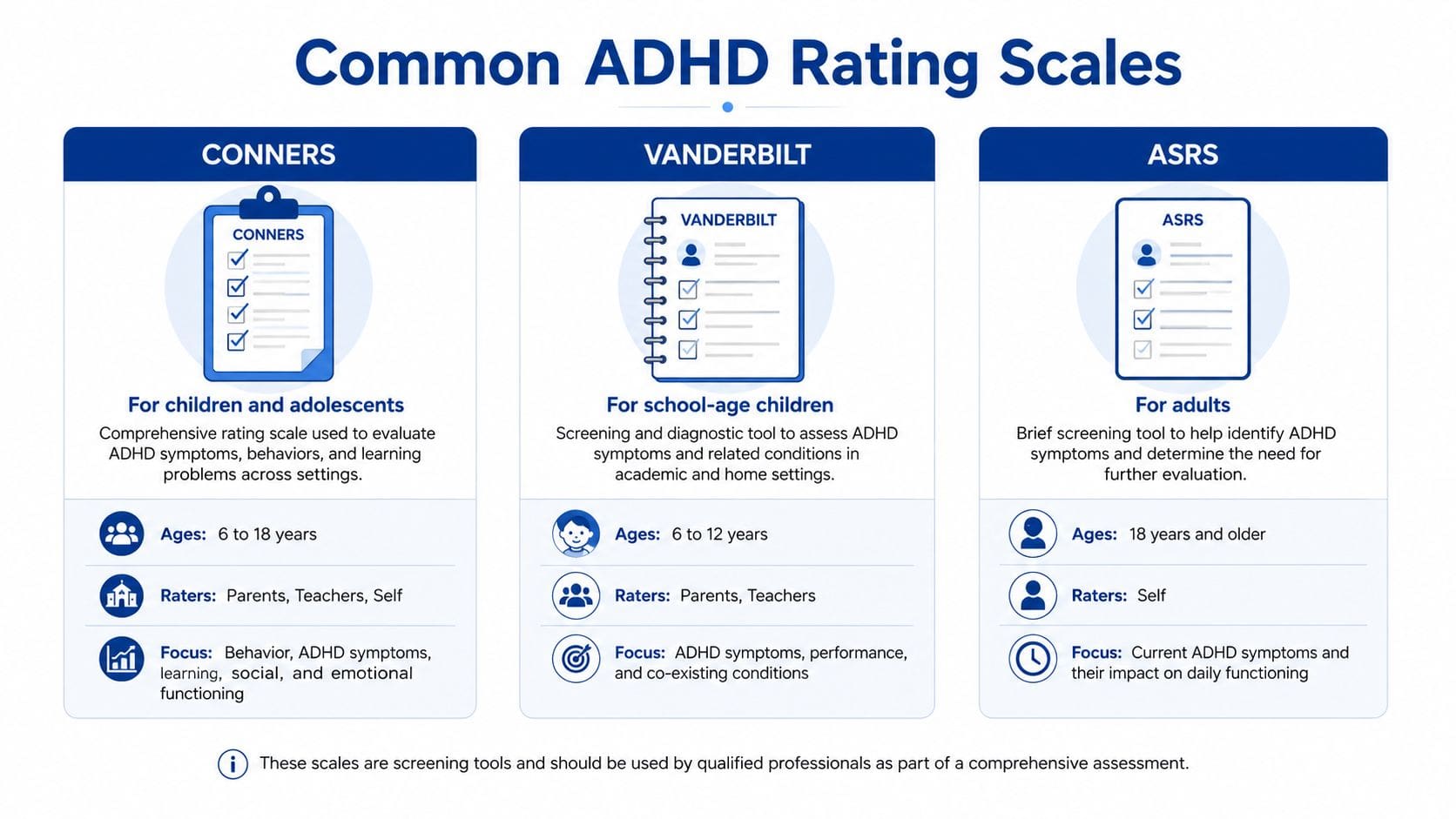
Rating scales are questionnaires that ask about symptoms in a structured way. Tools such as the Conners Abbreviated Symptom Questionnaire and the Vanderbilt ADHD Diagnostic Rating Scales can flag concern, but they don't diagnose ADHD by themselves. The AAFP review notes that the Conners Abbreviated Symptom Questionnaire has the best combination of positive and negative likelihood ratios, while the Vanderbilt scales show only moderate sensitivity and specificity in elementary-school-aged children (AAFP review).
A clinical evaluation is different. It's a detailed semi-structured interview that explores current symptoms, childhood history, impairment, and collateral information from family, school records, or older documentation when available. For adults, that history is the backbone of diagnosis.
Computerized tests measure attention and response patterns in a controlled setting. NICE's assessment review describes QbTest as a class I device for ages 6 to 60 that combines a computer task with infrared motion tracking and compares the result with a normative sample matched for age and sex (NICE protocol). These tools can add useful quantitative data, especially for baseline tracking, but they're still adjunctive.
How the categories differ in practice
Psychological testing and neuropsychological testing look broader. They can assess working memory, learning, processing, and other cognitive functions that sometimes help when the picture is messy. Even so, the most important point remains the same. The more the evaluation relies on a single score, the weaker it becomes as an ADHD decision tool.
| ADHD Testing Methods Compared | What It Measures | Typical Duration | Diagnostic Role |
|---|---|---|---|
| Rating scales | Symptom frequency and severity | Brief, usually forms completed before or during visit | Screening and symptom tracking |
| Clinical evaluation | History, impairment, childhood onset, differential diagnosis | Longer interview | Core diagnostic step |
| Computerized testing | Attention, impulsivity, motor activity | About 15 to 20 minutes | Adjunctive data |
| Psychological testing | Broader cognitive and behavioral patterns | Varies by battery | Clarifies complex cases |
| Neuropsychological testing | Cognitive domains such as attention and executive functioning | Varies by battery | Helpful when comorbidity or diagnostic uncertainty is high |
For patients considering a virtual visit, an online ADHD evaluation can still include the right clinical steps, as long as the clinician is using the tools in the right order. That ordering matters more than the brand name of the questionnaire.
Why No Single Test Confirms ADHD
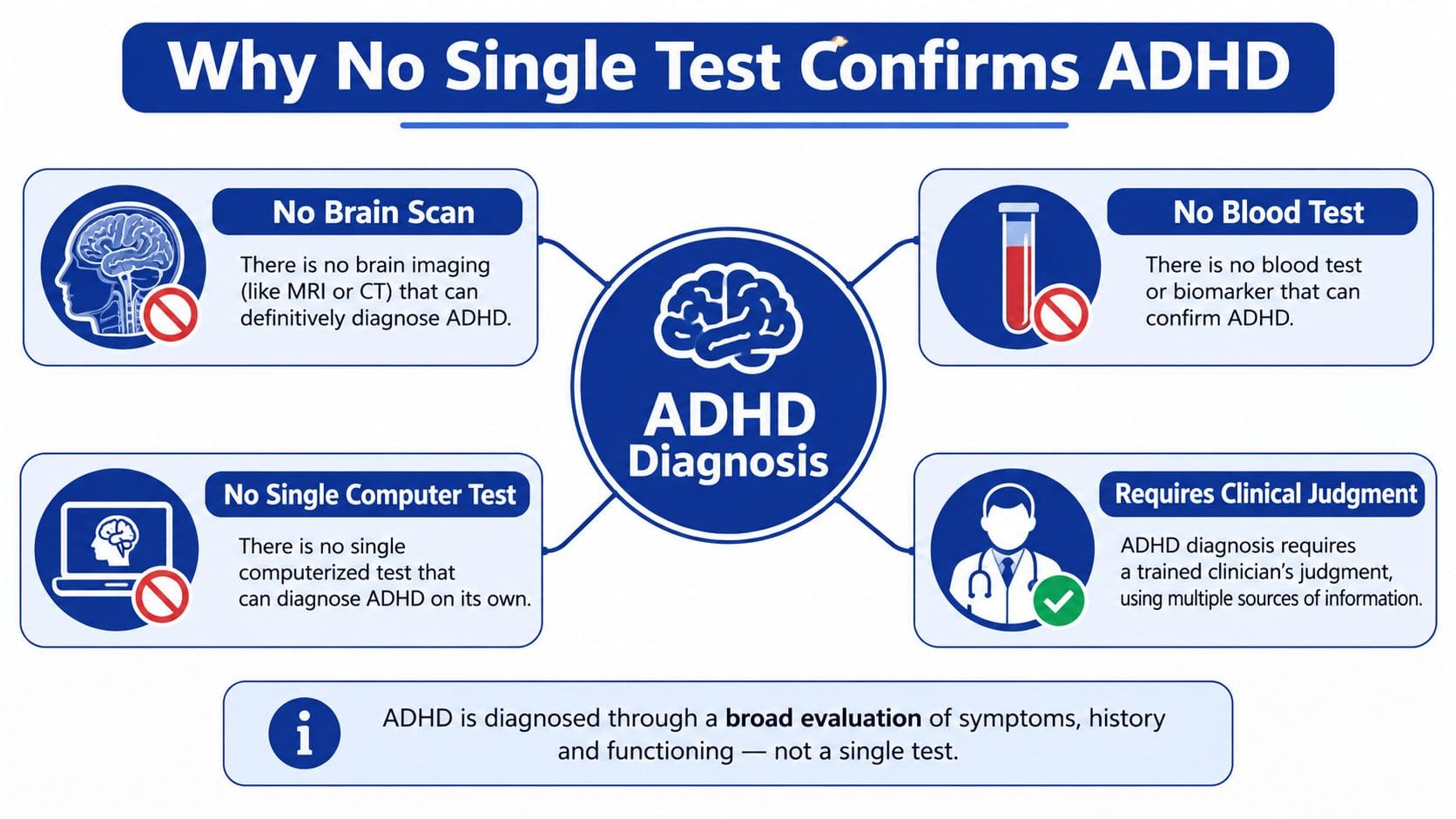
The biggest misconception in ADHD Testing is the idea that there must be a definitive scan, lab test, or computer score that proves the diagnosis. There isn't. The CDC states directly that there is no single diagnostic test for ADHD, and that problems such as sleep disorders, anxiety, depression, and learning disabilities can look similar during evaluation (CDC diagnosis guidance).
What the evidence-based model actually looks like
Adult ADHD diagnosis is clinical. That means the clinician weighs symptom history, functional impairment, and collateral information, then checks for other explanations before deciding whether ADHD best fits the pattern. The U.S. HHS ASPE report says clinical experts unanimously reported that neuropsychological testing is not necessary to diagnose ADHD in adults, and the National Academies chapter notes that false-positive screening and comorbidities like trauma and substance use can complicate the picture (HHS ASPE report).
That matters because more testing can create false confidence. A person may score in a way that looks concerning, but if sleep deprivation, panic, depression, or trauma is driving the presentation, the score doesn't solve the diagnostic problem. It only becomes useful when it sits inside a broader clinical picture.
Why objective tests can't do the whole job
A clinical interview remains central because objective tests have limits in real outpatient settings. A study in adults found that neuropsychological tests had poor discriminative ability, while the DIVA interview performed better, with sensitivity 90.0% and specificity 72.9%; adding continuous performance test variables improved specificity to 83.3% (PubMed study). Another Frontiers study concluded that QbTest was not able to discriminate ADHD patients from non-ADHD patients in an outpatient clinic, which reinforces the same practical point, standalone testing can't replace clinical judgment.
No computer task can tell the full story of a person's attention, impairment, and life history.
For readers who notice anxiety around testing itself, it can help to understand how symptom overlap works in other conditions too. The article on why social situations trigger anxiety is a useful example of how similar outward behaviors can come from different causes, which is exactly why diagnostic reasoning matters.
What a Comprehensive ADHD Evaluation Actually Involves
A strong adult ADHD test process is more like a structured investigation than a one-time exam. Clinicians usually begin with symptom screening, then move into a detailed interview, gather context from history, and rule out alternative causes before making a diagnosis. Cleveland Clinic describes this as a three-step process, identify symptoms and impairment, rule out alternative causes, and identify comorbid conditions (Cleveland Clinic).
The workflow patients can expect
The first part is usually a screening conversation and questionnaire set. That helps the clinician see whether the symptom pattern sounds like ADHD, another condition, or a mixture of both. It also gives a starting point for what needs deeper review.
The next step is the clinical interview. For children, Cleveland Clinic notes that diagnosis typically looks for six or more symptoms for at least six months, while adults are assessed for at least five established ADHD behaviors in one category for the same six-month period (Cleveland Clinic). That's why childhood history matters so much in an adult assessment. ADHD has to make developmental sense, not just current sense.
What makes the evaluation feel complete
A careful clinician also looks at function. Symptoms that are mildly annoying on paper can be severely disruptive at work, at home, or in relationships. The key question is not only whether symptoms exist, but whether they interfere with daily life.
Common parts of the evaluation include:
- Developmental history: early school behavior, report cards, and parent observations when available.
- Functional impairment: missed deadlines, disorganization, forgetfulness, driving issues, relationship strain, or money problems.
- Collateral information: family input, old records, or teacher comments when available.
- Comorbid screening: anxiety, depression, learning differences, sleep problems, and substance use.
A patient preparing for an adult diagnosis visit can make the appointment more productive by collecting old school records, a current medication list, and a short list of the daily problems that matter most. The goal is not to prove ADHD by force. The goal is to give the clinician enough information to separate ADHD from other possibilities.
Common ADHD Rating Scales and Testing Tools
Not every tool in ADHD Testing has the same purpose, and the difference is easy to miss online. Some tools are designed to screen for symptoms, some to quantify baseline performance, and some to support treatment monitoring after diagnosis. A good clinician chooses the tool based on the clinical question, not the other way around.
Conners, Vanderbilt, and adult screeners
The Conners Abbreviated Symptom Questionnaire stands out because the AAFP review reports that it has the best combination of positive and negative likelihood ratios for screening (AAFP review). That makes it useful when the goal is to raise or lower suspicion in a structured way.
The Vanderbilt ADHD Diagnostic Rating Scales are common in school-age populations. The same review says they have only moderate sensitivity and specificity in elementary-school-aged children, which means they can help, but they can't carry the diagnosis alone (AAFP review). Adult screeners serve a similar role, they organize symptom review, but they do not replace interview-based diagnosis.
Computerized attention testing
Computerized tools like QbTest add another layer. NICE describes it as a 15 to 20 minute computer task with motion tracking and age and sex-matched norms, and notes a UK per-test cost of £31.20 excluding VAT in the health system it reviewed (NICE protocol). That kind of test can be useful for baseline measurement and for tracking changes over time, especially when medication is started or adjusted.
Clinical rule: quantitative data can sharpen an evaluation, but it can't overrule a weak history or missing impairment.
A practical reason some clinics use these tools is continuity. A baseline attention score can be compared later when treatment is underway, which helps clinicians follow change without relying only on a patient's memory of how they felt. That's especially useful in telehealth settings, where follow-up needs to stay efficient and consistent.
For patients exploring care options, Integrative Psychiatry of America also offers psychological testing for ADHD as part of its telepsychiatry workflow, which can be helpful when a structured assessment needs more depth than a screening form provides. Used correctly, that kind of service complements clinical judgment rather than trying to replace it.
Who Gets Misdiagnosed or Missed in ADHD Testing
Some people show up to ADHD diagnosis after years of being overlooked. Others show up after being told they have ADHD when the actual issue is different. Both problems happen because the symptoms are not unique to ADHD, and the presentation is not the same in every patient.
Disparities and symptom overlap
The HHS report says ADHD diagnosis and treatment among adults have increased, but sex, racial, and ethnic disparities persist, and underdiagnosis remains an issue (HHS barriers report). That means the people most likely to be missed are often the ones who don't match the stereotype, including adults who mask symptoms well, women whose inattention gets mislabeled, and patients whose difficulties are attributed to stress alone.
Symptom overlap also makes misdiagnosis more likely. Trauma can look like distractibility. Depression can look like low motivation. Anxiety can look like restlessness and poor concentration. Sleep problems can make even a healthy attention system seem broken.
Why false positives happen in adults
The National Academies chapter notes that adults often screen false-positive, symptoms are heterogeneous, and comorbidities such as trauma and substance use complicate diagnosis (National Academies). That's one reason a long questionnaire by itself can be misleading. It may capture distress, but not the cause.
A useful way to think about it is this. A patient may score high on a screener because they are overwhelmed, not because they have ADHD. Another patient may score modestly but still have ADHD because they've built a life around coping strategies that hide the pattern. The evaluation has to pick up both situations.
What newer tools can and cannot do
Digital and multimodal assessment tools, including VR, eye-tracking, EEG, and actigraphy, are getting attention. A 2025 review says the evidence in adults is still preliminary and these tools are not guideline-endorsed for routine diagnosis yet (HHS barriers report). That makes them interesting, but not decisive.
For adults who feel missed by standard care, the most useful next step is usually not more gadgets, it's a more careful history. The question is whether the symptoms were present earlier in life, whether they impair function across settings, and whether another explanation better fits the pattern. That framework keeps the evaluation grounded in real clinical decision-making.
Getting an ADHD Evaluation Through Telepsychiatry in Pennsylvania
For many Pennsylvania adults, access is the biggest barrier. Travel time, work schedules, insurance questions, and long waits can slow down an adult ADHD evaluation long before treatment begins. Telepsychiatry helps remove some of that friction by bringing the evaluation to the patient's home, which matters for people in Philadelphia, Pittsburgh, Harrisburg, Erie, Scranton, Allentown, Lancaster, Reading, and surrounding communities.
What virtual assessment can include
A well-run online ADHD assessment still follows the same clinical logic as an in-person visit. The clinician reviews symptoms, developmental history, impairment, and possible comorbid conditions, then decides whether rating scales, additional testing, or medication planning make sense. Integrative Psychiatry of America provides virtual psychiatric evaluations, medication management, and evidence-informed mental health treatment throughout Pennsylvania through secure telehealth.
That matters after diagnosis, because ADHD treatment after diagnosis usually doesn't end with a label. It may involve medication management, lifestyle changes, sleep support, and ongoing monitoring so that treatment fits the patient's day-to-day life. For some patients, anxiety or mood symptoms also need to be addressed at the same time.
Making the appointment work better
Preparation helps the visit move faster. A patient who has a short symptom timeline, prior records, a medication list, and a few concrete examples of work or home impairment gives the clinician better material to work with. That's especially important when a virtual assessment needs to balance efficiency with depth.
Patients also worry about logistics. A practice using a virtual assistant for mental health practice can make scheduling, reminders, and intake smoother, which reduces the back-and-forth that often delays care. For people trying to get answers without adding more administrative stress, that kind of support can matter.
For readers comparing options, a telehealth route can be especially practical when the goal is not just diagnosis, but continuity. The right evaluation should lead to a plan, and the plan should lead to follow-up that's easy to keep.
If ADHD symptoms are getting in the way of work, parenting, relationships, or daily structure, a focused evaluation is the right next step. Integrative Psychiatry of America offers virtual ADHD evaluation, medication management, and practical mental health tools for adults across Pennsylvania, including Philadelphia and beyond. Visit Integrative Psychiatry of America to learn more about care options, verify coverage, or start with a free tool that fits your situation.