
A positive pregnancy test can turn a routine refill into a hard decision overnight. For someone in Philadelphia, Pittsburgh, Harrisburg, or a smaller Pennsylvania town, the question is often sitting right there in the medicine cabinet, keep taking Focalin or stop now. That's not a theoretical internet query, it's a real clinical crossroads shaped by ADHD symptoms, work demands, safety, and what happens if treatment suddenly disappears.
Table of Contents
- The Question That Brings You Here
- What Focalin Is and Why That Matters in Pregnancy
- What the Focalin Label and Animal Studies Show
- The Larger Methylphenidate Evidence Base in Pregnancy
- How Clinicians Make This Decision
- Beyond Birth Defects What Else the Evidence Shows
- Pregnancy Planning Breastfeeding and the Pregnancy Registry
- Key Takeaways and Getting Personalized Care in Pennsylvania
The Question That Brings You Here
A patient in Philadelphia may sit down for a telehealth visit with a bottle of Focalin in one hand and a positive pregnancy test in the other. Another person in Erie or Lancaster may already be planning conception and asking whether it makes sense to stay on dexmethylphenidate at all. The anxiety is usually immediate, because the decision feels too important to leave to a search result.
What the real question is
The question is not whether Focalin while pregnant is “safe.” That framing is too blunt for the evidence available. The better question is whether continuing treatment helps more than it harms in a specific pregnancy, at a specific stage, for a specific person.
Practical rule: if ADHD symptoms threaten driving, work, prenatal follow-through, or basic organization, the decision deserves a real medication review, not an automatic stop.
That review starts with symptom severity, prior response, blood pressure history, and what has happened when stimulant treatment was paused before. It also has to include the obstetric side of the conversation, because pregnancy changes appetite, sleep, blood pressure, and day-to-day functioning.
What this article can answer
The evidence can clarify what's known about Focalin pregnancy, what remains uncertain, and why clinicians usually make this a risk-benefit decision instead of a one-size-fits-all rule. It can also explain why dexmethylphenidate data are limited, why the broader methylphenidate literature still matters, and how breastfeeding and pregnancy planning fit into the picture.
What it cannot do is replace a prescriber who knows the full history. The right plan for one patient may be to continue. For another, it may be to taper, switch, or pause with close monitoring. Both can be reasonable depending on the facts.
What Focalin Is and Why That Matters in Pregnancy
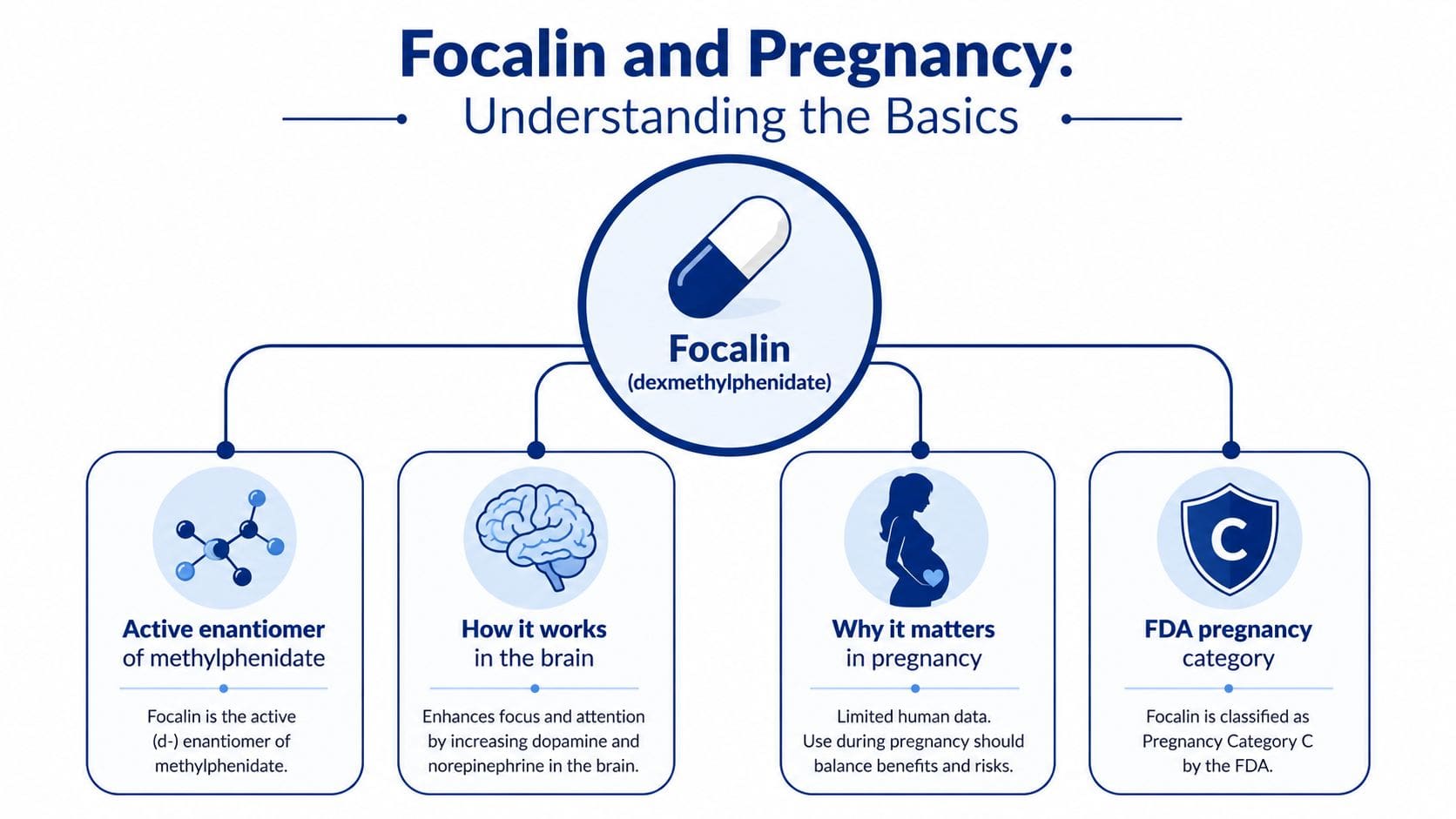
A patient asks whether she can stay on Focalin while pregnant, and the first step is to identify exactly what she is taking. Focalin contains dexmethylphenidate, the active enantiomer of methylphenidate. That distinction matters because much of the pregnancy literature is built around the broader methylphenidate class, not Focalin alone. In practical terms, Focalin is not the entire compound, it is the part that produces most of the medication's clinical effect.
Why the chemistry matters
Dexmethylphenidate and methylphenidate are closely related, but they are not identical exposures. Amphetamine pregnancy data also should not be carried over to Focalin, because the molecules, metabolism, and clinical effects are different. A careful clinician separates dexmethylphenidate pregnancy counseling from amphetamine counseling instead of treating every stimulant as interchangeable.
That distinction becomes real in treatment planning. If a patient functions well enough on Focalin to eat, work, drive safely, and keep prenatal visits, that benefit has to be weighed against the limits of the pregnancy data. A medication review in a Pennsylvania telepsychiatry visit usually starts there, with current symptoms, prior stimulant response, blood pressure history, sleep, appetite, and what happened the last time treatment was stopped or reduced. For readers comparing stimulant classes, the broader discussion of Ritalin and pregnancy helps show why methylphenidate data matter, even when the question begins with Focalin.
How clinicians usually interpret the label
The FDA label for Focalin XR classifies the medication as Pregnancy Category C, which means risk could not be ruled out and human data were limited at the time of labeling FDA label. That does not mean the drug is known to be dangerous. It means the evidence was not strong enough to call it harmless.
The label language also explains why Focalin during pregnancy is usually approached cautiously. The starting point is limited direct evidence, then the conversation shifts to the patient's psychiatric stability, day-to-day functioning, and the trade-offs of continuing treatment versus tapering, pausing, or switching with monitoring.
What the Focalin Label and Animal Studies Show
The strongest direct evidence for Focalin in pregnancy still comes from the product label and animal reproduction studies, not from large human trials. The 2012 prescribing information reports rat and rabbit studies during organogenesis at doses up to 20 mg/kg/day in rats and 100 mg/kg/day in rabbits, with no clear teratogenicity seen, although delayed fetal skeletal ossification occurred at the highest rat dose FDA label. The label also notes decreased postweaning body-weight gain in male offspring after exposure throughout pregnancy and lactation.
What those findings mean in practice
Animal data do not map cleanly onto human risk. Species, dose, timing, and route of exposure all differ, and therapeutic use in a patient is not the same as a reproduction study designed to test developmental toxicity. Even so, these studies are not meaningless reassurance. They are part of why clinicians stay cautious when a patient asks about Focalin pregnancy.
The older Focalin XR labeling also stated that adequate and well-controlled studies in pregnant women have not been conducted and that racemic methylphenidate caused teratogenic effects in rabbits at 200 mg/kg/day during organogenesis. That historical caution still shapes how prescribers think about the medication today, especially before a pregnancy is fully planned.
Why placental blood flow comes up so often
The more recent Focalin XR information also frames the issue as a fetal-perfusion concern. CNS stimulants such as Focalin XR can cause vasoconstriction and may decrease placental perfusion Novartis Focalin XR information. That is one reason obstetric and psychiatric teams usually treat stimulant exposure in pregnancy as a monitoring and decision-making issue, not a reflexive yes or no.
For readers comparing stimulant options, the broader methylphenidate discussion in Ritalin and pregnancy helps show why the class evidence matters, even when the question starts with Focalin.
The label does not prove harm in a human pregnancy, but it does explain why clinicians do not treat Focalin as a casual continuation medication during gestation.
The Larger Methylphenidate Evidence Base in Pregnancy
Direct Focalin data are limited, so counseling usually depends on the wider methylphenidate literature, since dexmethylphenidate is the active enantiomer of that compound. That broader human evidence is more reassuring than the animal-label caution, but it still does not justify treating the medication as risk-free.
What the numbers show
A U.S. analysis summarized by the MGH Center for Women's Mental Health reported congenital malformations in 3.5% of unexposed infants versus 4.59% of methylphenidate-exposed infants, with cardiac malformations at 12.7 per 1,000 unexposed infants versus 18.8 per 1,000 exposed infants; the adjusted relative risk was 1.11 for any malformation and 1.28 for cardiac malformations MGH summary. Those differences are small, but they are large enough to explain why cardiac risk stays on the radar in counseling.
A later systematic review and meta-analysis in JAMA Network Open included 10 studies and 16.5 million pregnant women. It found methylphenidate and atomoxetine were not associated with a significant increase in congenital anomalies or miscarriages, with pooled odds ratios of 1.14 for congenital anomalies and 1.15 for miscarriages versus unexposed pregnancies JAMA Network Open.
How to read those findings without overreacting
The practical reading is straightforward. Human data are mostly reassuring, and there is no strong signal for major teratogenicity across the class. At the same time, the cardiac signal in some analyses is enough that clinicians should not dismiss the question or talk as if there is no uncertainty. That is why Focalin during pregnancy is usually handled as an individualized decision, not a blanket yes or no.
MotherToBaby summarizes data from about 2,200 pregnancies and reports that methylphenidate is not expected to increase the chance of birth defects above background risk, while also noting one large database study that suggested a possible increased risk of heart defects with first-trimester exposure. I use that kind of mixed evidence in practice by separating reassurance from caution, then matching the plan to the patient's symptom burden, pregnancy timing, and whether the broader stimulant question has been reviewed in a focused way, such as in ADHD medication during pregnancy, stimulants and bupropion.
How Clinicians Make This Decision
A prescriber does not decide on Focalin and Pregnancy by reading one label and issuing a verdict. The practical question is whether continuing the medication preserves enough function to justify the exposure, and whether there are safer or workable alternatives for this patient at this point in pregnancy.
What gets reviewed first
The first conversation usually covers symptom severity without medication, how much the patient depends on treatment for daily structure, and whether there is a history of blood pressure changes, insomnia, appetite suppression, or anxiety. Trimester matters too, because the earliest organ-development concerns are different from later concerns about growth, blood pressure, or placental perfusion.
A good visit also asks what has happened before when stimulant treatment was stopped. Some patients can function with behavioral strategies and close support. Others quickly lose track of work, driving, prenatal care, or home responsibilities, and that loss of function becomes part of the medical picture.
Integrative Psychiatry of America's pregnancy-focused ADHD guidance fits into that kind of review because it centers medication history, symptom burden, and coordination with obstetric care rather than treating every stimulant exposure the same way.
What shared decision-making looks like in practice
Clinical reality: the right plan often changes if ADHD symptoms threaten safety, even when the pregnancy is otherwise uncomplicated.
In Pennsylvania telepsychiatry, follow-up can be easier to arrange, and that makes real-time adjustment more realistic. Clinicians can review appetite, sleep, blood pressure concerns, mood, and functioning without asking the patient to wait weeks for the next opening. That matters when the decision needs to respond to how the patient is doing now, not how she looked at a single appointment.
The conversation often includes a functional threshold. If ADHD symptoms worsen during pregnancy and the patient becomes less able to eat consistently, attend appointments, or manage work demands, that impairment becomes part of the risk calculation. The goal is not to push medication at all costs. It is to avoid creating a bigger problem by ignoring how impairment shows up in real life.
Breastfeeding also belongs in the same discussion, because the plan after delivery affects how clinicians think about treatment during pregnancy. A patient may choose to continue Focalin through pregnancy, taper before delivery, switch strategies after birth, or keep the medication stable and reassess once breastfeeding begins. The best choice depends on symptom severity, prior response, obstetric input, and how much support the patient has at home.
Beyond Birth Defects What Else the Evidence Shows
A patient may come in focused on birth defects, but counseling has to cover more than that. With stimulants, the next questions are placental blood flow, maternal blood pressure, preeclampsia, and preterm birth. The answer is not the same across the stimulant class, because dexmethylphenidate is not interchangeable with amphetamine data.
Why placental concerns stay on the table
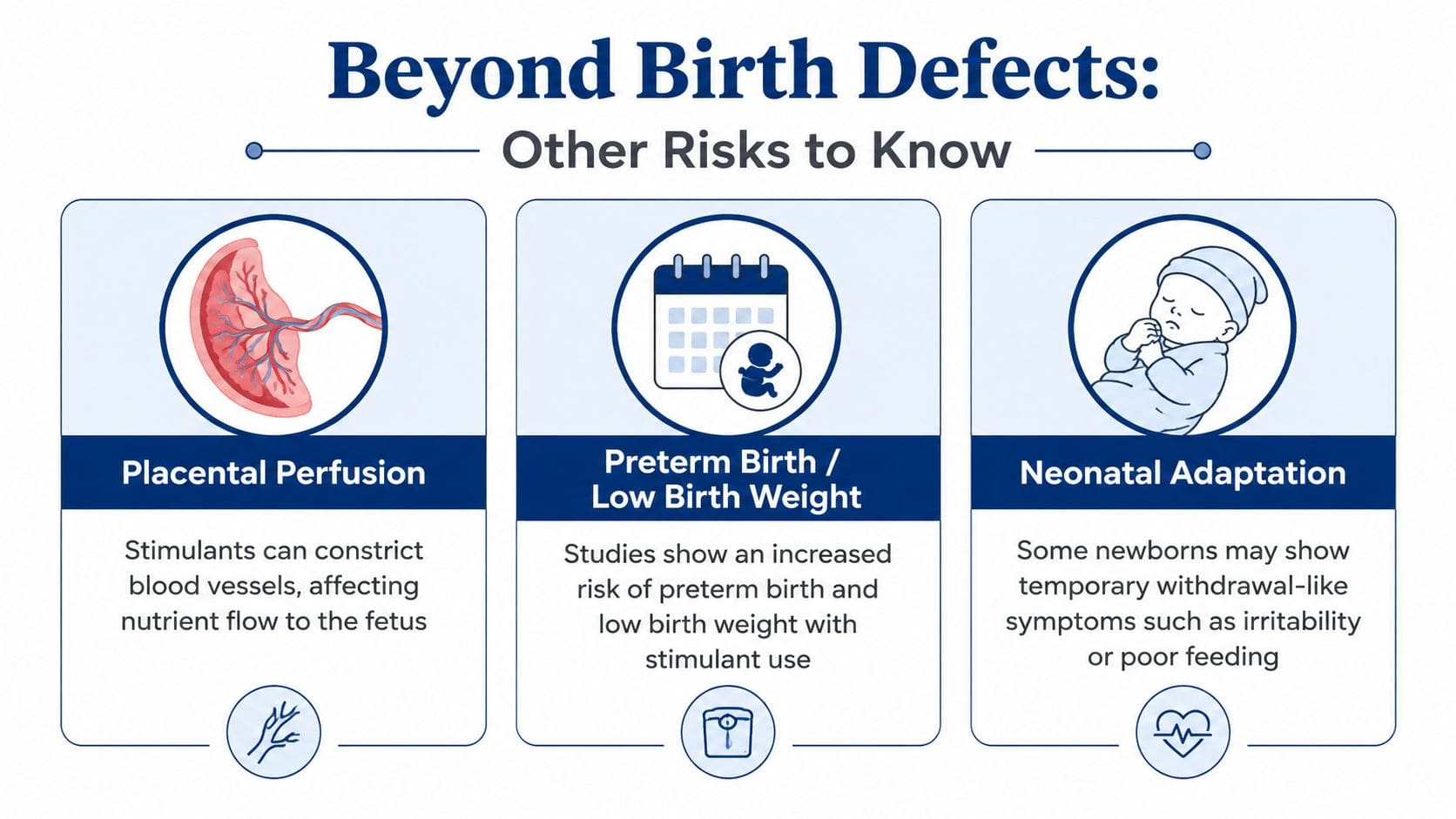
The Focalin XR label states that CNS stimulants can cause vasoconstriction and may decrease placental perfusion. That gives clinicians a concrete reason to watch blood pressure, nutrition, and fetal growth more carefully when treatment continues.
The broader literature also points to class differences. Independent reviews describe methylphenidate data as generally reassuring overall, while amphetamines may show more signal for preterm birth and low birth weight. That does not make methylphenidate risk-free, but it does mean medication choice matters.
Why adjusted studies matter more than headlines
Pregnant patients who take stimulants often differ from those who do not in ways that affect outcomes, including baseline health, mental health symptoms, and treatment complexity. That is why crude associations can shrink after confounding adjustment. In the broader stimulant literature, a large cohort study found that apparent risks were attenuated after adjustment, which argues against psychostimulant exposure being a major causal factor for most perinatal harms.
A 2024 systematic review also concluded that continuation of prescribed ADHD medication in pregnancy was not associated with a significant negative effect on maternal or offspring outcomes. In practice, that shifts the conversation away from blanket avoidance and toward individualized planning.
Integrative Psychiatry of America's stimulant pregnancy overview is helpful because it separates stimulant classes instead of treating every medication as if the risk profile were identical. That kind of distinction helps patients avoid unnecessary fear without sliding into false reassurance, and it fits the same practical approach used in Pennsylvania telepsychiatry when treatment choices are reviewed alongside planning, monitoring, and breastfeeding. For families thinking ahead after delivery, a skin to skin contact guide can also be part of the broader postpartum discussion, since infant care and feeding plans affect how medication decisions are made.
Pregnancy Planning Breastfeeding and the Pregnancy Registry
Planning ahead changes the conversation. So does the postpartum period, when sleep deprivation, recovery, and feeding demands can make ADHD symptoms feel sharper than they did before delivery.
What to discuss before conception
A patient thinking about pregnancy should bring a few practical questions to the prescriber: how stable symptoms are now, whether medication has been needed continuously, what happened on past dose reductions, and whether a slower taper or a different option makes sense. The right answer may be to stay on treatment. It may also be to adjust the dose before conception rather than after a positive test.
Breastfeeding deserves the same kind of honesty. Methylphenidate passes into breast milk in low amounts, and current guidance generally considers it compatible with breastfeeding in many cases, though the plan should still be individualized with psychiatric and pediatric input. That's especially important when the infant is premature, feeding is already difficult, or the mother needs a higher dose to remain functional.
Why the registry matters
The product information for Focalin XR states that there is a pregnancy exposure registry for females exposed to ADHD medications during pregnancy and directs patients and clinicians to the National Pregnancy Registry of ADHD Medications at 1-866-961-2388 Focalin XR prescribing information. Enrollment helps build the evidence base while giving patients a way to contribute to better counseling for others later.
For postpartum recovery, practical support matters too. A resource like the skin to skin contact guide can be helpful for families preparing for newborn care, especially when they're also planning medication discussions and feeding routines.
A good pregnancy plan doesn't end at delivery, it includes sleep, feeding, and how quickly symptom control may need to change after birth.
Key Takeaways and Getting Personalized Care in Pennsylvania
A patient often reaches this point after reading mixed messages and wanting a straight answer. For Focalin pregnancy, the honest answer is that direct human data are limited, so clinicians have to weigh the medication's mechanism, animal findings, and the wider methylphenidate evidence base. That broader evidence is generally reassuring, though a small cardiac signal still deserves respect in counseling and follow-up.
Focalin and Pregnancy Evidence at a Glance
| Evidence Source | Population | Key Finding | Practical Meaning |
|---|---|---|---|
| FDA label for Focalin XR | Animal and labeling data | Human studies in pregnant women were not adequate and well-controlled; vasoconstriction and placental perfusion concerns are noted | Use is a risk-benefit decision, not a routine default |
| FDA label for Focalin | Rat and rabbit studies | No clear teratogenicity in those studies, but delayed fetal skeletal ossification appeared at the highest rat dose | Animal data are cautiously reassuring, but not proof of human safety |
| MGH summary of U.S. analysis | Exposed and unexposed infants | Malformations 3.5% vs 4.59%, cardiac malformations 12.7 vs 18.8 per 1,000, adjusted RR 1.11 and 1.28 | Overall risk looks low, but cardiac monitoring stays relevant |
| JAMA Network Open meta-analysis | 10 studies, 16.5 million pregnancies | No significant increase in congenital anomalies or miscarriages, pooled ORs 1.14 and 1.15 | The class looks mostly reassuring, with ongoing caution |
| MotherToBaby methylphenidate fact sheet | About 2,200 pregnancies | Not expected to raise birth-defect risk above background, with one database signal for heart defects | Helpful reassurance, but not a blanket guarantee |
| Focalin XR prescribing information | Pregnancy exposure registry | Registry available through the National Pregnancy Registry of ADHD Medications at 1-866-961-2388 | Patients can contribute to future evidence and monitoring |
The common question focuses on birth-defect risk, but the decision rarely ends there. ADHD severity, what happens when medication is interrupted, the trimester, and the patient's daily functioning all matter. In practice, I also look at driving safety, work demands, prenatal follow-through, and whether untreated symptoms are likely to create more risk than the medicine itself.
For many patients, the safest plan is not an automatic stop or an automatic continuation. The right call often comes from a structured conversation, then a monitoring plan that can change as pregnancy progresses. A practical review of stimulants and pregnancy can help frame that conversation before symptoms, sleep loss, or anxiety make it harder to think clearly.
For patients across Philadelphia, Pittsburgh, Harrisburg, Erie, Scranton, Allentown, Lancaster, Reading, and throughout Pennsylvania, a virtual medication review can make this discussion easier to start and easier to revisit. Integrative Psychiatry of America offers telepsychiatric evaluation and medication management to help clarify whether Focalin should be continued, adjusted, or paused during pregnancy.
Breastfeeding should be part of the same plan. If the medication is likely to be resumed after delivery, the postpartum conversation needs to include infant feeding, maternal sleep, and how quickly ADHD symptoms tend to return once the structure of pregnancy changes. That is where individualized psychiatric and pediatric input matters, especially if the infant is premature, feeding is already difficult, or the mother needs a higher dose to stay organized and safe.
The product information for Focalin XR also points to a pregnancy exposure registry for females exposed to ADHD medications during pregnancy and directs patients and clinicians to the National Pregnancy Registry of ADHD Medications at 1-866-961-2388 Focalin XR prescribing information. Enrollment does not solve the uncertainty right away, but it helps build a better evidence base for the next patient who asks the same question.
A good pregnancy plan includes sleep, feeding, and the possibility that symptom control will need to change after birth. The goal is not to force one rule onto every patient, but to choose the safest workable plan for the person sitting in front of you.