
The search usually starts on a hard night. A Pennsylvania adult has run out of medication, the drive to the nearest specialist feels impossible, or the first available appointment is weeks away, and the question becomes simple. Can a telehealth psychiatric nurse practitioner in PA take care of this without turning treatment into a maze?
That question deserves a direct answer because virtual psychiatric care in Pennsylvania is not just a video visit. It sits inside licensure rules, prescribing limits, collaborative agreements, and patient-readiness checks that shape what can happen from the first login to the next refill. For many people in Philadelphia, Pittsburgh, Harrisburg, Erie, Scranton, Allentown, Lancaster, and Reading, the appeal is obvious, but the value is knowing what the portal can do, what it cannot do, and how a board-certified PMHNP uses telehealth to provide psychiatric evaluation, medication management, and ongoing follow-up across the state.
Table of Contents
- What It Feels Like to Seek Virtual Psychiatric Care in Pennsylvania
- Who a Telehealth Psychiatric Nurse Practitioner Actually Is
- Services You Can Receive From a Telehealth PMHNP in PA
- Pennsylvania Licensure and Telehealth Rules Patients Should Know
- Controlled Substances, ADHD Meds, and Suboxone via Telehealth
- How to Find and Prepare for a Telehealth PMHNP Visit
- Outcomes, Follow-Up, and Where Integrative Psychiatry of America Fits
- Insurance, Payment, and Common Questions Before You Book
What It Feels Like to Seek Virtual Psychiatric Care in Pennsylvania
A common first call sounds like this. Someone has tried to keep up with work, family, and symptoms of anxiety, depression, ADHD, or PTSD, but the logistics keep getting in the way. The nearest specialist may be far away, parking is expensive, and the next open visit may come too late for a refill or a worsening symptom pattern.
That shift matters in Pennsylvania because telehealth is not just a convenience feature. A patient can sit at home, log in from a private room, and meet with a clinician who is licensed in Pennsylvania and able to evaluate treatment needs without adding another commute to the week. If you want a plain-language overview of how that format works, telepsychiatry is the term many practices use for psychiatric care delivered by video. Pennsylvania's behavioral health telemedicine rules have allowed services this way since 2011, and the state continues to reimburse telemedicine in fee-for-service Medicaid at the same rate as in-person care, with managed care organizations also reimbursing telehealth services Pennsylvania Telemedicine FAQs.
Practical rule: the best telehealth setup feels less like “video as a compromise” and more like a normal clinical appointment that happens on a screen.
For many patients, the relief comes from getting one appointment that moves care forward. That usually means a medication review, diagnostic clarification, and a real plan for follow-up, not just reassurance. In a practice like Integrative Psychiatry of America, virtual psychiatric evaluations and medication management are built for statewide access, so the patient experience stays focused on care rather than travel.
The questions people ask next are usually practical. Who can prescribe? What does Pennsylvania allow for controlled medications? How does a provider decide whether telehealth is appropriate? Those are the right questions to ask before booking, because the portal only matters when the clinician behind it can legally deliver the treatment the patient needs.
Who a Telehealth Psychiatric Nurse Practitioner Actually Is
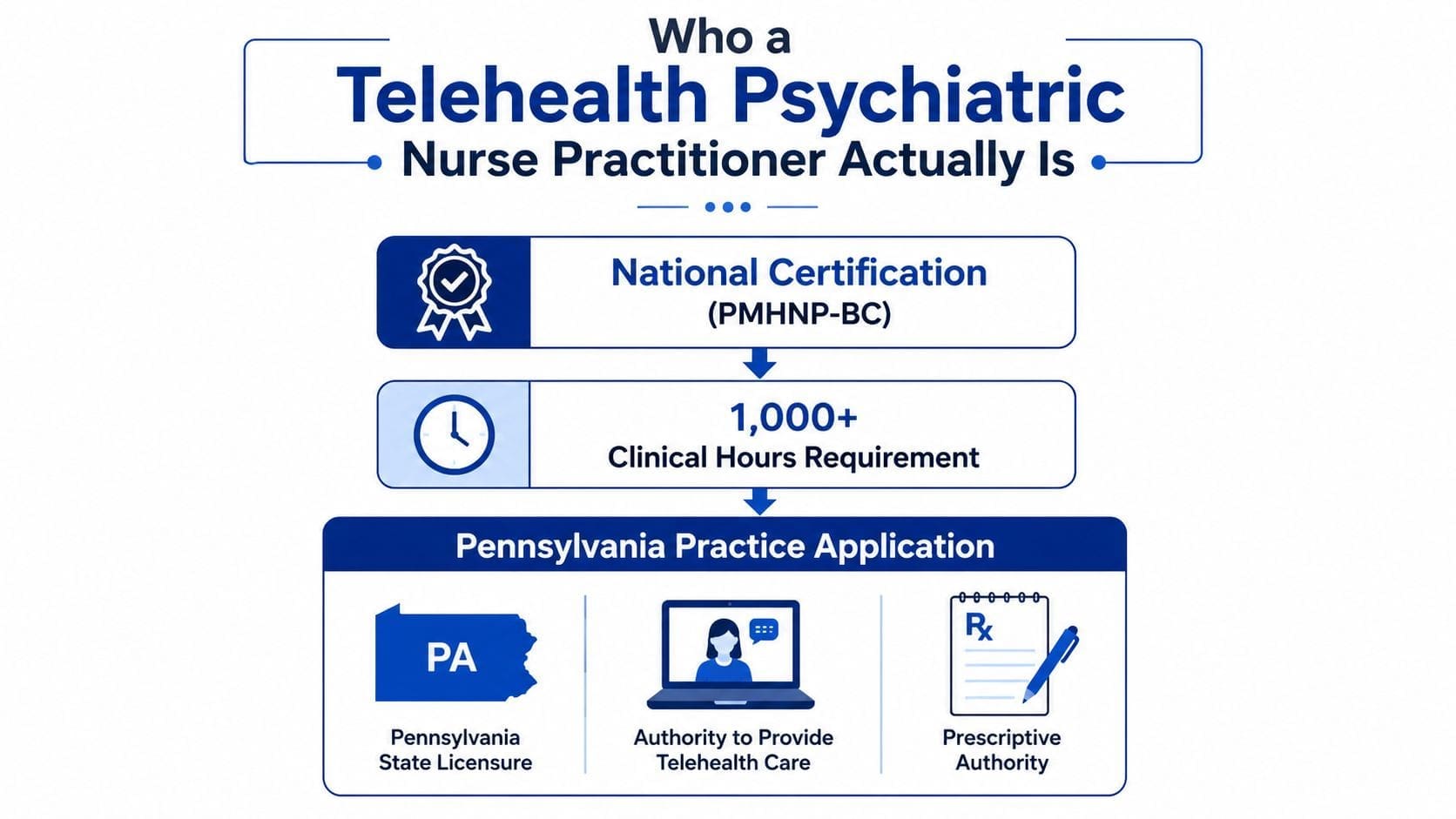
A psychiatric mental health nurse practitioner, often shortened to PMHNP, is an advanced practice nurse trained to evaluate, diagnose, and treat mental health conditions. In practical terms, that means the clinician can assess symptoms, review history, choose medications when appropriate, and monitor response over time. The role is different from counseling alone, because it includes prescriptive and diagnostic authority within the rules of the state.
Training that sits behind the screen
National certification is not casual or informal. ANCC-related guidance says applicants submit education verification documents and transcripts, then schedule testing through Prometric, and PMHNP-BC preparation includes 500 faculty-supervised clinical hours, with certification renewed every five years American Nurses Credentialing Center. That preparation matters because psychiatric care often requires decisions that connect diagnosis, medication choice, side effects, sleep, substance use, and safety planning.
In Pennsylvania, that training is paired with a state practice framework that still expects collaboration. A PMHNP may function very differently from a therapist or counselor because the nurse practitioner can manage medication, follow symptom changes, and adjust treatment within the scope of practice. A psychiatrist is a physician, while a PMHNP is an advanced practice nurse, and patients usually choose between them based on access, clinical needs, and what kind of follow-up they want.
Patients usually care less about the title and more about whether the clinician can diagnose clearly, prescribe safely, and stay available when treatment needs adjustment.
The telehealth workforce reflects that reality. A national presentation reported telemedicine use at 73.3% among psychiatric PAs, compared with 39.5% across all other specialties combined, and 97.6% of those telemedicine users relied on video conferencing. Separately, an APNA workforce summary reported that 85% of PMH-APRNs provide mental health services using telehealth NCCPA workforce presentation. That tells patients something important. Remote psychiatric care is no longer a novelty in the nursing workforce, it is part of normal access.
For readers trying to compare roles, the cleanest rule is this. A PMHNP is built for psychiatric assessment, medication management, and ongoing treatment planning, while a therapist focuses on psychotherapy and a psychiatrist is a physician specialist. For a practical comparison, the page on psychiatric nurse practitioners versus psychiatrists helps frame the difference without turning the choice into jargon.
Services You Can Receive From a Telehealth PMHNP in PA
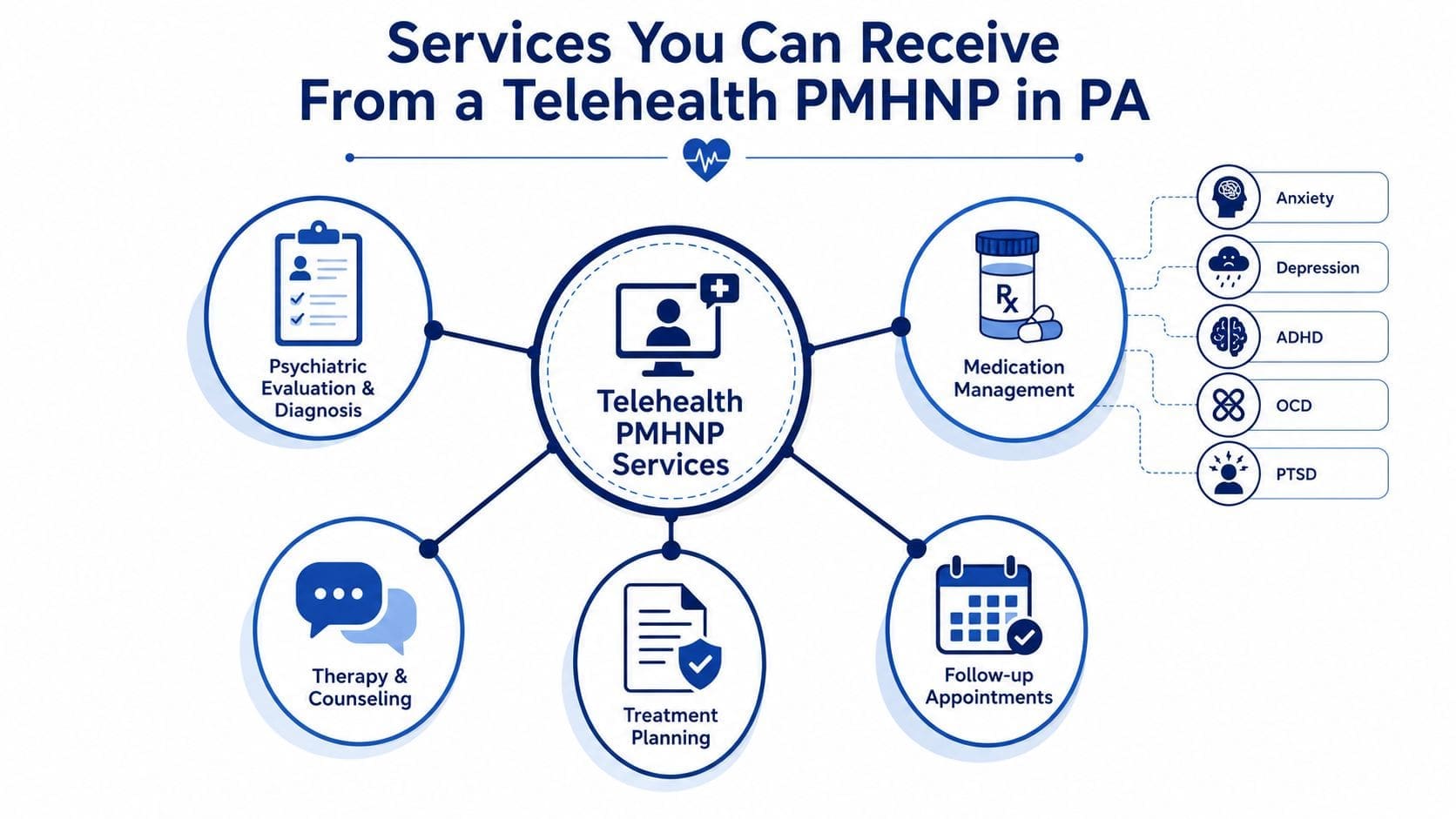
A telehealth PMHNP visit is usually more structured than people expect. The first step is often a psychiatric evaluation that looks at symptoms, history, prior treatment, family background, sleep, substance use, and safety. From there, the clinician decides whether the care plan should center on medication, therapy-informed support, or both.
What medication management looks like in practice
For common conditions such as anxiety, depression, ADHD, OCD, and PTSD, telehealth can work well because a large part of the work happens through careful history-taking and repeated follow-up. Medication management is not just sending a prescription, it is reviewing side effects, checking adherence, and deciding whether the current dose is doing enough. A useful internal resource for patients who want a deeper explanation is the page on online medication management.
Follow-up cadence depends on the situation. Someone starting an SSRI, changing a stimulant, or monitoring sleep and irritability may need closer check-ins than someone on a stable long-term regimen. That is one reason virtual care can be effective, because it lowers the friction around the visits that keep treatment moving.
Where integrative care fits
Telehealth psychiatric care can also include sleep, nutrition, exercise, and lifestyle planning when those issues affect symptoms. Patients often do better when the treatment plan addresses how they wake up, eat, move, and recover, not only what medication they take. That is especially true for conditions where stress, burnout, and poor sleep are part of the symptom picture.
For some patients, the clinical menu also includes addiction care and other specialized services when indicated. A PMHNP can help with recovery-oriented planning, medication follow-up, and coordination with counseling or support services. That matters for people who have spent years trying to get care in between work shifts, childcare, or rural travel.
Clinical reality: virtual care works best when the visit ends with one clear next step, not five disconnected suggestions.
The strongest telehealth programs also use structured tools between visits. A patient might use an Adult ADHD Assessment, an Anxiety Symptom Checker, a Daily Agenda Planner, a Feeling Journal, an Exercise Routine Generator, or the 5-4-3-2-1 Grounding Tool to track patterns that matter at the next follow-up.
Pennsylvania Licensure and Telehealth Rules Patients Should Know
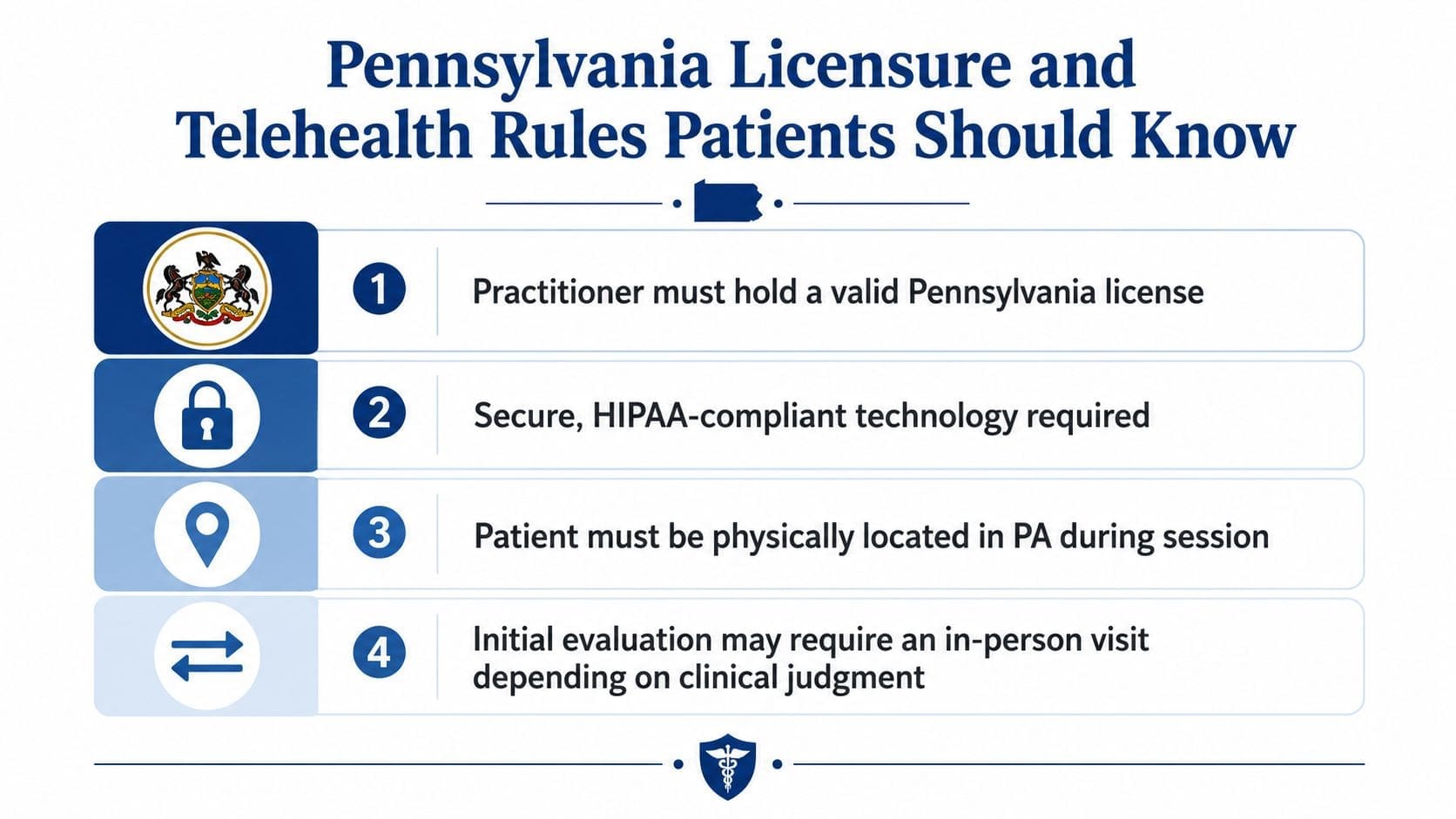
A virtual psychiatric visit in Pennsylvania starts with a licensing question, not a video link. If a patient is physically located in Pennsylvania, the clinician providing care needs to be licensed in Pennsylvania, whether the appointment happens in person or through telehealth. That rule matters because it keeps the clinician accountable to Pennsylvania's licensing system and gives patients a clearer standard for who is treating them.
What providers check before the first visit
Before the first appointment, good telehealth practices check more than the patient's willingness to meet on camera. Pennsylvania behavioral health guidance asks providers to look at whether the patient can participate effectively, whether accommodations are needed, whether the patient has usable technology and internet access, whether they can log in and use the platform, whether they have a private space, whether parent or guardian consent is needed, and whether any safety or health concerns should change the plan Pennsylvania BH Telehealth Phase II Roadmap. A patient may only see a portal screen, but the clinician is also checking whether the visit can be done safely and with enough privacy to be clinically useful.
That readiness check affects the visit itself. A quiet room, stable internet, and a device that works without constant troubleshooting make it easier for a patient to speak openly and for the clinician to notice changes in mood, attention, speech, or thought process. If the environment is noisy or unstable, the appointment can still happen, but the quality of the assessment usually drops.
How Pennsylvania handles reimbursement
Pennsylvania has also treated telehealth as a normal part of behavioral health care for some time. The Department of Human Services has allowed behavioral health services to be delivered by telemedicine since 2011, and fee-for-service Medicaid reimburses telemedicine at the same rate as in-person care, with managed care organizations also reimbursing telehealth services Pennsylvania Telemedicine FAQs. That does not mean every plan treats every service the same way, but it does show that telehealth is built into the state system rather than layered on as an exception.
The practical takeaway is simple. A legitimate telehealth PMHNP should be able to explain licensure, privacy, and the visit workflow in plain language before you book. If you want to understand the privacy side first, the page on telehealth HIPAA compliance gives a clear overview of what patients should expect before sharing health information online.
Controlled Substances, ADHD Meds, and Suboxone via Telehealth
Many searches for a telehealth psychiatric nurse practitioner in PA are really asking one thing. Can this clinician prescribe the medication that helps? That question matters most with stimulant treatment for ADHD and with medications used in opioid use disorder care, because both areas have real prescribing rules and real follow-up consequences.
What constrains prescribing
A PMHNP seeking prescriptive authority in Pennsylvania must maintain a written collaborative agreement, and controlled-substance prescribing is more operationally constrained than routine non-controlled medication management Pennsylvania PMHNP licensing summary. One independent licensing summary reports 45 hours of advanced pharmacology for prescriptive authority qualification, 30 contact hours of continuing education every two years, and limits of 30 days for Schedule II and 90 days for Schedule III-V prescriptions.
| Requirement | Standard | Why It Matters for Patients |
|---|---|---|
| Collaborative agreement | Written agreement required | Shapes what the PMHNP can prescribe and how care is supervised |
| Advanced pharmacology | 45 hours reported in licensing summary | Signals specific training before prescriptive work begins |
| Continuing education | 30 contact hours every two years reported in licensing summary | Supports ongoing competence in medication management |
| Schedule II supply | 30 days reported in licensing summary | Affects refill timing for many stimulant prescriptions |
| Schedule III-V supply | 90 days reported in licensing summary | Helps define how long a stable medication plan can run before review |
The practical effect is easy to miss until a patient runs into it. Follow-up timing, refill automation, and medication monitoring all have to match the medication class, not just the patient's preference. That is why ADHD stimulant management often needs tighter scheduling than many antidepressant refills.
Why Suboxone keeps coming up in policy conversations
Suboxone and related medication-assisted treatment questions sit in a live policy space, not a settled one. Pennsylvania's rural mental-health testimony shows that access debates now include prescriptive authority questions and specifically notes that mixed opioid agonist-antagonists like Suboxone are part of the access conversation, which signals that medication access remains a current issue Pennsylvania rural mental-health testimony. For patients, that means the provider should be able to explain what can be started remotely, what needs closer monitoring, and how refills will be handled.
A patient switching from another prescriber should bring the prior medication list, pharmacy history if available, and the exact questions about refill timing. That helps the PMHNP avoid gaps and avoid guessing about what worked before. For people specifically looking for opioid use disorder treatment, the page on Suboxone doctors in Pennsylvania is a practical starting point.
How to Find and Prepare for a Telehealth PMHNP Visit
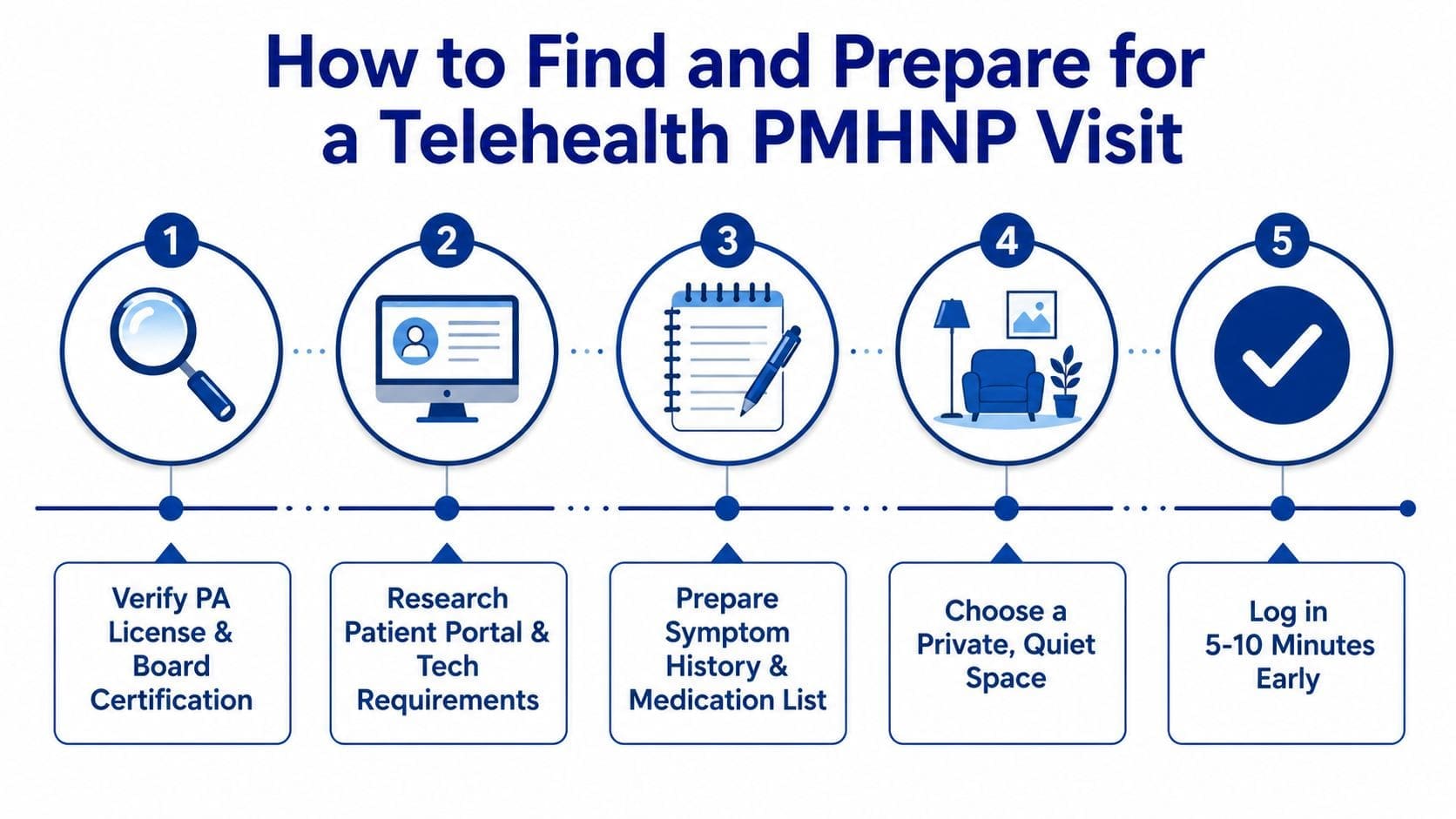
The best first visit starts before the camera turns on. Patients can save time by confirming that the clinician is licensed in Pennsylvania, board certified, and set up for secure video visits. A quick review of the patient portal also matters, because messaging, refill requests, and appointment reminders often make the difference between a smooth follow-up and a frustrating delay.
What to gather before logging in
The first appointment usually goes better when the patient has a concise history ready. That includes current symptoms, prior medications, previous reactions, hospitalizations if any, current therapists or primary care clinicians, and the main treatment goal. If the visit is for ADHD, anxiety, depression, OCD, or PTSD, it helps to be specific about what is most impairing, not just what is most annoying.
A private room is not optional. It is part of the clinical setup, because patients need space to speak openly about sleep, panic, intrusive thoughts, concentration problems, safety concerns, or substance use. For parents, guardianship and consent issues can matter too, especially when the appointment involves a child or dependent.
How to vet the provider
A reasonable checklist is short and direct.
- Verify the license: The clinician should hold a Pennsylvania license for Pennsylvania patients.
- Check the credentials: Board certification should be easy to confirm.
- Review the portal: Messaging and refill requests should be understandable before the first visit.
- Confirm payment: Insurance, cash, and membership options should be clear before booking.
- Ask about follow-up: The clinician should explain how often medication checks happen.
For a neutral resource on provider identity, the guide on how to find NPI numbers can help patients confirm who they're booking with. That extra verification is useful when comparing options across Philadelphia, Pittsburgh, Harrisburg, Erie, Scranton, Allentown, Lancaster, and Reading.
The YouTube video below gives a simple overview of telepsychiatry access and is useful for patients who want a quick orientation before scheduling.
Outcomes, Follow-Up, and Where Integrative Psychiatry of America Fits
Telehealth works best when it does not end at the prescription pad. The true outcome comes from follow-up, symptom tracking, and a care plan that adjusts as life changes. That is especially true in rural and underserved parts of Pennsylvania, where the issue is often not only access to a prescriber, but access to steady care that continues after the first visit.
The strongest telepsychiatry model uses the full scope of PMHNP practice, then pairs it with realistic check-ins and patient tools. That is where lifestyle medicine, structured self-monitoring, and medication management fit together. For patients who need evaluation, ongoing medication support, and integrative care, Integrative Psychiatry of America delivers virtual psychiatric services statewide through a HIPAA-compliant portal, led by board-certified PMHNP Christopher Clark, with options that can include evidence-informed treatment, exercise counseling, nutrition education, and other whole-person supports.
The broader point is simple. Telehealth is not just a convenience feature. In Pennsylvania, it is a legitimate access model that works when the clinician is licensed here, the patient is ready for the visit, and the treatment plan is built for continuity rather than a one-time refill.
Insurance, Payment, and Common Questions Before You Book
Insurance questions usually come down to three things, coverage, network status, and the kind of visit being scheduled. Pennsylvania Medicaid managed care organizations reimburse telehealth services, and many patients in commercial plans still need to verify benefits before the first visit Pennsylvania Telemedicine FAQs. If the plan is unclear, the front office should explain what's covered before the appointment begins.
A few fast answers help most patients decide:
- Is the visit private? It should be on a secure, HIPAA-compliant platform.
- Can controlled medications be refilled by telehealth? Sometimes, but the answer depends on the medication class and the treatment plan.
- What should a switching patient bring? The current medication list, prior records if available, and insurance details.
For people comparing practices, a good next step is to confirm the clinician's NPI, licensure, and communication process before booking. That prevents avoidable delays and makes the first session more useful.
If you're looking for virtual psychiatric evaluations, medication management, or integrative treatment in Pennsylvania, Integrative Psychiatry of America offers statewide telehealth care built around real follow-up and practical access. Patients can verify insurance, book online, and use free tools like the Anxiety Symptom Checker, Daily Agenda Planner, and Feeling Journal while deciding on the next step.