
A single brain zap usually lasts a second or two, while the overall symptom window often lasts a few days to a few weeks. Some people do have intermittent symptoms for months, especially after antidepressant changes or missed doses.
The part that catches people off guard is the split between the instant sensation and the longer withdrawal pattern around it. Someone may feel a sharp jolt behind the eyes while turning their head, then worry for hours because the sensation keeps returning, even though each individual zap is over almost immediately.
Table of Contents
- A Sudden Shock That No One Warned You About
- What Brain Zaps Actually Feel Like
- The Most Common Causes of Brain Zaps
- Who Is Most Likely to Experience Them
- Practical Strategies to Reduce Frequency and Intensity
- When Duration Becomes a Warning Sign
- How Integrative Medication Management and Telehealth Can Help
- Frequently Asked Questions About Brain Zaps
A Sudden Shock That No One Warned You About
A person turns their head in the kitchen and feels a quick flash, almost like a camera went off inside the skull. The moment is gone before there's time to react, but the startle lingers.
That's the confusion many run into when they search how long do brain zaps last. They're trying to read two timelines at once, the length of one zap and the length of the whole withdrawal window.
A single episode is usually measured in seconds, not minutes. WebMD says the sensation usually lasts “a second or two”, and Psychiatrist.com describes it as typically lasting “about one second each”. The broader symptom period is different. WebMD says antidepressant discontinuation symptoms often stop “within a few days or a couple of weeks” and generally “within a few weeks”, while Health.com says the sensations usually resolve “within a few weeks” after withdrawal. practical advice for ADHD refills can be helpful for anyone who also struggles to keep medication timing consistent.
Why the distinction matters
A zap that lasts a second can still feel alarming if it happens repeatedly during a taper or after a missed dose. The person feels the shock, then keeps bracing for the next one, which makes the whole experience seem longer than it is.
Practical rule: the brief sensation and the recovery period are not the same problem. One is a moment, the other is a nervous system adjustment.
That distinction becomes useful when symptoms start after a dose change, because the goal is not just to ask whether the zap is brief. The key question is whether the broader pattern fits antidepressant discontinuation, or whether something else is going on.
What Brain Zaps Actually Feel Like
Brain zaps usually feel like a brief electrical jolt, a tiny flash behind the eyes, or a sudden burst of static in the head. Some people describe them as a camera flash, others as a skipped beat in the brain, and the language changes because the sensation is hard to pin down.
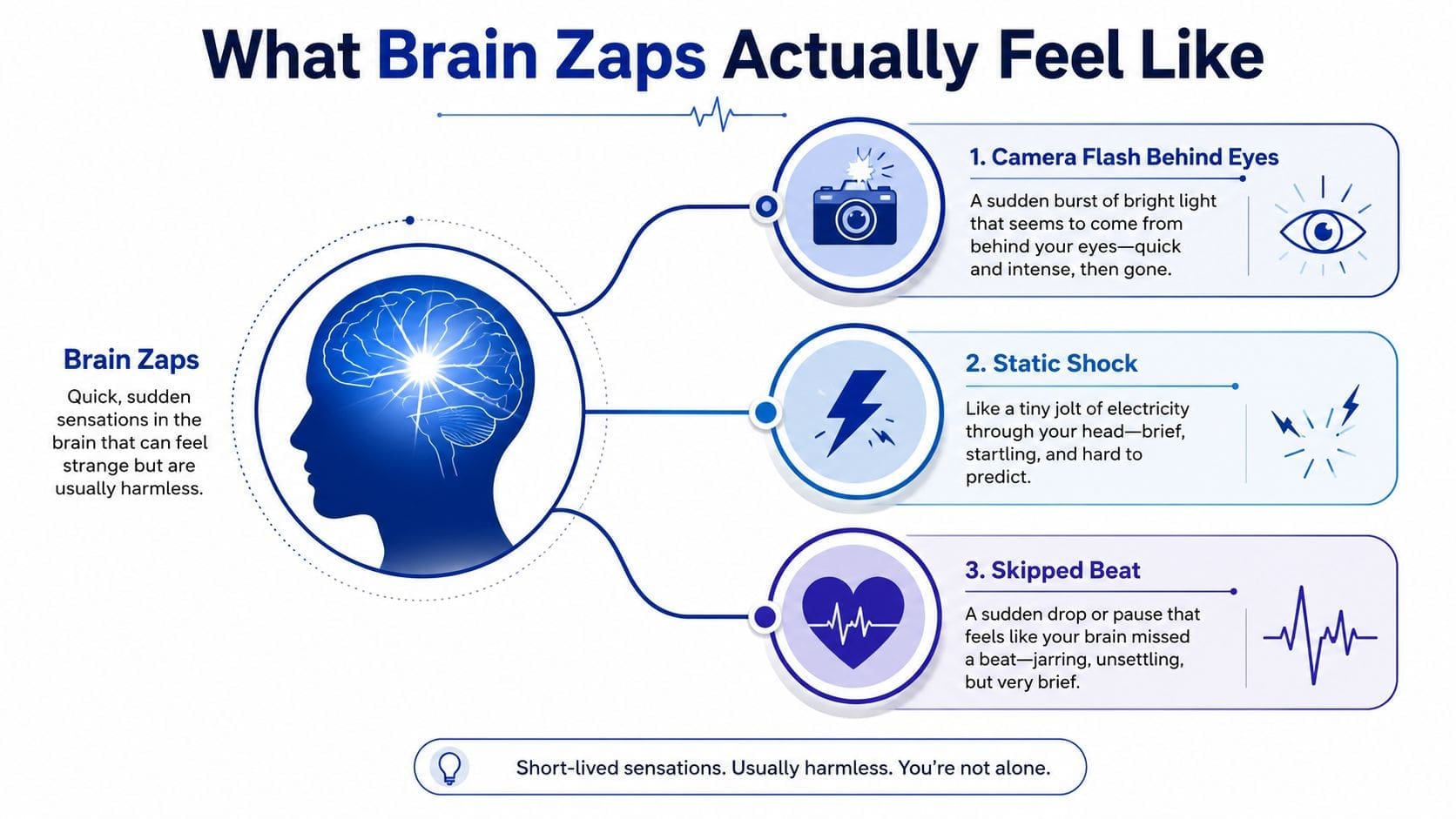
The sensation is brief, but the pattern can repeat
The electrical metaphor is not saying the brain is getting shocked. It's a plain-language way to describe a sudden sensory interruption, the kind that makes someone stop mid-sentence or blink hard because something felt off for a split second.
WebMD notes that some people notice brain zaps after taking a dose late or missing one, and Medical News Today says they usually happen after stopping or reducing antidepressants. The key point is that a zap is an event, while withdrawal is a pattern. A person might have several zaps in a day, yet each one still passes in about a second.
Common triggers that make them seem random
Head turning, eye movement, fatigue, and a general sense of being run down can make the sensation more noticeable. That's why people often report that the zap arrives while they're looking to the side, standing up quickly, or trying to fall asleep.
The pattern can feel random, but the body is often showing a link to medication change or nervous system stress. For a clear, plain-language explanation of serotonin's role in this process, the overview at what is 5-HT is useful for readers who want the biology without jargon.
A simple way to describe it to a clinician
A helpful description is short and specific, for example, “a one-second jolt behind the eyes when turning my head after missing doses.” That gives a prescriber enough detail to think about withdrawal timing, triggers, and whether the symptom fits the expected window.
The Most Common Causes of Brain Zaps
Brain zaps are most often tied to changes in serotonergic antidepressants, especially SSRIs and SNRIs. Medical News Today notes that they usually appear after stopping or reducing antidepressants, and WebMD explains that they're a recognized symptom of antidepressant discontinuation syndrome.
Why dose changes matter
SSRIs and SNRIs change how much serotonin is available between neurons. When the medication is reduced suddenly, the brain has to adjust fast, and that adjustment can produce the brief shock-like feeling people call a zap. WebMD and Psychiatrist.com both note that abrupt stopping or taking a dose late can trigger symptoms, and Psychiatrist.com adds that shorter half-life drugs are more likely to cause withdrawal symptoms.
That helps explain why some medication changes feel rougher than others. A slower taper gives the nervous system more time to adapt, which is why clinicians often plan gradual reductions instead of stopping all at once.
Medications and situations that can set them off
- Missed doses: Even a late dose can be enough for some people to notice symptoms, especially with sensitive withdrawal patterns.
- Abrupt discontinuation: Sudden stopping is the classic trigger in antidepressant discontinuation syndrome.
- Switching medicines too quickly: A rapid switch can leave the brain adjusting to a new pattern before the old one has settled.
- Other brain-active medications: WebMD and Psychiatrist.com both note that discontinuation symptoms aren't unique to antidepressants.
Medical News Today also notes that symptoms may be intermittent for no more than a few months in many cases, though some people do report a longer course. The important point is that the timeline usually follows a medication change rather than appearing out of nowhere.
Why this is a modern clinical topic
Brain zaps became widely recognized as SSRI and SNRI use expanded. That doesn't make the symptom mysterious, it just means more people began noticing the same withdrawal pattern once these medications became common in everyday psychiatric care.
The article at how long before Zoloft starts working is useful for readers who are also trying to understand the beginning of treatment, because the same medication that helps mood can create timing questions during dose changes.
Who Is Most Likely to Experience Them
The people most likely to notice brain zaps are often the ones with recent dose changes, missed doses, or longer use of an antidepressant. WebMD notes that symptoms can happen after stopping suddenly, while Psychiatrist.com reports they're more common after longer periods of use and with medications that leave the body faster.
Personal factors that shape the timeline
Dose matters. Duration matters. So does how quickly the medication leaves the body. Someone taking a higher dose, or taking a drug with a shorter half-life, may be more likely to feel symptoms when the dose shifts.
Anxiety and sleep problems can also make the experience harder to tolerate. That doesn't mean those conditions cause the zap by themselves, but they can make the body feel more alert, more jumpy, and less able to shrug off the sensation.
A realistic example comes from a patient in Philadelphia who has taken sertraline for three years and misses two doses during a hectic week. The zaps can begin quickly, because the medication level has changed enough for the nervous system to notice. In that setting, the problem is less about dramatic danger and more about a body that does not like sudden change.
Longer use, a faster taper, and missed doses tend to raise the chance of symptoms. A careful plan lowers the odds of a rough week.
Why some people feel a longer window
People taking more than one psychiatric medication may notice that the timeline feels less predictable, especially if several medications are being adjusted close together. The same is true for people who have had withdrawal symptoms before. Their nervous system may be more sensitive to changes.
For readers who want a plain overview of medication side effects and reactions, understand prescription drug reactions is a practical reference point. It helps frame the symptom as a medication-change issue first, rather than a reason to panic.
The overview at how does Wellbutrin work can also be helpful for people comparing different antidepressants, since not every medication changes the brain in the same way.
Practical Strategies to Reduce Frequency and Intensity
The most useful step is still the least glamorous one, don't stop suddenly. Medical News Today and Psychiatrist.com both support slow tapering as the better path, and Psychiatrist.com notes that switching from a shorter half-life drug to fluoxetine can reduce severity in some cases.
What helps in real life
- Work with a clinician on the taper: Smaller dose steps give the brain time to adapt.
- Avoid abrupt schedule changes: Even a missed dose can matter for sensitive medications.
- Ask about longer half-life options: Some people do better when the medication change is gentler.
- Keep sleep steady: Fatigue can make symptoms feel louder.
- Eat regular meals and drink enough water: A stable routine helps the nervous system feel less strained.
- Cut back on caffeine if it seems to worsen symptoms: Stimulants can make the body feel more keyed up.
Sleep, hydration, meals, and stress control do not replace a proper taper. They make the week of change easier to tolerate. Movement, nutrition, and mindfulness can also support the nervous system during medication adjustments, especially when anxiety is part of the picture.
A practical way to track what's happening is to note the day, the dose, the time of the zap, and what was happening right before it. A simple log makes patterns easier to see, and it gives the prescriber something concrete to work with.
The article SSRI supplements and diet for depression may help readers who want to discuss nutrition alongside medication planning.
A slow, thoughtful taper is not a guarantee of zero symptoms. It is the most reliable way to reduce how often they show up and how intense they feel.
The same principle appears in the YouTube discussion below, which is useful for people who learn best by hearing taper concepts explained out loud.
When Duration Becomes a Warning Sign
A longer zap is not automatically a more serious withdrawal event. In fact, the warning sign is the opposite, because a true brain zap is usually brief. DetoxPlus UK notes that anything lasting longer than a few seconds could point to a seizure rather than a typical zap, and Medical News Today and WebMD both emphasize that the usual sensation is short-lived.
When another diagnosis needs to be considered
If the sensation lasts far beyond a second or two, a clinician may need to think beyond antidepressant withdrawal. Migraine aura, panic symptoms, sleep disruption, medication side effects, and seizure activity can all create confusing head sensations. Duration alone can't sort those out.
Red flags that deserve prompt medical evaluation include:
- Loss of awareness: Any blackout, confusion, or time loss changes the picture.
- New neurological symptoms: Weakness, trouble speaking, or abnormal movements need attention.
- Persistent dizziness or fainting: Those symptoms don't fit a simple, harmless zap pattern.
- Symptoms that keep going long after a taper should have settled: Ongoing recurrence deserves a review of the medication plan.
WebMD says brain zaps themselves are not medically dangerous, but it also advises contacting a physician for extreme or persistent symptoms. That's the right balance, calm but not dismissive.
If the sensation is brief and tied to a medication change, withdrawal is a strong possibility. If it's prolonged, paired with confusion, or arriving with other neurological symptoms, it needs evaluation.
Why clinicians look at the whole picture
The right question is not just, “How long did it last?” The better question is, “What else was happening when it happened?” A medication review can reveal whether the taper was too fast, whether another medicine is contributing, or whether the symptom belongs to a different condition entirely.
That kind of review matters because persistent symptoms deserve a real differential diagnosis, not a shrug. A focused clinical conversation can separate expected withdrawal from something that needs a different workup.
How Integrative Medication Management and Telehealth Can Help
A careful medication review is often the fastest way to make the timeline make sense. Integrative medication management looks at the prescription, the dose timing, sleep, stress, nutrition, and other factors that can make withdrawal feel smoother or rougher.
Why telehealth fits this problem well
Brain zaps are often time-sensitive and easy to misunderstand, which makes virtual follow-up especially practical. A secure telehealth visit through medication management online can help a patient review symptoms without waiting weeks for an in-person opening.
For people across Philadelphia, Pittsburgh, Harrisburg, Erie, Scranton, Allentown, Lancaster, and Reading, statewide virtual psychiatric care can make it easier to talk through a taper plan before symptoms spiral into confusion. Tracking tools like the Feeling Journal and Daily Agenda Planner can also help a patient notice whether zaps cluster around missed doses, poor sleep, or stressful days.
A good next step for Pennsylvania patients
A clinician can review whether the symptoms fit antidepressant discontinuation, whether the taper needs to slow down, or whether another issue should be ruled out. That's especially useful for people who've already tried to “wait it out” and haven't seen improvement.
For anyone in Pennsylvania who wants to understand options for virtual psychiatric evaluation, medication management, and evidence-informed mental health treatment, the most useful move is to schedule a visit, verify insurance, or use a free tracking tool before the next dose change. Clear data from a few days of symptom logging can make the appointment far more productive.
Frequently Asked Questions About Brain Zaps
Can brain zaps come back after they stop? Yes, especially if a dose is missed again or a taper changes too quickly. That usually points back to medication timing rather than a permanent problem.
Do supplements help? Sometimes people ask about omega-3s or magnesium, but the safest answer is that they should be discussed with a clinician. Supplements can support overall health, but they're not a substitute for a careful taper.
How long should a safe taper take? There isn't one universal schedule. The taper has to match the medication, the dose, and how sensitive the person is to changes.
Do brain zaps damage the brain? The available clinical descriptions treat them as distressing but usually harmless when they fit the typical withdrawal pattern. Persistent or unusual symptoms still deserve evaluation.
A CTA for Integrative Psychiatry of America is to schedule a virtual psychiatric visit, verify insurance, or use a tracking tool if brain zaps are lingering, returning, or making a taper feel unmanageable. A careful medication plan can make the next few days much easier to read.