
Anxiety often hits at the worst possible time. A person can be in a meeting in Philadelphia, sitting in traffic outside Pittsburgh, or trying to finish a normal workday in Harrisburg when the chest tightens, thoughts speed up, and the body starts acting like danger is everywhere.
In that moment, the brain usually wants one thing. Escape. But many people can't leave the room, pull over immediately, or explain what's happening to everyone around them. That's where grounding helps. It gives the mind and body a direct task in the present moment so anxiety doesn't keep pulling attention into panic.
Grounding techniques for anxiety aren't complicated, and they aren't only for therapy offices. They can be used at a desk, in a parked car, during a break, or discreetly in a crowded space. For many people, they work best as a small toolkit rather than a single perfect trick. One person may respond well to breathing. Another may need a sensory cue, a movement-based reset, or a silent mental exercise that nobody else notices.
For readers who need additional calming tools alongside grounding, this guide to self-soothing skills can also help build a steadier response when anxiety spikes.
Table of Contents
- That Overwhelming Feeling and Finding Your Footing
- What Is Grounding and Why Does It Work
- Sensory and Breathing Techniques for Immediate Relief
- Physical and Cognitive Grounding Techniques
- Applying Grounding in Real-World Pennsylvania Scenarios
- Building Your Coping Plan and Getting Expert Support
That Overwhelming Feeling and Finding Your Footing
A common anxiety episode doesn't always look dramatic from the outside. Someone in Allentown may still be answering emails. Someone in Scranton may still be driving home. Someone in Lancaster may still be sitting through a routine conversation while internally feeling like everything is unraveling.
The body often notices it first. Tight shoulders. Shaky hands. A sudden hot or unreal feeling. Then the mind joins in with fast thoughts, catastrophic predictions, or the sense that something bad is about to happen even when nothing obvious has changed.
That's the moment many people start fighting themselves. They try to “calm down” by force. They argue with the panic. They tell themselves they shouldn't feel this way. That usually adds another layer of distress.
Grounding works differently. It doesn't demand that anxiety disappear on command. It asks the brain to notice what is here, right now. The chair under the legs. The sound of air moving through a vent. The pressure of feet inside shoes. The coolness of water on the hands.
Anxiety pulls attention into threat. Grounding pulls attention back into the present.
That shift matters because panic thrives on spiraling attention. The more the mind chases the alarm, the louder the alarm gets. Grounding interrupts that loop with something concrete.
A better way to think about grounding is this. It's an anchor, not a cure-all. It helps a person regain enough footing to think clearly, get through the moment, and decide what comes next. Sometimes that next step is finishing the workday. Sometimes it's texting a support person. Sometimes it's deciding that symptoms have become frequent enough to deserve formal treatment.
What Is Grounding and Why Does It Work
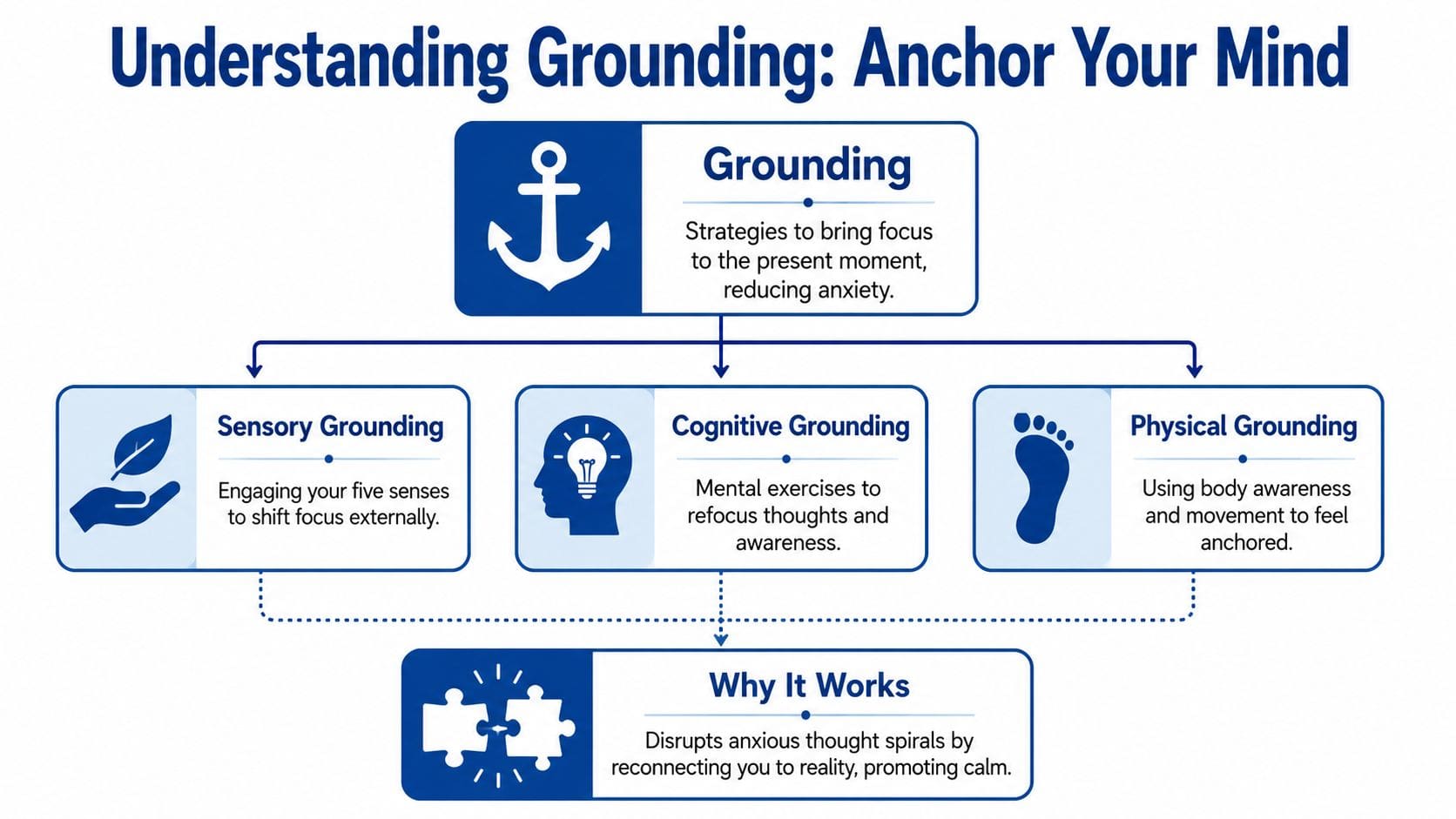
Grounding is a set of practical skills that helps a person reconnect with the present moment when anxiety, panic, distressing thoughts, or emotional overwhelm start taking over. Some grounding techniques use the senses. Others use breathing, movement, or focused thinking.
Grounding means returning to the present
When anxiety escalates, attention narrows. The brain starts scanning for danger, replaying a feared outcome, or acting as if an internal sensation is proof of an emergency. Grounding changes the assignment. Instead of asking, “What if this gets worse?” it asks, “What is happening around me right now?”
That sounds simple, but it's clinically useful. A person who notices the texture of a sleeve, the sound of a fan, or the pressure of both feet on the floor is doing more than distracting themselves. They're orienting to the environment and reducing the mind's grip on abstract fear.
Grounding usually falls into three broad categories:
- Sensory grounding uses sight, touch, sound, smell, or taste.
- Physical grounding uses breathing, posture, pressure, or muscle release.
- Cognitive grounding uses structured mental tasks that redirect attention.
Different situations call for different tools. A loud grocery store may call for internal counting instead of more sensory input. A private bedroom may be a good place for stretching or a full muscle relaxation routine.
Why the body responds
Grounding helps because anxiety isn't only a thought problem. It's also a body state. Muscles tighten, breathing changes, and the nervous system shifts toward alarm. A 2021 study by Keptner et al. found that techniques such as Progressive Muscle Relaxation and deep breathing significantly reduced anxiety levels and provided measurable physiological benefits, including regulation of muscle tension and the induction of a calmer state, as summarized in this review of grounding research and clinical applications.
That finding matters in everyday practice. It means grounding techniques for anxiety aren't just “taking your mind off things.” They can influence the physical stress response in a direct way.
Practical rule: If a technique helps the body slow down and helps attention return to the room, it's doing its job.
People sometimes assume grounding should feel dramatic. Often it doesn't. The first sign that it's working may be modest. Breathing gets less shallow. Thoughts stop racing quite as fast. The room feels a little more solid. That's enough to build on.
Sensory and Breathing Techniques for Immediate Relief
Some grounding skills work best because they're fast and portable. They don't require privacy, equipment, or perfect concentration. When anxiety is rising, simple usually works better than complicated.

Using the 5 4 3 2 1 method
The 5-4-3-2-1 grounding technique is one of the most widely used sensory tools because it gives the brain a clear sequence. It asks a person to identify five visible objects, four tangible textures, three audible sounds, two identifiable smells, and one tasteable item, and clinical guidance describes it as effective for shifting attention away from distressing thoughts by forcing the brain to process concrete environmental data, as explained in this overview of the 5-4-3-2-1 grounding technique.
A simple way to use it in real life:
- Look for five things you can see. Not just “desk” or “wall.” Notice detail. A crack in the paint. A blue folder. Light reflecting off a window.
- Find four things you can touch. The fabric of a sleeve, the arm of a chair, a ring, a tabletop.
- Identify three things you can hear. Footsteps, distant traffic, a humming appliance.
- Notice two things you can smell. Coffee, soap, clean air, even a neutral scent.
- Name one thing you can taste. Gum, water, toothpaste, or the taste already in the mouth.
People who want a guided version can use a dedicated 5-4-3-2-1 grounding tool as part of a broader coping routine.
What doesn't work well with this method is rushing through it. If the brain barely registers each item, the exercise becomes another box to check. Slow observation is what gives the technique its power.
Paced breathing that feels manageable
Breathing practices help most when they feel steady, not forced. The goal isn't to take the deepest breath possible. The goal is to create a rhythm the body can follow.
A useful starting pattern is this:
- Inhale gently
- Pause briefly if comfortable
- Exhale a little longer than the inhale
- Repeat for several rounds
Some people prefer box breathing. Others do better with a softer count because strict breath holds can feel uncomfortable during anxiety. The best version is the one a person can continue without straining.
If breathing practice makes a person feel air hungry or more panicked, the fix usually isn't “try harder.” It's to make the breath smaller, slower, and less forced.
This brief demonstration can help people who want a visual guide before practicing on their own.
A grounding object for work or travel
A grounding object is a small item that can be touched and described when anxiety starts climbing. It could be a smooth stone, textured keychain, coin, fabric square, or ring. The object matters less than the attention given to it.
A quick comparison shows how people often use these tools:
| Setting | Grounding object example | What to focus on |
|---|---|---|
| Office desk | Smooth stone | Temperature, weight, edges |
| Commute | Keychain | Shape, pressure in the palm |
| Waiting room | Ring or bracelet | Texture, coolness, movement |
| Home workspace | Fabric swatch | Softness, weave, contrast |
This works well because it gives the hands a job and the mind a script. Instead of following anxious thoughts, attention shifts to concrete detail. For many adults, that's enough to lower the intensity of the moment and prevent escalation.
Physical and Cognitive Grounding Techniques
Some people don't respond much to sensory exercises. That doesn't mean grounding isn't a fit. It usually means a different route is needed. Physical and cognitive methods often work better for people who carry anxiety as muscle tension or who calm down when the mind has a structured task.
Physical methods that release tension
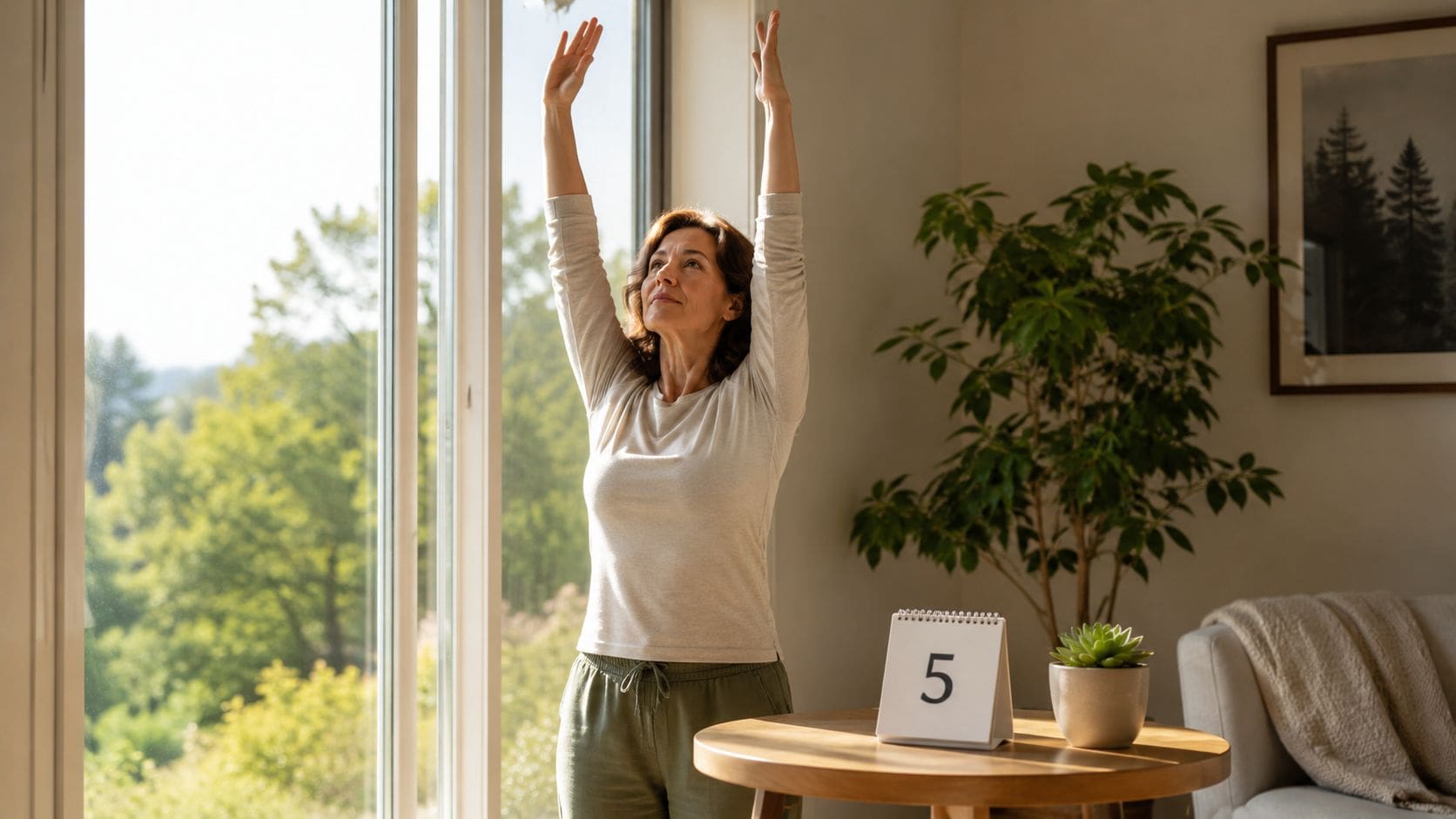
Progressive Muscle Relaxation, often called PMR, is one of the clearest examples of body-based grounding. A person intentionally tenses a muscle group, then releases it and notices the difference. Common areas include the feet, calves, thighs, hands, shoulders, jaw, and forehead.
A basic PMR routine looks like this:
- Start low with the feet or legs so the process feels orderly.
- Tense briefly without causing pain.
- Release fully and notice the contrast.
- Move upward through the body one region at a time.
PMR works well for anxiety that feels physical first. It's especially useful when a person says, “My mind won't stop,” but their shoulders are raised, jaw is clenched, and hands are tight.
Another simple physical option is pressure. Press both feet into the floor. Notice the heel, the ball of the foot, and the contact with the shoe. Push the palms together. Lean the back into a chair. These small actions remind the body where it is.
For readers dealing with trauma symptoms, this guide to PTSD grounding techniques can help distinguish what feels stabilizing from what feels too activating.
Cognitive methods for a busy mind
Cognitive grounding gives anxious thoughts a competing task. It works well for people who become more distressed when told to “just breathe” but settle when the brain is occupied in a deliberate way.
A few strong options:
- Color search. Count everything blue in the room, then everything rectangular.
- Category listing. Name Pennsylvania cities, dog breeds, grocery items, or movie titles.
- Environmental description. Describe the room as if writing a scene for a novel.
- Silent math. Count backward or add simple numbers in the environment.
These techniques help because they move the brain from emotional alarm toward observation and organization.
A good cognitive exercise is challenging enough to hold attention, but not so hard that it becomes frustrating.
What usually doesn't help is trying to “think positive” in the middle of acute anxiety. Positive affirmations can be useful later, but a panicked brain often responds better to neutral facts than to upbeat statements it doesn't believe. “The chair is black, the table is square, the window is open” often lands better than “Everything is fine” when the body feels anything but fine.
Applying Grounding in Real-World Pennsylvania Scenarios
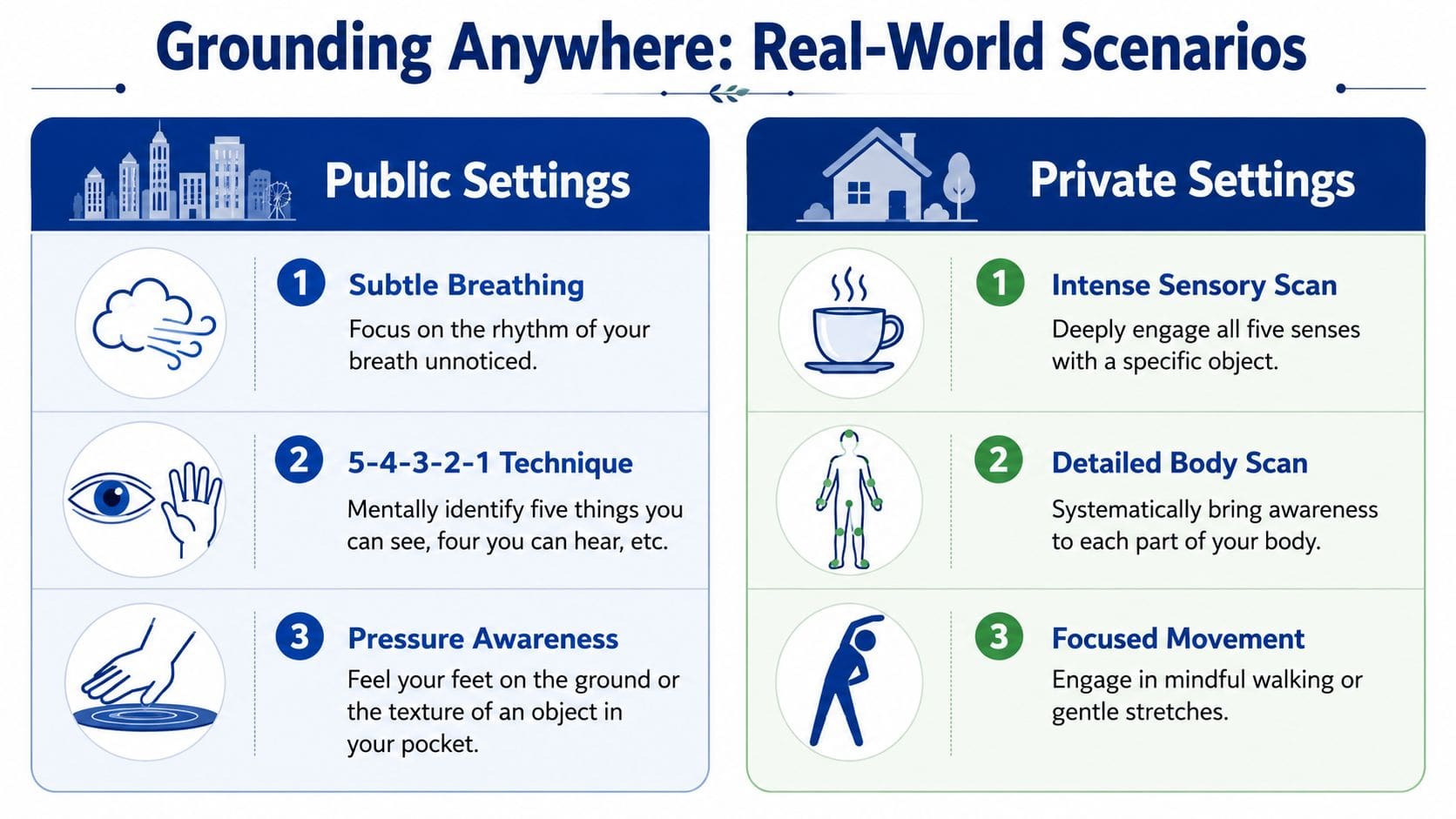
Grounding sounds straightforward until anxiety shows up somewhere inconvenient. A person may be in a work meeting in Reading, driving through Erie, sitting in a waiting room in Philadelphia, or attending a crowded event in Pittsburgh. In those moments, the real question isn't “What's a grounding technique?” It's “What can be done right now without drawing attention?”
Stealth grounding when nobody can tell
Many adults avoid coping skills because they worry other people will notice. That concern is real. A 2025 study in the Journal of Clinical Psychology found that 68% of anxiety patients in high-pressure careers avoid grounding entirely due to fear of judgment or disruption, highlighting the need for stealth methods such as internal muscle tension and silent mental arithmetic, as discussed in this article on grounding techniques and public settings.
Stealth grounding is built for those situations. It should be quiet, subtle, and safe.
A few examples work well:
- Inside the shoes. Press the toes downward, then release. Alternate left and right.
- Under the table. Tighten one fist for a moment, then relax it slowly.
- At a desk. Count five objects of one color without moving the head much.
- During conversation. Match the exhale to the end of each sentence spoken by the other person.
- While waiting. Mentally name categories such as state capitals, vegetables, or car brands.
Here's what matters most. If a technique disrupts work, driving, or communication, it's the wrong tool for that setting. Grounding has to fit the moment.
People looking for more structured care when anxiety affects daily functioning can review options for anxiety treatment in Pennsylvania through telepsychiatry.
Modifying grounding for sensory overload or pain
One-size-fits-all grounding advice leaves many people behind. Some adults with sensory processing differences feel worse when asked to notice multiple sounds, textures, or smells at once. Some people with trauma histories become more activated by certain body-focused exercises. Others live with pain conditions that make touch or movement the opposite of soothing.
In those cases, modification matters more than strict compliance. A person who finds tactile input overwhelming may do better with visual-only grounding. Someone with chronic pain may need a cognitive exercise or a gentle visual anchor rather than stretching or scanning the body for sensation.
A practical way to choose is to match the technique to the barrier:
| If this is the problem | Try this instead |
|---|---|
| Too much sensory input | Limit grounding to one sense, often vision |
| Touch feels irritating | Use counting, naming, or mental categories |
| Movement increases pain | Use breath pacing or visual focus |
| Crowded public setting | Choose silent internal tasks |
| Trauma symptoms feel activated | Use simple orientation to the room and seek professional guidance for a tailored plan |
The best grounding technique for anxiety is the one a person can actually use when symptoms hit. If a method reliably increases distress, it needs to be changed, not forced.
Building Your Coping Plan and Getting Expert Support
Grounding works better when it's practiced before the next anxious moment. Waiting until panic is already peaking makes every skill feel harder to remember. A coping plan reduces that scramble.
Practice before the next anxious moment
A simple plan often works best. Choose two or three grounding techniques for anxiety that fit different settings. One might be sensory, one physical, and one stealth-based.
For example:
- At home a person might use Progressive Muscle Relaxation.
- At work they might use toe pressing and silent counting.
- In public they might use a shortened sensory scan with visual focus only.
Practice them when anxiety is low. That's how the brain learns, “This is what to do when the alarm starts.” It also helps to keep a brief note in a phone or planner with the exact steps.
For people whose anxiety overlaps with chronic pain, this planning matters even more. A 2025 study in Pain Medicine found that 57% of anxiety patients with chronic pain avoid standard grounding because they fear making pain worse, which points to the importance of pain-adapted alternatives such as cognitive-only strategies or breath-focused visual anchoring, as described in this piece on grounding strategies and redirected attention.
That trade-off is important. A technique can be evidence-based and still be the wrong fit for one person's body.
When self-help stops being enough
Grounding is a coping skill. It isn't a full treatment plan for persistent anxiety, panic disorder, OCD, PTSD, or depression. If symptoms keep returning, interfere with work or sleep, strain relationships, or lead to avoidance, outside support becomes the next practical step.
Warning signs often include:
- Frequent episodes that keep happening despite repeated self-help efforts
- Avoidance behaviors such as skipping work tasks, driving less, or withdrawing socially
- Layered symptoms like depression, trauma reactions, obsessive thinking, or insomnia
- Heavy dependence on coping tools without meaningful improvement over time
Some people benefit from therapy alone. Others need a broader plan that may include medication management, trauma-informed care, sleep support, lifestyle changes, or a review of coexisting conditions such as ADHD. For readers who want a compassionate outside resource, expert anxiety support in Vernon offers another example of structured counseling support for anxiety.
Anyone wondering whether symptoms have reached the point of needing specialty care can review signs for when to see a psychiatric specialist.
The goal isn't to prove toughness by handling everything alone. The goal is to get well. Grounding can help a person get through the moment. Professional care helps reduce how often those moments take over in the first place.
For adults across Pennsylvania, including Philadelphia, Pittsburgh, Harrisburg, Erie, Scranton, Allentown, Lancaster, and Reading, Integrative Psychiatry of America provides virtual psychiatric evaluations, medication management, and evidence-informed mental health treatment through secure statewide telehealth. Readers looking for next steps can explore treatment options, verify insurance coverage, or use free tools such as the Anxiety Symptom Checker, Adult ADHD Assessment, Daily Agenda Planner, Feeling Journal, Exercise Routine Generator, and 5-4-3-2-1 Grounding Tool before scheduling an appointment.