
Most answers to the question why am I emotional arrive as a label. Hormones. Stress. Personality. Burnout. A label feels satisfying for about a minute, then leaves you with the same three unanswered questions: what changed, will it settle, and is this something a clinician should look at?
Strong emotions rarely come from a single switch. They come from a stack: a stretch of broken sleep, a demanding season at work, a prescription started in March, a loss nobody has named out loud. Emotionality behaves like a pattern, and patterns can be observed, logged and discussed. What follows separates the common contributors, explains how stress and sleep reinforce each other, covers medication and hormonal effects, draws a clear line between screening and diagnosis, and ends with a two-week tracking method that turns vague feelings into evidence a clinician can use.
Table of Contents
- Why Your Emotions Feel Stronger Than Usual
- Common Causes and What They Look Like
- How Stress and Grief Change Emotional Reactions
- How Poor Sleep Makes Emotions Harder to Manage
- Medications, Substances and Hormonal Changes
- When Emotions Point to Anxiety, Depression or Trauma
- How to Track Your Emotions for Two Weeks
- Decide Whether to Book a Mental Health Evaluation
Why Your Emotions Feel Stronger Than Usual
A stronger-than-usual emotional reaction usually means something has raised the sensitivity of your nervous system. It doesn't mean your character has changed. Stress, short sleep, physical illness, medication, hormonal shifts and mood conditions all press on the same dial, and several of these factors may be at play at once.
That dial is crowded for a lot of people. The World Health Organization reported that in 2023 nearly 1 in 7 people worldwide, roughly 1.2 billion people, were living with a mental disorder, with anxiety and depressive disorders the most common categories (WHO fact sheet on mental disorders). The same assessment estimated 470 million people living with an anxiety disorder and 322 million living with depression. Emotional intensity isn't a rare defect or a private weakness. It's a widely shared human load.
Think of the emotional system as a smoke alarm. A well-calibrated alarm stays quiet for burnt toast and wakes the house for real smoke. A sensitive one goes off for both. The alarm isn't broken, it's set wrong. When tears arrive during a commercial, or irritation spikes over a misplaced spoon, the useful question isn't "what's wrong with me." It's "what adjusted the setting, and when."
The reframe that helps most: stop asking why you are emotional in general, and start asking what changed in the last six weeks.
An emotional day is weather. An emotional pattern is climate. Clinically, duration, intensity and impact separate a hard week from a condition: how long the feelings last, how intense they get, and how much they interfere with work, relationships and daily functioning.
Some readers want to know what non-medical support exists alongside clinical care. Acupuncture support for emotional shifts is one complementary option people ask about, and it works best as an addition to proper evaluation rather than a replacement for it.
Three questions organize everything that follows:
- What's the contributor? Stress, grief, sleep, hormones, substances or a mood condition.
- What's the pattern? Situational and short-lived, or persistent across settings.
- What's the next step? Self-tracking, a primary care check, or a mental health evaluation.
An article or an online checklist can point toward likely causes. Neither can establish a diagnosis.
Common Causes and What They Look Like
The table below compares nine common contributors on three practical questions: what the emotion typically looks like, what to check first, and when it deserves professional attention.
| Possible cause | Typical emotional pattern | Check first | When to get evaluated |
|---|---|---|---|
| Stress and daily pressure | Tearfulness or irritability tied to deadlines, money or conflict; eases with rest | Recent workload, finances, caregiving demands | Lasts several weeks or affects work and relationships |
| Grief and loss | Waves of sadness or sudden tears, often triggered by reminders | Time since the loss and available support | Intense distress that stays severe and blocks daily functioning |
| Poor or short sleep | Short temper, flat mood or tearfulness after several bad nights | Hours slept and awakenings over two weeks | Sleep problems continue after sleep changes |
| Hormonal shifts | Mood changes linked to menstrual cycle, pregnancy, postpartum, perimenopause or thyroid disease | Timing of mood changes against cycle or life stage | Severe mood changes around hormonal events, or thyroid symptoms |
| Medication effects | Mood changes after starting, stopping or changing a dose | Date of the change and listed side effects | Any new emotional change after a medication change |
| Alcohol, cannabis, nicotine or stimulants | Anxiety, low mood or irritability after use or during withdrawal | Frequency, amount and timing of use | Use is increasing, or withdrawal symptoms appear |
| Anxiety disorders | Persistent worry, irritability, panic or avoidance | How often worry occurs and what physical symptoms come with it | Symptoms persist or lead to avoidance |
| Depression | Low mood, tearfulness, loss of interest and fatigue | Whether symptoms occur most days for two weeks | Symptoms persist most days for two weeks |
| Trauma-related stress | Startle, intrusive memories or intense reactions to reminders | Specific triggers and recurring memories | Reactions disrupt sleep, work or safety |
How to read the pattern column
Start with the middle column, not the cause column. Take a 41-year-old who cries most Sunday evenings. Sleep is fine, no medication changed, no recent loss. The pattern points toward stress and dread tied to the workweek, and the third column says to act when it spreads into relationships or performance. If the same tears began three weeks after a dose change, the table sends that person to the prescriber, not toward a mood disorder workup.
Where causes overlap
Contributors feed each other. A run of poor sleep makes a normal workload feel unbearable. Two glasses of wine on Friday deepen low mood and anxiety on Saturday morning. Thyroid disease, chronic pain, diabetes and some neurological conditions can produce mood changes too, which is why a primary care visit with blood work (thyroid function, blood count, glucose, vitamin levels) belongs early in the process rather than last.
Use this as a conversation starter, not a verdict. The table is a starting point for a clinician who can take a history, order tests and rule causes in or out. It is not a diagnostic instrument.
How Stress and Grief Change Emotional Reactions
Could a change in your emotions be a response to what you are carrying, rather than a fixed part of your personality? Stress can draw on the same reserves you use for patience, focus, and motivation. APA's Stress in America surveys have repeatedly found cost of living and health-care costs among top concerns, along with stress-related effects on sleep, motivation, and focus (APA Stress in America 2026 report).
When these pressures build, small frustrations may feel unusually difficult to manage. A spilled coffee or delayed drive home can become the moment that exposes how little capacity remains.

Consider a nurse finishing three consecutive long shifts. She cries in the car after a minor traffic delay, snaps at a delivery driver, then feels fine after two days off. The timing suggests her reactions may follow workload and recovery, rather than reveal a permanent personality trait. A brief log of shifts, emotional reactions, and time off can make that pattern easier to see and discuss with a clinician.
Grief can also bring waves of sadness, sudden tears, and strong reactions to reminders. These experiences can occur after a loss without meaning someone is fragile. If grief remains intensely disruptive beyond the expected period, a clinician can assess whether it may meet criteria for prolonged grief. A friend can offer support, but diagnosis requires clinical evaluation.
Use these checks to examine the pattern:
- Does it move with demands? If emotions rise during a specific stressful period and settle when it passes, the timing may point to workload or another demand.
- Does recovery help? Notice whether support, time off, or a lighter week changes the intensity. If there is no improvement after genuine recovery time, mention that to a clinician.
- Does it cross settings? Irritability at work, at home, and with friends may extend beyond one stressful context. Record when it appears and what was happening beforehand.
These checks are clues, not a diagnosis. Tracking them over time can turn a vague sense of being “too emotional” into concrete information about triggers, changes, and recovery.
How Poor Sleep Makes Emotions Harder to Manage
Have your reactions felt sharper after a poor night's sleep? Sleep loss can change emotional responses, not just leave you tired. A meta-analysis spanning five decades of research found that total sleep deprivation, partial sleep loss and fragmented sleep were associated with measurable emotional changes. Reduced positive mood was the most consistent finding, and anxiety also rose (CNN's summary of the sleep and mood research). People may feel unusually flat or more reactive than they do when rested. Adults generally need at least seven hours of sleep nightly.
The loop, in three moves
Stress can make it harder to fall asleep and reduce deep sleep. Then, short sleep can weaken emotional control, so everyday frustrations feel more difficult to manage. Irritability or low mood can add to perceived stress, making sleep harder again. The pattern can reinforce itself.
A parent repeatedly woken by a newborn may feel tearful and hopeless during the day. If longer stretches of sleep bring relief, that change offers useful evidence that sleep may be affecting the emotional pattern. It does not, by itself, establish a diagnosis.
The CDC's sleep guidance discusses how sleep relates to health and daily functioning (CDC guidance on sleep and health). For your own pattern, a brief log can be more useful than trying to remember how you felt over several weeks. Note your sleep, stress and mood each day. The record can help you and a clinician see whether difficult emotions tend to follow disrupted nights.
For two weeks, you could try:
- Anchor the wake time. Keep it consistent, including weekends, to support a regular sleep rhythm.
- Get light early. Morning outdoor light can reinforce the body's daily timing.
- Cut caffeine after midday. An afternoon cup may still affect sleep at bedtime.
- Dim the last hour. Lowering light and avoiding bright screens may help reduce delays in falling asleep.
- Watch alcohol. It may help you fall asleep sooner, but can fragment sleep later in the night.
If insomnia persists for weeks, snoring comes with daytime sleepiness, or sleep problems began after a major life event and have not resolved, consider discussing them with a clinician. For more on the connection between sleep and mood, read why sleep matters in anxiety and depression.
Medications, Substances and Hormonal Changes
Some emotional changes trace straight back to a bottle, a patch or a dose. Others trace to timing in the body.
Antidepressants can produce emotional blunting or, in some people, a jittery, activated feeling in the first weeks. Corticosteroids such as prednisone are well known for irritability, insomnia and low mood, especially at higher doses. Stimulants used for ADHD can leave a short fuse as the dose wears off in the late afternoon. None of that means the medication is wrong; it means the timing, the dose or the drug itself deserves a review.
Never stop a prescription abruptly to test a theory. Call the prescriber first, because abrupt stops create their own symptoms and can be physically risky with several drug classes.
Alcohol is a depressant that commonly raises anxiety and lowers mood the day after use. Cannabis, nicotine and caffeine each produce their own cycle of mood swings, anxiety and withdrawal irritability, and heavy use can mimic a mood disorder convincingly.
Hormonal shifts deserve careful attention. Mood changes can track the menstrual cycle, including premenstrual dysphoric disorder, pregnancy and the postpartum period, perimenopause, testosterone changes and thyroid disease. Perimenopause in particular mixes mood, sleep and irritability into one picture, covered in more depth in this guide to perimenopause and depression. For anyone weighing treatment for menopausal symptoms, a review of postmenopausal hormone therapy benefits and risks is a sensible companion to a clinical conversation, since hormone-related mood and sleep effects rarely respond to willpower alone.
Bring these questions to a clinician:
- When did the emotional change start, to the month?
- Did a medication start, stop or change dose around that time?
- How much alcohol or cannabis is used in a typical week?
- Do symptoms follow a monthly or seasonal pattern?
- Has thyroid function been checked recently?
A medication review plus basic blood work resolves a surprising share of these puzzles.
When Emotions Point to Anxiety, Depression or Trauma
Emotional flooding often reflects threat-processing circuits that fire early. The amygdala links sensory input with emotional meaning and can start a fear or anxiety response, while the hippocampus supplies context and emotional memory. When those systems repeatedly read neutral situations as dangerous, the body shifts toward vigilance, worry, irritability or tearfulness, as described in an NIMH anxiety fact sheet hosted by the New Jersey Department of Health.
What each condition tends to look like
- Anxiety shows up as persistent worry, restlessness, panic surges or avoidance of situations that once felt ordinary.
- Depression usually means low mood or tearfulness most days for at least two weeks, with loss of interest, fatigue and changes in sleep or appetite.
- Trauma-related stress brings startle, intrusive memories or intense reactions to reminders, often with avoidance of anything that resembles the original event.
- ADHD belongs in the picture too. Adults with ADHD often describe frequent frustration and fast-rising emotion, partly because unfinished tasks and sleep irregularity pile up.
Four words that get used interchangeably
Screening identifies symptoms worth a closer look; it takes two minutes and proves nothing on its own. Evaluation gathers history, timing, sleep, substances, medical factors and functional impact, and rules out other causes. Diagnosis is made by a qualified clinician who weighs that evidence against established criteria. Treatment follows from the assessment, not from a search result. No online checklist makes a diagnosis, and no single bad month does either.
The neurobiological model supports working on both the interpretation and the physical arousal, through evidence-based psychotherapy, sleep stabilization, exercise and, when clinically indicated, medication management. Pennsylvania readers can read more about anxiety treatment in Philadelphia for how that assessment typically runs.
How to Track Your Emotions for Two Weeks
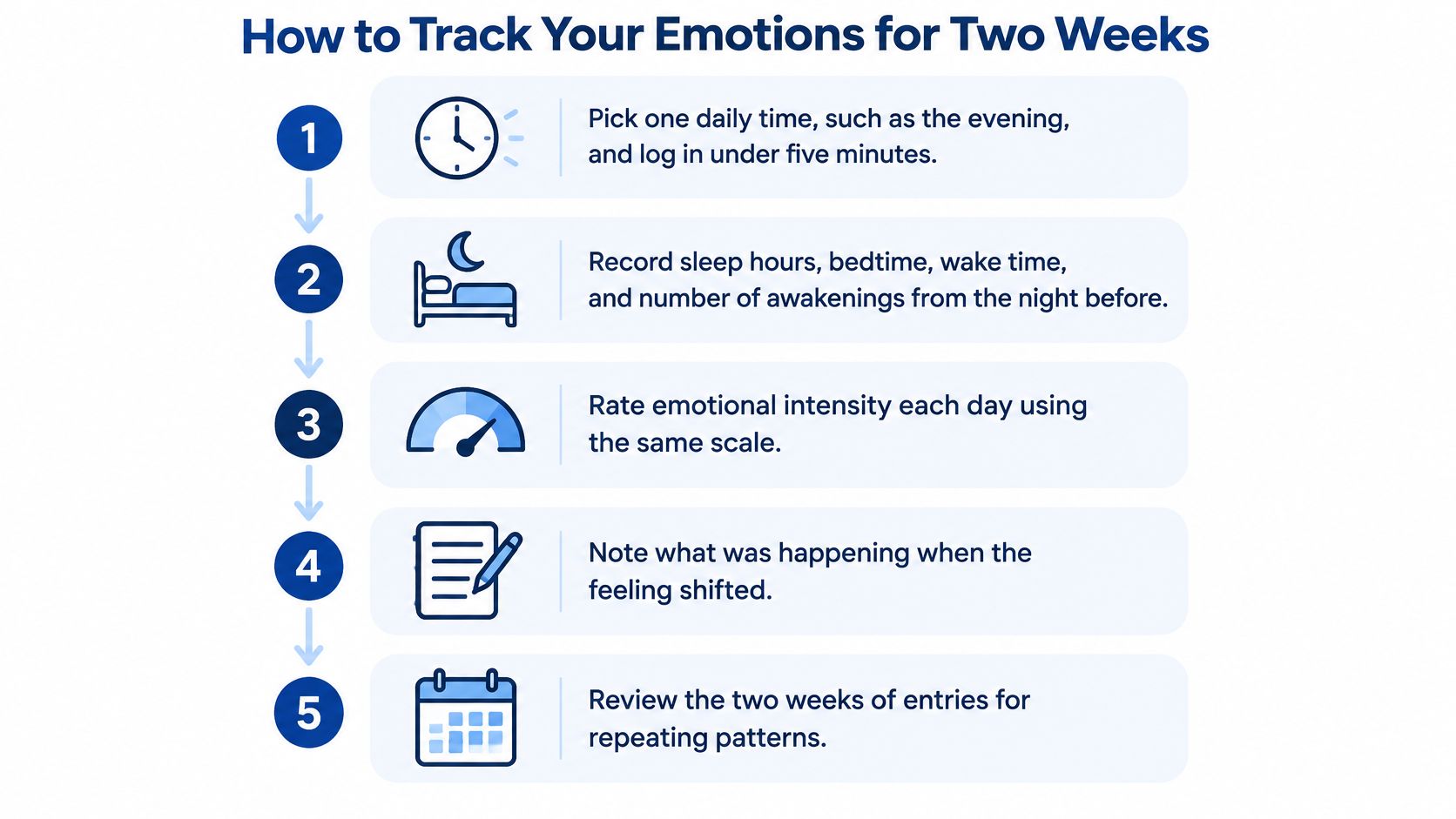
A short log beats a long memory. Here's the process in brief.
- Pick one fixed time. Evening works well, and the entry should take under five minutes so it happens.
- Record last night's sleep. Bedtime, wake time, total hours and number of awakenings, because sleep is the most modifiable driver on the list.
- Rate intensity from 0 to 10 and name the feeling. Sadness, anger, worry and overwhelm behave differently, and naming them separates them.
- Note the trigger. Write what happened in the hour before the shift, even if it seems trivial.
- Log substances and medication. Caffeine, alcohol, cannabis, nicotine, plus any doses taken or missed.
- Mark hormonal timing if relevant. Cycle day, postpartum week, or a perimenopause symptom note.
- Record recovery time. How long the feeling lasted tells a clinician more than how strong it was.
What to look for at day 14
Read the whole log in one sitting and look for repeats rather than single bad days. Emotions clustering after nights under six hours point to sleep. A sharp change that lines up with a new prescription points to medication. Feelings that arrive without any trigger and last for hours point toward something worth evaluating.
The log supports a clinician's review. It doesn't diagnose anything by itself, and a low intensity score doesn't cancel out a bad week. A structured daily mood journal keeps entries consistent enough to compare, and the finished log should go to any appointment, whether that's primary care or psychiatry.
Decide Whether to Book a Mental Health Evaluation
Choose the next step based on safety and how much emotions are disrupting daily life. If the situation feels urgent, seek help now.
| Situation | Next step |
|---|---|
| Thoughts of self-harm or suicide | Call or text 988 for the Suicide and Crisis Lifeline, or call 911 |
| Severe confusion, agitation or inability to function | Call 911 or go to the nearest emergency department |
| Rapidly escalating mood changes | Contact a clinician the same day |
| Emotional changes lasting several weeks | Book a nonurgent mental health evaluation |
| Changes that disrupt work, school or relationships | Book a nonurgent mental health evaluation |
What to bring to an evaluation
You do not need to know whether you have a diagnosis before booking. Bring your two-week log, a list of medications and supplements with doses, recent health changes, and any blood work from the past year. Add a sentence or two about what has become harder, such as getting through work or maintaining relationships. These details help a clinician understand how the pattern affects daily functioning.
Cost can make care harder to access. Pennsylvania data show 598,000 adults who needed mental-health care did not receive it, with 32.7% citing cost (Pennsylvania mental health fact sheet). Check benefits before booking: coverage, copays, deductibles, network status and prior-authorization requirements vary by plan. For readers comparing remote options, finding safe remote mental health support offers general guidance on choosing care.
Telehealth can make an initial conversation easier to arrange. Integrative Psychiatry of America provides online psychiatry and telepsychiatry across Pennsylvania, with secure, HIPAA-compliant visits and a patient portal for messaging, appointment requests and medication refills. An online mental health evaluation can help review symptom patterns and their effects on daily life. Screening tools can flag areas to discuss, while an evaluation considers the broader picture; neither a screener nor a log alone establishes a diagnosis. The practice offers free tools, including an Adult ADHD Screener, Anxiety Symptom Checker, 5-4-3-2-1 Grounding Tool, Focus Block Planner and My Self-Care Tracker, within a library of 15 tools.

If the last two weeks show a recurring pattern rather than an isolated bad mood, consider discussing it with a clinician. Integrative Psychiatry of America offers virtual evaluation and medication management for adults across Pennsylvania, including care for ADHD, anxiety and depression. Bringing your log and medication list can make the first conversation more focused. You can verify insurance and request an appointment through the practice's website.