
Useful PTSD treatment goals pair a sustained drop in core symptoms with restored daily functioning, not a promise that every symptom will disappear. Initial improvement may become noticeable after approximately 4–8 sessions, but a lower symptom score alone doesn't establish recovery.
The familiar advice to focus only on feeling less distressed misses something important. A person may feel calmer during appointments yet still avoid driving, miss work, or withdraw from family. Another person may return to valued activities while occasional nightmares continue.
A practical treatment plan makes both kinds of change visible. It tracks what PTSD feels like and what the person can do again.
Table of Contents
- PTSD Treatment Goals Worth Measuring
- How Symptom Clusters Become Treatment Targets
- Session Milestones From the First Month On
- Therapy Medication and Care for Other Problems
- Goals That Matter When Symptoms Remain
- Relapse Checks Between and After Sessions
- Bring Two Goals to a Pennsylvania Visit
PTSD Treatment Goals Worth Measuring
Consider a Pennsylvania adult who can describe nightmares and poor sleep but can't tell whether care is working. Appointments happen regularly, yet nobody has defined what improvement should look like outside the visit. The following domains turn that uncertainty into concrete targets.
PTSD treatment goals by domain
| Goal domain | What better looks like | How it is tracked | Early checkpoint |
|---|---|---|---|
| Intrusive memories | Fewer unwanted memories, nightmares, or flashbacks | Clinician-rated PTSD symptoms or a repeated scale such as the PCL-5 | Review after about 4–8 weekly sessions |
| Avoidance | Returning to places, people, conversations, or memories previously skipped | Count of avoided situations plus planned approach practice | Review after about 4–8 weekly sessions |
| Negative mood and beliefs | Less trauma-related shame, guilt, numbness, or hopelessness | Mood ratings and examples from home or work | Reassess across the 8–12-week course |
| Hyperarousal | Steadier sleep, startle response, irritability, and concentration | Nights slept, anger episodes, and focus during tasks | Check by about 4–8 sessions |
| Daily functioning | Work, school, parenting, errands, or social contact resume | Days participated, tasks finished, and relationship contact | Review at 8–12 weeks |
| Well-being and coping | More meaningful activity and a written plan for setbacks | Personal goal rating and safety-plan review | Revisit after about 10–12 sessions and again later |
These checkpoints are review prompts, not deadlines or promises. A baseline is the starting picture recorded before treatment, so later ratings and everyday examples have something meaningful to compare against.
Define improvement before judging it
A sound goal describes meaningful, sustained change rather than a few calm days. Clinician-rated symptoms capture clinical severity; life markers capture whether treatment helps someone participate in daily activities.
The PCL-5, a PTSD symptom questionnaire, can help track symptom patterns over time. It doesn't replace clinical judgment, and a score shouldn't become the patient's only definition of success.
NICE's PTSD treatment recommendations describe standard adult trauma-focused CBT protocols as typically 8–12 sessions, with additional sessions when multiple or complex traumas make them clinically appropriate. Treatment includes education, safety planning, trauma-memory processing, work on trauma-related meanings, and reduction of avoidance.
Include approach, not just relief
Avoidance can bring immediate relief while keeping threat beliefs intact. Someone who never enters a safe supermarket has little opportunity to discover that the reminder and the original danger aren't the same.
A clinician therefore helps the patient plan manageable approaches to safe reminders. This isn't an instruction to enter unsafe situations or confront overwhelming memories without support.
Practical rule: A useful goal names both the symptom that should ease and the activity that should become possible.
Patients and clinicians should write goals together and revise them when safety, trauma history, or other conditions change the pace. Before the next appointment, a patient can select a symptom target and a life target that matter most.
How Symptom Clusters Become Treatment Targets
PTSD symptoms fall into recognizable groups, but treatment becomes clearer when those groups connect to ordinary situations. A household evening or a difficult workday often reveals more than a general statement about feeling stressed.
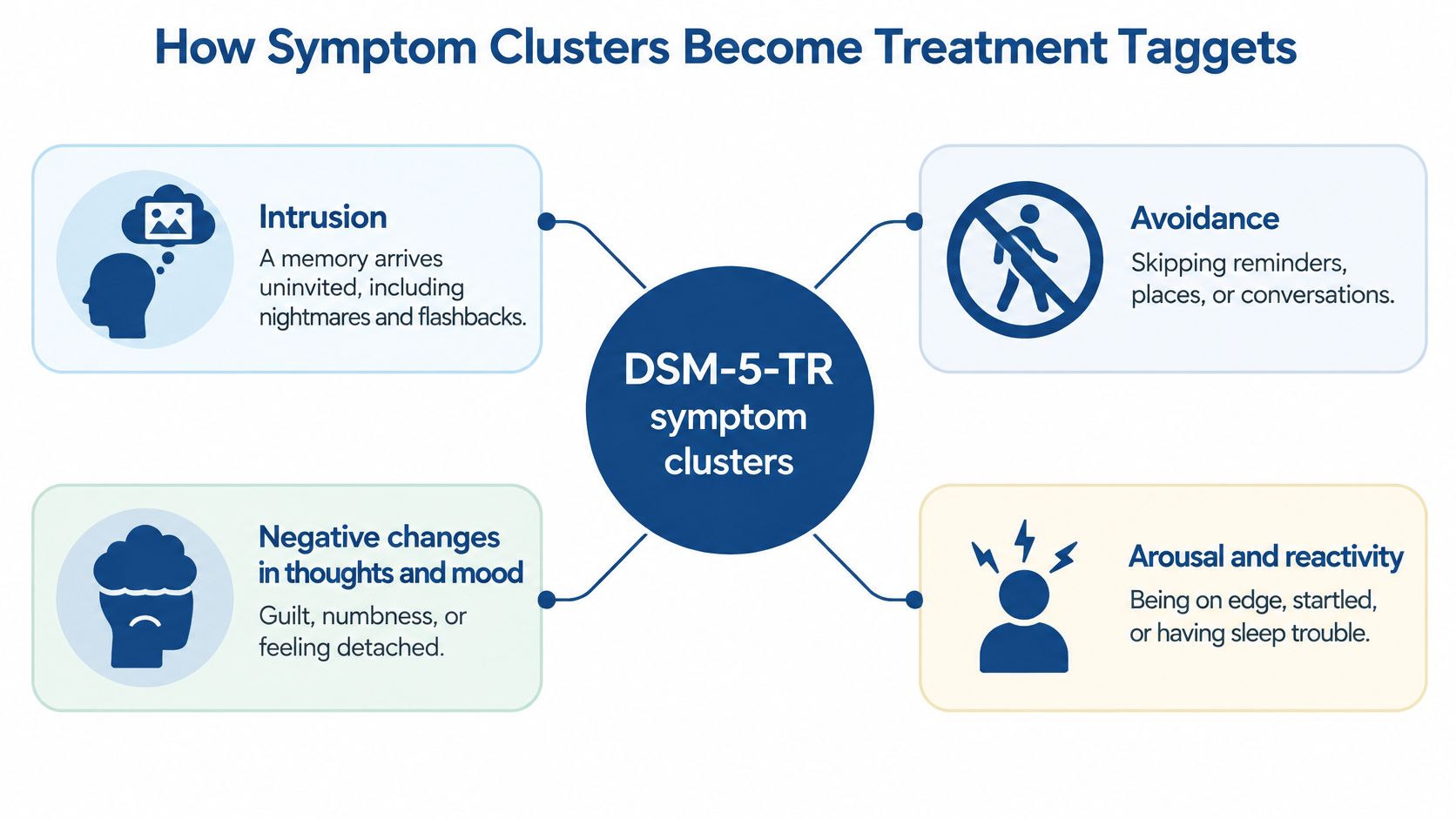
The diagram organizes the clinical terms into everyday experiences.
Recognize the pattern in daily life
Intrusion means a memory arrives uninvited. Someone washing dishes hears a sound and suddenly experiences a vivid trauma memory. A treatment target might involve less intense reactivity and a quicker return to the present task.
Avoidance might look like taking a long detour around a highway associated with a collision. The target isn't merely feeling calmer at home. It includes carefully planned practice with safe travel reminders.
Negative changes in thoughts and mood can appear during dinner. A person feels detached from family or assumes responsibility for something outside their control. Treatment can target trauma-related guilt and the ability to remain emotionally present.
Arousal and reactivity describe the body's persistent alarm response. At work, a closing door triggers a strong startle reaction, followed by irritability and lost concentration.
Symptoms resemble dashboard lights; functioning concerns whether the person can drive to work and sit through dinner. Both deserve attention, but they don't always improve together.
Look beyond a global distress rating
The American Psychological Association's discussion of PTSD treatment guidelines describes outcomes including intrusive memories, anger outbursts, sleep disturbance, substance use, emotional regulation, suicidal ideation, and dissociation. Dissociation can involve feeling disconnected from the body, surroundings, or present moment.
A single distress rating can hide important differences. Nightmares might ease while highway avoidance remains unchanged, requiring a different next step.
A useful preparation list includes:
- Most disruptive symptom: The experience that most often interrupts the day.
- Avoided activity: A safe place, conversation, or task the person keeps skipping.
- Sleep measure: A record of nightmare nights or remembered awakenings.
- Life problem: A specific difficulty with relationships, school, or work.
Safety takes priority when suicidal thoughts, severe dissociation, or uncontrolled substance use are present. A screening questionnaire can flag concerns, but only an evaluation can establish a diagnosis.
For clinicians seeking a training-oriented explanation, Orange Neurosciences offers a resource on integrating CPT techniques into clinical practice. Patients exploring nighttime symptoms can also review PTSD and sleep problems.
An integrative plan can support arousal regulation, sleep, and meaningful activity while trauma-focused therapy addresses trauma memories and their meanings.
Session Milestones From the First Month On
PTSD treatment milestone timeline
| Phase | Typical timing | Question to ask | If progress stalls |
|---|---|---|---|
| Setup | Sessions 1–3 | Are safety, baseline symptoms, and personal goals documented? | Clarify diagnosis, preferences, and urgent risks before judging therapy |
| Early change | About 4–8 weekly sessions, roughly 1–2 months | Have core symptoms or a life target begun to move? | Avoid judging after 1–2 visits; less-than-weekly meetings may weaken the effect |
| Initial course | Usually 8–12 weeks of weekly care | Has avoidance dropped and daily functioning improved? | Review treatment fit, dose, safety, and co-occurring problems |
| Added sessions | Additional care when trauma is multiple or complex | Do remaining symptoms still block sleep, work, or relationships? | Keep functioning goals active even when symptom scores fall |
| After the initial course | Periodic reassessment | Are gains holding outside sessions? | Update the setback plan; completion isn't automatic recovery |
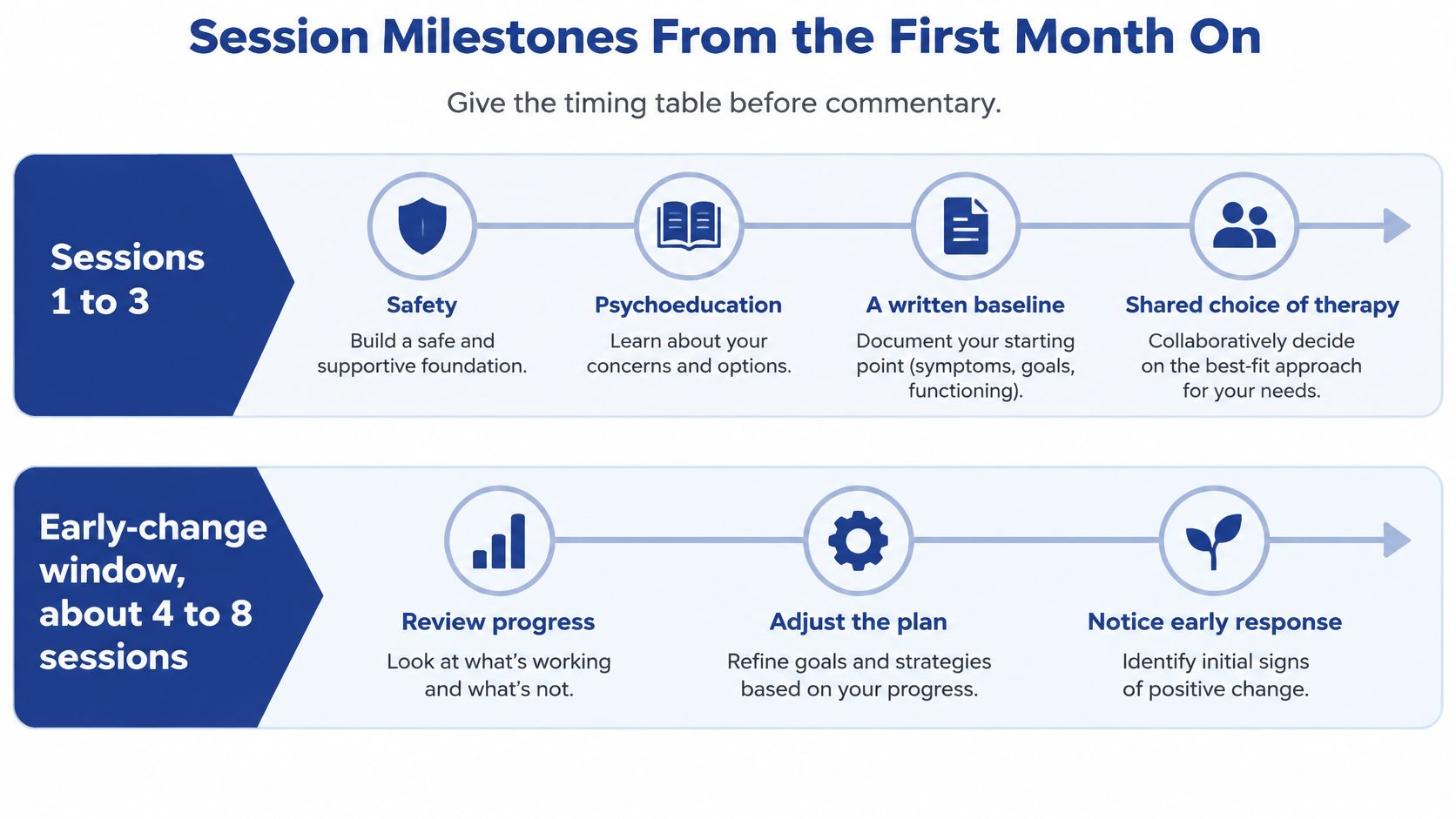
The VA/Department of Defense provider summary places noticeable initial effects at approximately 4–8 sessions, typically delivered over 8–12 weeks, and cautions that less-than-weekly psychotherapy may have a reduced effect. The early-change checkpoints are therefore occasions for review, not pass-or-fail tests.
The timeline highlights the distinction between getting started and assessing early response.
Interpret the milestones without self-blame
The VA/DoD key recommendations describe about 10–12 sessions as an adequate therapeutic dose for many protocols, while some patients continue benefiting after 15 or more sessions. “Dose” here means enough structured treatment to assess its effects, not medication dosage.
Early appointments commonly establish safety, explain PTSD, record starting symptoms, and support shared treatment choices. A lack of immediate relief doesn't establish that the therapy is unsuitable.
Attendance matters, but attendance alone isn't the treatment goal. Someone may complete every appointment while remaining unable to travel, work, or maintain relationships.
Review the plan when change stalls
Between visits, a brief record can include:
- Symptoms: A repeated symptom measure agreed upon with the clinician.
- Sleep: Nightmare nights, awakenings, or time spent awake.
- Approach behavior: A safe reminder approached rather than avoided.
- Participation: Changes in work, school, or family contact.
If early reviews show no movement, the clinician should examine treatment fit, consistency, safety, and co-occurring problems. Medication effects, substance use, pain, or an unclear diagnosis may also need attention.
A person whose symptom score falls but who still can't sleep or work needs an active functioning goal. Trauma-informed mental health care should support that discussion without pressure or blame.
These ranges describe treatment patterns in guidelines. They don't guarantee an individual recovery schedule.
Therapy Medication and Care for Other Problems
Patients don't necessarily have to choose between trauma therapy and medication, or wait until every other problem disappears. Shared decision-making means the clinician explains reasonable options and the patient's preferences help shape the plan.
A treatment discussion should clarify the job each option is expected to do.

Match each treatment to its purpose
| Treatment component | Main purpose | Important limit |
|---|---|---|
| Trauma-focused psychotherapy | Work with trauma memories, meanings, and avoidance | Requires a trained practitioner and an individualized pace |
| Medication management | Address PTSD symptoms or co-occurring mood, anxiety, and sleep concerns | Doesn't automatically resolve avoidance or restore daily roles |
| Concurrent substance-use care | Address substance-related risks while PTSD treatment proceeds | Requires coordinated safety planning |
| Integrative supports | Support sleep, activity, nutrition, and coping | Don't replace evidence-based PTSD treatment |
The 2025 APA clinical practice guideline strongly recommends offering adults CPT, Prolonged Exposure, CBT, or Cognitive Therapy rather than no intervention or treatment as usual; it also suggests EMDR, Brief Eclectic Psychotherapy, and Narrative Exposure Therapy. These approaches differ, so choosing a named therapy should include an explanation of what sessions involve.
The VA's discussion of PTSD treatment guidance prioritizes individual trauma-focused psychotherapy such as CPT, EMDR, or Prolonged Exposure, with medication when psychotherapy is unavailable, not preferred, or infeasible. It also supports treating PTSD and substance-use disorder concurrently rather than requiring completion of either treatment first.
Trauma processing doesn't mean repeatedly recounting painful events without a purpose. A trained therapist helps the patient work with memories, reconsider meanings such as shame or permanent danger, and reduce avoidance.
For an accessible comparison before a clinical discussion, patients can explore evidence-based PTSD therapies through Be Your Best Self & Thrive Counseling, PLLC.
The following video can accompany, rather than replace, a conversation about treatment choices.
Coordinate goals rather than creating prerequisites
Consider a hypothetical patient whose nightmares and drinking interfere with employment. Concurrent goals might include fewer nightmares, fewer heavy-drinking days, and two sober workweeks, with withdrawal risk assessed before changes in alcohol use.
Medication isn't proof that therapy failed. It may support symptom management while other treatment addresses avoidance, beliefs, and daily participation.
Care for trauma and care for substance use shouldn't become opposing entry requirements.
Telehealth still requires a safety plan, follow-up, and clear instructions for reporting worsening symptoms. Sleep habits, movement, nutrition, and mindfulness can serve as adjuncts.
Relevant laboratory testing may help identify medical contributors or guide prescribing. Genetic information has limits and can't reliably identify a guaranteed effective PTSD medication.
Goals That Matter When Symptoms Remain
Treatment hasn't automatically failed because a symptom remains. Useful recovery can include returning to work or school, rebuilding trust, sleeping more steadily, parenting, and participating in meaningful activities.
In VA research on veterans' treatment goals, 83% identified symptom improvement, 55% wanted better interpersonal functioning, and 33% wanted greater personal well-being, growth, or leisure engagement. Veterans generally supported measurement-based care, meaning regular assessment to guide treatment, but preferred measures connected to their own priorities.
Separate symptom goals from life goals
The following hypothetical examples illustrate different forms of progress. They aren't treatment targets that every patient should adopt.
- An Allentown-area warehouse supervisor: The symptom goal is to reduce overnight panic from most nights to two nights a week. The life goal is to finish a full shift without leaving early.
- A Pittsburgh graduate student: Some startle remains, but recovery no longer waits for its complete disappearance. The symptom goal is to recover more quickly after sudden noises; the life goal is to return to in-person class and email one professor instead of dropping the course.
- A Bucks County parent: Crowded stores remain uncomfortable. The symptom goal is less intense distress during shopping, while the life goals are one weekly grocery trip and reading with a child for 15 minutes.
- A first responder: Occasional intrusive images persist. The symptom goal is less disruption when images occur; the life goal is to use a written grounding plan and discuss modified duty with a clinician.
A scale can fall while daily life stays restricted. Conversely, someone may attempt valued activities before symptom scores change dramatically.
Neither pattern makes symptom measurement useless. It means the clinician needs both the score and the story behind it.
Make the goal observable
A vague goal such as feeling normal again gives little guidance for treatment decisions. An observable goal describes an action, the setting, and the barrier that needs attention.
For example, a patient hoping for better relationships might target staying present during a family meal or restarting contact with a trusted friend. The clinician can explore whether fear, numbness, irritability, or exhaustion gets in the way.
A useful test: Another person could recognize the behavior without needing access to the patient's thoughts.
PTSD grounding techniques may help a patient return attention to the present during distress. Grounding supports participation; it doesn't require pretending that symptoms have disappeared.
A patient can rewrite a broad hope as a behavior to observe this month. Goals should remain meaningful enough to justify the effort, yet flexible enough to accommodate safety and changing circumstances.
Relapse Checks Between and After Sessions
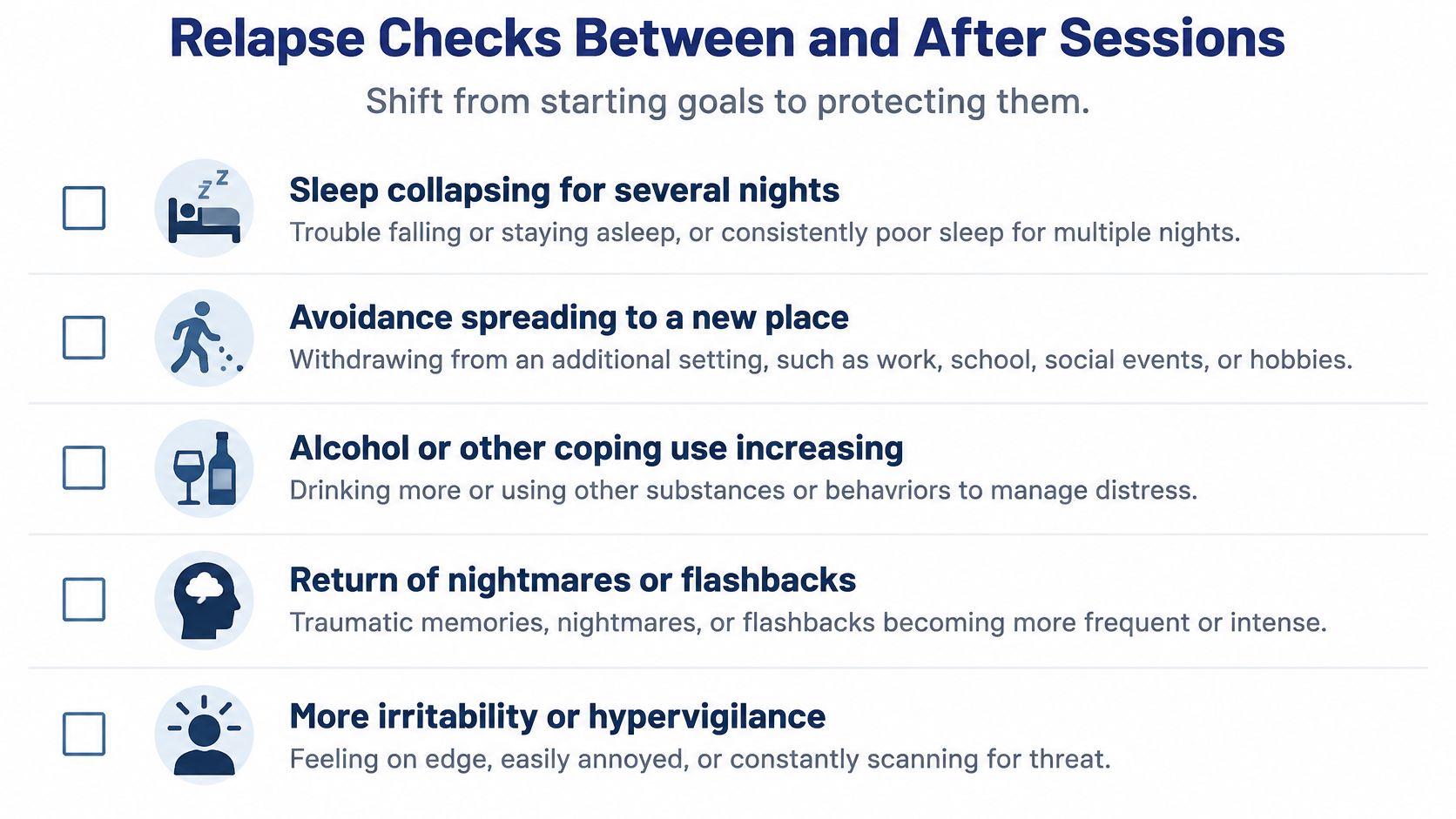
Protecting improvement requires noticing changes before everyday participation narrows again. A difficult stretch doesn't automatically mean a full relapse, but it deserves attention when symptoms or safety risks increase.
The checklist highlights patterns worth bringing to the treatment team.
Keep a brief weekly record
A patient can use a secure portal or notebook for a short weekly check. The purpose is to support decisions, not create another demanding assignment.
- Rate the main symptom: Use the same agreed description or scale so changes remain interpretable.
- Record sleep: Note disrupted nights and whether daytime functioning suffered.
- Identify an approach step: Record a safe activity attempted despite discomfort.
- Note a functioning change: Include a completed shift, cancelled plan, family interaction, or missed responsibility.
Warning signs include sleep collapsing for several nights, avoidance spreading to a new place, or increasing alcohol or opioid use. Anger affecting work and withdrawal from previously renewed relationships also warrant discussion.
A grounding exercise can support present-moment attention, while a mood note can help explain what happened before symptoms worsened. Neither an app nor a notebook provides treatment by itself.
Plan for barriers and worsening symptoms
A 2025 review of 85 trials found a mean dropout rate of 20.9% for guideline-recommended PTSD treatments. Missed sessions are a recognized treatment risk, not evidence of a personal flaw.
A practical plan identifies barriers before attendance becomes difficult. Schedule conflicts, costs, lack of privacy, and fear of sessions require different solutions.
A relapse-prevention visit can review triggers, refresh the safety plan, and consider booster sessions. It isn't a declaration that earlier progress no longer counts.
Patients should contact the clinical team promptly for suicidal thoughts, severe dissociation, or escalating substance use. Inability to stay safe requires emergency or crisis care rather than waiting for a portal response.
Guidance on PTSD treatment at home can help distinguish supportive daily practices from professional care. At-home coping should complement treatment rather than replace it.
A useful review ends with these questions:
- Symptom change: Did the target symptom move?
- Life change: Did a meaningful life role improve or become harder?
- Treatment fit: Is the current mix of therapy, medication, and daily supports still appropriate?
Bring Two Goals to a Pennsylvania Visit
A lower symptom score is useful, but it is not the finish line. A patient may want fewer nightmares and also hope to sleep through the night, return to work, or feel more present with family. Bring both kinds of goals to a Pennsylvania visit. They can be stated in everyday language.
Before the appointment, a patient could note recurring nightmares, sleep disruption, avoided places, or missed responsibilities over a period of time. A completed questionnaire may help organize those observations, but a screening tool cannot replace an evaluation.
Prepare for evaluation and coordinated care
Integrative Psychiatry of America offers virtual psychiatric care across Pennsylvania. Led by board-certified psychiatric nurse practitioner Christopher Clark, MSN, PMHNP-BC, the practice provides care through telehealth. Its PTSD care information describes the care pathway for prospective patients.
An evaluation considers symptoms, trauma history, daily functioning, safety, medical factors, and other possible explanations. A provider diagnoses PTSD only when the clinical criteria support it. The evaluation also helps clarify what the patient wants treatment to change, both in symptoms and in everyday life.
Care may include medication management when trauma-focused psychotherapy is unavailable, not preferred, or infeasible, alongside coordination with CPT, EMDR, or Prolonged Exposure. Ask which therapy services are available directly and which may require referral.
Bring a few practical details:
- Written goals: The symptom causing the most disruption and the daily role the patient hopes to restore.
- Treatment history: Previous therapy and medications, what helped, side effects, and why treatment stopped.
- Optional tools: A PTSD or anxiety checker, grounding record, or mood note to organize concerns.
- Practical needs: A private telehealth location, scheduling constraints, and questions about follow-up.
Sleep, movement, nutrition, mindfulness, and relevant laboratory information can support care. They do not guarantee recovery or replace treatment.
Verify benefits alongside the appointment request
Check insurance before assuming what care will cost. Copays, deductibles, network status, and authorization requirements differ by plan, so confirm applicable benefits with the practice and insurer.
Suicidal thoughts, inability to stay safe, severe dissociation, or escalating substance use call for prompt attention. A patient facing these concerns should contact local emergency or crisis services rather than wait for routine telehealth.
Integrative Psychiatry of America offers virtual psychiatric evaluation and medication management across Pennsylvania, with goals suited to symptoms and daily functioning. Patients can visit Integrative Psychiatry of America to request an appointment and ask about insurance verification. Bring one symptom goal and one life goal to guide the discussion.