
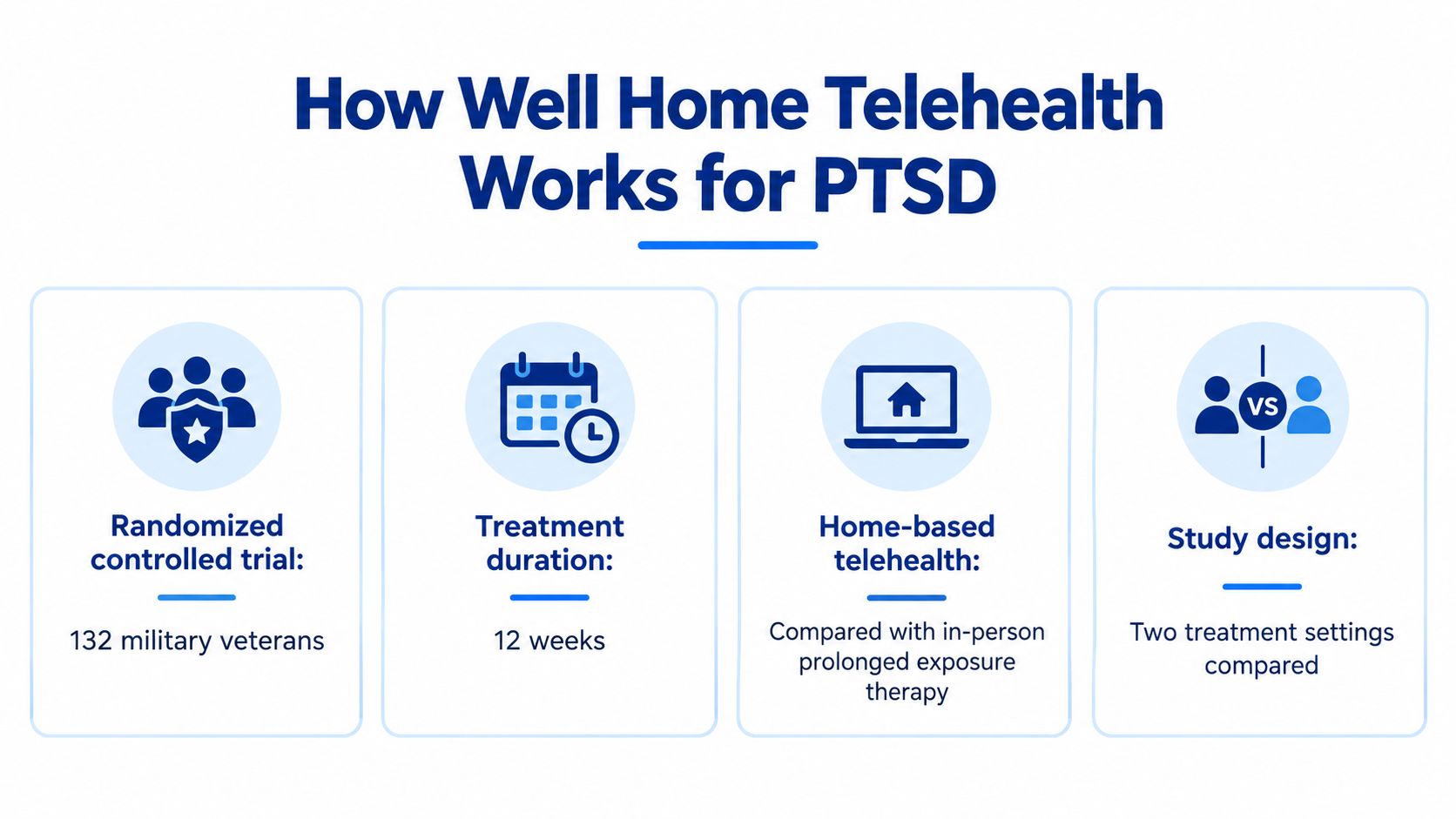
Clinician-guided trauma therapy delivered by secure video is a clinically supported option for many adults. In a trial of 132 military veterans, home-based care matched office-based prolonged exposure on the main PTSD measure, while self-help books and apps used alone aren't recommended as standalone PTSD treatment.
It's late, the house is finally quiet, and the drive to a clinic feels heavier than the symptoms. Sleep is broken. A slammed door still lands too hard. A waiting room sounds like one more place to stay on guard. PTSD treatment at home can remove that trip, but only when the session is a real protocol with a trained clinician, a privacy plan, and a written emergency plan. An app or a workbook used alone doesn't meet that bar.
Secure video can carry structured trauma work from a private room. It doesn't turn convenience into clinical quality, and it isn't the right first step for every household.
Table of Contents
- Who Can Start PTSD Treatment at Home
- How Well Home Telehealth Works for PTSD
- Safety Setup and When Home Care Is Not Enough
- How a Guided Home Program Runs Week by Week
- Medication Options to Discuss With Your Provider
- Exercise, Nutrition and Mindfulness Between Sessions
- Confirm Home Care Fits Before You Start
Who Can Start PTSD Treatment at Home
Many adults can begin trauma-focused treatment at home, but only when a trained clinician guides the work. PTSD is the condition in which trauma-related memories, avoidance, hypervigilance, and sleep disruption persist for months after an event. The room you sit in doesn't replace the treatment itself.
Five options, very different evidence
People often lump every at-home option together. The evidence doesn't.
| Option | Evidence for PTSD | Clinician involvement | Best fit |
|---|---|---|---|
| Self-help books or PTSD apps used alone | Insufficient evidence as standalone care (VA/DoD) | None | Skill practice and symptom tracking alongside care |
| Unguided online self-help programs | Insufficient evidence as standalone care | None | Learning grounding and psychoeducation only |
| Guided internet CBT | Large symptom improvement in a trial of 96 adults | Weekly clinician contact | Mild to moderate symptoms with a stable home setting |
| Clinician-led home telehealth trauma therapy (CPT, PE, or EMDR) | First-line recommendation; outcomes comparable to office care in randomized trials | 8 to 12 scheduled sessions with a trained therapist | Adults with a private room, stable internet, and no imminent safety risk |
| In-person office trauma therapy | First-line recommendation; standard comparison | Scheduled in-clinic sessions | Adults with an unsafe or unpredictable home, high-risk needs, or a preference for face-to-face care |
The VA/DoD PTSD guideline recommends individual, manualized Cognitive Processing Therapy, Eye Movement Desensitization and Reprocessing, or Prolonged Exposure as first-line treatment. It finds insufficient evidence for mobile apps or self-help as standalone care. Guided internet CBT is a different category. In one randomized trial, 96 adults completed ten sessions over five weeks, and PTSD severity improved with a large effect.
A fit test before you book
Home sessions fit when four conditions hold.
- Stable internet: Audio and video stay clear for a full session, with a backup phone number if the call drops.
- A private room: You can speak about trauma without a partner, child, or roommate overhearing.
- No active substance misuse: Intoxication during sessions makes exposure unsafe.
- No imminent safety risk: Suicidal intent, violence in the home, or an inability to stay grounded needs a different starting point.
Practical rule: If any item on that list fails, start with an in-person or stabilizing assessment rather than trauma exposure on video.
Failing the fit test isn't a refusal of care. It means the first job is safety and a workable setting, not rushing into the hardest part of treatment.
How Well Home Telehealth Works for PTSD
For someone who avoids clinic travel, home-based prolonged exposure can make structured trauma treatment easier to attend. A randomized trial compared 12 weeks of home telehealth with in-person care for 132 military veterans: 64 received treatment at home and 68 in an office. Both groups were offered 10 to 12 weekly sessions lasting about 90 minutes, according to the VA prolonged exposure comparison.
What matched, and what didn't
On the PTSD Checklist, home telehealth was not inferior to office treatment at the end of care or at the 3- and 6-month follow-ups. This finding applies to the primary PTSD measure, not every symptom. Depression scores were worse in the home group at treatment's end and at 3 months; by 6 months, that difference was gone.
An earlier trial assigned 52 veterans with combat-related PTSD to 8 to 12 weeks of prolonged exposure at home or in an office. PTSD, depression, and anxiety improved in both groups, with no difference by format in clinician-rated PTSD outcomes or satisfaction.
Home video can support structured trauma treatment and similar PTSD symptom improvement. Depression still needs to be monitored separately.
Who actually stays in treatment
Travel can affect attendance. A pooled analysis of two trials tracked 268 participants. Overall, 57.5% (154 people) attended at least eight sessions. Completion rates differed by delivery format:
| Delivery format | Completed at least eight sessions |
|---|---|
| In-home treatment | 75.4% |
| Telehealth | 58.3% |
| Office-based care requiring travel | 44.0% |
In-home treatment's completion rate was 31.4 percentage points higher than office care requiring travel. The analysis combined different trial formats and participant characteristics, so the results show an association, not proof that home treatment is always better.
That difference may matter if driving is difficult, your schedule depends on a caregiver, or clinic visits intensify avoidance. Before committing, learn what telepsychiatry involves, including how appointments are conducted. Home treatment works best when your clinician tracks depression, sleep, daily functioning, and PTSD symptoms throughout care.
Safety Setup and When Home Care Is Not Enough
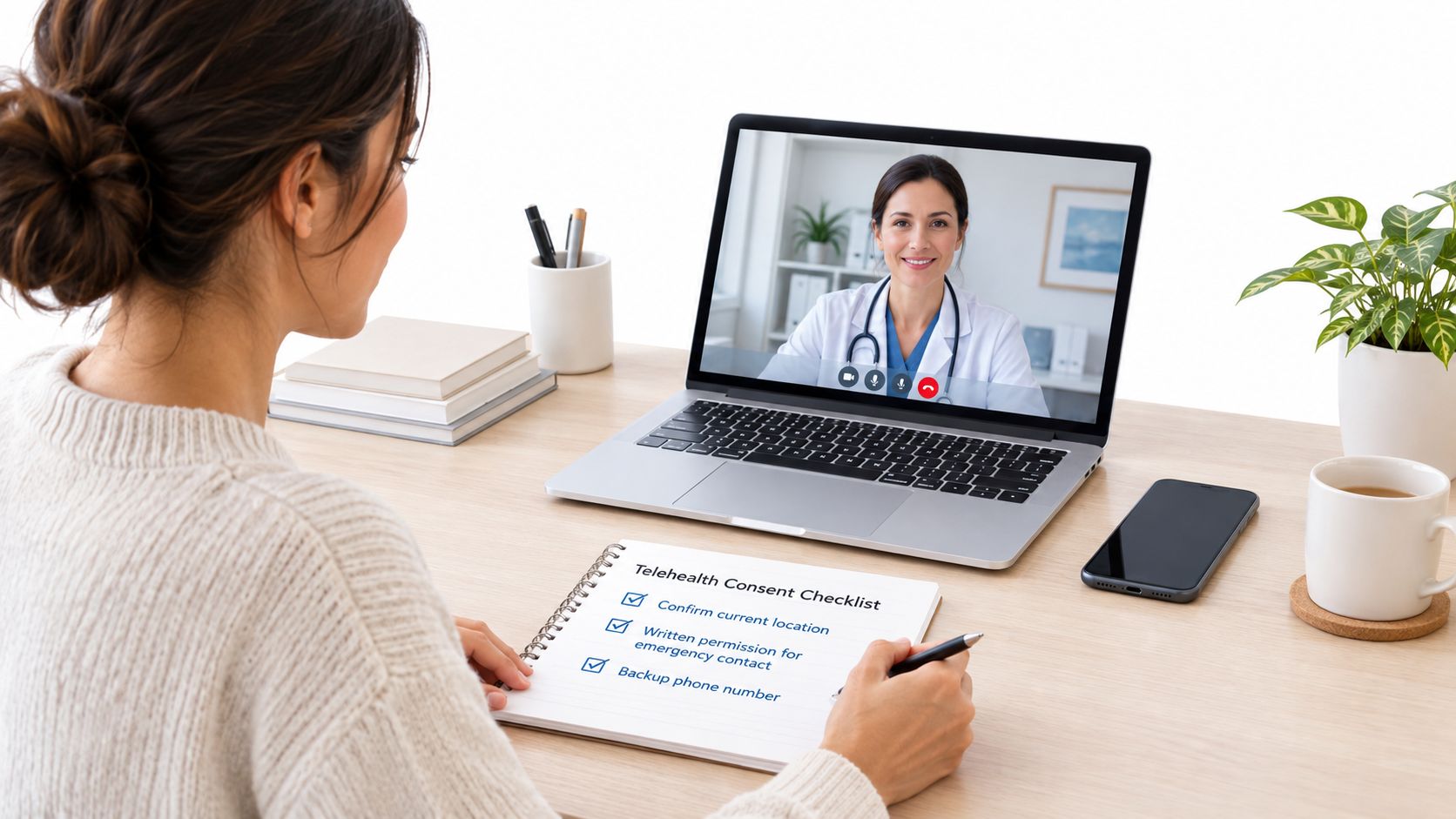
Before a home exposure session begins, the clinician should know where you are, how to reach you if the video fails, and who can help in an emergency. You should know the same details. The emergency plan is part of treatment, not a form to sign and forget.
Why the setup changes dropout and risk
The VA telemental health guidance recommends confirming your physical location at each visit, getting permission to contact an emergency person, and setting emergency procedures before treatment starts. An in-person risk assessment can help determine whether video care is appropriate, although there are no absolute contraindications to home video. Before a session, test audio and video, identify likely household interruptions, and agree on what to do if someone nearby compromises your privacy. At each visit, the clinician should track attendance, exposure homework, distress, suicidal thoughts, substance use, and changes in daily functioning.
Delivery format matters, but dropout figures should be compared only when the treatment groups are clearly defined. A VA comparison of prolonged exposure formats found no significant difference in symptom improvement by modality. Its dropout odds ratios compare specific study groups and are not directly interchangeable with pooled completion rates for in-home treatment, interactive telehealth, and office care requiring travel. Those measures describe different comparisons, so they do not establish that one format consistently has the lowest dropout. For your care, a reliable connection and a backup phone line help the clinician respond if a session is interrupted.
Common problems include beginning exposure without a safety assessment, relying on an app instead of psychotherapy, allowing avoidance to prevent the planned work, and having no response plan for missed visits. Trauma-informed mental health care puts consent, choice, and safety checks into early appointments, before a crisis occurs.
Severe symptoms do not automatically rule out video care, especially when the alternative is no treatment. They may mean the clinician should first help stabilize symptoms or arrange in-person care before starting trauma exposure.
Screen for severe dissociation, psychosis, mania, active intoxication, imminent self-harm, and an unsafe household before deciding that home treatment is suitable. Hypervigilance and avoidance may be harder to manage without another person physically present. The decision should reflect both the potential benefit of starting care at home and the support available if symptoms intensify.
When to escalate
| Warning sign | Urgency | What to do |
|---|---|---|
| Suicidal thoughts with a plan or intent, or thoughts of self-harm | Emergency | Call or text 988 now. Call 911 if you are in immediate danger. |
| Immediate danger in the home, including violence or unsafe circumstances | Emergency | Call 911. Leave if you can do so safely, and tell the clinician your location. |
| Psychosis, mania, or severe dissociation | Urgent | Contact the provider the same day. The provider may recommend in-person evaluation or stabilization. |
| Substance use escalating or intoxication during sessions | Urgent | Pause exposure work and contact the provider the same day to discuss a higher level of care. |
| Flashbacks lasting hours and unable to ground | Urgent | Use the grounding plan. If you cannot settle, call 988 or contact your provider. |
| Worsening depression, sleep loss, or inability to function for several days | Prompt | Contact the provider within one to two business days. |
| Missed session or video drop during exposure | Same day | Reconnect through the backup channel and contact the clinician that day. |
If the video disconnects during exposure, do not wait alone with the memory until the next appointment. Use the backup number and contact the clinician the same day.
How a Guided Home Program Runs Week by Week
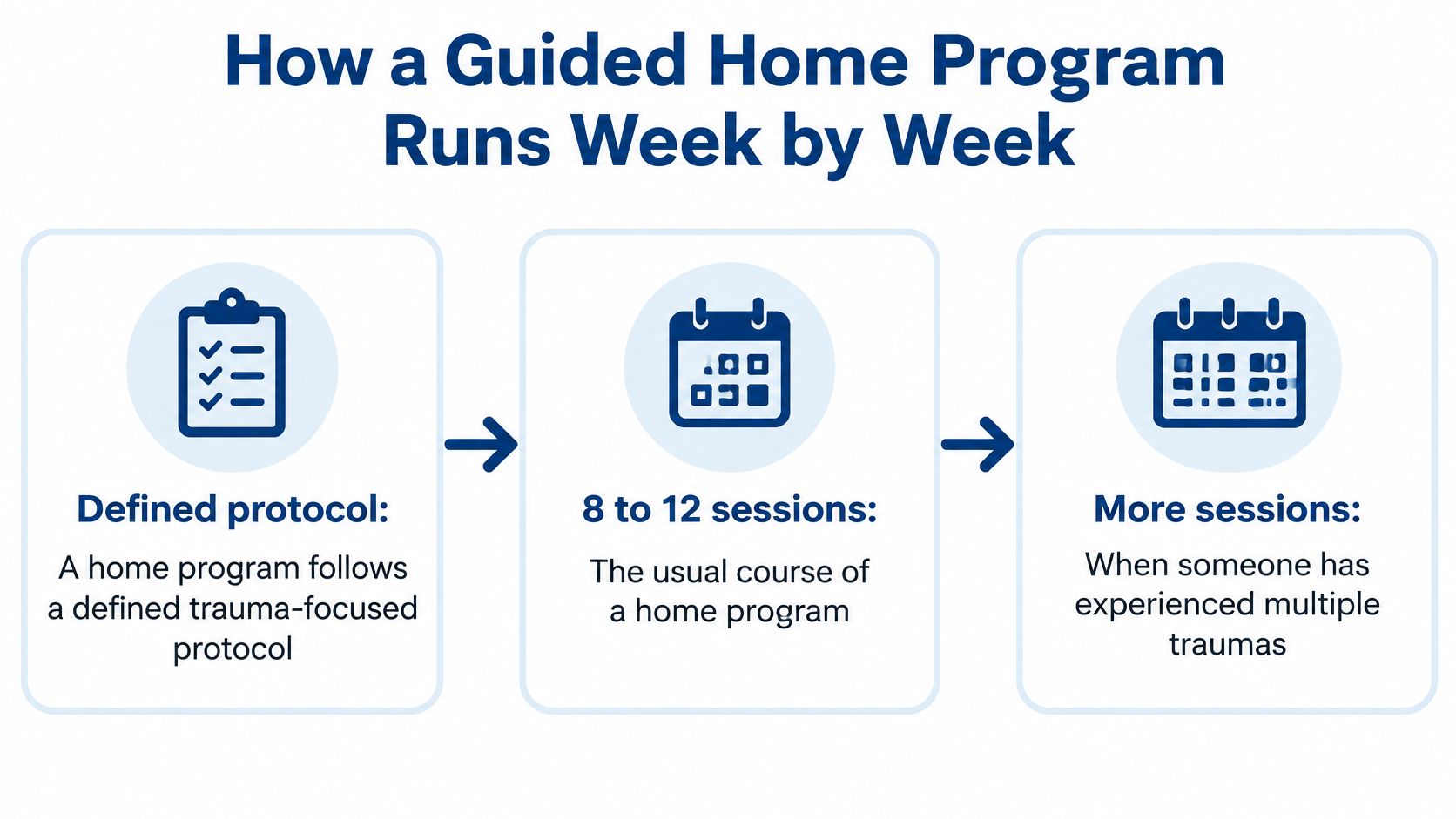
A home program follows a defined trauma-focused protocol, usually 8 to 12 sessions, with more sessions when someone has lived through multiple traumas. Effective home care isn't informal counseling on video.
The sequence, and why each step comes first
NICE guidance on PTSD says trauma-focused cognitive behavioral therapy for adults should use a validated manual, be delivered by trained practitioners under supervision, and include psychoeducation, skills for arousal and flashbacks, and safety planning. Remote delivery fits that frame when assessment and monitoring stay in place. The practical order is:
- Complete diagnostic and safety screening first. A full assessment, including suicide and lethal-means screening, shapes the safety plan and whether home care fits at all. Trauma processing waits until that screen is done.
- Confirm the room and the connection. You need privacy, stable internet, and a stretch of time without interruptions. Test audio and video before the first exposure session, not during it.
- Write the safety plan while you are calm. List coping steps, the backup phone number, and the person the clinician may contact. This is the document you use if a session destabilizes you.
- Attend weekly clinician-guided sessions. The clinician sets the pace. You don't decide alone when to push into the worst memory.
- Do the between-session work. Worksheets or graduated exposure assignments only count if you log distress and avoidance. Skipping them without telling your clinician is a form of avoidance.
- Track symptoms on a standard measure. Scores at baseline and at regular intervals show whether PTSD, depression, and sleep are changing.
Schedule the visit at the same time each week, and keep a short note on what felt hardest. That log is more useful than trying to remember a whole month at the next appointment.
What the clinician controls
In Prolonged Exposure, the clinician assigns graduated in-vivo or imaginal exposure, reviews distress and avoidance, and pauses for destabilization, substance misuse, or acute safety risk. You don't run unsupervised exposure between visits. Change often becomes noticeable after about 4 to 8 sessions across roughly 8 to 12 weeks, though some people need longer, especially after repeated trauma.
The five-week internet CBT trial noted earlier, ten sessions with those 96 adults, showed a large intent-to-treat effect (d = 1.40). 16% of treatment participants didn't complete the second assessment. That supports guided telehealth. It doesn't support treating yourself from a workbook. Sleep often lags behind daytime symptoms, which is why clinicians fold PTSD and sleep problems into the same course rather than waiting until therapy ends.
Medication Options to Discuss With Your Provider
Medication can support PTSD treatment, and it is usually discussed alongside therapy rather than instead of it. A prescriber looks at your symptoms, other conditions, current medicines, and side-effect history before choosing anything.
How the common options differ
| Medication | FDA status for PTSD | Class | Key consideration |
|---|---|---|---|
| Sertraline | FDA-approved for PTSD | SSRI antidepressant | Early nausea or sleep changes are common. Full effect can take several weeks. |
| Paroxetine | FDA-approved for PTSD | SSRI antidepressant | Possible weight gain and sexual side effects. |
| Venlafaxine | Not FDA-approved specifically for PTSD. Recommended in the VA/DoD guideline. | SNRI antidepressant | Can raise blood pressure, so monitoring is needed. |
| Prazosin | Not FDA-approved for PTSD. Used mainly for nightmares. | Alpha-blocker | Dizziness and low blood pressure on standing. Evidence for nightmares is mixed. |
Sertraline and paroxetine are the two antidepressants with FDA approval for PTSD. Venlafaxine isn't approved specifically for PTSD, but the VA/DoD guideline includes it as a recommended option, with blood pressure checks because it can raise pressure. Prazosin isn't a general PTSD treatment. Clinicians sometimes use it for nightmares, and the evidence there is mixed, so it isn't a default.
What the first weeks actually feel like
Antidepressants often need several weeks before the benefit is clear. Early nausea or a shift in sleep may fade. Stopping suddenly can bring withdrawal symptoms, so any change goes through the prescriber, including a dose you think isn't working.
Don't stop a PTSD medicine on your own because the first week feels worse. Call the prescriber, and ask whether the dose, the timing, or the drug itself should change.
Telehealth prescribing rules and coverage vary by medicine and by plan. Some drugs need extra monitoring that a video visit can handle, and some situations still need an in-person check, such as blood pressure on venlafaxine or dizziness on prazosin. Bring a symptom log and a full medication list, including supplements, to that first medication conversation. The log should note nightmares, irritability, sleep, and any day you drank more to get through the evening.
Exercise, Nutrition and Mindfulness Between Sessions
At home, a walk, a meal, or a grounding exercise can become a trauma reminder rather than a calming routine. Keep lifestyle changes alongside therapy and medication, and adjust them with your clinician if they bring up symptoms.

Movement and sleep
Choose activity that feels manageable in your current surroundings. If walking past a place associated with trauma raises distress, try a different route, walk indoors, or discuss alternatives with your therapist. Keep the pace easy enough that you can stop without feeling you have failed. Your clinician can help you distinguish ordinary discomfort from a level of activation that calls for changing the plan.
For sleep, agree on a routine with your clinician and track how it affects you. If a difficult night leads to a later wake time, note the change rather than forcing a strict schedule. Bring persistent sleep disruption or worsening hypervigilance to your provider's attention.
Food, caffeine, and alcohol
Notice whether caffeine or alcohol seems connected to changes in sleep, nightmares, or irritability, and share that pattern with your clinician. If you decide to change your use, make one adjustment at a time so you can tell what affects symptoms. The episode on cognitive behavioral therapy for better mood is background material, not a substitute for PTSD assessment or individualized advice.
Grounding that doesn't overwhelm
Use a brief, eyes-open practice if closing your eyes or focusing inward feels unsafe. Name objects in the room, or try paced breathing only if it does not intensify distress. A trauma-focused therapist can help adapt the practice; pause and tell them if it brings on flashbacks. See these PTSD grounding techniques as options to discuss, not exercises you must push through alone.
Keep a simple log of the activity, food or drink changes, grounding practice, sleep, and symptoms. Review it with your home-based clinician before adding more habits. If a practice makes symptoms sharper, stop it and discuss another approach rather than trying to endure it.
Confirm Home Care Fits Before You Start
A private room and a plan for handling a difficult session are part of home treatment, not optional extras. Guided telehealth trauma therapy is worth exploring only if all four conditions in the fit test above hold. If even one does not, begin with an in-person or stabilizing assessment rather than exposure at home.
A practical order for Pennsylvania adults
- Check benefits before the first visit. Coverage, network status, prior authorization, copays, and deductibles vary by plan. Ask your insurer about video psychotherapy and medication visits separately. Neither is guaranteed to be covered.
- Use a symptom checker as a starting point. A free PTSD symptom checker can help you describe your symptoms, but it cannot establish a diagnosis. That requires a clinical evaluation.
- Book an evaluation, not a promise of home exposure. Practices offering virtual care across Pennsylvania, including Integrative Psychiatry of America, can arrange an assessment with a licensed psychiatric provider. The clinician reviews your symptoms, assesses safety, and discusses whether home care fits. You can also compare PTSD therapists and treatment options if you prefer face-to-face care or another format.
- Bring details that shape the plan. Gather your symptom history, current medication list, past treatment information, and emergency contact details. Be ready to discuss whether the clinician may call your emergency contact if needed.
Plan for safety before the first session. The evaluation is a chance to agree on what to do if distress rises during or after a visit, including whom to contact and when home care is no longer enough. You do not need to arrive certain that video-based trauma work is right for you. You do need to be able to speak openly about privacy, substance use, and your safety plan.
If your home is not private or safe right now, choose a different level of care. That decision can change; stabilizing care does not rule out trauma-focused treatment later, when your circumstances support it.
Integrative Psychiatry of America provides virtual psychiatric care for adults across Pennsylvania, including PTSD evaluation and follow-up alongside concerns such as anxiety, depression, and sleep. If you want help deciding whether guided home treatment fits, visit Integrative Psychiatry of America to verify benefits and request an appointment.