
A Pennsylvania parent may notice the pattern long before anyone uses the word ADHD. Homework starts but rarely gets finished. Instructions need repeating. A child interrupts, loses supplies, struggles to wait, or has an emotional reaction that seems much bigger than the immediate problem. At school, the same child may appear bright and willing, yet still fall behind because attention, organization, and impulse control don't work reliably.
Those concerns deserve a careful response, not blame. ADHD isn't a character flaw or a parenting failure. It's a neurodevelopmental condition that can affect learning, relationships, emotions, and daily routines. Online ADHD treatment for children can give Pennsylvania families access to structured evaluation and ongoing support, but effective care requires more than a video visit and a prescription.
Table of Contents
- Recognizing ADHD Patterns in Your Child
- The Three-Step Telehealth Intake Process
- What Makes a Thorough ADHD Evaluation Different
- Building an Individualized Treatment Plan
- Understanding Telehealth Limitations and Federal Rules
- When Online Care Works Best for Children with ADHD
- Next Steps for Pennsylvania Parents
Recognizing ADHD Patterns in Your Child
A child with ADHD may know what to do and still struggle to do it consistently. One evening, a Pennsylvania student may follow a homework routine with close supervision. The next evening, the same child forgets the assignment, leaves the desk repeatedly, and becomes distressed when a parent tries to help. At school, teachers may describe frequent daydreaming, blurting out, unfinished work, or difficulty shifting between activities.
These behaviors can occur in many children, especially during stress, poor sleep, transitions, or demanding academic periods. A professional evaluation becomes more important when the pattern is persistent, appears across meaningful settings, and interferes with functioning. The clinician needs to understand whether symptoms affect home life, school performance, friendships, emotional regulation, or more than one of these areas.
Behaviors that deserve a closer look
Parents can write down specific examples rather than relying on broad descriptions such as “he's distracted” or “she's out of control.” Useful observations include:
- Attention: The child misses parts of instructions, loses materials, or needs repeated reminders to complete ordinary tasks.
- Impulsivity: The child interrupts, acts before considering consequences, or struggles with waiting and turn-taking.
- Activity level: The child appears unable to settle during situations that require quiet attention, or moves constantly without a clear purpose.
- Emotional regulation: Frustration escalates quickly, transitions trigger outbursts, or disappointment feels unusually difficult to manage.
- Functioning: Schoolwork, family routines, peer relationships, or self-confidence begin to suffer.
A symptom checklist can help organize observations before an appointment, but it can't diagnose ADHD by itself. Pennsylvania parents may use the ADHD Symptom Checker as a starting point, then share the results with a qualified clinician.
Why early attention matters
Untreated difficulties can become layered. A child who repeatedly misses assignments may begin to believe that effort won't help. Parents may become caught in cycles of reminders and arguments, while teachers may interpret inconsistent performance as defiance or lack of motivation. Early evaluation doesn't guarantee a particular diagnosis or treatment, but it can clarify what the child needs.
Online care can be practical for families in Philadelphia, the Lehigh Valley, Pittsburgh, or rural communities where specialty appointments may be difficult to coordinate. In a landmark community-based randomized controlled trial, the Children's ADHD Telemental Health Treatment Study enrolled 223 children referred by 88 primary care providers across 7 communities. The telehealth model used 6 sessions across 22 weeks, and children receiving telehealth improved significantly more than those receiving augmented primary care on caregiver-reported inattention and hyperactivity. The study concluded that telehealth was effective for improving access to specialty care in underserved communities. (Read the CATTS trial)
That evidence supports telehealth as a legitimate way to deliver ADHD care, not as a shortcut around clinical standards.
The Three-Step Telehealth Intake Process
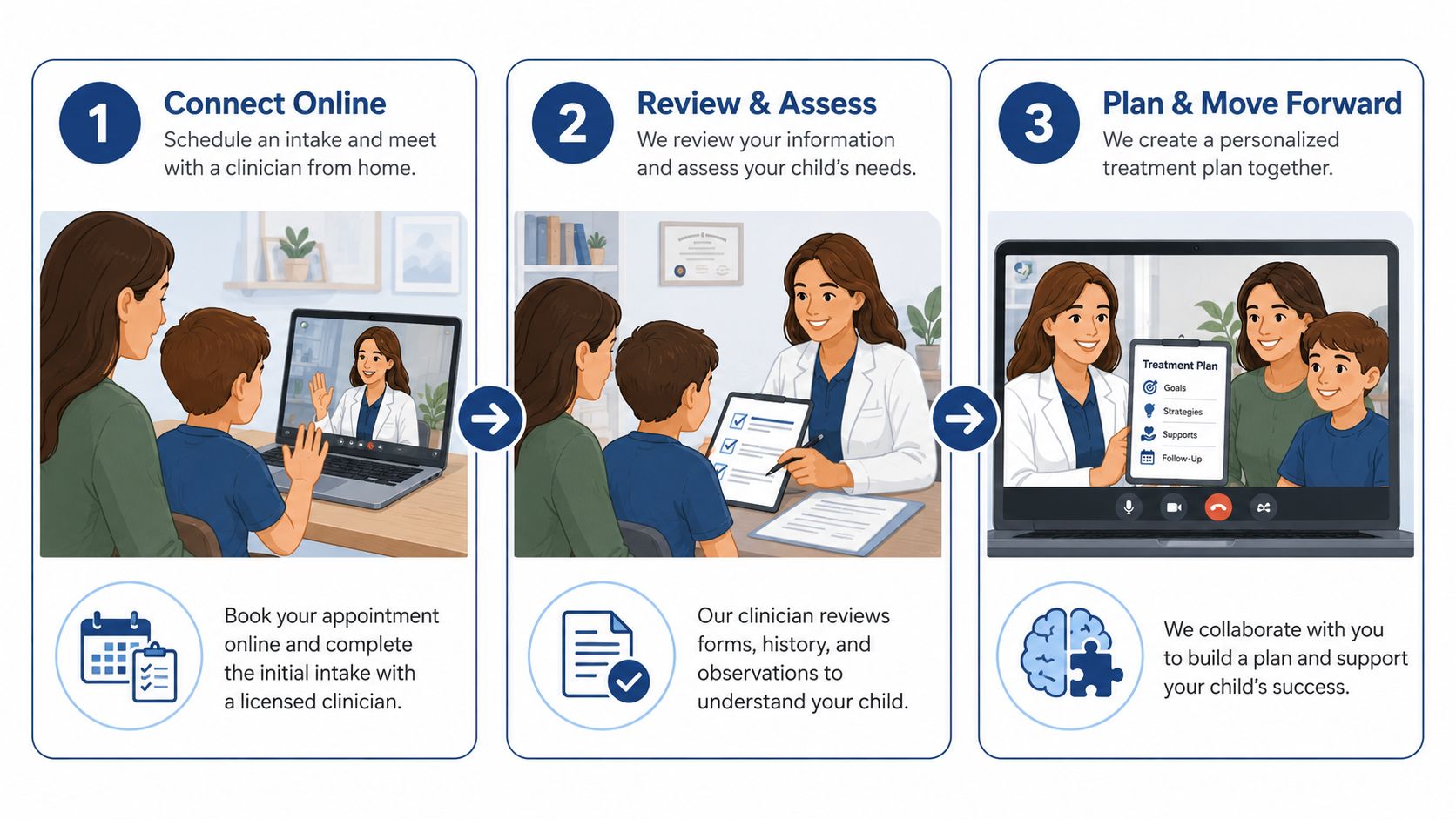
A thorough pediatric telehealth intake usually follows three connected steps, although the order and depth can change according to the child's presentation. The process involves the parent or guardian, the child when developmentally appropriate, and collateral information from school or other caregivers when clinically useful.
Step one involves the family and patient interview
The first step is a clinical interview. The provider asks about current symptoms, developmental history, school functioning, family concerns, medical conditions, previous mental health care, medications, sleep, and the situations in which difficulties occur.
The parent or guardian often supplies essential history because children may not remember early development or recognize how symptoms affect other people. The child's own perspective still matters. A clinician may ask what school feels like, which tasks are hardest, what happens before an outburst, and what helps the child regain control.
This conversation also helps identify urgent concerns and possible explanations beyond ADHD. Anxiety, depression, trauma-related symptoms, learning problems, sleep disorders, and medical issues can all affect attention or behavior.
Step two uses structured assessment and collateral information
The second step adds standardized measures and observations from more than one setting. Depending on the child, this may include validated parent and teacher rating scales, school records, IEP or 504 information, prior evaluations, and reports from other caregivers.
Collateral information matters because ADHD symptoms should be considered in context, not only during a video appointment. A child may focus well during a preferred activity but struggle with lengthy instructions, transitions, or independent work. Parent and teacher observations help the provider compare demands across settings.
The clinician also considers alternative or co-occurring conditions rather than treating every attention problem as ADHD. The Pennsylvania ADHD evaluation service can be discussed with families seeking a structured assessment pathway.
Step three turns findings into a plan
The third step is a diagnostic review and individualized treatment plan. The provider explains what the information supports, what remains uncertain, and which interventions may help. Recommendations can include medication management, behavioral strategies, psychotherapy, parent training, school-related support, and lifestyle considerations.
A evaluation commonly requires multiple visits. CHADD states that a child or teen's assessment should use scientifically backed procedures, involve a well-trained licensed provider, and typically require multiple visits, with each visit usually lasting one or two hours. (CHADD guidance for parents)
The family should leave with understandable next steps, not a label.
What Makes a Thorough ADHD Evaluation Different
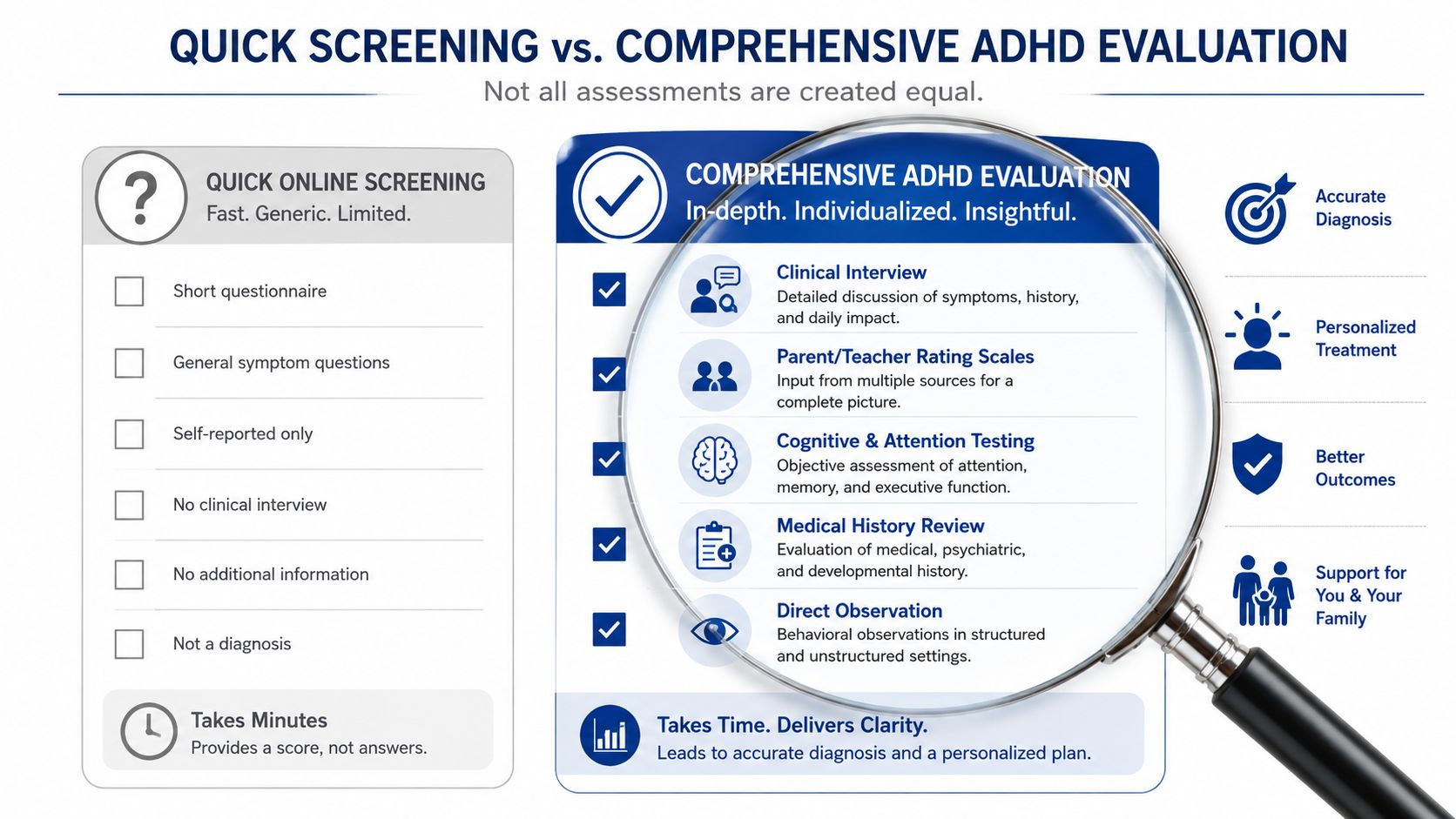
A quick online questionnaire can identify symptoms worth discussing. It cannot establish an ADHD diagnosis on its own. ADHD is diagnosed clinically through history, functioning, symptom patterns, and professional judgment.
A thorough evaluation examines more than rating-scale answers. The provider clarifies when symptoms began, where they occur, how they affect daily functioning, and whether another condition explains them more accurately. Anxiety, depression, trauma responses, disrupted sleep, learning disabilities, and medical concerns can resemble or worsen ADHD symptoms.
The information that strengthens diagnostic accuracy
Parents should prepare information from daily life, not only the child's responses during a video visit. Useful records may include:
- Parent rating scales: A Vanderbilt form can document attention, hyperactivity, impulsivity, and related behaviors at home.
- Teacher observations: School input shows how the child manages instruction, transitions, group work, and independent assignments.
- Educational records: Report cards, school communications, IEP or 504 documentation, and previous psychological testing provide context.
- Medical history: Sleep, developmental milestones, medications, family history, and relevant physical concerns may change the clinical interpretation.
- Child perspective: An age-appropriate conversation may reveal frustration, worry, low confidence, social difficulties, or coping strategies adults do not see.
Stanford's pediatric telehealth guidance recommends reviewing diagnostic details, prior medications, dose changes, side effects, follow-up Vanderbilt scales, school information, IEP status, sleep, family history, and a virtual examination before deciding on refills or dose adjustments. (Stanford pediatric ADHD telehealth guide)
Why routine genetic or laboratory testing isn't the answer
Integrative Psychiatry of America does not present a particular laboratory or genetic test as a routine method for diagnosing pediatric ADHD. ADHD is diagnosed clinically. Laboratory testing, medical evaluation, or other testing may be considered when symptoms or medical history suggest a contributing condition, but those tests do not replace an interview and functional assessment.
Parents can ask an online provider:
- Who will conduct the evaluation, and what pediatric ADHD training do they have?
- How will parent and school information be collected?
- How will anxiety, learning problems, sleep disorders, trauma, or mood symptoms be assessed?
- What happens if the diagnosis remains uncertain?
- How will treatment be monitored after the initial evaluation?
A service focused mainly on rapid prescription access may not provide the depth a child needs. The distinction between ADHD evaluation and ADHD testing matters because testing tools support assessment, while diagnosis requires professional synthesis.
Building an Individualized Treatment Plan
An effective plan matches the child's age, symptoms, medical history, family circumstances, school demands, and treatment preferences. Medication can be useful, but it shouldn't carry the entire plan. Behavioral care, psychotherapy, parent support, school collaboration, and healthy routines often address problems that medication alone cannot solve.
Medication management requires active monitoring
A psychiatric provider considers the child's symptoms, functional impairment, previous treatment, side effects, and family goals before recommending medication. Follow-up focuses on whether the child can complete work, participate in class, manage transitions, sleep, eat, and interact more successfully, not whether the child seems quieter.
Medication changes should respond to symptoms, functioning, tolerability, and feedback from the child and caregivers. Pediatric telehealth recommendations include medication reconciliation, screening tools such as Vanderbilt forms, classroom interventions, and follow-up on weight and blood pressure. (Pediatric telehealth recommendations)
Behavioral strategies change the environment around the child
Behavioral treatment gives adults practical ways to support skills that ADHD makes harder. A plan may include:
- Predictable routines: Use a visible morning, homework, and bedtime sequence.
- Short directions: Give one or two concrete instructions, then ask the child to repeat them.
- Positive reinforcement: Notice specific behaviors, such as starting homework or putting materials away.
- Smaller tasks: Break assignments into manageable steps with planned movement breaks.
- Environmental changes: Reduce visual distractions, organize supplies, and create a consistent workspace.
Parent training can help caregivers respond consistently instead of relying on repeated criticism. School strategies may include communication with teachers, organizational supports, and collaboration around an IEP or 504 plan when appropriate.
Psychotherapy and whole-child support fill important gaps
Psychotherapy can help children develop emotional regulation, coping, problem-solving, and communication skills. Parent-focused therapy can help adults understand triggers, reinforce progress, and manage family conflict. Older children and adolescents may benefit from cognitive-behavioral approaches adapted to their developmental level.
An integrative plan also considers sleep, nutrition, physical activity, daily structure, and school functioning. These factors can support attention and resilience, but they shouldn't be marketed as substitutes for evaluation or evidence-based treatment. Genetic or laboratory assessments may have a role only when clinically indicated, as discussed in genetic testing for mental health.
Clinical expectation: Families shouldn't be promised a fixed number of weeks or visits before improvement. Progress varies, and clinicians monitor symptoms, functioning, tolerability, and parent or patient feedback during follow-up.
Some changes may appear relatively early, while an effective long-term plan can require ongoing adjustment.
Understanding Telehealth Limitations and Federal Rules
Online ADHD care can provide high-quality assessment, therapy, and medication management, but it isn't a universal substitute for in-person services. A child may need an in-person physical examination, local vital-sign monitoring, psychological testing, educational assessment, or a higher level of psychiatric support.
Controlled medications create another limitation. Stimulants and certain other medications fall under controlled-substance rules, so a video appointment alone doesn't guarantee that a prescription can be issued or continued. The American Academy of Pediatrics described a DEA proposal concerning non-narcotic Schedule III through V controlled substances prescribed through telemedicine without a prior in-person visit when specific conditions are met. This illustrates why online medication access depends on federal prescribing requirements, not merely on the availability of a video platform. (AAP comments on DEA telehealth rules)
Practical coordination keeps care safe
Parents may need to coordinate weight and blood-pressure checks with a pediatrician, primary care office, or local clinic. The online provider can review those findings alongside medication response and side effects. Families should also provide a complete medication list, including nonprescription products and supplements.
A provider may recommend in-person care when the diagnosis is unclear, the child has significant medical complexity, safety concerns, severe behavioral symptoms, or needs specialized testing. That referral isn't a failure of telehealth. It's part of responsible clinical decision-making.
Access has improved, but equity remains unfinished
Telehealth expanded quickly during the COVID-19 era. In a large U.S. study of stimulant initiation, telemedicine accounted for 53% to 57% of initiations at its peak in April 2020, then fell to about 14% for children by April 2022. The same study found that mean monthly adjusted stimulant initiations among children stayed unchanged, at 57 per 100,000 enrollees before the pandemic versus 56 during it. (U.S. study of pediatric stimulant initiation)
The shift shows that online care became part of mainstream treatment while not eliminating every barrier. A review found that none of its included studies addressed health equity, and another study found telehealth ADHD evaluations were more likely to involve older, White children with fewer comorbidities and longer travel distances. (Review of equity in ADHD telehealth)
Families still need reliable internet, privacy, digital confidence, transportation for any required in-person care, and a provider who understands their circumstances. Secure systems and privacy practices matter, which is why parents may review a practice's HIPAA-compliant telehealth approach.
When Online Care Works Best for Children with ADHD
Telehealth tends to work well when the child can engage through video, caregivers can participate, and the provider can collect information from home and school. It can be particularly useful for families who live far from pediatric ADHD specialists or who need appointments that fit around school, work, and caregiving responsibilities.
The setting also gives the clinician a view of the child's ordinary environment. A parent can show the homework area, medication organizer, visual schedule, or other supports. Those details may help the provider recommend practical changes rather than abstract advice.
Signs that telehealth may be a reasonable fit
Online treatment may be appropriate when:
- The diagnostic picture is reasonably focused: Symptoms and impairment can be described across settings without major unanswered questions.
- Caregivers can participate: A parent or guardian can provide history, complete forms, and support follow-through.
- School information is available: Teacher observations, records, or rating scales can be shared securely.
- The child can engage: The child can communicate through video or participate in an age-appropriate way.
- Local coordination is possible: The family can arrange vital signs, primary care input, or in-person services if needed.
Situations that call for additional support
Parents should ask about in-person or specialized care when the child has severe behavioral dysregulation, significant developmental delays, complex medical concerns, urgent safety issues, uncertain diagnosis, or previous treatment failures. A child with multiple co-occurring conditions may need coordinated services involving pediatrics, psychology, education, therapy, or psychiatry.
Telehealth is a delivery method, not a lower clinical standard.
The provider's training, evaluation depth, communication with caregivers, and willingness to refer determine whether online care is appropriate. Parents can request another opinion when the explanation feels rushed, school information is ignored, or treatment begins without a clear diagnostic discussion.
Next Steps for Pennsylvania Parents
Start by verifying whether the practice is in network and whether the child's plan covers evaluation, therapy, telehealth, and medication management. IPA accepts plans that include Cigna, Aetna, UnitedHealthcare, and BCBS/IBX, but coverage isn't guaranteed. Benefits, copays, deductibles, authorization rules, and out-of-pocket costs vary by plan, so families should confirm details before scheduling.
Prepare a concise clinical folder:
- School information: Report cards, teacher comments, IEP or 504 documents, and completed rating scales.
- Medical history: Current medications, past trials, side effects, allergies, sleep concerns, and relevant diagnoses.
- Developmental history: Milestones, early concerns, family history, and previous evaluations.
- Family observations: Two or three recent examples from home, school, and social settings.
- Questions: Ask how the provider evaluates alternatives, gathers collateral information, monitors treatment, and handles referrals.
Appointments can be requested through the IPA patient portal, where families can also manage communication and medication-related requests. Parents who want broader practice-selection guidance may also review these strategies for medical and dental clinics, particularly when evaluating how a healthcare practice communicates access and patient pathways.
Quality online treatment should follow the same clinical standards expected in person. The first contact is a conversation about the child's needs, available information, insurance, and whether telehealth is a suitable setting.
Integrative Psychiatry of America provides secure virtual ADHD evaluations, treatment planning, psychotherapy recommendations, and medication management for eligible children and adolescents across Pennsylvania. Parents can visit Integrative Psychiatry of America to review care options, verify insurance, and request an appointment to discuss whether online ADHD treatment fits their child's needs.