
Lexapro (escitalopram) is not approved as a sleep medication. It may improve sleep when depression or anxiety is driving the insomnia, but it can also cause insomnia or sleepiness, so the effect varies from person to person.
If a medication makes someone sleepy, does that necessarily mean it helps them sleep well? Not always. Daytime drowsiness, restful nighttime sleep, and relief from depression are different outcomes.
For adults asking, “Does Lexapro help with sleep?” the useful starting point is why sleep became disrupted. A person lying awake with worry may need a different treatment adjustment than someone whose insomnia began after a prescription change.
Table of Contents
- The Short Answer on Lexapro and Sleep
- What the Evidence Says About Lexapro and Sleep
- Why Lexapro Makes Some People Sleepy and Others Restless
- Lexapro Sleep Aids and Other Medications
- Sleep Changes That Need Prompt Medical Attention
- Bring Your Sleep Log to a Prescriber Visit
The Short Answer on Lexapro and Sleep
Lexapro can help sleep indirectly, but it isn't a treatment designed specifically for insomnia. Its sleep effects need to be weighed against its benefits for the condition being treated.
The distinction matters when discussing dose. A higher dose doesn't necessarily mean better sleep, even when a clinician recommends it for persistent mood or anxiety symptoms.
Sleep side effects by Lexapro dose in FDA trial data
The FDA's fixed-dose Lexapro depression trial table reports the following percentages of adults with depression experiencing insomnia or somnolence at each daily dose.
| Sleep effect | Placebo | Escitalopram 10 mg | Escitalopram 20 mg |
|---|---|---|---|
| Insomnia | 4% | 7% | 14% |
| Somnolence (sleepiness) | 1% | 4% | 9% |
These are population rates, not predictions for an individual patient. The higher-dose groups reported more of both effects, but that doesn't mean every dose increase will worsen sleep.
The placebo results also matter. They show that sleep complaints can occur during treatment even without the active medication. Depression, daily stress, and other factors can complicate the picture.
Sleep changes can still become significant enough to affect treatment. In the FDA prescribing information's adult depression trial summary, insomnia was associated with treatment discontinuation in 1% of escitalopram-treated patients versus 0% receiving placebo.
Describe the problem before deciding on a solution
A useful medication review begins with a clear description rather than the broad statement that sleep feels worse:
- Before treatment: Did the sleep difficulty already exist?
- Type of disruption: Is the problem falling asleep, staying asleep, or feeling sleepy during the day?
- Relationship to treatment: Did it begin after starting Lexapro or after a dose change?
- Daily impact: Does it interfere with concentration, work, caregiving, or safe travel?
Someone who sleeps through the night but struggles to stay alert has a different problem from someone who feels exhausted yet remains awake at bedtime. Those details help the prescriber decide whether to investigate medication effects, ongoing symptoms, or another sleep condition.
What the Evidence Says About Lexapro and Sleep
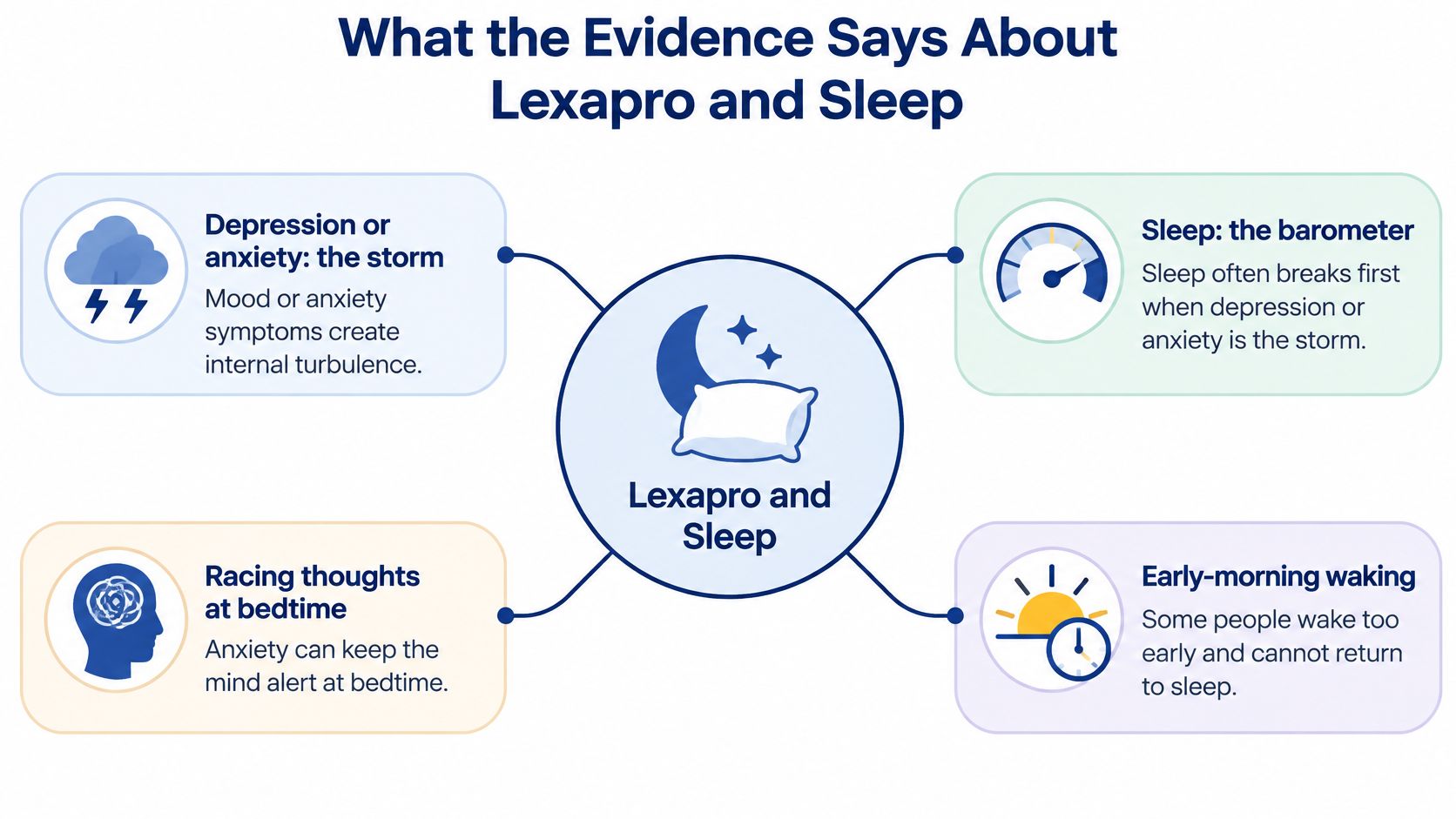
Sleep can act like a barometer: it often becomes disrupted when depression or anxiety creates an emotional storm. Anxiety may bring racing thoughts at bedtime, while depression may involve early-morning waking and unrefreshing sleep.
Reducing those symptoms may make sleep easier. However, sleep and mood don't always improve together, and improvement isn't necessarily immediate.
The relationship is easier to understand as several connected patterns rather than a single medication effect.
Randomized trials suggest a conditional benefit
A pooled analysis of three randomized, double-blind, eight-week depression trials found improvement on the depression-scale item measuring reduced sleep versus placebo at weeks 6 and 8, and versus citalopram at weeks 4, 6, and 8.
That finding supports a possible sleep benefit during depression treatment. It doesn't establish that escitalopram treats insomnia independently of depression. A sleep item within a depression questionnaire isn't the same as a dedicated evaluation of an insomnia disorder.
In a randomized trial involving healthy perimenopausal and postmenopausal women with hot flashes, 50.0% taking escitalopram versus 35.4% receiving placebo achieved at least a 50% reduction in Insomnia Severity Index scores after eight weeks (p=0.04). The same study found Pittsburgh Sleep Quality Index responses of 29.6% versus 19.2%, respectively, but that difference wasn't statistically significant (p=0.09).
The mixed findings matter. Improvement on one sleep questionnaire doesn't mean every measure of sleep improved convincingly.
Sleep evidence for escitalopram by study
A smaller preliminary eight-week study of 13 men with major depressive disorder found significant subjective sleep and depression improvement, partial objective sleep improvement, and limited improvement in melatonin-related circadian rhythms.
| Study and population | Sleep result | Limit |
|---|---|---|
| Pooled randomized depression trials in adults | Reduced-sleep questionnaire item improved compared with placebo and citalopram | Depression-scale item, not a primary insomnia trial |
| Randomized trial in perimenopausal and postmenopausal women with hot flashes | Insomnia severity improved; the sleep-quality response difference wasn't statistically significant | Specific population limits broader application |
| Preliminary study in men with major depression | Perceived sleep improved; objective sleep improved partly; biological sleep timing improved little | Very small preliminary study; findings can't be generalized |
The preliminary study used polysomnography, an overnight recording of sleep. Researchers assessed total sleep time, time to fall asleep, wakefulness after sleep onset, sleep efficiency, sleep-stage percentages, and REM latency. Feeling better rested didn't necessarily mean the body's sleep timing had normalized.
Better perceived sleep is meaningful, but it isn't proof that every aspect of sleep has recovered.
The explanation of why depression causes insomnia adds context to this mood-sleep connection. Tracking mood and sleep side by side helps identify an important pattern: if mood improves but sleep remains poor, sleep deserves its own assessment.
Why Lexapro Makes Some People Sleepy and Others Restless
Consider two adults starting the same prescribed dose during the same week. One lies awake at night and wakes early; the other feels heavy and drowsy by mid-afternoon. Neither response proves that the medication is working better.
The contrasting experiences can look like this:

The FDA prescribing information recognizes both insomnia and somnolence among common adverse reactions. These differing responses make labels such as universally sedating or universally activating misleading.
Activation and sedation aren't the same experience
Activation describes feeling more alert, restless, or unable to settle. It may involve difficulty falling asleep or nighttime awakenings; some people also notice vivid dreams.
Sedation means increased sleepiness or reduced alertness. A person may feel ready to doze during a meeting without sleeping any better overnight. Fatigue can feel different again: depleted energy without an actual tendency to fall asleep.
Early treatment can produce either pattern. Later improvement may occur as anxiety or depression responds, but there's no guaranteed adjustment period that makes severe impairment acceptable.
The guide to what to expect during the first week of Lexapro offers additional context for discussing early symptoms with a prescriber.
This accompanying video provides another format for learning about the topic.
Timing requires an individualized plan
For an activating response, a prescriber may recommend morning dosing. For sedation, evening dosing may be considered. A timing change needs prescriber guidance, including instructions for the transition between dosing times.
Moving the dose isn't a substitute for evaluating severe symptoms. Avoiding alcohol and using caution with driving or safety-sensitive work remain important until the individual response is clear.
A simple log can reveal whether symptoms cluster around dosing or follow a different pattern:
- Dose time: Record when the medication was taken.
- Nighttime pattern: Note bedtime, estimated time to fall asleep, and nighttime awakenings.
- Morning recovery: Record wake time and whether sleep felt refreshing.
- Afternoon energy: Describe sleepiness, restlessness, or difficulty concentrating.
A log doesn't establish causation. It gives the prescriber a more reliable account than trying to reconstruct difficult nights from memory.
Lexapro Sleep Aids and Other Medications
Adding a sleep aid isn't automatically safer than reviewing the original prescription. Prescription medications, over-the-counter products, supplements, and substances can introduce different risks.
A medication and supplement safety review
Melatonin needs context. Evidence specifically supporting it for SSRI-related insomnia is limited. It can cause drowsiness and may add to existing sedation. The discussion of melatonin use alongside Zoloft addresses a related SSRI question, but it isn't a Lexapro-specific dosing recommendation.
Antihistamines can affect the following day. Diphenhydramine may worsen drowsiness, confusion, and fall risk, particularly in older adults. An over-the-counter label doesn't mean a product is appropriate for routine use.
Prescription hypnotics require a risk discussion. Benzodiazepines and Z-drugs such as zolpidem can involve dependence, falls, memory problems, and next-day impairment. Clinicians generally consider them short-term options rather than a default response to medication-related insomnia.
Trazodone has its own adverse effects. Although sometimes prescribed for insomnia, it can cause heavy sedation and orthostasis, a blood-pressure drop on standing.
Serotonergic combinations need review. Tramadol, triptans, St. John's wort, and other antidepressants can increase serotonin syndrome risk when combined with Lexapro. The prescriber or pharmacist should review the complete list before anything is added.
Alcohol and cannabis aren't substitutes for treatment. Alcohol can fragment sleep and add sedation. Cannabis isn't a recommended treatment for this medication-related sleep problem.
Herbal products still belong on the medication list
For readers exploring herbal approaches, the Pumpernickel Health Foods sleep guide discusses lemon balm. Such resources can help identify questions for a pharmacist, but they don't establish compatibility with Lexapro.
Safety checkpoint: Every sleep product belongs on the medication list, including products marketed as natural.
The review should also include caffeine sources, alcohol, and cannabis. Patients shouldn't independently stop Lexapro or start a sleep aid to counteract an unexplained change.
Sleep Changes That Need Prompt Medical Attention
| Symptom | Timing | Action |
|---|---|---|
| Mild sleep change early in treatment | Early in treatment | Log it and mention it at the next visit |
| Insomnia that persists or worsens after a dose change | Ongoing or after dose change | Contact the prescriber within a few days |
| Daytime sleepiness affecting work or driving | Ongoing | Contact the prescriber promptly and avoid driving until assessed |
| Markedly reduced need for sleep, racing thoughts, or unusually elevated mood | Any time | Contact the prescriber the same day; seek emergency care if severe |
| Thoughts of self-harm | Any time | Call or text 988 or go to the nearest emergency department now |
Severity and safety matter more than whether a symptom appears on a side-effect list. The FDA's Lexapro labeling provides warnings relevant to monitoring antidepressant treatment, including clinical worsening and activation of mania or hypomania.
Distinguish insomnia from a reduced need for sleep
A person with insomnia generally wants sleep but can't obtain it. Someone sleeping much less while feeling unusually energized or impulsive may have a different clinical problem.
That second pattern warrants prompt assessment rather than reassurance that extra energy means recovery. Severe agitation or unsafe behavior increases the urgency.
Thoughts of self-harm require immediate support rather than waiting for a routine medication appointment. The information on emergency mental health services can help clarify crisis-care pathways, but an outpatient appointment shouldn't delay emergency care.
Persistent symptoms need a broader assessment
Stopping suddenly can cause discontinuation symptoms, and mood symptoms may return. A clinician should guide any reduction, discontinuation, or replacement.
The assessment may also consider caffeine, alcohol, other medications, or a separate sleep disorder. For example, loud snoring, witnessed breathing pauses, and unrefreshing sleep may prompt evaluation for sleep apnea rather than another sedating prescription.
Integrative Psychiatry of America's care process includes thorough psychiatric evaluations, personalized treatment plans, medication optimization, and collaborative care coordination through secure virtual visits. That process allows discussion of psychiatric symptoms alongside other possible contributors and appropriate referrals.
Any sleep change that feels new, severe, or unsafe deserves a same-day call.
Routine monitoring fits mild, manageable changes. It shouldn't become a reason to tolerate escalating symptoms or dangerous daytime impairment.
Bring Your Sleep Log to a Prescriber Visit
A useful appointment record connects medication changes, nighttime symptoms, and daytime functioning. It doesn't need specialized equipment, and estimates are acceptable when exact sleep times aren't known.
Prepare a record that supports decisions
Write a medication timeline. Include the Lexapro start date, current prescribed dose, and dose changes. Pharmacy records or the patient portal may help confirm details.
Keep a two-week sleep log. Record bedtime, estimated time to fall asleep, awakenings, wake time, and daytime energy. Pair the record with a weekly mood entry in a free mood tracker or a simple phone note. Consistent descriptions matter more than elaborate scoring.
List everything taken or used. Include prescription drugs, antihistamines, supplements, caffeine intake, alcohol, and cannabis. Recording timing helps distinguish an evening stimulant effect from morning medication-related drowsiness.
Prepare focused questions. Useful questions address whether depression, medication, or another condition best explains the pattern; whether dose timing might help; and whether sleep apnea or another sleep condition needs evaluation.
Schedule the review and bring the record. A concise summary is easier to discuss than scattered screenshots. Highlight the most disruptive symptom and its effect on everyday responsibilities.
The value of organized symptom records extends beyond psychiatric care. Cardiogram's guide to logging POTS symptoms for appointments illustrates the broader principle of recording symptoms and context for clinical discussions. Its condition-specific guidance doesn't diagnose or explain a Lexapro-related sleep problem.
What a collaborative medication visit can address
A prescriber considers both symptom relief and tolerability. The discussion may involve continuing with monitoring, adjusting the treatment plan, or arranging a separate sleep assessment. An automatic dose increase isn't the only option.
The information on psychiatric medication management for depression describes a relevant pathway for ongoing review. Integrative Psychiatry of America serves Pennsylvania patients, who can schedule a psychiatric evaluation through the website; all visits use secure, convenient telehealth.
Board-certified psychiatric nurse practitioners can prescribe when clinically appropriate within an evidence-based treatment plan. Medication decisions are made collaboratively with patients and families.
Insurance benefits, copays, deductibles, network status, and authorization requirements vary by plan. Verification before booking helps clarify possible out-of-pocket costs without assuming coverage.
Integrative Psychiatry of America offers virtual psychiatric evaluation and medication management across Pennsylvania for adults whose sleep problems overlap with mood, anxiety, or medication effects. If disrupted sleep is affecting daily life, visit Integrative Psychiatry of America to request an appointment or verify insurance, and bring a sleep log to support a personalized discussion.