
A Harrisburg parent sits beside unfinished homework, searching for doctors that prescribe Adderall. A Pittsburgh college student types the same phrase after missing another deadline. Both want a clinic name, but neither search result can answer the most important question: what's causing the difficulty, and which treatment is safe?
Prescribing authority is only the first filter. A trustworthy clinician also explains how an evaluation works, checks medical risks, and can withhold or stop Adderall when the evidence doesn't support it.
Table of Contents
- Which Clinicians Can Prescribe Adderall
- How to Verify a Prescriber Before You Book
- What a Real ADHD Evaluation Includes
- How Safe Adderall Prescribing Is Monitored
- Red Flags and Treatments Besides Adderall
- Book a Pennsylvania ADHD Evaluation
Which Clinicians Can Prescribe Adderall
Physicians, psychiatric mental health nurse practitioners, and some physician assistants can prescribe Adderall within their legal authority. The clinician needs appropriate state licensure, controlled-substance prescriptive authority, and an active Drug Enforcement Administration registration.
Adderall and Adderall XR contain mixed amphetamine salts. The FDA prescribing information identifies Adderall XR as a Schedule II controlled substance and central nervous system stimulant, which means prescribing requires safeguards against misuse, dependence, and diversion.
Who can prescribe Adderall
| Clinician | Can prescribe Adderall | Best first stop when | Cannot do |
|---|---|---|---|
| Primary care physician | Yes, with DEA registration and appropriate authority | Adult symptoms are clear and medical history is uncomplicated | Replace a full ADHD evaluation with a same-day stimulant request |
| Psychiatrist (MD or DO) | Yes, with DEA registration and appropriate authority | Psychosis, bipolar disorder, complex medication regimens, or serious cardiac history complicate care | Guarantee Adderall because ADHD was searched online |
| Psychiatric mental health nurse practitioner | Yes, with state authority and DEA registration | Psychiatric ADHD evaluation and medication management, including Pennsylvania telehealth | Be described as a psychiatrist unless that person is a physician |
| Physician assistant | Often, if state law and the practice arrangement allow | Follow-up after a diagnosis is already documented | Prescribe independently where state rules require physician involvement |
| Psychologist, therapist, or ADHD coach | No, in these roles in Pennsylvania | Behavioral treatment, school strategies, and history that supports an evaluation | Write or renew a stimulant prescription |
A primary care physician may manage an uncomplicated adult's evaluation and treatment. Some primary care practices prescribe stimulants; others refer patients because they don't offer ongoing controlled-medication management.
Complex symptoms deserve a clinician with relevant psychiatric expertise. Mood instability, anxiety, PTSD, substance use, or possible psychosis can change the treatment decision. Serious cardiac concerns may also require medical or cardiology assessment, not a different psychiatric prescriber.
Children and teens need a clinician experienced with their developmental stage. That clinician may be a pediatrician or psychiatric provider, depending on the child's needs and the practice's services.
Credentials and clinical fit are different checks
A nurse practitioner isn't a physician psychiatrist. IPA's explanation of psychiatric nurse practitioners versus psychiatrists helps patients distinguish those credentials without assuming either title guarantees a particular medication.
For telehealth, the clinician must have authority to treat patients where the patient is physically located during the appointment. A Pennsylvania address on an insurance card doesn't establish eligibility for a visit taken elsewhere.
Integrative Psychiatry of America is one statewide virtual option led by a board-certified psychiatric mental health nurse practitioner, not a psychiatrist. It isn't a guaranteed Adderall service.
For perspective on the broader medication conversation, Jan Kutschera on ADHD medication offers an additional discussion resource, rather than a prescribing standard.
Practical rule: FDA approval for ADHD allows appropriate prescribing. It doesn't obligate any clinician to prescribe Adderall.
How to Verify a Prescriber Before You Book
Verification means checking the clinician's credentials, the appointment's purpose, and the practice's follow-up process before paying. A professional-looking website or an available appointment doesn't establish those things.
A connected routine makes the search more manageable.
Search for an evaluation. Search for ADHD evaluation or ADHD medication management rather than an Adderall coupon or guaranteed same-day prescription. Limit the search to clinicians authorized to treat patients in Pennsylvania when that's where the appointment will occur.
Check the licensing record. Open the official Pennsylvania licensing record and match the clinician's full name, license type, active status, and any listed discipline. The State Board of Medicine licenses physicians and physician assistants; the State Board of Nursing licenses nurse practitioners. Osteopathic physicians have a separate state board.
Confirm controlled-prescribing authority. Ask the practice to confirm current DEA registration covering Schedule II prescribing. A website badge isn't verification. The DEA's registration-validation system has access restrictions, so patients who can't use it should ask how the practice verifies registration. Also ask whether the prescriber reviews the Pennsylvania Prescription Drug Monitoring Program before prescribing a controlled stimulant.
Identify the appointment type. A diagnostic evaluation investigates whether ADHD is present. Medication management generally reviews an established diagnosis and treatment plan. A transferred diagnosis may still require reassessment, and a page promising a particular drug or dose should end the search.
The visual checklist summarizes the initial screening process.
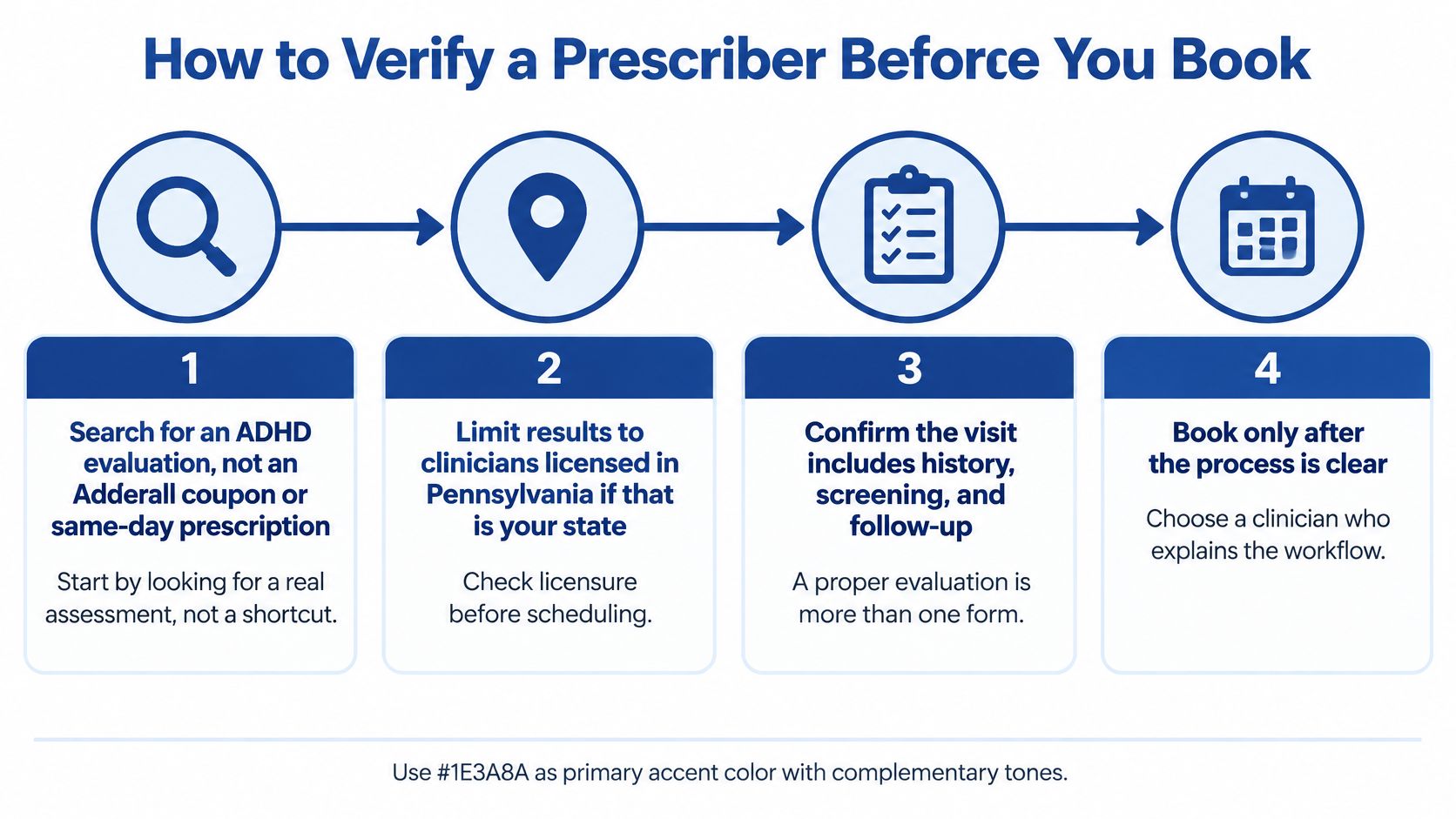
Confirm the visit and payment workflow
Ask about telehealth requirements. Confirm the patient's physical location, the clinician's authority there, and whether an in-person assessment could be necessary. For IPA's virtual care, appointments use HIPAA-compliant video. Text messages or chat alone shouldn't substitute for a diagnostic appointment.
Check prescription delivery. Ask how the practice sends controlled prescriptions to the pharmacy and handles transmission problems. Compliant electronic prescribing is the expected workflow, subject to applicable exceptions. A photograph of a prescription isn't a substitute for a valid pharmacy prescription.
Confirm the age range. For a child or teen, ask whether the clinician treats that age group and gathers school information. A practice advertising adult ADHD care may not provide pediatric evaluations.
Clarify costs before booking. Ask about evaluation fees, follow-up fees, cancellation terms, and insurance verification. Cigna, Aetna, UnitedHealthcare, and Independence Blue Cross shouldn't be treated as automatic coverage for either the visit or medication.
IPA's guide to finding ADHD doctors provides a related starting point for comparing care options. Through the practice's website, prospective patients can locate insurance information, the appointment pathway, and the Adult ADHD Symptom Checker.
The checker can help organize concerns before a visit. It can't establish a diagnosis or determine which medication is appropriate.
Before scheduling, the patient should be able to explain what the appointment includes, who provides it, and what happens afterward.
Useful preparation includes prior evaluation records, a current medication list, and report cards or concrete work examples. These documents usually answer more clinical questions than a request for a particular brand.
What a Real ADHD Evaluation Includes
A short questionnaire doesn't equal an ADHD diagnosis. There's no single blood test or brain scan that establishes ADHD. A clinician makes the diagnosis by combining history, symptoms, impairment, and assessment of other explanations.
A child's appointment often includes both family discussion and information about school functioning.

ADHD symptom thresholds by age
The CDC's clinical guidance describes the following symptom thresholds, alongside the need to establish diagnostic criteria and assess alternative or coexisting conditions.
| Age group | Inattention symptoms needed | Hyperactivity-impulsivity symptoms needed |
|---|---|---|
| Up to age 16 | 6 or more | 6 or more; either group alone can meet the symptom-count threshold |
| Age 17 and older, including adults | 5 or more | 5 or more; either group alone can meet the symptom-count threshold |
Meeting a symptom count isn't enough. The clinician also considers childhood onset, persistence, impairment across settings, and whether another condition better explains the pattern.
Screening identifies concerns worth investigating. Evaluation gathers the evidence. Diagnosis is the clinician's judgment after reviewing that evidence.
What the clinician needs to understand
A careful assessment usually collects:
- Developmental history: Early behavior, school experiences, and the course of attention or impulse-control difficulties.
- Functional examples: Missed assignments, unpaid bills, repeated work errors, relationship strain, or difficulty completing ordinary tasks.
- Standardized rating scales: Structured questionnaires, interpreted alongside interviews and records.
- Medical and sleep history: Illnesses, sleep quality, current medications, and possible medical contributors.
- Psychiatric and substance-use history: Mood symptoms, trauma, substance exposure, and family psychiatric history.
The CDC's diagnostic overview emphasizes that sleep disorders, anxiety, depression, and some learning disabilities can resemble ADHD. Clinicians may also assess PTSD, language disorders, autism, tics, thyroid problems, and medication or substance effects. Some can coexist with ADHD rather than replace the diagnosis.
Consider an adult who reports unfinished work. Childhood records and a partner's observations may reveal longstanding difficulties across settings. If the problem began only after severe insomnia, the clinician needs to investigate that change.
For a child struggling with reading, teacher reports may show whether attention problems occur throughout the day or mainly during language-heavy tasks. That distinction can prompt an additional learning assessment.
The video provides another format for learning about the evaluation conversation.
IPA's adult ADHD testing guide offers further preparation for adult assessment. The Adult ADHD Symptom Checker can organize the story, but its result isn't a diagnosis.
The visit may end with ADHD, another diagnosis, both, or a request for more information. Medication comes after that judgment. Prior evaluations, school reports, job reviews, and a clear symptom timeline help the clinician reach it; preschool treatment requires a different age-specific discussion.
How Safe Adderall Prescribing Is Monitored
The first prescription is only the start of the safety check. The clinician sets goals, watches for side effects, and changes or stops treatment if the risks outweigh the benefit.
Before treatment, the clinician documents blood pressure, pulse, cardiovascular history, tics or Tourette history, mood symptoms, psychosis history, substance-use risk, and medicines that could interact. The medication review should include prescriptions, over-the-counter products, and supplements.
Adderall monitoring checkpoints
NICE's ADHD recommendations support baseline assessment, symptom and adverse-effect monitoring during dose changes, and blood pressure and pulse checks after each dose change and at least every six months.
| Checkpoint | When | What is reviewed | Action if off target |
|---|---|---|---|
| Baseline | Before the first dose | Diagnosis and impairment, blood pressure and pulse, heart history, tics, mood, psychosis, substances, medicines | Delay or avoid a stimulant if a contraindication or better explanation is present |
| Early titration | After each dose change | Symptom targets, sleep, appetite, mood, blood pressure and pulse compared with age norms | Slow the increase, lower the dose, or switch strategy |
| Maintenance | At least every six months, sooner when needed | Ongoing benefit, side effects, growth in children, misuse or diversion risk, pharmacy access | Continue, adjust, pause, or stop rather than automatically renew |
| Urgent change | Same day | Chest pain, fainting, severe headache, marked agitation, worsening tics, suspected misuse | Obtain prompt assessment. Emergency symptoms need emergency care, and medication may need holding |
The FDA prescribing information for Adderall identifies taking an MAOI within the preceding 14 days as a contraindication. Serious cardiovascular disease also calls for careful assessment before a stimulant is started; some conditions warrant avoiding it altogether.
Clinicians generally begin with a low dose and adjust gradually. Anxiety, depression, PTSD, substance misuse, or cardiac disease can call for slower titration and closer monitoring.
Benefit means better functioning
Before prescribing, the patient and clinician should choose observable targets: fewer missed deadlines, completed assignments, fewer driving mistakes, or less disruption during morning routines.
A Cochrane review of amphetamines for adult ADHD found a large clinician-rated symptom effect, standardized mean difference −0.90 across 13 studies involving 2,028 participants. Patient-rated effects were smaller, evidence certainty was low to very low, and participants more often stopped treatment because of adverse events.
That evidence supports a trial with reassessment, not a promise of perfect focus. Completing more work while losing sleep may mean the balance is still wrong.
The FDA prescribing information for Adderall reports average stimulant-related increases of approximately 2–4 mm Hg in blood pressure and 3–6 beats per minute in heart rate. Individual responses can differ, so regular measurements help show what is happening for a particular patient.
- Emergency symptoms: Chest pain, fainting, or severe headache can require emergency evaluation rather than a routine portal message.
- Prompt contact: Agitation, new or worsening tics, persistent insomnia, or marked appetite or weight loss need clinical review.
- Medication safety concerns: Suspected misuse, sharing, or taking extra doses calls for an immediate treatment discussion.
The adult ADHD medication management guide describes ongoing care. A practical plan also names the pharmacy, sets expectations for prescription requests, and explains what to do if medication is unavailable. Do not double doses or substitute medication independently.
Red Flags and Treatments Besides Adderall
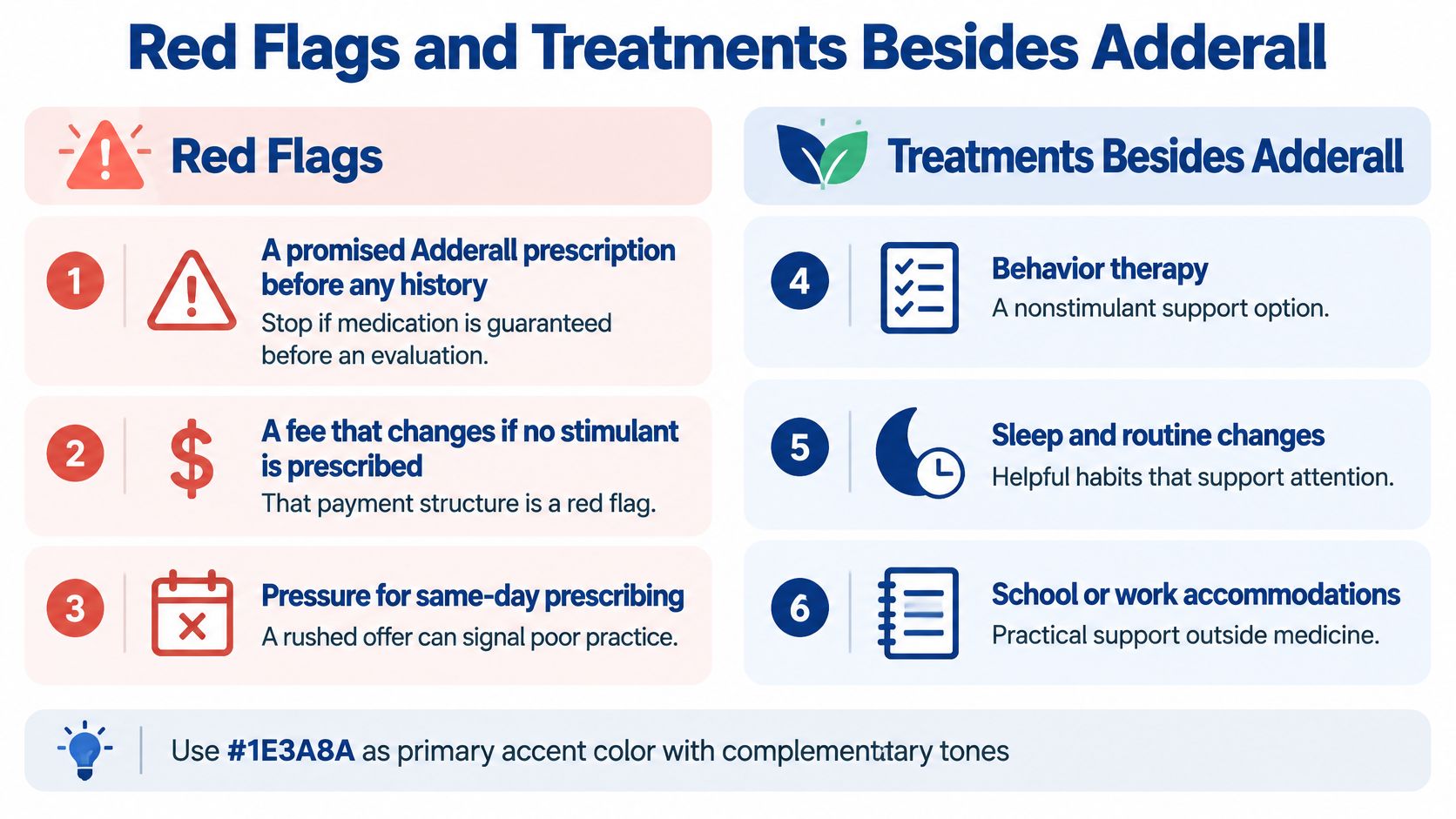
A promised Adderall prescription before any history is a reason to leave the booking page. A legitimate clinician offers an assessment, not a purchase agreement for a controlled medication.
Other warning signs deserve the same caution:
- Medication-linked fees: The charge changes according to whether a stimulant is prescribed.
- Missing safety questions: Nobody asks about heart disease, other medicines, or substance use.
- Quiz-only diagnosis: A brief online form or chat substitutes for clinical assessment.
- Secrecy around payment: Cash payment is requested specifically to avoid records. Transparent self-pay care itself isn't a red flag.
- Unexplained pharmacy pressure: The practice insists on a particular pharmacy without a clear clinical or logistical reason.
- Travel advice to evade safeguards: Staff suggest crossing state lines for looser prescribing.
A clinician's refusal can represent good care. A useful explanation identifies the concern and offers an alternative assessment or treatment plan.
The checklist below contrasts unsafe offers with broader treatment options.
Treatment approaches by age group
The CDC's ADHD overview recommends parent training and classroom behavioral interventions first for children ages 4–5, and describes medication with behavioral supports for children age 6 and older.
| Age group | Common approaches | Role of medication |
|---|---|---|
| Ages 4 to 5 | Parent training in behavior management; behavioral classroom interventions | Considered after first-line behavioral approaches when clinically warranted |
| Age 6 through adolescence | FDA-approved medication with parent training and/or behavioral classroom interventions | One part of a plan that includes monitoring |
| Adults | Stimulant, nonstimulant, therapy, behavioral treatment, or a combination | Chosen for the individual's needs and environment, not automatic |
For adults, a clinician may discuss atomoxetine or viloxazine as nonstimulant options. Guanfacine or clonidine may fit selected circumstances, with age, formulation, approved indications, and possible off-label use requiring explanation.
Medication choice also involves sleep, anxiety, depression, and daily demands. IPA's comparison of stimulant and nonstimulant ADHD treatment helps clarify those categories. Broader education, including Wald Behavioral Health ADHD resources, can support discussion without replacing individualized care.
When treating something else comes first
Consider an Allentown adult whose concentration deteriorated after prolonged insomnia and escalating anxiety. Starting Adderall without understanding that timeline could miss the main cause of the difficulty.
The appropriate plan might prioritize sleep treatment, anxiety care, or depression assessment. Workplace accommodations, task planning, behavioral therapy, and practical organizational tools can also address functional problems.
Wanting better focus isn't the same as having ADHD.
For an established ADHD diagnosis, a nonstimulant or combined approach isn't a lesser form of care. The relevant question is whether the plan improves daily functioning with acceptable risks and a manageable follow-up schedule.
Book a Pennsylvania ADHD Evaluation
A late work deadline or a string of unfinished tasks may prompt a Pennsylvania resident to seek an ADHD evaluation. A virtual appointment can help sort out possible explanations, but it is not emergency care or a shortcut to a stimulant prescription. Adderall is a clinical decision, and a careful prescriber may decide against it.
Medication is one possible part of adult ADHD care. A CDC analysis published in the October 10, 2024, Morbidity and Mortality Weekly Report found that 50.4% of adults with current ADHD had been prescribed medication during the preceding twelve months, while 33.4% reported prescription stimulant use. Those figures describe treatment patterns, not what any one person should take.
A diagnosis still calls for an individual decision about benefits, risks, preferences, and other supports.
What IPA offers
IPA provides secure, HIPAA-compliant telepsychiatry to patients physically located in Pennsylvania. Christopher Clark, MSN, PMHNP-BC, a board-certified psychiatric mental health nurse practitioner, leads the practice.
The practice treats ADHD, with medication management when clinically appropriate, and Christopher Clark leads its care. IPA also treats anxiety, depression, OCD, and PTSD, which may be relevant when attention problems bring someone to an appointment.
People outside Pennsylvania should look for a clinician authorized to treat them where they are located. An immediate safety crisis calls for emergency services, not a wait for an outpatient appointment.
Preparing an appropriate appointment request
Check insurance or ask about self-pay options. Confirm whether the specific clinician and evaluation service are covered, whether telehealth is included, and what follow-up may cost. Benefits, copays, deductibles, network status, and authorization requirements vary by plan.
Use the Adult ADHD Symptom Checker as preparation. Save examples and questions to discuss. Its result does not establish an ADHD diagnosis.
Request an appointment with relevant records ready. Bring prior evaluations, a medication list, and any available school or work documentation. Ask the practice what records or participation it requires.
A first visit should lead to a clinical impression or a clear plan for gathering missing information. If treatment is appropriate, ask about medication and non-medication options, the goals of treatment, and follow-up.
A safe prescriber can say yes, no, or not yet, and explain why.
Integrative Psychiatry of America offers virtual ADHD care and medication management when clinically appropriate for Pennsylvania patients. Visit Integrative Psychiatry of America to review care options, ask about insurance or self-pay costs, and request an appointment.