
A lot of adults in Pennsylvania start in the same place. Work is slipping, emails are piling up, simple tasks take too long, and a late-night search for ADHD medication online brings up everything from serious medical practices to websites that look like they were built to sell a shortcut. That mix of hope and skepticism is reasonable.
Online ADHD care can be legitimate, safe, and clinically useful. It can also be misunderstood. The biggest confusion usually isn't whether telehealth exists. It's whether an online evaluation automatically means a prescription, whether stimulant medication is available, and what a real treatment process should look like for someone living in Pennsylvania.
Adults looking for care often want a clear answer, not marketing language. A proper telepsychiatry process involves diagnosis, discussion of treatment choices, and ongoing monitoring. It isn't the same as filling out a quiz and getting medication on demand. Patients who want a grounded overview of online care can start with online psychiatric care in Pennsylvania, and readers who want broad educational material about ADHD can review CHADD's ADHD information and the American Psychiatric Association's mental health resources.
Table of Contents
- Is Getting ADHD Medication Online Legitimate and Safe
- The Online ADHD Evaluation Process Step by Step
- Stimulant and Non-Stimulant Medication Options
- Pennsylvania Laws and Telehealth Safety Guidelines
- How to Choose a Reputable Telehealth Provider
- Navigating Insurance Payments and Follow-Up Care
- Your Questions Answered and Next Steps for Care
Is Getting ADHD Medication Online Legitimate and Safe
For a Pennsylvania adult who's exhausted by long waits and fragmented care, online treatment can feel almost too convenient to trust. That's especially true for someone in Philadelphia trying to keep up with deadlines, home responsibilities, and constant mental clutter while wondering whether a telehealth platform is a real medical service or just a fast funnel toward a prescription.
The short answer is that legitimate online ADHD care is real, but it isn't automatic. Many patients are confused about what medications are available online. While telehealth providers can prescribe ADHD medication, not all are qualified to do so, and many services only offer non-stimulants. Access to stimulants like Adderall is often more restricted, creating a gap between what patients expect and what can be legally and safely prescribed online, as noted by Cigna's overview of telehealth for ADHD.
Why people get mixed messages
Some websites market convenience so aggressively that patients start to assume every online ADHD service works the same way. They don't. One practice may offer full psychiatric evaluation and medication management. Another may limit care to non-stimulants. Another may require a more extensive review before deciding whether any medication makes sense.
That difference matters because an evaluation and a prescription aren't the same thing. A qualified clinician first has to determine whether ADHD is present, whether another condition better explains the symptoms, whether medication is appropriate, and whether telehealth is the right setting for the next step.
Practical rule: If a website seems more committed to promising medication than explaining assessment, safety, and follow-up, that's a warning sign.
What legitimate care looks like
Safe online ADHD treatment should feel like healthcare, not online shopping. Patients should expect questions about symptoms, functioning, past treatment, medical history, current medications, sleep, anxiety, depression, substance use, and side effects if they've taken ADHD medication before.
A reputable practice also explains limits. Some adults are good candidates for telehealth-based treatment. Others may need in-person medical input, additional records, or a broader diagnostic workup before medication decisions are made. That's not a barrier. It's part of good psychiatric care.
The Online ADHD Evaluation Process Step by Step
A real online ADHD evaluation has a sequence. It doesn't start with a prescription. It starts with information.
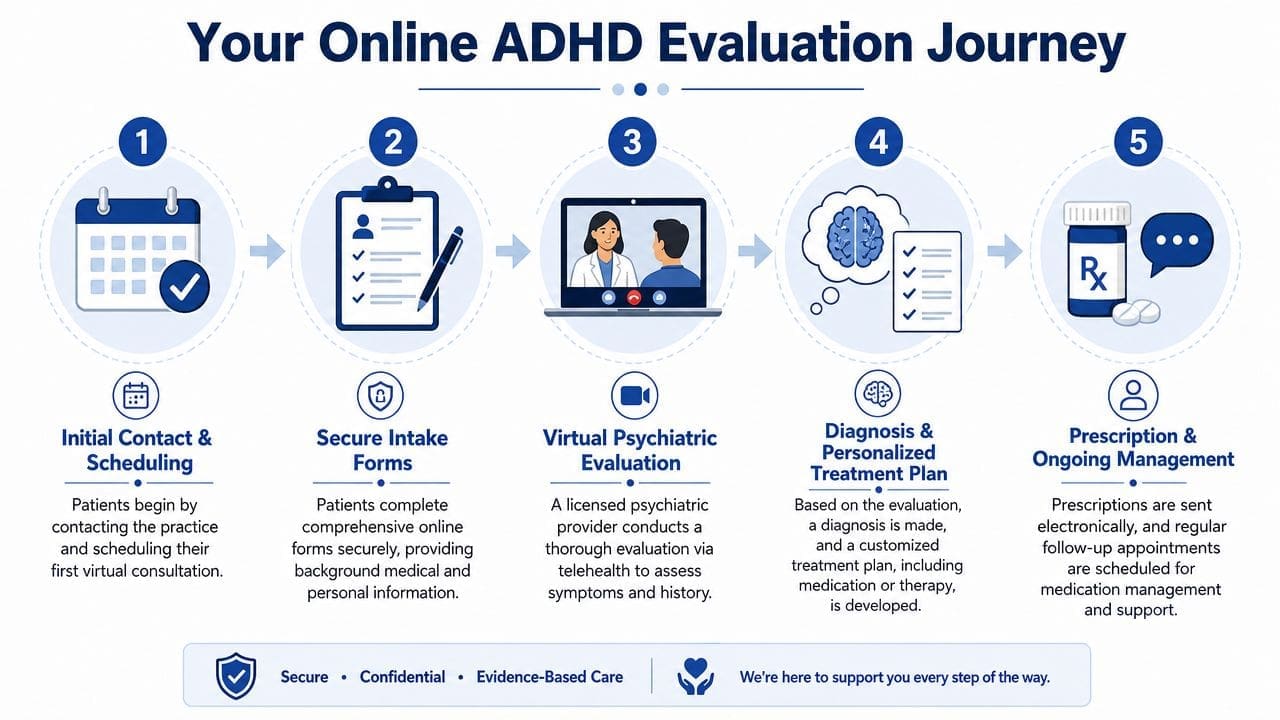
Telehealth ADHD prescribing is a structured clinical service. Licensed providers require a full intake, a review of symptoms and medical history, and ongoing monitoring. A prescription might be sent after the first visit if it's clinically appropriate, but the process prioritizes safety and efficacy through follow-up visits to adjust dosages and manage side effects, according to Medvidi's description of online ADHD medication care.
What happens before the visit
Most legitimate practices begin with scheduling and intake paperwork. Patients usually provide background information before the appointment so the clinician can spend the visit evaluating rather than collecting only basic facts. Adults seeking a formal online ADHD evaluation should expect forms that ask about attention symptoms, prior diagnoses, medication history, physical health issues, and current concerns.
Common intake elements include:
- Symptom history: Difficulty sustaining focus, disorganization, forgetfulness, procrastination, impulsivity, restlessness, or task switching.
- Medical background: Heart history, blood pressure concerns, sleep problems, thyroid issues, and past medication reactions.
- Psychiatric history: Anxiety, depression, trauma symptoms, substance use, or prior counseling.
- Current treatment details: Existing prescriptions, supplements, and prior ADHD medication trials.
Patients can also verify a nurse practitioner's Pennsylvania license through the Pennsylvania State Board of Nursing.
What happens during and after the evaluation
The video visit should feel thorough and conversational. The clinician asks how symptoms show up in work, home life, relationships, time management, and daily routines. The goal isn't just to hear that focus is poor. The goal is to understand pattern, duration, impairment, and whether ADHD fits better than another explanation.
After the assessment, a few outcomes are possible:
- ADHD appears likely, and medication may be appropriate. If the clinical picture is clear, treatment options may be discussed during that visit.
- ADHD is possible, but more information is needed. Prior records, collateral history, or additional assessment may help.
- Another condition may be driving symptoms. Anxiety, mood symptoms, trauma, poor sleep, or medical issues can overlap with ADHD complaints.
- Medication isn't the only plan. Some adults need therapy, skills-based support, sleep regulation, or lifestyle changes alongside or before medication.
A careful evaluation often saves patients from the wrong prescription. Adults commonly describe attention problems, but attention problems don't always equal ADHD.
If medication is appropriate, the prescription is sent electronically to the patient's chosen pharmacy in Pennsylvania. Then comes the part many people underestimate: follow-up. Early follow-up visits matter because dose, timing, side effects, sleep, appetite, and day-to-day function all need review.
Stimulant and Non-Stimulant Medication Options
A common Pennsylvania telehealth scenario looks like this: an adult completes a careful ADHD evaluation, expects a stimulant prescription, and then learns the plan may start with a non-stimulant instead. That is not always a red flag. It is often the result of good prescribing judgment, state-specific practice rules, medical history, or simple safety concerns.
The question is which medication class fits the patient and can be prescribed responsibly through telehealth.
Why the medication category matters
ADHD medications fall into two broad groups: stimulants and non-stimulants. Both can help. They differ in onset, side effects, misuse risk, monitoring needs, and how often they fit an online treatment model in Pennsylvania.
Stimulants get the most attention because they often work quickly and can be very effective for core ADHD symptoms. They are also controlled substances. That means I have to screen more carefully for cardiac history, substance use, sleep problems, anxiety severity, and any signs that another condition could be driving concentration complaints.
Non-stimulants are not a lesser option. In telehealth practice, they are often a practical and clinically sound choice for adults with anxiety, insomnia, appetite concerns, a history of stimulant side effects, or a situation where stimulant prescribing is not appropriate at that point in care.
Checking a provider's prescribing scope before booking saves time.
How I explain the trade-offs to patients
Stimulant medications include amphetamine and methylphenidate products such as Adderall, Vyvanse, and Ritalin. For the right patient, they can improve focus, follow-through, and task initiation more noticeably and more quickly than other options. The trade-off is closer monitoring. Common concerns include appetite loss, insomnia, increased heart rate, blood pressure changes, irritability, and misuse risk.
Non-stimulant medications include atomoxetine, viloxazine, guanfacine, and clonidine. These medications may be a better fit when stimulant risks outweigh benefits, or when the clinical picture calls for a slower, steadier approach. The trade-off is patience. Some non-stimulants take longer to show full benefit, and each has its own side-effect pattern, including fatigue, dizziness, sedation, nausea, or blood pressure effects depending on the medication.
Official prescribing details are available through the FDA labeling for Adderall and the National Library of Medicine's drug information for Strattera.
| Feature | Stimulant Medications (e.g., Adderall, Ritalin) | Non-Stimulant Medications (e.g., Strattera, Qelbree) |
|---|---|---|
| General role in treatment | Often considered when symptoms are clearly impairing and no major contraindication is present | Often used when stimulants are not a good fit, are not preferred, or are not available through a provider's telehealth model |
| Onset pattern | Often noticed sooner | May take longer to judge fairly |
| Misuse potential | Higher. Requires controlled-substance prescribing safeguards | Lower in routine outpatient practice |
| Common monitoring concerns | Sleep, appetite, pulse, blood pressure, anxiety activation, misuse risk | Sedation, fatigue, nausea, blood pressure changes, and medication-specific effects |
| Telehealth fit | More dependent on clinician judgment, documentation, and legal requirements | Often simpler to manage through telehealth |
| Good questions to ask before starting | Does this practice prescribe controlled ADHD medications in Pennsylvania, and what follow-up is required? | Which non-stimulants do you prescribe, and how long before we reassess benefit? |
A good medication plan should match real life. Work hours, parenting demands, sleep schedule, panic symptoms, blood pressure history, and past medication response all matter. So does access. There is little value in building a plan around a medication the clinician cannot prescribe safely or the patient cannot tolerate consistently.
Some telepsychiatry practices, including online ADHD medication management, assess both the diagnosis and the realistic treatment path before recommending a prescription. That approach tends to produce fewer surprises and a safer long-term plan.
Pennsylvania Laws and Telehealth Safety Guidelines
Adults often hear fragments about federal law, pandemic-era telehealth changes, and state rules, then try to piece them together on their own. That's difficult, especially when the medication in question is a controlled substance.
What legal compliance means in practice
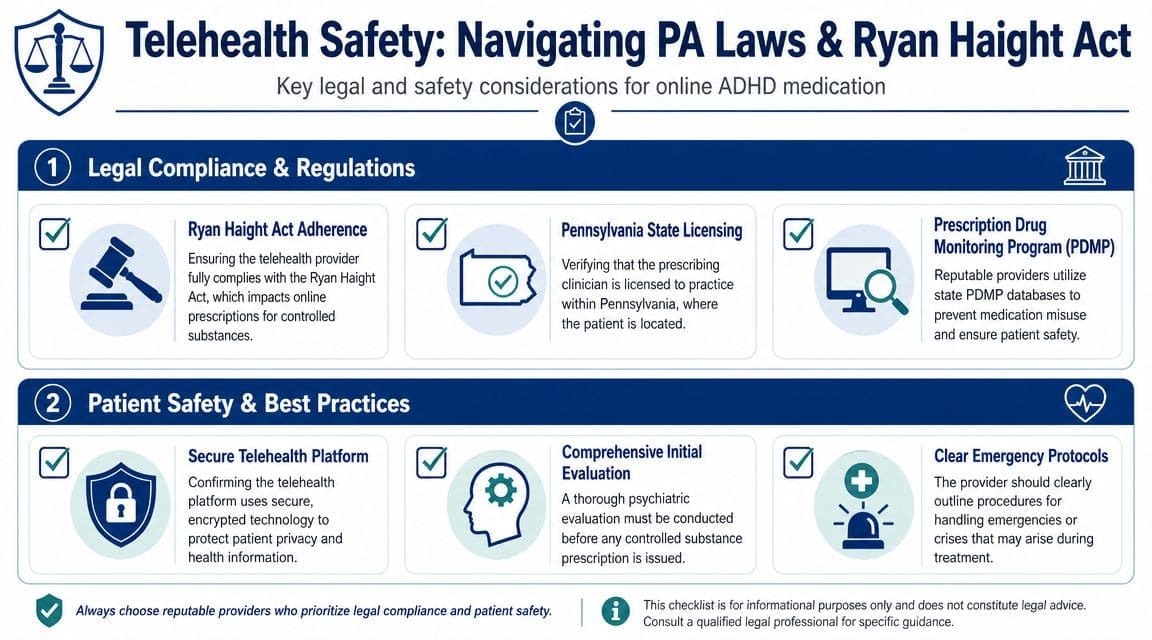
The broad legal framework includes federal controlled-substance rules, often discussed in relation to the Ryan Haight Act, and Pennsylvania licensure requirements. For a patient, the practical takeaway is simple. The prescriber must be authorized to treat patients in Pennsylvania, the telehealth encounter must meet proper clinical standards, and any controlled-substance prescribing must follow current federal and state requirements.
Patients can review Pennsylvania's telehealth framework through the Commonwealth of Pennsylvania telehealth information. They should also confirm that the clinician offering ADD medication online is licensed in Pennsylvania and uses secure systems for prescribing and follow-up.
A legitimate provider should be willing to answer these questions clearly:
- State licensure: Is the prescriber licensed for Pennsylvania patients?
- Visit format: Is the evaluation conducted by video rather than only chat or text?
- Controlled-substance policy: Does the practice prescribe stimulants at all, and under what conditions?
- Safety procedures: How are side effects, refill timing, and ongoing review handled?
If a service won't explain its prescribing rules before payment, that's not transparency. That's risk shifting onto the patient.
What safe monitoring looks like
Safety isn't just a legal issue. It's clinical. Adults treated for ADHD need monitoring for whether the medication is helping, whether side effects are emerging, and whether the diagnosis still fits the overall picture. With stimulant treatment, clinicians commonly pay close attention to appetite, sleep, activation, blood pressure, and pulse. With non-stimulants, monitoring still matters because sedation, dizziness, blood pressure changes, or other medication-specific effects can show up.
Good telehealth care has a structure for check-ins, symptom review, refill procedures, and escalation if something doesn't feel right. A secure platform, privacy protections, and clear emergency instructions are part of that structure. Convenience matters, but safety is what makes convenience useful.
How to Choose a Reputable Telehealth Provider
Online ADHD care ranges from careful psychiatric practice to websites that lean on urgency, vague promises, and minimal screening. Patients need a practical filter.
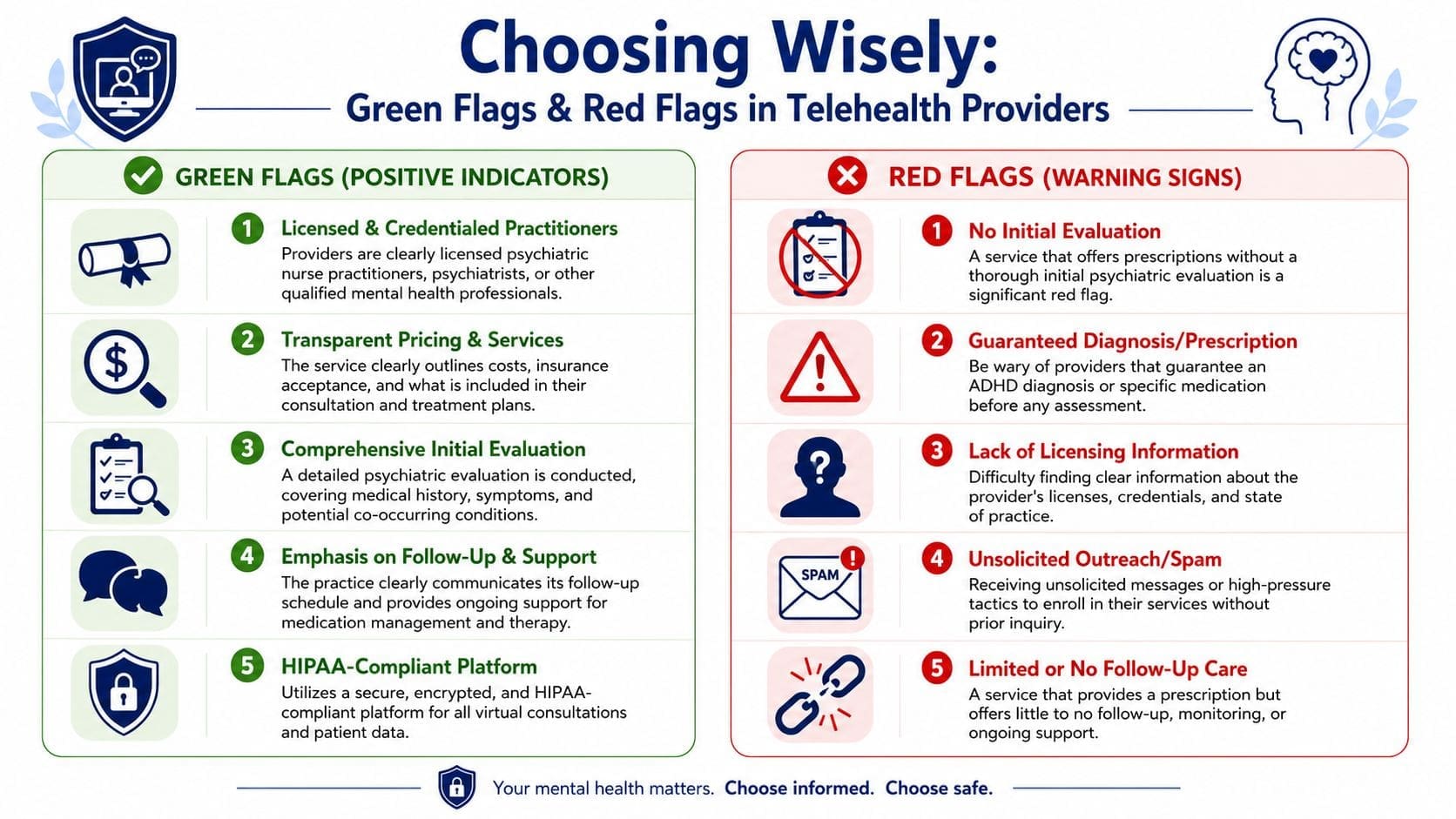
A quick visual summary helps before getting into details.
Green flags
A trustworthy telehealth provider acts like a medical practice, not a checkout page. The signs are usually visible before the first appointment.
- Qualified prescribers: Look for psychiatric nurse practitioners, psychiatrists, or other licensed clinicians who can legally prescribe in Pennsylvania.
- Video-based evaluation: A real ADHD assessment should happen face to face by secure video, not solely by text.
- Detailed intake process: The practice asks about medical history, psychiatric history, current medications, and co-occurring conditions.
- Clear follow-up plan: Medication management includes return visits, side-effect review, and refill policies.
- Secure technology: The portal should be HIPAA-compliant and built for protected health information.
Patients comparing local and statewide options may also look at ADHD doctor availability in Pennsylvania when deciding whether virtual care is the best fit.
Later in the search process, it's worth hearing how clinicians talk through these issues in plain language.
Red flags
The warning signs are usually blunt.
- Guaranteed prescriptions: No ethical prescriber can promise an ADHD diagnosis or a specific medication before the evaluation.
- No live assessment: A platform offering controlled medication after only chat-based contact should raise concern.
- Pressure-first sales flow: If payment is pushed before services, limits, and credentials are explained, patients should slow down.
- Unclear licensing: If credentials or state licensure are hard to find, move on.
- Little or no follow-up: A prescription without ongoing management isn't good psychiatric care.
Choose the practice that explains what might happen if medication isn't appropriate. That's often the one taking the diagnosis seriously.
Navigating Insurance Payments and Follow-Up Care
Once a patient finds a provider that looks credible, the next questions are practical. Will insurance apply? What if it doesn't? How hard is it to get follow-up appointments or refill requests handled without repeated confusion?
Questions to ask before booking
Insurance coverage for telepsychiatry varies by plan and by provider contract status, so patients shouldn't assume that "telehealth" and "in network" mean the same thing. Before the first appointment, it helps to ask the office a few direct questions and then confirm details with the insurance plan.
A useful checklist includes:
- Network status: Is the practice in network with the patient's plan?
- Visit type: Is the initial ADHD evaluation covered the same way as a routine medication follow-up?
- Medication coverage: Are prior authorizations common for the likely medication options?
- Cash-pay policy: If insurance isn't used, is there a clear self-pay structure?
- Portal workflow: How are refill requests, messages, and scheduling handled?
Patients who want specifics on cost structure and coverage logistics can review insurance and pricing information.
How follow-up care usually works
ADHD treatment works better when the logistics are simple enough for a distracted adult to maintain. Follow-up visits are where medication is adjusted, side effects are reviewed, and the treatment plan is fine-tuned around work hours, appetite changes, sleep, anxiety, and real functioning.
Some practices offer insurance-based care. Others provide self-pay or membership-style options. Integrative Psychiatry of America offers telepsychiatry in Pennsylvania with secure visits, medication management, portal messaging, and broader support such as nutrition and lifestyle counseling when clinically relevant. That model can be useful for adults who need more than a prescription and want care organized in one place.
Patients should also ask how refill requests work between visits. The best systems don't leave people guessing whether a message was received or whether a pharmacy issue can be corrected quickly.
Your Questions Answered and Next Steps for Care
A common Pennsylvania telehealth scenario looks like this. An adult finally schedules an ADHD visit after months of missed deadlines, late fees, and friction at home, then realizes their primary questions are not about the label. They want to know whether a new clinician can continue a current prescription, whether stimulants can legally be prescribed through telehealth, how privacy works, and what kind of follow-up care will be manageable.
Common patient questions
Can an existing ADHD prescription be transferred to an online practice?
Sometimes. A Pennsylvania-licensed clinician still has to confirm the diagnosis, review prior treatment, assess current symptoms, and check for safety concerns before prescribing. A pill bottle helps, but it is rarely enough by itself. Prior records, a pharmacy fill history, and a signed release of information often make the transition faster and safer.
What if both therapy and medication management are needed?
That is very common in ADHD care. Medication may improve attention or impulse control, but it does not automatically fix routines, sleep loss, procrastination, emotional reactivity, or relationship stress. In practice, adults usually do better when treatment includes skills, structure, and realistic behavior changes along with medication.
How is privacy protected in online treatment?
The basics should be clear from the start. Patients should see secure video visits, HIPAA-compliant messaging, consent forms that explain telehealth risks and limits, and a private portal for records and prescriptions. If a platform is vague about confidentiality or uses informal communication for clinical care, I would treat that as a warning sign.
What if stimulant medication is the main reason for seeking care?
Ask before you book. In Pennsylvania, the biggest point of confusion is often the difference between telehealth prescribing for stimulants and for non-stimulants. Stimulants are Schedule II medications, so the rules, documentation, identity verification, and follow-up expectations are tighter. Non-stimulants may be a better fit for some adults because they can be easier to continue safely when there is concern about misuse, side effects, anxiety, insomnia, or cardiovascular risk. The right answer depends on diagnosis, history, and state and federal prescribing requirements, not just patient preference.
Medication also works better when the home setup supports follow-through. Families trying to reduce clutter, forgotten tasks, and visual overload may find Everblog's organization tools for families useful alongside treatment.
A practical next step
Good online ADHD care in Pennsylvania starts with a real evaluation and clear expectations. Patients should leave the first visit understanding whether the diagnosis is straightforward or still being sorted out, whether stimulant prescribing is even appropriate, what monitoring will be required, and what the backup plan is if a medication causes side effects or does not help enough.
Choose a clinician based on process, not speed. Fast access matters, but safe prescribing matters more.
If you are ready to start, a confidential evaluation with a Pennsylvania psychiatric clinician is the right next step. Integrative Psychiatry of America offers confidential telepsychiatry for Pennsylvania adults who need ADHD evaluation, medication management, and follow-up care through a secure online platform.