
A Pennsylvania adult often reaches for the search bar after the same pattern repeats for months or years. Bills get paid late despite good intentions. Work takes twice as long as it should. Conversations drift mid-sentence, and the effort to stay organized starts to feel heavier than the task itself. Typing ADHD medication management near me is usually less about curiosity and more about relief.
That search also comes with uncertainty. Many adults aren't just asking who can prescribe. They're trying to figure out whether telehealth is legitimate for ADHD care, whether a psychiatric nurse practitioner can manage treatment safely, what the first appointment will feel like, and how to keep treatment stable once real life gets involved. In Pennsylvania, those are practical questions, not small ones.
Table of Contents
- Starting Your Search for ADHD Care in Pennsylvania
- How to Find and Evaluate ADHD Providers in PA
- Your First Telehealth Appointment What to Expect
- Navigating Prescriptions Insurance and Documentation
- Thriving with ADHD Long-Term Success and Coordinated Care
Starting Your Search for ADHD Care in Pennsylvania
A common scenario looks like this. An adult in Pittsburgh, Philadelphia, Scranton, or a smaller Pennsylvania town has already tried planners, reminder apps, sticky notes, and late-night promises to “just get more disciplined.” Some tools help for a week. Then the same missed deadlines, unfinished tasks, and impulsive decisions return.
That's often the moment the search changes. It stops being about self-improvement and starts becoming a medical question. Could ADHD be part of the problem, and if so, what kind of treatment helps?
The search is for care, not just a prescription
Effective ADHD treatment isn't a quick transaction. It works best when the patient and clinician review symptoms carefully, look at daily demands, and choose a plan that can be adjusted over time. That includes work hours, sleep patterns, driving needs, anxiety symptoms, appetite, and previous medication experiences.
For many adults, a useful first step is learning the difference between diagnostic care and ongoing treatment support. A page about finding ADHD doctors near you in Pennsylvania can help clarify what kind of provider relationship is needed, especially when the goal is long-term medication follow-up rather than a one-time evaluation.
Practical rule: The right ADHD provider doesn't just decide whether medication is appropriate. That clinician should also be prepared to adjust timing, monitor side effects, and respond when life circumstances change.
Why medication management matters beyond focus
Medication management isn't only about attention span. A nationwide Swedish study that followed 247,420 ADHD medication users from 2006 to 2020 found that medication use was consistently associated with lower risks of self-harm, unintentional injury, traffic crashes, and crime, even as prescribing rose nearly 5-fold over the study period. In that study, the strongest association for self-harm appeared in 2006 to 2010, with an incidence rate ratio of 0.77 (95% CI, 0.73-0.81), representing a 23% lower rate during medication use compared with nonuse, according to JAMA Psychiatry's nationwide Swedish analysis.
That matters because adults often minimize the downstream effects of untreated ADHD. Missed exits while driving, preventable accidents at work, impulsive arguments, and burnout from chronic disorganization all affect safety and stability. Medication may be one tool among several, but for many people it becomes a central part of functioning more reliably.
What usually works and what usually doesn't
A strong start usually includes a full psychiatric evaluation, honest reporting about symptoms, and willingness to fine-tune treatment rather than expecting a perfect answer on day one.
What tends not to work is chasing convenience alone. A fast appointment with no real follow-up may sound appealing when someone feels overwhelmed, but ADHD management often needs dose review, monitoring, and a plan that fits actual daily life in Pennsylvania, whether that means commuting, shift work, parenting, or remote work from home.
How to Find and Evaluate ADHD Providers in PA
The biggest mistake in this stage is choosing the first name that appears in a search result without checking if that clinician manages adult ADHD in a structured way. A provider can be licensed, available, and still not be the right fit for medication decisions that require nuance.
Pennsylvania patients usually weigh two models. One is local in-person care. The other is telehealth. Each has advantages, and the better option depends on logistics, comfort, and the level of coordination needed.
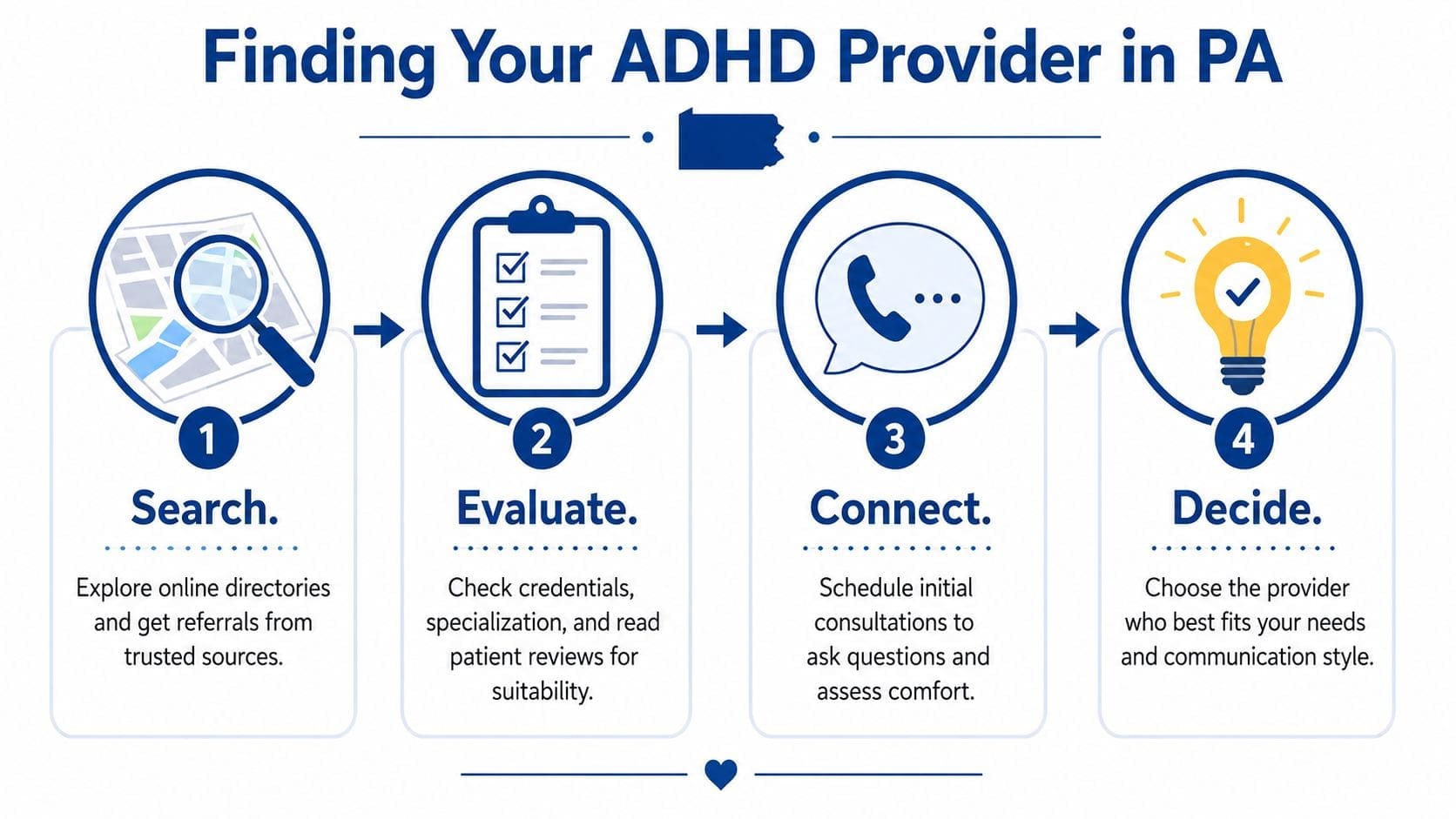
Telehealth versus in-person care
In-person care can feel familiar. Some patients prefer the structure of physically going to an office, especially if they already see other local clinicians nearby.
Telehealth often solves a different problem. Adults in rural parts of Pennsylvania, busy professionals, parents, and college students may need care that fits around work or family obligations. It also reduces travel time, parking hassles, and time away from work. For ADHD care, that convenience matters because medication management usually involves follow-up, not just one intake.
A quick comparison can help:
| Care model | Often works well for | Potential drawback |
|---|---|---|
| In-person visits | Patients who prefer face-to-face appointments and local office routines | Travel and scheduling can become a barrier |
| Telehealth visits | Adults who need privacy, flexibility, and statewide access from home | Requires a quiet space, internet access, and comfort with virtual communication |
What credentials and experience to check
A psychiatric nurse practitioner who manages ADHD should have clear psychiatric training and a scope of practice that includes evaluation, diagnosis, and medication treatment. For nurse practitioners, credentials such as PMHNP-BC matter because they indicate psychiatric specialization.
It also helps to understand how that role compares with other prescribers. Patients who are sorting through options can review how a psychiatric nurse practitioner differs from a psychiatrist so the decision is based on training and treatment style rather than assumptions.
Signs a provider is equipped for adult ADHD
Adult ADHD rarely shows up alone. Recent guidance emphasizes that comorbidity is common, with anxiety, PTSD, depression, insomnia, substance-use history, and cardiovascular considerations shaping treatment decisions, as discussed in this overview of individualized ADHD medication care.
That means a strong provider should be able to do more than confirm symptoms. Look for these signs:
- They ask about coexisting conditions. Anxiety, sleep problems, trauma symptoms, and depression can change medication choices and dosing pace.
- They discuss monitoring, not just prescribing. Side effects, blood pressure concerns, sleep disruption, appetite changes, and misuse risk should be part of the conversation.
- They explain trade-offs clearly. A careful clinician doesn't present stimulants or non-stimulants as universally right for everyone.
- They have a treatment process. There should be a plan for titration, follow-up visits, refill questions, and what happens if a medication doesn't fit.
A one-size-fits-all ADHD plan usually fails in adult practice because adult life is not one-size-fits-all.
Questions worth asking before booking
Patients don't need to interrogate the office. A few focused questions usually reveal whether the practice is organized and realistic.
- “Do you regularly treat adult ADHD?” Adult care has different patterns than childhood treatment.
- “How do you handle follow-up and medication adjustments?” This tells a patient whether the relationship is active or transactional.
- “How do you approach ADHD when anxiety or depression is also present?” The answer often reveals the provider's depth.
- “Do you offer telehealth across Pennsylvania?” That matters for ongoing convenience and continuity.
One factual example of a telehealth option is Integrative Psychiatry of America, which provides online psychiatric care across Pennsylvania through secure virtual visits. For adults looking up ADHD medication management near me, the relevant question isn't whether the office is physically around the corner. It's whether the care model can support consistent evaluation, prescribing, and follow-up month after month.
Your First Telehealth Appointment What to Expect
The first telehealth visit feels less intimidating when the patient knows what the clinician is trying to learn. This isn't a performance test, and it isn't a race to a prescription. It's a structured psychiatric evaluation built to answer a few practical questions. Do the symptoms fit ADHD, what else may be present, and what treatment approach is safe?

A typical Pennsylvania adult often logs in worried about saying the wrong thing. That worry usually fades once the conversation starts. A good telehealth intake is steady and practical. The clinician asks for examples, not perfect wording.
What the conversation usually covers
The appointment commonly starts with present-day problems. Trouble finishing work. Difficulty tracking tasks. Losing focus during meetings. Restlessness, impulsive spending, procrastination, missed appointments, and mental fatigue from trying to compensate.
Then the history widens. A psychiatric evaluation often includes childhood patterns, school history, prior diagnoses, family psychiatric history, sleep habits, substance use, physical health concerns, and any prior response to medications. Adults sometimes expect a narrow ADHD checklist, but the visit should be broader than that.
A 2023 national report found that 69.6% of adult ADHD visits included at least one co-diagnosed mental health disorder, and about 40% included a chronic condition such as overweight or obesity, according to the National Center for Biotechnology Information's report on adult ADHD visits. That's one reason an intake often includes questions about anxiety, depression, trauma symptoms, and general medical health.
Many adults feel relieved when the evaluation covers more than attention alone. It means the clinician is trying to build a safe plan, not a rushed one.
How to prepare before logging on
The best preparation is simple, not elaborate. Helpful items include:
- A short symptom list. Write down recent examples of inattention, impulsivity, lateness, disorganization, or emotional dysregulation.
- Current medications and supplements. Include anything prescribed by primary care or another specialist.
- Past mental health history. Previous therapy, diagnoses, or medication trials can shape the plan.
- A quiet private space. Telehealth works better when the patient can speak freely.
Adults who want a sense of how remote treatment logistics work can review online ADHD medication management options before the visit.
A brief visual overview can also help set expectations:
What happens at the end of the first visit
Some visits end with a treatment recommendation. Others end with next steps, more history gathering, or a decision to clarify diagnosis before discussing medication. Either outcome can be appropriate.
The key is whether the plan makes clinical sense. A solid first appointment usually produces one of these paths:
- Medication is considered appropriate, with discussion of benefits, risks, and follow-up.
- More assessment is needed, especially if symptoms overlap with anxiety, trauma, sleep deprivation, or mood issues.
- A combined approach is chosen, pairing medication planning with therapy, coaching, or behavioral supports.
That final point matters. A good telehealth ADHD intake should leave the patient feeling understood and informed, even if the answer isn't instantaneous.
Navigating Prescriptions Insurance and Documentation
After diagnosis or treatment planning, the next hurdles are practical. Prescriptions, insurance, refill timing, pharmacy communication, and records management can either support treatment or derail it. Adults with ADHD often do better when this part is simplified early.
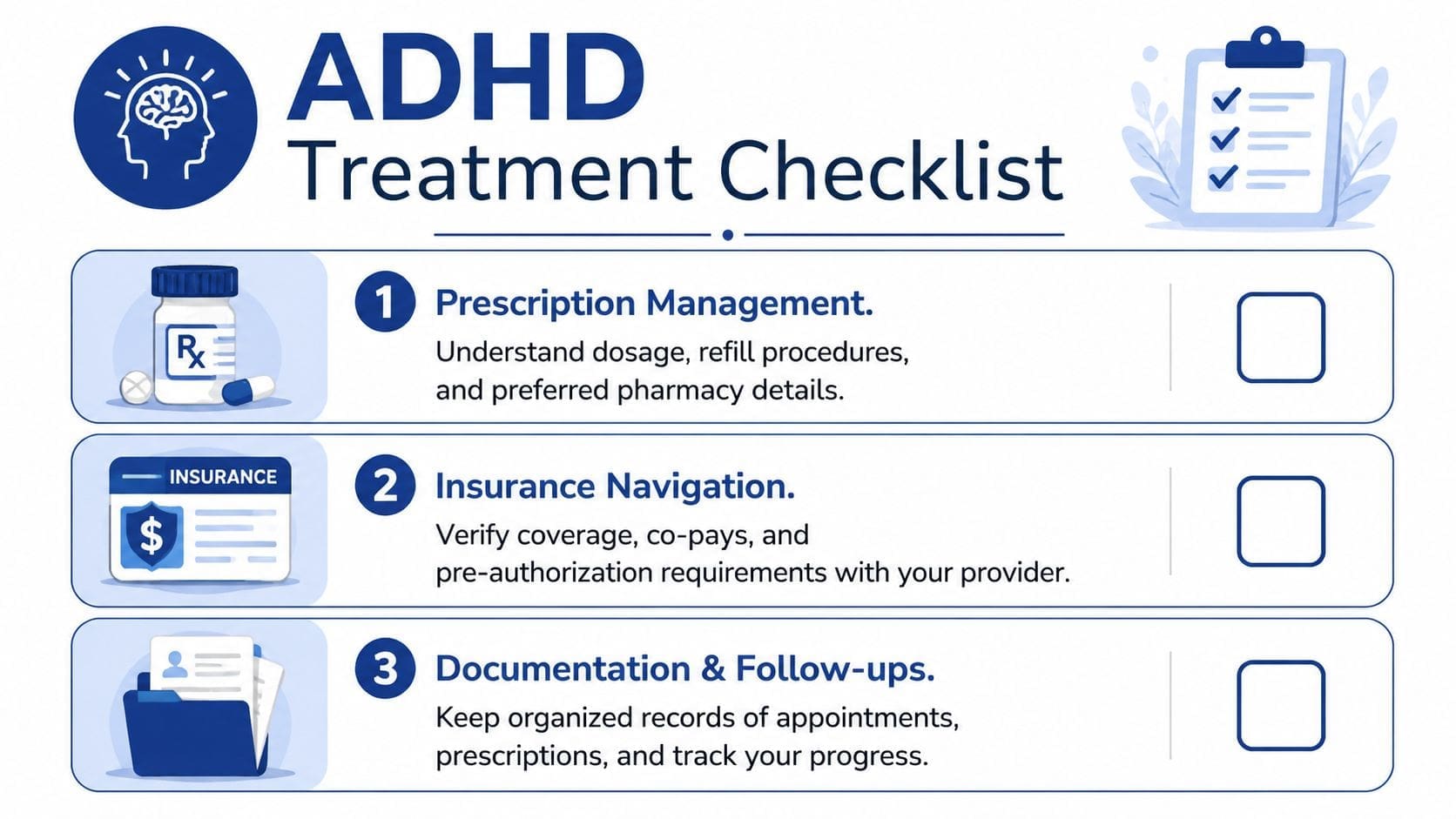
Medication categories and why the distinction matters
Medication management usually starts with a conversation about stimulants and non-stimulants. Stimulants remain the most widely used class. A systematic review of 133 studies found that amphetamines were the most efficacious compounds in adults, and the CDC reports that 70-80% of children with ADHD have fewer symptoms on stimulant medication, as summarized in CHADD's adult medication management guidance.
That doesn't mean stimulants are automatically right for every adult. Coexisting anxiety, insomnia, blood pressure concerns, misuse risk, or side effects may push treatment toward slower titration or a non-stimulant option instead. Medication choice should match the patient's actual life, not just the diagnosis on paper.
A practical checklist before treatment starts
Some preparation reduces delays and repeat phone calls.
- Bring identification and insurance details. Accurate demographic and coverage information matters if prior authorization or pharmacy verification becomes necessary.
- Pick a preferred pharmacy carefully. ADHD medications may involve refill timing limits and stock variability.
- Track symptoms by time of day. Morning focus, afternoon decline, evening irritability, or sleep problems can help guide dose timing later.
- Keep copies of visit summaries. Documentation helps if pharmacy questions or insurance issues come up.
For adults specifically exploring stimulant treatment, a page on Adderall prescription considerations near you can be useful for understanding the broader prescribing process and common questions.
Insurance, telehealth, and controlled prescriptions
Insurance rules vary, so it helps to verify behavioral health coverage, copays, and any authorization requirements before the first follow-up. Patients paying cash or using membership-style models should still ask about visit cadence, refill procedures, and what kinds of portal communication are included.
Controlled medications also require planning. Telehealth prescribing doesn't remove the need for good documentation, ongoing follow-up, or clear communication with the pharmacy. Problems often arise when a patient waits until the last minute to request a refill, changes pharmacies without notifying the clinic, or assumes stock will be available everywhere.
Medication habit: Save the pharmacy phone number, the clinic number, and refill dates in the same place. ADHD treatment becomes much easier when logistics don't depend on memory alone.
Thriving with ADHD Long-Term Success and Coordinated Care
The adults who do best with ADHD treatment usually stop thinking of medication as a single event. It's an ongoing system. Dosing may need adjustment. Work schedules change. Side effects can show up later than expected. Sleep, stress, parenting, and anxiety can all shift the way treatment feels over time.

Why follow-up matters more than people expect
A first prescription can help, but long-term care is where real stability gets built. Patients often need dose timing changes, help with sleep disruption, appetite issues, or a decision about whether the medication covers the workday without creating an evening crash.
Medication also works better when the patient builds structure around it. That may include therapy, coaching, calendars that see regular use, simpler routines, and external supports for time blindness and task initiation. Adults who want practical non-medication strategies can also use proven tips for ADHD productivity to strengthen daily functioning between appointments.
Shortages, substitutions, and continuity plans
One of the most underappreciated parts of ADHD medication management near me is what happens when the pharmacy says the medication isn't available. Rising demand and persistent stimulant shortages have made continuity planning a real part of care, as described in this discussion of ADHD medication shortages and treatment stability.
Patients need a clinician who can respond with options. That may mean checking equivalent formulations, discussing non-stimulant alternatives, adjusting the plan temporarily, or coordinating with the pharmacy rather than leaving the patient to troubleshoot alone.
Coordinated care works better than isolated care
Long-term ADHD treatment often improves when the prescriber coordinates with a therapist or primary care clinician. If anxiety treatment is underway, if sleep is worsening, or if blood pressure becomes a concern, shared information helps prevent fragmented care.
Adults who want a broader view of medication and non-medication strategies can review adult ADHD treatment options as part of building a fuller treatment plan.
Stable ADHD care isn't defined by getting a prescription once. It's defined by staying functional when life gets messy.
Adults in Pennsylvania who are ready for structured, compassionate ADHD care can explore telepsychiatry through Integrative Psychiatry of America. The practice offers online psychiatric evaluation and medication management across Pennsylvania, with treatment designed around real-world follow-up, coexisting conditions, and practical continuity of care.