
The search usually starts late at night or between work meetings. A Pennsylvania adult misses another deadline, loses track of an important email, forgets why they opened a browser tab, and finally types adderall prescription near me into Google because something feels harder than it should.
That search can come with equal parts hope and hesitation. Some people are wondering whether they have ADHD. Others already carry a diagnosis and need legitimate follow-up care, a medication review, or help navigating pharmacy shortages. Many just want clear answers about what’s legal on ADHD in Pennsylvania, who can prescribe safely, and what a real evaluation looks like. AdHD is increasing in Pennsylvania
Table of Contents
- Why ‘Adderall Prescription Near Me’ is a Common Pennsylvania Search
- Navigating Your ADHD Evaluation A Step-by-Step Guide
- Choosing Your Provider Telehealth vs In-Person Care in PA
- Preparing for Your Appointment Documentation Costs and Insurance
- Identifying Reputable Providers and Avoiding Red Flags
- Long-Term Success Beyond the Initial Prescription
Why ‘Adderall Prescription Near Me’ is a Common Pennsylvania Search
Many adults don’t start with a diagnosis. They start with frustration. Work takes longer than it should, home life feels disorganized, and simple tasks pile up because attention keeps drifting. By the time someone searches adderall prescription near me, they’re often trying to solve a much bigger problem than medication alone.
That search has become more common for a reason. According to the IQVIA Report on Stimulant Trends prepared for the DEA, Adderall accounted for 49% of all stimulant prescriptions in the United States in 2023, and from 2012 to 2023 Adderall prescriptions for adults ages 31 to 40 tripled. The same report shows a major shift among women, with prescriptions increasing 92% for females compared with 36% for males.

Why adults often recognize ADHD later
Adult ADHD doesn’t always look like the stereotype people expect. It may show up as missed details, chronic lateness, difficulty finishing routine tasks, restlessness during meetings, or a pattern of high effort with inconsistent results.
Common reasons adults start looking for help include:
- Work strain: Deadlines slip even when effort is high.
- Home disorganization: Bills, appointments, and chores keep falling through.
- Emotional wear: Repeated underperformance can look like low motivation when it’s really poor executive function.
- Late recognition in women: Many women were overlooked earlier in life and only pursue care after family, career, or caregiving demands increase.
Searching for medication is often a search for an explanation.
Pennsylvania residents also run into a practical problem. Access to mental health clinicians can be uneven, especially outside major urban centers. The state’s workforce gap is one reason telepsychiatry has become part of the conversation, and this broader access issue is outlined in this review of the mental health provider shortage in Pennsylvania.
Why online search results can feel confusing
Search results mix together local clinics, telehealth platforms, pharmacy content, and general health sites. That makes it hard to tell who evaluates ADHD carefully and who merely targets high-intent keywords. For readers curious about how healthcare practices make themselves visible online, this overview of medical practice marketing strategies helps explain why some clinics dominate search results even when quality varies.
The important point is simple. A common search term doesn’t mean a simple medical decision. It means many Pennsylvanians are trying to find legitimate, timely ADHD care in a system that often feels hard to get through.
Navigating Your ADHD Evaluation A Step-by-Step Guide
A proper ADHD evaluation should feel structured, careful, and collaborative. For many Pennsylvania adults, the first appointment comes after years of missed deadlines, chronic overwhelm, or hearing some version of “you just need to try harder.” In practice, my job as a psychiatric nurse practitioner is to sort out what is causing those symptoms and whether ADHD is the right diagnosis.
If this is your first formal assessment, it helps to review a clear overview of how to get an ADHD diagnosis as an adult before the visit. Patients usually feel less anxious when they know what the process is meant to answer.
What happens before the visit
Many ADHD evaluations, including telehealth visits, start with intake forms. Those forms usually ask about current symptoms, past treatment, medications, medical conditions, sleep, work performance, school history, and daily functioning.
That paperwork matters more than patients expect.
Attention problems can reflect ADHD, but they can also show up with anxiety, depression, trauma, poor sleep, substance use, thyroid problems, and other medical or psychiatric concerns. If the intake is shallow, the visit is more likely to miss something important.
A useful pre-visit checklist includes:
- Symptom history: When did the problems start, and in what settings do they show up?
- Functional impact: How are symptoms affecting work, home life, school, finances, or relationships?
- Past treatment: Any therapy, medication trials, prior testing, or earlier ADHD diagnosis.
- Medical background: Cardiac history, blood pressure issues, and other safety concerns.
What a real ADHD assessment includes
A legitimate ADHD evaluation does not rely on a single checklist or a quick request for Adderall. It includes time to ask follow-up questions, compare ADHD symptoms with other conditions, and understand the patient’s history over time. In many telehealth settings, that means a visit long enough to discuss childhood patterns, adult functioning, mental health history, and medical safety, rather than rushing to a prescribing decision.
Clinicians often use screening tools such as the ASRS-v1.1, but a screener is only one part of the assessment. Good care depends on clinical judgment.
A careful visit usually includes:
- Current symptoms described in plain language: distractibility, forgetfulness, poor follow-through, impulsive choices, or constant task switching
- Developmental and school history: even when childhood ADHD was never formally recognized, longstanding patterns still matter
- Psychiatric review: anxiety, depression, OCD, PTSD, and bipolar-spectrum symptoms can change both diagnosis and treatment planning
- Medical safety review: stimulant prescribing requires screening for heart history, substance use concerns, sleep problems, and medication interactions
Patients also deserve to hear the clinician’s reasoning. If ADHD fits, the explanation should be clear. If the picture is mixed, that should be clear too. A thoughtful evaluation makes room for uncertainty instead of forcing a fast answer.
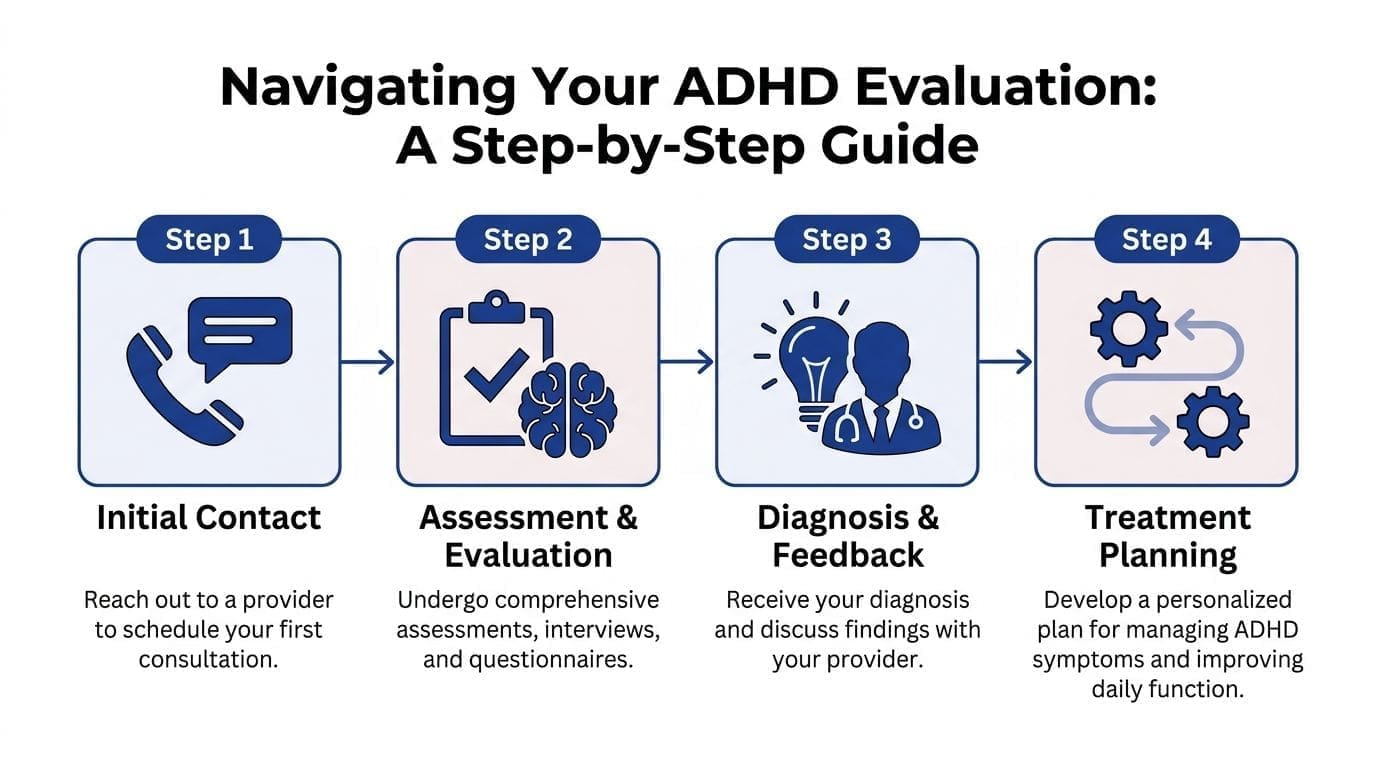
A short visual summary can make the process easier to follow:
Practical rule: A fast prescription is not the same thing as good care.
How treatment decisions are made
Medication can be helpful, but it is never the whole evaluation. Some Pennsylvania adults are good candidates for Adderall or another stimulant. Others need more diagnostic clarification, treatment for anxiety or sleep problems first, or a non-stimulant option because of side effects, medical history, or misuse risk.
Experience matters. A psychiatric nurse practitioner should be able to explain why a stimulant makes sense, why it does not, or why the safest decision is to wait.
What helps the process go well:
- Using specific real-life examples instead of self-diagnosis language
- Being honest about sleep, anxiety, substance use, and prior medication reactions
- Staying open to a treatment plan that may include therapy, behavioral strategies, or non-stimulant medication
What raises concern:
- Asking for a specific Schedule II medication before a full assessment
- Leaving out parts of your medical or psychiatric history
- Expecting same-visit prescribing without enough information to make a safe decision
The strongest ADHD treatment plans are individualized. They take symptoms seriously, follow Pennsylvania prescribing standards, and treat medication as one tool within a larger plan for long-term functioning.
Choosing Your Provider Telehealth vs In-Person Care in PA
Pennsylvania residents often compare two paths. One is the traditional route of finding an in-person clinic, waiting for an opening, traveling to appointments, and managing follow-up that way. The other is telehealth with a licensed psychiatric nurse practitioner or other qualified prescriber who evaluates and manages ADHD remotely.
Both models can work. The better choice depends on access, comfort with virtual care, scheduling needs, and how quickly someone can be seen.
What Pennsylvania residents should know
A lot of confusion comes from outdated assumptions. Some adults still believe stimulant treatment always requires an in-person first step or that only a local office can handle ADHD medication management.
That misunderstanding shows up in the data. A 2025 American Telemedicine Association survey found that 62% of ADHD patients in the mid-Atlantic reported barriers to stimulant access, and 40% were unaware that Pennsylvania-licensed psychiatric nurse practitioners can prescribe stimulants via telehealth, according to this Pennsylvania-focused access review.
For patients comparing options, this guide to online psychiatry in Pennsylvania for ADHD care can help frame what a legitimate telehealth experience should look like.
Telehealth vs. In-Person ADHD Care in Pennsylvania
| Feature | Telehealth (e.g., Integrative Psychiatry of America) | Traditional In-Person Clinic |
|---|---|---|
| Access | Often easier for adults balancing work, childcare, or transportation limits | Can be harder when local specialists have long waitlists |
| Location | Useful across Pennsylvania, including areas with fewer mental health providers | Best for patients who prefer office visits and live near a clinic |
| Visit format | Secure video appointments from home or work | Office-based evaluation and follow-up |
| Privacy | Discreet, especially for adults who don’t want to leave work for appointments | Some prefer face-to-face interaction in a clinic setting |
| Medication management | Can be handled legally by qualified Pennsylvania-licensed prescribers when appropriate | Also appropriate, but may involve more travel and scheduling friction |
| Best fit | Adults who want convenience and consistent remote follow-up | Adults who strongly prefer in-person care or need hands-on coordination |
Telehealth is not lower-standard care when the evaluation is thorough, the platform is HIPAA-compliant, and the prescriber is licensed in Pennsylvania.
A common mistake is choosing a format based only on speed. A better test is whether the provider explains the legal process clearly, requires a real video assessment, documents the diagnosis carefully, and has a plan for follow-up. Convenience matters, but structure matters more.
Preparing for Your Appointment Documentation Costs and Insurance
Preparation lowers the chance of delays. It also helps the first visit stay focused on symptoms and treatment decisions instead of missing paperwork, insurance confusion, or pharmacy problems.
People looking up adderall prescription near me often want to know one very practical thing. What needs to be ready before the appointment starts?

What to gather before the visit
A strong pre-visit checklist includes both administrative and clinical details. Patients who prepare these items usually move through intake more smoothly.
- Photo ID: Telehealth prescribers need to verify identity.
- Insurance card: Bring front and back images if the portal requests them.
- Medication list: Include current prescriptions, supplements, and recent psychiatric medications.
- Past records: Prior testing, school accommodations, old ADHD diagnoses, or recent behavioral health notes can help.
- Pharmacy details: Have a preferred pharmacy ready, including address and phone number.
For cost planning, it helps to review expected testing or evaluation expenses before booking. This overview of how much ADHD testing can cost is useful when comparing self-pay and insurance-supported options.
Handling pharmacy and cost issues
The pharmacy side of care deserves just as much planning as the clinical side. The ongoing shortage has made filling stimulant prescriptions unpredictable, and many patients learn that after the prescription is already sent.
According to Medfinder’s Adderall stock guide, the average retail price for a common prescription is about $54.74, and services such as GoodRx can reduce costs by up to 69%. That same source notes that the shortage continues to create fulfillment problems, which is why responsive follow-up matters.
Useful habits include:
- Verify stock before sending the prescription: Some pharmacies won’t discuss controlled substance inventory in detail, but many will confirm whether a medication is currently available.
- Ask about generic and formulation issues: A pharmacy may have one strength or form but not another.
- Check insurance restrictions early: Prior authorization, quantity limits, and preferred formulary rules can slow things down.
- Use practical referral workflows: When another office or pharmacy needs paperwork, secure systems matter. For readers who want a plain-language example of how referral transmission works in pharmacy settings, this guide to faxing prescription referrals is a helpful operational reference.
A supportive provider doesn’t just write the prescription. They help patients handle the parts that usually go wrong after the prescription is sent.
The main trade-off is realism. Even with good documentation and insurance verification, stimulant treatment can still hit delays at the pharmacy counter. Planning ahead reduces stress, but it doesn’t eliminate every bottleneck.
Identifying Reputable Providers and Avoiding Red Flags
The safest ADHD care rarely comes from the clinic making the biggest promise. It comes from the clinic that evaluates carefully, sets boundaries, and explains the reasoning behind treatment.
That distinction matters more online, where some websites are built to convert urgency into subscriptions. Patients searching adderall prescription near me are often vulnerable to claims that sound convenient but skip the clinical safeguards that protect them.
Signs of a legitimate practice
A reputable ADHD provider usually does several things consistently. They list licensure clearly, use secure technology, require a real clinical assessment, and explain that medication may or may not be appropriate.
They also tend to be transparent about who is providing care. For patients comparing credentials, this explanation of psychiatrist vs psychiatric NP can help clarify scope, training, and what to expect from a psychiatric nurse practitioner in medication management.
Good providers usually:
- Require video evaluation: not just a form or chat box
- Review medical and psychiatric history carefully
- Discuss risks, benefits, and alternatives
- Set follow-up expectations before treatment begins
- Use HIPAA-compliant systems for messaging and visits
Red flags that deserve caution
Some warning signs are easy to miss because they’re framed as convenience. A site may advertise instant approval, same-day controlled substance prescribing without meaningful evaluation, or a membership model that pressures people to sign up before they understand the clinical process.
Pay attention when a provider:
- Guarantees an Adderall prescription
- Skips diagnostic depth and focuses only on checkout
- Offers no clear follow-up structure
- Avoids discussing side effects, misuse risk, or alternative treatments
- Makes it hard to verify who is licensed in Pennsylvania
A careful evaluation can feel slower than a marketing promise. That’s not a flaw. It’s one of the clearest signs that the practice takes patient safety seriously.
Long-Term Success Beyond the Initial Prescription
The first prescription is only one moment in ADHD treatment. The harder and more important work is what happens after that. Is the medication helping? Are side effects showing up? Is sleep getting worse? Is focus improving at work but emotional regulation still lagging behind?
These questions don’t get answered by a one-time visit.
Why follow-up matters
Schedule II stimulant care requires ongoing monitoring. According to ADHDone’s discussion of same-day ADHD prescribing and follow-up care, monthly check-ins are required for Schedule II drugs, and content online often skips that reality. The same source notes that integrative models that combine medication with lifestyle changes can reduce dropout rates by up to 50% compared with medication-only approaches.
That difference reflects a practical truth. Medication can improve attention, but ADHD management often also depends on sleep structure, exercise, nutrition, therapy, stress management, and systems that support follow-through.
Patients exploring a broader care plan can compare options in this overview of ADHD treatment options for adults.
What steady ADHD care looks like
Long-term treatment usually works best when it includes a few repeating elements:
- Regular monitoring: not just refill requests, but actual discussion of benefit, side effects, timing, and function
- Dose adjustment when needed: a starting plan may need revision
- Alternatives when stimulants aren’t a fit: some patients tolerate non-stimulant approaches better
- Lifestyle support: calendar systems, sleep habits, movement, and therapy often determine whether gains last
Medication can open the door. Daily habits determine whether someone can walk through it consistently.
What tends not to work is chasing a prescription without building a treatment framework around it. That often leads to frustration, inconsistent adherence, and the sense that ADHD care “stopped working” when the issue is that the plan never became fully developed.
For Pennsylvania adults, the most durable results usually come from care that treats ADHD as an ongoing clinical relationship rather than a one-time transaction.
Pennsylvania residents who want thoughtful ADHD care can connect with Integrative Psychiatry of America for secure telepsychiatry, thorough evaluation, and whole-person treatment planning. The practice’s psychiatric nurse practitioners provide online care across Pennsylvania with attention to medication management, therapy-informed support, and integrative strategies that fit real life.
Key Takeaways
- Many adults search ‘adderall prescription near me’ due to hidden ADHD symptoms and increased awareness of treatment options.
- ADHD evaluations must be thorough and collaborative, covering medical history and current functioning to ensure accurate diagnosis.
- Residents in Pennsylvania may choose between telehealth and in-person ADHD care, with telehealth providing easier access and flexibility.
- Preparation for ADHD appointments is crucial; gathering necessary documents and understanding insurance can streamline the process.
- Legitimate providers prioritize comprehensive assessments and ongoing follow-up care, addressing both medication management and lifestyle support.