
Is the hard part finding doctors that prescribe Adderall online, or keeping a lawful prescription working after the video visit ends? Most searches stop at “who will send it.” A Schedule II stimulant still has to survive a real evaluation, a pharmacy shelf, a dose that fits one person, and follow-up that looks at sleep, appetite, blood pressure, and misuse risk.
An online visit can be the right door for a Pennsylvania adult. It cannot skip the clinical work that makes the medicine appropriate, and it never guarantees a prescription.
Table of Contents
- Who Can Prescribe Adderall Online?
- How Do I Get Adderall Prescribed Online Legally?
- Documents and History to Gather Before Your Visit
- What Does an Online ADHD Evaluation Cover?
- Legal Limits and Red Flags to Avoid
- What If the Pharmacy Cannot Fill My Adderall?
- Medication Options Besides Adderall to Discuss
- Which Next Step Fits My ADHD Care in Pennsylvania?
Who Can Prescribe Adderall Online?
An online clinician can prescribe Adderall only with a DEA registration for Schedule II controlled substances, a license in the state where the patient is physically located during the visit, and practice that follows current telehealth rules. In Pennsylvania that is usually a physician psychiatrist, a board-certified psychiatric mental health nurse practitioner, or another licensed prescriber who holds that registration.
Primary care clinicians may prescribe stimulants. Many will not manage them for years. Plenty of telehealth companies refuse stimulants, and many will not start ADHD medication at a first visit.
Integrative Psychiatry of America uses psychiatric providers, including board-certified psychiatric mental health nurse practitioners. Those clinicians are not physician psychiatrists. A short comparison of a psychiatric NP and a psychiatrist shows how the roles differ.
Check four items before you book:
- Credentials: Who will see you, and what training that person holds.
- Authority: DEA registration plus a Pennsylvania license that covers your location.
- Scope: Whether that provider evaluates ADHD and manages stimulant treatment.
- Cost: Insurance status and fees stated before the visit, not after.
How Do I Get Adderall Prescribed Online Legally?
A lawful online path always includes a live clinical evaluation. Adderall is a Schedule II stimulant, so a questionnaire cannot approve it.
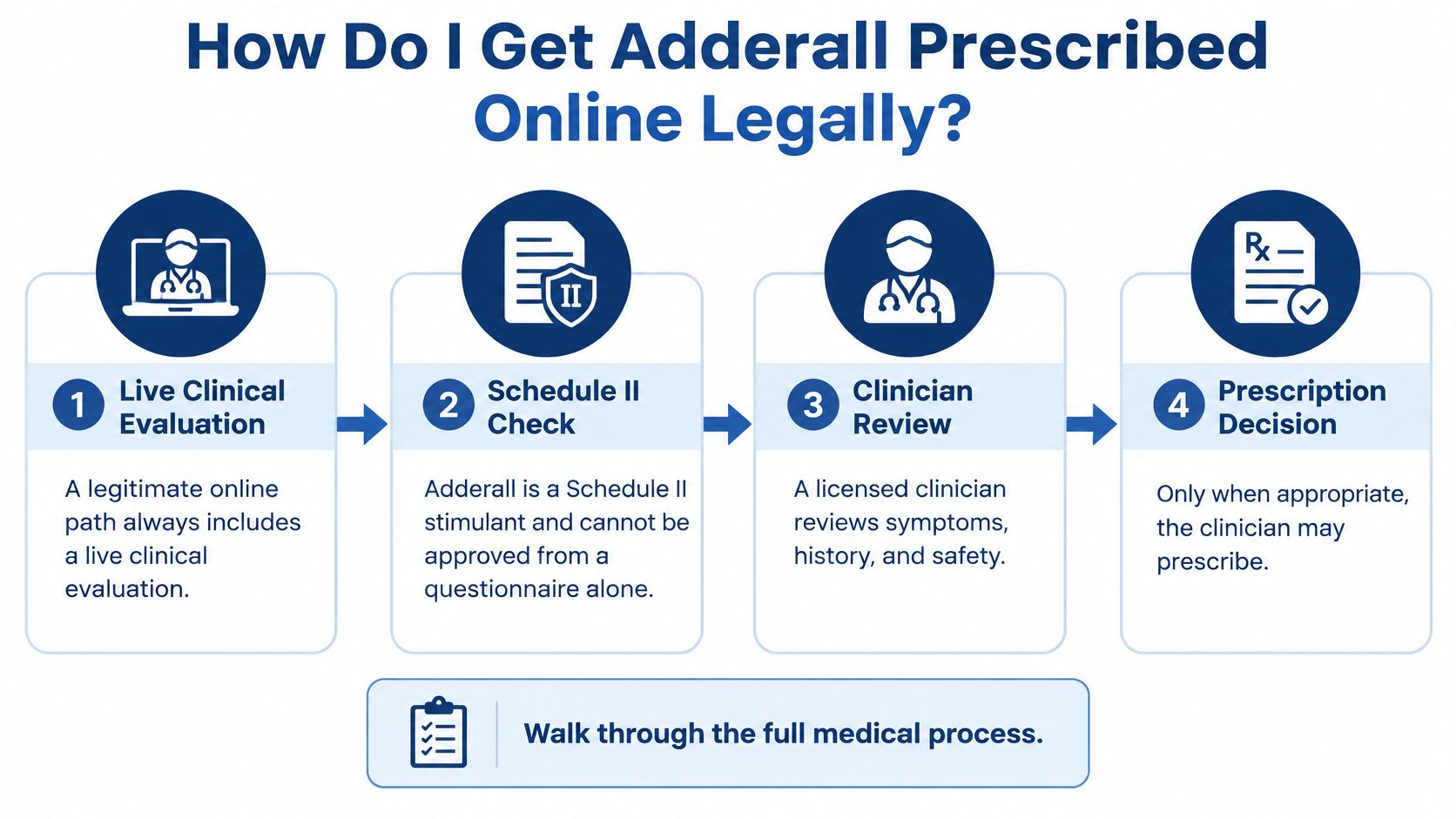
The visit sequence
- Request the evaluation. Ask for a thorough psychiatric evaluation on the practice website.
- Wait for confirmation. The practice confirms the appointment and sends a secure link for the virtual visit.
- Attend the video visit. The clinician takes a full history, reviews symptoms and daily functioning, and decides whether ADHD fits.
- Receive a prescription only if it is appropriate. Medication goes electronically to a pharmacy you choose. Later visits review benefit, side effects, sleep, appetite, and blood pressure.
A refill follows that review. It is not an automatic renewal. If ADHD is not supported, the plan may move to more testing, another condition, or care that does not use a stimulant.
How the dose is chosen
The FDA Adderall label requires individualized dosing at the lowest effective amount and says late-evening doses should be avoided because they may cause insomnia. For adults starting Adderall XR, or switching onto it, the FDA prescribing information lists 20 mg per day as the recommended dose. That number is a labeled start for one extended-release product. It is not a dose for every adult.
Practical rule: Treat the first prescription as a monitored trial, not a standing monthly order.
A 2024 CDC survey found that 46.0% of U.S. adults with current ADHD had ever received telehealth services for the condition. Since March 2020, 30.5% had used telehealth to obtain an ADHD medication prescription. Virtual care is mainstream, which is why the visit has to stay structured.
Documents and History to Gather Before Your Visit
Bring proof of who you are and where you will sit during the call. Licensing follows that physical location, not the clinic's office address.
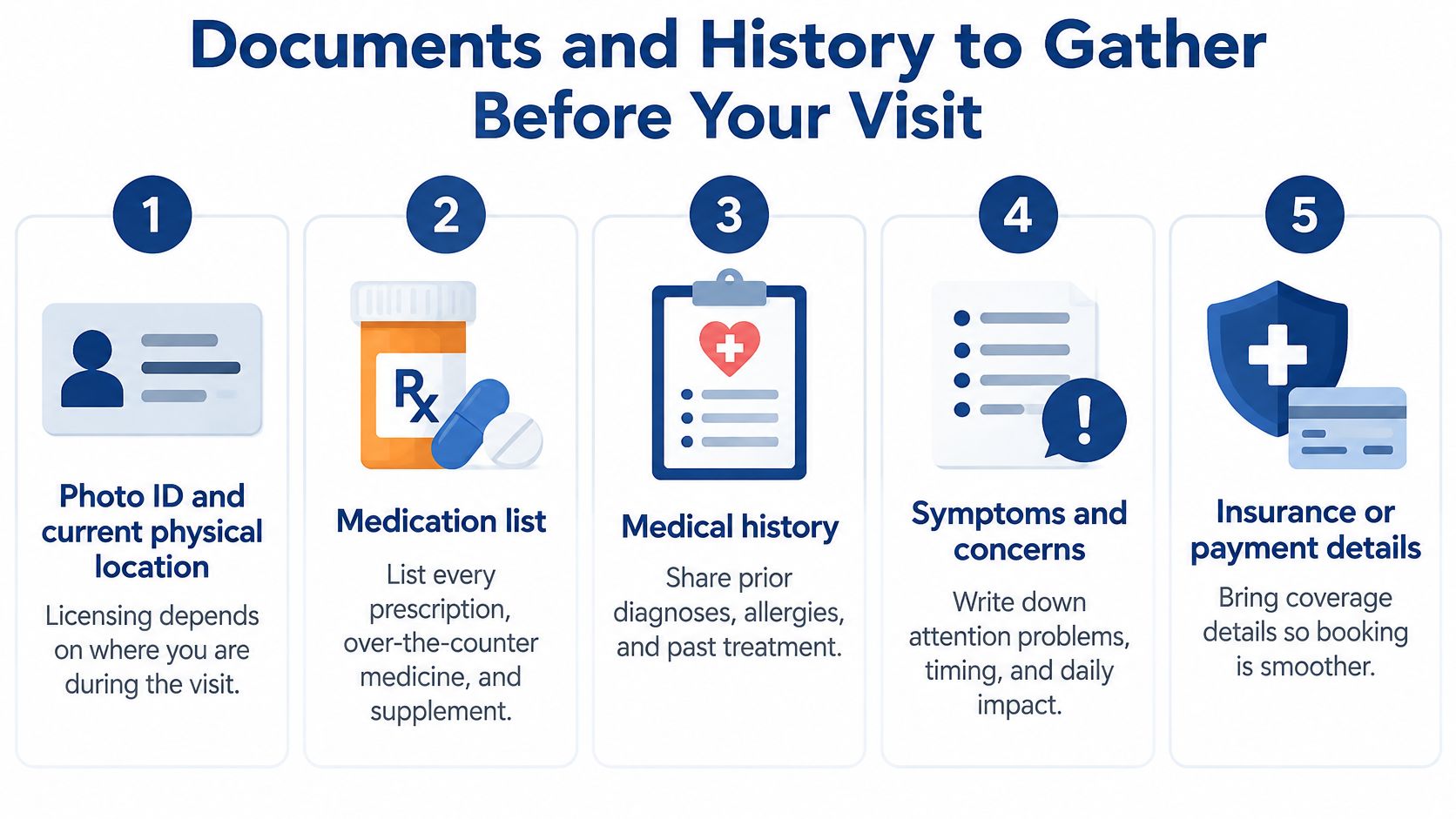
What to pull together
- Photo ID and location: Have identification ready and name the Pennsylvania address, or other state, where you will be during the visit.
- Medication list: Write doses for prescriptions, supplements, and anything you recently stopped. Hidden stimulants and antidepressants change the safety call.
- Old records: Gather past ADHD evaluations, school report cards, and IEP or 504 notes. Childhood paperwork is often stronger than memory alone.
- Prior contacts: List past prescribers and the pharmacy you use.
- Six-month examples: Note missed deadlines, late bills, or unfinished projects. Impairment is what the history has to show.
- Family pattern: Mention ADHD, mood disorders, or substance use in close relatives.
- Substance list: Be direct about alcohol, cannabis, nicotine, and any medicine taken other than as prescribed.
Pennsylvania's controlled-substance rule generally requires an initial medical history and physical examination before a controlled substance is prescribed, unless an emergency justifies an exception. A telehealth clinician may still ask for exam findings or outside records. Booking an ADHD evaluation in Pennsylvania is the point to say what records you already hold.
All Integrative Psychiatry of America visits use secure, HIPAA-compliant video. Test the camera, sit in a private room, and set aside 60 to 90 minutes so the history is not rushed.
A thin packet produces a thin visit. The prescription decision gets safer when the history arrives with you.
What Does an Online ADHD Evaluation Cover?
What gets decided on the video visit is whether the history supports ADHD, whether another condition explains the same symptoms, and whether medication belongs in the plan.
Screening, evaluation, diagnosis, and treatment are separate steps. The Adult ADHD Screener can flag patterns for that conversation. A provider reviews any screen result before it affects care. Diagnosis still depends on history, impairment, and a differential.
A board-certified psychiatric mental health nurse practitioner runs the assessment on video. Integrative Psychiatry of America conducts these evaluations and, when clinically appropriate, prescribes and manages ADHD medication under current Pennsylvania and federal telehealth rules. Patients can start with an online ADHD evaluation.
The CDC description of adult ADHD says diagnosis generally includes symptom-rating checklists, behavioral history, childhood onset, and a look for other conditions. Sample annotated assessment notes from PatientNotes show how a write-up records that reasoning instead of a yes-or-no score.
What changes the decision
| Assessment area | What the clinician checks | Why it matters |
|---|---|---|
| Childhood history | Symptoms before age 12, confirmed with school records or family reports | ADHD that appears only in adulthood points toward other causes |
| Current symptoms and impairment | Inattention, hyperactivity, or impulsivity affecting work, school, home, or driving | Symptoms without functional impairment do not confirm a diagnosis |
| Validated rating scale | Adult ADHD Self-Report Scale or a similar instrument | Structures the interview but does not diagnose on its own |
| Co-occurring conditions | Anxiety, depression, sleep disorders, substance misuse, learning disorders, bipolar-spectrum illness | These can mimic or coexist with ADHD and change the plan |
| Medical history and medications | Heart conditions, blood pressure, current prescriptions, and supplements | Stimulants can raise heart rate and blood pressure |
| Substance-use history | Alcohol, cannabis, nicotine, and misuse of prescription medicines | Shapes medication choice and misuse risk |
A rating scale organizes the interview. Collateral history and a differential still carry the diagnosis. Stimulant treatment follows a confirmed diagnosis, a risk review, and a decision made with the patient or family.
If medication is appropriate, the prescription starts a monitored process. Follow-up appointments review response and side effects. Dose changes wait on that clinical picture. Prescriptions are sent electronically to the pharmacy the patient chooses.
The visit can end three ways: a diagnostic impression, a treatment recommendation, or a referral for further testing. Any of those is a complete result. Holding a stimulant when the risks outweigh the benefit is a sound clinical call.
Legal Limits and Red Flags to Avoid
The pitch that sells a prescription as an instant purchase does not match how controlled-substance prescribing works. Online Adderall prescribing is legally possible under temporary federal telemedicine flexibility, but it is not an unrestricted pathway. federal telehealth prescribing guidance sets the core test: a DEA-registered clinician may prescribe Schedule II to V medication without a prior in-person exam only when the prescription has a legitimate medical purpose, follows a real-time interactive telemedicine encounter, stays inside the clinician's registration, and meets the other controlled-substance rules.
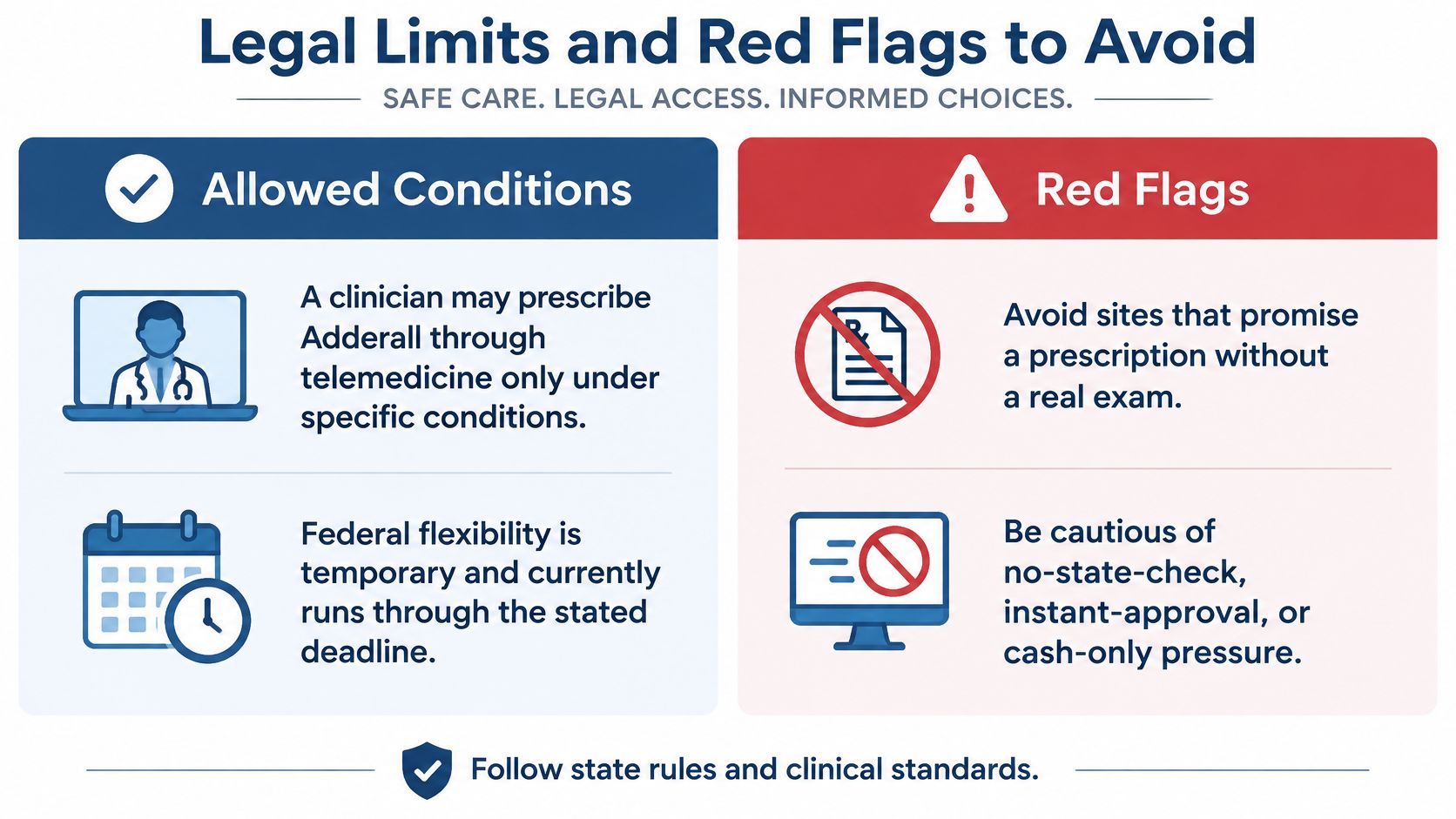
Legitimate practice next to a warning sign
| Practice | Legitimate telehealth | Red flag |
|---|---|---|
| Visit format | Live audiovisual assessment with a clinician | Approval from an online form with no clinical conversation |
| Diagnosis | Documented symptoms, history, and differential assessment | Prescription offered without any diagnostic review |
| Dose and refills | Set after review of response and side effects | Fixed dose, automatic refills, or pressure to increase |
| Pharmacy | Electronic prescription sent to a pharmacy you choose | Sellers that ship pills without a licensed pharmacy |
| Cost | Fees and insurance status stated before booking | Pressure to pay before any evaluation, or unclear charges |
Three rules worth keeping
- No conversation, no prescription. Decline any service that approves a request without a clinical conversation.
- No unnamed pharmacy. Do not buy Adderall from a seller that skips a prescription or cannot name a licensed pharmacy. Counterfeit tablets can hide the wrong dose or the wrong drug.
- No self-adjustment. Do not change dose, product, or frequency without prescriber approval, even when the shelf is empty.
A sound prescription records the reason, checks identity and location, and sets a monitoring plan for effect, adverse effects, sleep, appetite, blood pressure, and misuse. If a service never asked about history, symptoms, or other medicines, treat that silence as the warning. A legitimate clinician also explains what happens after the visit: how refills are handled, when follow-up is due, and what to do if a pharmacy cannot fill the order. That conversation is part of the prescription, not an optional extra.
The federal flexibility is temporary. Before booking, recheck current DEA and state rules in case the extension is renewed, replaced, or allowed to lapse. Pennsylvania requirements still apply either way. At Integrative Psychiatry of America, board-certified psychiatric nurse practitioners prescribe only as part of an evidence-based plan, and only when it is clinically appropriate. The prescription is the start of a monitored process, not a one-time transaction.
What If the Pharmacy Cannot Fill My Adderall?
A signed prescription does not guarantee a fill. FDA shortage listings continue to list amphetamine mixed-salt tablets (Adderall), and availability shifts by product, strength, manufacturer, and location. During a shortage, many patients spend hours calling pharmacies and still come home empty-handed. An online visit also does not promise same-day dispensing, a brand, a strength, or a substitute.
Work from the least disruptive step:
- Call the pharmacy first. Ask which strengths or manufacturers are on hand before you assume the medicine is gone.
- Call the prescriber before any switch. Ask whether another product is clinically suitable. Do not split tablets or borrow someone else's supply.
- Allow time for a search. Ask whether the prescription can be transferred where the law permits. A same-afternoon solution is often unrealistic.
- Keep a written history. Record fill dates, products, and side effects when you change pharmacies or clinicians.
- Plan the gap. If work, school, driving, or caregiving will suffer, ask for an interim plan. A practical ADHD medication shortage guide walks through those pharmacy steps in more detail.
Ongoing care at Integrative Psychiatry of America includes electronic prescriptions to a local pharmacy, a personalized plan, and regular follow-up. If you are about to run out, contact the prescriber the same day. Pennsylvania adults feel these gaps at work and at home even when the video visit itself went smoothly.
Medication Options Besides Adderall to Discuss
Adderall is one option in a wider set. The useful comparison is the family of medicine, not a single brand name.
A consultation is a discussion of families, not a menu that guarantees one product.
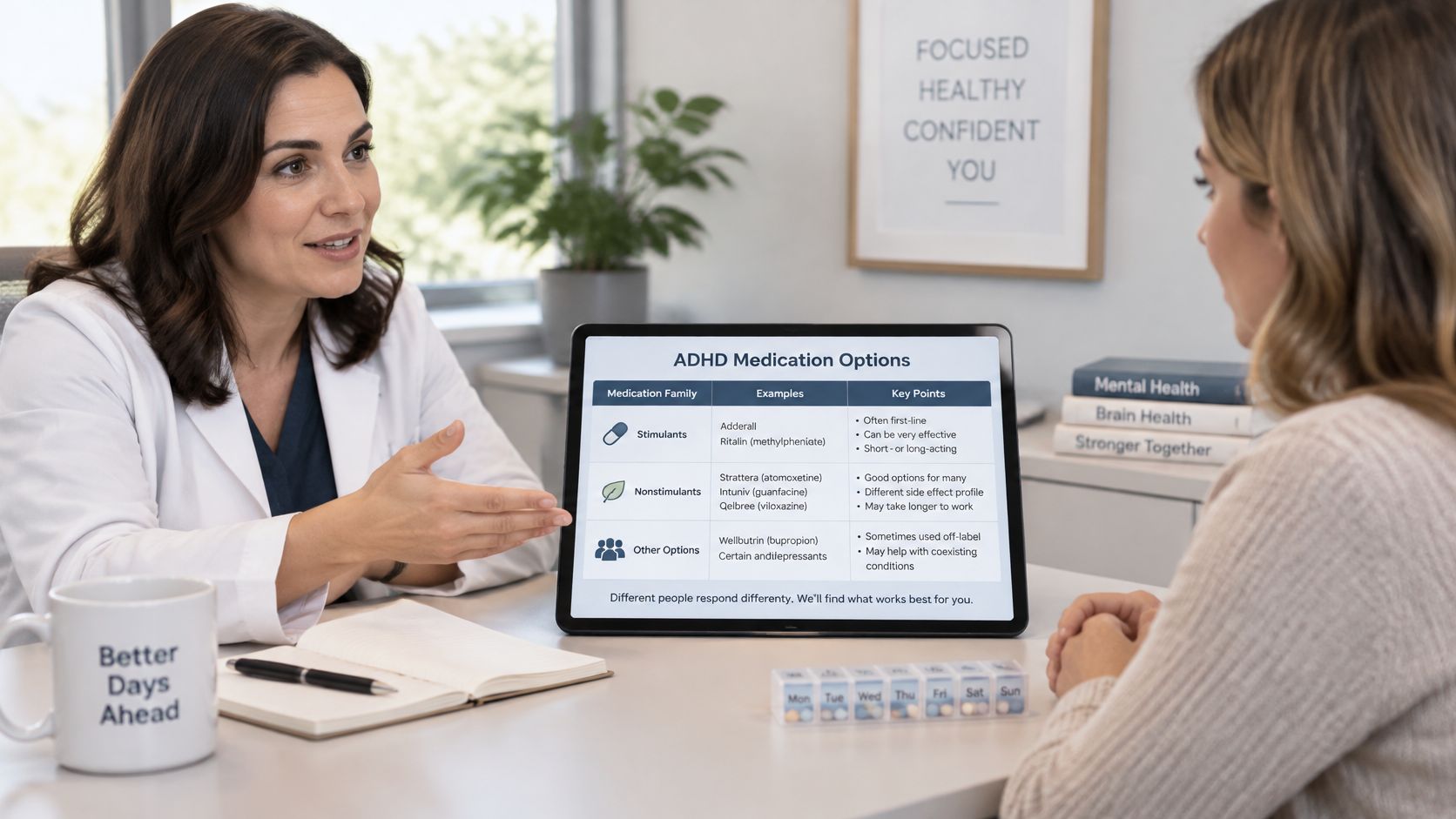
| Medication family | Examples | Key considerations |
|---|---|---|
| Amphetamine stimulants | Adderall, lisdexamfetamine (Vyvanse) | Controlled substances; monitor sleep, appetite, heart rate, blood pressure, and misuse risk |
| Methylphenidate stimulants | Ritalin, Concerta | Controlled substances; similar monitoring; effects can be felt within hours |
| Atomoxetine | Strattera | Not a controlled substance; may take several weeks; watch appetite, mood, and blood pressure |
| Viloxazine | Qelbree | Not a controlled substance; may take several weeks; watch sleepiness, appetite, and mood |
| Extended-release guanfacine or clonidine | Intuniv, Kapvay | Not a controlled substance; watch sedation, low blood pressure, and dizziness |
What the trade-off actually is
Stimulants often change attention within hours. They are controlled substances, so each new prescription needs a clinician, and follow-up watches sleep, appetite, heart rate, blood pressure, and misuse. Non-stimulants are not controlled. They often need several weeks before the effect is clear, and they can bring fatigue, nausea, sedation, or blood-pressure changes.
Neither column suits every adult. Anxiety, a heart history, substance use, or a goal of steadier all-day coverage can push the choice away from the medicine someone requested by name. A closer look at stimulant and non-stimulant ADHD treatment helps frame that conversation before the visit.
Therapy, skills training, sleep work, and school or workplace accommodations can sit beside medication. For some adults they are the first step. Medication decisions at the practice are made with the patient, and with family when that person is involved.
Which Next Step Fits My ADHD Care in Pennsylvania?
Match the next step to what you already know, not to the medicine you hope to receive.
Start with evaluation if nobody has assessed you for ADHD. A thorough visit is the correct first appointment, and it may end without a stimulant.
Request medication management if you already have a documented diagnosis and need ongoing prescribing plus follow-up. Bring the prior records so the new clinician is not guessing.
Verify insurance first if cost or network status is the barrier. Benefits, copays, deductibles, network status, and prior authorization differ by plan, including Cigna, Aetna, UnitedHealthcare, BCBS/IBX, and other insurers. Nothing is covered until that plan confirms it.
The practice's free Adult ADHD Screener can flag patterns before you talk with a provider. It is a screen, not a diagnosis, and any result should be reviewed in a visit.
Telepsychiatry from Integrative Psychiatry of America is available across Pennsylvania, from home, an office, or another private spot. ADHD care includes diagnostic evaluations and medication management for children, adolescents, college students, and adults. This guide is written for adults, so intake confirms age and fit. New patients can schedule a thorough psychiatric evaluation on the website.
Pick the single action that matches your situation, request the evaluation, ask about medication management, or verify benefits, and complete that step before you chase a specific capsule.
Integrative Psychiatry of America offers statewide virtual psychiatric care, including ADHD evaluation and medication management when a medicine such as Adderall is clinically appropriate. The appointment is a full assessment with follow-up, not a promised prescription. Visit Integrative Psychiatry of America to request an appointment or see how to verify insurance before you book.