
A patrol shift ends, the radio goes quiet, and sleep still doesn't come. For many Pennsylvania police officers, firefighters, paramedics, and EMTs, the pattern builds slowly. Irritability rises at home, certain roads get avoided, and a call from months ago keeps replaying during quiet moments. Effective PTSD treatment for first responders exists, but getting to it often feels harder than the work itself.
Table of Contents
- Why PTSD Treatment Looks Different for First Responders
- How Common PTSD Really Is in This Workforce
- Trauma-Focused Therapies with the Strongest Evidence
- When Medication Fits into the Treatment Plan
- Integrative Supports That Strengthen Trauma-Focused Care
- Why Moral Injury and Repeated Exposure Change the Picture
- How Telehealth Makes Confidential Care Possible
- Your Next Steps Toward Getting Help
Why PTSD Treatment Looks Different for First Responders
Consider a firefighter outside Harrisburg with more than a decade of service. Fatal crashes, house fires, and pediatric calls were handled professionally at the time. Months later, sirens trigger a racing heart, sleep breaks into fragments, and emotional numbness replaces interest in family life. Nothing about that response signals weakness. It signals a nervous system trained for threat that hasn't stood down.
Civilian trauma often centers on a single event. Responder trauma usually accumulates. One difficult call layers onto the next, and repeated exposure becomes the defining feature of the clinical picture. Treatment built around one index trauma may miss the call that drives nightmares now.
Culture Shapes Both Symptoms and Help Seeking
Occupational culture rewards composure under pressure. Dark humor, emotional control, and reluctance to burden the crew help during a shift. Those same habits can delay care for years afterward. Many responders worry about fitness for duty, promotion, or a supervisor learning details shared in confidence.
A treatment plan that ignores shift work, crew loyalty, and fear of being seen differently rarely survives contact with real responder life.
Generic counseling can also miss the mark. A clinician unfamiliar with emergency work may need basic education about chain of command, critical incident stress, or why a responder can't avoid trauma reminders. Those reminders are the job. Trauma-informed care adapted to this reality tends to hold attention longer, and trauma-informed mental health care built around safety and trust describes that foundation in more detail.
Practical barriers compound cultural ones. Rotating schedules, mandatory overtime, and rural coverage gaps across Pennsylvania make weekly in-person appointments difficult. Sleep disruption from night shifts worsens hyperarousal before treatment even starts. A realistic plan accounts for all of it, rather than asking the responder to reorganize an entire career around therapy.
How Common PTSD Really Is in This Workforce
Prevalence numbers for responders look inconsistent at first glance. That inconsistency is informative rather than confusing once measurement is considered. Rates shift depending on occupation, exposure type, timing of assessment, and whether symptoms came from a screening questionnaire or a clinical interview.
A systematic review and meta-analysis of active first responders found that approximately 1 in 7, or 14.3%, develop probable PTSD associated with routine occupational duties, while about 1 in 12 develop probable PTSD after disaster response, across 138 studies published from 2008 onward in a systematic review of probable PTSD in active first responders. Earlier estimates for actively serving responders commonly placed prevalence between 10% and 14%, compared with roughly 1% to 4% in the general population, in that same review summary.
The visual below shows why a single headline number never tells the whole story for this workforce.
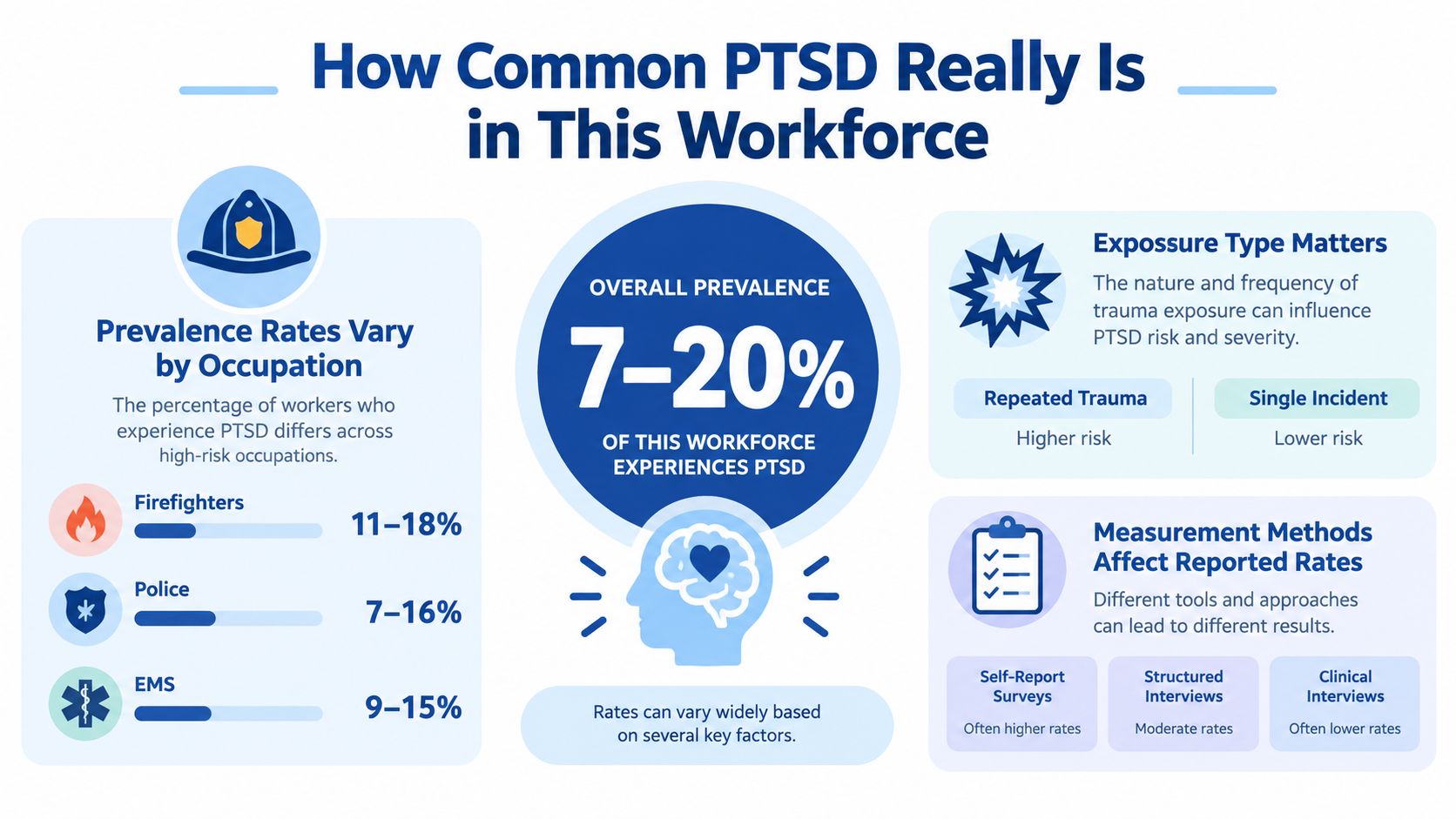
Why Disaster Samples Look So Different
Disaster rescue and response workers show especially wide ranges. The U.S. Department of Veterans Affairs National Center for PTSD reports PTSD prevalence ranging from 0% to 34% and depression prevalence from 21% to 53% in studies of those workers, reflecting differences in exposure severity, assessment timing, and populations studied in the VA evidence summary on disaster rescue and response workers.
Three factors explain most of the spread:
- Exposure type matters: A single mass casualty event produces a different risk profile than years of routine critical calls.
- Timing changes results: Symptoms measured weeks after an event differ from symptoms measured years later.
- Tools aren't interchangeable: Self-report screening and structured diagnostic interviews don't capture severity the same way.
Symptoms can also emerge or persist after a responder leaves service. Retirement removes structure and peer contact while leaving memories intact. Routine, confidential assessment catches problems earlier than waiting for a crisis, a disciplinary issue, or a relationship breakdown to force the conversation.
Trauma-Focused Therapies with the Strongest Evidence
Three therapies carry the strongest evidence for PTSD, and guidelines place them ahead of medication when both options are feasible. The 2023 VA/DoD clinical practice guideline identifies Prolonged Exposure, Cognitive Processing Therapy, and EMDR as the therapies with the strongest evidence, noting that trauma-focused psychotherapies generally produce greater and more durable improvement than medication under the VA/DoD guideline summary for trauma-focused psychotherapy.
The comparison below outlines how each approach works in practice.
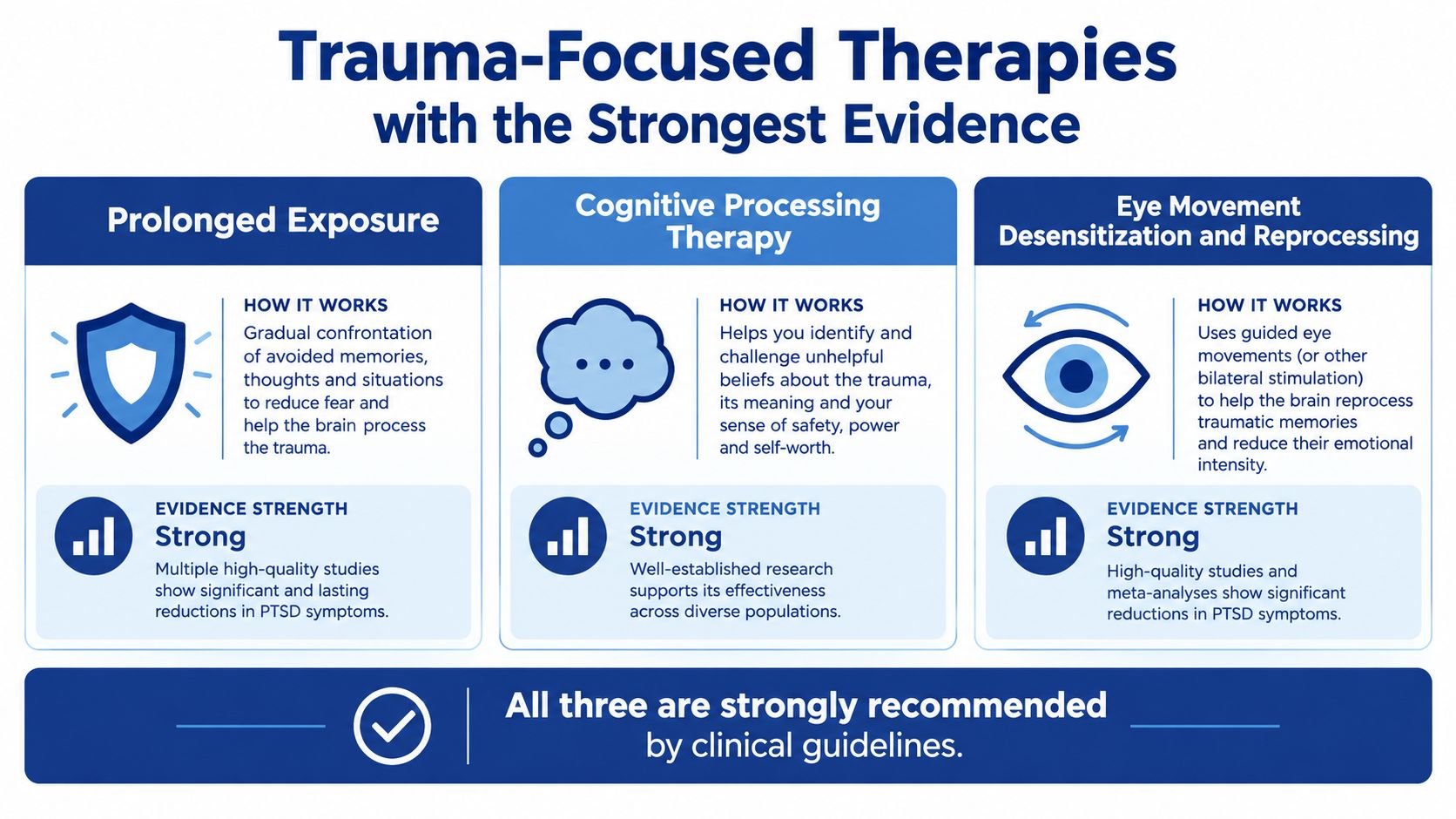
What Happens in Each Approach
Prolonged Exposure gradually confronts avoided memories and situations. Sessions involve recounting the trauma in a controlled way and approaching safe but avoided reminders between visits. Avoidance shrinks as the brain learns the memory itself isn't dangerous.
Cognitive Processing Therapy targets stuck beliefs that follow trauma. Thoughts about blame, safety, trust, and control get examined and tested against evidence. Written exercises help separate what happened from conclusions formed under extreme stress.
EMDR uses guided eye movements or other bilateral stimulation while the patient briefly focuses on traumatic material. Detailed verbal recounting isn't always required, which some responders prefer. Distress linked to the memory typically decreases as processing continues.
Evidence in responders specifically supports this group of therapies. A systematic review of 15 randomized or quasi-experimental studies found trauma-focused approaches, especially CBT and EMDR, showed the most consistent reductions in PTSD symptoms among emergency personnel, police, firefighters, and disaster workers in a systematic review of first-responder PTSD interventions. A separate meta-analysis found a standardized mean difference of -0.86 (95% CI -1.34 to -0.39), indicating a large average treatment effect, with CBT significantly more effective than comparators for PTSD specifically in a meta-analysis of psychological interventions for first responders.
Treatment often runs approximately 8 to 12 sessions, based on the guidance summarized in the Springer review linked above. One specialized CBT trial with 100 participants found brief 10-minute exposure sessions performed comparably to 40-minute sessions, with large improvements maintained at two-year follow-up, according to that same review. Shorter structured formats may fit working responders better than assumed.
The video below offers a plain language overview of how trauma-focused therapy sessions are structured.
Choosing among these options involves preference, symptom profile, and readiness for direct trauma work. A fuller comparison appears in the guide to the best therapy options for PTSD. None of these approaches requires reliving every call from an entire career. Treatment targets the memories and beliefs driving current symptoms.
When Medication Fits into the Treatment Plan
Medication isn't routine first-line treatment when trauma-focused therapy is available. Current NICE guidance recommends individual trauma-focused psychological treatment first and advises that benzodiazepines should not be used for PTSD prevention or treatment under current NICE recommendations for PTSD treatment. That position surprises responders who expected a prescription as the starting point.
Medication becomes reasonable in specific situations. Severe symptoms may block engagement in trauma processing. Therapy may be unavailable locally, or a patient may clearly prefer medication after an informed discussion. Co-occurring depression or anxiety may also shift the calculation.
Options With the Strongest Trial Support
| Medication | Class | Guideline position |
|---|---|---|
| Sertraline | SSRI | Among the most robust trial evidence |
| Paroxetine | SSRI | Among the most robust trial evidence |
| Venlafaxine | SNRI | Evidence-supported alternative |
VA/DoD guidance identifies sertraline and paroxetine as the two SSRIs with the most randomized-trial evidence, and venlafaxine as an evidence-supported SNRI, while recommending neither for nor against routinely combining medication with psychotherapy because added benefit isn't consistently established in VA/DoD medication guidance for PTSD.
Clinical reality: A prescription that improves sleep but leaves avoidance untouched hasn't treated the core of PTSD.
Benzodiazepines deserve a direct warning. They can blunt anxiety short term, but guidance discourages them for PTSD because they may interfere with trauma processing and carry dependence risk. For responders already using alcohol to sleep, that risk matters even more.
Medication management involves active monitoring, not a one-time prescription. Benefit, adverse effects, sleep, anxiety, and occupational functioning all get tracked over time. If symptoms plateau, the plan should revisit whether trauma-focused therapy needs to start or intensify. Medication works best as one considered element in PTSD treatment for first responders, not as a shortcut around the harder therapeutic work.
Integrative Supports That Strengthen Trauma-Focused Care
Trauma-focused therapy does the heavy lifting. Integrative supports lower the physiological load that makes that work harder. A responder sleeping four broken hours, skipping meals, and running on caffeine will struggle to engage in exposure work regardless of motivation.
The photo below reflects a simple point. Regulation skills can be practiced in small windows, even during a break on shift.

Matching Supports to Symptom Clusters
Different supports target different parts of the symptom picture:
- Aerobic exercise: Regular movement helps discharge hyperarousal and improves sleep pressure at night.
- Sleep regulation: Consistent wind-down routines and light management around night shifts reduce next-day reactivity.
- Nutrition: Regular meals stabilize energy and mood across long shifts, instead of blood sugar swings amplifying irritability.
- Mindfulness practice: Brief attention training builds tolerance for intrusive thoughts without immediate suppression.
- Grounding techniques: Sensory-based skills interrupt dissociation and flashback spirals in the moment.
Practical instruction on the last category appears in PTSD grounding techniques for managing sudden symptoms. Grounding isn't a cure. It keeps a responder present long enough to use other skills or get through a shift safely.
Honesty about limits matters here. Yoga, nutrition counseling, and meditation don't replace Prolonged Exposure or EMDR for diagnosed PTSD. Wellness education alone, without structured trauma work, rarely moves re-experiencing and avoidance symptoms in a lasting way. Supports earn a place in the plan because they make evidence-based therapy more tolerable and more sustainable.
Integrative psychiatry blends these elements with medication management and psychotherapy in one coordinated plan. That coordination matters for responders whose symptoms intersect with physical injuries, alcohol use, strained relationships, and chronic sleep debt. Treating each problem in isolation usually leaves the others to undermine progress.
Why Moral Injury and Repeated Exposure Change the Picture
Standard PTSD protocols assume fear sits at the center of symptoms. For many responders, guilt and shame sit there instead. A child couldn't be saved despite correct protocol. A split-second decision gets replayed for years. Leadership decisions after a bad call feel like betrayal. That cluster has a name, moral injury, and it doesn't always respond to fear-based treatment alone.
Moral injury describes distress following actions, inactions, or witnessed events that violate core values. Perceived betrayal by leadership or systems can produce it as reliably as personal decisions can. Symptoms overlap with PTSD but center on self-blame, loss of trust, and spiritual or existential pain rather than threat response.
Guilt about a call handled correctly won't resolve through exposure alone. The belief underneath the guilt needs direct attention.
Research hasn't caught up with clinical reality. A 2025 review found a relative lack of research examining moral injury and PTSD together among firefighters, EMS personnel, and emergency operators, leaving open how guilt, shame, and perceived betrayal should be assessed and treated in a 2025 review of moral injury and PTSD in emergency personnel. EMS providers face a specific gap, since intervention studies often pool them with other responders and obscure occupation-specific stressors, according to that same review.
Cumulative Exposure Complicates Recovery
Repeated exposure keeps adding material while treatment tries to process it. A paramedic mid-treatment may run a similar call the following week. Organizational stress, understaffing, and mandatory overtime maintain arousal between sessions. Progress under those conditions looks slower, and that doesn't mean treatment is failing.
Effective plans address the full picture. Trauma-focused therapy handles fear and avoidance. Explicit work on self-blame tackles moral pain. Sleep, alcohol use, relationships, and return-to-duty concerns each need named attention rather than hopeful neglect. Treating police, firefighters, and EMS as interchangeable groups misses stressors unique to each role, and generic protocols lose credibility with patients quickly.
How Telehealth Makes Confidential Care Possible
Stigma keeps more responders out of care than cost or distance does. Texas A&M summarized first-responder research indicating stigma may outweigh practical barriers such as cost, time, and local provider availability in Texas A&M coverage of mental health challenges among first responders. Telehealth directly reduces the visibility problem. There's no waiting room, no marked building, and no chance of meeting a coworker in a parking lot.
The steps below show how confidential virtual care is structured.
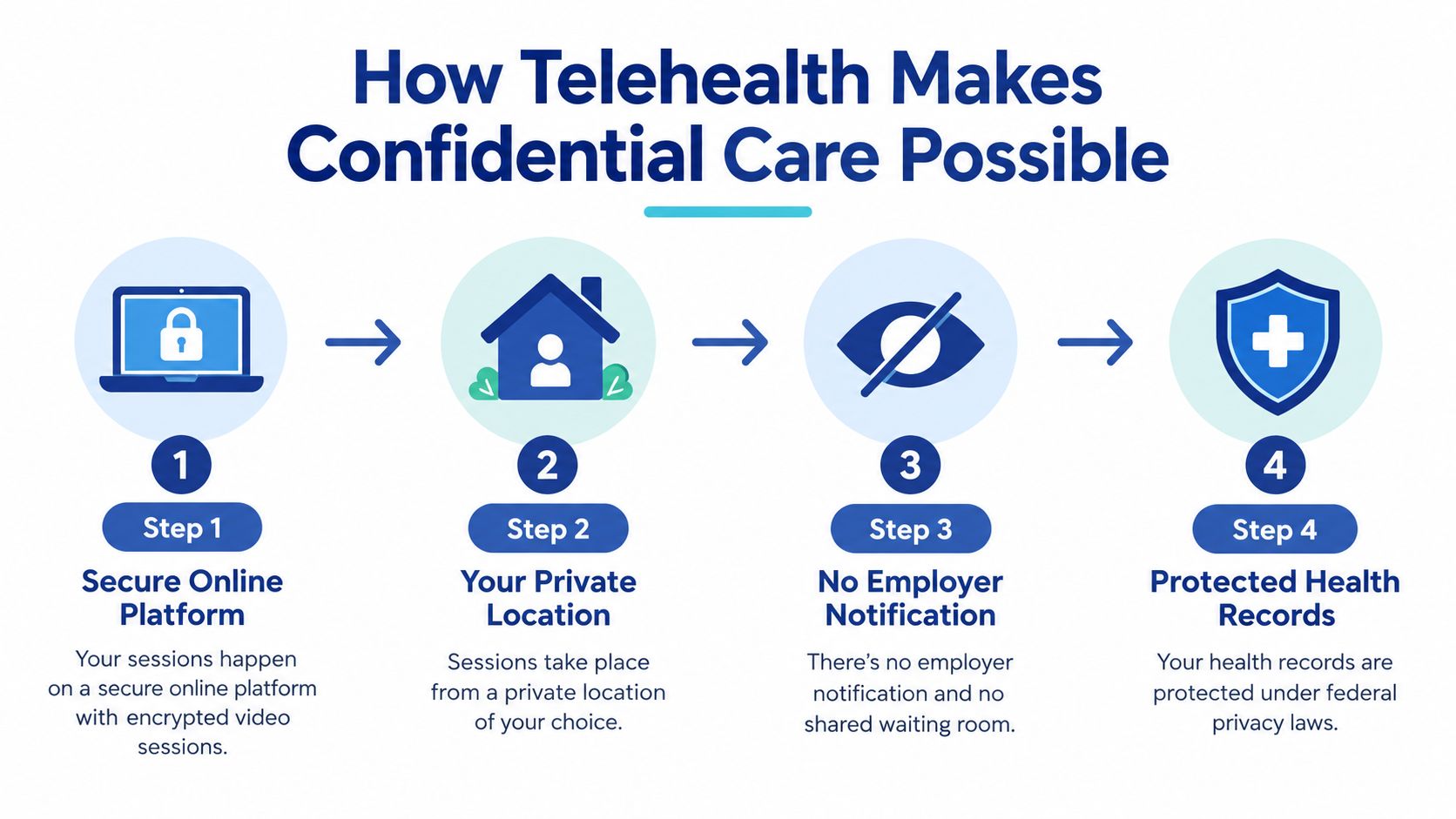
How Private Virtual Care Works in Pennsylvania
Secure video visits run through encrypted, HIPAA-compliant platforms. Records stay in the clinical chart, separate from occupational health files, and employers don't receive session details. Details on platform safeguards appear in the explanation of HIPAA compliance in telehealth care. Responders comparing virtual options can also review general guidance on choosing a safe online therapist before committing to any platform.
Access still isn't automatic. In a 2024 stepped-care study, 229 personnel completed screening and 43% screened positive for at least one risk, yet only 56.6% of those identified as needing treatment completed a telehealth appointment, according to the Texas A&M summary linked above. Screening without an easy, trusted next step loses nearly half of identified cases.
Practical questions deserve direct answers:
- Insurance versus cash pay: Using insurance creates a claim record with the insurer, while cash pay limits that paper trail. Benefits, copays, and network status vary by plan and need verification.
- Scheduling around shifts: Early morning or post-shift slots can be arranged without travel time eating into sleep.
- Prescriptions by telehealth: Psychiatric medications discussed earlier can be managed virtually when clinically appropriate.
- Clinician fit: A provider with emergency trauma background needs less basic education about the job, which builds trust faster.
Telehealth has limits that shouldn't be softened. Imminent danger, severe dissociation, or intoxication requires urgent in-person evaluation rather than a video visit. Within those boundaries, virtual care removes the exposure risk that keeps many responders silent.
Your Next Steps Toward Getting Help
Screening, evaluation, diagnosis, and treatment are four different things. A symptom checker flags possible problems but doesn't diagnose anything. A clinical evaluation gathers history, exposure background, sleep, substance use, and safety information. Diagnosis follows from that full picture, and treatment planning comes after.
A Practical Sequence for Starting Care
- Complete a confidential screening: A validated PTSD instrument gives a baseline that later scores can be measured against.
- Book a private evaluation: Telehealth intake can happen from home, outside work hours, without department involvement.
- Choose the therapy foundation: Prolonged Exposure, Cognitive Processing Therapy, or EMDR forms the core, based on preference and clinical fit.
- Decide on medication deliberately: Sertraline, paroxetine, or venlafaxine enters the plan for defined reasons, with monitoring attached.
- Add targeted supports: Sleep, exercise, and grounding skills address the symptoms most likely to derail therapy.
Clinician selection matters as much as modality selection. Responders often engage faster with a provider who understands emergency culture without needing it explained. A directory of therapists who treat post-traumatic stress disorder can help narrow that search across Pennsylvania, from Philadelphia and Pittsburgh to smaller communities without local specialists.
Waiting rarely improves the picture. Avoidance feels protective short term and expands the territory symptoms control. Starting PTSD treatment for first responders while still functioning at work is both possible and preferable to starting after a crisis forces the issue. Verifying insurance coverage takes minutes and commits nobody to anything. That small, private step opens every option discussed in the sections above.
Pennsylvania responders ready for a private conversation about PTSD symptoms can request a virtual psychiatric evaluation, discuss trauma-focused treatment and medication management options, and verify insurance coverage before the first visit. Care is delivered by secure telehealth statewide, with scheduling built around shift work and records kept separate from employers. Visit Integrative Psychiatry of America to request an appointment or check coverage today.