
An adult may spend years hiding rituals that seem too strange to explain, repeating checks before leaving home, washing until the skin hurts, or seeking reassurance about thoughts that feel dangerous. Some people recognize the pattern, while others only know that daily life has become exhausting. Effective OCD treatment for adults exists, but it usually requires more than general stress counseling. The most useful starting point is a careful evaluation followed by individualized Exposure and Response Prevention, medication management when appropriate, and practical support for sleep, health, and functioning.
Table of Contents
- Recognizing Adult OCD and the Need for Specialized Care
- The Comprehensive Psychiatric Evaluation Process
- Exposure and Response Prevention as the Gold Standard
- Medication Management and Stepped-Care Strategies
- Integrative Support for Whole-Person Recovery
- Accessing Virtual OCD Treatment in Pennsylvania
- Managing Relapse and Long-Term Symptom Monitoring
Recognizing Adult OCD and the Need for Specialized Care
A professional may see a familiar pattern in an adult who arrives late to work because the front door had to be checked repeatedly. Another patient may avoid touching public surfaces, then wash or disinfect long after any reasonable hygiene need has passed. Someone else may experience intrusive images or fears about harming a loved one, followed by mental reviewing, prayer, reassurance-seeking, or avoidance.
These presentations can look different on the surface. Contamination concerns, checking, symmetry, unwanted taboo thoughts, relationship doubts, and fears of responsibility may all involve the same cycle: an intrusive thought or sensation creates distress, a ritual temporarily lowers that distress, and the short-term relief strengthens the compulsion.
OCD affects about 2% to 3% of adults worldwide and typically begins around age 19 on average, according to a major clinical review in the BMJ review of OCD. The National Institute of Mental Health reports that 1.2% of U.S. adults had OCD in the past year, while 2.3% had it at some point during their lifetime. These figures help explain why many adults seek care after years of symptoms rather than soon after onset.
Why ordinary counseling may not be enough
Supportive therapy can help someone feel heard, but it may not interrupt the reinforcement cycle. Reassurance can accidentally become part of the ritual, especially when a patient repeatedly asks whether a thought means something about their character or safety. Avoidance advice can also make the feared situation feel more dangerous.
Clinical focus: The important question isn't only what a person does. It's what feared consequence the behavior is meant to prevent and what relief keeps the behavior going.
A person isn't weak, immoral, or irrational because intrusive thoughts occur. OCD is a recognized mental health condition associated with substantial disability and societal costs, as described in the BMJ review linked above. Specialized assessment helps distinguish unwanted obsessions from intentions, preferences, or psychotic beliefs, then identifies the treatment pathway most likely to address the actual cycle. Adults exploring specialized OCD care for intrusive thoughts can use that distinction as a practical starting point.
The Comprehensive Psychiatric Evaluation Process
A thorough evaluation determines whether OCD explains the symptoms, how much they interfere with functioning, and which treatments are safe and realistic. A virtual intake can assess obsessions, compulsions, avoidance, insight, distress, work or school effects, relationships, sleep, substance use, medical history, and previous medication or therapy trials.

A Pennsylvania adult may be asked to describe a recent episode in sequence. What triggered the fear? What thought, image, urge, or sensation appeared? What did the person do next? How long did relief last? Did the person avoid a place, ask someone to confirm safety, mentally review an event, or repeat an action until it felt complete?
Distinguishing OCD from related conditions
The surface behavior can mislead. Contamination OCD often involves fear of illness, contamination, or harm followed by washing or avoidance. Checking may be driven by doubt, responsibility, or fear of causing harm. The same action, such as repeated handwashing, can have different meanings in another condition, so treatment must follow the underlying pattern rather than the label alone.
The evaluation also considers conditions that commonly overlap with OCD. Anxiety and depressive disorders may intensify distress, while ADHD can affect organization, follow-through, medication routines, and the ability to complete therapy homework. Trauma symptoms, eating-disorder symptoms, tic-related symptoms, substance use, and sleep problems may also change the care plan.
Screening tools can organize information, but they don't establish a diagnosis by themselves. A clinician may use a validated severity measure such as the Yale-Brown Obsessive Compulsive Scale, commonly called the Y-BOCS, to monitor symptoms and functional change. The score supports clinical judgment; it doesn't replace an interview.
When laboratory or genetic testing has a role
Genetic and laboratory testing doesn't diagnose OCD and isn't routinely required. A provider may order labs when medical conditions, medication effects, or suspected deficiencies could affect energy, concentration, sleep, or general functioning. Pharmacogenomic information may occasionally inform medication discussions, but it can't determine the diagnosis or guarantee the best medication.
A careful assessment should end with a shared plan, not an automatic prescription. The plan may prioritize ERP therapy, medication, treatment of a co-occurring condition, or a staged combination based on severity, impairment, prior response, safety, and patient preference.
Exposure and Response Prevention as the Gold Standard
Exposure and Response Prevention, or ERP, is the specialized form of CBT with the strongest evidence for OCD. It asks patients to face carefully selected triggers while reducing or postponing rituals, avoidance, reassurance seeking, and mental neutralizing. Adults often know ERP is recommended yet cannot find a clinician trained to provide it. Virtual care can narrow that treatment gap when the provider offers structured ERP planning, psychiatric follow-up, and adjustments based on response.
ERP is not forced flooding. The therapist and patient create a hierarchy of situations, thoughts, or sensations linked to OCD fears. They start at a workable level, repeat the exposure, and allow uncertainty and discomfort without completing the usual compulsion. Patients can review this ERP treatment approach for OCD before deciding whether virtual treatment fits their needs.
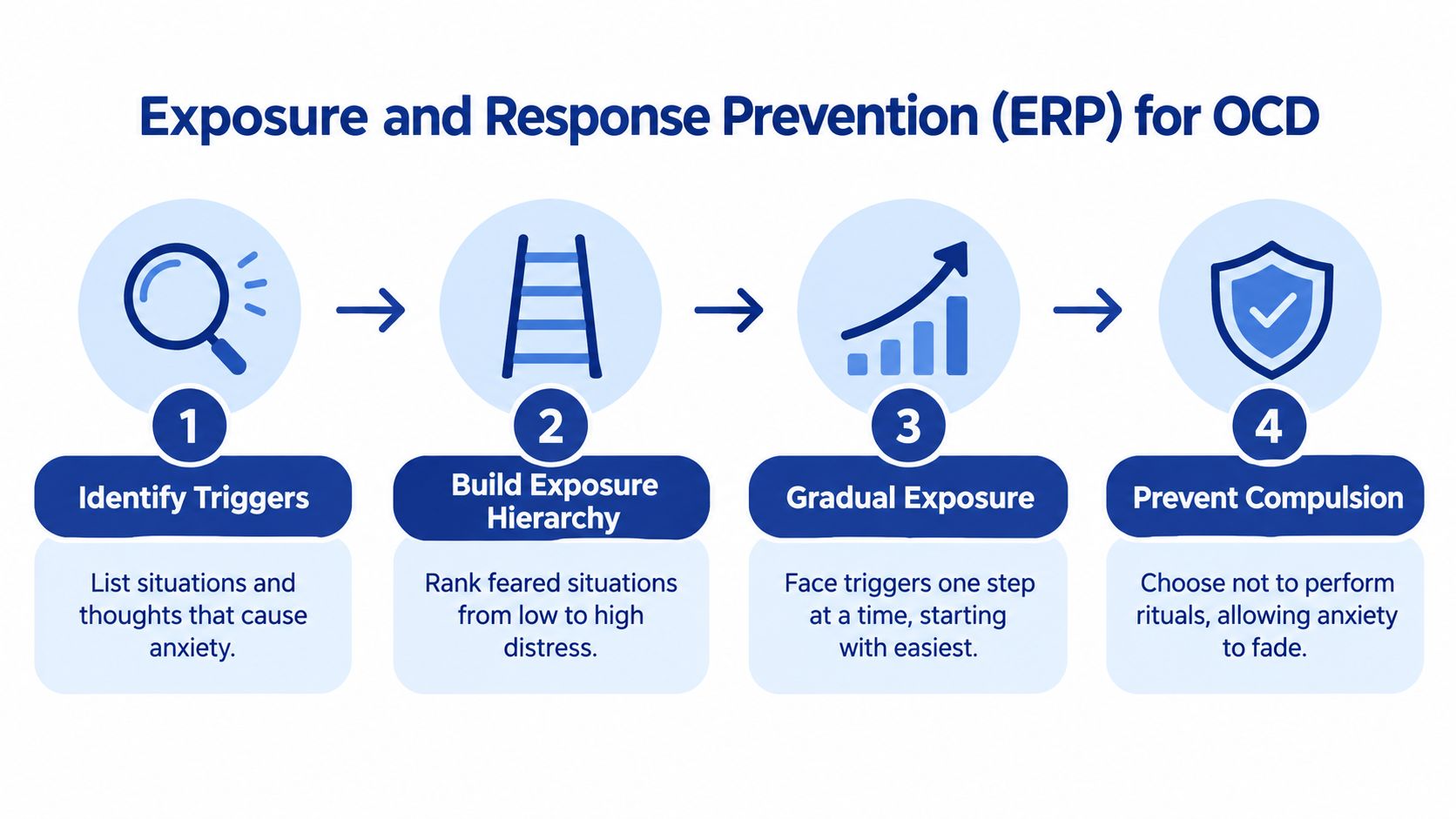
How ERP changes the cycle
ERP usually includes four clinical tasks:
- Identify triggers. Record situations, thoughts, images, urges, or sensations that provoke OCD distress.
- Build a hierarchy. Rank exposures from easier to harder, including avoidance and covert rituals as well as visible behaviors.
- Practice exposure. Approach a selected trigger repeatedly and learn that distress can be tolerated without immediate neutralization.
- Prevent the response. Refrain from rituals, reassurance requests, checking, washing, reviewing, or other actions that previously produced short-term relief.
The goal is not to eliminate every intrusive thought. ERP weakens the belief that rituals are necessary and builds the ability to act according to personal values while uncertainty remains. A contamination exercise might involve touching an ordinary object and delaying washing. A checking exercise might involve leaving after one check and accepting that absolute certainty is unavailable.
Supportive counseling may reduce loneliness, but it does not necessarily teach this behavioral learning. Repeated reassurance from a therapist can unintentionally reinforce compulsions. Effective ERP combines empathy with practice, without making certainty the treatment target.
Weekly care commonly includes structured sessions, between-appointment exercises, and review of exposure results. Some protocols assess response after about 13 to 20 sessions, followed by monthly booster sessions for 3 to 6 months in certain care models. The pace depends on symptom severity, avoidance, comorbid conditions, access, and the patient's ability to practice. The OCD therapy guide from Uptown Psychology provides another patient-facing explanation of ERP.
ERP can feel difficult because patients practice responses that oppose OCD's demands. Difficulty alone does not show that treatment is unsafe or failing. Exposures should be planned with a trained clinician, particularly when symptoms involve severe impairment, self-harm fears, trauma, or complex comorbidity. Patients who are not ready for a full exercise can begin with smaller steps instead of losing access to specialized care.
Medication Management and Stepped-Care Strategies
Medication can lower symptom intensity and make ERP practice more manageable. It does not replace learning to respond differently to obsessions, uncertainty, and urges to ritualize. Selective serotonin reuptake inhibitors, or SSRIs, are first-line pharmacotherapy for adult OCD. Common initial options include fluoxetine, fluvoxamine, paroxetine, sertraline, and citalopram when clinically appropriate, as summarized in the guideline summary for OCD treatment.
OCD medication trials often require a different discussion from depression treatment. Clinicians may work toward the highest tolerated dose and reassess after an acute trial of about 8 to 12 weeks. The prescriber must consider side effects, other medications, medical conditions, age, pregnancy considerations, and the patient's response. Medication decisions should also account for whether the person can start or continue specialized ERP.
A practical comparison
| Treatment stage | Clinical approach | Typical timeline |
|---|---|---|
| Initial care | ERP-focused CBT, an SSRI, or both, based on severity and preference | Medication response is reassessed after an acute trial of about 8 to 12 weeks |
| Partial SSRI response | Add CBT with ERP when clinically appropriate | NICE recommends this after a partial response following 12 weeks of SSRI treatment |
| Persistent symptoms | Review diagnosis, dose, adherence, ERP quality, comorbidities, and prior trials | Timing depends on safety, tolerability, and treatment history |
| Treatment-resistant OCD | Consider specialist-guided augmentation, including clomipramine after an SSRI or selected antipsychotic augmentation | Requires close monitoring and individualized risk-benefit review |
NICE describes stepped care, beginning with lower-intensity CBT that includes ERP for milder presentations. Greater impairment may call for more intensive CBT including ERP, an SSRI, or combined treatment. For severe functional impairment, combined SSRI and ERP-based CBT may be appropriate. Lower-intensity treatment may involve up to 10 therapist hours, according to the NICE guidance summarized by OCD-UK.
When first-line treatment only partly works
Partial response leaves several options. A 2026 review describes later strategies that may include clomipramine after an SSRI and augmentation with risperidone, aripiprazole, or haloperidol for treatment-resistant OCD. Lamotrigine or memantine may be considered in selected cases, although evidence gaps remain. These choices require a specialist review of benefits, risks, adherence, and the quality of prior ERP.
Older adults need careful prescribing. Canadian guidance notes that randomized controlled trials specifically examining pharmacotherapy or CBT/ERP for older adults with OCD are lacking. Clinicians should therefore use cautious dosing, review interactions and medical conditions, and explain what the available evidence can and cannot establish.
For adults who cannot reach an OCD specialist locally, virtual psychiatric medication management can support follow-up, side-effect review, adherence discussions, and coordination with psychotherapy. Medication changes should follow the prescriber's guidance and should not be made abruptly.
Integrative Support for Whole-Person Recovery
ERP and appropriate medication management form the clinical foundation. Whole-person care adds the conditions that help an adult attend therapy, tolerate discomfort, make decisions, and maintain daily responsibilities.
Sleep deserves early attention because irregular or inadequate rest can worsen concentration, emotional reactivity, and the ability to resist habitual responses. Exercise can support mood and stress regulation. Nutrition education may help patients establish consistent meals and reduce avoidable disruptions to energy and medication tolerance.
Supportive habits that fit OCD care
- Sleep structure: Keep a stable routine and discuss persistent insomnia, nighttime checking, or medication-related sleep changes with the treatment team.
- Movement: Choose regular activity that feels sustainable, such as walking, strength work, cycling, or another preferred form of exercise.
- Nutrition: Build consistent eating patterns and review restrictive or reassurance-driven food rules rather than treating them as ordinary wellness habits.
- Stress skills: Use paced breathing, mindfulness, grounding, and practical scheduling to support distress tolerance. These tools shouldn't become rituals used to guarantee that anxiety disappears.
- Functioning goals: Track work attendance, relationships, self-care, and valued activities, not only the intensity of intrusive thoughts.
A whole-person approach doesn't mean treating OCD with supplements instead of ERP. Supplements aren't routine first-line OCD treatment unless a specific, evidence-based indication exists. Magnesium, for example, may be discussed in a narrow clinical context, but patients should review safety, interactions, and the actual reason for use before starting magnesium and OCD support.
Resources describing whole-person healing strategies can help patients think about recovery beyond symptom suppression. The clinical boundary remains important: lifestyle practices support evidence-based treatment, but they don't replace ERP or indicated pharmacotherapy.
Patients can also ask whether a proposed supplement has a clear purpose, reliable evidence for the intended problem, and a safety profile compatible with current prescriptions. That conversation protects against turning health routines into another source of compulsive research or checking.
Accessing Virtual OCD Treatment in Pennsylvania
Adults in Pennsylvania may struggle to find an ERP-trained therapist nearby, particularly when work schedules, transportation, caregiving, or regional availability limit in-person options. OCD treatment online can reduce those barriers by bringing psychiatric assessment, medication follow-up, and psychotherapy coordination into the patient's home environment.
Virtual care can serve adults in Philadelphia, Bucks County, Pittsburgh, the Lehigh Valley, Harrisburg, Lancaster, Reading, Scranton, Wilkes-Barre, Erie, and other Pennsylvania communities when the provider is licensed and the service is clinically appropriate. Telehealth doesn't remove the need for specialized treatment. It changes how the patient reaches it.
A practical access pathway
- Request an evaluation. The patient describes the main symptoms, urgency, location, prior treatment, and desired type of care.
- Prepare a treatment history. Current and past prescriptions, therapy experiences, side effects, medical conditions, and relevant family history help the clinician avoid unnecessary trial and error.
- Verify insurance. Benefits vary by plan. Patients should ask about network status, copays, deductibles, authorization requirements, telehealth rules, and whether specialized psychotherapy is covered.
- Confirm the treatment format. Some patients need psychiatric medication management, while others need an ERP therapist, coordinated care, or both.
- Use secure follow-up. HIPAA-compliant video visits and patient portals can support messaging, appointment requests, prescription questions, and monitoring.
Insurance never guarantees payment. Coverage depends on the specific plan and can change based on provider network, service type, diagnosis requirements, and authorization rules. A benefits check can clarify expected expenses before treatment begins, but the insurer makes the final coverage determination.
Online OCD treatment in Pennsylvania may include virtual psychiatric evaluation, medication management, and coordination with structured psychotherapy. Integrative Psychiatry of America is one Pennsylvania telehealth option for adults seeking this type of care. Patients should ask directly whether the available clinician provides ERP, coordinates with an ERP therapist, or focuses on psychiatric assessment and medication management.
Managing Relapse and Long-Term Symptom Monitoring
OCD symptoms can fluctuate after improvement. An adult may notice stronger intrusive thoughts during illness, conflict, travel, or work pressure without meeting criteria for a full relapse. A relapse plan identifies what to monitor and when to contact the treatment team, especially if specialized ERP is difficult to access locally. Virtual integrative psychiatry can keep psychiatric follow-up, medication decisions, and coordination with an ERP therapist connected through a stepped-care plan.
A PubMed review of OCD relapse reported prior relapse ranges of 27% to 63% for clomipramine, 0% to 50% for exposure and response prevention, and 7% to 67% for combined exposure and response prevention plus clomipramine, depending on the criteria used. These ranges support continued monitoring without implying that relapse is inevitable.
Clinicians assess symptom duration, compulsive behavior, avoidance, functional impairment, and whether the patient can resume learned ERP skills. Early contact may allow treatment adjustments before rituals become established again.
What maintenance can include
- Booster ERP sessions: Revisit the hierarchy, address new symptom themes, and practice response prevention.
- Medication review: Assess adherence, side effects, dose, interactions, and whether a gradual change is clinically appropriate.
- Measurement: Use tools such as the Y-BOCS alongside functional goals to track meaningful change.
- Warning signs: Monitor expanding avoidance, increased reassurance-seeking, missed work, disrupted sleep, and rituals controlling ordinary decisions.
The practical goal is a fuller life in which OCD no longer directs daily choices. Continued follow-up can support that goal while allowing treatment intensity to increase or decrease as symptoms and functioning change.
Integrative Psychiatry of America provides virtual psychiatric evaluations, medication management, and coordinated support for adults in Pennsylvania seeking individualized OCD care. Adults can visit Integrative Psychiatry of America to discuss symptoms, ERP access, medication history, or insurance questions and request an evaluation.