
A Pennsylvania adult can have Aetna, a clear need for depression care, and still get stuck at the same point. The search starts with a practical question, not a clinical one, which provider can see the person soon, take the insurance, and treat depression without forcing a long commute or a surprise bill. For people in Philadelphia, Pittsburgh, Harrisburg, and smaller towns across the state, Depression Treatment Aetna Insurance usually comes down to one thing, how the plan handles therapy, medication management, telehealth, and any step-up care that needs prior approval.
Table of Contents
- The Search for Depression Care That Actually Fits Real Life
- What Aetna Typically Covers for Depression in Pennsylvania
- Realistic Aetna Costs for Therapy, Medication Management, and Evaluations
- How Telehealth and Virtual Psychiatry Fit Into Aetna Coverage
- How to Verify Aetna Depression Benefits Before You Book
- When First-Line Treatment Isn't Enough and Prior Authorization Comes In
- Starting Aetna-Covered Virtual Depression Care in Pennsylvania
The Search for Depression Care That Actually Fits Real Life
A lot of Pennsylvania patients reach the same point in the same way. Energy is low, sleep is off, motivation is gone, and the next question is whether Aetna depression treatment Pennsylvania can happen without taking half a day off work. That is where the insurance details stop being abstract and start deciding which option is realistic, an in-network therapist, a psychiatric evaluation, online medication management, or a higher level of care.
Aetna coverage usually exists in a broad sense, but the path is still shaped by network status, deductible stage, and whether the service is considered medically necessary. A person may see “therapy covered” on paper and still run into a different copay, coinsurance, or prior authorization rule depending on the plan. That is why the first real booking question is not just “does Aetna cover depression?” It is “which depression service can start now, at this stage of the benefit?”
A patient in Erie who wants evening telehealth, or someone in Lancaster who needs medication management after a long wait for local care, is usually trying to solve the same problem, getting started fast enough that symptoms do not keep deepening. In that situation, online depression treatment Aetna can be the most practical first move, especially when the plan includes outpatient mental health benefits and the provider can verify coverage before the first visit.
Practical rule: The best first appointment is the one that matches the current clinical need and the current insurance rules, not the one with the lowest advertised price.
For a direct path into care, some readers start by checking a local virtual option such as depression treatment near me, then compare that with what Aetna allows under their plan. The goal is to avoid the common trap of waiting for a perfect in-person opening when telepsychiatry could get treatment moving sooner.
What Aetna Typically Covers for Depression in Pennsylvania
Aetna's depression benefits are usually broader than many people expect, but the approval logic is specific. Across current plan structures, outpatient therapy, psychiatric evaluations, antidepressant prescriptions, medication management, and, when needed, partial hospitalization, intensive outpatient programs, or inpatient treatment may be covered when the clinical record supports medical necessity. That medical-necessity standard matters because coverage is generally tied to documented need, not diagnosis alone.
That framework sits inside the larger mental health parity model created by the Mental Health Parity and Addiction Equity Act (MHPAEA), which requires mental health benefits to be covered on terms comparable to physical health benefits. In practice, that does not mean every service is automatic. It means the plan structure usually treats depression care as a legitimate medical benefit, not an optional add-on.
Common Aetna depression services and typical coverage status
| Service | Typical Aetna Coverage | Likely Patient Cost |
|---|---|---|
| Outpatient therapy | Often covered when in network and medically necessary | Copay, coinsurance, or deductible-based cost |
| Psychiatric evaluation | Often covered under outpatient behavioral health benefits | Usually higher than a follow-up visit |
| Medication management | Often covered as part of outpatient mental health care | Plan-dependent copay or coinsurance |
| Antidepressant prescriptions | Often covered under pharmacy benefits | Drug tier, deductible, and formulary affect cost |
| Partial hospitalization program | Covered in some cases when medically necessary | Higher cost-sharing than routine outpatient care |
| Intensive outpatient program | Covered in some cases when medically necessary | Higher cost-sharing than routine outpatient care |
| Inpatient mental health treatment | Covered when medically necessary | Usually the highest level of member cost-sharing |
The clinical point is simple. Aetna does not usually limit depression care to one service type. Treatment can include therapy, medication, and follow-up, and the payer may also support escalation when symptoms are severe or persistent. That broader structure is one reason depression treatment covered by Aetna can fit both an early outpatient start and a step-up plan later on.
A Pennsylvania patient comparing options should expect the most important question to be not “is depression covered?” but “which part of care is covered right now, with this doctor, at this clinic, under this plan?” That distinction is what determines whether a first visit becomes a workable treatment plan or just another delay.
Realistic Aetna Costs for Therapy, Medication Management, and Evaluations
The cost side of depression medication management Aetna is where many people get surprised. One independent insurance guide reports that many Aetna therapy visits fall around $15 to $50 per session for some members, while other guidance notes therapy costs often range from $0 to $60 per session after the deductible is met, and out-of-network PPO therapy may run $50 to $100 per session or 20% to 50% of the therapist's fee. Those numbers are helpful because they show the spread, not just the headline benefit. Sources: Aetna therapy coverage cost guidance and Aetna depression therapy cost overview.
What changes the number a patient actually pays
The biggest drivers are straightforward. In-network providers usually bill Aetna directly and work inside the plan's negotiated rate. Out-of-network providers may leave the patient responsible for more of the bill, especially with PPO plans that still use coinsurance after the deductible.
Another shift happens with the deductible. Before the deductible is met, the member may owe the full negotiated rate. After the deductible, many plans switch to a more predictable copay or coinsurance structure. That is why two people with the same insurance card can see very different bills.
Medication management often follows a different pattern than therapy. A first psychiatric evaluation usually takes longer, so it is often priced higher than follow-up visits. That matters for someone looking for a psychiatric nurse practitioner Aetna Pennsylvania or an online psychiatrist Aetna style of appointment, because the first visit is usually where diagnosis, history, and medication choices get sorted out.
The cheapest session is not the right goal if it delays the right level of care. A workable plan is the one the insurance structure can actually support from the first appointment onward.
For readers comparing treatment options and out-of-pocket estimates, pricing details can help clarify the difference between an intake, a follow-up, and a therapy appointment. That matters more than whether the appointment is virtual or in person, because the billing code and network status usually drive the cost.

The most useful mental model is this, after the deductible, many Aetna members move into a more predictable share of the cost. Before the deductible, the plan can feel much less predictable. That is why the right question is not only “how much does therapy cost?” but “what level of care is affordable under this plan, with this provider, right now?”
How Telehealth and Virtual Psychiatry Fit Into Aetna Coverage
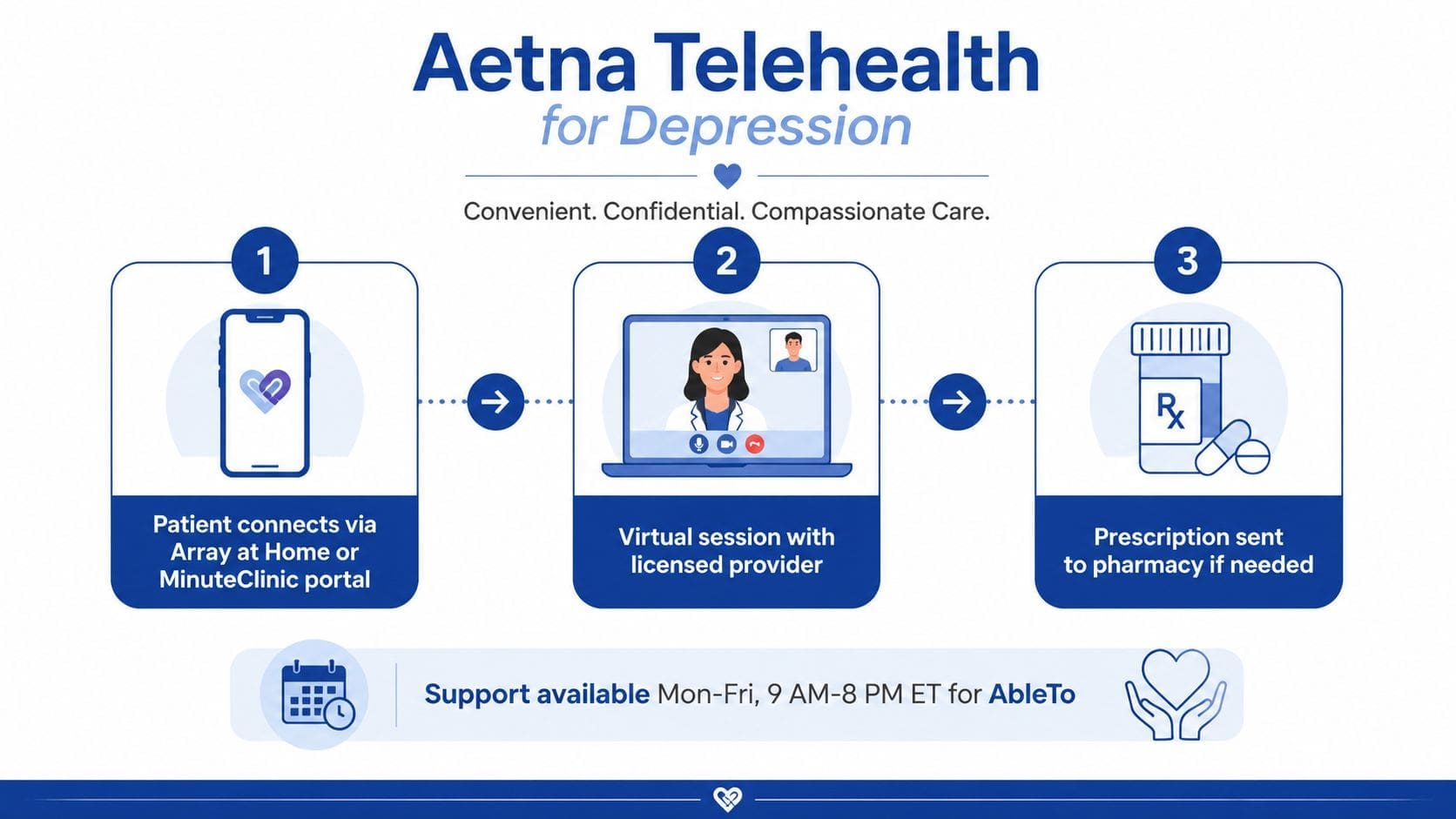
Aetna's own materials show that telehealth is not treated as a fringe option. Their public mental health resources list virtual and in-person support, including CVS Virtual Care, Teladoc Health, and MinuteClinic®, and their telehealth materials also name Array at Home, MinuteClinic®, and AbleTo, with support hours of Monday through Friday, 9 AM to 8 PM ET for one of those services. Source: Aetna telehealth services PDF.
That distinction matters for a Pennsylvania adult deciding between insurer-run support and an independent practice. Aetna-linked programs are structured around defined workflows, while a virtual psychiatric practice can provide ongoing evaluation, medication management, and longitudinal follow-up across visits. For many adults, that means telehealth depression treatment Pennsylvania can start with an online evaluation and then continue with the same clinician if the treatment plan needs adjusting.
A typical virtual depression visit is direct. The clinician reviews symptoms, sleep, appetite, concentration, mood, safety concerns, past treatment, and current medications. If the history supports it, the visit can end with a diagnosis discussion and a treatment plan that may include therapy referrals, antidepressant medication, or follow-up monitoring. For adults with depression symptoms and comorbid anxiety, that first appointment often clarifies what is driving the functional decline.
What telehealth solves in Pennsylvania
- Travel barriers: A patient in Scranton or Erie does not need to arrange a long drive for a routine check-in.
- Waitlist friction: Virtual access can shorten the gap between deciding to get help and speaking with a clinician.
- Follow-up consistency: Medication changes are easier to track when the same provider sees the patient over time.
Aetna members also benefit when telehealth is paired with a clear communication workflow. Mental health practices that use message reminders, follow-up nudges, and structured scheduling often reduce missed appointments, and general strategies for modern patient engagement support that kind of care coordination. For depression care, that can matter as much as the appointment itself, because missed follow-up is a common reason treatment stalls.
The telepsychiatry model is especially useful for people seeking what is telepsychiatry details before they book. It gives adults across Philadelphia, Pittsburgh, Harrisburg, Allentown, Reading, Lancaster, and beyond a way to start care without waiting for a local opening or spending an afternoon in transit.
How to Verify Aetna Depression Benefits Before You Book
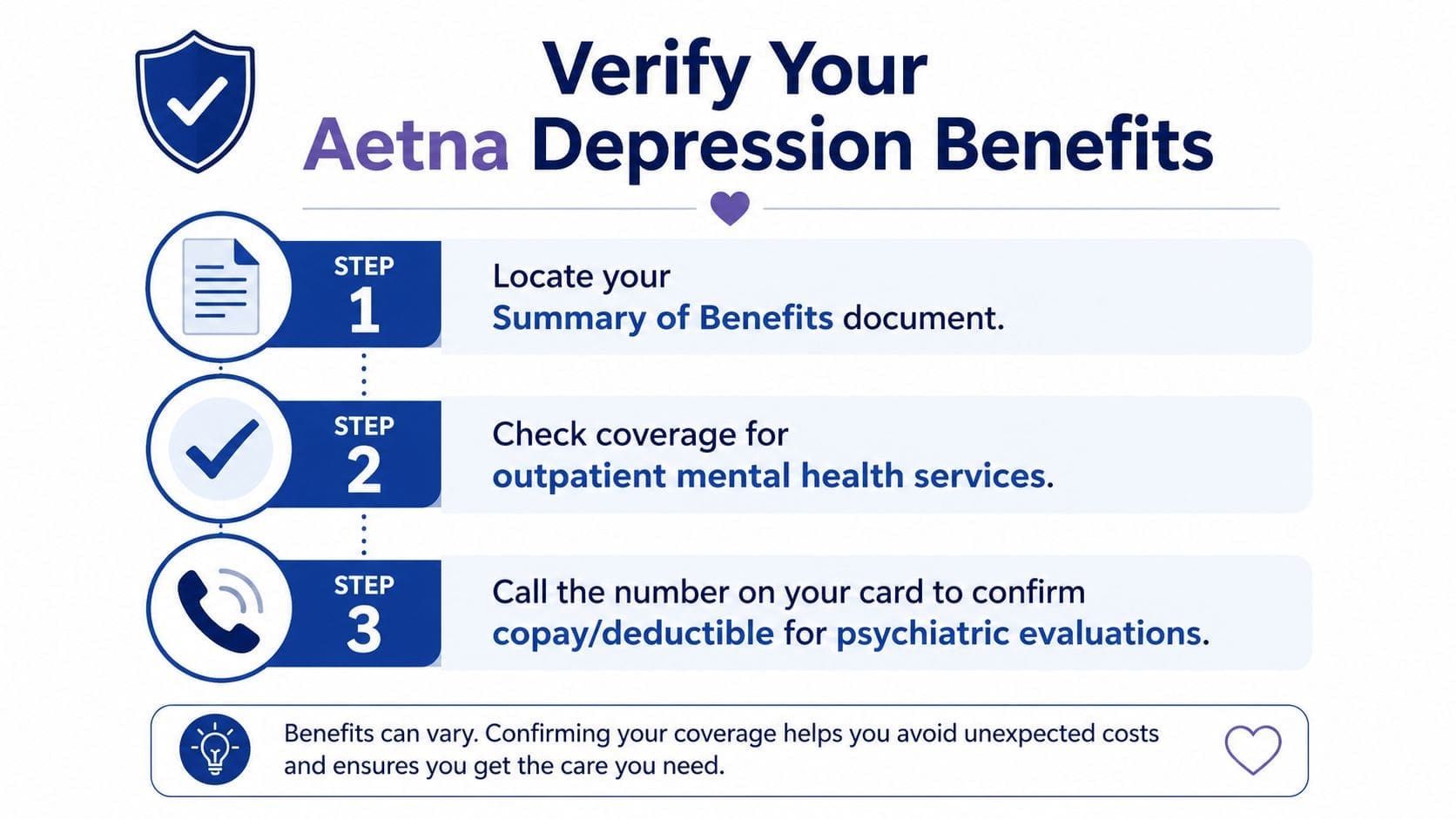
The fastest way to avoid a surprise bill is to read the plan document before scheduling. Aetna's consumer guidance says the Summary of Benefits is the key document, and the section to look for is the row labeled “If you need mental health, behavioral health, or substance abuse services” with the “Outpatient services” column. If the plan shows “not covered” for network or out-of-network mental health services, therapy is not covered under that plan. Source: Aetna therapy coverage verification guidance.
That check is especially useful for people searching depression treatment near me Aetna because the location alone does not tell the whole story. A provider may be nearby, but if they are out of network or if the service requires prior approval, the actual cost can change fast. The same is true for those looking up depression evaluation Aetna insurance and assuming every psychiatric intake is handled the same way.
A quick pre-call checklist
- Confirm network status: Ask whether the clinician or practice is in network for the exact Aetna plan.
- Ask about billing: Confirm whether the practice bills Aetna directly or expects the member to submit claims.
- Check authorization needs: Ask if therapy, medication management, or any higher level of care needs prior authorization.
- Clarify the cost model: Verify whether the visit is a copay, coinsurance, or deductible-based charge.
Aetna Medicare Advantage members have a separate but clearly defined benefit structure. Their mental health coverage can include a one-time “Welcome to Medicare” preventive visit, an annual wellness visit, individual and group therapy, clinical social worker visits, one depression screening each year, diagnostic tests, a psychiatric evaluation, hospital mental health care, and partial hospitalization in some cases. Source: Aetna Medicare Advantage mental health coverage.
For patients who want help with the verification step, insurance and fees can be reviewed before the first appointment. That kind of upfront check is often what keeps the first visit focused on care instead of coverage confusion.
When First-Line Treatment Isn't Enough and Prior Authorization Comes In
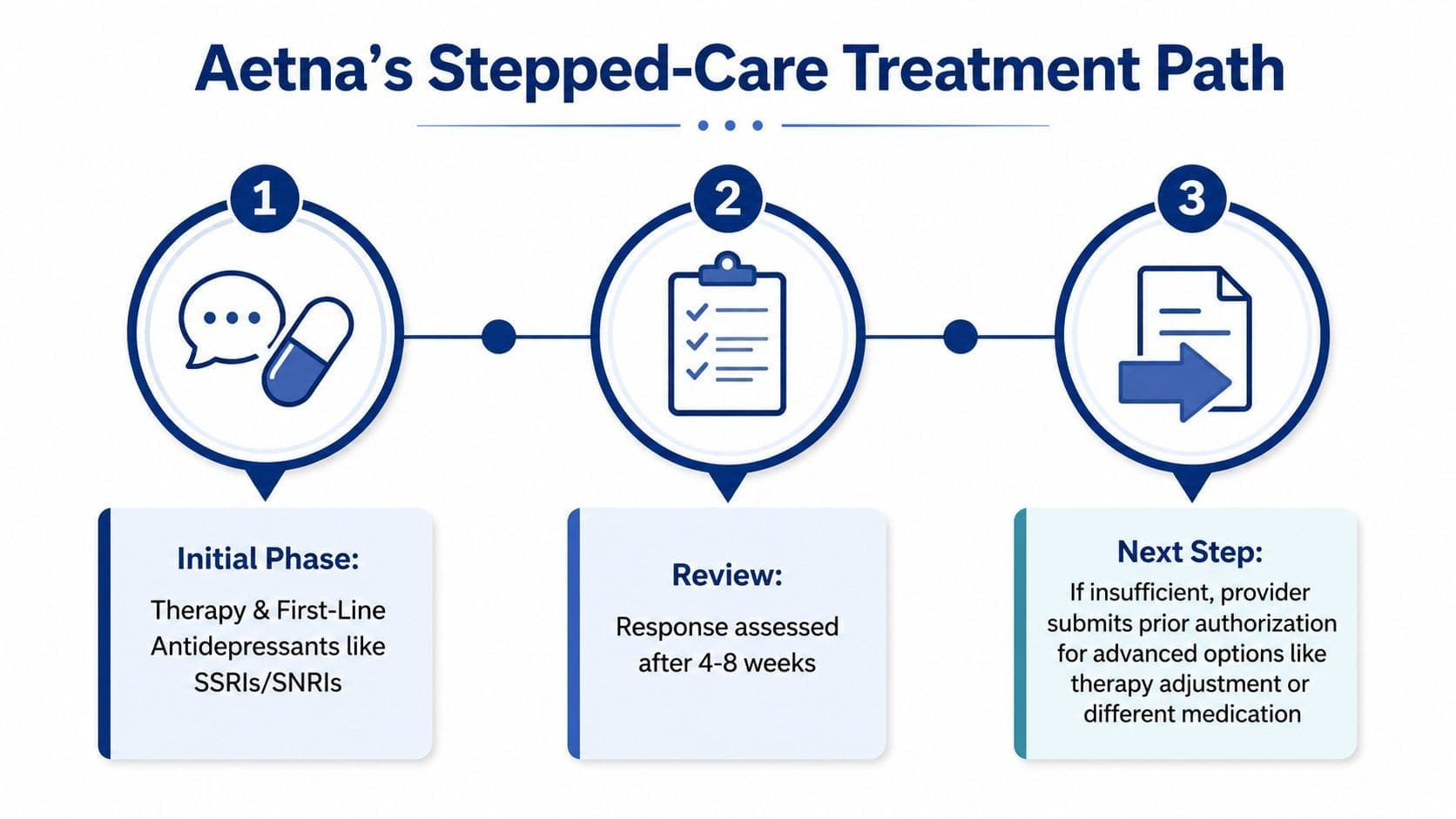
A representative Aetna depression case usually starts. A patient begins with therapy, an antidepressant, or both, often an SSRI or SNRI, and sometimes a medication such as Wellbutrin or Auvelity depending on symptoms, tolerability, and prior history. If the response is incomplete, the clinical record starts to matter more, because the plan may later ask what was tried, for how long, and whether the patient improved.
That is where treatment-resistant depression becomes a coverage issue, not just a diagnosis. For TMS, Aetna typically requires an FDA-approved device, age 18+, a confirmed diagnosis of severe major depressive disorder, documentation of failed psychotherapy, and inadequate response to at least 2 antidepressants. For Spravato (esketamine), coverage is considered medically necessary for treatment-resistant depression or major depressive disorder with acute suicidal ideation or behavior when plan criteria are met. Source: Aetna Spravato and TMS coverage criteria.
Where delays usually happen
The usual problem is not that the plan has no path forward. It is that prior treatment failures are not documented well enough for the reviewer. A patient may have tried medication, stopped early because of side effects, or had psychotherapy that helped only briefly, but if that history is not clearly recorded, the authorization request can stall.
That makes the work of the treatment team important. Good documentation can show why first-line care did not work and why the next step is clinically reasonable. Poor documentation can make an evidence-based next step look unproven, even when the patient's symptoms are very real.
Prior authorization is rarely instant, and it is rarely arbitrary. The paperwork exists because the insurer wants proof that escalation is medically necessary, not simply desired.
For people searching depression medication Aetna insurance, the practical takeaway is that stepped care is normal. Aetna coverage patterns often move from outpatient therapy and medication management to higher-intensity options only after the earlier steps are clearly charted. That is annoying, but it also means a well-prepared psychiatric team can often shepherd the process without guessing.
Starting Aetna-Covered Virtual Depression Care in Pennsylvania
For many adults, the cleanest next step is a virtual psychiatric evaluation that can be completed from home, with insurance checked before the first session. Integrative Psychiatry of America provides that kind of workflow through a secure, HIPAA-compliant telehealth visit, followed by an initial evaluation, a personalized treatment plan, and medication management when clinically indicated. Its online depression treatment page explains how virtual care fits into a broader treatment plan for Pennsylvania patients. Source: online depression treatment at Integrative Psychiatry of America.
The model is straightforward for adults in Philadelphia, Pittsburgh, Harrisburg, Erie, Scranton, Allentown, Reading, and Lancaster. The first appointment focuses on symptoms, diagnosis, safety, and next steps, while integrative supports such as exercise counseling, mindfulness, and nutrition can be added when useful. Free tools like the Daily Agenda Planner, Feeling Journal, Exercise Routine Generator, and 5-4-3-2-1 Grounding Tool can support daily structure, but they do not replace clinical treatment.
For readers looking for virtual psychiatry Pennsylvania Aetna or a mental health provider Aetna Pennsylvania, the main advantage is speed with structure. The patient does not have to choose between waiting for local care and paying out of pocket just to get an answer. Aetna coverage can often work with telehealth, and the first appointment can focus on the actual depression problem instead of the logistics around it.
If depression has already been dragging on, waiting usually costs more than the copay. Verify the plan, book the visit, and start with a clinician who can map the insurance rules to the right level of care.
Integrative Psychiatry of America provides virtual depression evaluations, medication management, and telepsychiatry across Pennsylvania, with Aetna verification handled before the first visit. If depression has made it hard to keep up with work, sleep, or daily life, visit Integrative Psychiatry of America to review coverage and schedule care from home.